
Solar Tracking Structure Design Concept Generation and Selection



- Slides: 24
Solar Tracking Structure Design Concept Generation and Selection Belsheim Joshua, Francis Travis, He Jiayang, Moehling Anthony, Liu Pengyan, Ziemkowski Micah Oct. 28. 2013 Jiayang 1
Presentation Outline • Project introduction • Concept generation • Concept selection • Updated project plan • Conclusion Jiayang 2
Project Introduction • Need Current solar tracking systems are expensive unreliable and hard to maintain. • Objective Design a efficient yet reliable solar tracking technology. • Sponsor Dr. Tom Acker • Testing environment Will be tested with existing fixed solar panels Jiayang 3
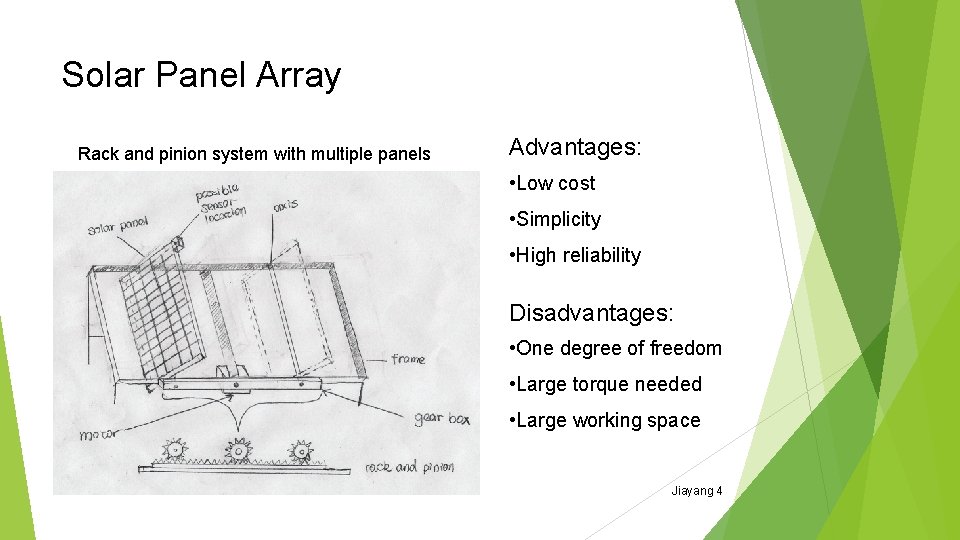
Solar Panel Array Rack and pinion system with multiple panels Advantages: • Low cost • Simplicity • High reliability Disadvantages: • One degree of freedom • Large torque needed • Large working space Jiayang 4
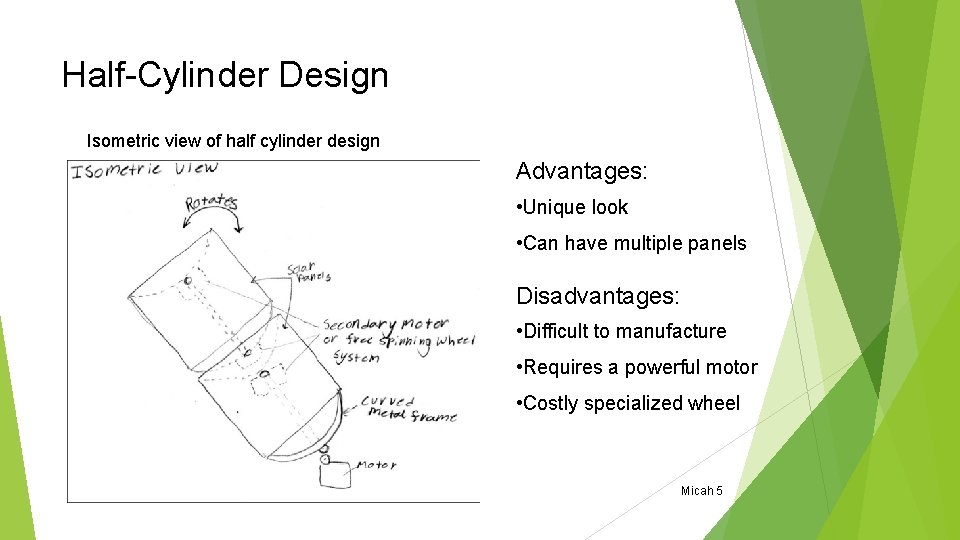
Half-Cylinder Design Isometric view of half cylinder design Advantages: • Unique look • Can have multiple panels Disadvantages: • Difficult to manufacture • Requires a powerful motor • Costly specialized wheel Micah 5
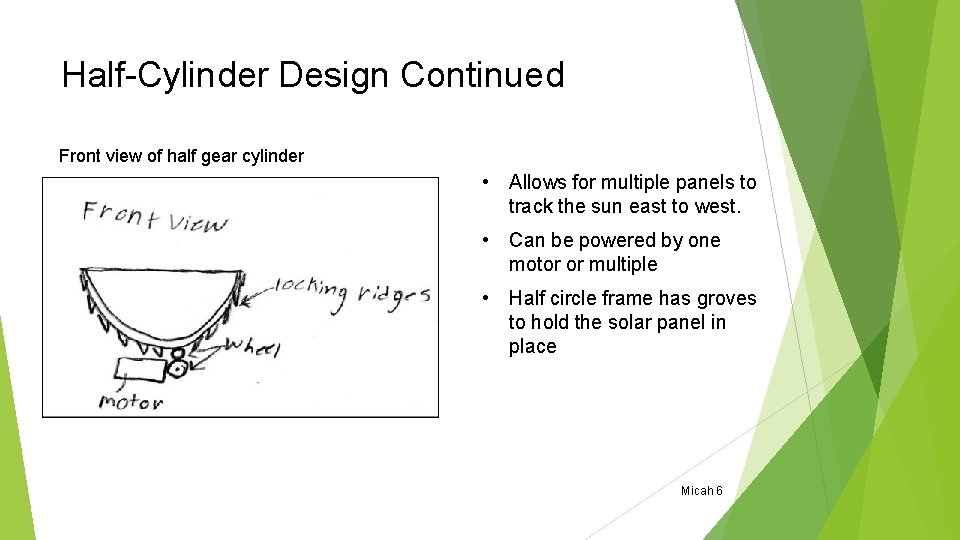
Half-Cylinder Design Continued Front view of half gear cylinder • Allows for multiple panels to track the sun east to west. • Can be powered by one motor or multiple • Half circle frame has groves to hold the solar panel in place Micah 6
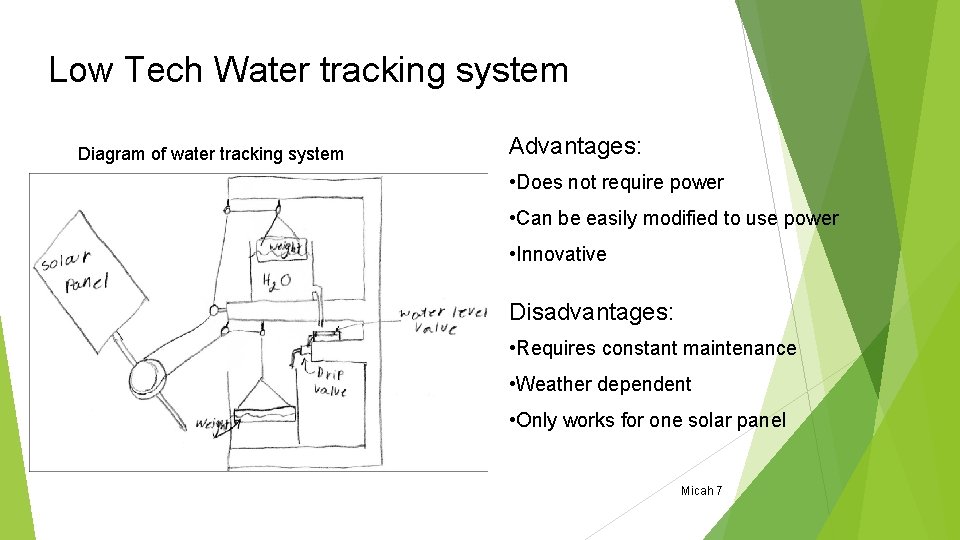
Low Tech Water tracking system Diagram of water tracking system Advantages: • Does not require power • Can be easily modified to use power • Innovative Disadvantages: • Requires constant maintenance • Weather dependent • Only works for one solar panel Micah 7
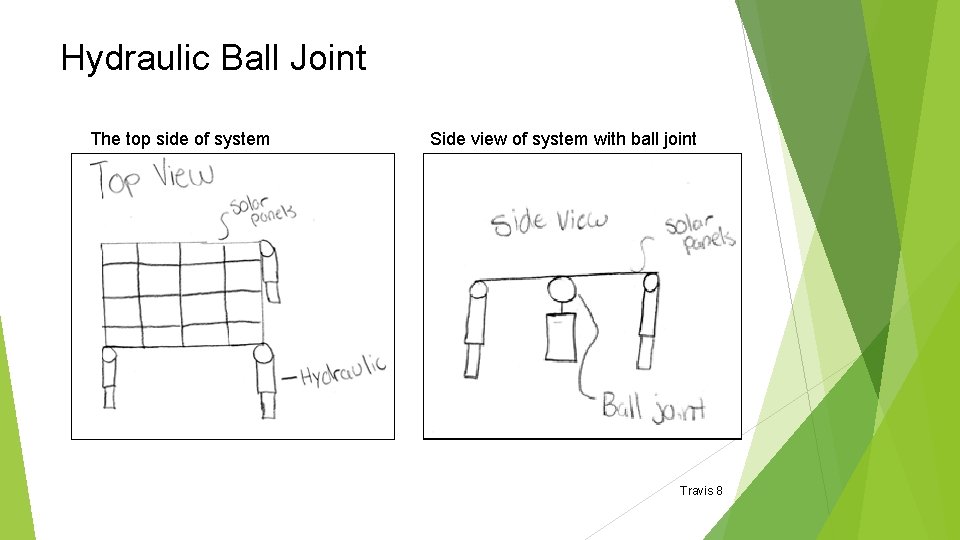
Hydraulic Ball Joint The top side of system Side view of system with ball joint Travis 8
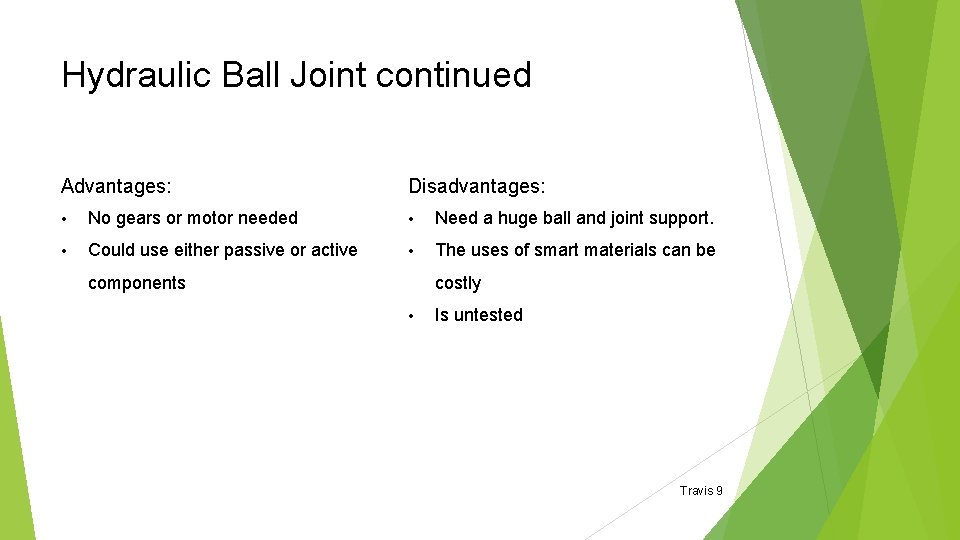
Hydraulic Ball Joint continued Advantages: Disadvantages: • No gears or motor needed • Need a huge ball and joint support. • Could use either passive or active • The uses of smart materials can be components costly • Is untested Travis 9
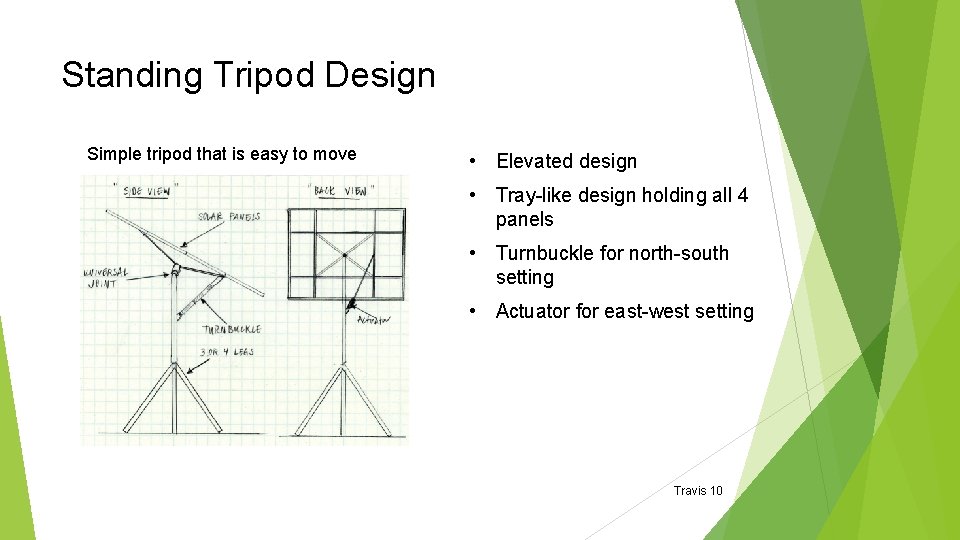
Standing Tripod Design Simple tripod that is easy to move • Elevated design • Tray-like design holding all 4 panels • Turnbuckle for north-south setting • Actuator for east-west setting Travis 10
Advantages vs. Disadvantages • Advantages • Disadvantages • Inexpensive • Needs external power source • North-south and east-west movement • Unsafe due to elevated design • Parts readily available • Manual operation for north-south setting • Portable • Cannot withstand inclement weather Travis 11
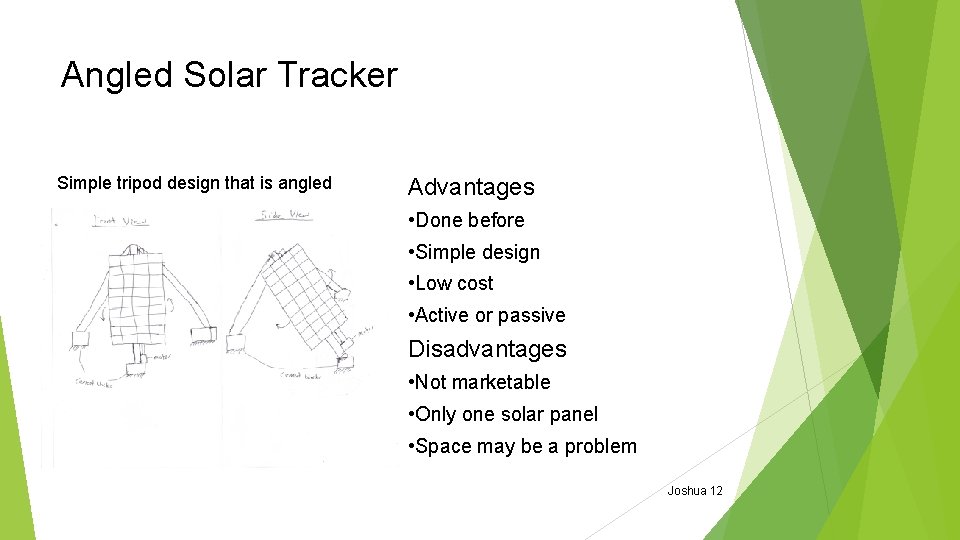
Angled Solar Tracker Simple tripod design that is angled Advantages • Done before • Simple design • Low cost • Active or passive Disadvantages • Not marketable • Only one solar panel • Space may be a problem Joshua 12
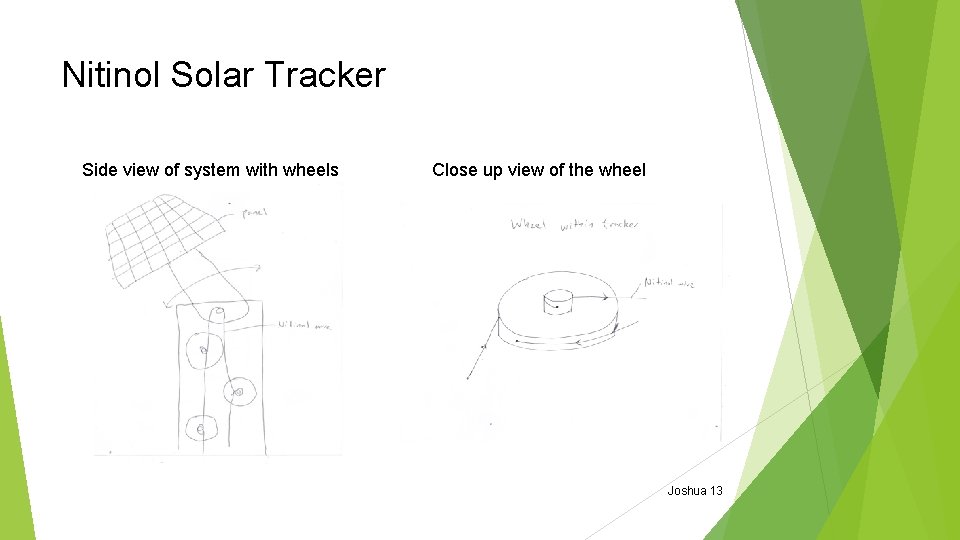
Nitinol Solar Tracker Side view of system with wheels Close up view of the wheel Joshua 13
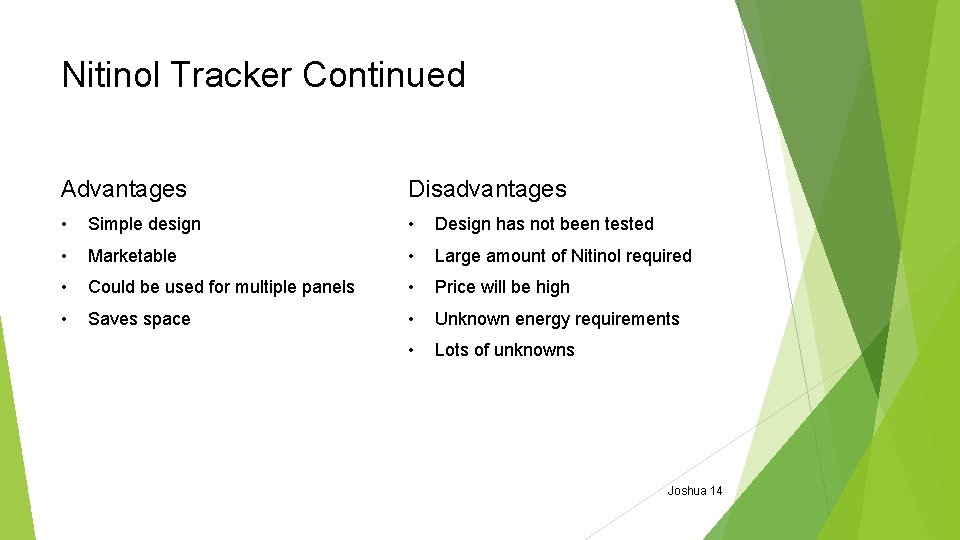
Nitinol Tracker Continued Advantages Disadvantages • Simple design • Design has not been tested • Marketable • Large amount of Nitinol required • Could be used for multiple panels • Price will be high • Saves space • Unknown energy requirements • Lots of unknowns Joshua 14
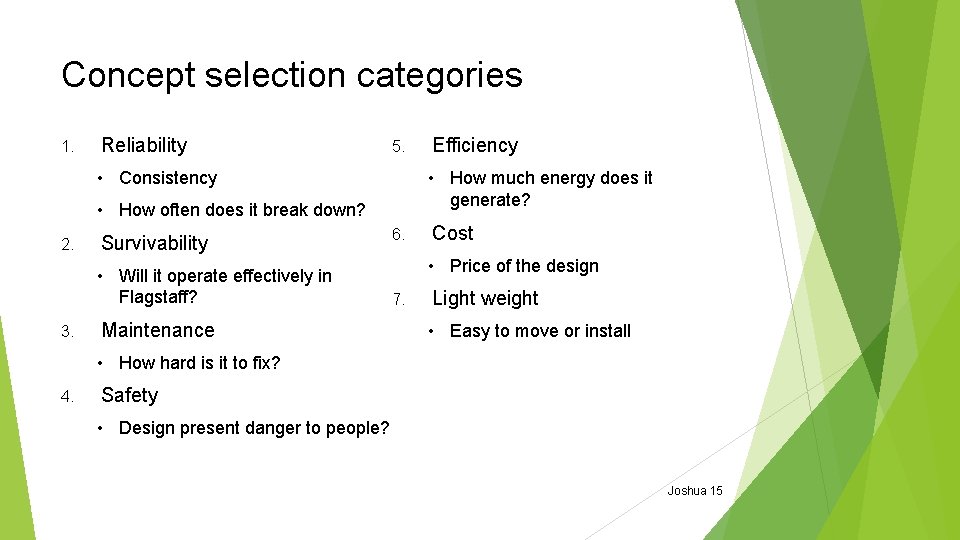
Concept selection categories 1. Reliability 5. • Consistency • How much energy does it generate? • How often does it break down? 2. Survivability • Will it operate effectively in Flagstaff? 3. Maintenance Efficiency 6. Cost • Price of the design 7. Light weight • Easy to move or install • How hard is it to fix? 4. Safety • Design present danger to people? Joshua 15
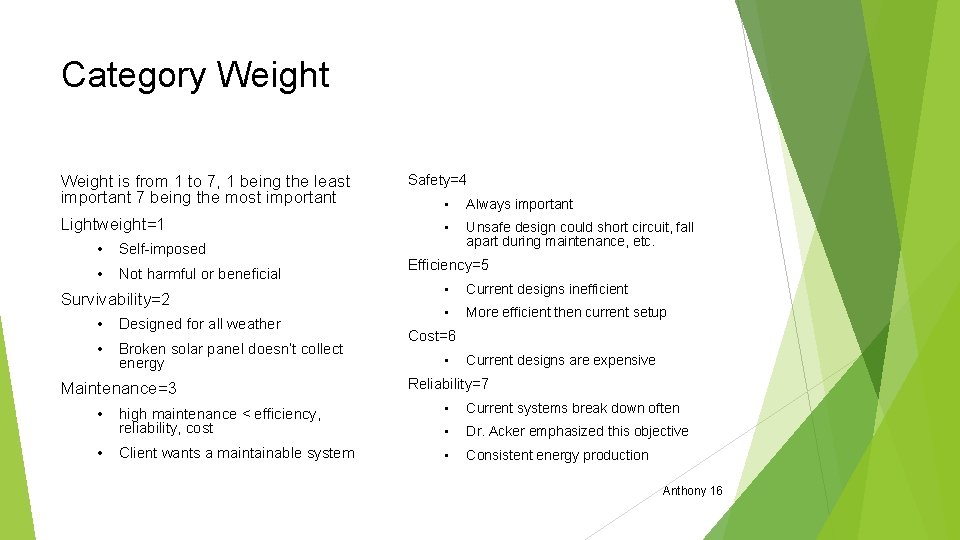
Category Weight is from 1 to 7, 1 being the least important 7 being the most important Lightweight=1 • Self-imposed • Not harmful or beneficial Survivability=2 • Designed for all weather • Broken solar panel doesn’t collect energy Maintenance=3 • • Safety=4 • Always important • Unsafe design could short circuit, fall apart during maintenance, etc. Efficiency=5 • Current designs inefficient • More efficient then current setup Cost=6 • Current designs are expensive Reliability=7 high maintenance < efficiency, reliability, cost • Current systems break down often • Dr. Acker emphasized this objective Client wants a maintainable system • Consistent energy production Anthony 16
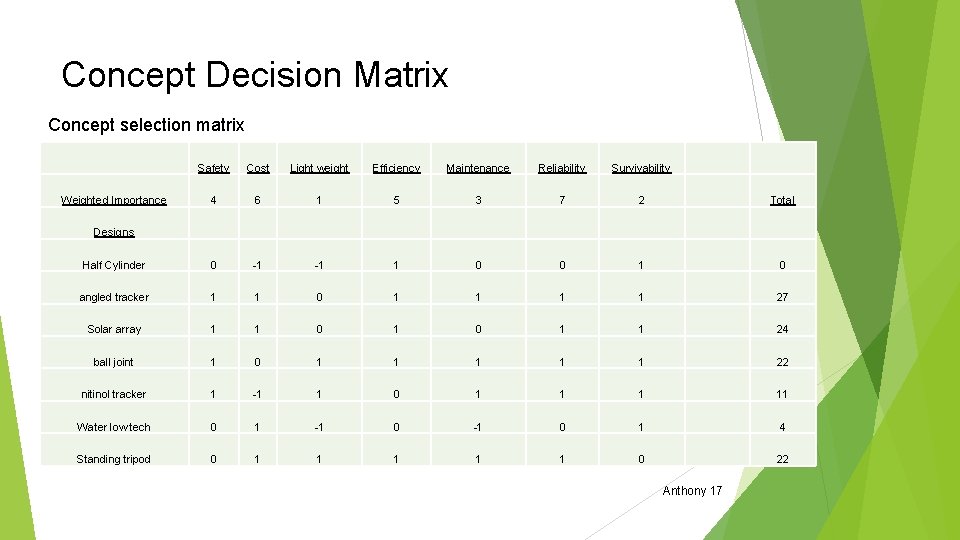
Concept Decision Matrix Concept selection matrix Safety Cost Light weight Efficiency Maintenance Reliability Survivability 4 6 1 5 3 7 2 Total Half Cylinder 0 -1 -1 1 0 0 1 0 angled tracker 1 1 0 1 1 27 Solar array 1 1 0 1 1 24 ball joint 1 0 1 1 1 22 nitinol tracker 1 -1 1 0 1 11 Water low tech 0 1 -1 0 1 4 Standing tripod 0 1 1 1 0 22 Weighted Importance Designs Anthony 17
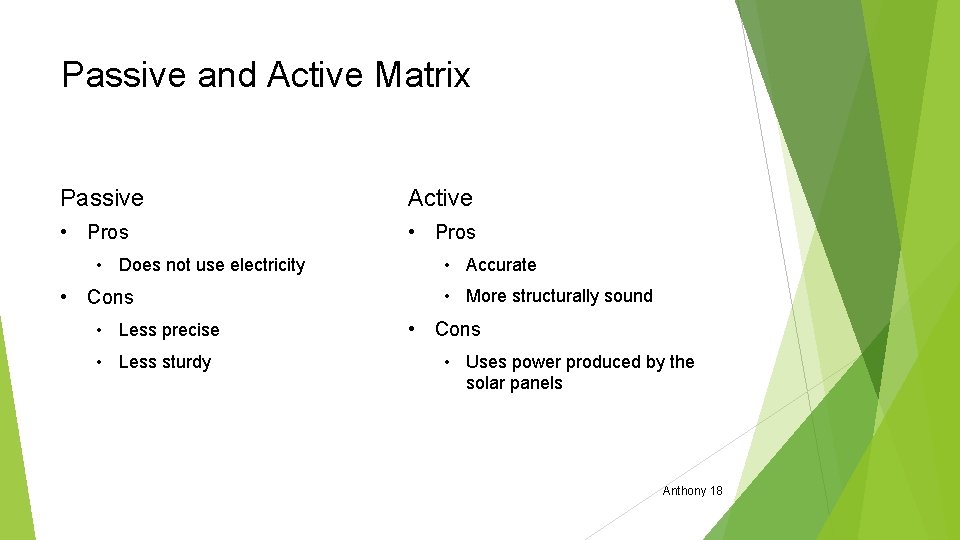
Passive and Active Matrix Passive Active • Pros • Does not use electricity • Cons • Less precise • Less sturdy • Accurate • More structurally sound • Cons • Uses power produced by the solar panels Anthony 18
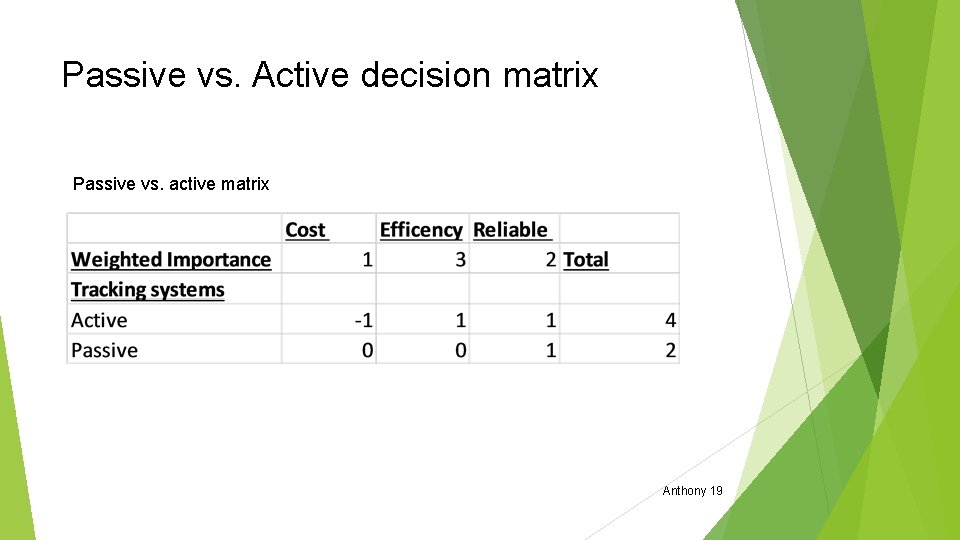
Passive vs. Active decision matrix Passive vs. active matrix Anthony 19
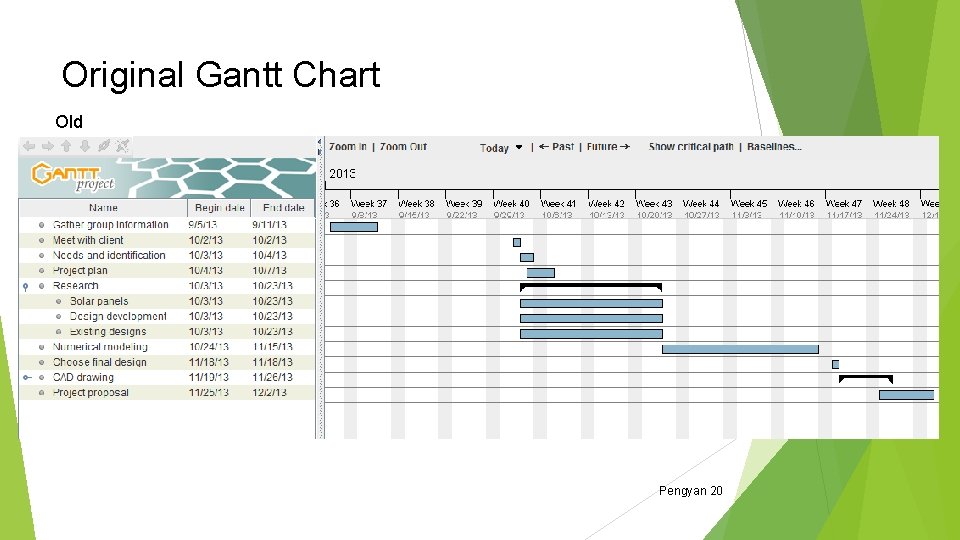
Original Gantt Chart Old Pengyan 20
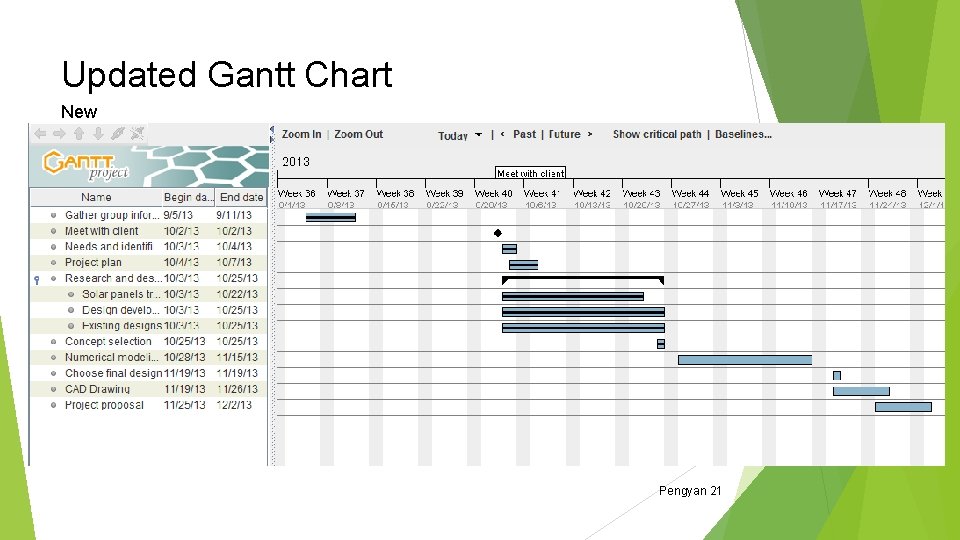
Updated Gantt Chart New Pengyan 21
Conclusion • Two main tracking methods can be applied for designing solar tracking structure • passive methods • active methods • 7 different design concepts which were introduced • The candidate for the design concept were chosen based on the decision matrix Pengyan 22
References 1. Budynas G. , Richard, Nisbett J. , Keith, 2011, “Shigley’s Mechanical Engineering Design”, Ninth Edition, Mc. Graw-Hill, New York 2. Leo J. , Donald, 2007, “Engineering Analysis of Smart Material Systems”, John Wiley & Sons, Inc. , Hoboken, New Jersey. 3. (2008). “ PVWATTS: Arizona – Flagstaff. ” PVWATTS Calculator <http: //rredc. nrel. gov/solar/calculators/PVWATTS/version 1/US/code /pvwattsv 1. cgi >(Oct. 26, 2013) Pengyan 23
Questions? Pengyan 24