
Solar Thermal System Concept 0304 261 Cornerstone Design
- Slides: 16
Solar Thermal System Concept 0304 -261 Cornerstone Design EDGE™
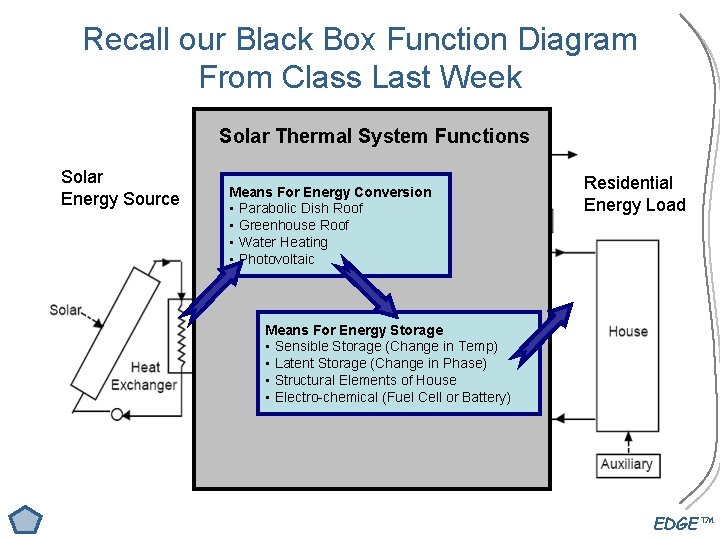
Recall our Black Box Function Diagram From Class Last Week Solar Thermal System Functions Solar Energy Source Means For Energy Conversion • Parabolic Dish Roof • Greenhouse Roof • Water Heating • Photovoltaic Residential Energy Load Means For Energy Storage • Sensible Storage (Change in Temp) • Latent Storage (Change in Phase) • Structural Elements of House • Electro-chemical (Fuel Cell or Battery) EDGE™
Cornerstone Design System Concept • You have all come up with a number of viable, reasonable, and possible economically attractive design concepts. • As the “Chief Engineer” I am now going to impose a design concept on the team, to simulate the concept selection process. In an industry setting, this concept selection decision may take several months. • For example, the concept selection process for the KGCOE Building 9 expansion considered three distinct building concepts over a period of nine months, until the final concept was eventually selected. Numerous stakeholders had input to the selection process. EDGE™
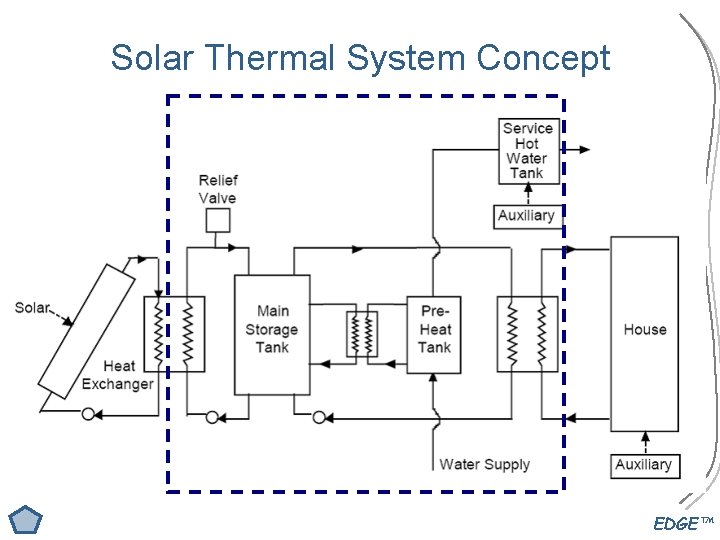
Solar Thermal System Concept EDGE™
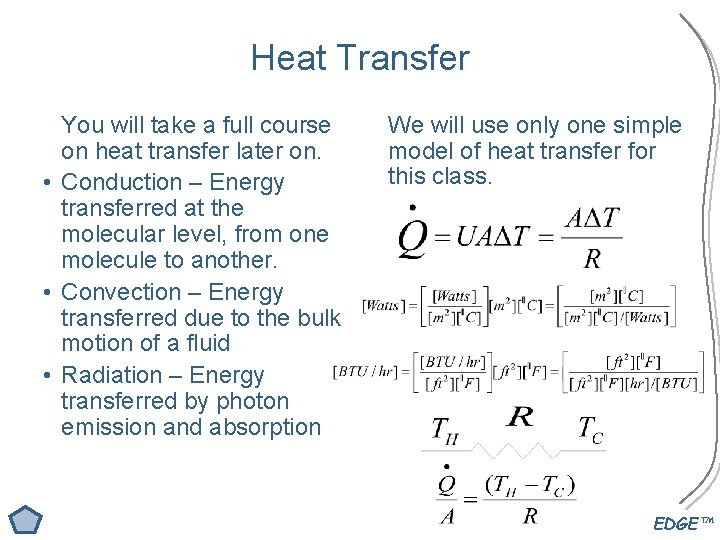
Heat Transfer You will take a full course on heat transfer later on. • Conduction – Energy transferred at the molecular level, from one molecule to another. • Convection – Energy transferred due to the bulk motion of a fluid • Radiation – Energy transferred by photon emission and absorption We will use only one simple model of heat transfer for this class. EDGE™
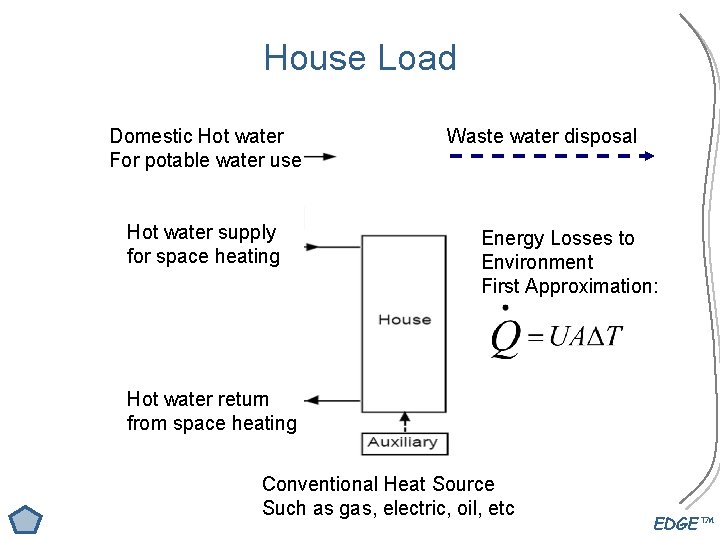
House Load Domestic Hot water For potable water use Hot water supply for space heating Waste water disposal Energy Losses to Environment First Approximation: Hot water return from space heating Conventional Heat Source Such as gas, electric, oil, etc EDGE™
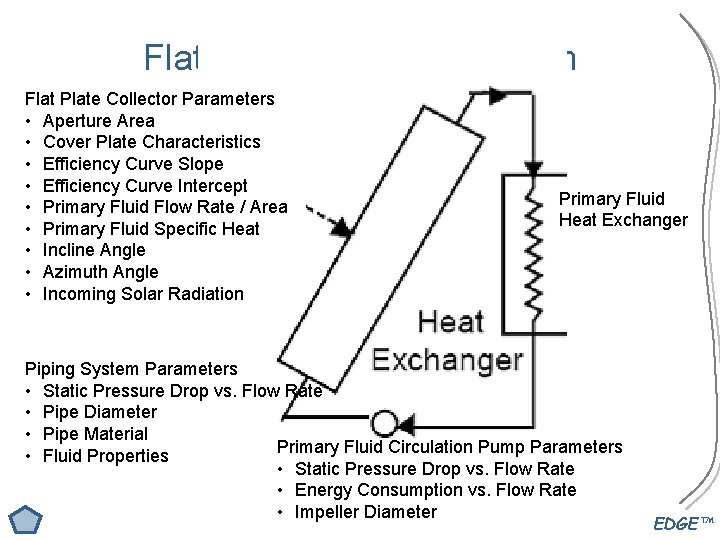
Flat Plate Collector System Flat Plate Collector Parameters • Aperture Area • Cover Plate Characteristics • Efficiency Curve Slope • Efficiency Curve Intercept • Primary Fluid Flow Rate / Area • Primary Fluid Specific Heat • Incline Angle • Azimuth Angle • Incoming Solar Radiation Primary Fluid Heat Exchanger Piping System Parameters • Static Pressure Drop vs. Flow Rate • Pipe Diameter • Pipe Material Primary Fluid Circulation Pump Parameters • Fluid Properties • Static Pressure Drop vs. Flow Rate • Energy Consumption vs. Flow Rate • Impeller Diameter EDGE™
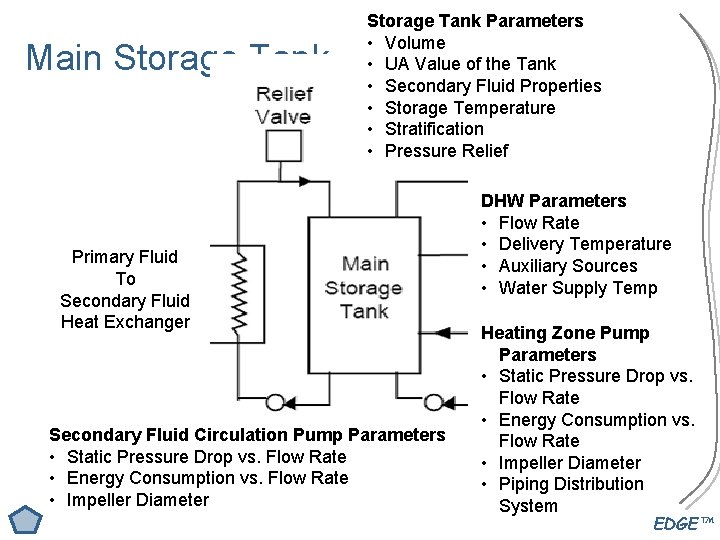
Main Storage Tank Parameters • Volume • UA Value of the Tank • Secondary Fluid Properties • Storage Temperature • Stratification • Pressure Relief Primary Fluid To Secondary Fluid Heat Exchanger Secondary Fluid Circulation Pump Parameters • Static Pressure Drop vs. Flow Rate • Energy Consumption vs. Flow Rate • Impeller Diameter DHW Parameters • Flow Rate • Delivery Temperature • Auxiliary Sources • Water Supply Temp Heating Zone Pump Parameters • Static Pressure Drop vs. Flow Rate • Energy Consumption vs. Flow Rate • Impeller Diameter • Piping Distribution System EDGE™
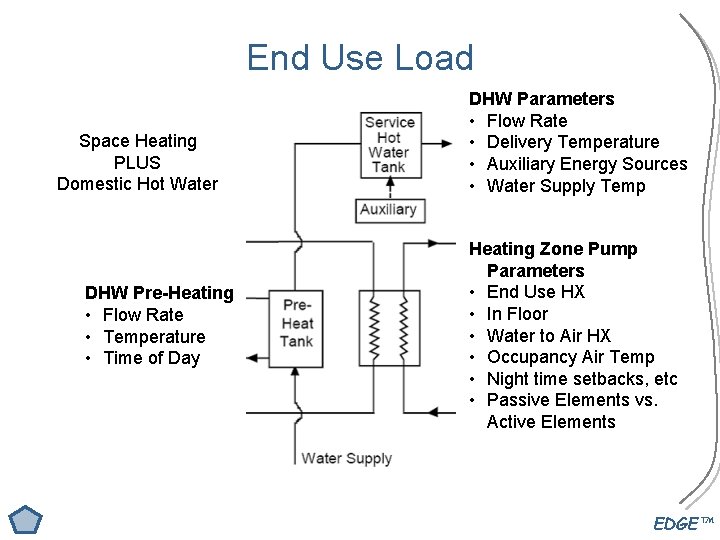
End Use Load Space Heating PLUS Domestic Hot Water DHW Pre-Heating • Flow Rate • Temperature • Time of Day DHW Parameters • Flow Rate • Delivery Temperature • Auxiliary Energy Sources • Water Supply Temp Heating Zone Pump Parameters • End Use HX • In Floor • Water to Air HX • Occupancy Air Temp • Night time setbacks, etc • Passive Elements vs. Active Elements EDGE™
Parametric Design • How do we make sense of all of these variables? • There are thousands of possible combinations. • How can we systematically investigate the most promising options? • We will use a tool called “Parametric Design” whereby we change one design parameter (which is an independent variable, over which we have control), and observe the influence upon a second design parameter (or objective) over which we have only indirect control. • Throughout the time we study the parameters, we satisfy all constraints, and keep other independent variables temporarily fixed. EDGE™
Primary Design Objectives • We need to use a small number of objective functions that will serve as a surrogate for meeting the customer’s needs. Once we fix the load profile of the client, then we can compare alternative designs using two simple variables. • LCC – The Life Cycle Cost of a chosen system. If we build a system • today, and absorb all of the energy costs and capitals costs into a single value in today’s dollars, then we can tell the Homeowner family the LCC for their energy needs over the next 20 years. Smaller LCC are clearly the preference of the Homeowner Family. F – The annual solar fraction. An annual solar fraction of 0 indicates that all energy needs are being met with conventional energy sources. An annual solar fraction of 1 indicates that all energy needs are being met with solar thermal energy sources. A larger solar fraction is clearly the preference of the homeowner family. EDGE™
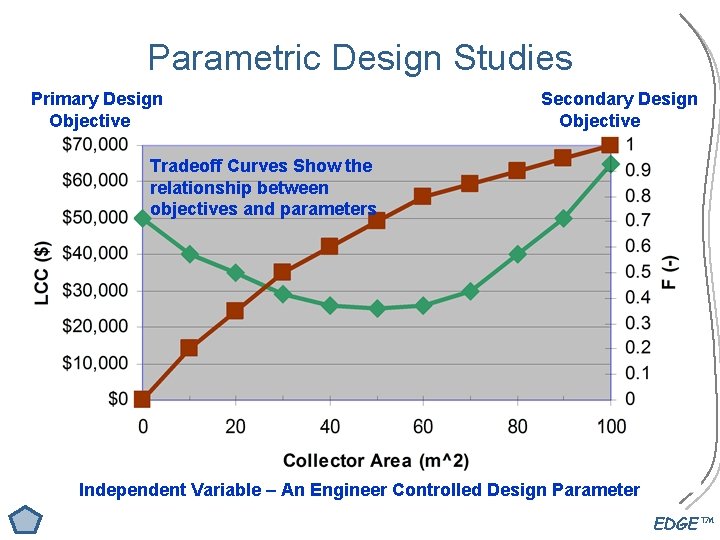
Parametric Design Studies Primary Design Objective Secondary Design Objective Tradeoff Curves Show the relationship between objectives and parameters Independent Variable – An Engineer Controlled Design Parameter EDGE™
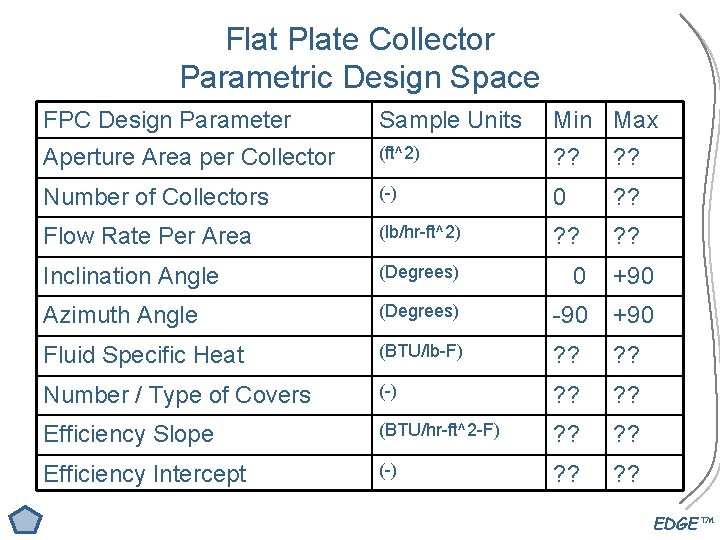
Flat Plate Collector Parametric Design Space FPC Design Parameter Sample Units Min Max Aperture Area per Collector (ft^2) ? ? Number of Collectors (-) 0 ? ? Flow Rate Per Area (lb/hr-ft^2) ? ? Inclination Angle (Degrees) 0 +90 Azimuth Angle (Degrees) -90 +90 Fluid Specific Heat (BTU/lb-F) ? ? Number / Type of Covers (-) ? ? Efficiency Slope (BTU/hr-ft^2 -F) ? ? Efficiency Intercept (-) ? ? EDGE™
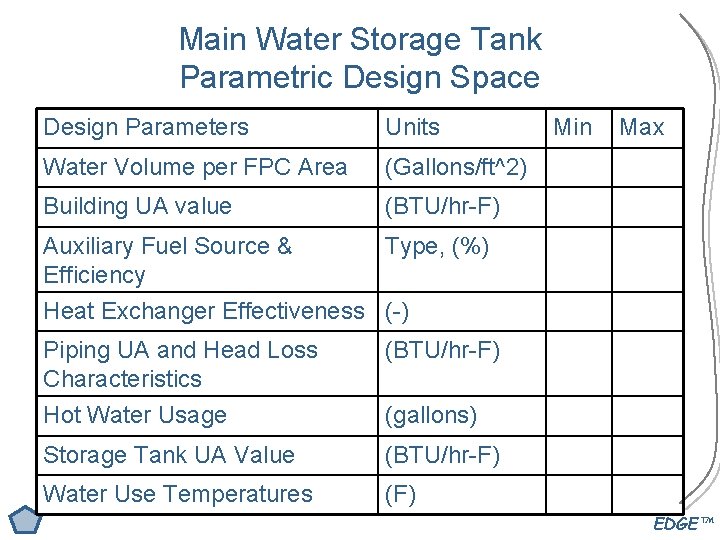
Main Water Storage Tank Parametric Design Space Design Parameters Units Water Volume per FPC Area (Gallons/ft^2) Building UA value (BTU/hr-F) Auxiliary Fuel Source & Efficiency Type, (%) Min Max Heat Exchanger Effectiveness (-) Piping UA and Head Loss Characteristics Hot Water Usage (BTU/hr-F) Storage Tank UA Value (BTU/hr-F) Water Use Temperatures (F) (gallons) EDGE™
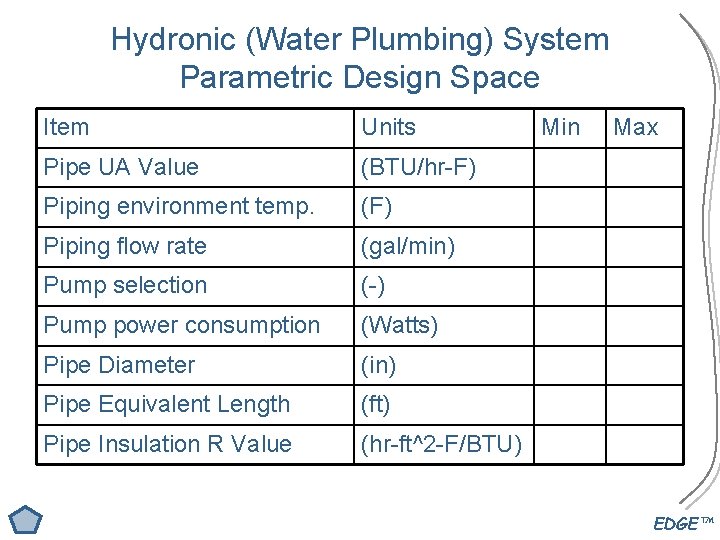
Hydronic (Water Plumbing) System Parametric Design Space Item Units Pipe UA Value (BTU/hr-F) Piping environment temp. (F) Piping flow rate (gal/min) Pump selection (-) Pump power consumption (Watts) Pipe Diameter (in) Pipe Equivalent Length (ft) Pipe Insulation R Value (hr-ft^2 -F/BTU) Min Max EDGE™
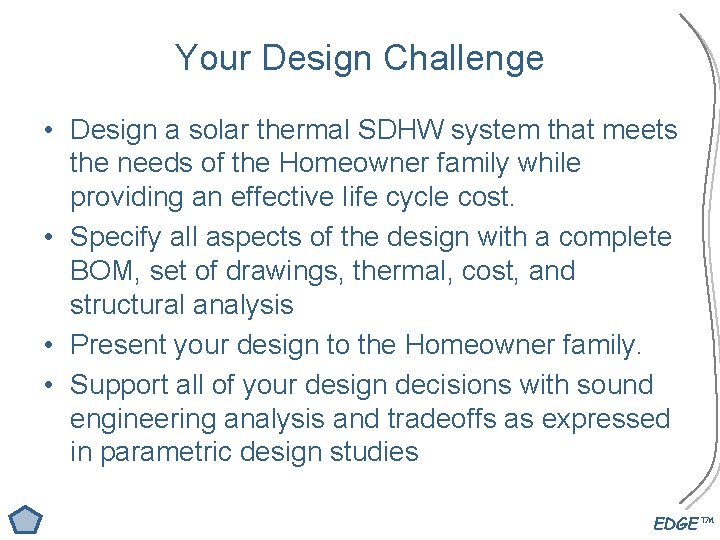
Your Design Challenge • Design a solar thermal SDHW system that meets the needs of the Homeowner family while providing an effective life cycle cost. • Specify all aspects of the design with a complete BOM, set of drawings, thermal, cost, and structural analysis • Present your design to the Homeowner family. • Support all of your design decisions with sound engineering analysis and tradeoffs as expressed in parametric design studies EDGE™