
Solar Thermal Decoupled Electrolysis Reaction Mechanism of Cobalt
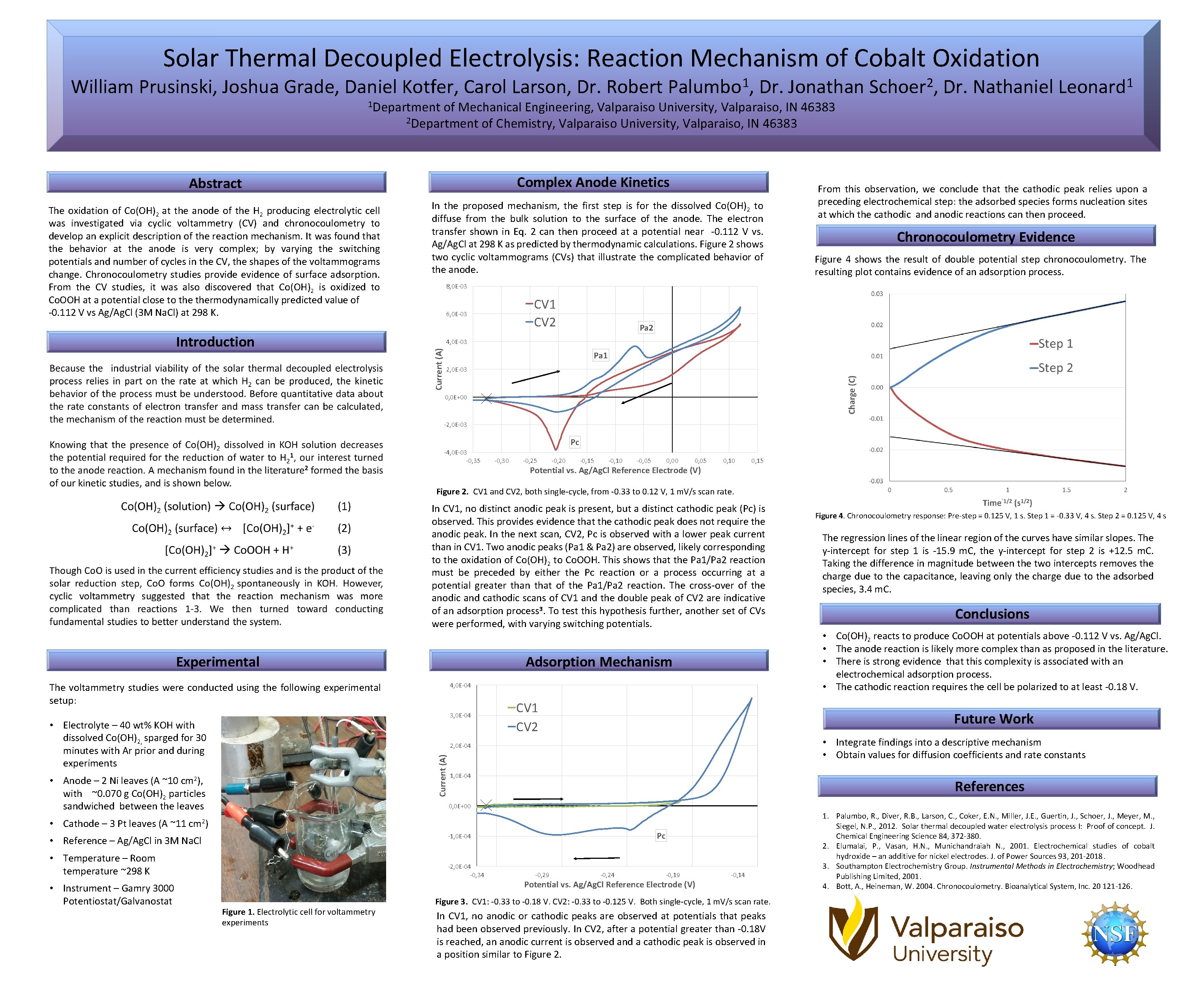
Solar Thermal Decoupled Electrolysis: Reaction Mechanism of Cobalt Oxidation William Prusinski, Joshua Grade, Daniel Kotfer, Carol Larson, Dr. Robert 1 Department 1 Palumbo , Dr. Jonathan of Mechanical Engineering, Valparaiso University, Valparaiso, IN 46383 2 Department of Chemistry, Valparaiso University, Valparaiso, IN 46383 Complex Anode Kinetics Abstract Introduction In the proposed mechanism, the first step is for the dissolved Co(OH)2 to diffuse from the bulk solution to the surface of the anode. The electron transfer shown in Eq. 2 can then proceed at a potential near -0. 112 V vs. Ag/Ag. Cl at 298 K as predicted by thermodynamic calculations. Figure 2 shows two cyclic voltammograms (CVs) that illustrate the complicated behavior of the anode. Dr. Nathaniel 1 Leonard From this observation, we conclude that the cathodic peak relies upon a preceding electrochemical step: the adsorbed species forms nucleation sites at which the cathodic and anodic reactions can then proceed. Chronocoulometry Evidence Figure 4 shows the result of double potential step chronocoulometry. The resulting plot contains evidence of an adsorption process. 8, 0 E-03 CV 1 CV 2 6, 0 E-03 Pa 2 4, 0 E-03 Current (A) The oxidation of Co(OH)2 at the anode of the H 2 producing electrolytic cell was investigated via cyclic voltammetry (CV) and chronocoulometry to develop an explicit description of the reaction mechanism. It was found that the behavior at the anode is very complex; by varying the switching potentials and number of cycles in the CV, the shapes of the voltammograms change. Chronocoulometry studies provide evidence of surface adsorption. From the CV studies, it was also discovered that Co(OH)2 is oxidized to Co. OOH at a potential close to thermodynamically predicted value of -0. 112 V vs Ag/Ag. Cl (3 M Na. Cl) at 298 K. 2 Schoer , Pa 1 2, 0 E-03 0, 0 E+00 -2, 0 E-03 Pc -4, 0 E-03 -0, 35 -0, 30 -0, 25 -0, 20 -0, 15 -0, 10 -0, 05 0, 00 0, 05 Potential vs. Ag/Ag. Cl Reference Electrode (V) 0, 10 0, 15 Figure 2. CV 1 and CV 2, both single-cycle, from -0. 33 to 0. 12 V, 1 m. V/s scan rate. In CV 1, no distinct anodic peak is present, but a distinct cathodic peak (Pc) is observed. This provides evidence that the cathodic peak does not require the anodic peak. In the next scan, CV 2, Pc is observed with a lower peak current than in CV 1. Two anodic peaks (Pa 1 & Pa 2) are observed, likely corresponding to the oxidation of Co(OH)2 to Co. OOH. This shows that the Pa 1/Pa 2 reaction must be preceded by either the Pc reaction or a process occurring at a potential greater than that of the Pa 1/Pa 2 reaction. The cross-over of the anodic and cathodic scans of CV 1 and the double peak of CV 2 are indicative of an adsorption process 3. To test this hypothesis further, another set of CVs were performed, with varying switching potentials. Experimental Adsorption Mechanism 4, 0 E-04 The voltammetry studies were conducted using the following experimental setup: 3, 0 E-04 • Electrolyte – 40 wt% KOH with dissolved Co(OH)2, sparged for 30 minutes with Ar prior and during experiments Current (A) • Anode – 2 Ni leaves (A ~10 with ~0. 070 g Co(OH)2 particles sandwiched between the leaves Conclusions • Co(OH)2 reacts to produce Co. OOH at potentials above -0. 112 V vs. Ag/Ag. Cl. • The anode reaction is likely more complex than as proposed in the literature. • There is strong evidence that this complexity is associated with an electrochemical adsorption process. • The cathodic reaction requires the cell be polarized to at least -0. 18 V. • Integrate findings into a descriptive mechanism • Obtain values for diffusion coefficients and rate constants 1, 0 E-04 References 0, 0 E+00 cm 2) Pc -1, 0 E-04 • Reference – Ag/Ag. Cl in 3 M Na. Cl • Temperature – Room temperature ~298 K • Instrument – Gamry 3000 Potentiostat/Galvanostat The regression lines of the linear region of the curves have similar slopes. The y-intercept for step 1 is -15. 9 m. C, the y-intercept for step 2 is +12. 5 m. C. Taking the difference in magnitude between the two intercepts removes the charge due to the capacitance, leaving only the charge due to the adsorbed species, 3. 4 m. C. Future Work 2, 0 E-04 cm 2), • Cathode – 3 Pt leaves (A ~11 CV 2 Figure 4. Chronocoulometry response: Pre-step = 0. 125 V, 1 s. Step 1 = -0. 33 V, 4 s. Step 2 = 0. 125 V, 4 s -2, 0 E-04 -0, 34 Figure 1. Electrolytic cell for voltammetry experiments -0, 29 -0, 24 -0, 19 Potential vs. Ag/Ag. Cl Reference Electrode (V) -0, 14 Figure 3. CV 1: -0. 33 to -0. 18 V. CV 2: -0. 33 to -0. 125 V. Both single-cycle, 1 m. V/s scan rate. In CV 1, no anodic or cathodic peaks are observed at potentials that peaks had been observed previously. In CV 2, after a potential greater than -0. 18 V is reached, an anodic current is observed and a cathodic peak is observed in a position similar to Figure 2. 1. Palumbo, R. , Diver, R. B. , Larson, C. , Coker, E. N. , Miller, J. E. , Guertin, J. , Schoer, J. , Meyer, M. , Siegel, N. P. , 2012. Solar thermal decoupled water electrolysis process I: Proof of concept. J. Chemical Engineering Science 84, 372 -380. 2. Elumalai, P. , Vasan, H. N. , Munichandraiah N. , 2001. Electrochemical studies of cobalt hydroxide – an additive for nickel electrodes. J. of Power Sources 93, 201 -2018. 3. Southampton Electrochemistry Group. Instrumental Methods in Electrochemistry; Woodhead Publishing Limited, 2001. 4. Bott, A. , Heineman, W. 2004. Chronocoulometry. Bioanalytical System, Inc. 20 121 -126.
- Slides: 1