
Solar System formation Philippe Thbault Stockholm ObservatoryParis Observatory
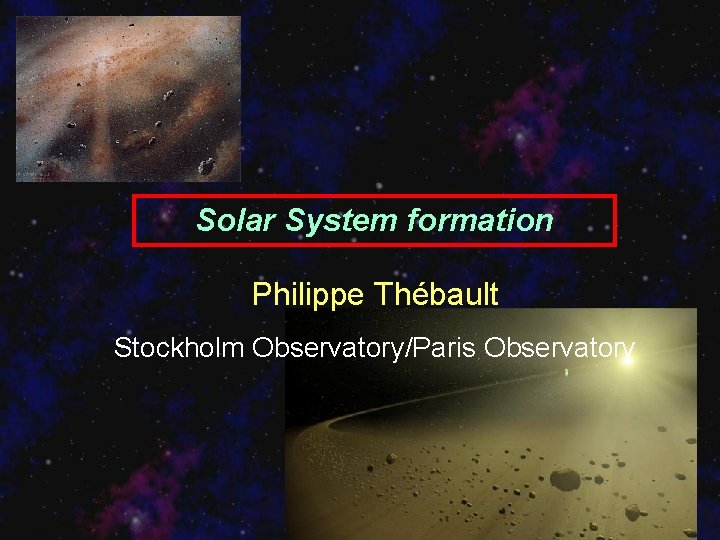
Solar System formation Philippe Thébault Stockholm Observatory/Paris Observatory
a very complex problem REQUIRING NUMEROUS DIFFERENT SCIENTIFICAL COMPETENCES • Stellar Physics • Hydrodynamics • Thermodynamics • M. H. D • Chemistry • Dynamics • Geophysics • ….
OUTLINE • Basic and not-so-basics facts & constraints Planetary orbits, Masses and composition Age of the Solar System Extrasolar discs & planets • The “standard” scenario Cloud collapse/star+disc formation Grain condensation formation of planetesimals Planetesimal accretion Embryo accretion • Giant Planet formation Can we form them in time? ? • Asteroids and Kuiper Belt getting rid of the mass
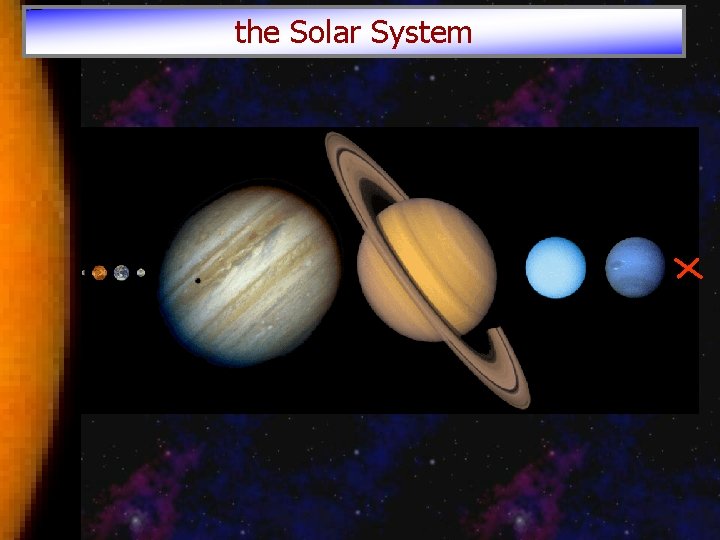
the Solar System
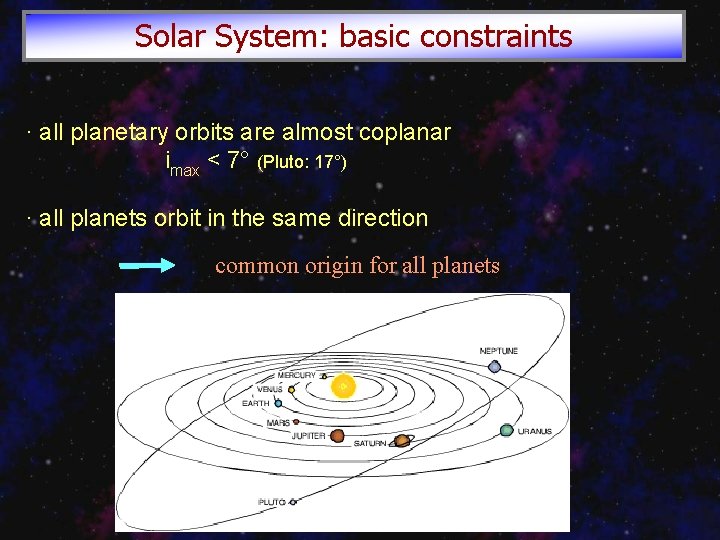
Solar System: basic constraints · all planetary orbits are almost coplanar imax < 7° (Pluto: 17°) · all planets orbit in the same direction common origin for all planets
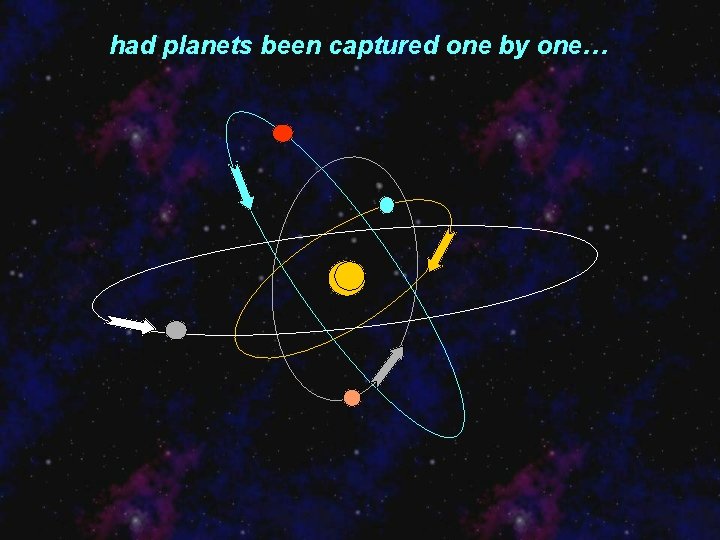
had planets been captured one by one…
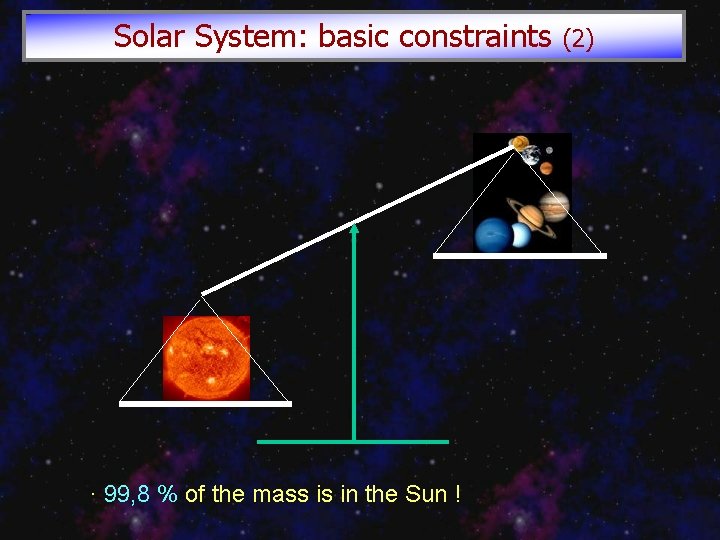
Solar System: basic constraints (2) · 99, 8 % of the mass is in the Sun !
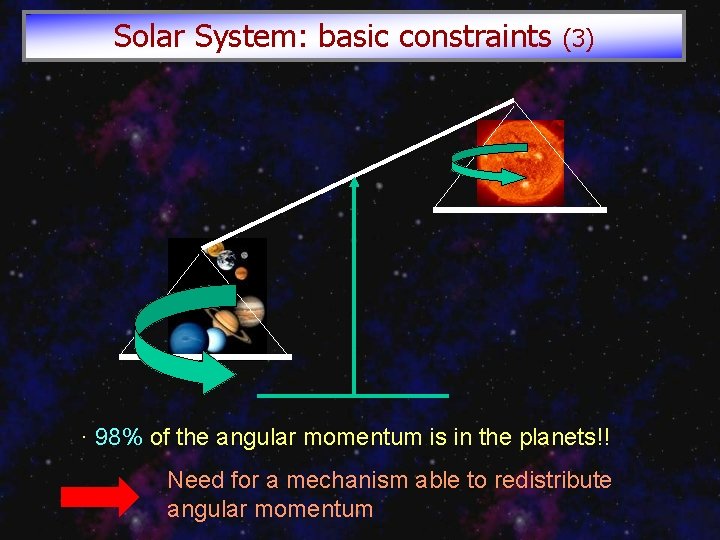
Solar System: basic constraints (3) · 98% of the angular momentum is in the planets!! Need for a mechanism able to redistribute angular momentum
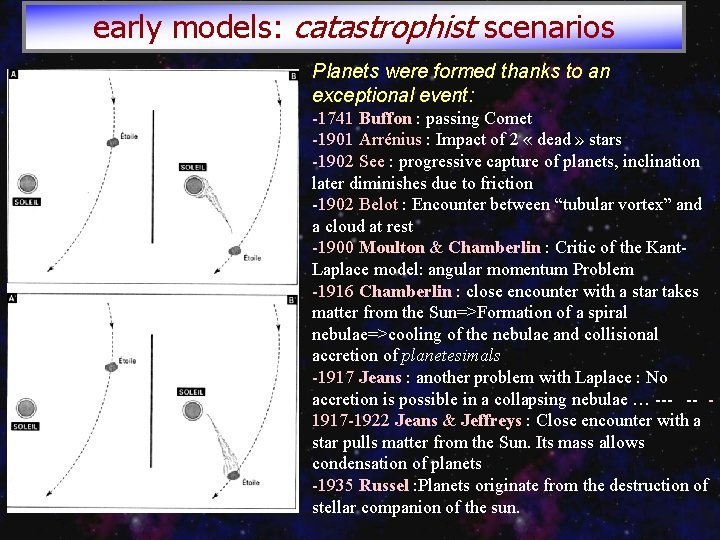
early models: catastrophist scenarios Planets were formed thanks to an exceptional event: -1741 Buffon : passing Comet -1901 Arrénius : Impact of 2 « dead » stars -1902 See : progressive capture of planets, inclination later diminishes due to friction -1902 Belot : Encounter between “tubular vortex” and a cloud at rest -1900 Moulton & Chamberlin : Critic of the Kant. Laplace model: angular momentum Problem -1916 Chamberlin : close encounter with a star takes matter from the Sun=>Formation of a spiral nebulae=>cooling of the nebulae and collisional accretion of planetesimals -1917 Jeans : another problem with Laplace : No accretion is possible in a collapsing nebulae … --- -- 1917 -1922 Jeans & Jeffreys : Close encounter with a star pulls matter from the Sun. Its mass allows condensation of planets -1935 Russel : Planets originate from the destruction of stellar companion of the sun.
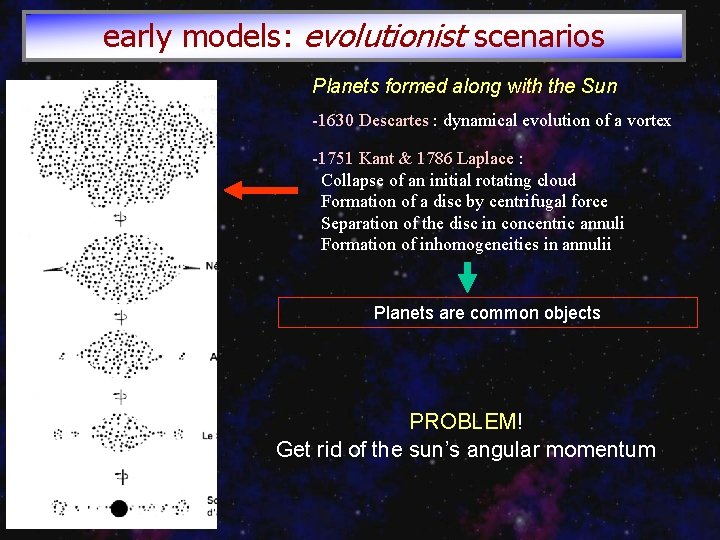
early models: evolutionist scenarios Planets formed along with the Sun -1630 Descartes : dynamical evolution of a vortex -1751 Kant & 1786 Laplace : Collapse of an initial rotating cloud Formation of a disc by centrifugal force Separation of the disc in concentric annuli Formation of inhomogeneities in annulii Planets are common objects PROBLEM! Get rid of the sun’s angular momentum
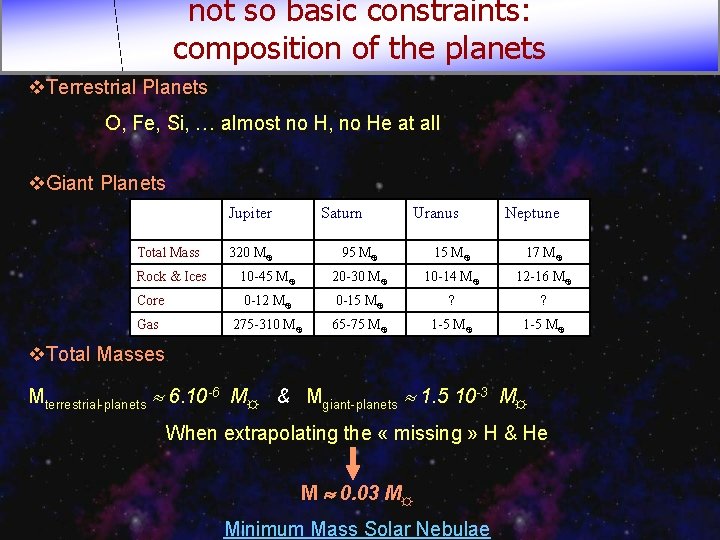
not so basic constraints: composition of the planets v. Terrestrial Planets O, Fe, Si, … almost no H, no He at all v. Giant Planets Jupiter Total Mass Saturn 320 M Uranus Neptune 95 M 17 M Rock & Ices 10 -45 M 20 -30 M 10 -14 M 12 -16 M Core 0 -12 M 0 -15 M ? ? Gas 275 -310 M 65 -75 M 1 -5 M v. Total Masses Mterrestrial-planets 6. 10 -6 M☼ & Mgiant-planets 1. 5 10 -3 M☼ When extrapolating the « missing » H & He M 0. 03 M☼ Minimum Mass Solar Nebulae
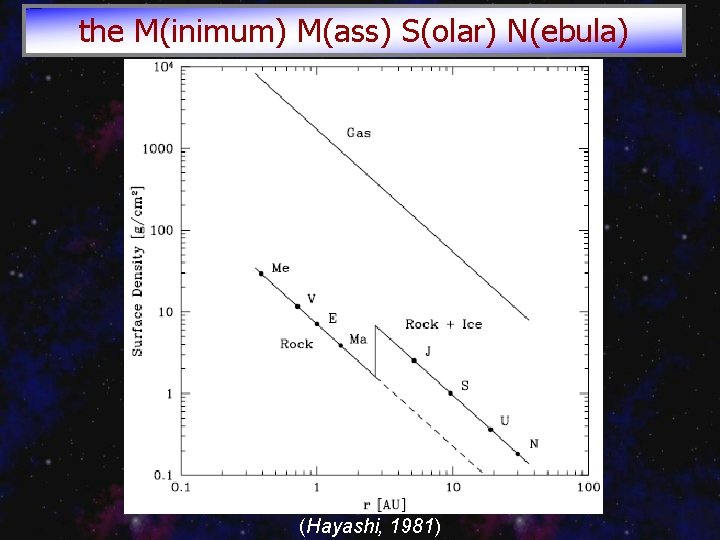
the M(inimum) M(ass) S(olar) N(ebula) (Hayashi, 1981)
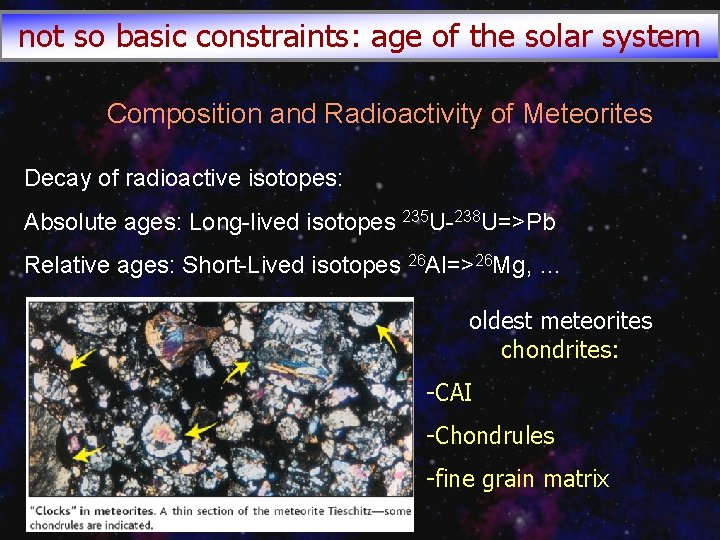
not so basic constraints: age of the solar system Composition and Radioactivity of Meteorites Decay of radioactive isotopes: Absolute ages: Long-lived isotopes 235 U-238 U=>Pb Relative ages: Short-Lived isotopes 26 Al=>26 Mg, … oldest meteorites chondrites: -CAI -Chondrules -fine grain matrix
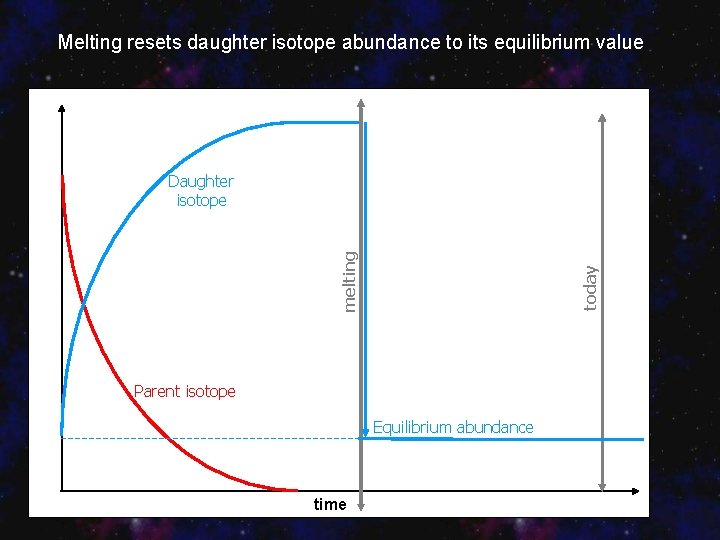
Melting resets daughter isotope abundance to its equilibrium value today melting Daughter isotope Parent isotope Equilibrium abundance time
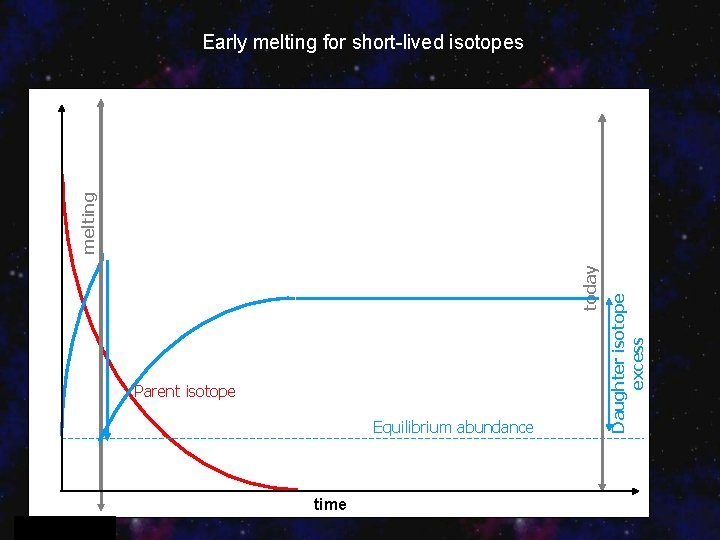
Parent isotope Equilibrium abundance time Daughter isotope excess Daughter isotope today melting Early melting for short-lived isotopes
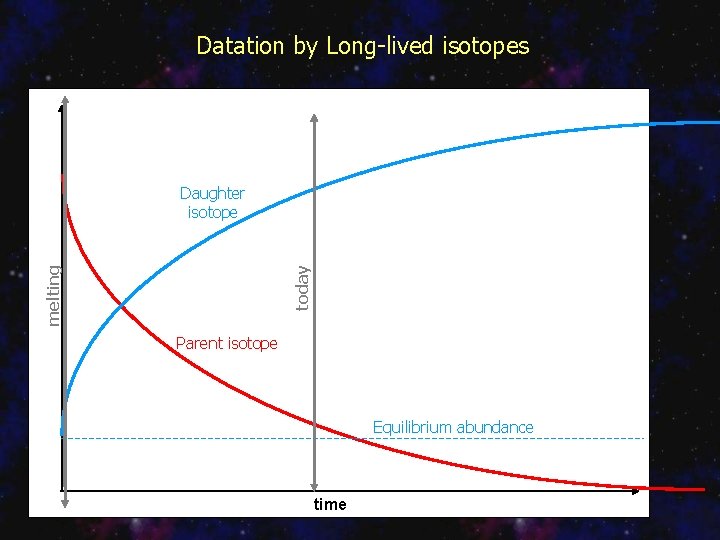
Datation by Long-lived isotopes today melting Daughter isotope Parent isotope Equilibrium abundance time
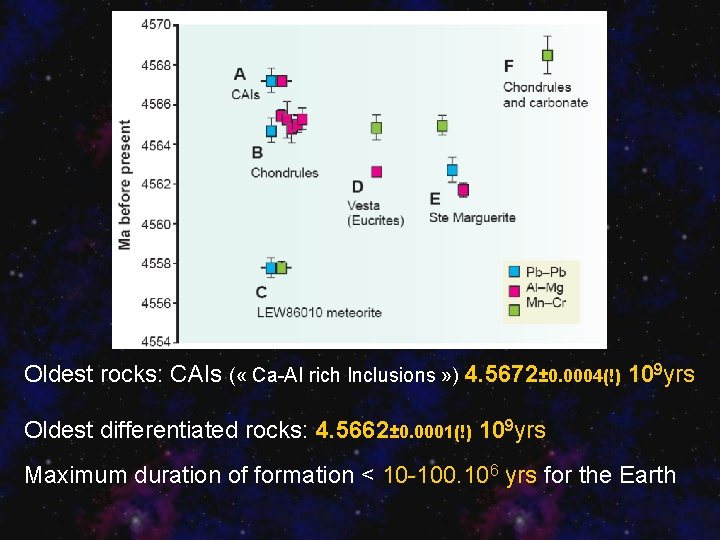
Oldest rocks: CAIs ( « Ca-AI rich Inclusions » ) 4. 5672± 0. 0004(!) 109 yrs Oldest differentiated rocks: 4. 5662± 0. 0001(!) 109 yrs Maximum duration of formation < 10 -100. 106 yrs for the Earth
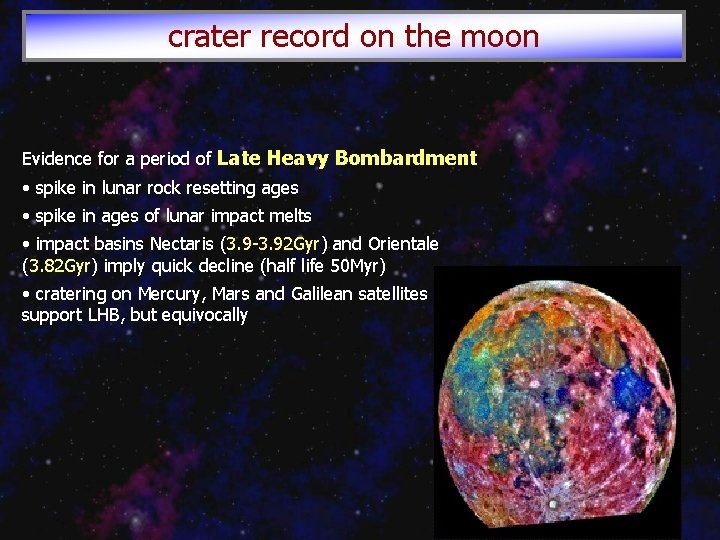
crater record on the moon Evidence for a period of Late Heavy Bombardment • spike in lunar rock resetting ages • spike in ages of lunar impact melts • impact basins Nectaris (3. 9 -3. 92 Gyr) and Orientale (3. 82 Gyr) imply quick decline (half life 50 Myr) • cratering on Mercury, Mars and Galilean satellites support LHB, but equivocally
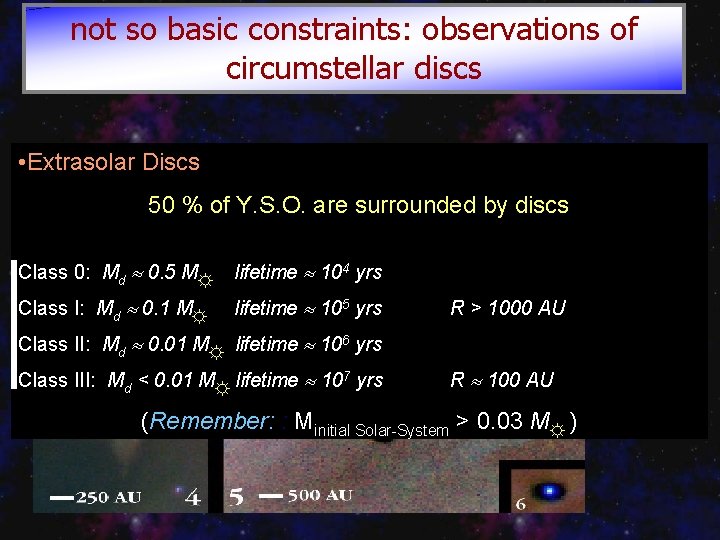
not so basic constraints: observations of circumstellar discs • Extrasolar Discs 50 % of Y. S. O. are surrounded by discs Class 0: Md 0. 5 M☼ lifetime 104 yrs Class I: Md 0. 1 M☼ lifetime 105 yrs R > 1000 AU Class II: Md 0. 01 M☼ lifetime 106 yrs Class III: Md < 0. 01 M☼ lifetime 107 yrs R 100 AU (Remember: : Minitial Solar-System > 0. 03 M☼ )
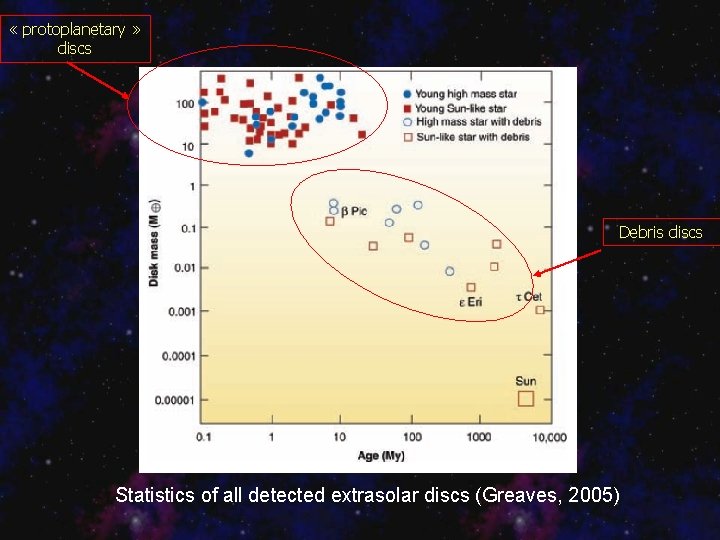
« protoplanetary » discs Debris discs Statistics of all detected extrasolar discs (Greaves, 2005)
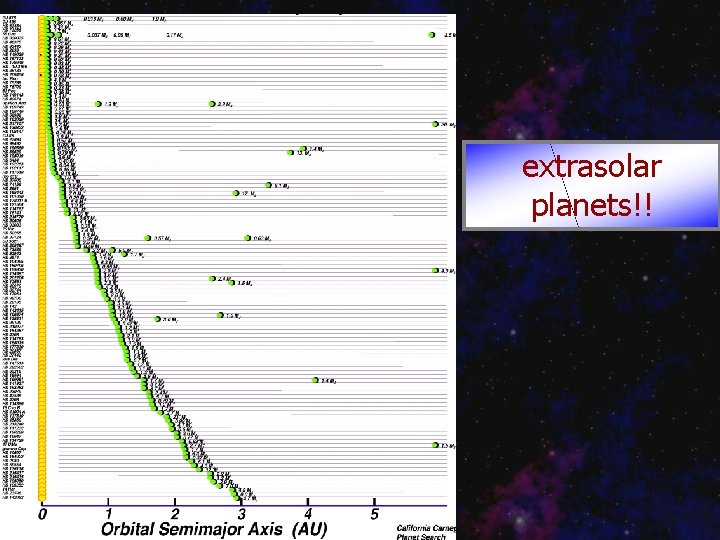
extrasolar planets!!
the “standard” scenario of planet formation • 1751/86 Kant & Laplace • 1969 Safronov • 1978 Greenberg • 1989 Wetherill & Stewart • 1996 Pollack et al. • 1997 Weidenschilling et al. • 1998 Kokubo&Ida • ……
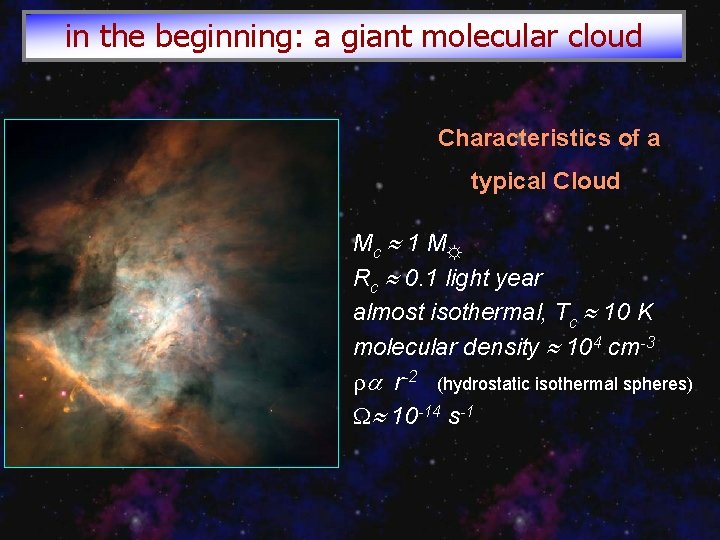
in the beginning: a giant molecular cloud Characteristics of a typical Cloud Mc 1 M☼ Rc 0. 1 light year almost isothermal, Tc 10 K molecular density 104 cm-3 r r-2 (hydrostatic isothermal spheres) 10 -14 s-1
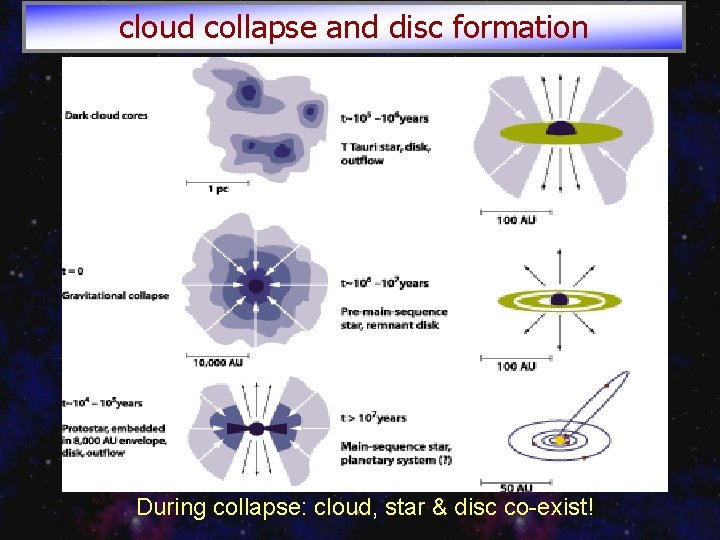
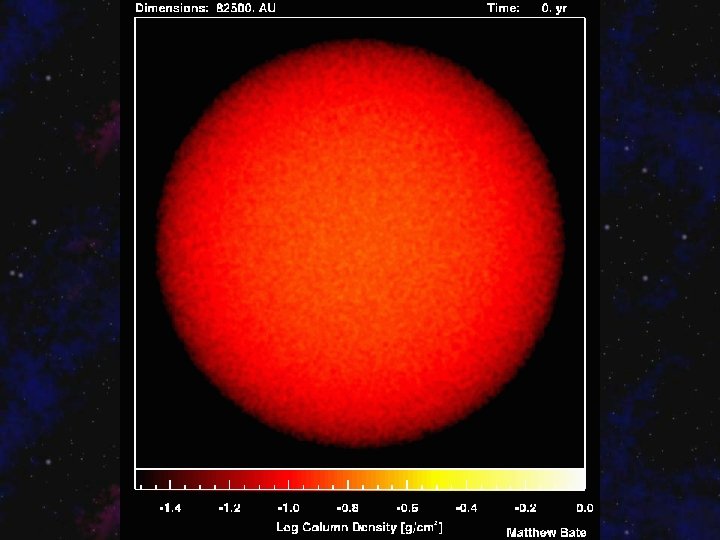
cloud collapse and disc formation During collapse: cloud, star & disc co-exist!
angular momentum transport: why? v. To transport most of J outward 99% of J is in the planets v. To allow mass accretion towards the central proto-star otherwise direct cloud-collapse would be halted before star formation Fcentri. = Fgrav for R = 2/5 RMercury outward J flux inward mass flux v. Heat source v. Rapid dispersion of the disc ( <107 yrs)
possible mechanisms for J transport v. Shear Turbulence v. Magnetic Winds v. Spiral Waves triggered by a companion v. Self-Gravitating Spiral-Waves v. Spiral Shocks v. One Armed Spiral, eccentric instabilities v….
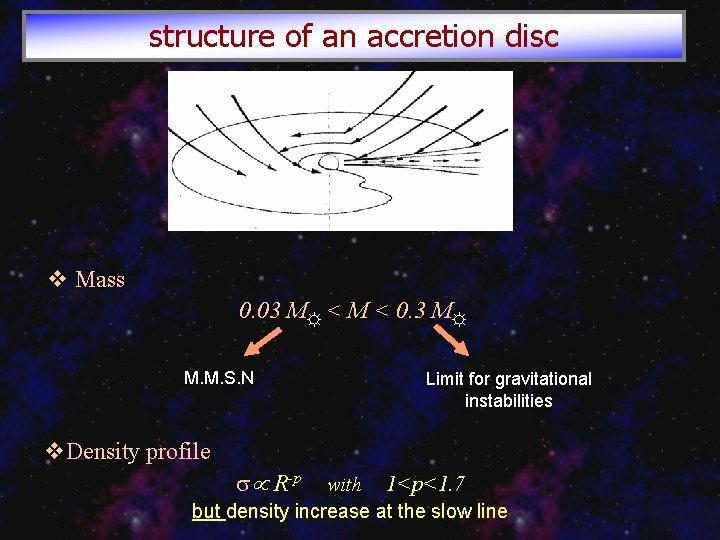
structure of an accretion disc v Mass 0. 03 M☼ < M < 0. 3 M☼ M. M. S. N Limit for gravitational instabilities v. Density profile s R-p with 1<p<1. 7 but density increase at the slow line
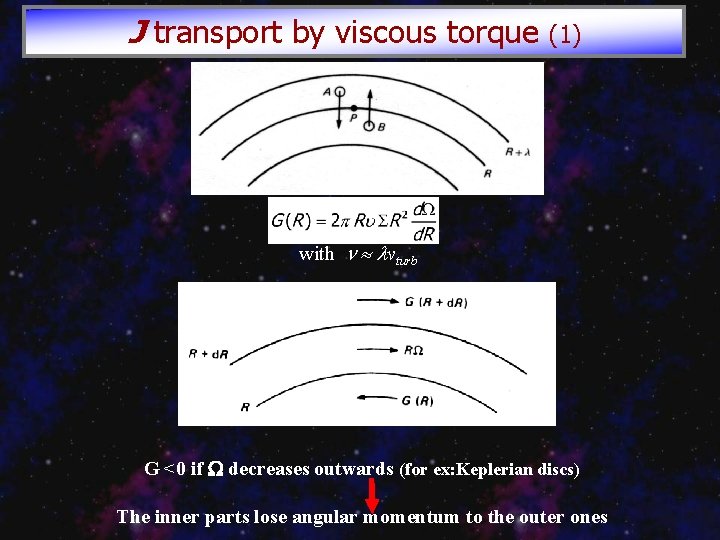
J transport by viscous torque (1) with vturb G <0 if decreases outwards (for ex: Keplerian discs) The inner parts lose angular momentum to the outer ones
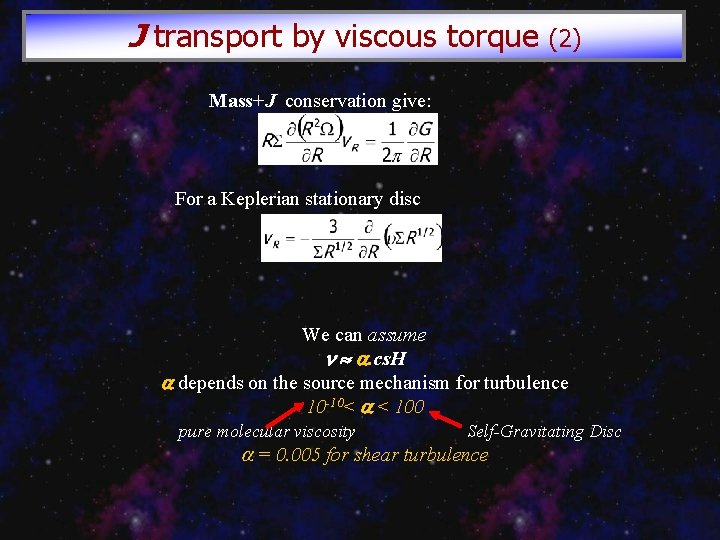
J transport by viscous torque (2) Mass+J conservation give: For a Keplerian stationary disc We can assume . cs. H depends on the source mechanism for turbulence 10 -10< < 100 pure molecular viscosity Self-Gravitating Disc = 0. 005 for shear turbulence
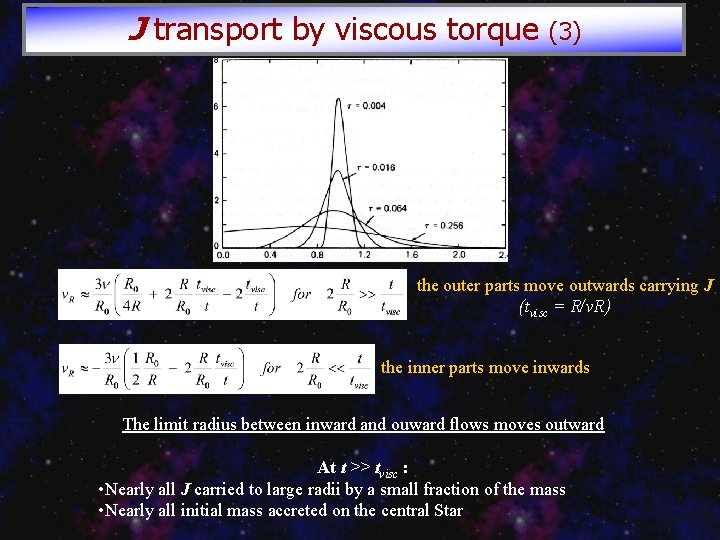
J transport by viscous torque (3) the outer parts move outwards carrying J (tvisc = R/v. R) the inner parts move inwards The limit radius between inward and ouward flows moves outward At t >> tvisc : • Nearly all J carried to large radii by a small fraction of the mass • Nearly all initial mass accreted on the central Star
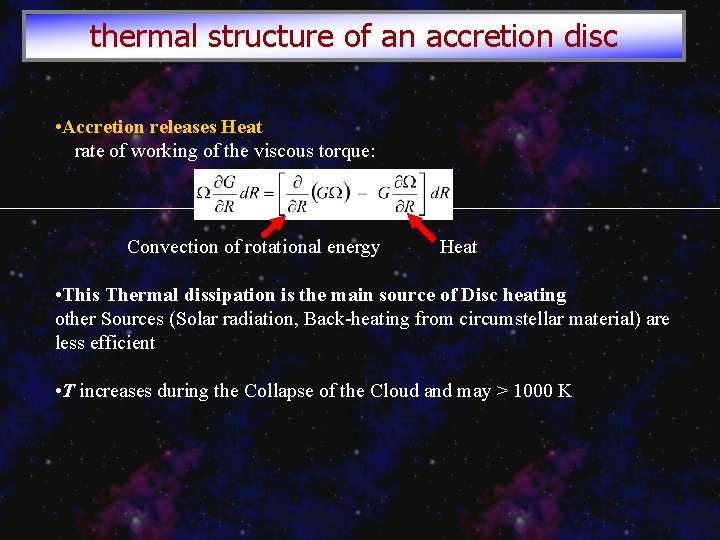
thermal structure of an accretion disc • Accretion releases Heat rate of working of the viscous torque: Convection of rotational energy Heat • This Thermal dissipation is the main source of Disc heating other Sources (Solar radiation, Back-heating from circumstellar material) are less efficient • T increases during the Collapse of the Cloud and may > 1000 K
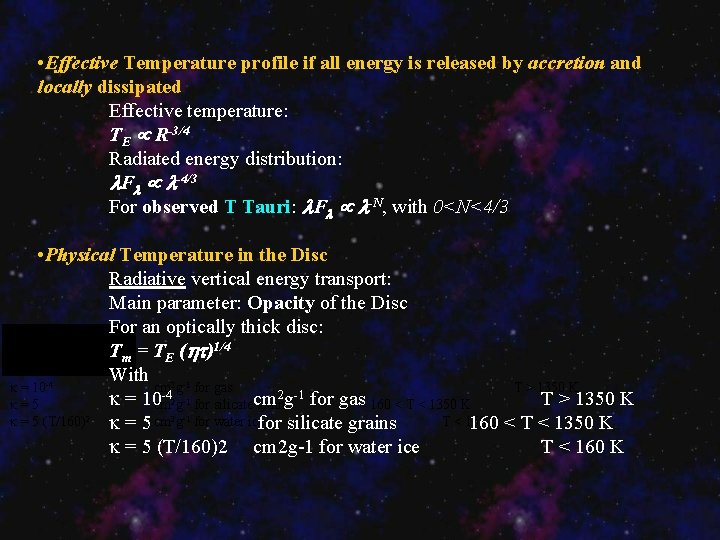
• Effective Temperature profile if all energy is released by accretion and locally dissipated Effective temperature: TE R-3/4 Radiated energy distribution: F -4/3 For observed T Tauri: F -N, with 0<N<4/3 • Physical Temperature in the Disc Radiative vertical energy transport: Main parameter: Opacity of the Disc For an optically thick disc: Tm = TE ( )1/4 With 2 -1 = 10 -4 cm g for gas T > 1350 K -42 -1 2 g-1 for gas = 10 cm T > 1350 K = 5 cm g for silicate grains 160 < T < 1350 K = 5 (T/160)2 = 5 cm 2 g-1 for water ice T < 160 K for silicate grains 160 < T < 1350 K = 5 (T/160)2 cm 2 g-1 for water ice T < 160 K
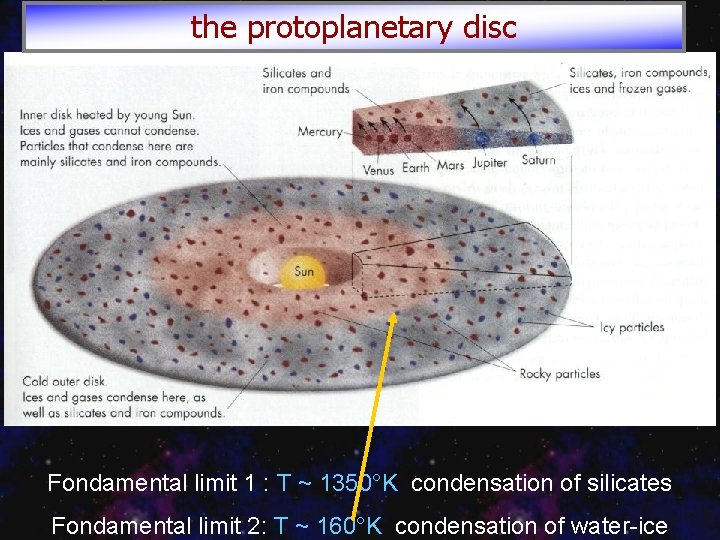
the protoplanetary disc Fondamental limit 1 : T ~ 1350°K condensation of silicates Fondamental limit 2: T ~ 160°K condensation of water-ice
from grains to planetesimals…a miracle occurs
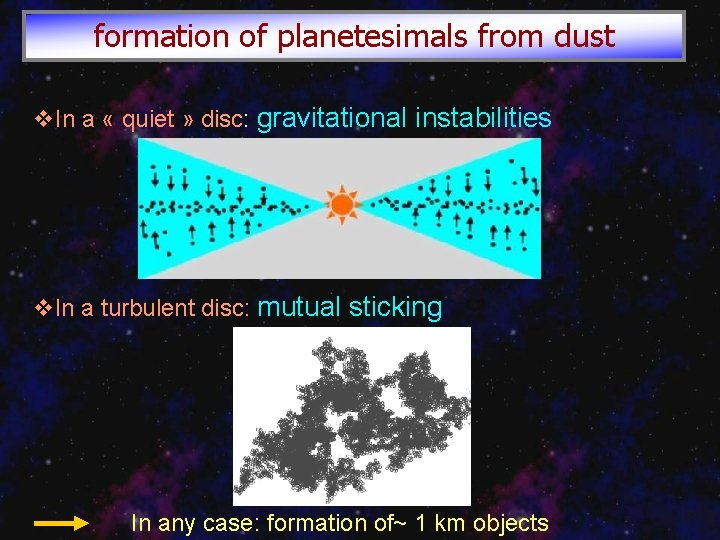
formation of planetesimals from dust v. In a « quiet » disc: gravitational instabilities v. In a turbulent disc: mutual sticking In any case: formation of~ 1 km objects
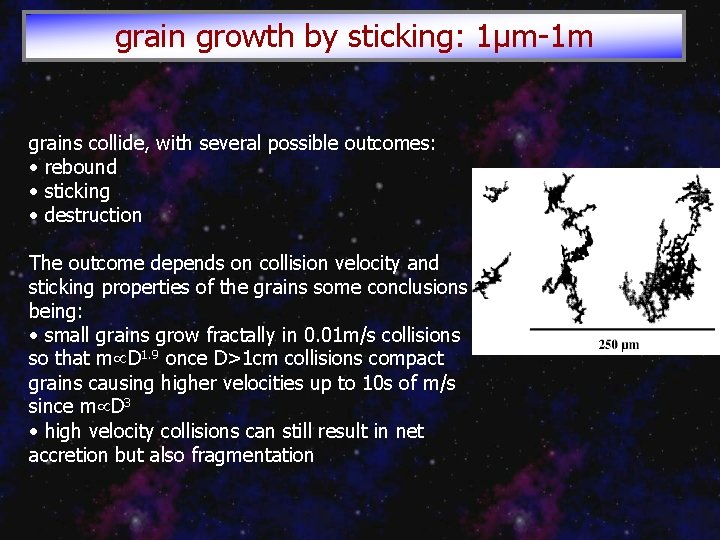
grain growth by sticking: 1μm-1 m grains collide, with several possible outcomes: • rebound • sticking • destruction The outcome depends on collision velocity and sticking properties of the grains some conclusions being: • small grains grow fractally in 0. 01 m/s collisions so that m D 1. 9 once D>1 cm collisions compact grains causing higher velocities up to 10 s of m/s since m D 3 • high velocity collisions can still result in net accretion but also fragmentation
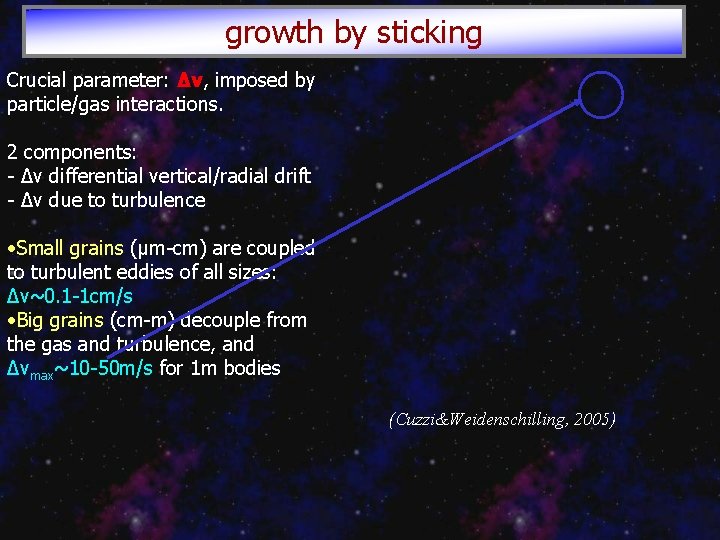
growth by sticking Crucial parameter: Δv, imposed by particle/gas interactions. 2 components: - Δv differential vertical/radial drift - Δv due to turbulence • Small grains (μm-cm) are coupled to turbulent eddies of all sizes: Δv~0. 1 -1 cm/s • Big grains (cm-m) decouple from the gas and turbulence, and Δvmax~10 -50 m/s for 1 m bodies (Cuzzi&Weidenschilling, 2005)
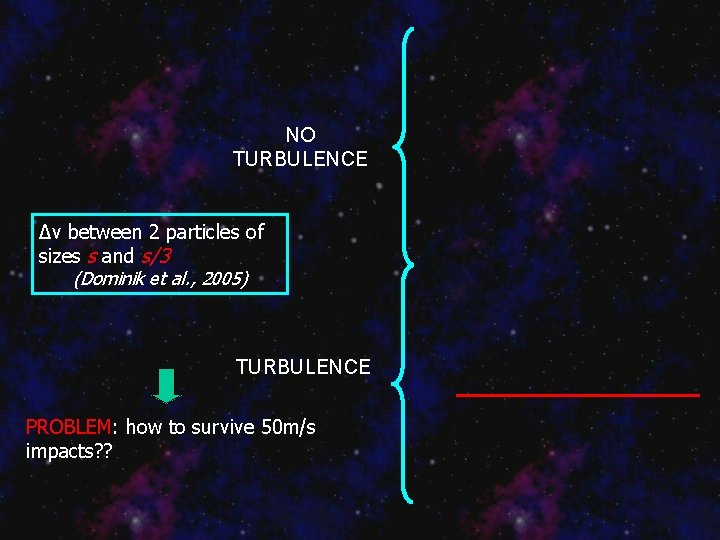
NO TURBULENCE Δv between 2 particles of sizes s and s/3 (Dominik et al. , 2005) TURBULENCE PROBLEM: how to survive 50 m/s impacts? ?
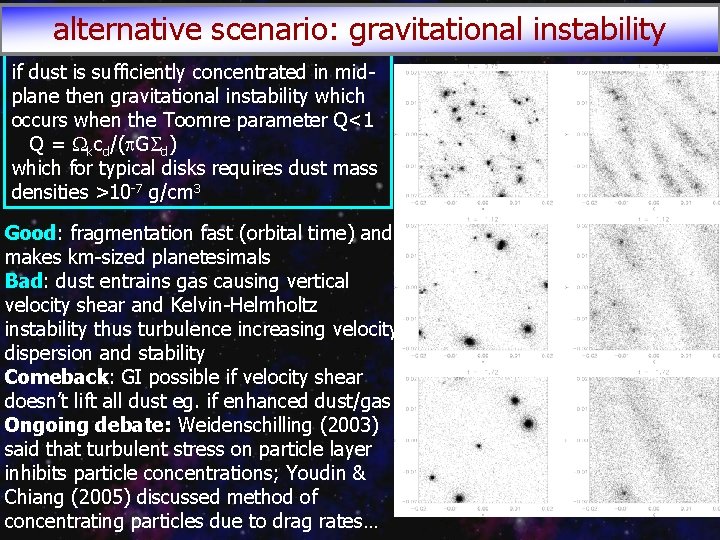
alternative scenario: gravitational instability if dust is sufficiently concentrated in midplane then gravitational instability which occurs when the Toomre parameter Q<1 Q = kcd/( G d) which for typical disks requires dust mass densities >10 -7 g/cm 3 Good: fragmentation fast (orbital time) and makes km-sized planetesimals Bad: dust entrains gas causing vertical velocity shear and Kelvin-Helmholtz instability thus turbulence increasing velocity dispersion and stability Comeback: GI possible if velocity shear doesn’t lift all dust eg. if enhanced dust/gas Ongoing debate: Weidenschilling (2003) said that turbulent stress on particle layer inhibits particle concentrations; Youdin & Chiang (2005) discussed method of concentrating particles due to drag rates…
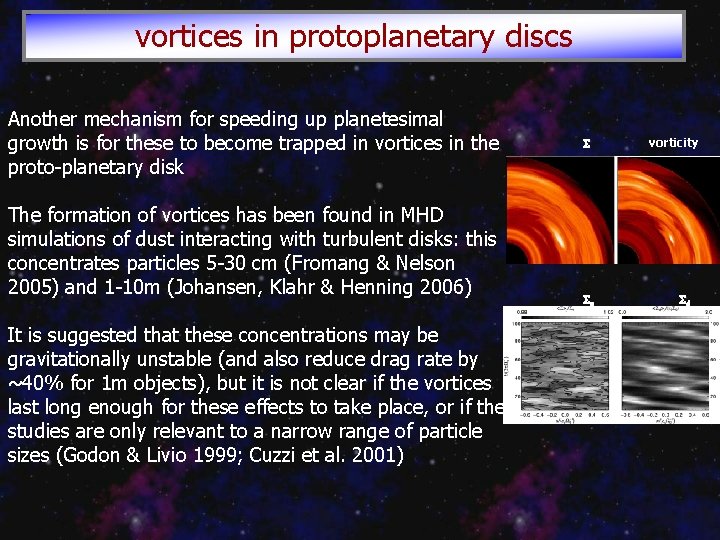
vortices in protoplanetary discs Another mechanism for speeding up planetesimal growth is for these to become trapped in vortices in the proto-planetary disk The formation of vortices has been found in MHD simulations of dust interacting with turbulent disks: this concentrates particles 5 -30 cm (Fromang & Nelson 2005) and 1 -10 m (Johansen, Klahr & Henning 2006) It is suggested that these concentrations may be gravitationally unstable (and also reduce drag rate by ~40% for 1 m objects), but it is not clear if the vortices last long enough for these effects to take place, or if the studies are only relevant to a narrow range of particle sizes (Godon & Livio 1999; Cuzzi et al. 2001) g vorticity d
concurrent scenarios: pros and cons vgravitational instability - Requires unrealitisticaly low turbulence v. Turbulence-induced sticking - Particles with 1 mm<R<10 m might be broken up by d. V>10 -50 m/s fierce debate going on…
(Dullemond et al. , 2005)
when does the gas disperse? • After t~107 years (circumstellar discs observations) how does the gas disperse? • Viscous evolution • Truncation by Stellar Encounters • Stripping by stellar Wind • Photo. Evaporation External Stars Central Star
coupling between viscous evolution and photo-evaporation: GAS REMOVAL
disc dispersal mechanisms: time scales (Hollenbach, 2006)
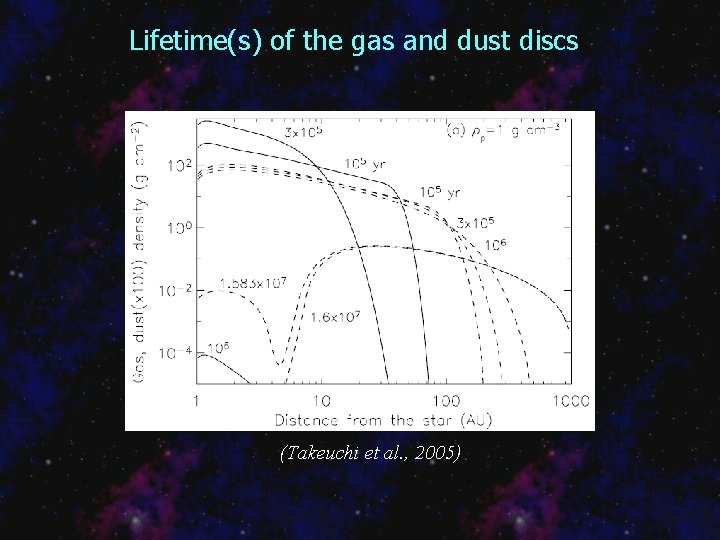
Lifetime(s) of the gas and dust discs (Takeuchi et al. , 2005)
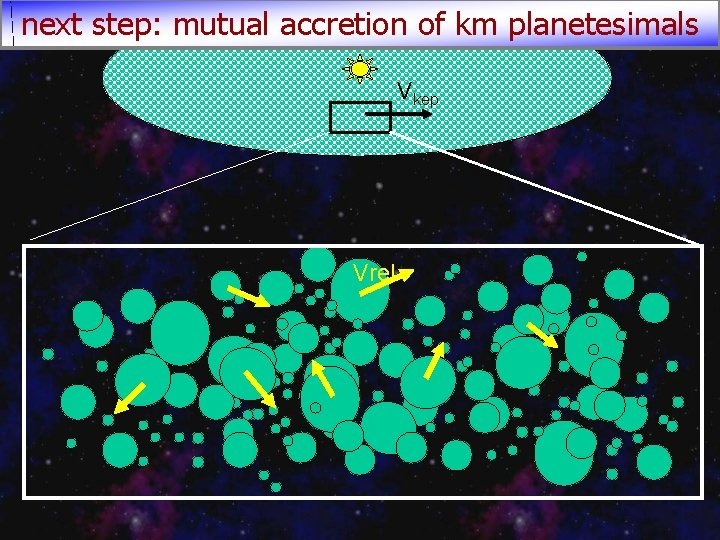
Planetesimal disc next step: mutual accretion of km planetesimals Vkep Vrel
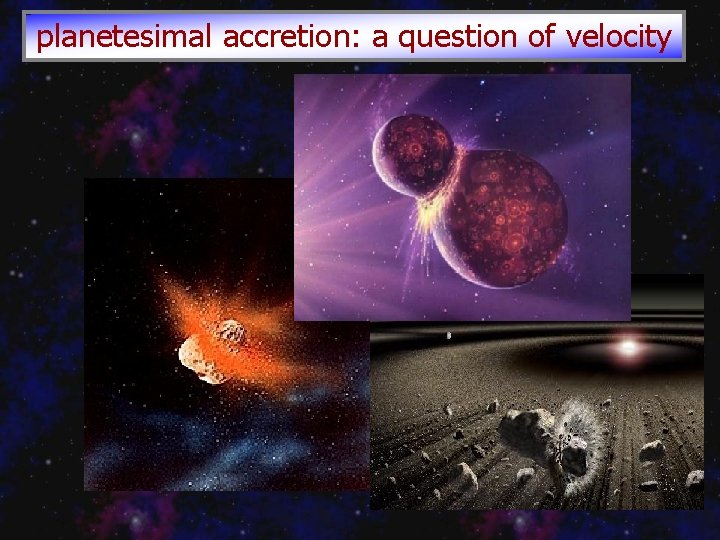
planetesimal accretion: a question of velocity
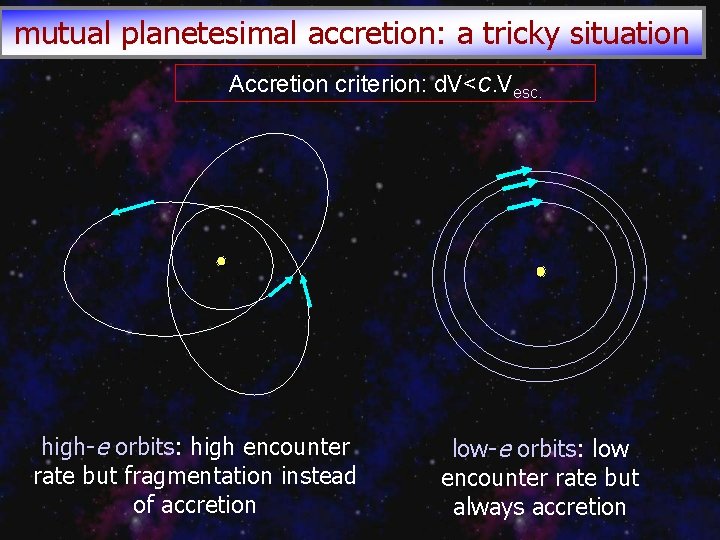
mutual planetesimal accretion: a tricky situation Accretion criterion: d. V<C. Vesc. high-e orbits: high encounter rate but fragmentation instead of accretion low-e orbits: low encounter rate but always accretion
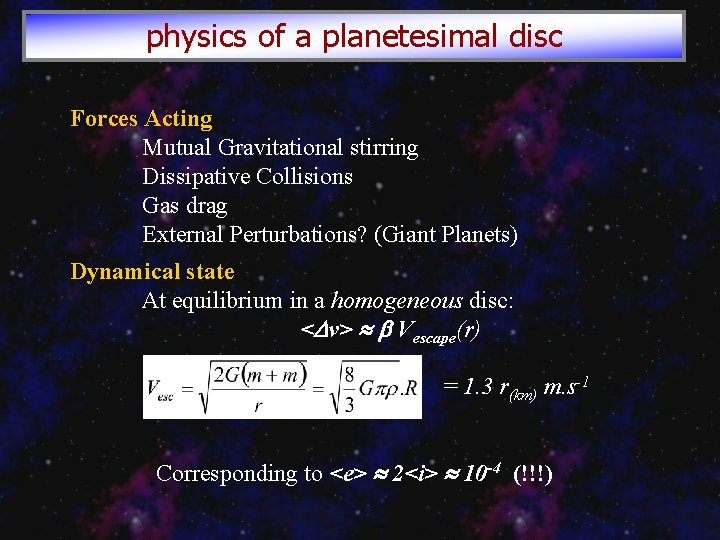
physics of a planetesimal disc Forces Acting Mutual Gravitational stirring Dissipative Collisions Gas drag External Perturbations? (Giant Planets) Dynamical state At equilibrium in a homogeneous disc: < v> Vescape(r) = 1. 3 r(km) m. s-1 Corresponding to <e> 2<i> 10 -4 (!!!)
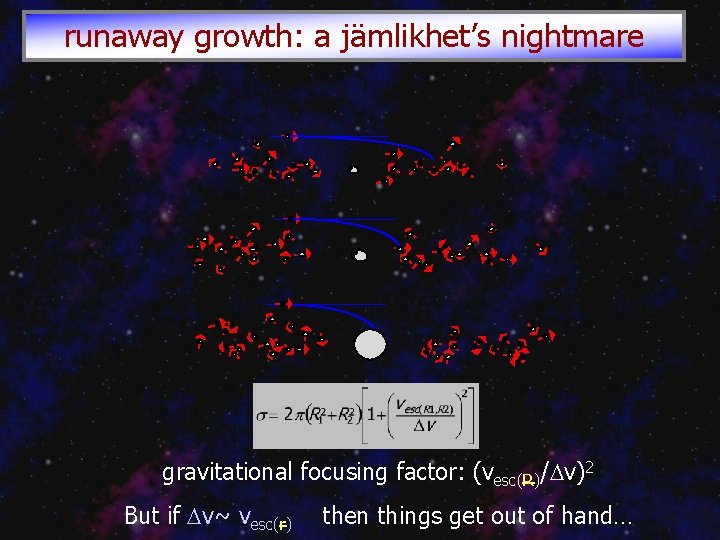
runaway growth: a jämlikhet’s nightmare gravitational focusing factor: (vesc(R)/ v)2 But if v~ vesc(r) then things get out of hand…
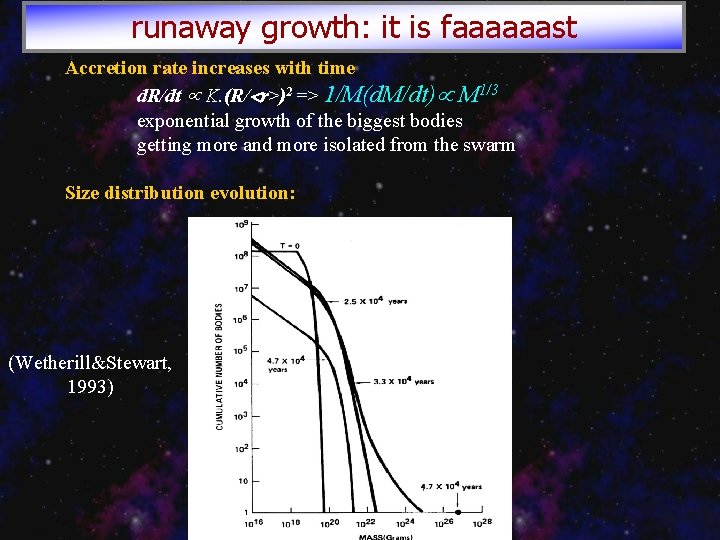
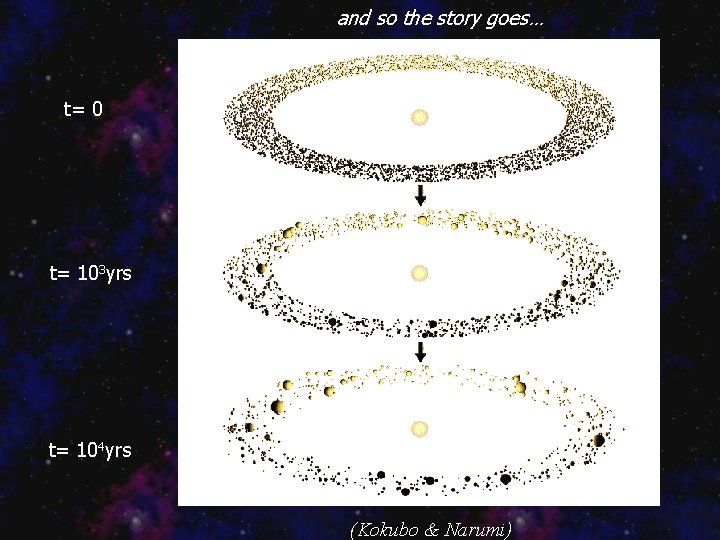
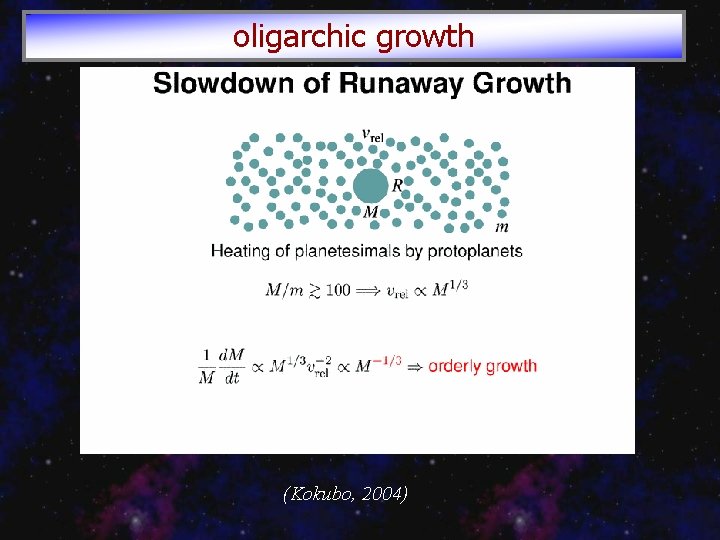
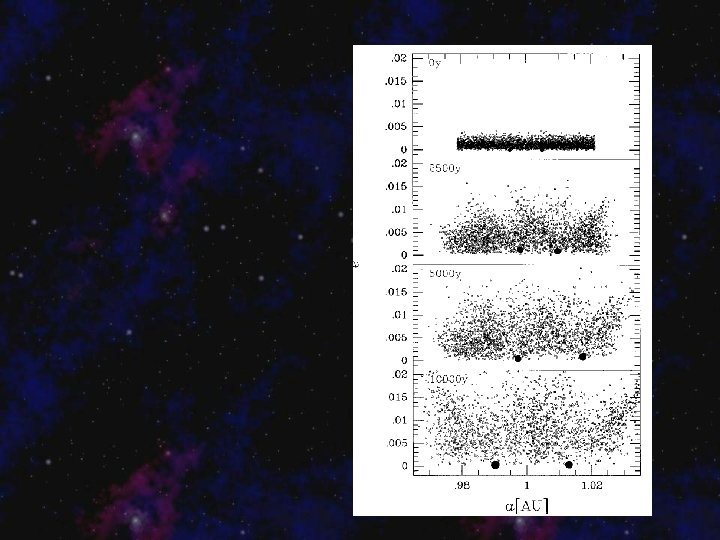
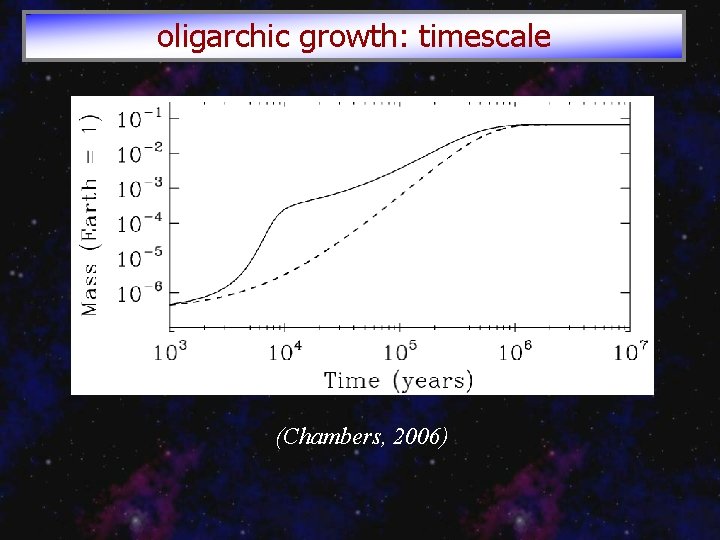
runaway growth: it is faaaaaast Accretion rate increases with time d. R/dt K. (R/ r>)2 => 1/M(d. M/dt) M 1/3 exponential growth of the biggest bodies getting more and more isolated from the swarm Size distribution evolution: (Wetherill&Stewart, 1993)
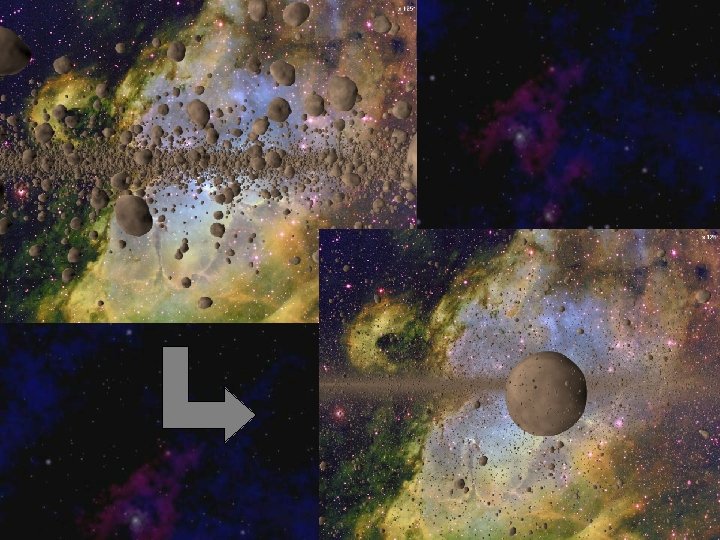
and so the story goes… t= 0 t= 103 yrs t= 104 yrs (Kokubo & Narumi)
oligarchic growth (Kokubo, 2004)
oligarchic growth: timescale (Chambers, 2006)
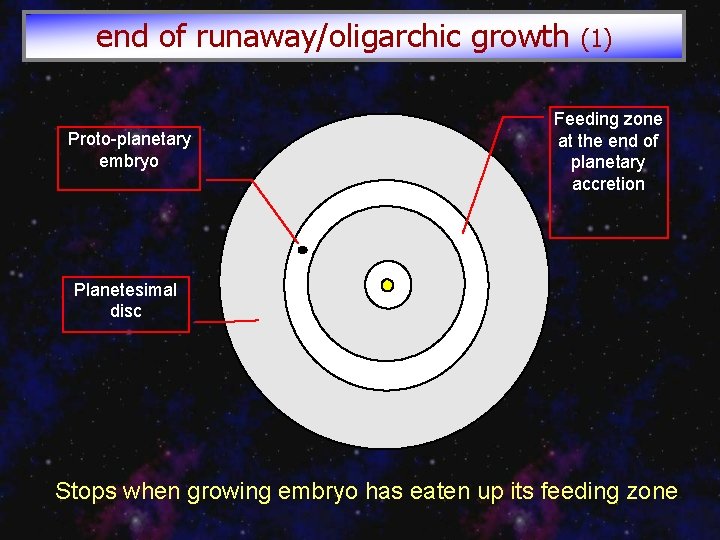
end of runaway/oligarchic growth (1) Proto-planetary embryo Feeding zone at the end of planetary accretion Planetesimal disc Stops when growing embryo has eaten up its feeding zone
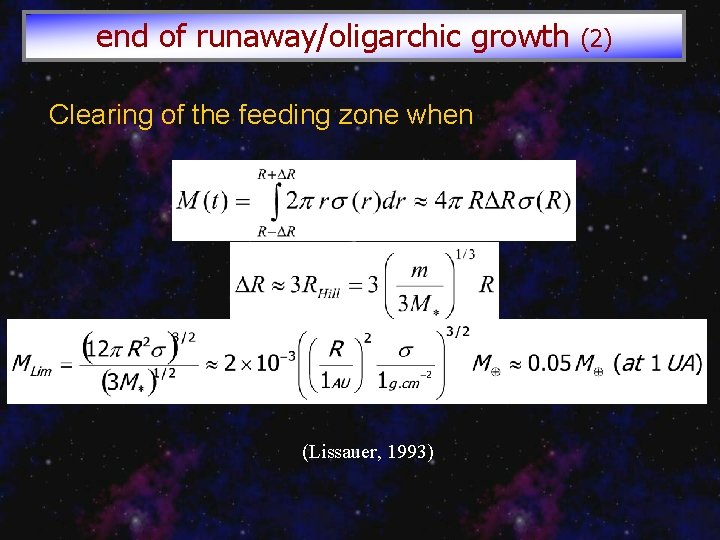
end of runaway/oligarchic growth (2) Clearing of the feeding zone when (Lissauer, 1993)
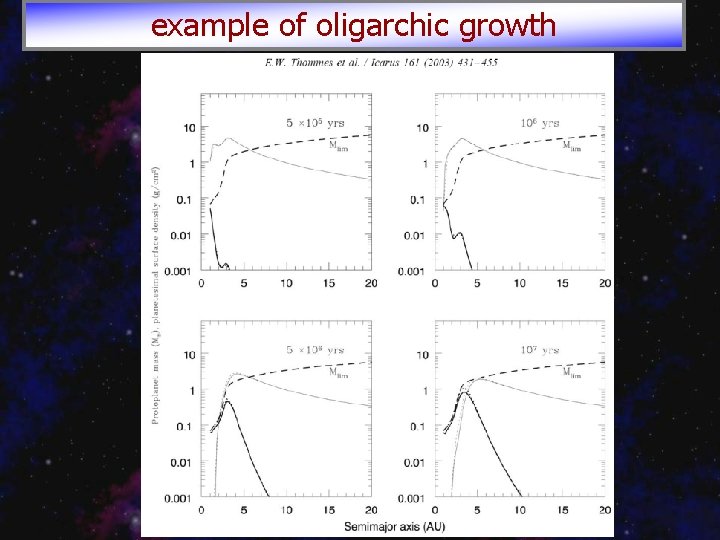
example of oligarchic growth
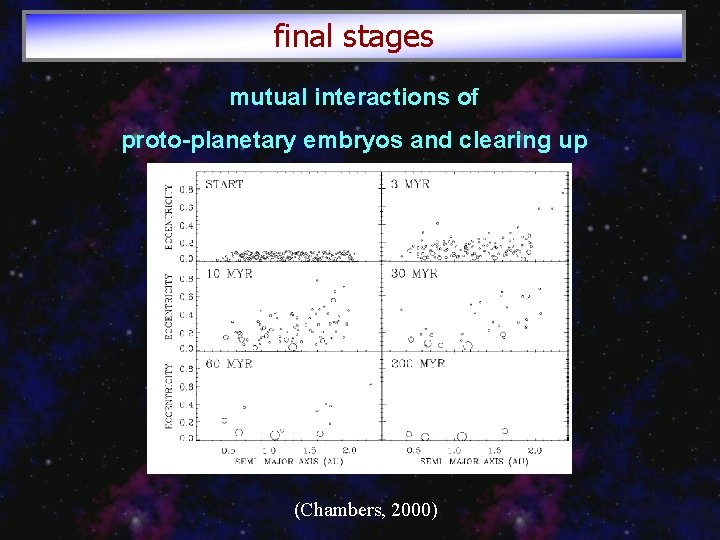
final stages mutual interactions of proto-planetary embryos and clearing up (Chambers, 2000)
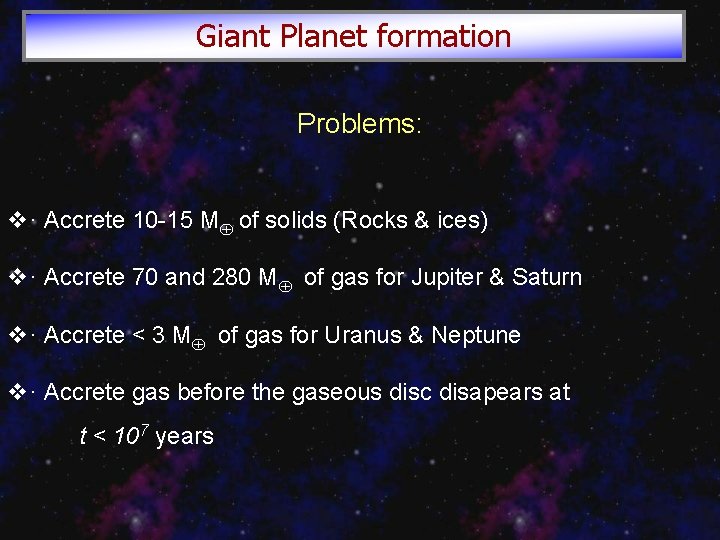
Giant Planet formation Problems: v· Accrete 10 -15 M of solids (Rocks & ices) v· Accrete 70 and 280 M of gas for Jupiter & Saturn v· Accrete < 3 M of gas for Uranus & Neptune v· Accrete gas before the gaseous disc disapears at t < 107 years
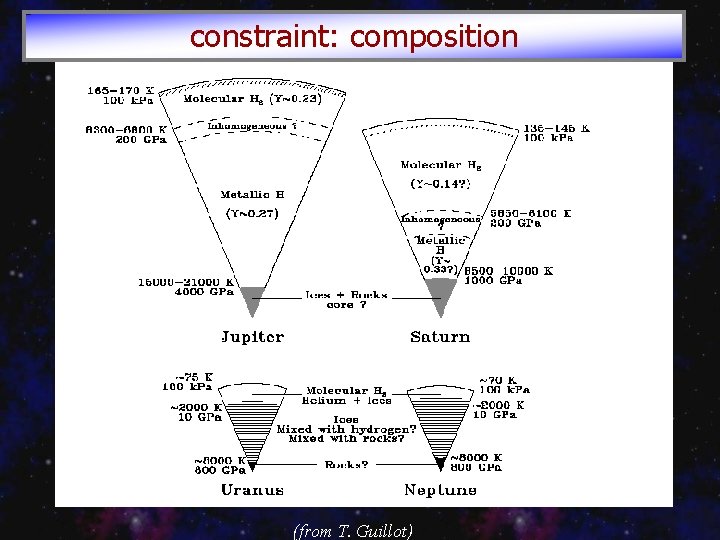
constraint: composition (from T. Guillot)
concurrent scenarios (here we go again) v· Solid Core in 2 steps (defending champion) · v Direct Instabilities/Gravitational collapse (maverick)
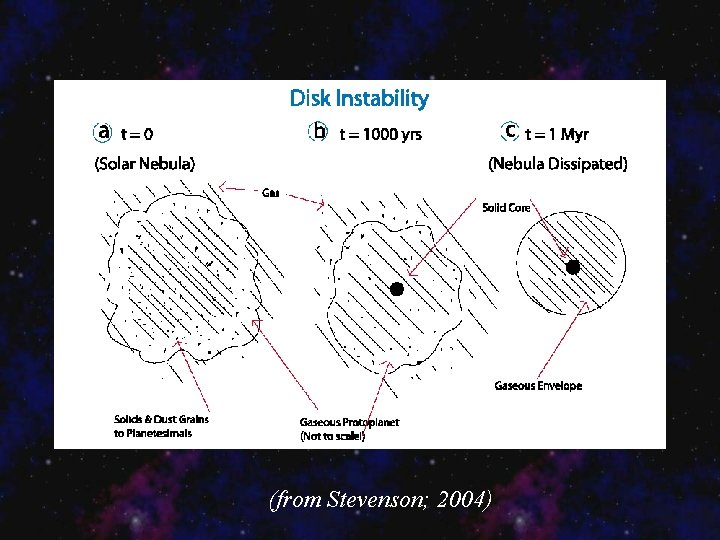
(from Stevenson; 2004)
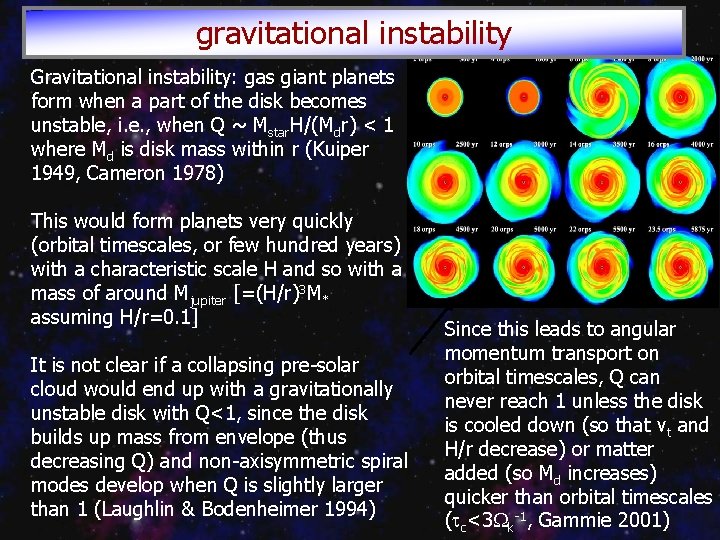
gravitational instability Gravitational instability: gas giant planets form when a part of the disk becomes unstable, i. e. , when Q ~ Mstar. H/(Mdr) < 1 where Md is disk mass within r (Kuiper 1949, Cameron 1978) This would form planets very quickly (orbital timescales, or few hundred years) with a characteristic scale H and so with a mass of around Mjupiter [=(H/r)3 M* assuming H/r=0. 1] It is not clear if a collapsing pre-solar cloud would end up with a gravitationally unstable disk with Q<1, since the disk builds up mass from envelope (thus decreasing Q) and non-axisymmetric spiral modes develop when Q is slightly larger than 1 (Laughlin & Bodenheimer 1994) Since this leads to angular momentum transport on orbital timescales, Q can never reach 1 unless the disk is cooled down (so that vt and H/r decrease) or matter added (so Md increases) quicker than orbital timescales ( c<3 k-1, Gammie 2001)
grav. instability: pros and cons • This process is fast! • Core rainout can satisfy the need for a core • Compatible with extrasolar planets Alan Boss (2000) • You don’t even know for sure if it happens! Depends on the rate at which you approach instability, etc. • Cooling problem! • May not have the right mass • Still need to make Uranus and Neptune
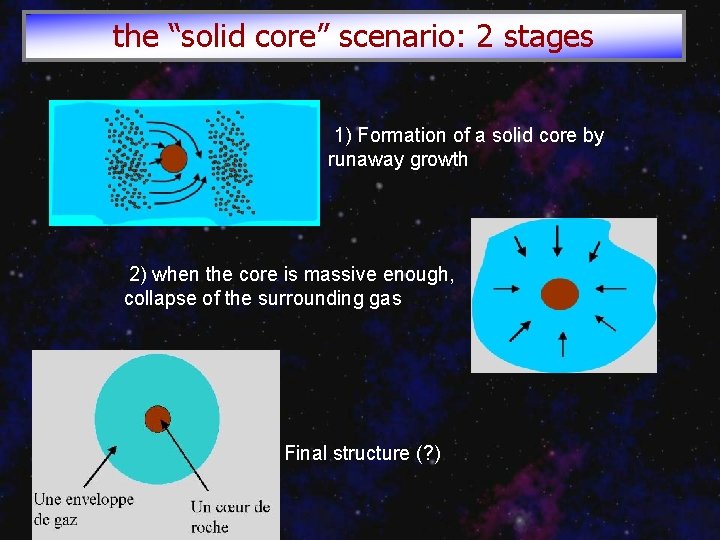
the “solid core” scenario: 2 stages 1) Formation of a solid core by runaway growth 2) when the core is massive enough, collapse of the surrounding gas Final structure (? )
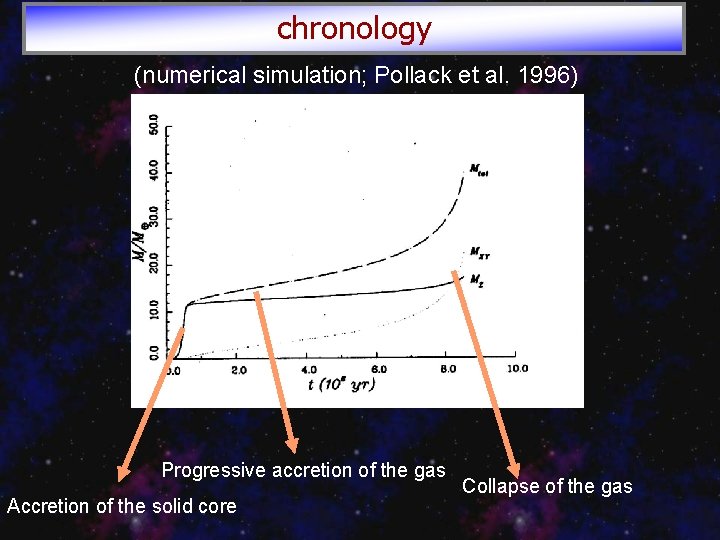
chronology (numerical simulation; Pollack et al. 1996) Progressive accretion of the gas Accretion of the solid core Collapse of the gas
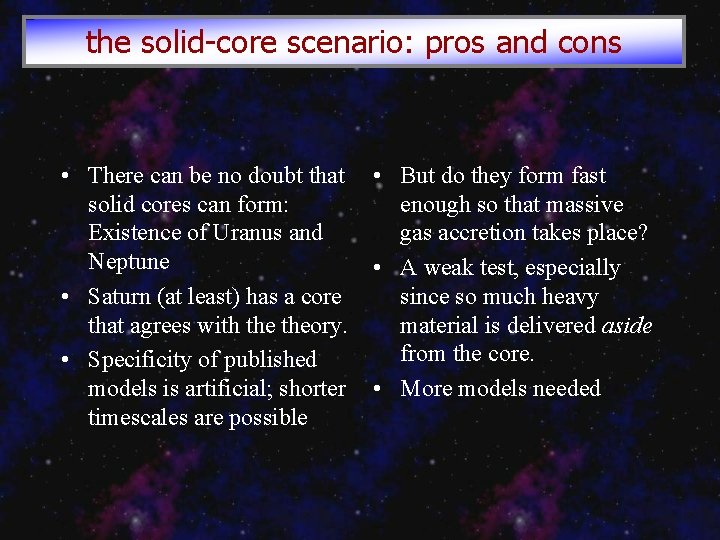
the solid-core scenario: pros and cons • There can be no doubt that • But do they form fast solid cores can form: enough so that massive Existence of Uranus and gas accretion takes place? Neptune • A weak test, especially • Saturn (at least) has a core since so much heavy that agrees with theory. material is delivered aside from the core. • Specificity of published models is artificial; shorter • More models needed timescales are possible
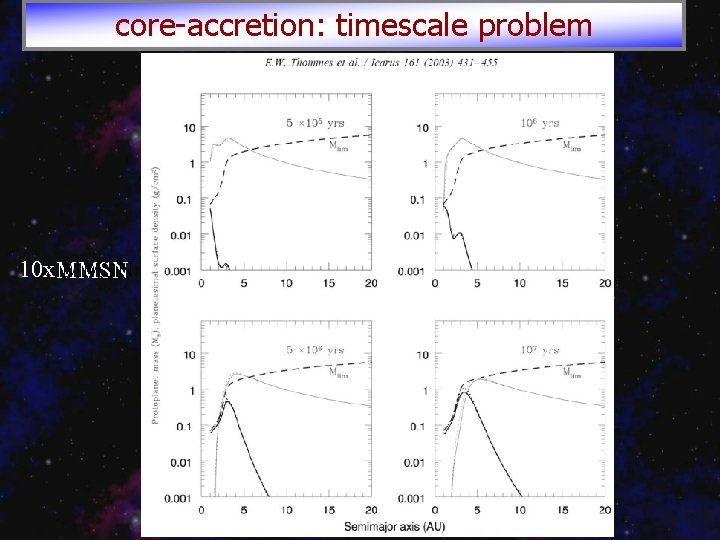
core-accretion: timescale problem 10 x MMSN
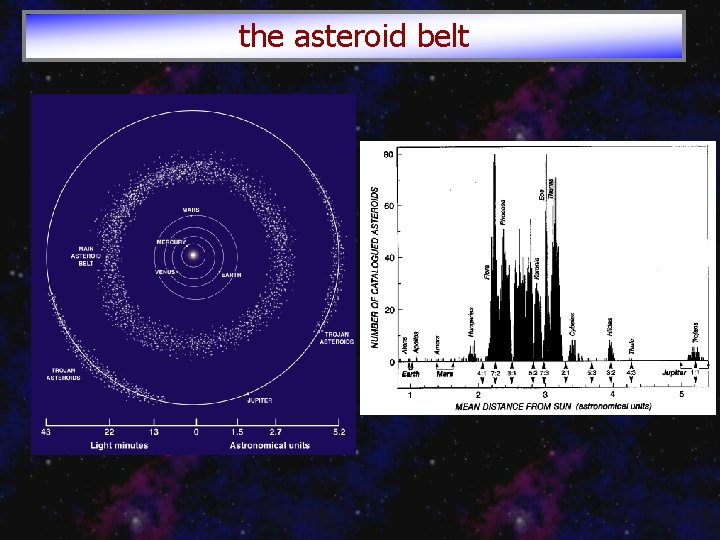
the asteroid belt
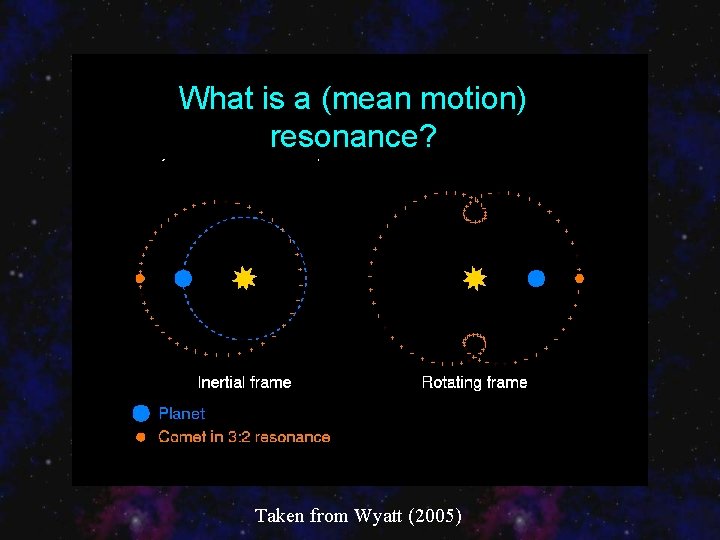
What is a (mean motion) resonance? Taken from Wyatt (2005)
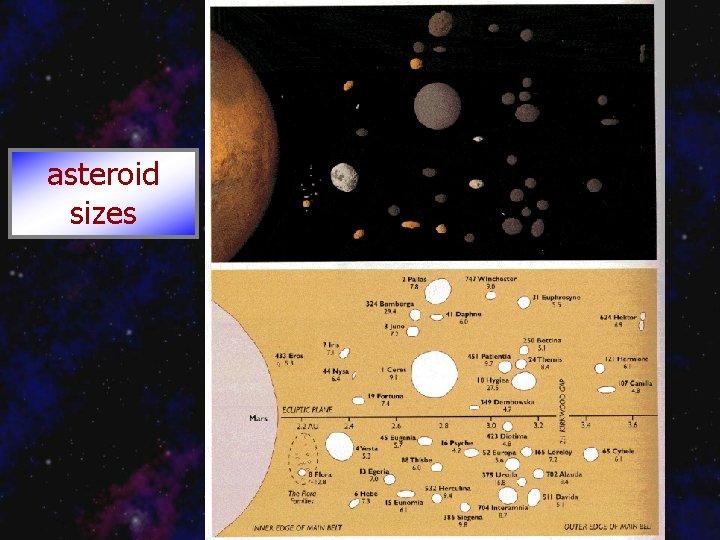
asteroid sizes
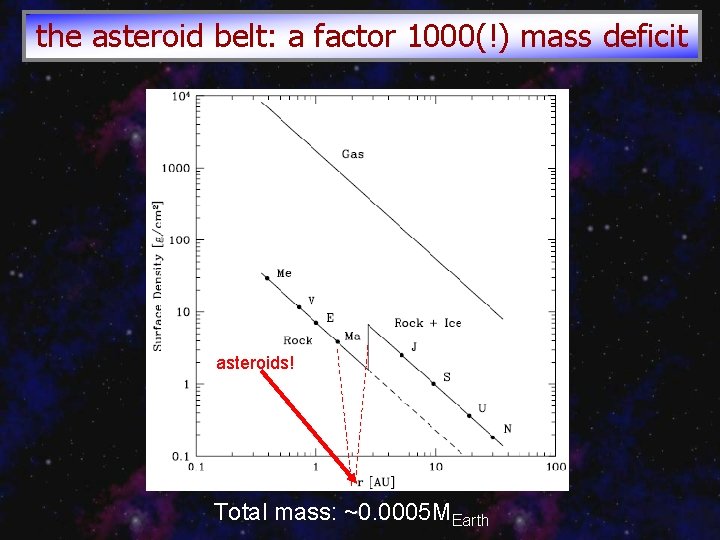
the asteroid belt: a factor 1000(!) mass deficit asteroids! Total mass: ~0. 0005 MEarth
the asteroid belt: problems to be solve by any formation scenario • Get rid of 99. 9% of the mass initialy there • Explain the present-day high-e & high-i • Explain the current size distribution
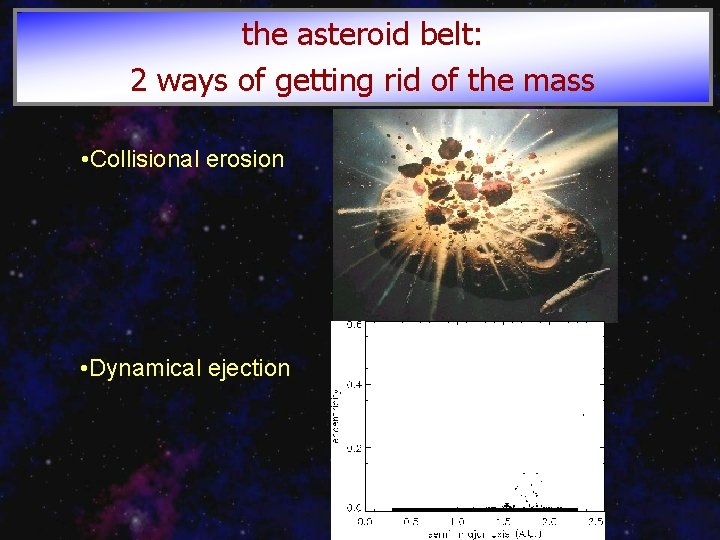
the asteroid belt: 2 ways of getting rid of the mass • Collisional erosion • Dynamical ejection
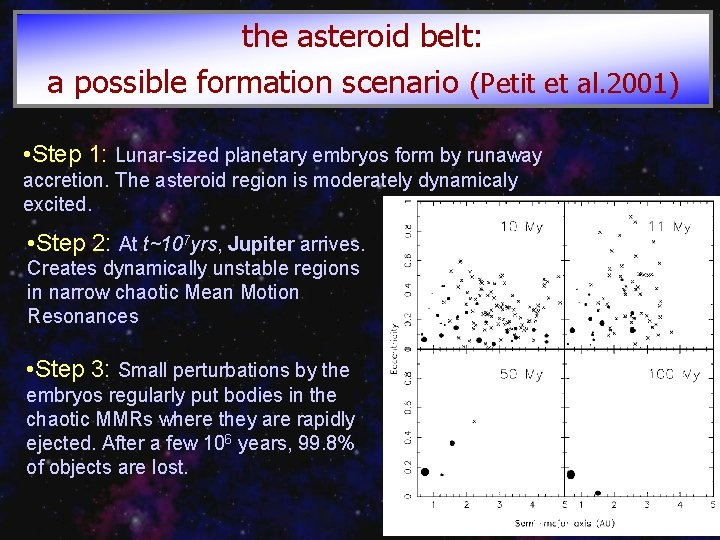
the asteroid belt: a possible formation scenario (Petit et al. 2001) • Step 1: Lunar-sized planetary embryos form by runaway accretion. The asteroid region is moderately dynamicaly excited. • Step 2: At t~107 yrs, Jupiter arrives. Creates dynamically unstable regions in narrow chaotic Mean Motion Resonances • Step 3: Small perturbations by the embryos regularly put bodies in the chaotic MMRs where they are rapidly ejected. After a few 106 years, 99. 8% of objects are lost.
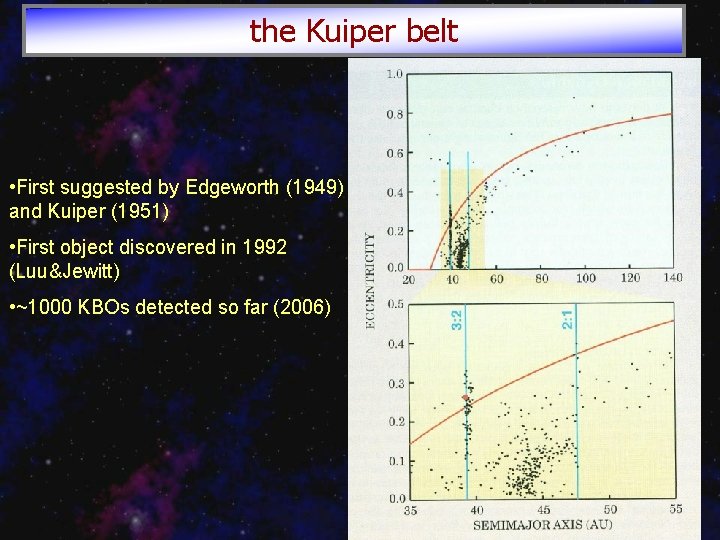
the Kuiper belt • First suggested by Edgeworth (1949) and Kuiper (1951) • First object discovered in 1992 (Luu&Jewitt) • ~1000 KBOs detected so far (2006)
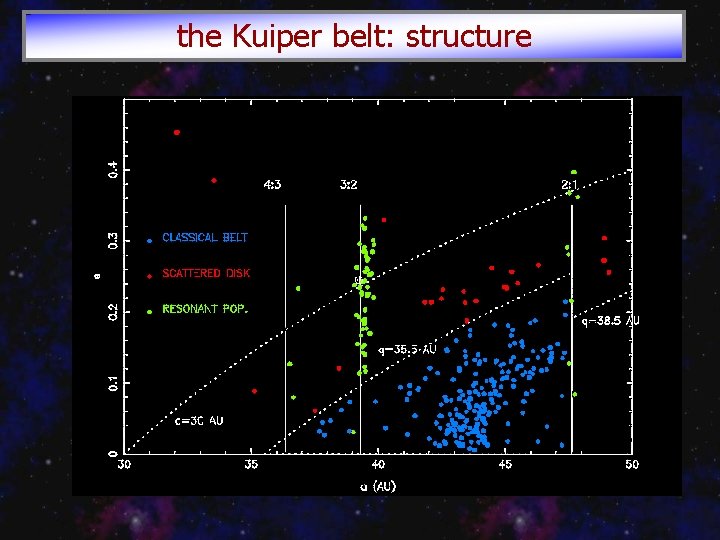
the Kuiper belt: structure
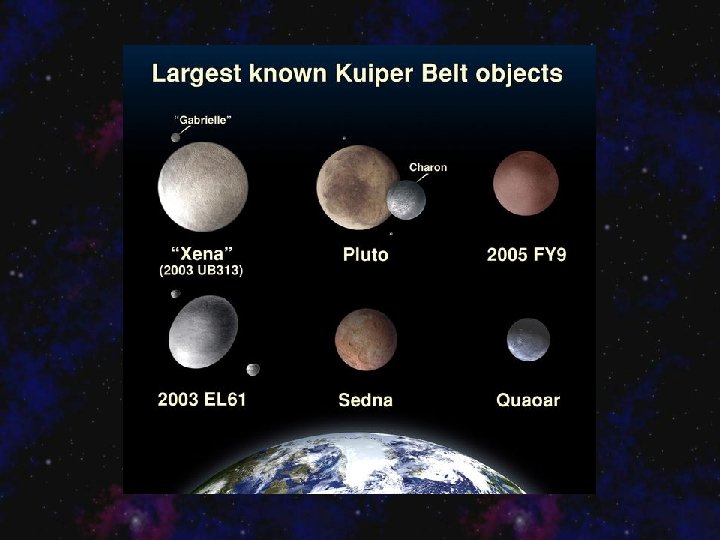
the Kuiper belt: some puzzling facts • ~104 objects>100 km (? ) Total mass ~0. 1 MEarth (? ) => Mass deficit • Highly structured spatial distribution => overdensity(? ) of plutinos => Outer edge at q=48 AU (1: 2 Neptune res. ) • « Color gradient » : high excited « blue » objects & cold « red » objects => 2 different populations(? )
The Kuiper Belt paradox: Need a massive disc (>10 MEarth) to built the KBOs, but how to get rid of it?
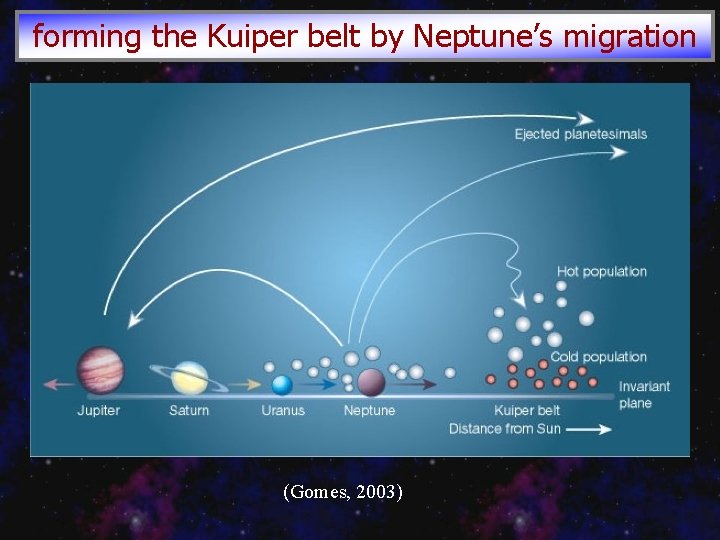
forming the Kuiper belt by Neptune’s migration (Gomes, 2003)
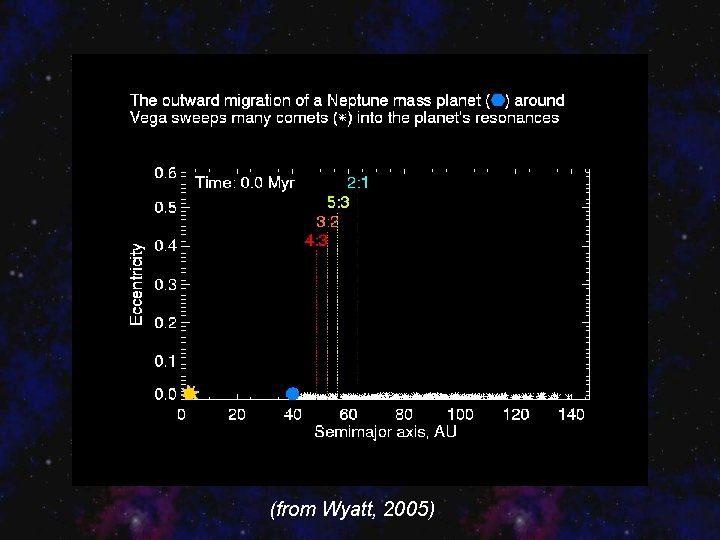
(from Wyatt, 2005)
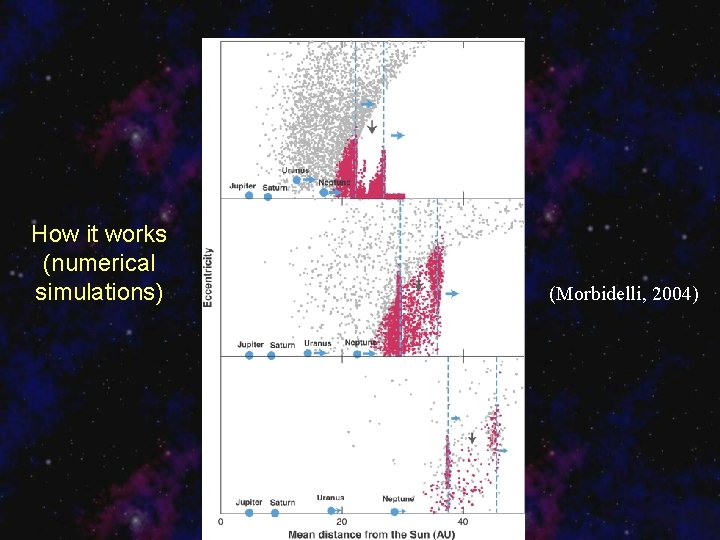
How it works (numerical simulations) (Morbidelli, 2004)
- Slides: 89