
Solar System Formation Earth Moon Asteroids Asteroid Discovery





- Slides: 40
Solar System Formation – Earth & Moon
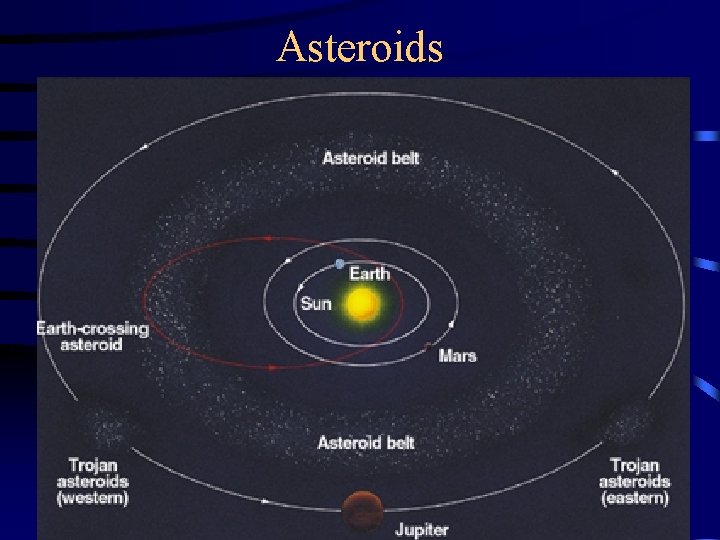
Asteroids
Asteroid Discovery • First (and largest) Asteroid Ceres discovered New Year’s 1801 by G. Piazzi, fitting exactly into Bode’s law: a=2. 8 A. U. • Today more than 100, 000 asteroids known • Largest diameter 960 km, smallest: few km • Most of them are named • about 20 of them are visible with binoculars
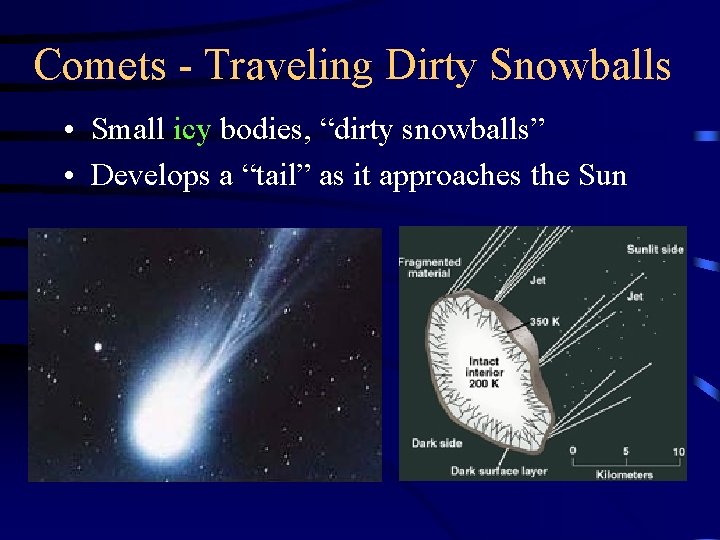
Comets - Traveling Dirty Snowballs • Small icy bodies, “dirty snowballs” • Develops a “tail” as it approaches the Sun
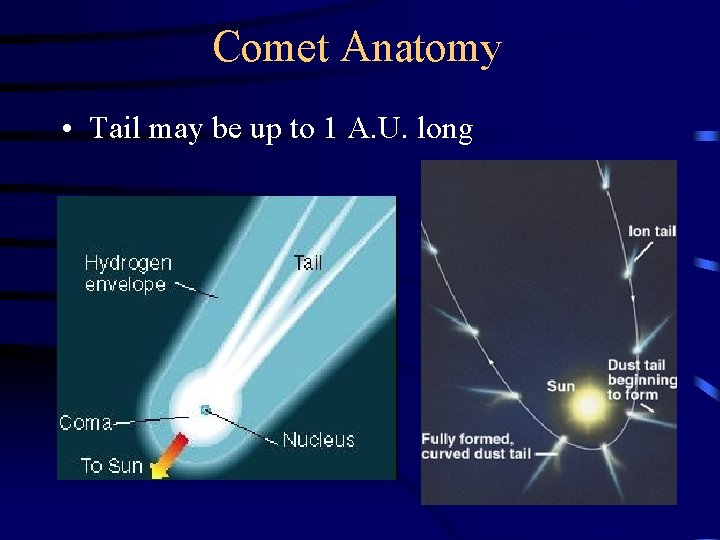
Comet Anatomy • Tail may be up to 1 A. U. long
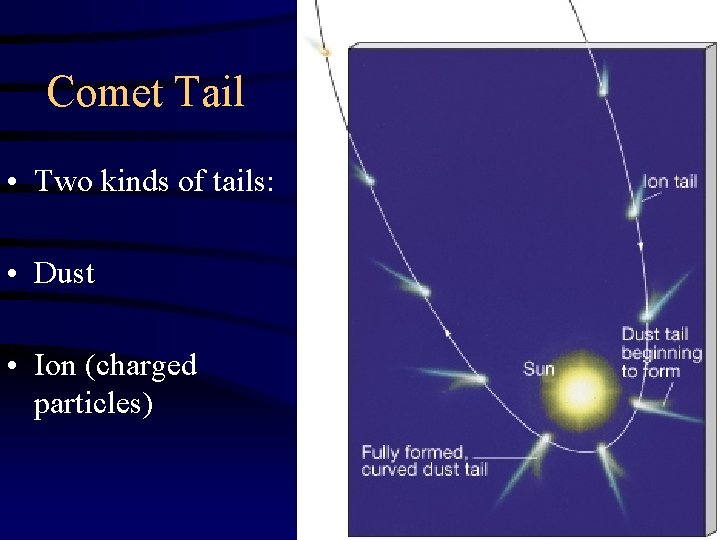
Comet Tail • Two kinds of tails: • Dust • Ion (charged particles)
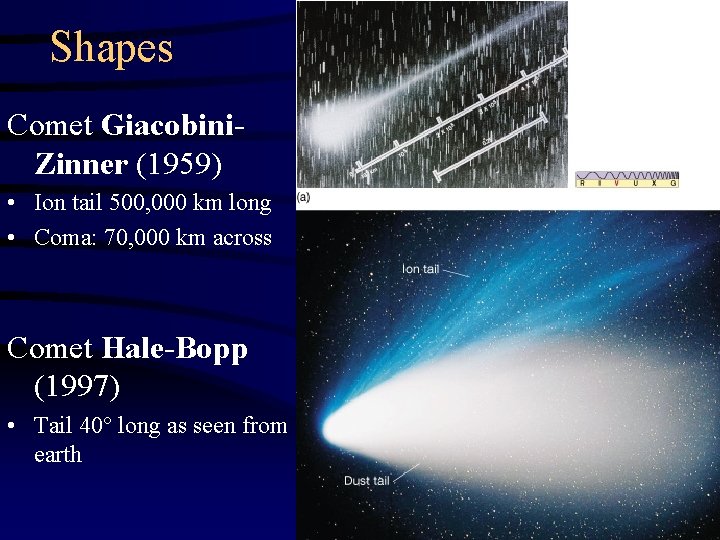
Shapes Comet Giacobini. Zinner (1959) • Ion tail 500, 000 km long • Coma: 70, 000 km across Comet Hale-Bopp (1997) • Tail 40° long as seen from earth
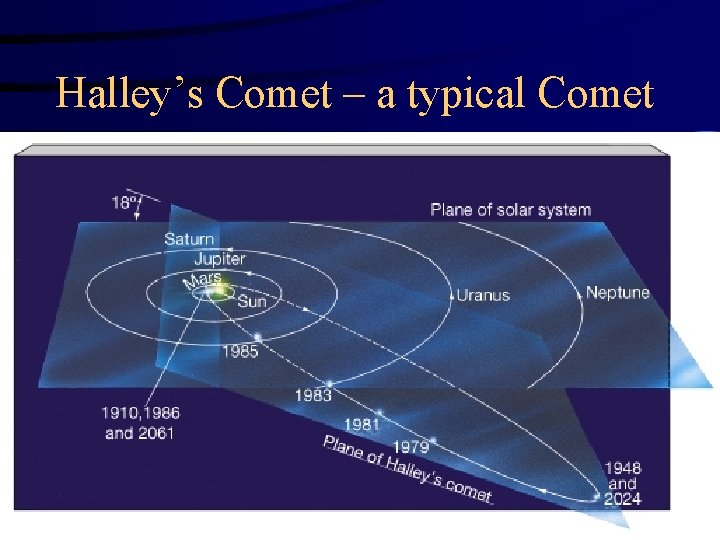
Halley’s Comet – a typical Comet
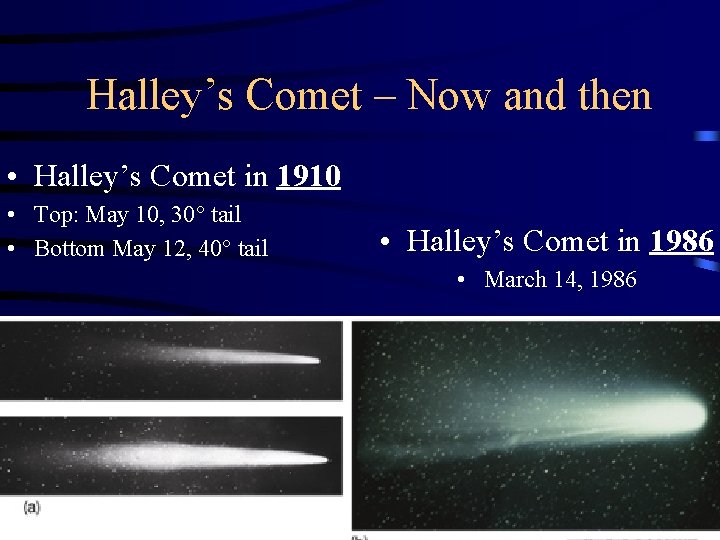
Halley’s Comet – Now and then • Halley’s Comet in 1910 • Top: May 10, 30° tail • Bottom May 12, 40° tail • Halley’s Comet in 1986 • March 14, 1986
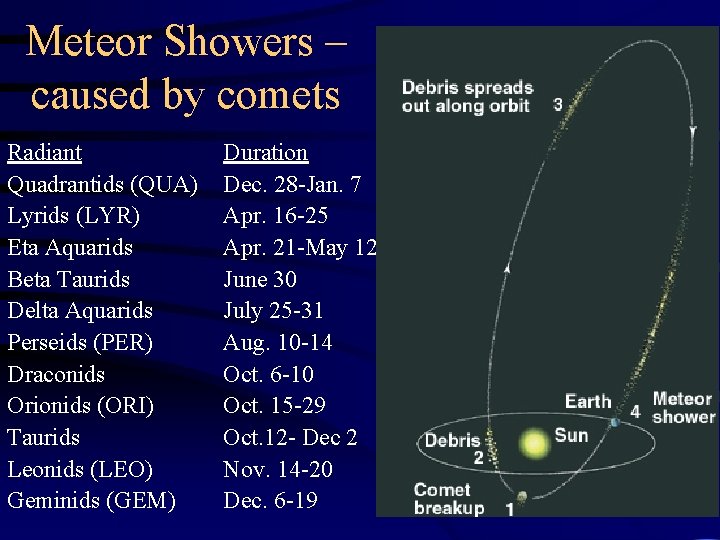
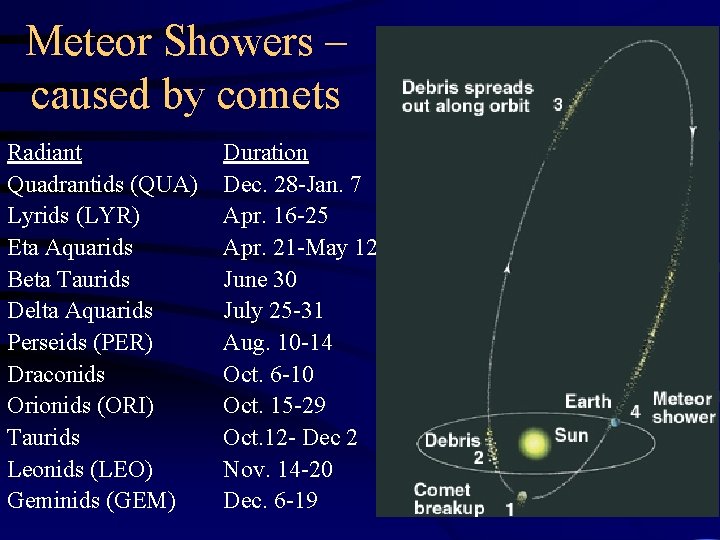
Meteor Showers – caused by comets Radiant Quadrantids (QUA) Lyrids (LYR) Eta Aquarids Beta Taurids Delta Aquarids Perseids (PER) Draconids Orionids (ORI) Taurids Leonids (LEO) Geminids (GEM) Duration Dec. 28 -Jan. 7 Apr. 16 -25 Apr. 21 -May 12 June 30 July 25 -31 Aug. 10 -14 Oct. 6 -10 Oct. 15 -29 Oct. 12 - Dec 2 Nov. 14 -20 Dec. 6 -19
Meteors, Meteroids and Meteorites • A Meteor is a sudden strike of light in the night sky • A Meteoroid is a small asteroid, less than 100 m in diameter • A Meteorite is any piece of interplanetary matter that survives the passage through Earth’s atmosphere and lands on Earth’s surface
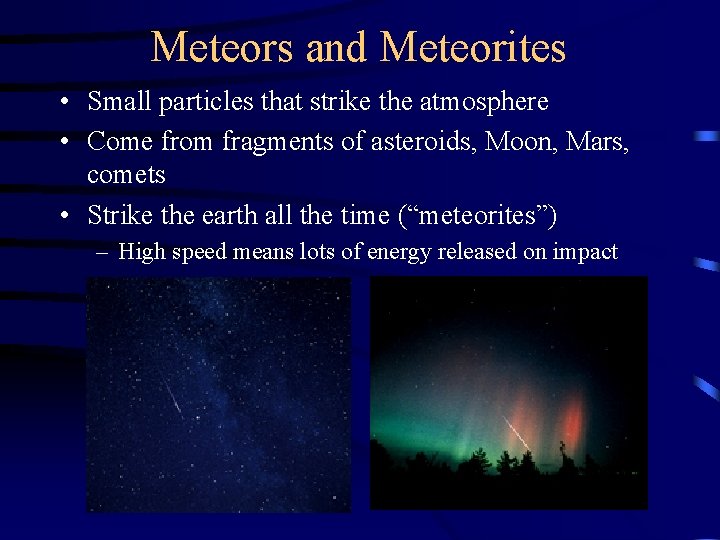
Meteors and Meteorites • Small particles that strike the atmosphere • Come from fragments of asteroids, Moon, Mars, comets • Strike the earth all the time (“meteorites”) – High speed means lots of energy released on impact
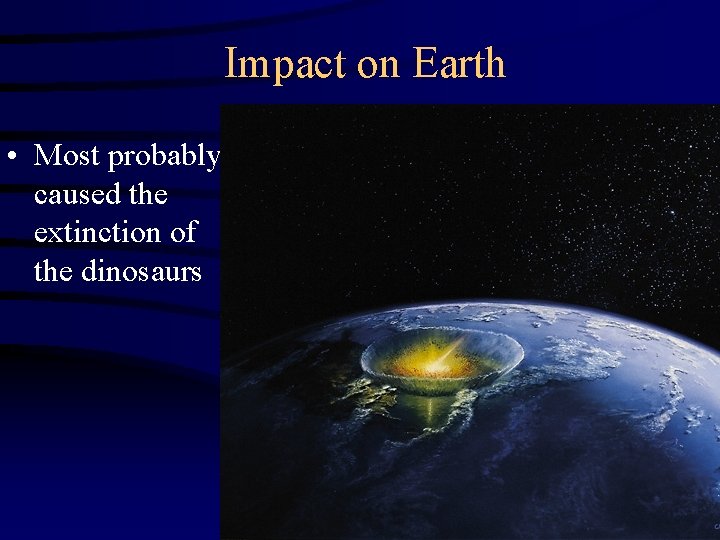
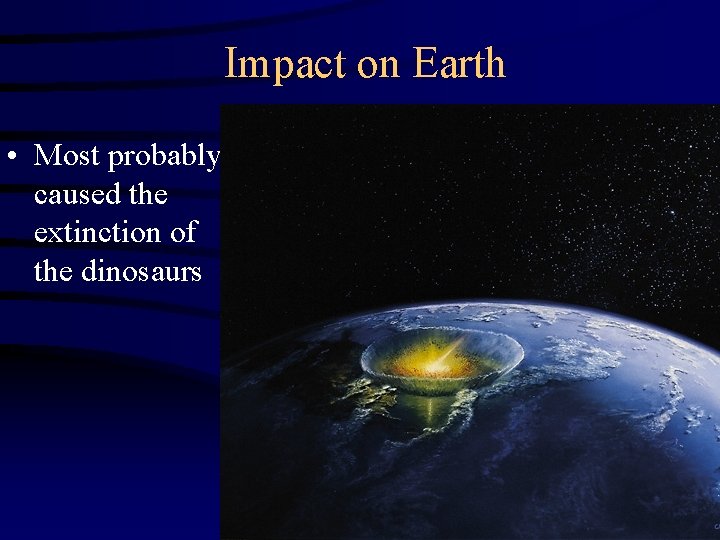
Impact on Earth • Most probably caused the extinction of the dinosaurs
Impact Craters • Barringer Crater, AZ 0. 8 mi diameter, 200 yd deep; produced by impact about 25, 000 years ago • Quebec's Manicouagan Reservoir. Large meteorite landed about 200 million years ago. The lake, 45 miles in diameter, now fills the ring.
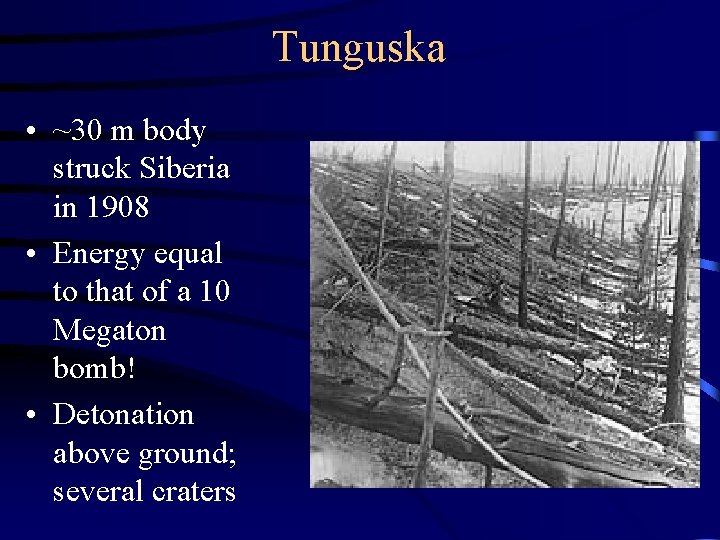
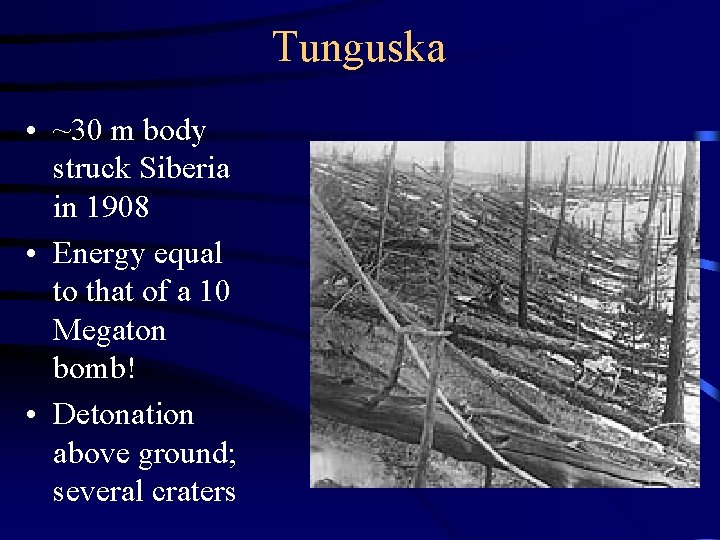
Tunguska • ~30 m body struck Siberia in 1908 • Energy equal to that of a 10 Megaton bomb! • Detonation above ground; several craters
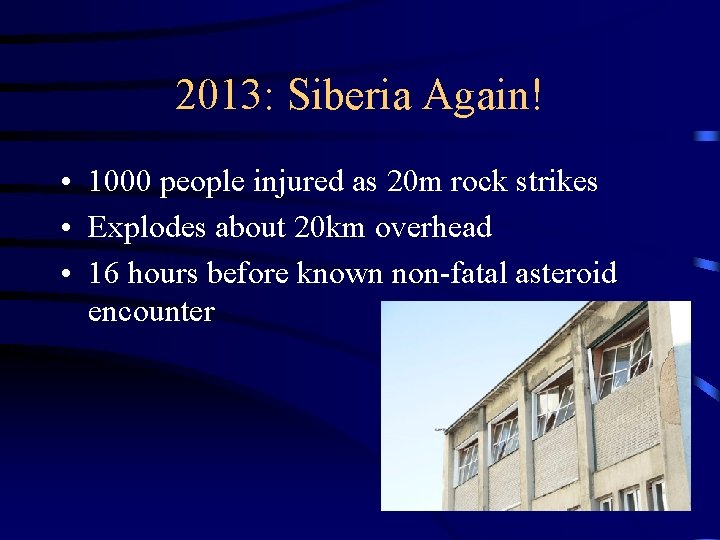
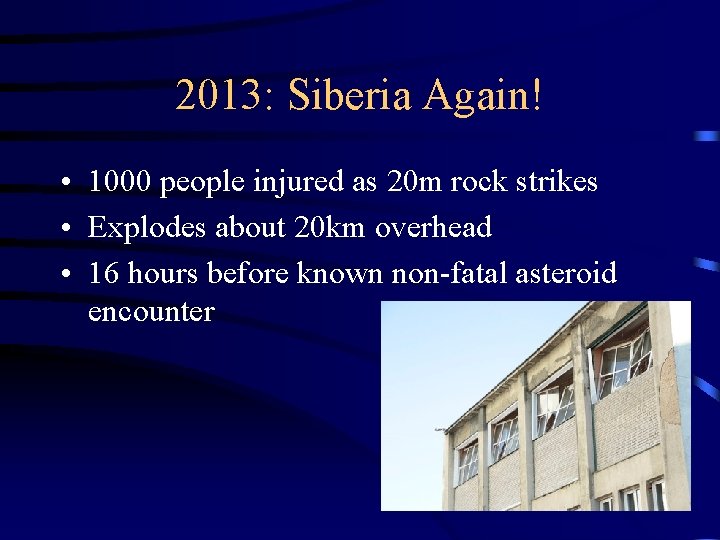
2013: Siberia Again! • 1000 people injured as 20 m rock strikes • Explodes about 20 km overhead • 16 hours before known non-fatal asteroid encounter
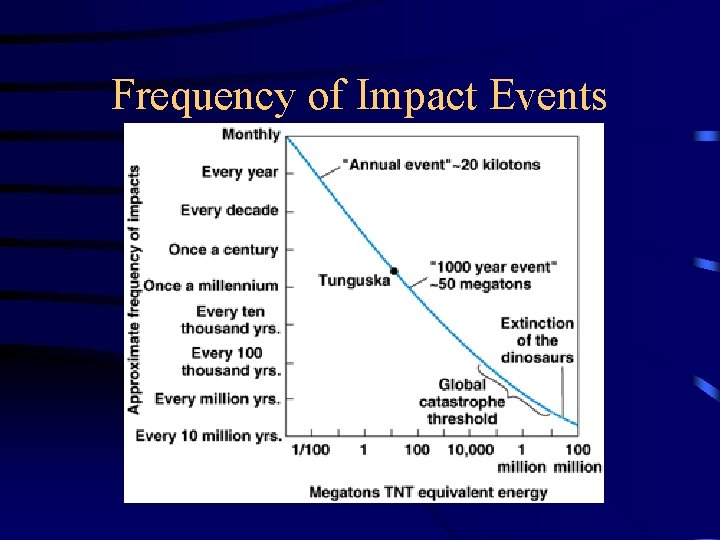
Frequency of Impact Events
Formation of the Solar System • Features to explain: – – – – – planets are far apart, not bunched together orbits of planets are nearly circular orbits of planets lie mostly in a single plane directions of revolution of planets about Sun is the same, and is the same as the direction of the Sun's rotation directions of rotation of planets about their axes is also mostly in the same direction as the Sun's (exceptions: Venus, Uranus, Pluto) most moons revolve around their planets in the same direction as the rotation of the planets differentiation between inner (terrestrial) and outer (Jovian) planets existence and properties of the asteroids existence and properties of the comets
Meteor Showers – caused by comets Radiant Quadrantids (QUA) Lyrids (LYR) Eta Aquarids Beta Taurids Delta Aquarids Perseids (PER) Draconids Orionids (ORI) Taurids Leonids (LEO) Geminids (GEM) Duration Dec. 28 -Jan. 7 Apr. 16 -25 Apr. 21 -May 12 June 30 July 25 -31 Aug. 10 -14 Oct. 6 -10 Oct. 15 -29 Oct. 12 - Dec 2 Nov. 14 -20 Dec. 6 -19
Meteors, Meteroids and Meteorites • A Meteor is a sudden strike of light in the night sky • A Meteoroid is a small asteroid, less than 100 m in diameter • A Meteorite is any piece of interplanetary matter that survives the passage through Earth’s atmosphere and lands on Earth’s surface
Meteors and Meteorites • Small particles that strike the atmosphere • Come from fragments of asteroids, Moon, Mars, comets • Strike the earth all the time (“meteorites”) – High speed means lots of energy released on impact
Impact on Earth • Most probably caused the extinction of the dinosaurs
Impact Craters • Barringer Crater, AZ 0. 8 mi diameter, 200 yd deep; produced by impact about 25, 000 years ago • Quebec's Manicouagan Reservoir. Large meteorite landed about 200 million years ago. The lake, 45 miles in diameter, now fills the ring.
Tunguska • ~30 m body struck Siberia in 1908 • Energy equal to that of a 10 Megaton bomb! • Detonation above ground; several craters
2013: Siberia Again! • 1000 people injured as 20 m rock strikes • Explodes about 20 km overhead • 16 hours before known non-fatal asteroid encounter
Frequency of Impact Events
Formation of the Solar System • Features to explain: – – – – – planets are far apart, not bunched together orbits of planets are nearly circular orbits of planets lie mostly in a single plane directions of revolution of planets about Sun is the same, and is the same as the direction of the Sun's rotation directions of rotation of planets about their axes is also mostly in the same direction as the Sun's (exceptions: Venus, Uranus, Pluto) most moons revolve around their planets in the same direction as the rotation of the planets differentiation between inner (terrestrial) and outer (Jovian) planets existence and properties of the asteroids existence and properties of the comets
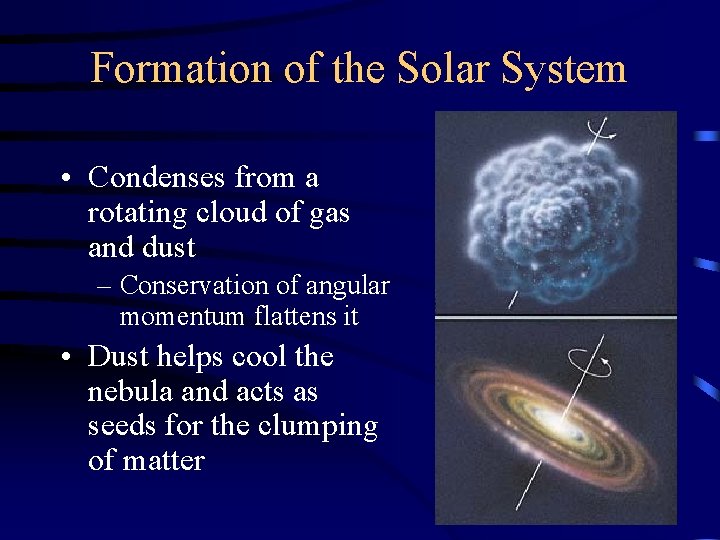
Formation of the Solar System • Condenses from a rotating cloud of gas and dust – Conservation of angular momentum flattens it • Dust helps cool the nebula and acts as seeds for the clumping of matter
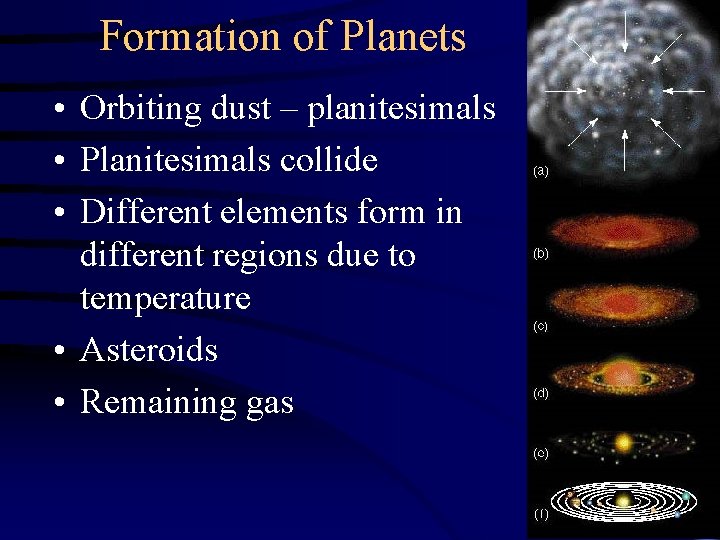
Formation of Planets • Orbiting dust – planitesimals • Planitesimals collide • Different elements form in different regions due to temperature • Asteroids • Remaining gas
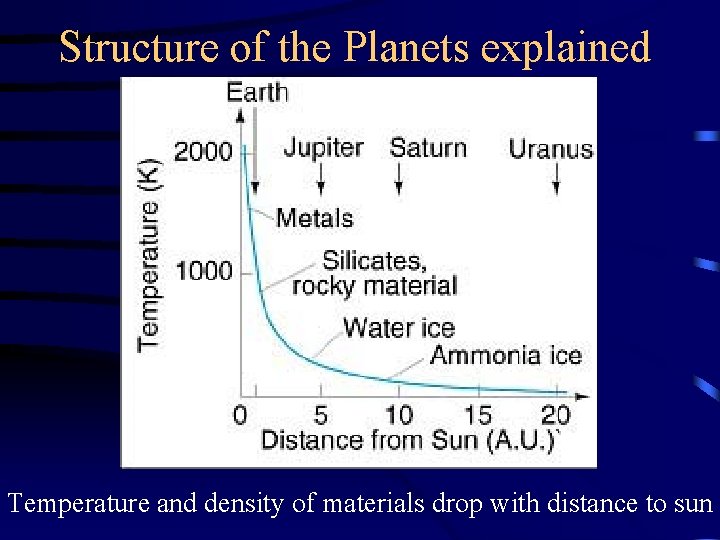
Structure of the Planets explained Temperature and density of materials drop with distance to sun
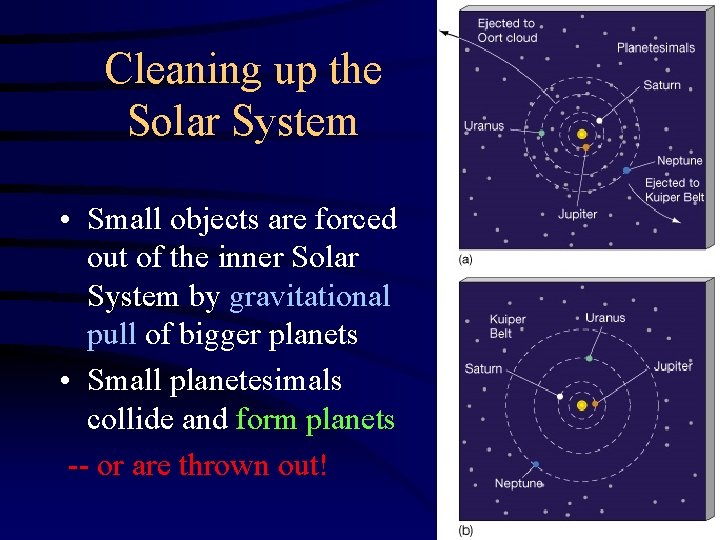
Cleaning up the Solar System • Small objects are forced out of the inner Solar System by gravitational pull of bigger planets • Small planetesimals collide and form planets -- or are thrown out!
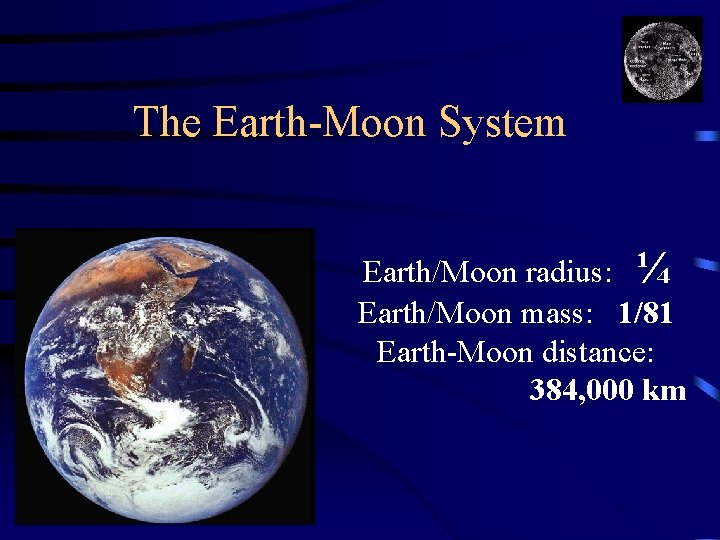
The Earth-Moon System Earth/Moon radius: ¼ Earth/Moon mass: 1/81 Earth-Moon distance: 384, 000 km
Features of the Earth & Moon • Mass: Earth: 6 1024 kg • Radius: Earth: 6400 km • Density: Earth: 5500 kg/m 3 Moon: 1/81 Earth’s Moon: 1/4 Earth’s ra Moon: 3300 kg/m 3 – 5. 5 times that of water – About 2 times that of a rock • Gravity: Earth: 9. 8 m/s 2 Moon: 1/6 Earth’s gravity (about the same as in water)
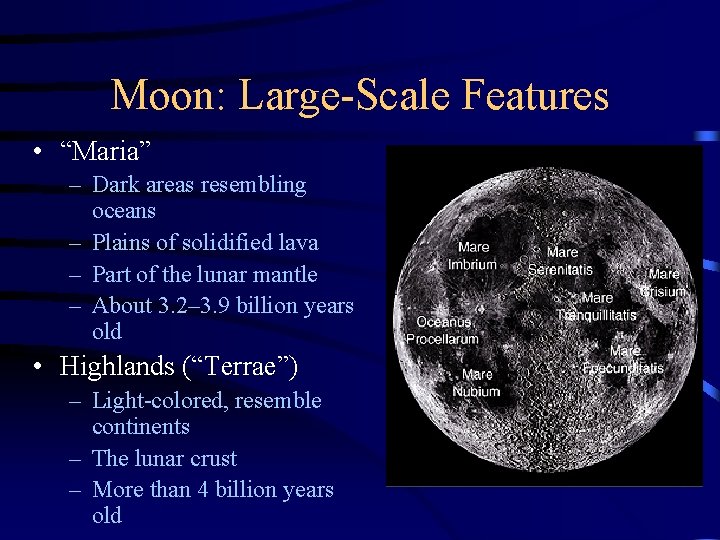
Moon: Large-Scale Features • “Maria” – Dark areas resembling oceans – Plains of solidified lava – Part of the lunar mantle – About 3. 2– 3. 9 billion years old • Highlands (“Terrae”) – Light-colored, resemble continents – The lunar crust – More than 4 billion years old
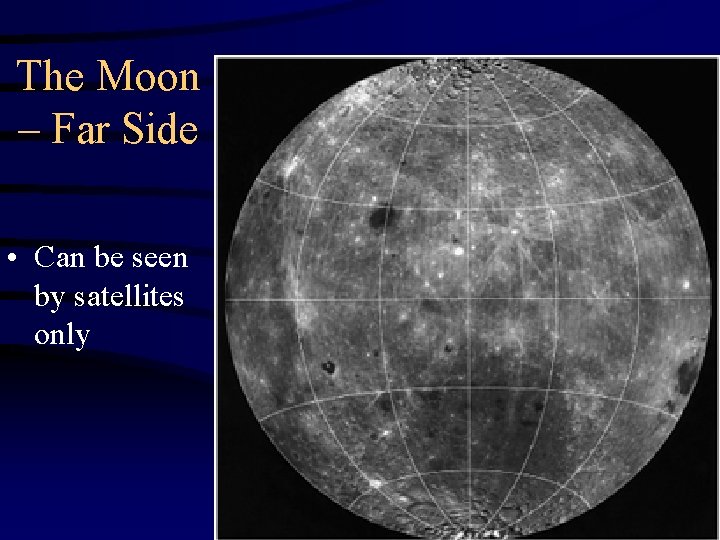
The Moon – Far Side • Can be seen by satellites only
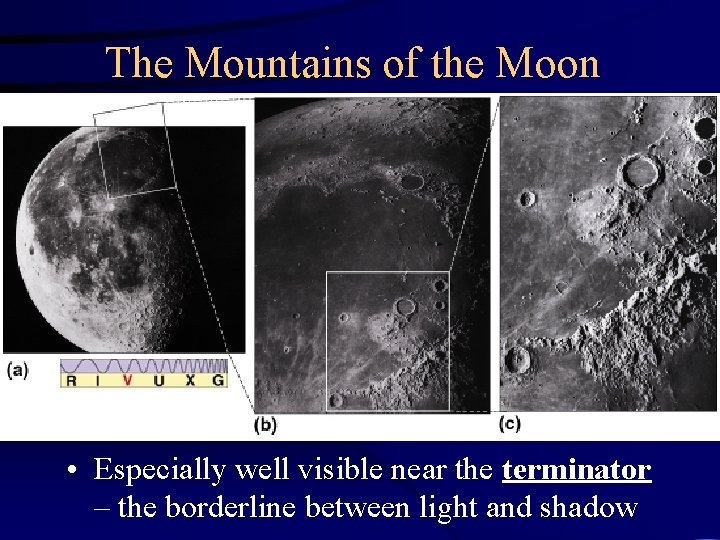
The Mountains of the Moon • Especially well visible near the terminator – the borderline between light and shadow
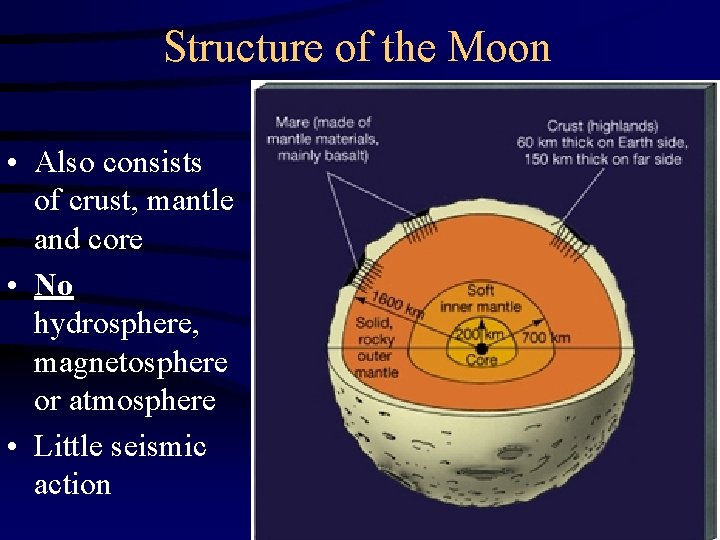
Structure of the Moon • Also consists of crust, mantle and core • No hydrosphere, magnetosphere or atmosphere • Little seismic action
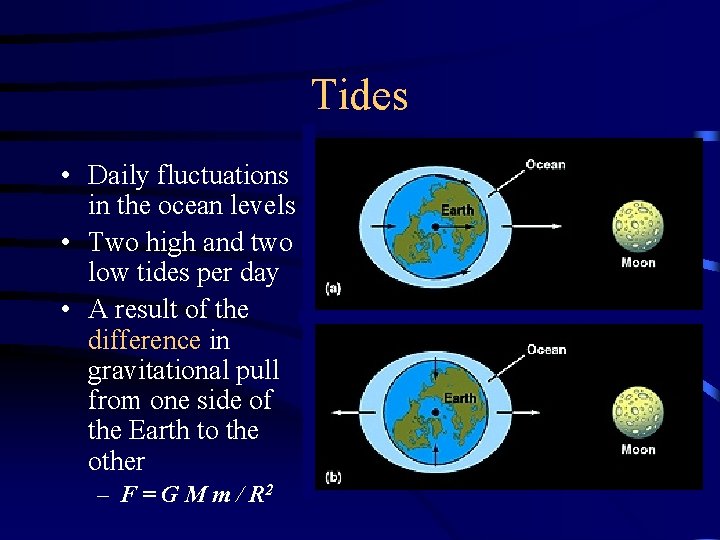
Tides • Daily fluctuations in the ocean levels • Two high and two low tides per day • A result of the difference in gravitational pull from one side of the Earth to the other – F = G M m / R 2
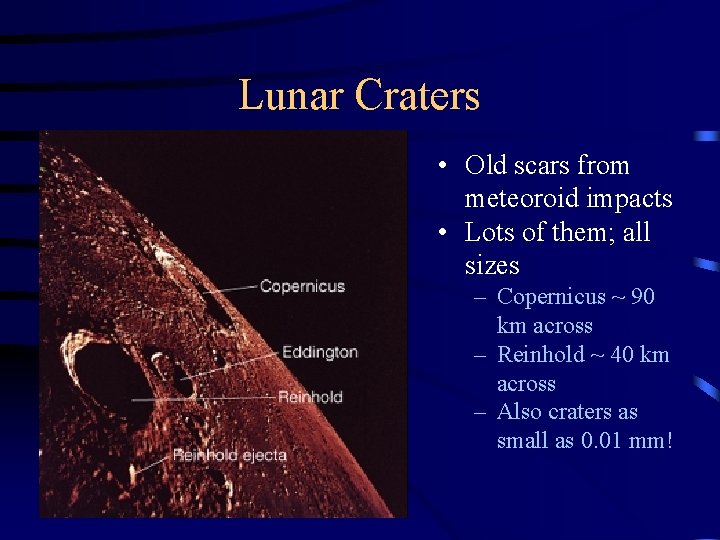
Lunar Craters • Old scars from meteoroid impacts • Lots of them; all sizes – Copernicus ~ 90 km across – Reinhold ~ 40 km across – Also craters as small as 0. 01 mm!
Ages of the Earth and Moon • Determined by radioactive dating – Compare amount of radioactive material with amount of decay product – Useful isotopes: • Uranium-238 (half-life 4. 5 billion years) • Uranium-235 (half-life 0. 7 billion years) • For shorter time scales, Carbon-14 (5730 years) • Oldest surface rocks on Earth (Greenland, Labrador) about 3. 9 billion years old – When rocks solidified • Lunar highlands: 4. 1– 4. 4 billion years old – Rocks from lunar maria slightly younger, more recently melted • Meteorites: 4. 5 billion years old – Date to origin of solar system