
Solar Stirling Engine Introduction Stirling engine It is

- Slides: 11
Solar Stirling Engine
Introduction: Stirling engine • It is an external combustion engine that works according to the Stirling cycle. • Originally conceived in 1816 as an industrial prime mover to rival the steam engine. • It is noted for its high efficiency (up to 40%), quiet operation. • Compatible with alternative and renewable energy sources.
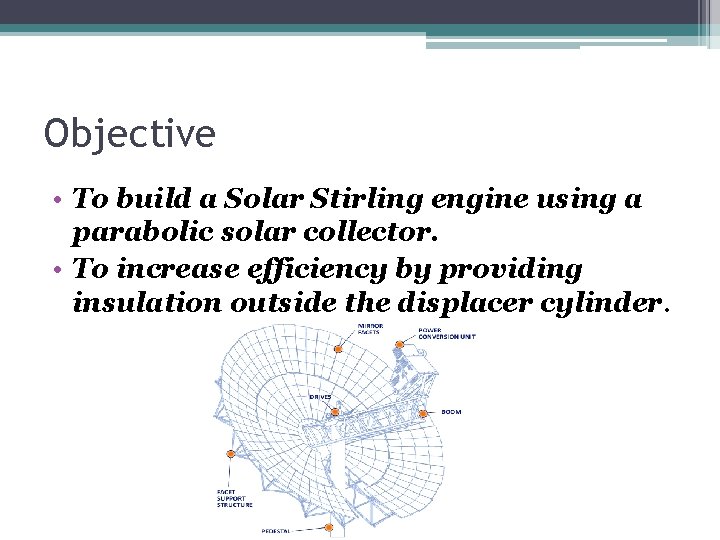
Objective • To build a Solar Stirling engine using a parabolic solar collector. • To increase efficiency by providing insulation outside the displacer cylinder.
Scope and Importance • Solar Energy in India has an estimated potential of about 5, 000 trillion KWh per year over India’s land area with most parts receiving 4 -7 KWh per sq. m per day. Out of this only 0. 01% has been explored. • Theoretically, a small fraction of the total incident solar energy (if captured effectively) can meet the entire country’s power requirements. • The power generated using solar thermal technology is relatively cheaper as compared to currently used coal based or diesel based electricity generation.
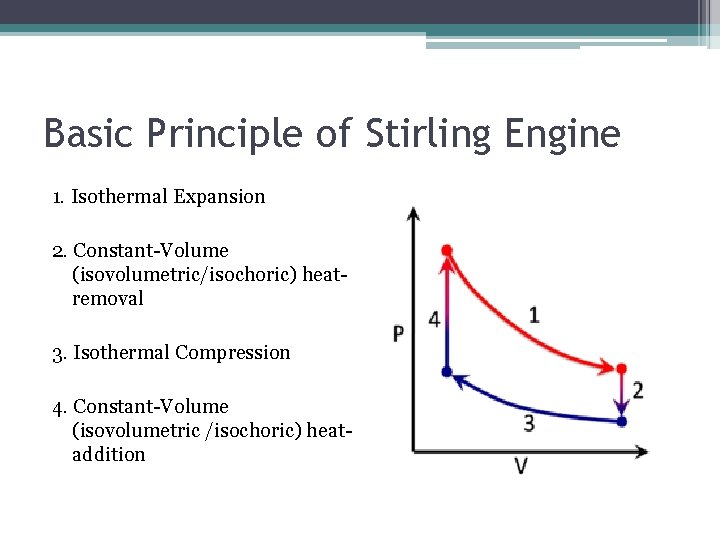
Basic Principle of Stirling Engine 1. Isothermal Expansion 2. Constant-Volume (isovolumetric/isochoric) heatremoval 3. Isothermal Compression 4. Constant-Volume (isovolumetric /isochoric) heataddition
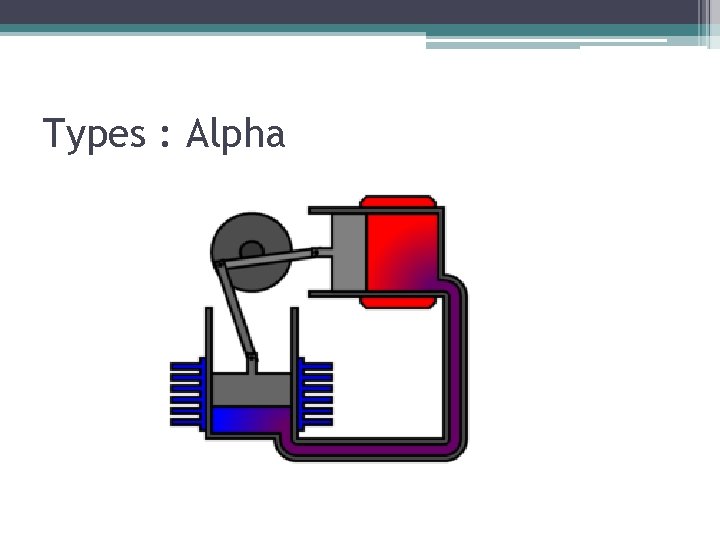
Types : Alpha
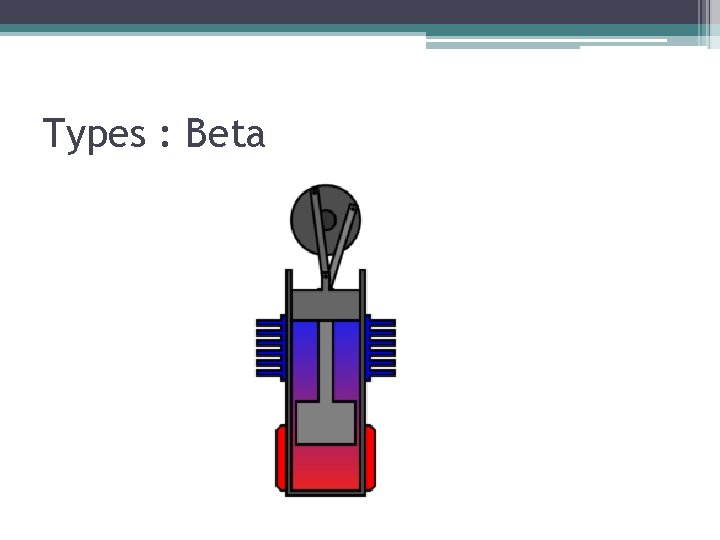
Types : Beta
Parts • • • Heat Source Heat Sink Displacer Power Piston Flywheel
Raw Material • • Cylinder : Aluminium Piston and Crank : Aluminium Working Fluid : Air Solar Collector : Wood and aluminium sheet
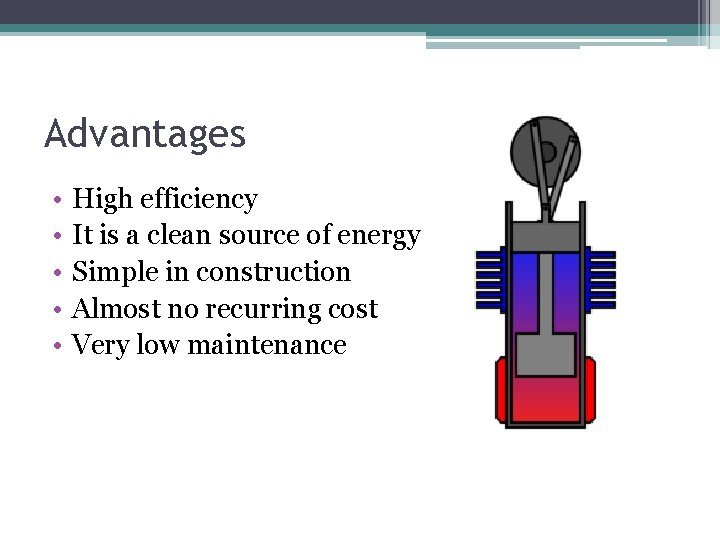
Advantages • • • High efficiency It is a clean source of energy Simple in construction Almost no recurring cost Very low maintenance
Thank You