
Solar radiation estimate differences between traditional and advanced
Solar radiation estimate differences between traditional and advanced view factor analysis methods Sookuk Park Climate Lab. , Department of Geography, University of Victoria, B. C. , Canada
Human radiation exchange model Shortwave (solar) radiation: § direct beam: sun’s altitude and azimuth angles § diffuse beam: sky view factor § reflected by buildings, vegetation (trees) and ground surfaces Longwave (terrestrial) radiation: § from the sky: sky view factor § from building surfaces § from vegetation (trees) surface § from the ground surface Lsky Kdif Kref Kdir Lbody Lbuild Human radiation exchange model Ltree Lgrd
Limitations of Previous Studies Shadow effect In urban geometry, not whole but parts of building walls, vegetation and ground surfaces are shaded depending on sun’s location. § It affects reflected solar radiation and longwave radiation after dividing each whole surface to sunny/shaded surfaces. § Vegetation effect § vegetation has a different reflectivity and transmissivity for solar radiation and a much different surface temperature than buildings which affects longwave radiation analysis. § It affects reflected solar radiation and longwave radiation after separating vegetation view factors from the view factors of buildings and other structures in the sky hemisphere.
Purpose § This study compares the traditional view factor analysis method for estimating radiation exchange and the advanced one which includes vegetation and shadow effects.
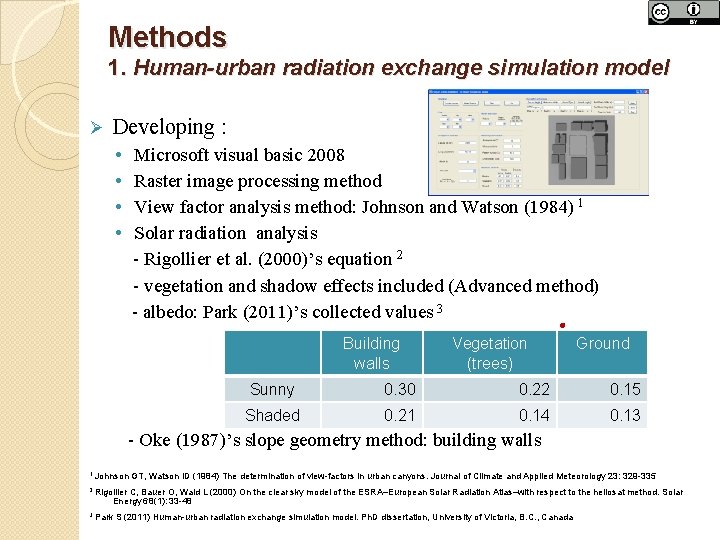
Methods 1. Human-urban radiation exchange simulation model Ø Developing : • • Microsoft visual basic 2008 Raster image processing method View factor analysis method: Johnson and Watson (1984) 1 Solar radiation analysis - Rigollier et al. (2000)’s equation 2 - vegetation and shadow effects included (Advanced method) - albedo: Park (2011)’s collected values 3 Building walls Vegetation (trees) Ground Sunny 0. 30 0. 22 0. 15 Shaded 0. 21 0. 14 0. 13 - Oke (1987)’s slope geometry method: building walls 1 Johnson GT, Watson ID (1984) The determination of view-factors in urban canyons. Journal of Climate and Applied Meteorology 23: 329 -335 2 Rigollier C, Bauer O, Wald L (2000) On the clear sky model of the ESRA–European Solar Radiation Atlas–with respect to the heliosat method. Solar Energy 68(1): 33 -48 3 Park S (2011) Human-urban radiation exchange simulation model. Ph. D dissertation, University of Victoria, B. C. , Canada
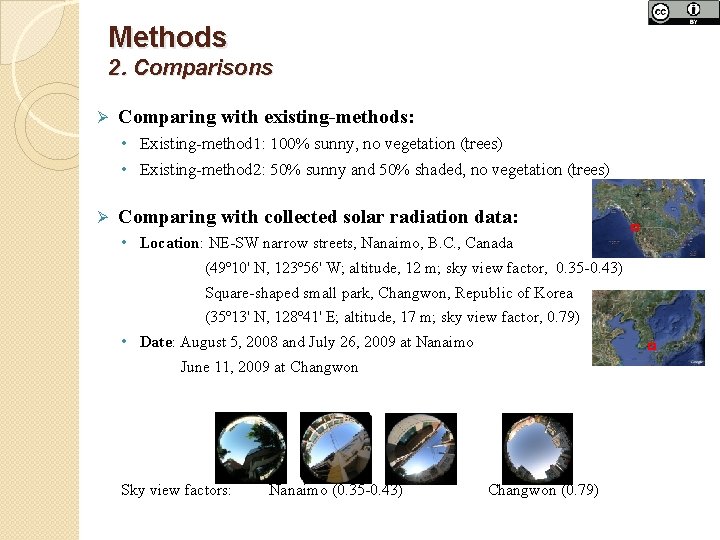
Methods 2. Comparisons Ø Comparing with existing-methods: • Existing-method 1: 100% sunny, no vegetation (trees) • Existing-method 2: 50% sunny and 50% shaded, no vegetation (trees) Ø Comparing with collected solar radiation data: • Location: NE-SW narrow streets, Nanaimo, B. C. , Canada (49º 10' N, 123º 56' W; altitude, 12 m; sky view factor, 0. 35 -0. 43) Square-shaped small park, Changwon, Republic of Korea (35º 13' N, 128º 41' E; altitude, 17 m; sky view factor, 0. 79) • Date: August 5, 2008 and July 26, 2009 at Nanaimo June 11, 2009 at Changwon Sky view factors: Nanaimo (0. 35 -0. 43) Changwon (0. 79)
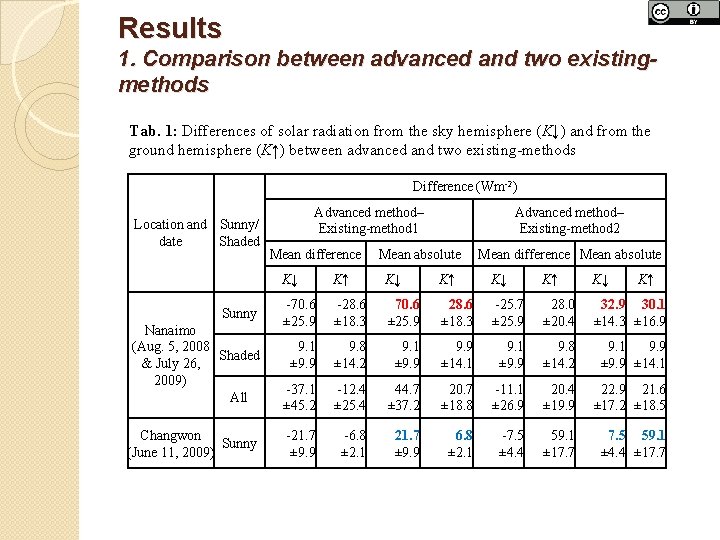
Results 1. Comparison between advanced and two existingmethods Tab. 1: Differences of solar radiation from the sky hemisphere (K↓) and from the ground hemisphere (K↑) between advanced and two existing-methods Difference (Wm-2) Location and Sunny/ date Shaded Sunny Nanaimo (Aug. 5, 2008 Shaded & July 26, 2009) All Changwon Sunny (June 11, 2009) Advanced method– Existing-method 1 Mean difference Advanced method– Existing-method 2 Mean absolute Mean difference Mean absolute K↓ K↑ -70. 6 ± 25. 9 -28. 6 ± 18. 3 70. 6 ± 25. 9 28. 6 ± 18. 3 -25. 7 ± 25. 9 28. 0 ± 20. 4 32. 9 30. 1 ± 14. 3 ± 16. 9 9. 1 ± 9. 9 9. 8 ± 14. 2 9. 1 ± 9. 9 ± 14. 1 9. 1 ± 9. 9 9. 8 ± 14. 2 9. 1 9. 9 ± 14. 1 -37. 1 ± 45. 2 -12. 4 ± 25. 4 44. 7 ± 37. 2 20. 7 ± 18. 8 -11. 1 ± 26. 9 20. 4 ± 19. 9 22. 9 21. 6 ± 17. 2 ± 18. 5 -21. 7 ± 9. 9 -6. 8 ± 2. 1 21. 7 ± 9. 9 6. 8 ± 2. 1 -7. 5 ± 4. 4 59. 1 ± 17. 7 7. 5 59. 1 ± 4. 4 ± 17. 7
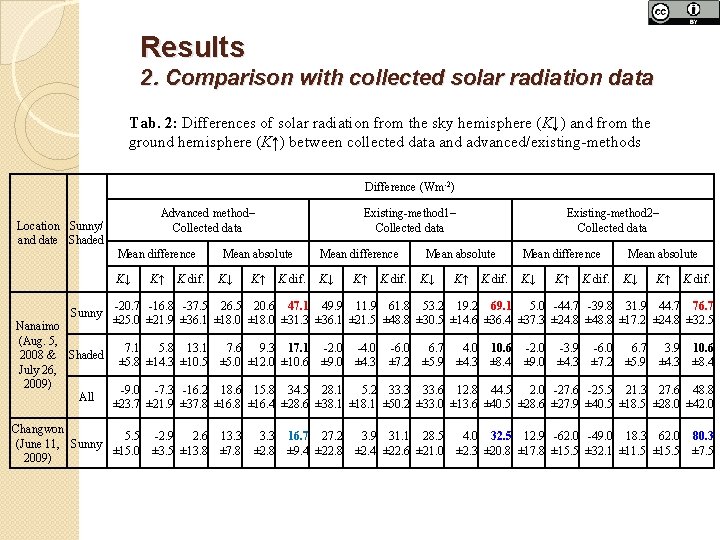
Results 2. Comparison with collected solar radiation data Tab. 2: Differences of solar radiation from the sky hemisphere (K↓) and from the ground hemisphere (K↑) between collected data and advanced/existing-methods Difference (Wm -2) Advanced method– Collected data Location Sunny/ and date Shaded Mean difference K↓ Sunny Nanaimo (Aug. 5, 2008 & Shaded July 26, 2009) All K↑ K dif. Existing-method 1– Collected data Mean absolute K↓ K↑ K dif. Mean difference K↓ K↑ K dif. Existing-method 2– Collected data Mean absolute K↓ K↑ K dif. Mean difference K↓ K↑ K dif. Mean absolute K↓ K↑ K dif. -20. 7 -16. 8 -37. 5 26. 5 20. 6 47. 1 49. 9 11. 9 61. 8 53. 2 19. 2 69. 1 5. 0 -44. 7 -39. 8 31. 9 44. 7 76. 7 ± 25. 0 ± 21. 9 ± 36. 1 ± 18. 0 ± 31. 3 ± 36. 1 ± 21. 5 ± 48. 8 ± 30. 5 ± 14. 6 ± 36. 4 ± 37. 3 ± 24. 8 ± 48. 8 ± 17. 2 ± 24. 8 ± 32. 5 7. 1 5. 8 13. 1 ± 5. 8 ± 14. 3 ± 10. 5 7. 6 9. 3 17. 1 ± 5. 0 ± 12. 0 ± 10. 6 -2. 0 ± 9. 0 -4. 0 ± 4. 3 -6. 0 ± 7. 2 6. 7 ± 5. 9 4. 0 ± 4. 3 10. 6 ± 8. 4 -2. 0 ± 9. 0 -3. 9 ± 4. 3 -6. 0 ± 7. 2 6. 7 ± 5. 9 3. 9 ± 4. 3 10. 6 ± 8. 4 -9. 0 -7. 3 -16. 2 18. 6 15. 8 34. 5 28. 1 5. 2 33. 3 33. 6 12. 8 44. 5 2. 0 -27. 6 -25. 5 21. 3 27. 6 48. 8 ± 23. 7 ± 21. 9 ± 37. 8 ± 16. 4 ± 28. 6 ± 38. 1 ± 18. 1 ± 50. 2 ± 33. 0 ± 13. 6 ± 40. 5 ± 28. 6 ± 27. 9 ± 40. 5 ± 18. 5 ± 28. 0 ± 42. 0 Changwon 5. 5 (June 11, Sunny ± 15. 0 2009) -2. 9 2. 6 ± 3. 5 ± 13. 8 13. 3 ± 7. 8 3. 3 ± 2. 8 16. 7 27. 2 ± 9. 4 ± 22. 8 3. 9 31. 1 28. 5 ± 2. 4 ± 22. 6 ± 21. 0 4. 0 32. 5 12. 9 -62. 0 -49. 0 18. 3 62. 0 ± 2. 3 ± 20. 8 ± 17. 8 ± 15. 5 ± 32. 1 ± 11. 5 ± 15. 5 80. 3 ± 7. 5
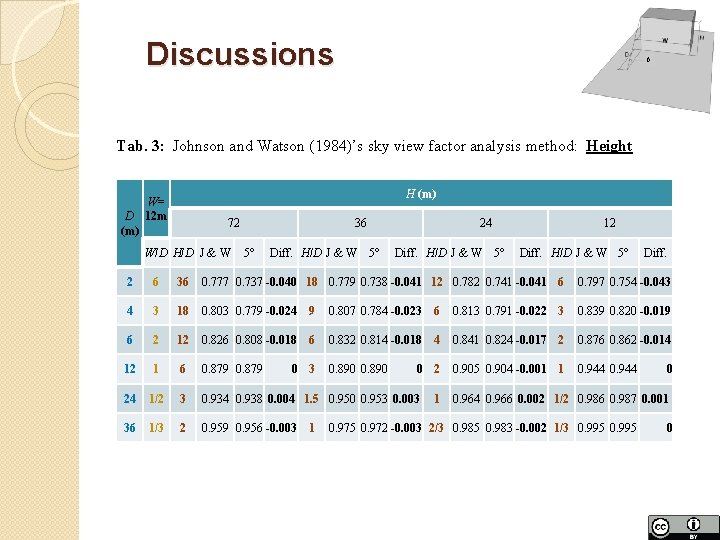
Discussions β Tab. 3: Johnson and Watson (1984)’s sky view factor analysis method: Height H (m) W= D 12 m (m) 72 W/D H/D J & W 36 5° Diff. H/D J & W 5° 24 Diff. H/D J & W 5° 12 Diff. H/D J & W 5° Diff. 2 6 36 0. 777 0. 737 -0. 040 18 0. 779 0. 738 -0. 041 12 0. 782 0. 741 -0. 041 6 0. 797 0. 754 -0. 043 4 3 18 0. 803 0. 779 -0. 024 9 0. 807 0. 784 -0. 023 6 0. 813 0. 791 -0. 022 3 0. 839 0. 820 -0. 019 6 2 12 0. 826 0. 808 -0. 018 6 0. 832 0. 814 -0. 018 4 0. 841 0. 824 -0. 017 2 0. 876 0. 862 -0. 014 12 1 6 0. 879 0. 890 0. 905 0. 904 -0. 001 1 0. 944 24 1/2 3 0. 934 0. 938 0. 004 1. 5 0. 950 0. 953 0. 003 36 1/3 2 0. 959 0. 956 -0. 003 1 0 3 0 2 1 0 0. 964 0. 966 0. 002 1/2 0. 986 0. 987 0. 001 0. 975 0. 972 -0. 003 2/3 0. 985 0. 983 -0. 002 1/3 0. 995 0
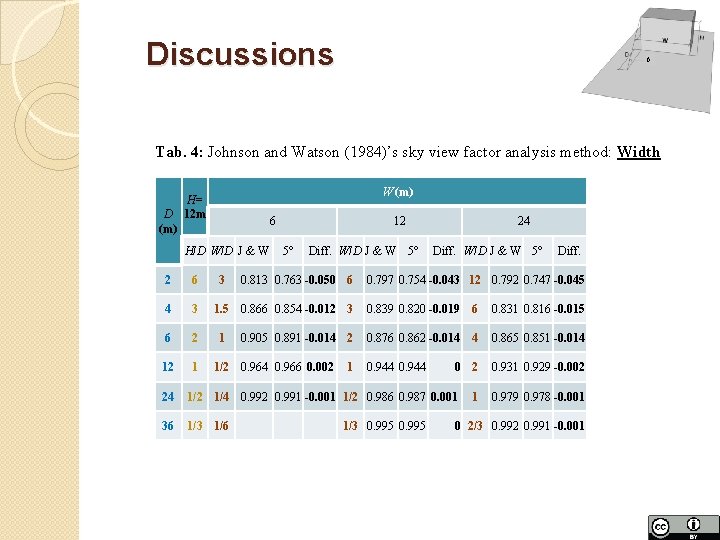
Discussions β Tab. 4: Johnson and Watson (1984)’s sky view factor analysis method: Width W (m) H= D 12 m (m) 6 H/D W/D J & W 2 6 4 3 6 2 12 1 3 12 5° Diff. W/D J & W 5° 0. 813 0. 763 -0. 050 6 1. 5 0. 866 0. 854 -0. 012 3 1 0. 905 0. 891 -0. 014 2 1/2 0. 964 0. 966 0. 002 1 24 Diff. W/D J & W 5° Diff. 0. 797 0. 754 -0. 043 12 0. 792 0. 747 -0. 045 0. 839 0. 820 -0. 019 6 0. 831 0. 816 -0. 015 0. 876 0. 862 -0. 014 4 0. 865 0. 851 -0. 014 0. 944 0. 931 0. 929 -0. 002 0 2 24 1/2 1/4 0. 992 0. 991 -0. 001 1/2 0. 986 0. 987 0. 001 36 1/3 1/6 1/3 0. 995 1 0. 979 0. 978 -0. 001 0 2/3 0. 992 0. 991 -0. 001
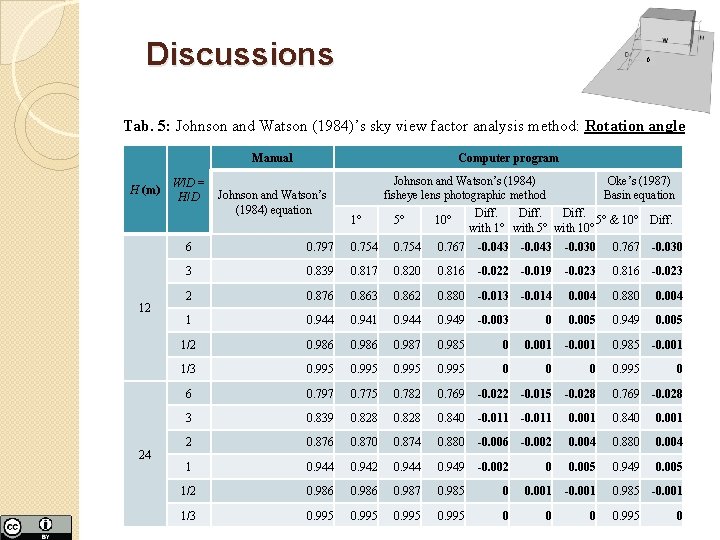
Discussions β Tab. 5: Johnson and Watson (1984)’s sky view factor analysis method: Rotation angle Manual H (m) 12 24 W/D = H/D Computer program Johnson and Watson’s (1984) equation Johnson and Watson’s (1984) fisheye lens photographic method 1° 5° 10° Oke’s (1987) Basin equation Diff. 5° & 10° Diff. with 1° with 5° with 10° 6 0. 797 0. 754 0. 767 -0. 043 -0. 030 0. 767 -0. 030 3 0. 839 0. 817 0. 820 0. 816 -0. 022 -0. 019 -0. 023 0. 816 -0. 023 2 0. 876 0. 863 0. 862 0. 880 -0. 013 -0. 014 0. 004 0. 880 0. 004 1 0. 944 0. 949 -0. 003 0 0. 005 0. 949 0. 005 1/2 0. 986 0. 987 0. 985 0 0. 001 -0. 001 0. 985 -0. 001 1/3 0. 995 0 6 0. 797 0. 775 0. 782 0. 769 -0. 022 -0. 015 -0. 028 0. 769 -0. 028 3 0. 839 0. 828 0. 840 -0. 011 0. 001 0. 840 0. 001 2 0. 876 0. 870 0. 874 0. 880 -0. 006 -0. 002 0. 004 0. 880 0. 004 1 0. 944 0. 942 0. 944 0. 949 -0. 002 0 0. 005 0. 949 0. 005 1/2 0. 986 0. 987 0. 985 0 0. 001 -0. 001 0. 985 -0. 001 1/3 0. 995 0
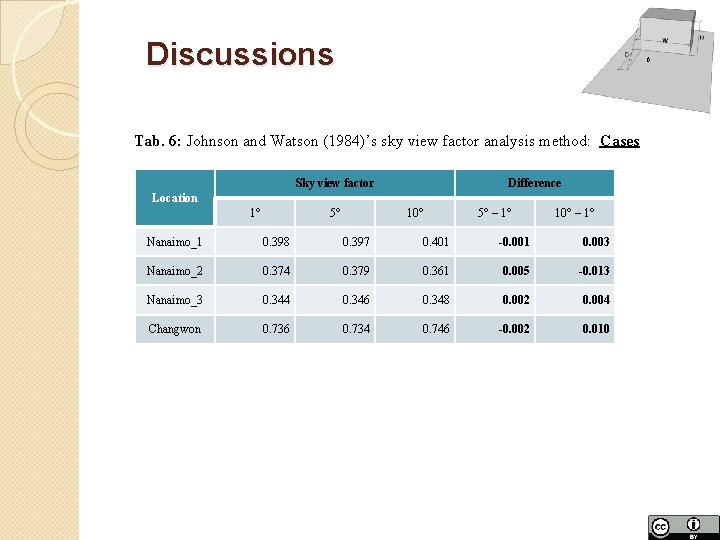
Discussions β Tab. 6: Johnson and Watson (1984)’s sky view factor analysis method: Cases Sky view factor Difference Location 1° 5° 10° 5° – 1° 10° – 1° Nanaimo_1 0. 398 0. 397 0. 401 -0. 001 0. 003 Nanaimo_2 0. 374 0. 379 0. 361 0. 005 -0. 013 Nanaimo_3 0. 344 0. 346 0. 348 0. 002 0. 004 Changwon 0. 736 0. 734 0. 746 -0. 002 0. 010
Conclusions 1. The advanced view factor analysis method which includes vegetation and shadow effects should improve radiation exchange estimates for human thermal sensation (comfort) analysis in complicated 3 D urban environments. 2. The 50% shadow effect produced almost two-thirds K↓ difference reductions at the sunny locations in both Nanaimo and Changwon. 3. When only the vegetation effect was considered after converting all obstruction view factors to vegetation in existing-method 1, the sunny locations had up to 38. 8 Wm-2 reductions in Nanaimo’s narrow urban canyons, and up to 19. 6 Wm-2 reductions at the more open Changwon site. More reductions happened at the lower solar altitudes, in the morning and afternoon.
Limitations 1. More case studies required 2. More input values of albedo and emissivity of each type of sunny/shaded building, tree or ground surface should be developed. 3. Vertical vegetation (trees)’s trunk height should be subtracted from vegetation height data.

Thank you
- Slides: 15