
Solar Probe Plus A NASA Mission to Touch
Solar Probe Plus A NASA Mission to Touch the Sun Integrated Science Investigation of the Sun Energetic Particles Preliminary Design Review 05 – 06 NOV 2013 ISIS Structural Nick Alexander ISIS Mechanical Engineer (Sw. RI) This document contains technical data that may be controlled by the International Traffic in Arms Regulations (22 CFR 120 -130) and may not be provided, disclosed or transferred in any manner to any person, whether in the U. S. or abroad, who is not 1) a citizen of the United States, 2) a lawful permanent resident of the United States, or 3) a protected individual as defined by 8 USC 1324 b(a)(3), without the written permission of the United States Department of State.
Outline Solar Probe Plus A NASA Mission to Touch the Sun § EPI-Hi Structural Analysis* § Requirements § FEM/Boundary Conditions § Modal Results § Stress Results § ISIS Bracket Structural Analysis § Mechanical design/structural requirements § ISIS overall mechanical configuration § FEM/Boundary Conditions § Modal Results § Stress Results § Structural design margins and plans for strength verification * EPI-Lo structural analysis shown in EPI-Lo mechanical presentation 2 ISIS PDR – 19 – ISIS Structural 05 - 06 NOV 2013
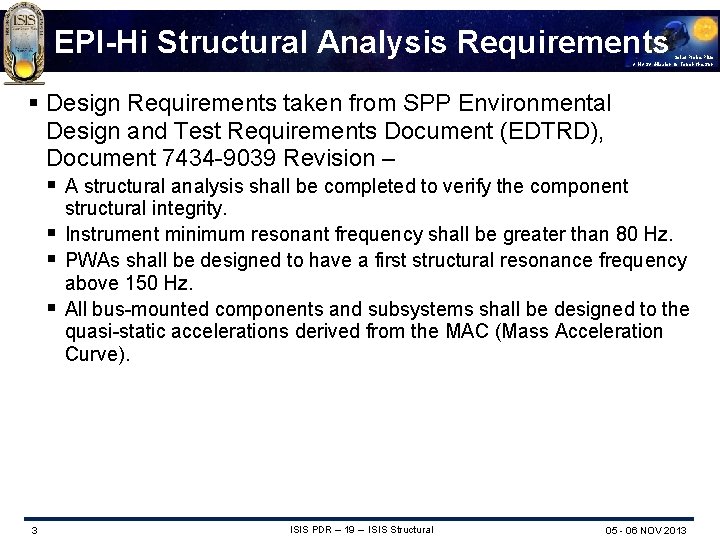
EPI-Hi Structural Analysis Requirements Solar Probe Plus A NASA Mission to Touch the Sun § Design Requirements taken from SPP Environmental Design and Test Requirements Document (EDTRD), Document 7434 -9039 Revision – § A structural analysis shall be completed to verify the component structural integrity. § Instrument minimum resonant frequency shall be greater than 80 Hz. § PWAs shall be designed to have a first structural resonance frequency above 150 Hz. § All bus-mounted components and subsystems shall be designed to the quasi-static accelerations derived from the MAC (Mass Acceleration Curve). 3 ISIS PDR – 19 – ISIS Structural 05 - 06 NOV 2013
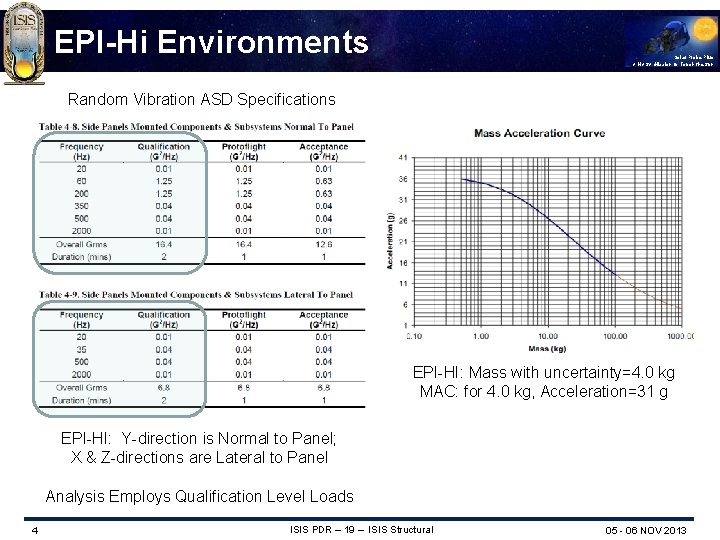
EPI-Hi Environments Solar Probe Plus A NASA Mission to Touch the Sun Random Vibration ASD Specifications EPI-HI: Mass with uncertainty=4. 0 kg MAC: for 4. 0 kg, Acceleration=31 g EPI-HI: Y-direction is Normal to Panel; X & Z-directions are Lateral to Panel Analysis Employs Qualification Level Loads 4 ISIS PDR – 19 – ISIS Structural 05 - 06 NOV 2013
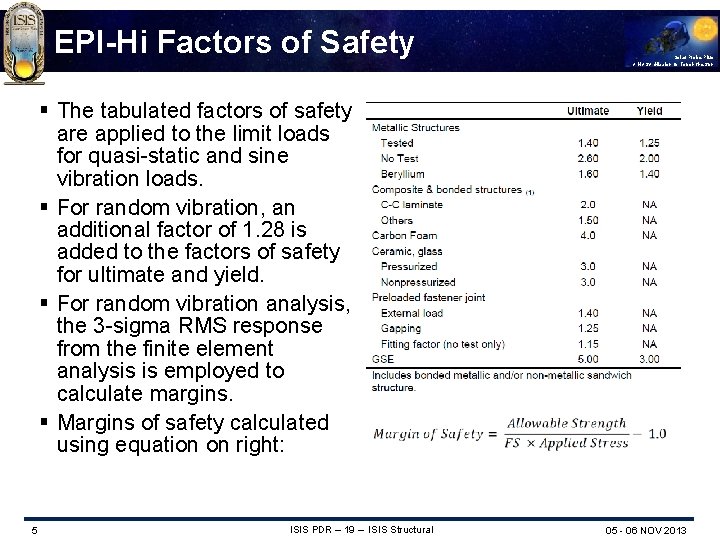
EPI-Hi Factors of Safety Solar Probe Plus A NASA Mission to Touch the Sun § The tabulated factors of safety are applied to the limit loads for quasi-static and sine vibration loads. § For random vibration, an additional factor of 1. 28 is added to the factors of safety for ultimate and yield. § For random vibration analysis, the 3 -sigma RMS response from the finite element analysis is employed to calculate margins. § Margins of safety calculated using equation on right: 5 ISIS PDR – 19 – ISIS Structural 05 - 06 NOV 2013
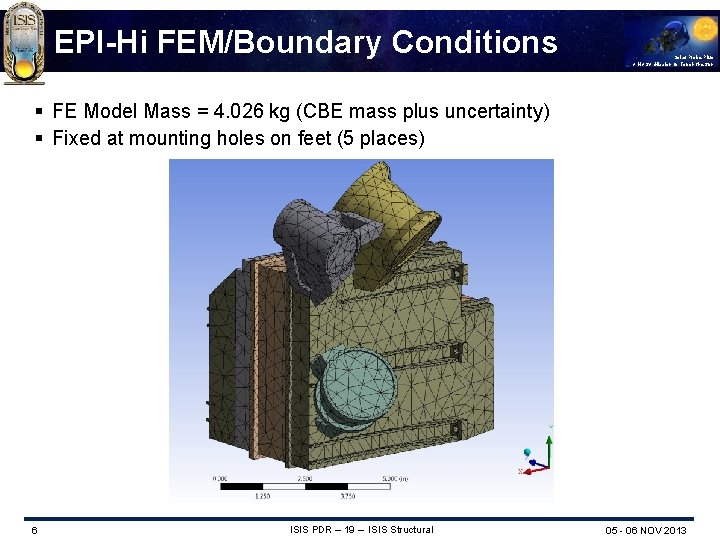
EPI-Hi FEM/Boundary Conditions Solar Probe Plus A NASA Mission to Touch the Sun § FE Model Mass = 4. 026 kg (CBE mass plus uncertainty) § Fixed at mounting holes on feet (5 places) 6 ISIS PDR – 19 – ISIS Structural 05 - 06 NOV 2013
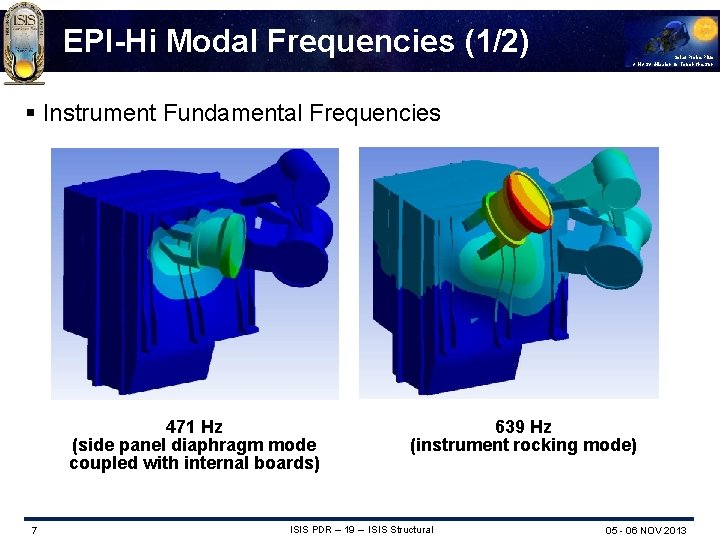
EPI-Hi Modal Frequencies (1/2) Solar Probe Plus A NASA Mission to Touch the Sun § Instrument Fundamental Frequencies 471 Hz (side panel diaphragm mode coupled with internal boards) 7 639 Hz (instrument rocking mode) ISIS PDR – 19 – ISIS Structural 05 - 06 NOV 2013
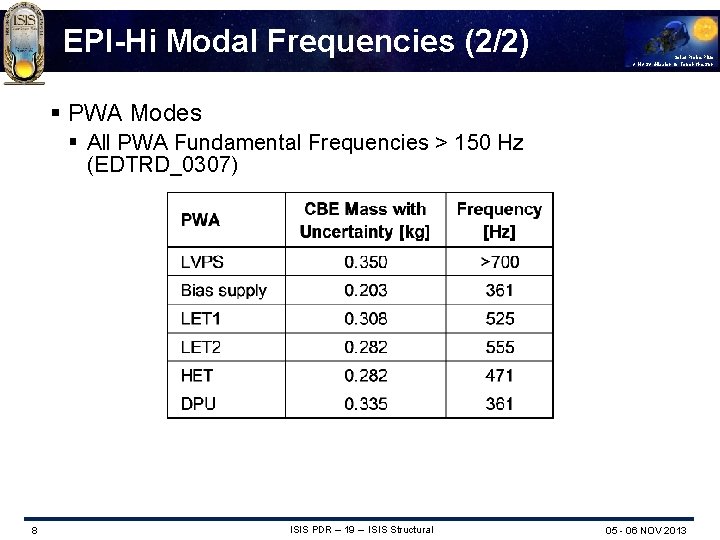
EPI-Hi Modal Frequencies (2/2) Solar Probe Plus A NASA Mission to Touch the Sun § PWA Modes § All PWA Fundamental Frequencies > 150 Hz (EDTRD_0307) 8 ISIS PDR – 19 – ISIS Structural 05 - 06 NOV 2013
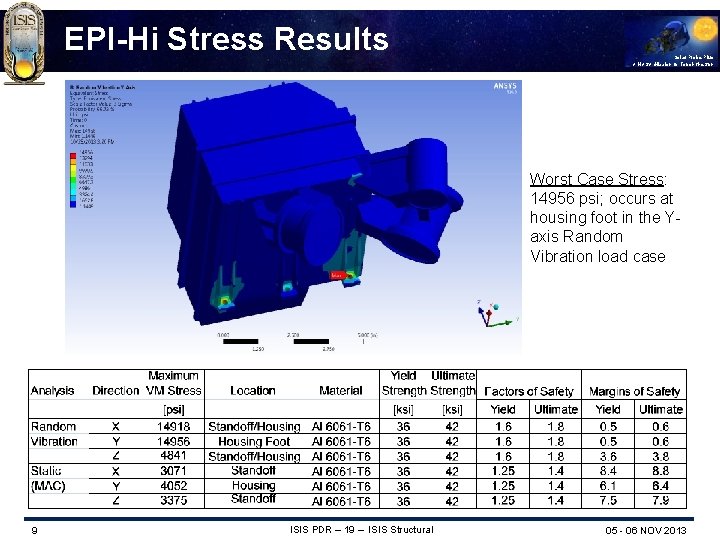
EPI-Hi Stress Results Solar Probe Plus A NASA Mission to Touch the Sun Worst Case Stress: 14956 psi; occurs at housing foot in the Yaxis Random Vibration load case 9 ISIS PDR – 19 – ISIS Structural 05 - 06 NOV 2013
ISIS Bracket Mechanical Design Requirements Solar Probe Plus A NASA Mission to Touch the Sun § ISIS bracket must hold EPI-Hi and EPI-Lo in position on the SPP deck § ISIS bracket must be capable of independently removing EPI-Hi and EPI-Lo, in either order § ISIS bracket must survive all environments for deck mounted components § Random vibration § Sine vibration § Shock § All ISIS suite testing shall be performed on the bracket, with instruments or instrument analogs as appropriate 10 ISIS PDR – 19 – ISIS Structural 05 - 06 NOV 2013
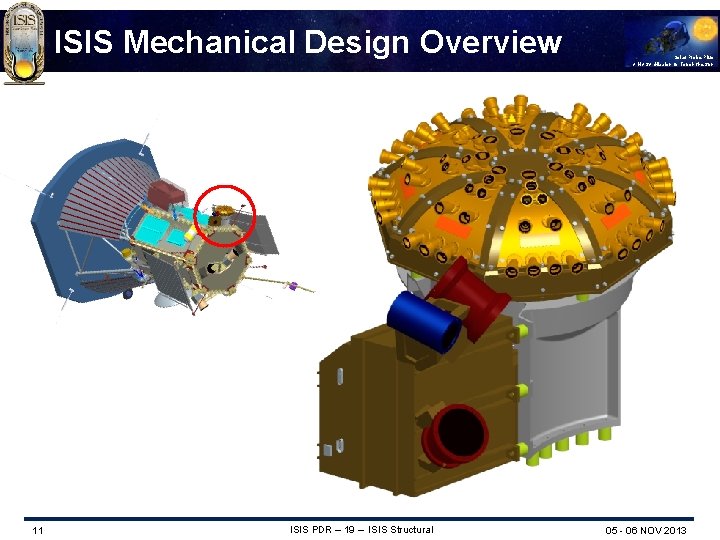
ISIS Mechanical Design Overview 11 ISIS PDR – 19 – ISIS Structural Solar Probe Plus A NASA Mission to Touch the Sun 05 - 06 NOV 2013
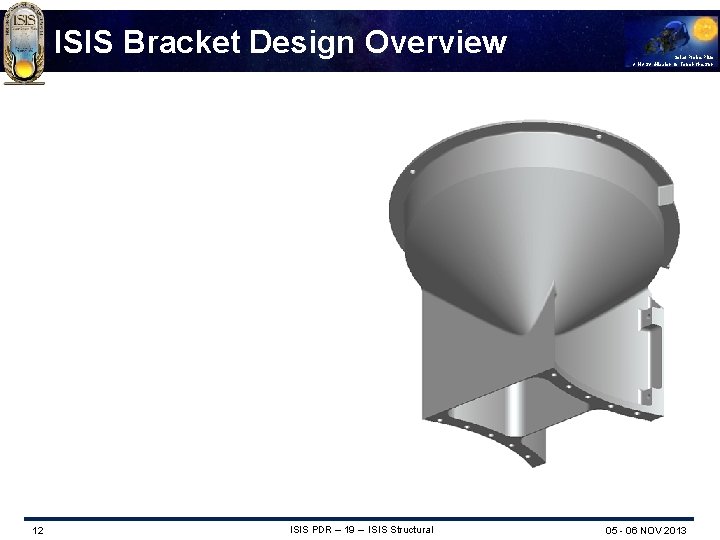
ISIS Bracket Design Overview 12 ISIS PDR – 19 – ISIS Structural Solar Probe Plus A NASA Mission to Touch the Sun 05 - 06 NOV 2013
ISIS Bracket Fabrication Solar Probe Plus A NASA Mission to Touch the Sun § The ISIS bracket can be machined using conventional machining processes § Monolithic design, will be machined from a single block § All operations can be performed on conventional machines (i. e. lathe, mill, etc. ) § Thermal isolators and mass models will also be fabricated to be used during structural testing § G 10 isolators will be machined to flight-like quality § Mass models to reflect instrument mass properties with flightlike mounting interfaces § Bracket height increase due to TPS shift can easily be accommodated as needed § Working with S/C mechanical team; any shift in the TPS only requires translation normal to the deck to remain adjacent to the umbra 13 ISIS PDR – 19 – ISIS Structural 05 - 06 NOV 2013
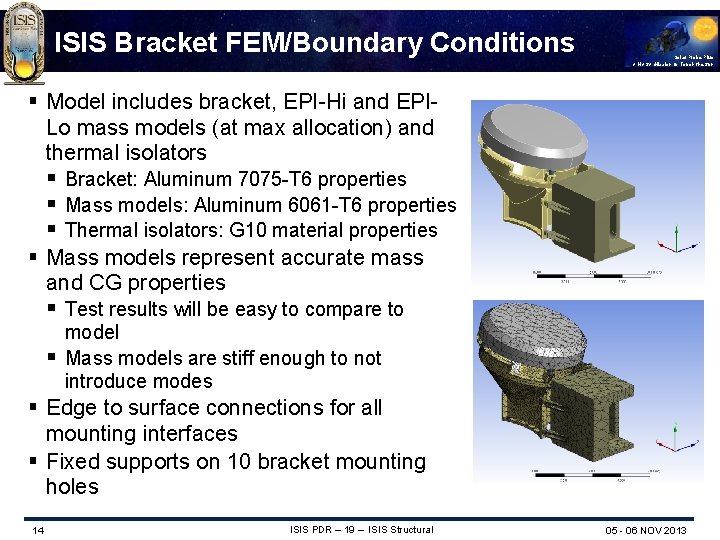
ISIS Bracket FEM/Boundary Conditions Solar Probe Plus A NASA Mission to Touch the Sun § Model includes bracket, EPI-Hi and EPILo mass models (at max allocation) and thermal isolators § Bracket: Aluminum 7075 -T 6 properties § Mass models: Aluminum 6061 -T 6 properties § Thermal isolators: G 10 material properties § Mass models represent accurate mass and CG properties § Test results will be easy to compare to model § Mass models are stiff enough to not introduce modes § Edge to surface connections for all mounting interfaces § Fixed supports on 10 bracket mounting holes 14 ISIS PDR – 19 – ISIS Structural 05 - 06 NOV 2013
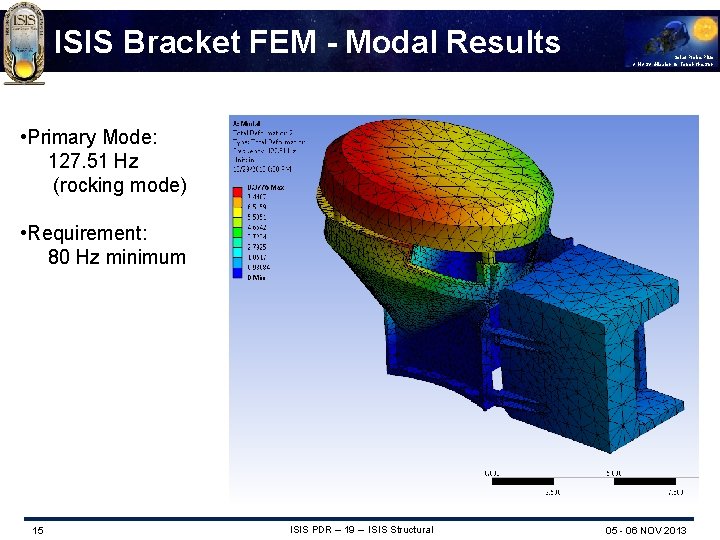
ISIS Bracket FEM - Modal Results Solar Probe Plus A NASA Mission to Touch the Sun • Primary Mode: 127. 51 Hz (rocking mode) • Requirement: 80 Hz minimum 15 ISIS PDR – 19 – ISIS Structural 05 - 06 NOV 2013
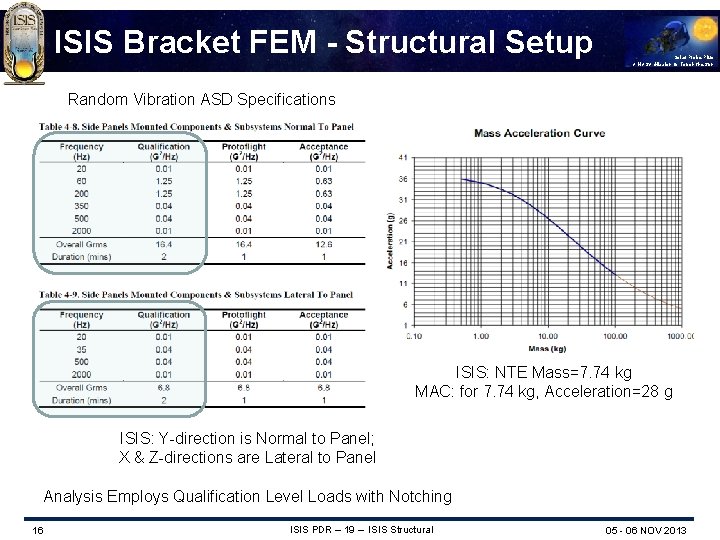
ISIS Bracket FEM - Structural Setup Solar Probe Plus A NASA Mission to Touch the Sun Random Vibration ASD Specifications ISIS: NTE Mass=7. 74 kg MAC: for 7. 74 kg, Acceleration=28 g ISIS: Y-direction is Normal to Panel; X & Z-directions are Lateral to Panel Analysis Employs Qualification Level Loads with Notching 16 ISIS PDR – 19 – ISIS Structural 05 - 06 NOV 2013
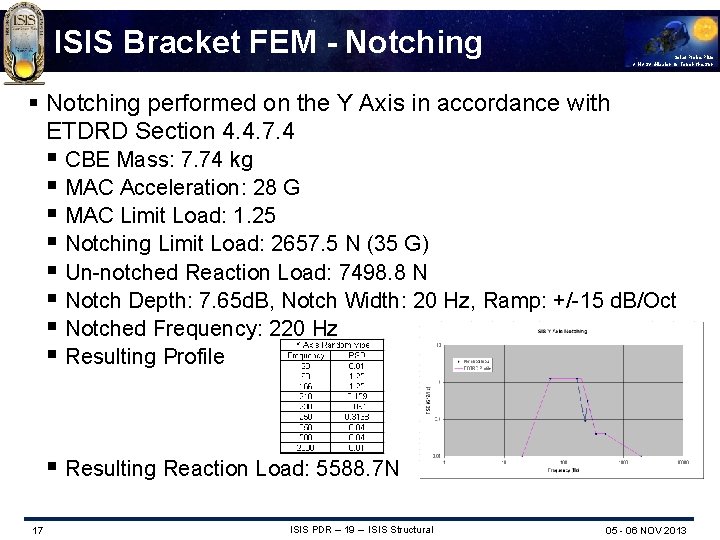
ISIS Bracket FEM - Notching Solar Probe Plus A NASA Mission to Touch the Sun § Notching performed on the Y Axis in accordance with ETDRD Section 4. 4. 7. 4 § CBE Mass: 7. 74 kg § MAC Acceleration: 28 G § MAC Limit Load: 1. 25 § Notching Limit Load: 2657. 5 N (35 G) § Un-notched Reaction Load: 7498. 8 N § Notch Depth: 7. 65 d. B, Notch Width: 20 Hz, Ramp: +/-15 d. B/Oct § Notched Frequency: 220 Hz § Resulting Profile § Resulting Reaction Load: 5588. 7 N 17 ISIS PDR – 19 – ISIS Structural 05 - 06 NOV 2013
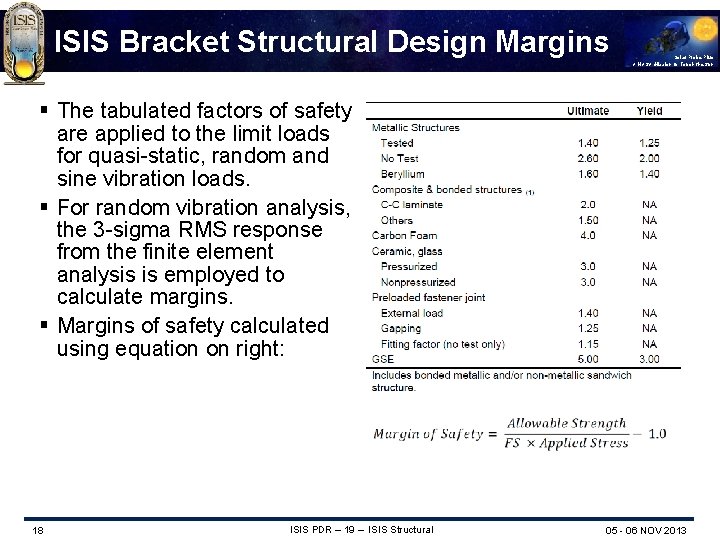
ISIS Bracket Structural Design Margins Solar Probe Plus A NASA Mission to Touch the Sun § The tabulated factors of safety are applied to the limit loads for quasi-static, random and sine vibration loads. § For random vibration analysis, the 3 -sigma RMS response from the finite element analysis is employed to calculate margins. § Margins of safety calculated using equation on right: 18 ISIS PDR – 19 – ISIS Structural 05 - 06 NOV 2013
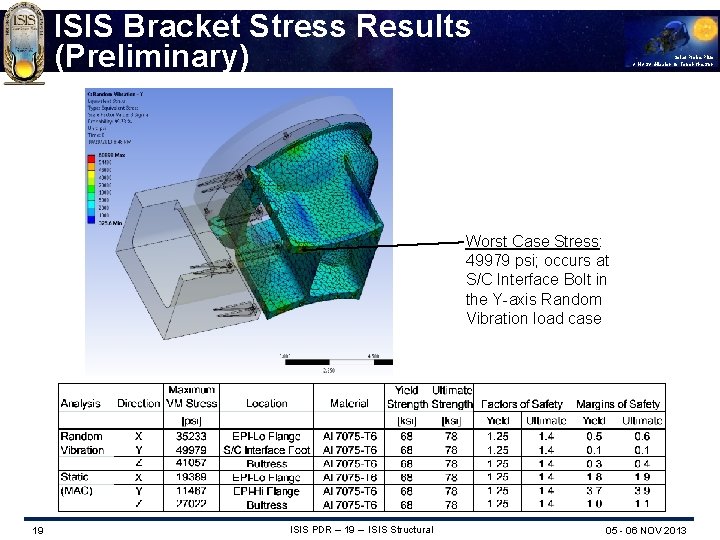
ISIS Bracket Stress Results (Preliminary) Solar Probe Plus A NASA Mission to Touch the Sun Worst Case Stress: 49979 psi; occurs at S/C Interface Bolt in the Y-axis Random Vibration load case 19 ISIS PDR – 19 – ISIS Structural 05 - 06 NOV 2013
ISIS Bracket Structural Testing Solar Probe Plus A NASA Mission to Touch the Sun § ISIS bracket will be tested at Sw. RI facilities with EPI-Hi and EPI-Lo mass models § G 10 thermal isolators will be included § Mounted using flight quality mounting hardware § Tests will check natural frequency, random vibe response, sine vibe response § Natural frequency must be >80 Hz (EDTRD_0095) § Must survive random vibration loads (EDTRD_0111) per tables in EDTRD 4. 4. 3 § Must survive sine sweep loads (EDTRD_0114) per sine environment (TBD) given in EDTRD 4. 4. 4 § Pre & post test low-level sine sweeps used to identify any change in fundamental frequency § Once fabricated and tested at Sw. RI, ISIS bracket will be used in support of EPI-Hi and EPI-Lo environmental testing 20 ISIS PDR – 19 – ISIS Structural 05 - 06 NOV 2013
Summary Solar Probe Plus A NASA Mission to Touch the Sun § EPI-Hi, EPI-Lo, and ISIS Bracket modeling have been completed § Satisfies EDTRD requirements § Have required margins of safety § Ready to begin EM Fabrication and move into Phase C 21 ISIS PDR – 19 – ISIS Structural 05 - 06 NOV 2013
- Slides: 21