
Solar Probe Plus A NASA Mission to Touch
Solar Probe Plus A NASA Mission to Touch the Sun Integrated Science Investigation of the Sun Energetic Particles Preliminary Design Review 05 – 06 NOV 2013 Systems Engineering John Dickinson
Outline Solar Probe Plus A NASA Mission to Touch the Sun § Instrument driving requirements § Flow down of instrument performance requirements to major subsystems § Instrument interfaces § Electrical § Mechanical § Thermal § Environmental design and test requirements § Resources allocated to the instrument § Mass, Power, Telemetry Volume, SSR Volume § Instrument command autonomy § Major trades performed in Phase B § Major changes since MDR 2 ISIS PDR – 06 – Systems Engineering 05 - 06 NOV 2013
ISIS Systems Engineering Approach Solar Probe Plus A NASA Mission to Touch the Sun § Distributed Systems Engineering § Both EPI-Hi and EPI-Lo have a dedicated SE § ISIS SE role is to § Coordinate interactions with the project § Maximize use of shared resources § Provide oversight of technical tasks 3 ISIS PDR – 06 – Systems Engineering 05 - 06 NOV 2013
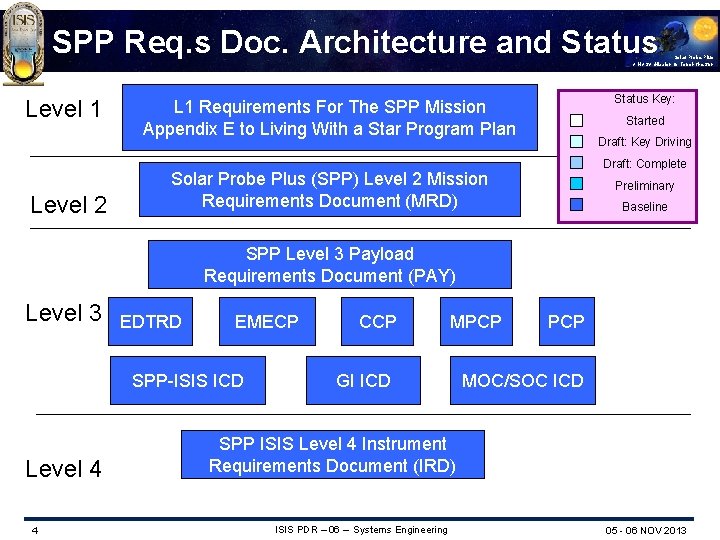
SPP Req. s Doc. Architecture and Status Solar Probe Plus A NASA Mission to Touch the Sun Level 1 Level 2 Status Key: L 1 Requirements For The SPP Mission Appendix E to Living With a Star Program Plan Started Draft: Key Driving Draft: Complete Solar Probe Plus (SPP) Level 2 Mission Requirements Document (MRD) Preliminary Baseline SPP Level 3 Payload Requirements Document (PAY) Level 3 EDTRD EMECP SPP-ISIS ICD Level 4 4 CCP MPCP GI ICD PCP MOC/SOC ICD SPP ISIS Level 4 Instrument Requirements Document (IRD) ISIS PDR – 06 – Systems Engineering 05 - 06 NOV 2013
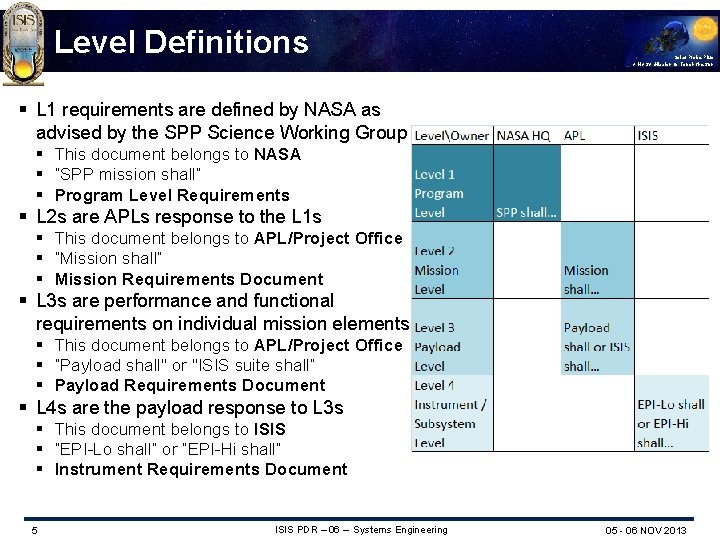
Level Definitions Solar Probe Plus A NASA Mission to Touch the Sun § L 1 requirements are defined by NASA as advised by the SPP Science Working Group § This document belongs to NASA § “SPP mission shall” § Program Level Requirements § L 2 s are APLs response to the L 1 s § This document belongs to APL/Project Office § “Mission shall” § Mission Requirements Document § L 3 s are performance and functional requirements on individual mission elements § This document belongs to APL/Project Office § “Payload shall" or "ISIS suite shall“ § Payload Requirements Document § L 4 s are the payload response to L 3 s § This document belongs to ISIS § “EPI-Lo shall” or “EPI-Hi shall” § Instrument Requirements Document 5 ISIS PDR – 06 – Systems Engineering 05 - 06 NOV 2013
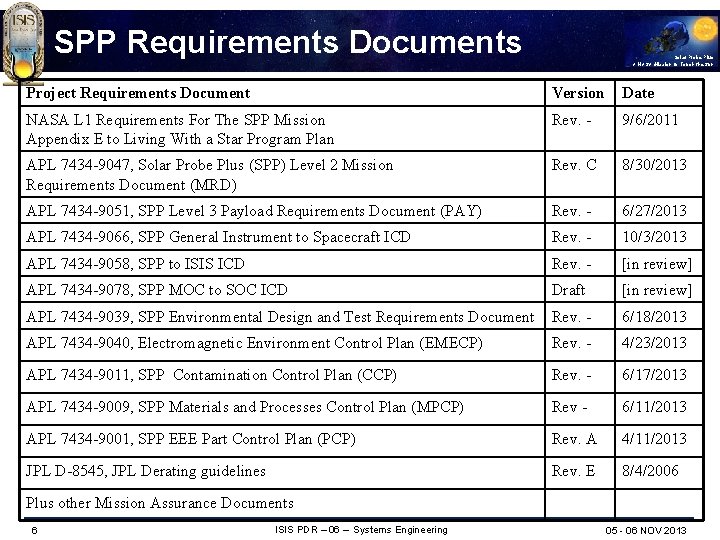
SPP Requirements Documents Solar Probe Plus A NASA Mission to Touch the Sun Project Requirements Document Version Date NASA L 1 Requirements For The SPP Mission Appendix E to Living With a Star Program Plan Rev. - 9/6/2011 APL 7434 -9047, Solar Probe Plus (SPP) Level 2 Mission Requirements Document (MRD) Rev. C 8/30/2013 APL 7434 -9051, SPP Level 3 Payload Requirements Document (PAY) Rev. - 6/27/2013 APL 7434 -9066, SPP General Instrument to Spacecraft ICD Rev. - 10/3/2013 APL 7434 -9058, SPP to ISIS ICD Rev. - [in review] APL 7434 -9078, SPP MOC to SOC ICD Draft [in review] APL 7434 -9039, SPP Environmental Design and Test Requirements Document Rev. - 6/18/2013 APL 7434 -9040, Electromagnetic Environment Control Plan (EMECP) Rev. - 4/23/2013 APL 7434 -9011, SPP Contamination Control Plan (CCP) Rev. - 6/17/2013 APL 7434 -9009, SPP Materials and Processes Control Plan (MPCP) Rev - 6/11/2013 APL 7434 -9001, SPP EEE Part Control Plan (PCP) Rev. A 4/11/2013 JPL D-8545, JPL Derating guidelines Rev. E 8/4/2006 Plus other Mission Assurance Documents 6 ISIS PDR – 06 – Systems Engineering 05 - 06 NOV 2013
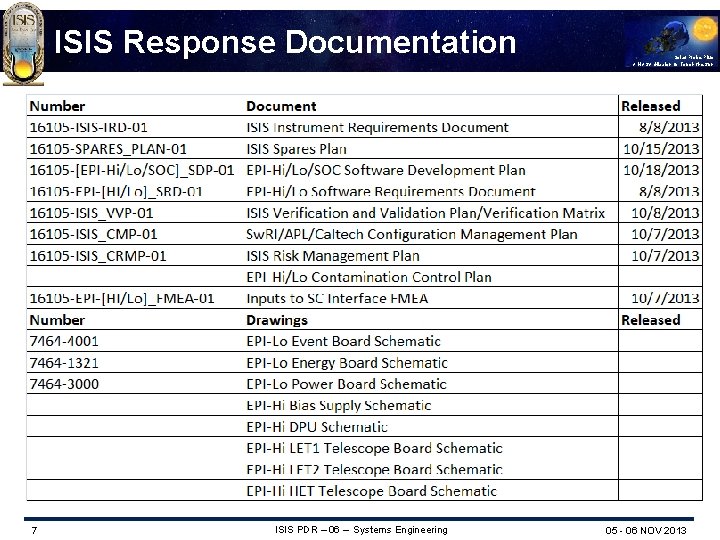
ISIS Response Documentation 7 ISIS PDR – 06 – Systems Engineering Solar Probe Plus A NASA Mission to Touch the Sun 05 - 06 NOV 2013
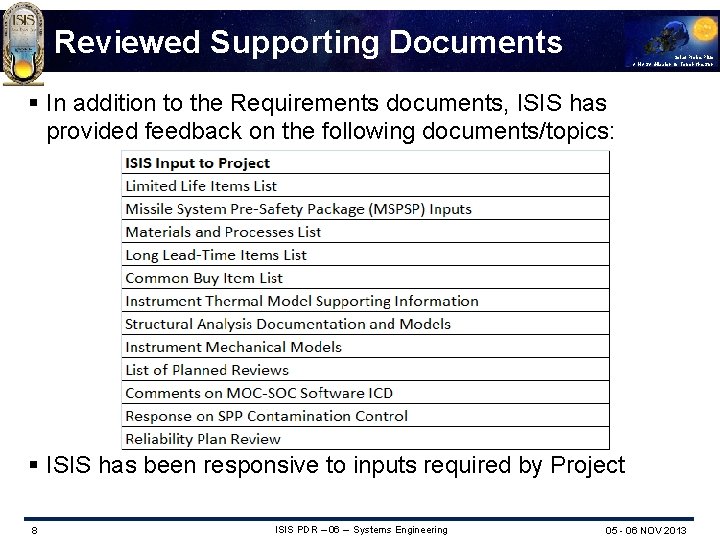
Reviewed Supporting Documents Solar Probe Plus A NASA Mission to Touch the Sun § In addition to the Requirements documents, ISIS has provided feedback on the following documents/topics: § ISIS has been responsive to inputs required by Project 8 ISIS PDR – 06 – Systems Engineering 05 - 06 NOV 2013
Driving Requirements at L 1/L 2 Solar Probe Plus A NASA Mission to Touch the Sun § The Mission shall measure energetic electrons, as follows: § Energy range: ≤ 0. 05 to ≥ 3 Me. V § Highest cadence: ≤ 1 s for selected rates § FOV: ≥ π/2 sr in sunward anti-sunward hemispheres § Angular sectoring: ≤ 45 degree sectors § Composition: n/a § The Mission shall measure energetic protons and heavy ions, as follows: § Energy range: ≤ 0. 05 to ≥ 50 Me. V/nucleon § Highest cadence: ≤ 5 s for selected rates § FOV: ≥ π/2 sr in sunward anti-sunward hemispheres § Angular sectoring: ≤ 30 degree sectors § Composition: at least H, He, 3 He, C, O, Ne, Mg, Si, Fe § Both EPI-Hi and EPI-Lo are required to meet all requirements at all energy ranges 9 ISIS PDR – 06 – Systems Engineering 05 - 06 NOV 2013
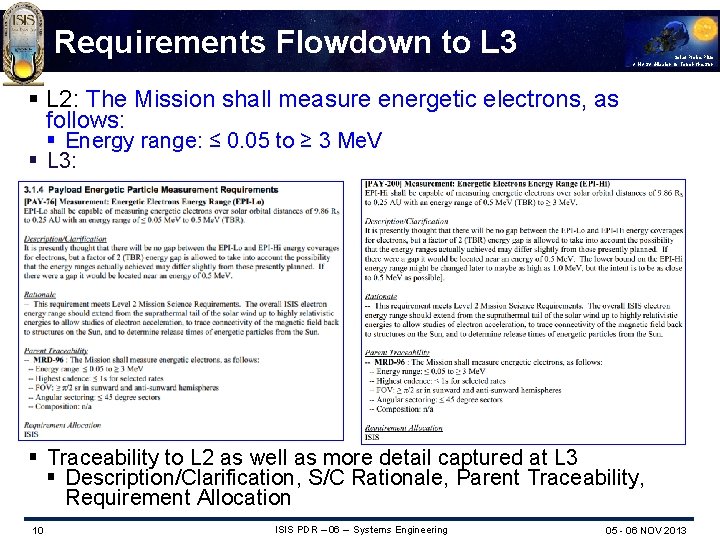
Requirements Flowdown to L 3 Solar Probe Plus A NASA Mission to Touch the Sun § L 2: The Mission shall measure energetic electrons, as follows: § Energy range: ≤ 0. 05 to ≥ 3 Me. V § L 3: § Traceability to L 2 as well as more detail captured at L 3 § Description/Clarification, S/C Rationale, Parent Traceability, Requirement Allocation 10 ISIS PDR – 06 – Systems Engineering 05 - 06 NOV 2013
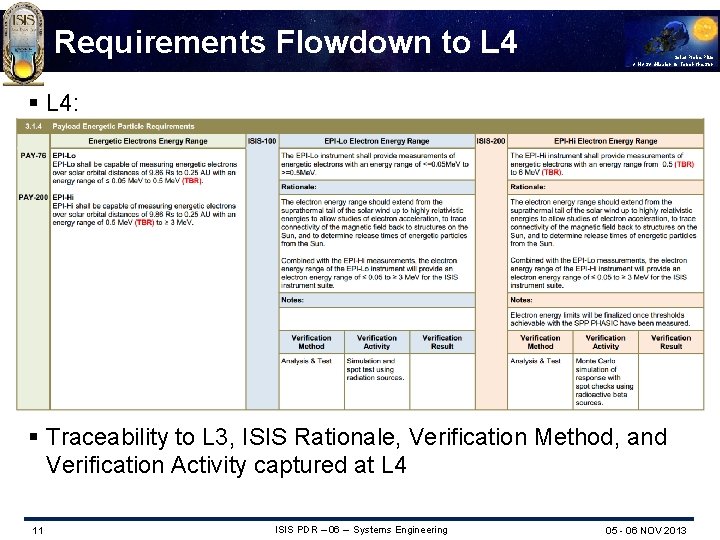
Requirements Flowdown to L 4 Solar Probe Plus A NASA Mission to Touch the Sun § L 4: NEEDS UPDATE FOR ISIS § Traceability to L 3, ISIS Rationale, Verification Method, and Verification Activity captured at L 4 11 ISIS PDR – 06 – Systems Engineering 05 - 06 NOV 2013
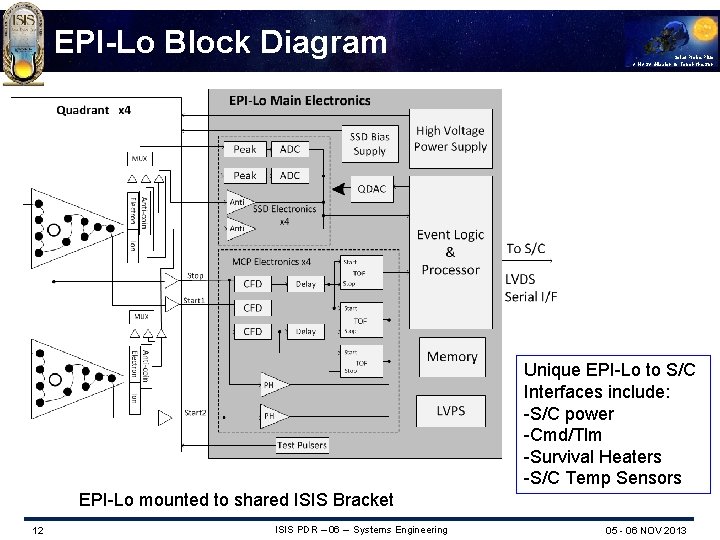
EPI-Lo Block Diagram Solar Probe Plus A NASA Mission to Touch the Sun Unique EPI-Lo to S/C Interfaces include: -S/C power -Cmd/Tlm -Survival Heaters -S/C Temp Sensors EPI-Lo mounted to shared ISIS Bracket 12 ISIS PDR – 06 – Systems Engineering 05 - 06 NOV 2013
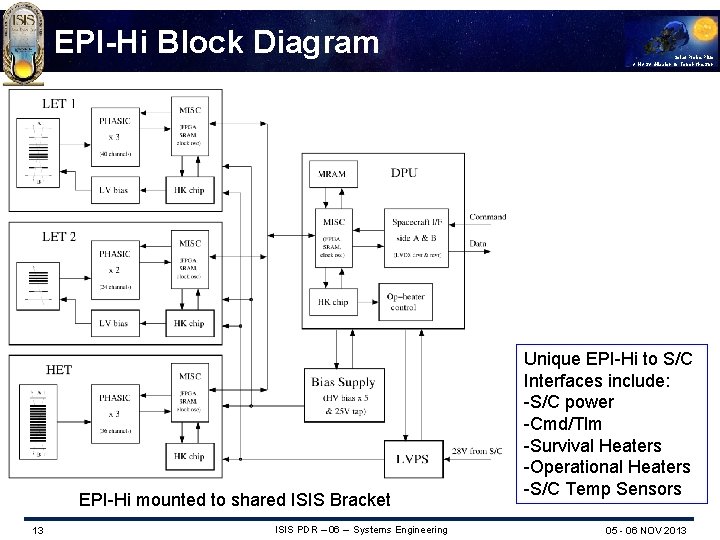
EPI-Hi Block Diagram EPI-Hi mounted to shared ISIS Bracket 13 ISIS PDR – 06 – Systems Engineering Solar Probe Plus A NASA Mission to Touch the Sun Unique EPI-Hi to S/C Interfaces include: -S/C power -Cmd/Tlm -Survival Heaters -Operational Heaters -S/C Temp Sensors 05 - 06 NOV 2013
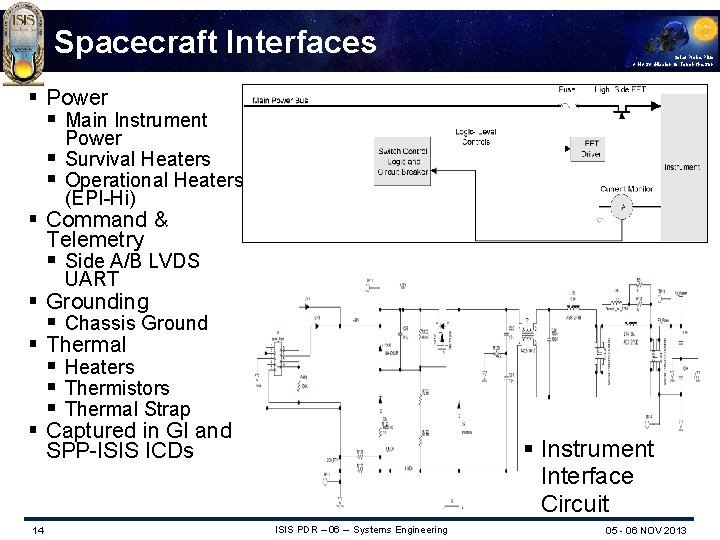
Spacecraft Interfaces Solar Probe Plus A NASA Mission to Touch the Sun § Power § Main Instrument Power § Survival Heaters § Operational Heaters (EPI-Hi) § Command & Telemetry § Side A/B LVDS UART § Grounding § Chassis Ground § Thermal § Heaters § Thermistors § Thermal Strap § Captured in GI and SPP-ISIS ICDs 14 § Instrument Interface Circuit ISIS PDR – 06 – Systems Engineering 05 - 06 NOV 2013
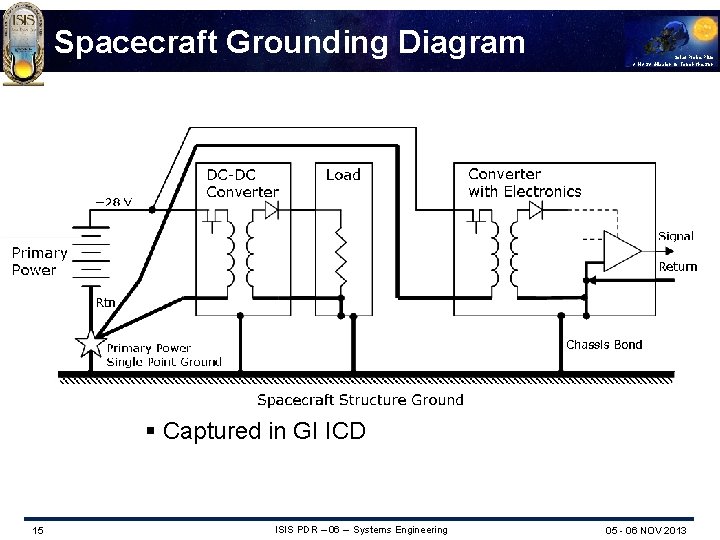
Spacecraft Grounding Diagram Solar Probe Plus A NASA Mission to Touch the Sun § Captured in GI ICD 15 ISIS PDR – 06 – Systems Engineering 05 - 06 NOV 2013
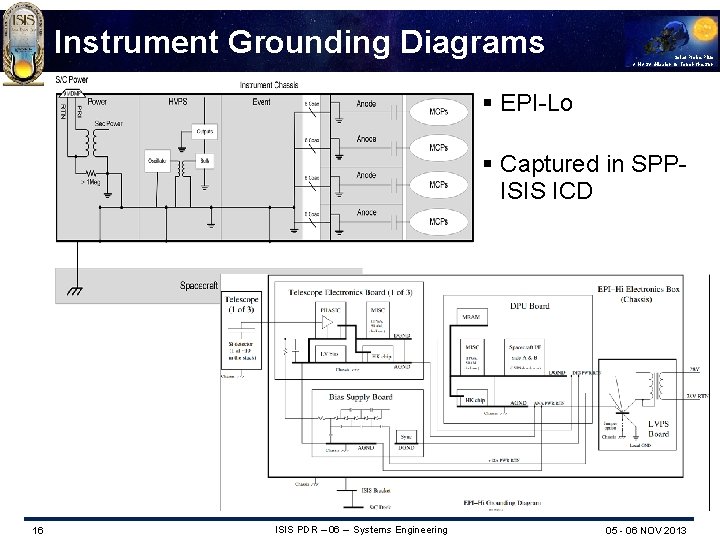
Instrument Grounding Diagrams Solar Probe Plus A NASA Mission to Touch the Sun § EPI-Lo § Captured in SPPISIS ICD 16 ISIS PDR – 06 – Systems Engineering 05 - 06 NOV 2013
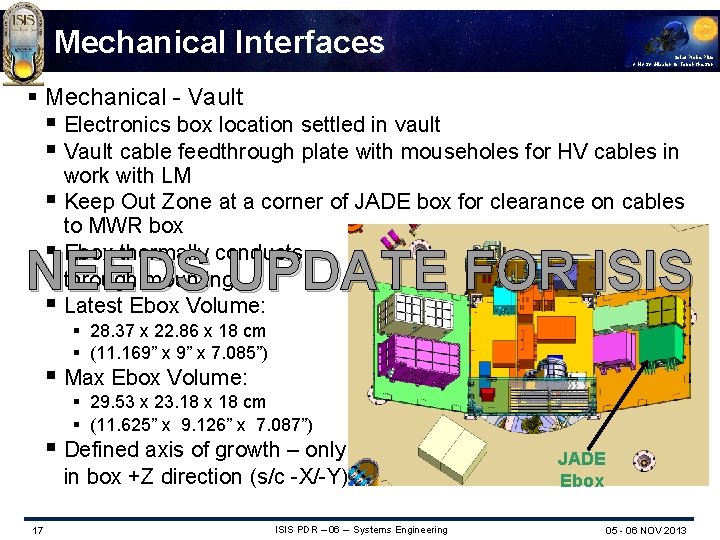
Mechanical Interfaces Solar Probe Plus A NASA Mission to Touch the Sun § Mechanical - Vault § Electronics box location settled in vault § Vault cable feedthrough plate with mouseholes for HV cables in work with LM § Keep Out Zone at a corner of JADE box for clearance on cables to MWR box § Ebox thermally conducts through mounting § Latest Ebox Volume: NEEDS UPDATE FOR ISIS § 28. 37 x 22. 86 x 18 cm § (11. 169” x 7. 085”) § Max Ebox Volume: § 29. 53 x 23. 18 x 18 cm § (11. 625” x 9. 126” x 7. 087”) § Defined axis of growth – only in box +Z direction (s/c -X/-Y) 17 ISIS PDR – 06 – Systems Engineering JADE Ebox 05 - 06 NOV 2013
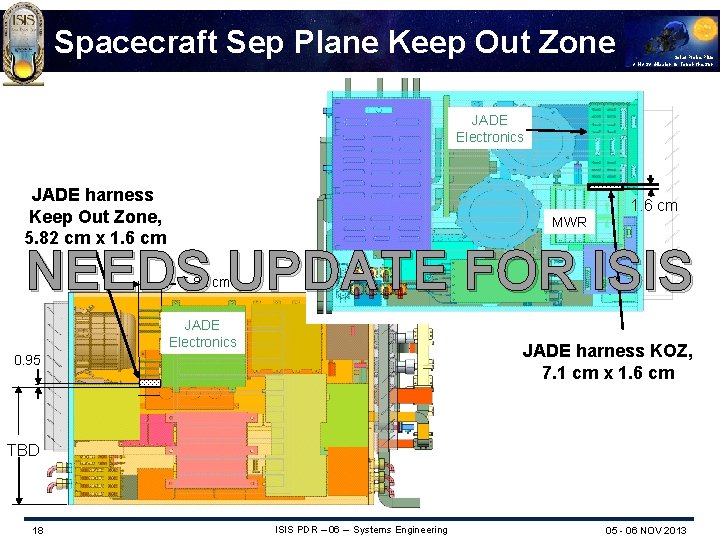
Spacecraft Sep Plane Keep Out Zone Solar Probe Plus A NASA Mission to Touch the Sun JADE Electronics 1. 6 JADE harness Keep Out Zone, 5. 82 cm x 1. 6 cm MWR NEEDS UPDATE FOR ISIS 5. 82 cm JADE Electronics JADE harness KOZ, 7. 1 cm x 1. 6 cm 0. 95 TBD 18 ISIS PDR – 06 – Systems Engineering 05 - 06 NOV 2013
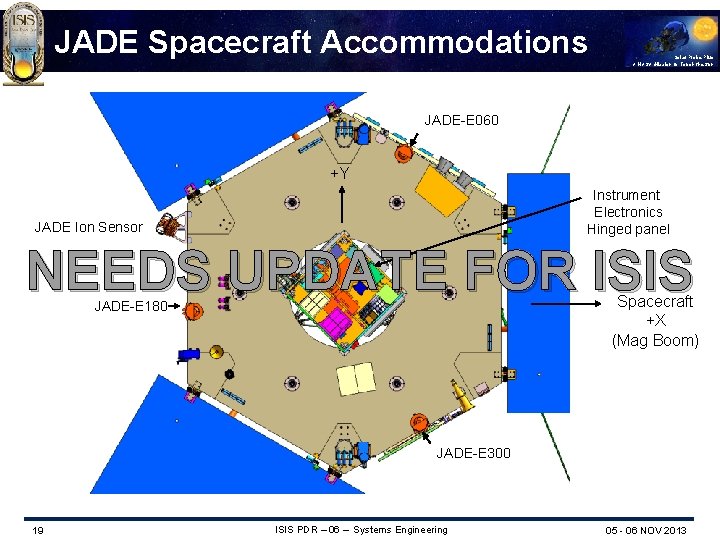
JADE Spacecraft Accommodations Solar Probe Plus A NASA Mission to Touch the Sun JADE-E 060 +Y Instrument Electronics Hinged panel JADE Ion Sensor NEEDS UPDATE FOR ISIS Spacecraft +X (Mag Boom) JADE-E 180 JADE-E 300 19 ISIS PDR – 06 – Systems Engineering 05 - 06 NOV 2013
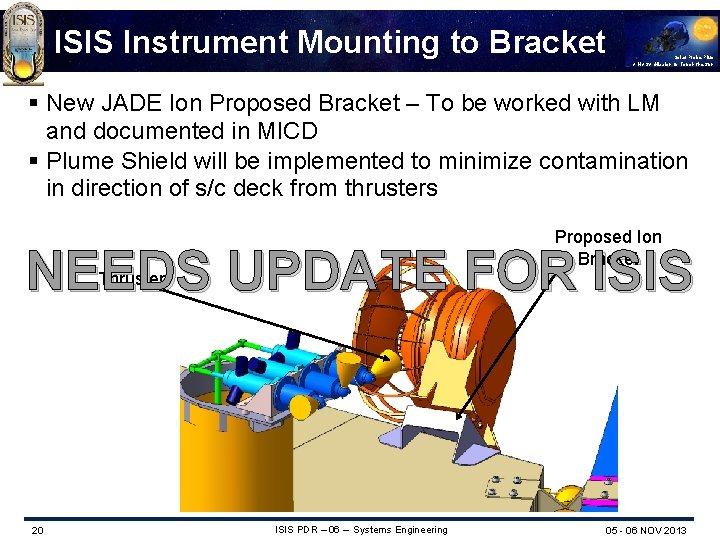
ISIS Instrument Mounting to Bracket Solar Probe Plus A NASA Mission to Touch the Sun § New JADE Ion Proposed Bracket – To be worked with LM and documented in MICD § Plume Shield will be implemented to minimize contamination in direction of s/c deck from thrusters Proposed Ion Bracket NEEDS UPDATE FOR ISIS Thruster 20 ISIS PDR – 06 – Systems Engineering 05 - 06 NOV 2013
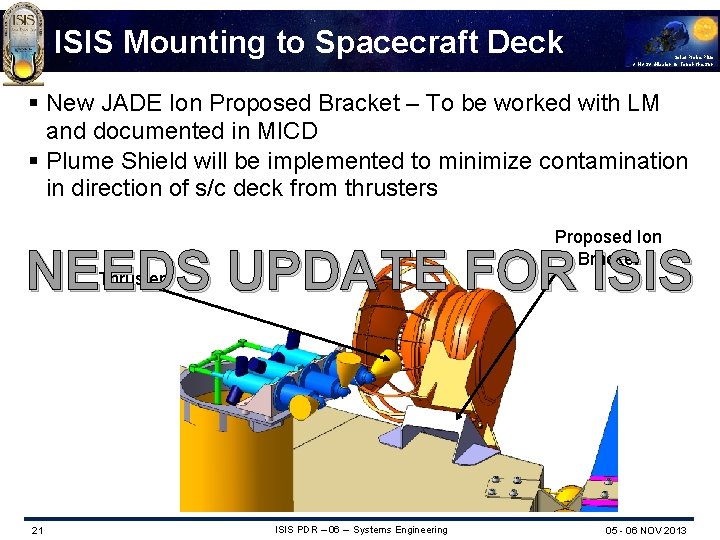
ISIS Mounting to Spacecraft Deck Solar Probe Plus A NASA Mission to Touch the Sun § New JADE Ion Proposed Bracket – To be worked with LM and documented in MICD § Plume Shield will be implemented to minimize contamination in direction of s/c deck from thrusters Proposed Ion Bracket NEEDS UPDATE FOR ISIS Thruster 21 ISIS PDR – 06 – Systems Engineering 05 - 06 NOV 2013
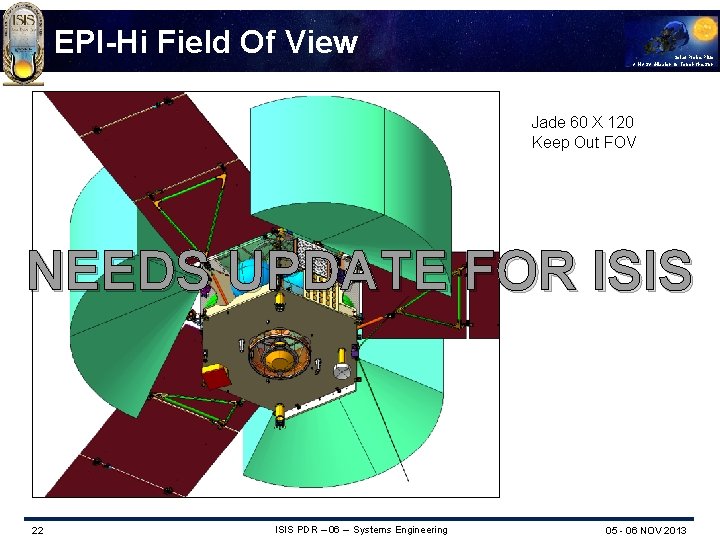
EPI-Hi Field Of View Solar Probe Plus A NASA Mission to Touch the Sun Jade 60 X 120 Keep Out FOV NEEDS UPDATE FOR ISIS 22 ISIS PDR – 06 – Systems Engineering 05 - 06 NOV 2013
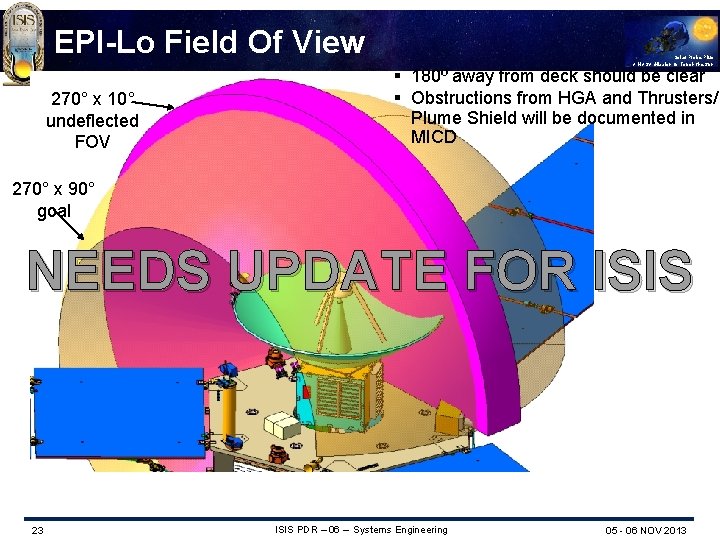
EPI-Lo Field Of View 270° x 10° undeflected FOV Solar Probe Plus A NASA Mission to Touch the Sun § 180º away from deck should be clear § Obstructions from HGA and Thrusters/ Plume Shield will be documented in MICD 270° x 90° goal NEEDS UPDATE FOR ISIS 23 ISIS PDR – 06 – Systems Engineering 05 - 06 NOV 2013
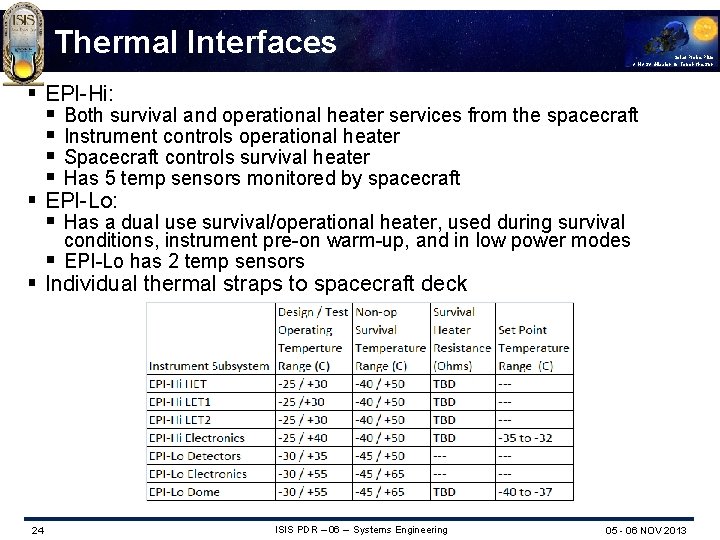
Thermal Interfaces Solar Probe Plus A NASA Mission to Touch the Sun § EPI-Hi: § Both survival and operational heater services from the spacecraft § Instrument controls operational heater § Spacecraft controls survival heater § Has 5 temp sensors monitored by spacecraft § EPI-Lo: § Has a dual use survival/operational heater, used during survival conditions, instrument pre-on warm-up, and in low power modes § EPI-Lo has 2 temp sensors § Individual thermal straps to spacecraft deck 24 ISIS PDR – 06 – Systems Engineering 05 - 06 NOV 2013
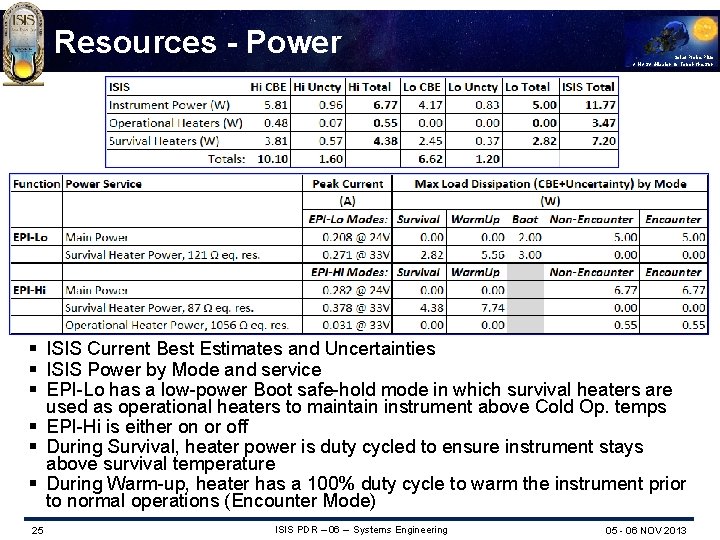
Resources - Power Solar Probe Plus A NASA Mission to Touch the Sun § ISIS Current Best Estimates and Uncertainties § ISIS Power by Mode and service § EPI-Lo has a low-power Boot safe-hold mode in which survival heaters are used as operational heaters to maintain instrument above Cold Op. temps § EPI-Hi is either on or off § During Survival, heater power is duty cycled to ensure instrument stays above survival temperature § During Warm-up, heater has a 100% duty cycle to warm the instrument prior to normal operations (Encounter Mode) 25 ISIS PDR – 06 – Systems Engineering 05 - 06 NOV 2013
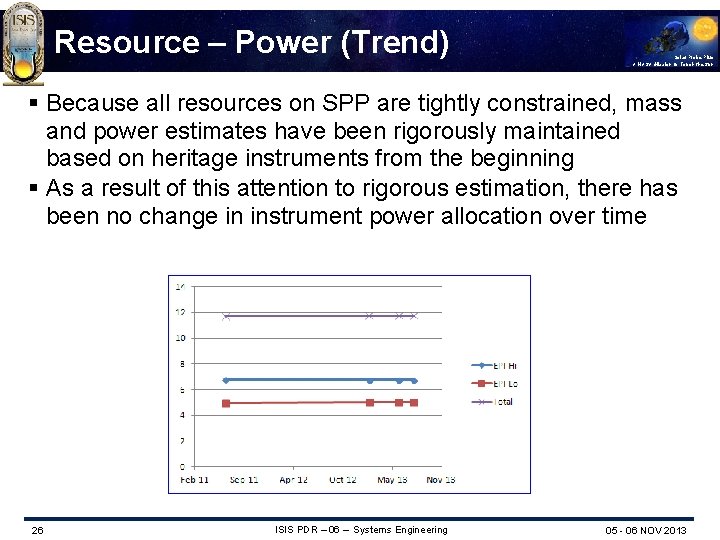
Resource – Power (Trend) Solar Probe Plus A NASA Mission to Touch the Sun § Because all resources on SPP are tightly constrained, mass and power estimates have been rigorously maintained based on heritage instruments from the beginning § As a result of this attention to rigorous estimation, there has been no change in instrument power allocation over time 26 ISIS PDR – 06 – Systems Engineering 05 - 06 NOV 2013
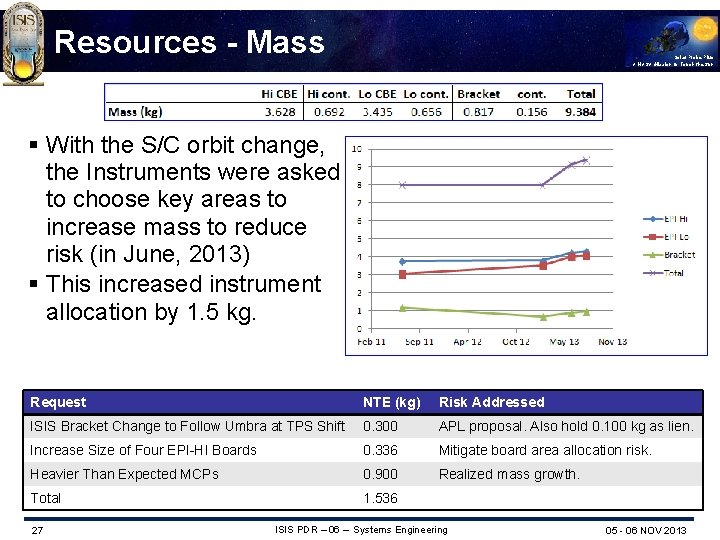
Resources - Mass Solar Probe Plus A NASA Mission to Touch the Sun § With the S/C orbit change, the Instruments were asked to choose key areas to increase mass to reduce risk (in June, 2013) § This increased instrument allocation by 1. 5 kg. Request NTE (kg) Risk Addressed ISIS Bracket Change to Follow Umbra at TPS Shift 0. 300 APL proposal. Also hold 0. 100 kg as lien. Increase Size of Four EPI-HI Boards 0. 336 Mitigate board area allocation risk. Heavier Than Expected MCPs 0. 900 Realized mass growth. Total 1. 536 27 ISIS PDR – 06 – Systems Engineering 05 - 06 NOV 2013
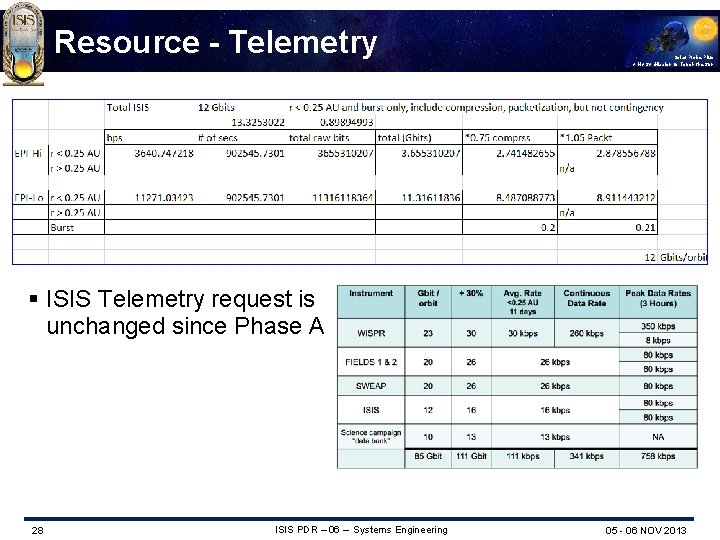
Resource - Telemetry Solar Probe Plus A NASA Mission to Touch the Sun § ISIS Telemetry request is unchanged since Phase A 28 ISIS PDR – 06 – Systems Engineering 05 - 06 NOV 2013
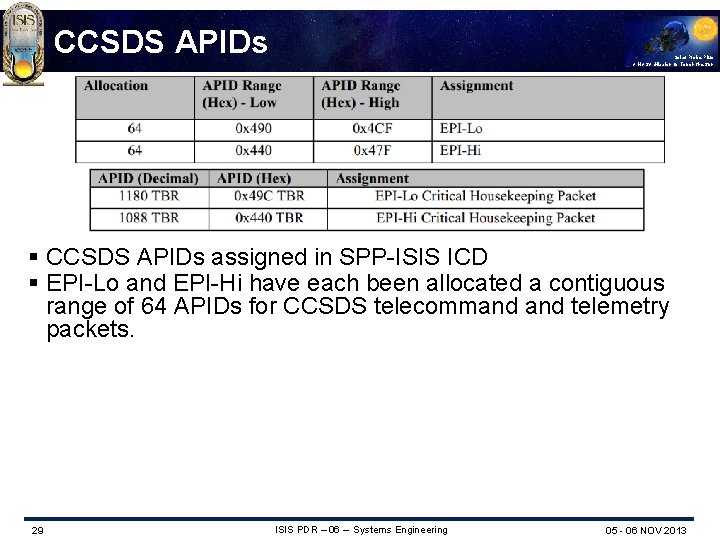
CCSDS APIDs Solar Probe Plus A NASA Mission to Touch the Sun § CCSDS APIDs assigned in SPP-ISIS ICD § EPI-Lo and EPI-Hi have each been allocated a contiguous range of 64 APIDs for CCSDS telecommand telemetry packets. 29 ISIS PDR – 06 – Systems Engineering 05 - 06 NOV 2013
Autonomy Summary Solar Probe Plus A NASA Mission to Touch the Sun The spacecraft will monitor and respond to: § ISIS Power requests instrument critical housekeeping telemetry packet: § instrument power-down (response = power-down) § instrument power-cycle (response when < 0. 25 AU = power-cycle; response when >= 0. 25 AU = power-down) § ISIS Stale aliveness status as determined from the sequence count in the ITF (response when < 0. 25 AU = power-cycle; response when >= 0. 25 AU = power-down) § Excessive instrument power levels as determined from spacecraft Power Distribution Unit (PDU) telemetry (response = power-down) § Excessive instrument temperature as determined from spacecraft Remote Interface Units (RIUs) (response = power-down) 30 ISIS PDR – 06 – Systems Engineering 05 - 06 NOV 2013
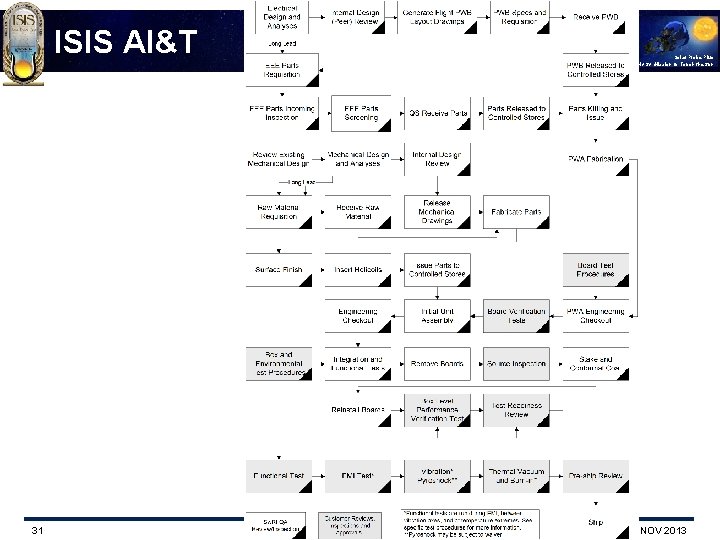
ISIS AI&T 31 Solar Probe Plus A NASA Mission to Touch the Sun ISIS PDR – 06 – Systems Engineering 05 - 06 NOV 2013
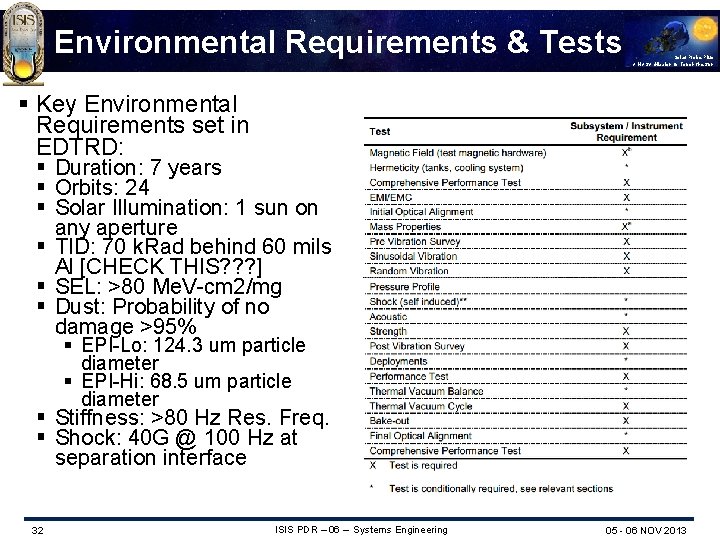
Environmental Requirements & Tests Solar Probe Plus A NASA Mission to Touch the Sun § Key Environmental Requirements set in EDTRD: § Duration: 7 years § Orbits: 24 § Solar Illumination: 1 sun on any aperture § TID: 70 k. Rad behind 60 mils Al [CHECK THIS? ? ? ] § SEL: >80 Me. V-cm 2/mg § Dust: Probability of no damage >95% § EPI-Lo: 124. 3 um particle diameter § EPI-Hi: 68. 5 um particle diameter § Stiffness: >80 Hz Res. Freq. § Shock: 40 G @ 100 Hz at separation interface 32 ISIS PDR – 06 – Systems Engineering 05 - 06 NOV 2013
ISIS Concept of Operations Solar Probe Plus A NASA Mission to Touch the Sun § Commissioning – 2 days for ISIS alone § Initial Turn-on and Checkout with Real-Time Telemetry § Multi-Instrument Commissioning – 5 days for Instrument Suite § EPI-Hi & EPI-Lo performs statistics gathering for calibration § Calibration goal: at least 1 d of data during significant SEP event on orbit 1 -2 § Spacecraft-Sun Distance R<0. 25 AU (Normal Science Mode) § Full nominal power § High data collection rate and burst mode § Spacecraft-Sun Distance: 0. 25< R<0. 76 AU (Low-rate Science Mode) § Full power when not downlinking § Full power or low-power mode when downlinking § Reduced data collection rate § Commanding window should be scheduled late in the series of telemetry passes, although it may not be used every orbit § Minimize power cycling the HV supplies 33 ISIS PDR – 06 – Systems Engineering 05 - 06 NOV 2013
Major Changes Since MDR Solar Probe Plus A NASA Mission to Touch the Sun § Mission Orbit Change § Embraced Quadrant Architecture on EPI-Lo § Added Anti-Coincidence in EPI-Lo NEEDS UPDATE FOR ISIS 34 ISIS PDR – 06 – Systems Engineering 05 - 06 NOV 2013
Trade Studies 35 Solar Probe Plus A NASA Mission to Touch the Sun ISIS PDR – 06 – Systems Engineering 05 - 06 NOV 2013
Summary Solar Probe Plus A NASA Mission to Touch the Sun § ISIS takes a comprehensive and distributed approach to systems engineering § ISIS requirements are approached with flowdown and verification in mind § Requirements flowdown is easily traceable and well understood § ISIS design meets or exceeds all Level 3 requirements § ISIS to Spacecraft electrical, mechanical, and thermal interfaces are well described in the ICDs § ISIS Resource estimates are within spacecraft allocations § ISIS has cultivated a reputation as a good steward of mission resources § Plans are in place for Environmental Testing and AI&T § ISIS has demonstrated tremendous design maturation and clarification throughout Phase B § Next steps § Continue with EM builds and testing 36 ISIS PDR – 06 – Systems Engineering 05 - 06 NOV 2013
Requirements Verification Solar Probe Plus A NASA Mission to Touch the Sun § Verification Planning § Inspection, Analysis, Test § Specs lead to VTP where individual requirements are checked § off Completing VTP’s in EM so we have the documents ready for FM build Linking specs, and VTP’s / As-Run tests in DOORS Verification Matrix shows how each requirement will be verified, and links to the appropriate test procedure Reviewing Juno Verification and Validation Plan, D-34004 NEEDS UPDATE FOR ISIS § § § 37 ISIS PDR – 06 – Systems Engineering 05 - 06 NOV 2013
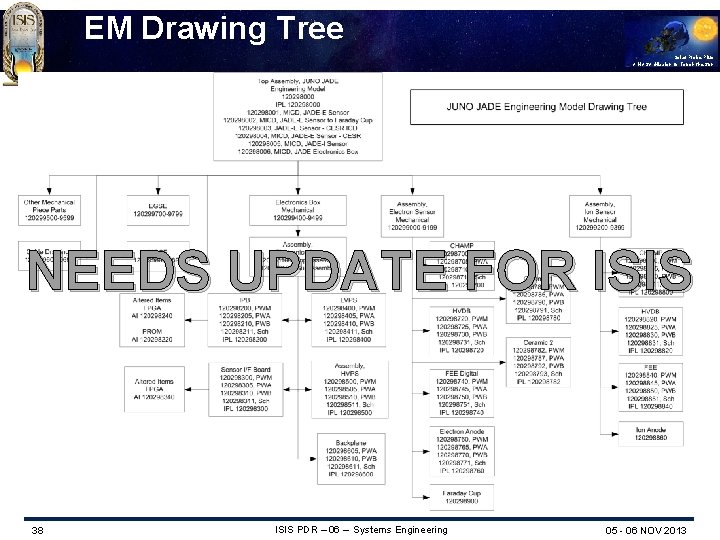
EM Drawing Tree Solar Probe Plus A NASA Mission to Touch the Sun NEEDS UPDATE FOR ISIS 38 ISIS PDR – 06 – Systems Engineering 05 - 06 NOV 2013
JADE Operations § JADE Hardware Modes Solar Probe Plus A NASA Mission to Touch the Sun § Boot § Instrument has been turned on and is booting up, not ready to respond to commands § Low Voltage Engineering § Low power mode, no high voltage. Initial post-boot state. § Functional testing, initial low voltage turn-on and checkout. § High Voltage Engineering § Allows direct control of high voltage via commands. § Allows for initial checkout of high voltage performance, as well as specific calibration activities. § No automatic sweeping of high voltage. NEEDS UPDATE FOR ISIS § High Voltage Survey § Low rate science data collection mode that is active for most of the 11 -day nominal science orbit, outside of the +/- 3 hr perijove prime observation period. § High Voltage Science § High rate science data collection mode. Active during the +/- 3 hr around perijove region in a nominal science orbit. § High Voltage Science + Burst § Burst data collection is active in addition to high voltage science mode. § Burst data is the uncollapsed data products produced by each sensor, sent out over the dedicated High Speed Synchronous (HSS) RS-422 data line to be collected in buffers by the spacecraft. Occurs over the north and south polar regions of Jupiter only, within the prime science observation region. 39 ISIS PDR – 06 – Systems Engineering 05 - 06 NOV 2013
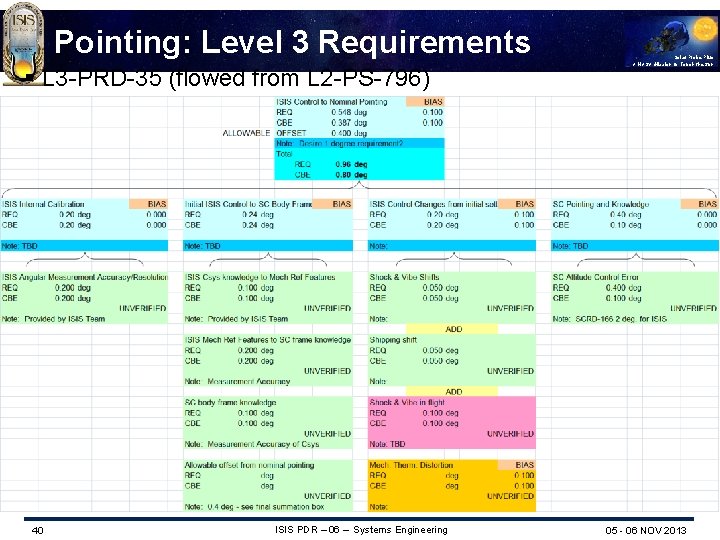
Pointing: Level 3 Requirements Solar Probe Plus A NASA Mission to Touch the Sun § L 3 -PRD-35 (flowed from L 2 -PS-796) § During the science orbits, the Juno Project shall provide attitude reconstruction with respect to inertial space for each Waves, UVS, JADE sensor/antenna's electrical boresight with errors within ± 20 milliradians, with 99. 73% certainty, to each instrument's team. Excluded from this requirement are the following periods: NEEDS UPDATE FOR ISIS § JADE Allocation: 4. 4 mrad (0. 25 degrees) DELETE? § 30 minutes following any thruster firing § 5 hours following any OTM, precession greater than 10 mrad or appendage articulation § Verified by Test during Calibration for knowledge of JADE Boresight 40 ISIS PDR – 06 – Systems Engineering 05 - 06 NOV 2013
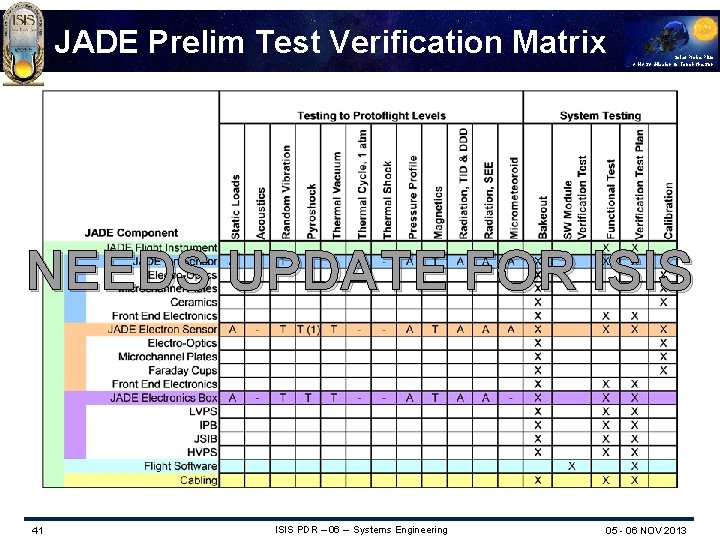
JADE Prelim Test Verification Matrix Solar Probe Plus A NASA Mission to Touch the Sun NEEDS UPDATE FOR ISIS 41 ISIS PDR – 06 – Systems Engineering 05 - 06 NOV 2013
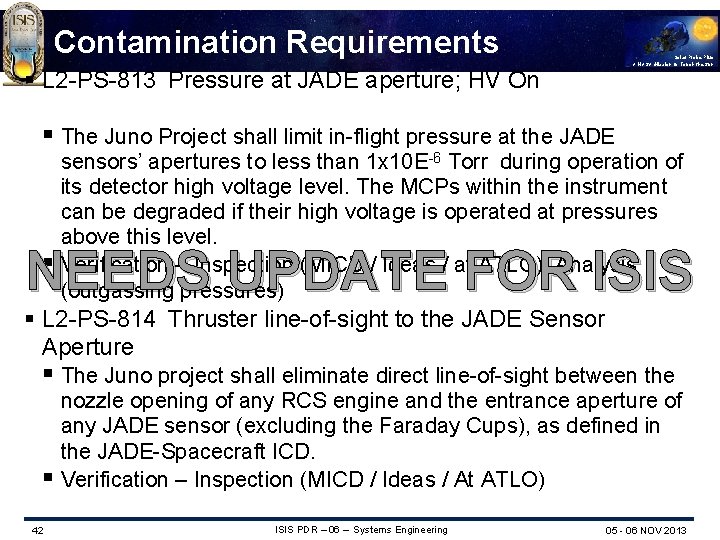
Contamination Requirements Solar Probe Plus A NASA Mission to Touch the Sun § L 2 -PS-813 Pressure at JADE aperture; HV On § The Juno Project shall limit in-flight pressure at the JADE sensors’ apertures to less than 1 x 10 E-6 Torr during operation of its detector high voltage level. The MCPs within the instrument can be degraded if their high voltage is operated at pressures above this level. § Verification – Inspection (MICD / Ideas / at ATLO), Analysis (outgassing pressures) NEEDS UPDATE FOR ISIS § L 2 -PS-814 Thruster line-of-sight to the JADE Sensor Aperture § The Juno project shall eliminate direct line-of-sight between the nozzle opening of any RCS engine and the entrance aperture of any JADE sensor (excluding the Faraday Cups), as defined in the JADE-Spacecraft ICD. § Verification – Inspection (MICD / Ideas / At ATLO) 42 ISIS PDR – 06 – Systems Engineering 05 - 06 NOV 2013
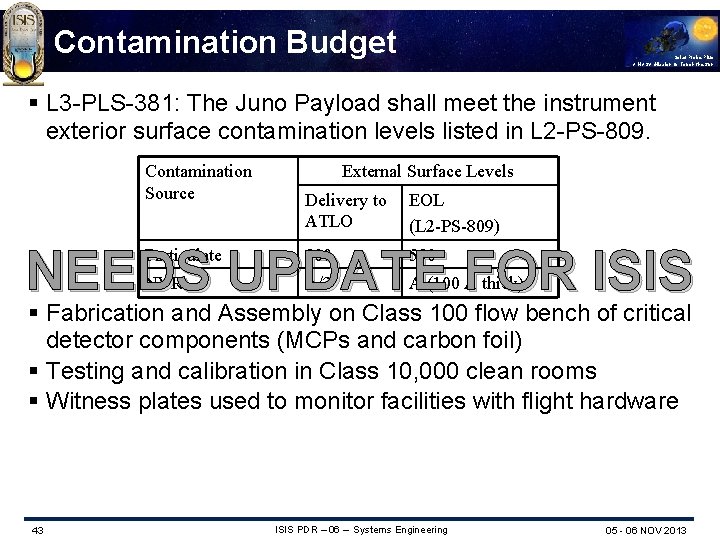
Contamination Budget Solar Probe Plus A NASA Mission to Touch the Sun § L 3 -PLS-381: The Juno Payload shall meet the instrument exterior surface contamination levels listed in L 2 -PS-809. Contamination Source External Surface Levels Delivery to ATLO EOL (L 2 -PS-809) NEEDS UPDATE FOR ISIS Particulate 500 550 NVR A/2 A (100 Å thick) § Fabrication and Assembly on Class 100 flow bench of critical detector components (MCPs and carbon foil) § Testing and calibration in Class 10, 000 clean rooms § Witness plates used to monitor facilities with flight hardware 43 ISIS PDR – 06 – Systems Engineering 05 - 06 NOV 2013
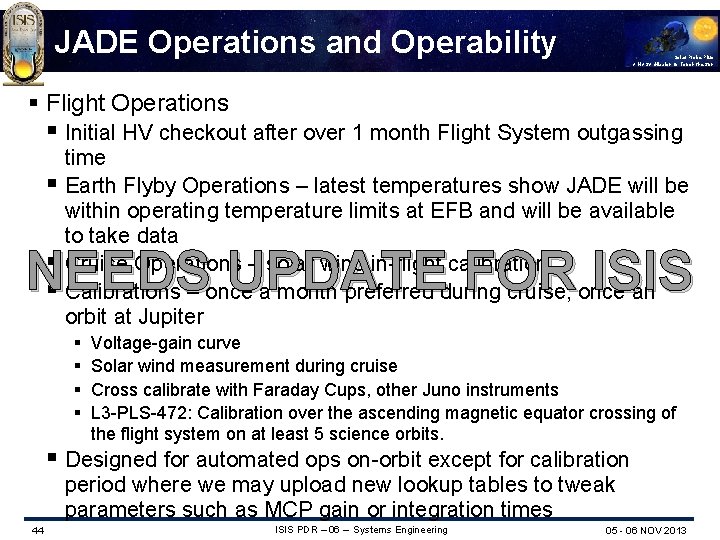
JADE Operations and Operability Solar Probe Plus A NASA Mission to Touch the Sun § Flight Operations § Initial HV checkout after over 1 month Flight System outgassing time § Earth Flyby Operations – latest temperatures show JADE will be within operating temperature limits at EFB and will be available to take data § Cruise Operations – solar wind in-flight calibration § Calibrations – once a month preferred during cruise, once an orbit at Jupiter NEEDS UPDATE FOR ISIS § § Voltage-gain curve Solar wind measurement during cruise Cross calibrate with Faraday Cups, other Juno instruments L 3 -PLS-472: Calibration over the ascending magnetic equator crossing of the flight system on at least 5 science orbits. § Designed for automated ops on-orbit except for calibration period where we may upload new lookup tables to tweak parameters such as MCP gain or integration times 44 ISIS PDR – 06 – Systems Engineering 05 - 06 NOV 2013
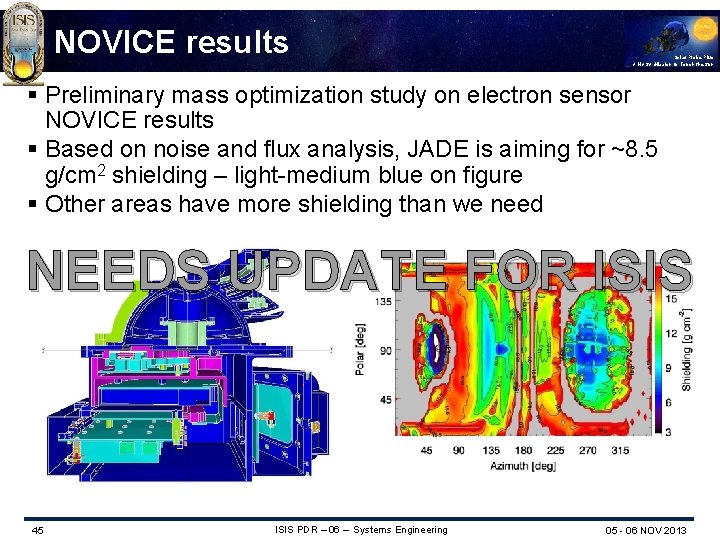
NOVICE results Solar Probe Plus A NASA Mission to Touch the Sun § Preliminary mass optimization study on electron sensor NOVICE results § Based on noise and flux analysis, JADE is aiming for ~8. 5 g/cm 2 shielding – light-medium blue on figure § Other areas have more shielding than we need NEEDS UPDATE FOR ISIS 45 ISIS PDR – 06 – Systems Engineering 05 - 06 NOV 2013
- Slides: 45