
Solar Probe Plus A NASA Mission to Touch
Solar Probe Plus A NASA Mission to Touch the Sun Integrated Science Investigation of the Sun Energetic Particles Preliminary Design Review 05 – 06 NOV 2013 Systems Engineering John Dickinson ISIS SE (Sw. RI) This document contains technical data that may be controlled by the International Traffic in Arms Regulations (22 CFR 120 -130) and may not be provided, disclosed or transferred in any manner to any person, whether in the U. S. or abroad, who is not 1) a citizen of the United States, 2) a lawful permanent resident of the United States, or 3) a protected individual as defined by 8 USC 1324 b(a)(3), without the written permission of the United States Department of State.
Outline Solar Probe Plus A NASA Mission to Touch the Sun § ISIS SE Approach § SPP Requirements § ISIS Requirements and Flowdown § Interfaces and Accommodation § Resources § Instrument Command Autonomy § Environmental Design and Test Requirements § Trade Studies § Summary 2 ISIS PDR – 06 – Systems Engineering 05 - 06 NOV 2013
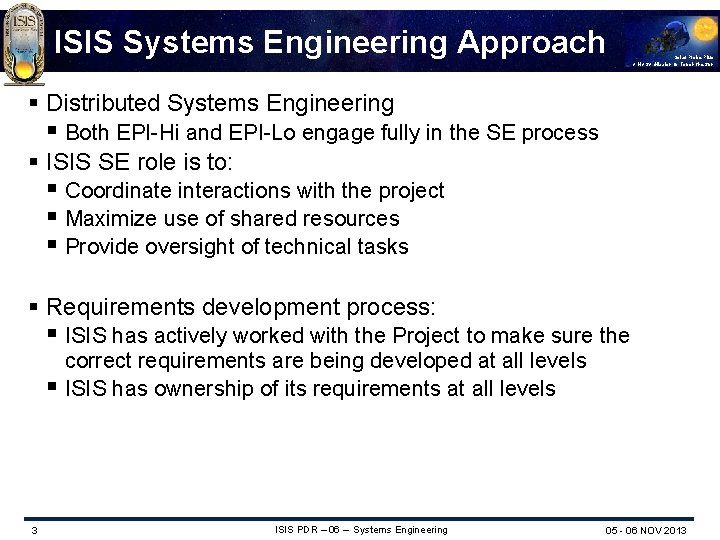
ISIS Systems Engineering Approach Solar Probe Plus A NASA Mission to Touch the Sun § Distributed Systems Engineering § Both EPI-Hi and EPI-Lo engage fully in the SE process § ISIS SE role is to: § Coordinate interactions with the project § Maximize use of shared resources § Provide oversight of technical tasks § Requirements development process: § ISIS has actively worked with the Project to make sure the correct requirements are being developed at all levels § ISIS has ownership of its requirements at all levels 3 ISIS PDR – 06 – Systems Engineering 05 - 06 NOV 2013
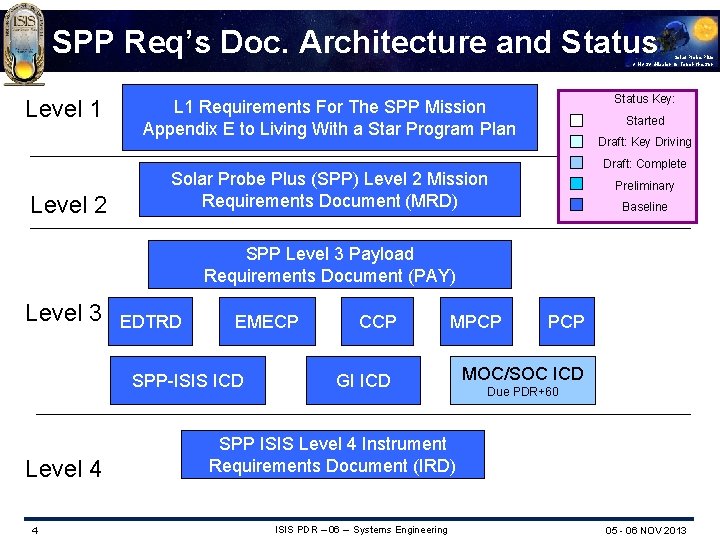
SPP Req’s Doc. Architecture and Status Solar Probe Plus A NASA Mission to Touch the Sun Level 1 Level 2 Status Key: L 1 Requirements For The SPP Mission Appendix E to Living With a Star Program Plan Started Draft: Key Driving Draft: Complete Solar Probe Plus (SPP) Level 2 Mission Requirements Document (MRD) Preliminary Baseline SPP Level 3 Payload Requirements Document (PAY) Level 3 EDTRD EMECP SPP-ISIS ICD Level 4 4 CCP MPCP GI ICD PCP MOC/SOC ICD Due PDR+60 SPP ISIS Level 4 Instrument Requirements Document (IRD) ISIS PDR – 06 – Systems Engineering 05 - 06 NOV 2013
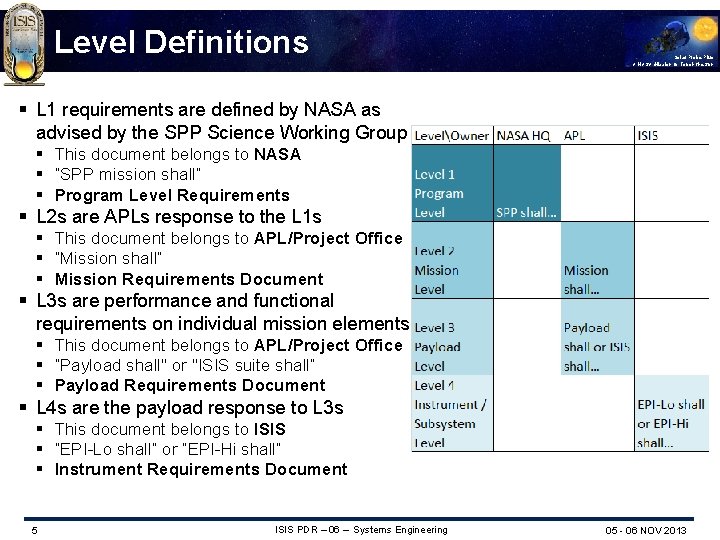
Level Definitions Solar Probe Plus A NASA Mission to Touch the Sun § L 1 requirements are defined by NASA as advised by the SPP Science Working Group § This document belongs to NASA § “SPP mission shall” § Program Level Requirements § L 2 s are APLs response to the L 1 s § This document belongs to APL/Project Office § “Mission shall” § Mission Requirements Document § L 3 s are performance and functional requirements on individual mission elements § This document belongs to APL/Project Office § “Payload shall" or "ISIS suite shall“ § Payload Requirements Document § L 4 s are the payload response to L 3 s § This document belongs to ISIS § “EPI-Lo shall” or “EPI-Hi shall” § Instrument Requirements Document 5 ISIS PDR – 06 – Systems Engineering 05 - 06 NOV 2013
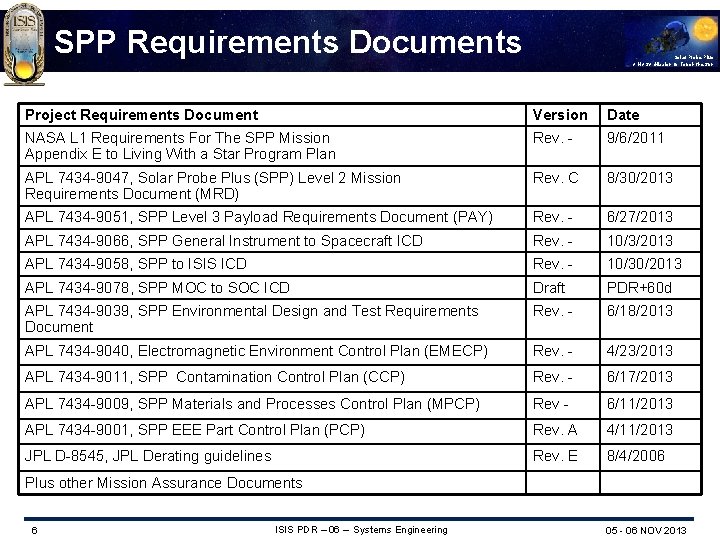
SPP Requirements Documents Solar Probe Plus A NASA Mission to Touch the Sun Project Requirements Document Version Date NASA L 1 Requirements For The SPP Mission Appendix E to Living With a Star Program Plan Rev. - 9/6/2011 APL 7434 -9047, Solar Probe Plus (SPP) Level 2 Mission Requirements Document (MRD) Rev. C 8/30/2013 APL 7434 -9051, SPP Level 3 Payload Requirements Document (PAY) Rev. - 6/27/2013 APL 7434 -9066, SPP General Instrument to Spacecraft ICD Rev. - 10/3/2013 APL 7434 -9058, SPP to ISIS ICD Rev. - 10/30/2013 APL 7434 -9078, SPP MOC to SOC ICD Draft PDR+60 d APL 7434 -9039, SPP Environmental Design and Test Requirements Document Rev. - 6/18/2013 APL 7434 -9040, Electromagnetic Environment Control Plan (EMECP) Rev. - 4/23/2013 APL 7434 -9011, SPP Contamination Control Plan (CCP) Rev. - 6/17/2013 APL 7434 -9009, SPP Materials and Processes Control Plan (MPCP) Rev - 6/11/2013 APL 7434 -9001, SPP EEE Part Control Plan (PCP) Rev. A 4/11/2013 JPL D-8545, JPL Derating guidelines Rev. E 8/4/2006 Plus other Mission Assurance Documents 6 ISIS PDR – 06 – Systems Engineering 05 - 06 NOV 2013
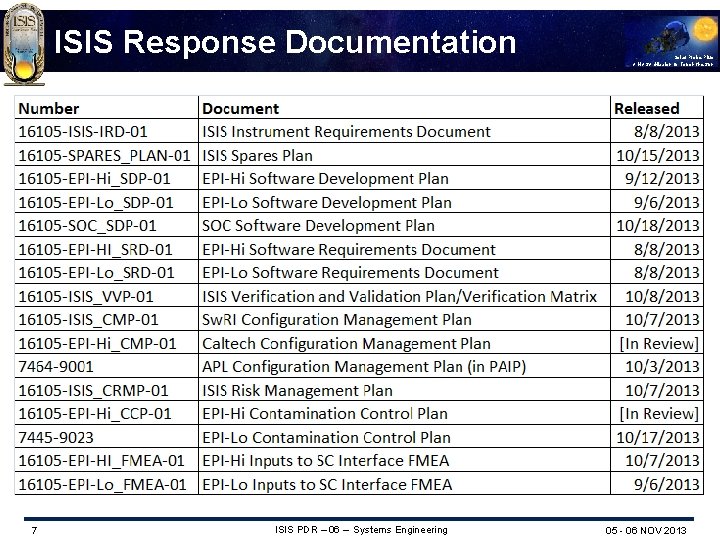
ISIS Response Documentation 7 ISIS PDR – 06 – Systems Engineering Solar Probe Plus A NASA Mission to Touch the Sun 05 - 06 NOV 2013
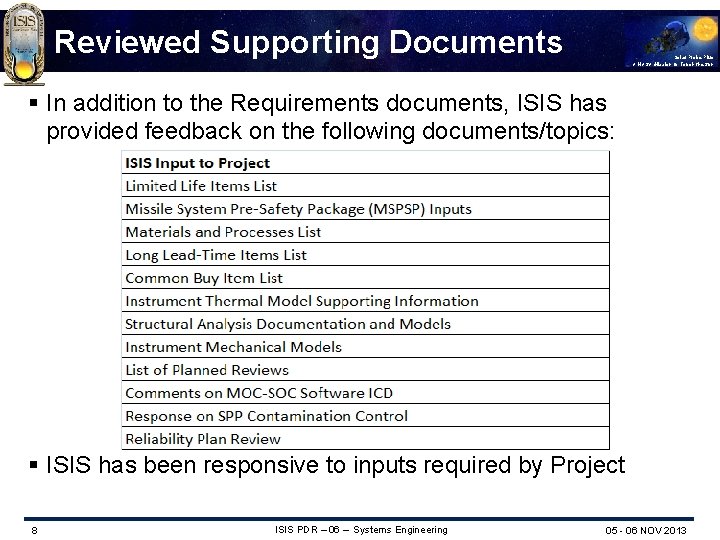
Reviewed Supporting Documents Solar Probe Plus A NASA Mission to Touch the Sun § In addition to the Requirements documents, ISIS has provided feedback on the following documents/topics: § ISIS has been responsive to inputs required by Project 8 ISIS PDR – 06 – Systems Engineering 05 - 06 NOV 2013
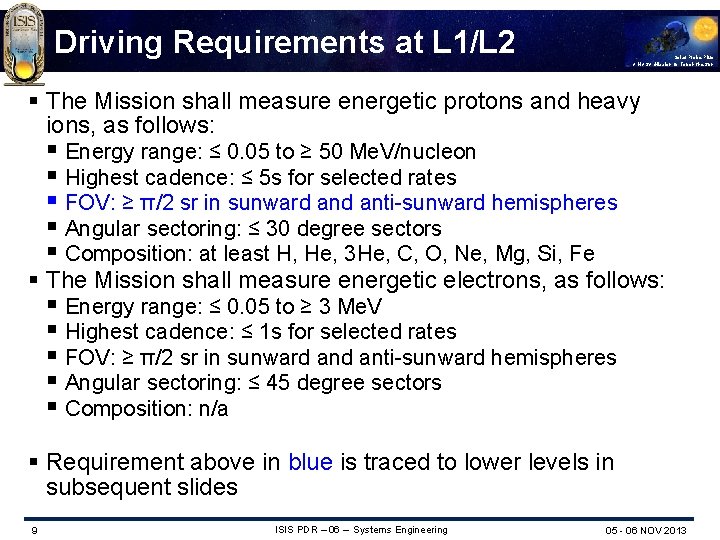
Driving Requirements at L 1/L 2 Solar Probe Plus A NASA Mission to Touch the Sun § The Mission shall measure energetic protons and heavy ions, as follows: § Energy range: ≤ 0. 05 to ≥ 50 Me. V/nucleon § Highest cadence: ≤ 5 s for selected rates § FOV: ≥ π/2 sr in sunward anti-sunward hemispheres § Angular sectoring: ≤ 30 degree sectors § Composition: at least H, He, 3 He, C, O, Ne, Mg, Si, Fe § The Mission shall measure energetic electrons, as follows: § Energy range: ≤ 0. 05 to ≥ 3 Me. V § Highest cadence: ≤ 1 s for selected rates § FOV: ≥ π/2 sr in sunward anti-sunward hemispheres § Angular sectoring: ≤ 45 degree sectors § Composition: n/a § Requirement above in blue is traced to lower levels in subsequent slides 9 ISIS PDR – 06 – Systems Engineering 05 - 06 NOV 2013
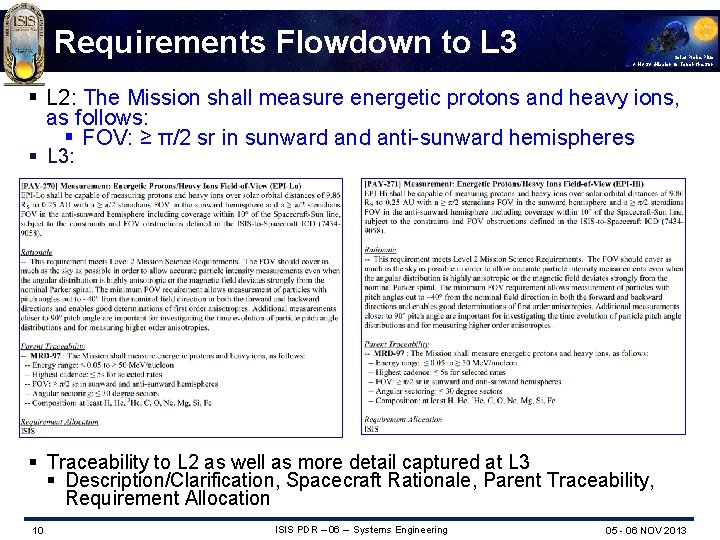
Requirements Flowdown to L 3 Solar Probe Plus A NASA Mission to Touch the Sun § L 2: The Mission shall measure energetic protons and heavy ions, as follows: § FOV: ≥ π/2 sr in sunward anti-sunward hemispheres § L 3: § Traceability to L 2 as well as more detail captured at L 3 § Description/Clarification, Spacecraft Rationale, Parent Traceability, Requirement Allocation 10 ISIS PDR – 06 – Systems Engineering 05 - 06 NOV 2013
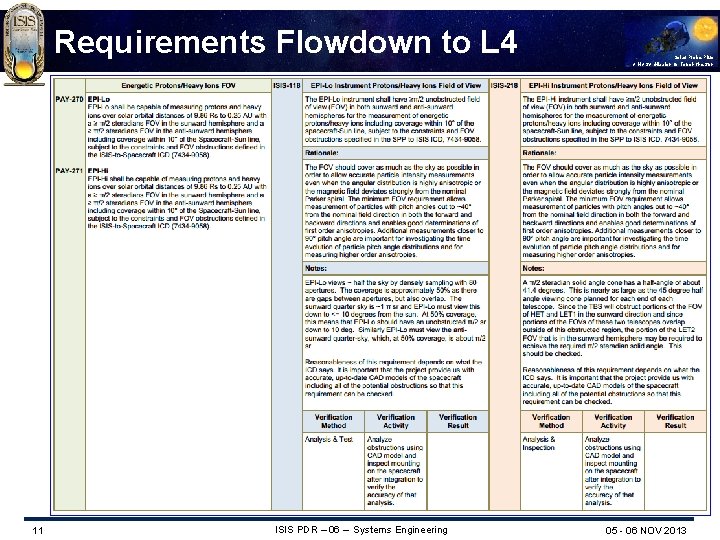
Requirements Flowdown to L 4 11 ISIS PDR – 06 – Systems Engineering Solar Probe Plus A NASA Mission to Touch the Sun 05 - 06 NOV 2013
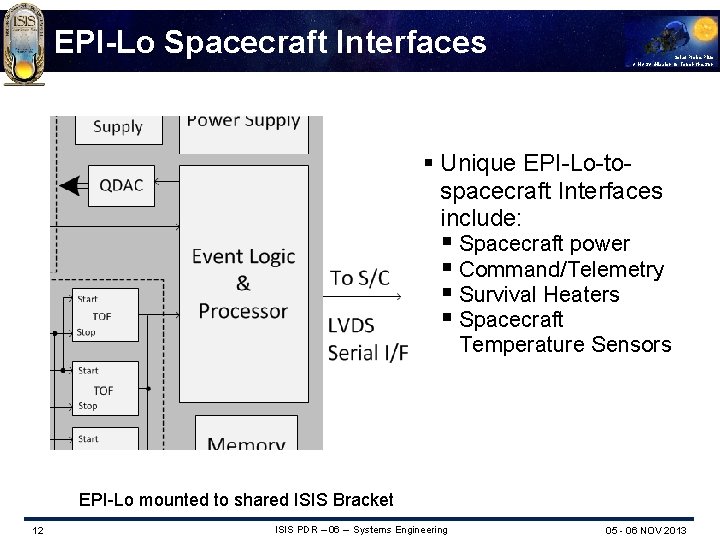
EPI-Lo Spacecraft Interfaces Solar Probe Plus A NASA Mission to Touch the Sun § Unique EPI-Lo-tospacecraft Interfaces include: § Spacecraft power § Command/Telemetry § Survival Heaters § Spacecraft Temperature Sensors EPI-Lo mounted to shared ISIS Bracket 12 ISIS PDR – 06 – Systems Engineering 05 - 06 NOV 2013
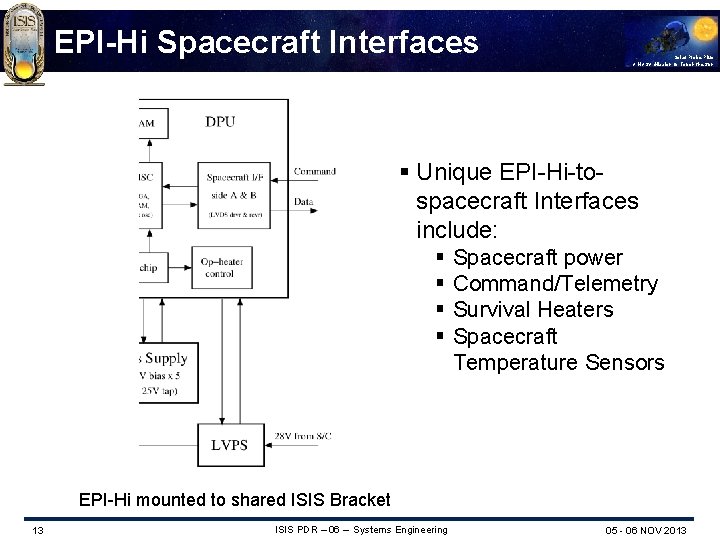
EPI-Hi Spacecraft Interfaces Solar Probe Plus A NASA Mission to Touch the Sun § Unique EPI-Hi-tospacecraft Interfaces include: § § Spacecraft power Command/Telemetry Survival Heaters Spacecraft Temperature Sensors EPI-Hi mounted to shared ISIS Bracket 13 ISIS PDR – 06 – Systems Engineering 05 - 06 NOV 2013
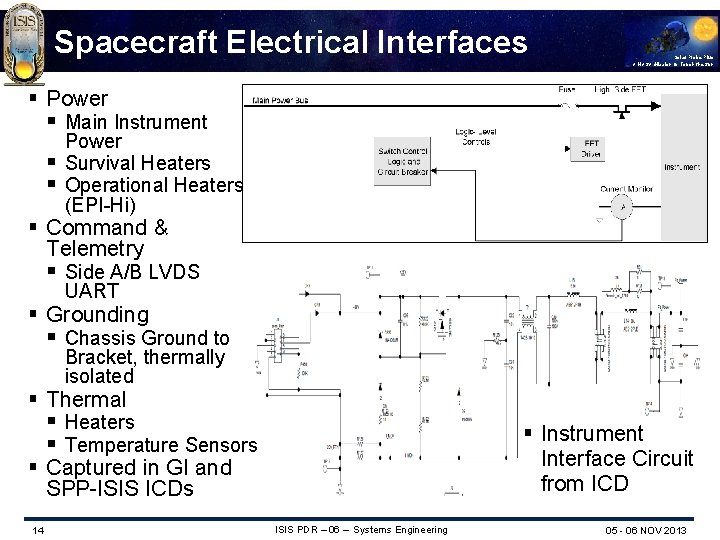
Spacecraft Electrical Interfaces Solar Probe Plus A NASA Mission to Touch the Sun § Power § Main Instrument Power § Survival Heaters § Operational Heaters (EPI-Hi) § Command & Telemetry § Side A/B LVDS UART § Grounding § Chassis Ground to Bracket, thermally isolated § Thermal § Heaters § Temperature Sensors § Captured in GI and SPP-ISIS ICDs 14 § Instrument Interface Circuit from ICD ISIS PDR – 06 – Systems Engineering 05 - 06 NOV 2013
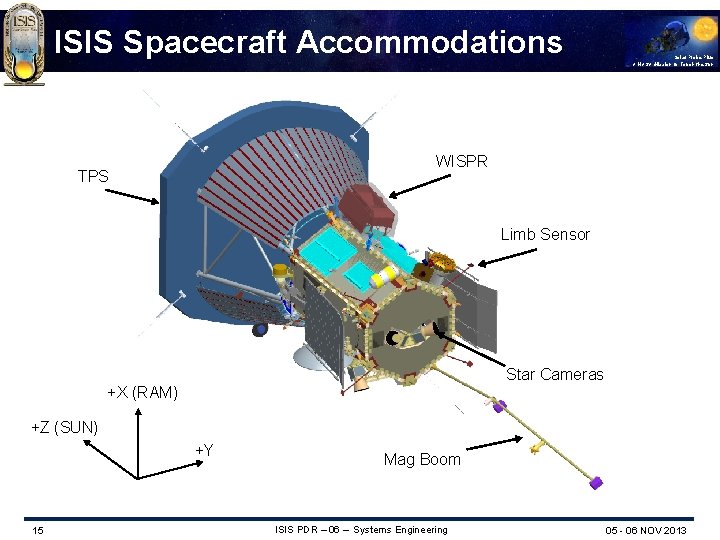
ISIS Spacecraft Accommodations Solar Probe Plus A NASA Mission to Touch the Sun WISPR TPS Limb Sensor Star Cameras +X (RAM) +Z (SUN) +Y 15 Mag Boom ISIS PDR – 06 – Systems Engineering 05 - 06 NOV 2013
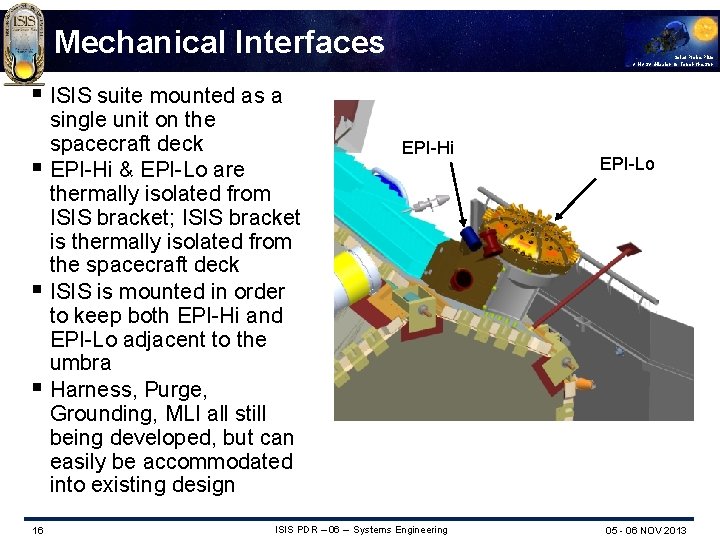
Mechanical Interfaces Solar Probe Plus A NASA Mission to Touch the Sun § ISIS suite mounted as a single unit on the spacecraft deck § EPI-Hi & EPI-Lo are thermally isolated from ISIS bracket; ISIS bracket is thermally isolated from the spacecraft deck § ISIS is mounted in order to keep both EPI-Hi and EPI-Lo adjacent to the umbra § Harness, Purge, Grounding, MLI all still being developed, but can easily be accommodated into existing design 16 EPI-Hi ISIS PDR – 06 – Systems Engineering EPI-Lo 05 - 06 NOV 2013
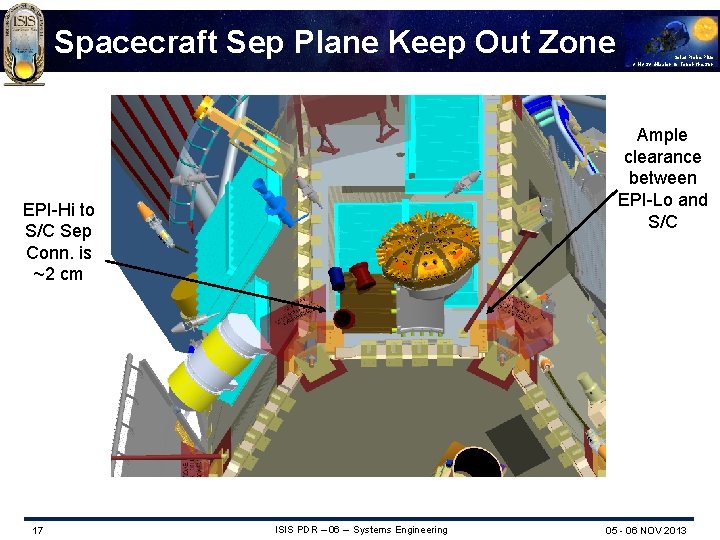
Spacecraft Sep Plane Keep Out Zone Ample clearance between EPI-Lo and S/C EPI-Hi to S/C Sep Conn. is ~2 cm 17 Solar Probe Plus A NASA Mission to Touch the Sun ISIS PDR – 06 – Systems Engineering 05 - 06 NOV 2013
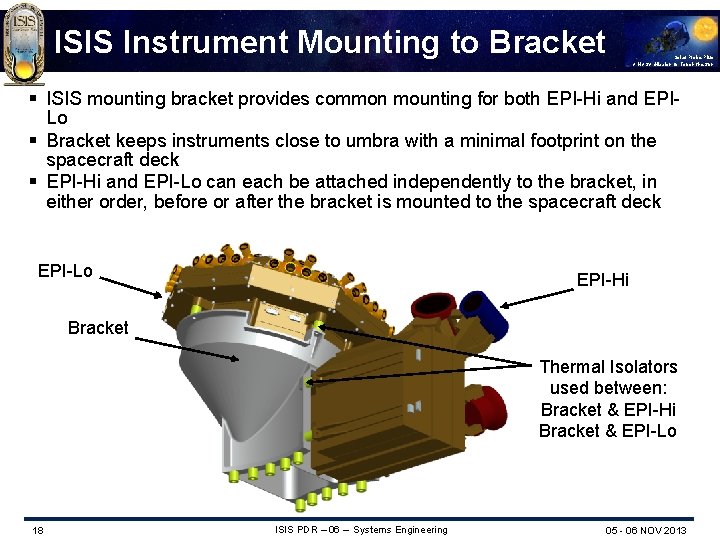
ISIS Instrument Mounting to Bracket Solar Probe Plus A NASA Mission to Touch the Sun § ISIS mounting bracket provides common mounting for both EPI-Hi and EPILo § Bracket keeps instruments close to umbra with a minimal footprint on the spacecraft deck § EPI-Hi and EPI-Lo can each be attached independently to the bracket, in either order, before or after the bracket is mounted to the spacecraft deck EPI-Lo EPI-Hi Bracket Thermal Isolators used between: Bracket & EPI-Hi Bracket & EPI-Lo 18 ISIS PDR – 06 – Systems Engineering 05 - 06 NOV 2013
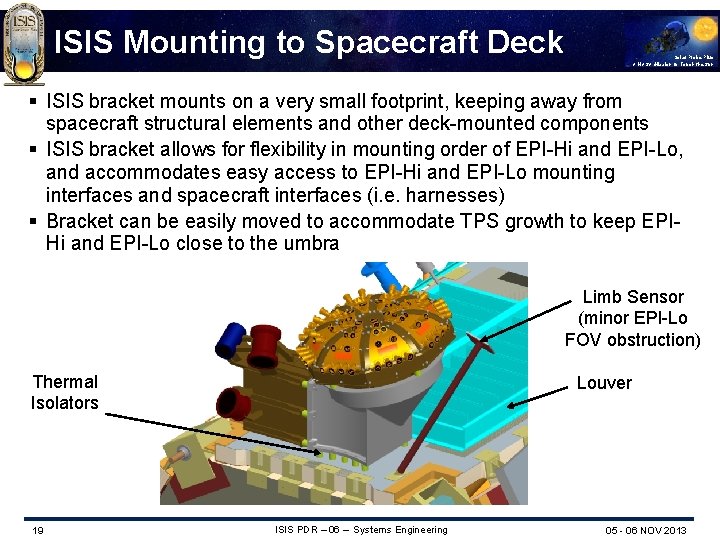
ISIS Mounting to Spacecraft Deck Solar Probe Plus A NASA Mission to Touch the Sun § ISIS bracket mounts on a very small footprint, keeping away from spacecraft structural elements and other deck-mounted components § ISIS bracket allows for flexibility in mounting order of EPI-Hi and EPI-Lo, and accommodates easy access to EPI-Hi and EPI-Lo mounting interfaces and spacecraft interfaces (i. e. harnesses) § Bracket can be easily moved to accommodate TPS growth to keep EPIHi and EPI-Lo close to the umbra Limb Sensor (minor EPI-Lo FOV obstruction) Thermal Isolators 19 Louver ISIS PDR – 06 – Systems Engineering 05 - 06 NOV 2013
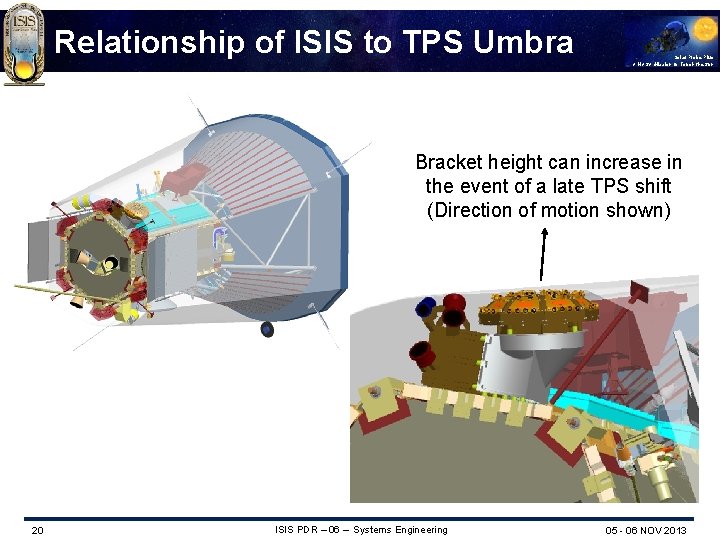
Relationship of ISIS to TPS Umbra Solar Probe Plus A NASA Mission to Touch the Sun Bracket height can increase in the event of a late TPS shift (Direction of motion shown) 20 ISIS PDR – 06 – Systems Engineering 05 - 06 NOV 2013
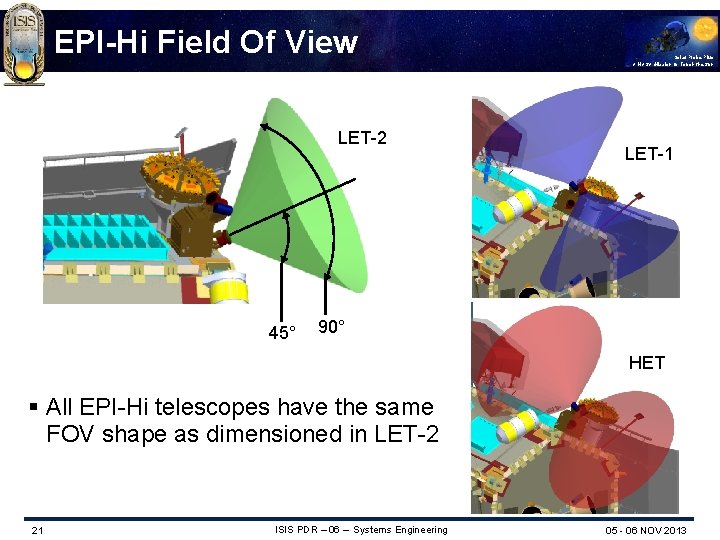
EPI-Hi Field Of View LET-2 45° Solar Probe Plus A NASA Mission to Touch the Sun LET-1 90° HET § All EPI-Hi telescopes have the same FOV shape as dimensioned in LET-2 21 ISIS PDR – 06 – Systems Engineering 05 - 06 NOV 2013
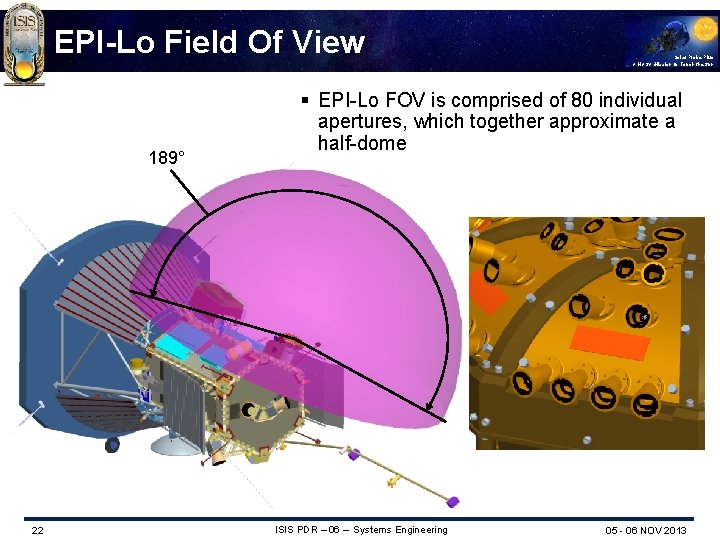
EPI-Lo Field Of View 189° 22 Solar Probe Plus A NASA Mission to Touch the Sun § EPI-Lo FOV is comprised of 80 individual apertures, which together approximate a half-dome ISIS PDR – 06 – Systems Engineering 05 - 06 NOV 2013
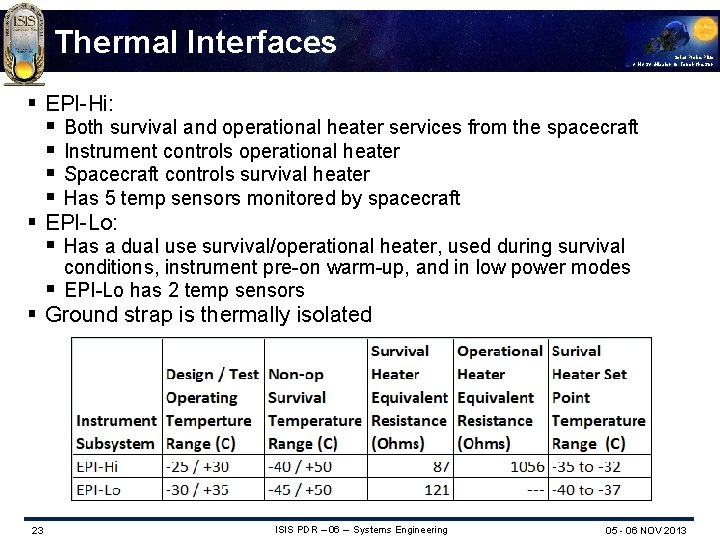
Thermal Interfaces Solar Probe Plus A NASA Mission to Touch the Sun § EPI-Hi: § Both survival and operational heater services from the spacecraft § Instrument controls operational heater § Spacecraft controls survival heater § Has 5 temp sensors monitored by spacecraft § EPI-Lo: § Has a dual use survival/operational heater, used during survival conditions, instrument pre-on warm-up, and in low power modes § EPI-Lo has 2 temp sensors § Ground strap is thermally isolated 23 ISIS PDR – 06 – Systems Engineering 05 - 06 NOV 2013
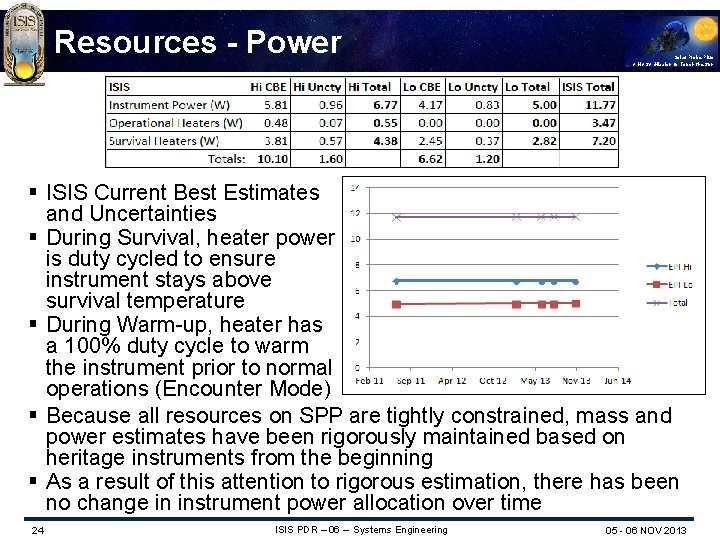
Resources - Power Solar Probe Plus A NASA Mission to Touch the Sun § ISIS Current Best Estimates and Uncertainties § During Survival, heater power is duty cycled to ensure instrument stays above survival temperature § During Warm-up, heater has a 100% duty cycle to warm the instrument prior to normal operations (Encounter Mode) § Because all resources on SPP are tightly constrained, mass and power estimates have been rigorously maintained based on heritage instruments from the beginning § As a result of this attention to rigorous estimation, there has been no change in instrument power allocation over time 24 ISIS PDR – 06 – Systems Engineering 05 - 06 NOV 2013
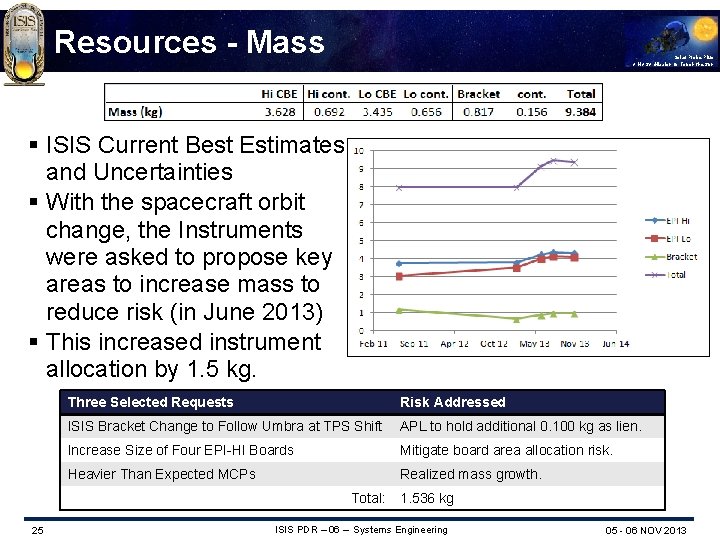
Resources - Mass Solar Probe Plus A NASA Mission to Touch the Sun § ISIS Current Best Estimates and Uncertainties § With the spacecraft orbit change, the Instruments were asked to propose key areas to increase mass to reduce risk (in June 2013) § This increased instrument allocation by 1. 5 kg. Three Selected Requests Risk Addressed ISIS Bracket Change to Follow Umbra at TPS Shift APL to hold additional 0. 100 kg as lien. Increase Size of Four EPI-HI Boards Mitigate board area allocation risk. Heavier Than Expected MCPs Realized mass growth. Total: 25 1. 536 kg ISIS PDR – 06 – Systems Engineering 05 - 06 NOV 2013
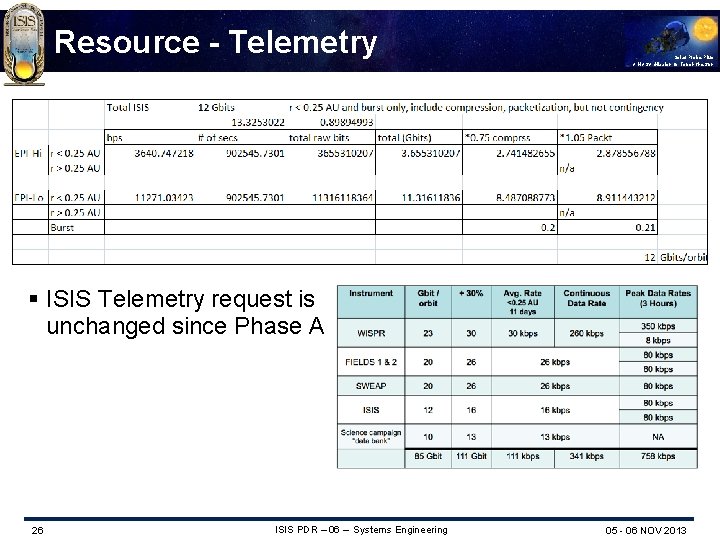
Resource - Telemetry Solar Probe Plus A NASA Mission to Touch the Sun § ISIS Telemetry request is unchanged since Phase A 26 ISIS PDR – 06 – Systems Engineering 05 - 06 NOV 2013
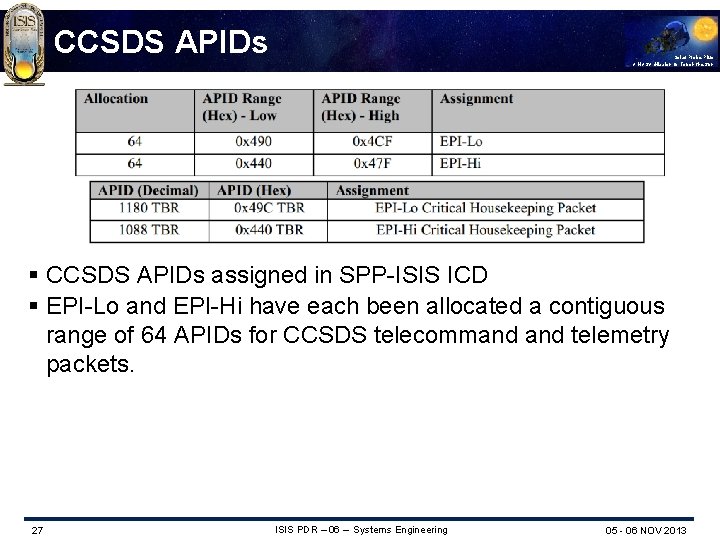
CCSDS APIDs Solar Probe Plus A NASA Mission to Touch the Sun § CCSDS APIDs assigned in SPP-ISIS ICD § EPI-Lo and EPI-Hi have each been allocated a contiguous range of 64 APIDs for CCSDS telecommand telemetry packets. 27 ISIS PDR – 06 – Systems Engineering 05 - 06 NOV 2013
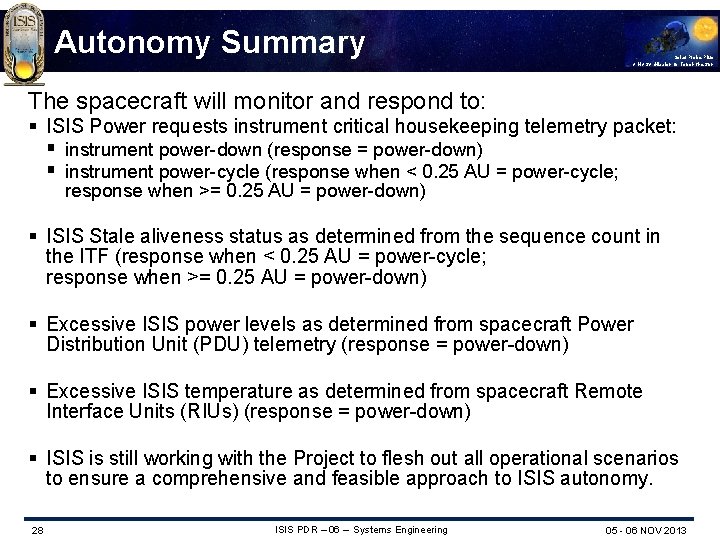
Autonomy Summary Solar Probe Plus A NASA Mission to Touch the Sun The spacecraft will monitor and respond to: § ISIS Power requests instrument critical housekeeping telemetry packet: § instrument power-down (response = power-down) § instrument power-cycle (response when < 0. 25 AU = power-cycle; response when >= 0. 25 AU = power-down) § ISIS Stale aliveness status as determined from the sequence count in the ITF (response when < 0. 25 AU = power-cycle; response when >= 0. 25 AU = power-down) § Excessive ISIS power levels as determined from spacecraft Power Distribution Unit (PDU) telemetry (response = power-down) § Excessive ISIS temperature as determined from spacecraft Remote Interface Units (RIUs) (response = power-down) § ISIS is still working with the Project to flesh out all operational scenarios to ensure a comprehensive and feasible approach to ISIS autonomy. 28 ISIS PDR – 06 – Systems Engineering 05 - 06 NOV 2013
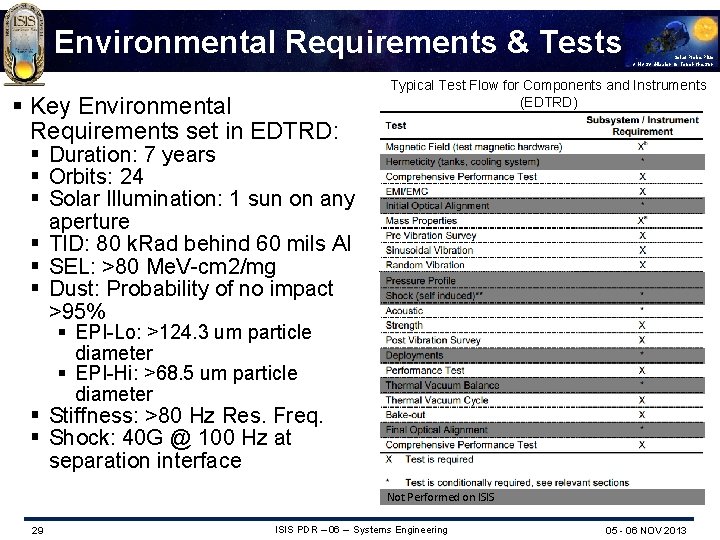
Environmental Requirements & Tests § Key Environmental Requirements set in EDTRD: Solar Probe Plus A NASA Mission to Touch the Sun Typical Test Flow for Components and Instruments (EDTRD) § Duration: 7 years § Orbits: 24 § Solar Illumination: 1 sun on any aperture § TID: 80 k. Rad behind 60 mils Al § SEL: >80 Me. V-cm 2/mg § Dust: Probability of no impact >95% § EPI-Lo: >124. 3 um particle diameter § EPI-Hi: >68. 5 um particle diameter § Stiffness: >80 Hz Res. Freq. § Shock: 40 G @ 100 Hz at separation interface Not Performed on ISIS 29 ISIS PDR – 06 – Systems Engineering 05 - 06 NOV 2013
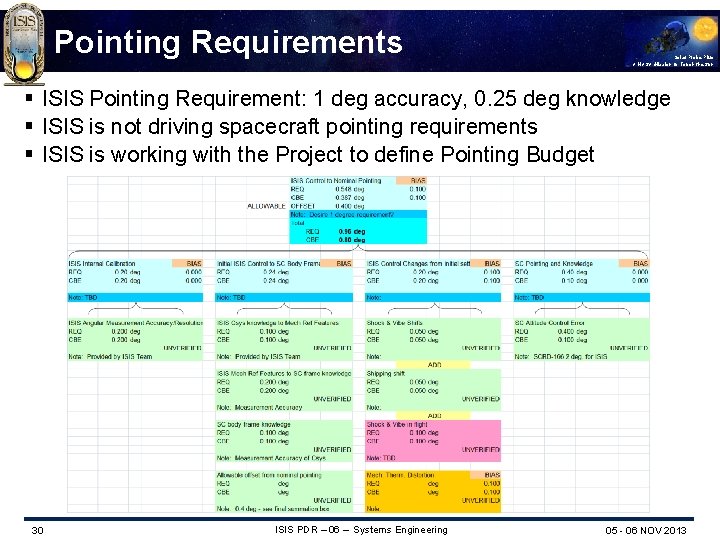
Pointing Requirements Solar Probe Plus A NASA Mission to Touch the Sun § ISIS Pointing Requirement: 1 deg accuracy, 0. 25 deg knowledge § ISIS is not driving spacecraft pointing requirements § ISIS is working with the Project to define Pointing Budget 30 ISIS PDR – 06 – Systems Engineering 05 - 06 NOV 2013
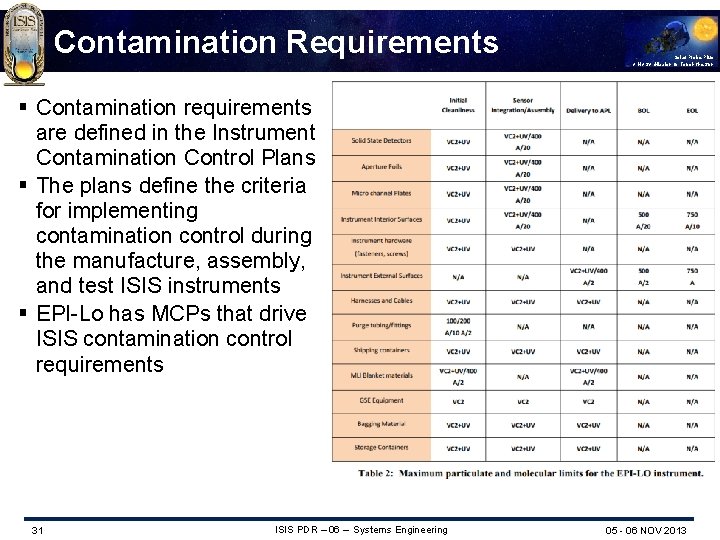
Contamination Requirements Solar Probe Plus A NASA Mission to Touch the Sun § Contamination requirements are defined in the Instrument Contamination Control Plans § The plans define the criteria for implementing contamination control during the manufacture, assembly, and test ISIS instruments § EPI-Lo has MCPs that drive ISIS contamination control requirements 31 ISIS PDR – 06 – Systems Engineering 05 - 06 NOV 2013
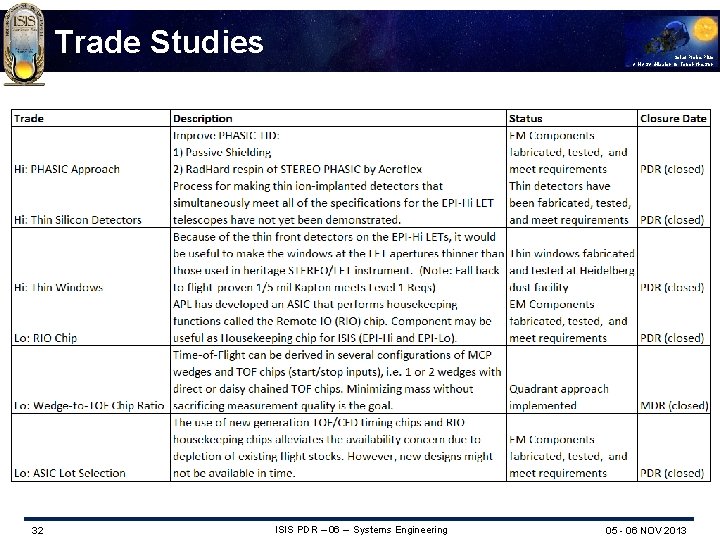
Trade Studies 32 Solar Probe Plus A NASA Mission to Touch the Sun ISIS PDR – 06 – Systems Engineering 05 - 06 NOV 2013
Summary Solar Probe Plus A NASA Mission to Touch the Sun § ISIS takes a comprehensive and distributed approach to systems engineering § ISIS requirements are approached with flowdown and verification in mind § ISIS has been involved at all levels of requirement generation § Requirements flowdown is easily traceable and well understood § ISIS design meets or exceeds all Level 3 requirements § ISIS to Spacecraft electrical, mechanical, and thermal interfaces are well described in the ICDs § ISIS Resource estimates are within spacecraft allocations § ISIS has cultivated a reputation as a good steward of mission resources § Plans are in place for Environmental Testing and AI&T § ISIS has demonstrated tremendous design and definition maturation throughout Phase B 33 ISIS PDR – 06 – Systems Engineering 05 - 06 NOV 2013
Backup 34 Solar Probe Plus A NASA Mission to Touch the Sun ISIS PDR – 06 – Systems Engineering 05 - 06 NOV 2013
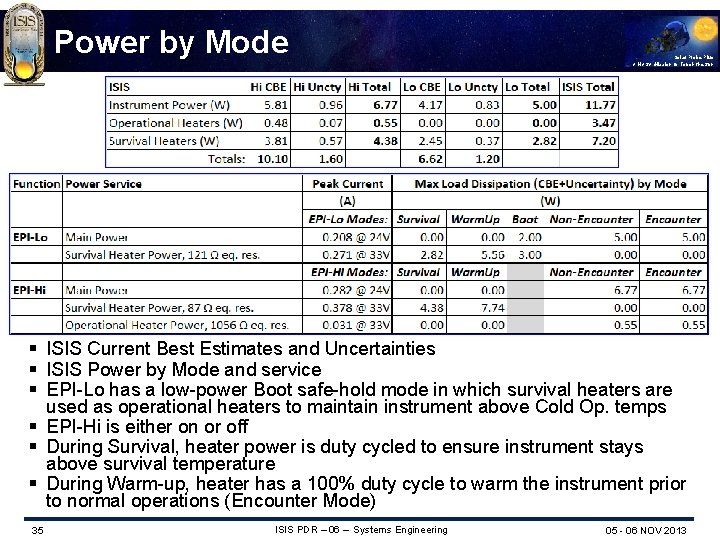
Power by Mode Solar Probe Plus A NASA Mission to Touch the Sun § ISIS Current Best Estimates and Uncertainties § ISIS Power by Mode and service § EPI-Lo has a low-power Boot safe-hold mode in which survival heaters are used as operational heaters to maintain instrument above Cold Op. temps § EPI-Hi is either on or off § During Survival, heater power is duty cycled to ensure instrument stays above survival temperature § During Warm-up, heater has a 100% duty cycle to warm the instrument prior to normal operations (Encounter Mode) 35 ISIS PDR – 06 – Systems Engineering 05 - 06 NOV 2013
- Slides: 35