
Solar Probe Plus A NASA Mission to Touch
Solar Probe Plus A NASA Mission to Touch the Sun Integrated Science Investigation of the Sun Energetic Particles EPI-Hi Autonomy Review 11 November 2015 Rick Cook & Andrew Davis EPI-Hi Software Engineering (Caltech) Eric Christian (GSFC)

Overview Solar Probe Plus A NASA Mission to Touch the Sun § Start-up: boot process § S/C Command Interface Management § S/C Time & Status Monitor § Time-Tagged Commands (Macros) § Active Operational Heater Control § DPU Monitoring of Detector Module Health § Management of Data Volume transferred to SSRs as function of time § Instrument safety…Alarm Monitors § Detector Module Dynamic Threshold Modes § Status 2 EPI-Hi Autonomy 11 November 2015
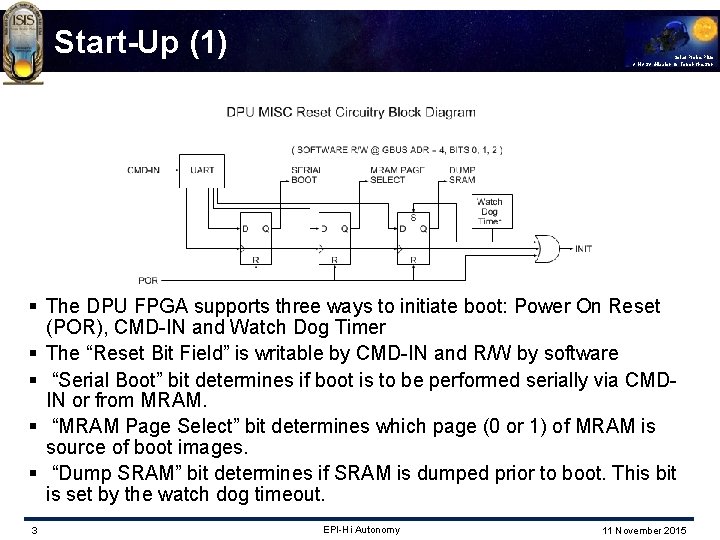
Start-Up (1) Solar Probe Plus A NASA Mission to Touch the Sun § The DPU FPGA supports three ways to initiate boot: Power On Reset (POR), CMD-IN and Watch Dog Timer § The “Reset Bit Field” is writable by CMD-IN and R/W by software § “Serial Boot” bit determines if boot is to be performed serially via CMDIN or from MRAM. § “MRAM Page Select” bit determines which page (0 or 1) of MRAM is source of boot images. § “Dump SRAM” bit determines if SRAM is dumped prior to boot. This bit is set by the watch dog timeout. 3 EPI-Hi Autonomy 11 November 2015

Start-Up (2) Solar Probe Plus A NASA Mission to Touch the Sun FPGA Resident Boot Program § A small boot program is permanently coded as part of the FPGA design. § Simple and small: <64 - 24 bit words § On POR or Watchdog-timer reset, loads Second Boot Program from MRAM into high SRAM § Upon receipt of an 8 -byte sync on CMD-IN, boots the system based on the reset bit field byte immediately following the sync (i. e. Serial boot or MRAM boot). 4 EPI-Hi Autonomy 11 November 2015
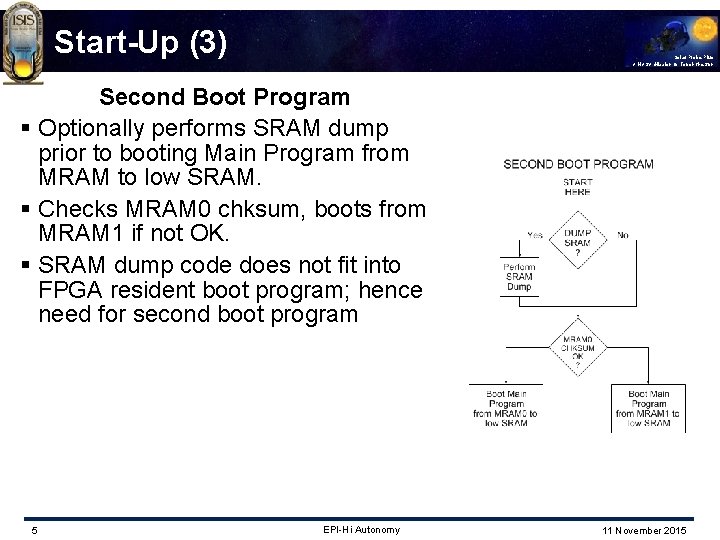
Start-Up (3) Solar Probe Plus A NASA Mission to Touch the Sun Second Boot Program § Optionally performs SRAM dump prior to booting Main Program from MRAM to low SRAM. § Checks MRAM 0 chksum, boots from MRAM 1 if not OK. § SRAM dump code does not fit into FPGA resident boot program; hence need for second boot program 5 EPI-Hi Autonomy 11 November 2015
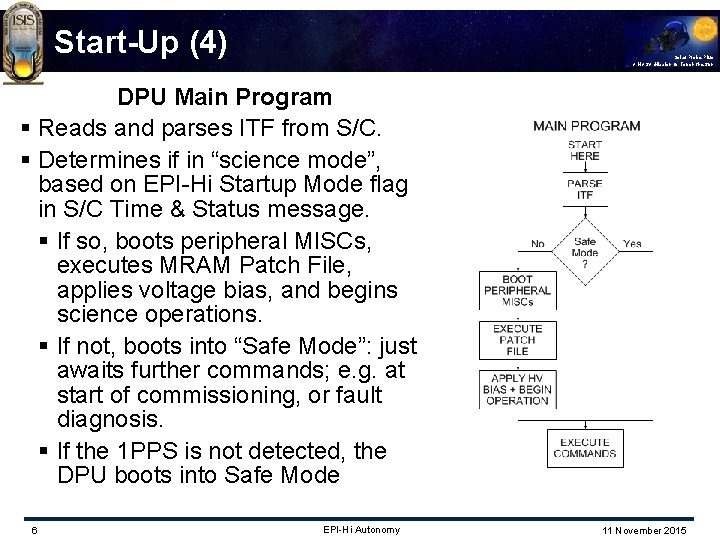
Start-Up (4) Solar Probe Plus A NASA Mission to Touch the Sun DPU Main Program § Reads and parses ITF from S/C. § Determines if in “science mode”, based on EPI-Hi Startup Mode flag in S/C Time & Status message. § If so, boots peripheral MISCs, executes MRAM Patch File, applies voltage bias, and begins science operations. § If not, boots into “Safe Mode”: just awaits further commands; e. g. at start of commissioning, or fault diagnosis. § If the 1 PPS is not detected, the DPU boots into Safe Mode 6 EPI-Hi Autonomy 11 November 2015

Start-Up (5) Solar Probe Plus A NASA Mission to Touch the Sun Peripheral MISC Boot § Each of the peripheral MISCs (HET, LET 1, LET 2) contains the same FPGA Resident Boot Program as the DPU MISC. § The peripheral MISCs have no MRAM. They must be booted via the serial command link from the DPU. § The DPU boots each peripheral MISC via the same serial boot procedure as used to boot the DPU from the ground, except the boot image data comes from the DPU MRAM. § This serial boot procedure and software is inherited from STEREO and Nu. STAR missions, and is mature/welltested. 7 EPI-Hi Autonomy 11 November 2015
Management of S/C Command Interface Solar Probe Plus A NASA Mission to Touch the Sun § The command interface with the spacecraft is described in section 3. 4. 2 of the SPP_GI_ICD (Ref. 3). It consists of two 115. 2 kbaud (80 kbit/s) UARTs (A-side and B-side). At any point in time only one of the two command UARTs will be active. It is on this interface that the instrument receives the S/C time/status message and virtual 1 PPS pulses, as well as ground commands. § Sensing of which of the two command UARTS (A-side or B-side) is active is a hardware function in the DPU FPGA. Once the source of the virtual 1 PPS is determined, a multiplexor on the A/B command lines is used to provide the data received via the active UART to the DPU FSW. § According to the SPP_GI_ICD, our DPU FSW should select the same telemetry interface side for data transmission as the 1 PPS appears on, so this information is software-readable. § If no virtual 1 PPS is being received from the S/C, the decision about whether to continue transmitting data TO the S/C is implemented in software. It is expected that the next version of the SPP_GI_ICD will provide information to guide this decision. 8 EPI-Hi Autonomy 11 November 2015
Receive/Monitor status, and time-synchronization data from the spacecraft, and perform autonomous mode adjustments as needed Solar Probe Plus A NASA Mission to Touch the Sun The Time and Status message from the S/C is received by the DPU within a Command Instrument Transfer Frame (ITF). The S/C sends one, and only one Command ITF to the instrument per second. See section 4. 4 of the GI-ICD for details. The items in the S/C Time and Status message that are relevant for EPI-Hi mode control are: § Mission Elapsed Time (MET) (Seconds since Jan 1 2010, not corrected for drift) § Solar Distance (km). § Solar Distance Valid. 0=Not valid. 1=Valid. § Solar Distance Inflection. 0=Decreasing. 1=Increasing. § EPI-Hi Instrument Power Down Warning: Inst. Will be powered-down 60 secs after bit is asserted. During normal operations (i. e. when the instrument is not in a special operating mode, such as software upload mode) the DPU operational mode controller will use these items, along with internal commandable parameters, to set the operational mode. 9 EPI-Hi Autonomy 11 November 2015
Receive/Monitor status, and time-synchronization data from the spacecraft, and perform autonomous mode adjustments as needed (2) Solar Probe Plus A NASA Mission to Touch the Sun The two normal operating modes are: § Spacecraft-Sun Distance R<=0. 25 AU (Encounter Science Mode) § Spacecraft-Sun Distance R > 0. 25 AU (Low-rate Science Mode) Two algorithms will be implemented to enable the mode controller to switch between these two modes. The algorithm to use will be selectable by ground command. These algorithms are: § MET-based: a table of Encounter-Start and Encounter-End times (in MET units) will be used to select the mode § Solar Distance based: a commandable solar distance parameter (in km) will be used to select the mode Currently, a MET-based algorithm appears to be preferable, given that the DPU needs to manage the volume of instrument data transferred to the SSRs on the S/C as function of time (see later slide) EPI-Hi has no special mode for pre-power-down. The instrument may be powered-down with no warning. 10 EPI-Hi Autonomy 11 November 2015
Time-tagged Commands (Macros) Solar Probe Plus A NASA Mission to Touch the Sun An entry in the 2 msec timer-interrupt periodically (once every second, for instance) wakes up a time-tagged command task (TTC) in the round-robin multitasker. The TTC task polls a table (TTC-Table) with three entries per "row": § Macro execution token § Macro execution time (in units of MET seconds) § Macro status (Pending/Done) For each row in TTC-Table If ((MET within macro execution time window) AND (Status==Pending)) Execute the macro Set Status = Done Endif End. For A separate ground command can update the TTC-Table to include an entry that schedules a new macro to be executed at a given time. The TTC-Table contents are stored in MRAM after each update, and re-loaded after any instrument reset, just like software patches. 11 EPI-Hi Autonomy 11 November 2015
Time-tagged Commands (Macros) (2) Solar Probe Plus A NASA Mission to Touch the Sun § For EPI-Hi, a macro is simply a Forth word. A new macro can be uploaded from the ground and compiled into the Forth dictionary. A new macro can make use of any Forth words that have already been compiled into the dictionary. Thus, this macro/time-tagged command capability is very powerful, and there is the potential for it to be the cause of serious software malfunctions. However, we note the following: § If we do use this capability, each instance of use will be tested thoroughly on the ground on the EM-unit, prior to upload to the Flight Unit. § We intend this capability to be used for time-dependent parametric control of the instrument, i. e. adjustment of existing parameters, not implementation of an entirely new operational task. § We have not yet identified a single case where we would need to make use of this time-tagged command capability. Therefore we expect to use it very sparingly, if at all. § This capability will be implemented in the DPU FSW. It is not required in the FSW resident in the detector modules. 12 EPI-Hi Autonomy 11 November 2015
Active Operational Heater Control Solar Probe Plus A NASA Mission to Touch the Sun § Operational heater power is adjusted via duty cycle, with switching period of 1 second and duty cycle control granularity of 2 msec. § Temperature is measured once every 4 seconds with redundant thermistors placed near heater. Resolution of measurement is about 0. 01 deg C. § A S/W loop executing in DPU MISC adjusts heater power setting once per 4 seconds, based on 2 nd order algorithm characterized by two time constants and a goal temperature, which are changeable by ground command. Typical time constants are a few minutes to 10's of minutes. § Heater control loop stability and performance are verified during thermal vacuum and thermal balance testing. Initial setup up of loop parameters is done with thermal mockups and the EPI-Hi engineering unit. § For EPI-Hi, final heater power levels at 100% duty cycle and the minimum buss voltage (26 V) are 250 m. W for each telescope and 2 W for the electronics box. 13 EPI-Hi Autonomy 11 November 2015
DPU Monitoring of Detector Module Health Solar Probe Plus A NASA Mission to Touch the Sun § The DPU FSW monitors data blocks received from each of the detector module MISCs, and the Code. OK flag within the Housekeeping telemetry from each detector module MISC. the DPU FSW has the capability to respond in two ways to an anomaly in the data received from a detector module MISC: 1. 2. Do nothing (await action by ground controllers). Reboot the detector MISC from MRAM. § When the instrument is in Encounter Science Mode (R <= 0. 25 U), option 2 will be enabled, to ensure properation throughout the encounter. § If the DPU FSW detects “repeated closely-spaced” anomaly/reboot cycles occurring for a detector module, it may revert to option 1, at least for some programmable delay period. Definition of “repeated, closelyspaced” is TBR. 14 EPI-Hi Autonomy 11 November 2015
Management of Volume of Data Transferred to SSRs as Function of Time (1) Solar Probe Plus A NASA Mission to Touch the Sun The DPU MISC FSW shall manage the volume of EPI-Hi instrument data telemetered to the Spacecraft as a function of time, based on the Solid. State-Recorder “fill-level” information in the Spacecraft time/status message, and the time-length of the current encounter (FSW requirement L 5 -INSTW-134, Ref. 1). The inputs from the spacecraft time/status message pertinent to this task are: § Mission Elapsed Time (MET). Seconds since Jan 1 2010 (drifts). § Solar Distance (km). § Solar Distance Valid. 0=Not valid. 1=Valid. § Solar Distance Inflection. 0=Decreasing. 1=Increasing. § EPI-Hi SSR Allocation Status: SSR%FULL: 0 -255. 255 = 100% § Note: S/C will stop recording new EPI-Hi data to the SSR when this parameter reaches 255 (100% full) 15 EPI-Hi Autonomy 11 November 2015
Management of Volume of Data Transferred to SSRs as Function of Time (2) Solar Probe Plus A NASA Mission to Touch the Sun The inputs that are available as commandable parameters in the DPU FSW are: § Total SSR Allocation (bytes): SSR_ALLOC. Equals number of bytes written to SSR when SSR allocation Status from spacecraft = 255 (100%). § This could be the same for every encounter, but may change… § Needed for DPU to meter the data flow to SSR. § Predicted Encounter Start time (MET seconds): ESTART § Predicted Encounter End time: EEND § Needed for DPU to meter the data flow to SSR. § Amount of SSR allocation to reserve for use after end of encounter: SSR_RESERVE § EPI-Hi will (hopefully) be powered-up and delivering low-rate data to the SSR after the end of each encounter. The SSR allocation status from the spacecraft will be adjusted downwards (or reset to 0%) at some point after the end of the encounter. 16 EPI-Hi Autonomy 11 November 2015
Management of Volume of Data Transferred to SSRs as Function of Time (3) Solar Probe Plus A NASA Mission to Touch the Sun A simple algorithm that the DPU FSW may use to implement this task is: WHILE (Encounter==TRUE) Each Hour (or whatever time unit we agree upon) #HOURS_LEFT = (EEND – MET)/3600 #BYTES_LEFT = (SSR_ALLOC * SSR%FULL) – SSR_RESERVE IF (#BYTES_LEFT > 0) #BYTESPERHOUR = #BYTES_LEFT/#HOURS_LEFT ELSE #BYTESPERHOUR = 0 ENDIF ENDWHILE § Nominally, the #BYTESPERHOUR value is enough to send 1 hour of “IN_ENCOUNTER” EPI-Hi rates and HK data, plus some events, to the SSR. § If solar activity is low early in an encounter, we won’t collect enough events in an hour to use up the full #BYTESPERHOUR. Thus, #BYTESPERHOUR may grow in size later in the encounter. § The actual algorithm that the DPU will use for this task is currently being worked out by the science team 17 EPI-Hi Autonomy 11 November 2015
Dynamic Adjustment of Detector Thresholds (1) Solar Probe Plus A NASA Mission to Touch the Sun § Based on dynamic threshold scheme used for STEREO LET § As particle intensity rises, reduce the LET 1 singles rates due to H and He by progressively raising selected detector thresholds to Z ≥ 6 levels, thereby reducing the geometry factor for H and He single detector triggers and events § The Pixel count rates in LET 1 will serve as the "monitor" rates that trigger these successive threshold “stages” (and guide the retreat to normal operations). § We use the 95% "Worst-Case" spectrum defined in the EDTRD to estimate the singles count rates. § Note that the Z ≥ 6 geometry can remain fully active in all of the stages. § Threshold stage change decision occurs on 1 -minute intervals, and incorporates “hysteresis”. § Same algorithm for LET 2, HET 18 EPI-Hi Autonomy 11 November 2015
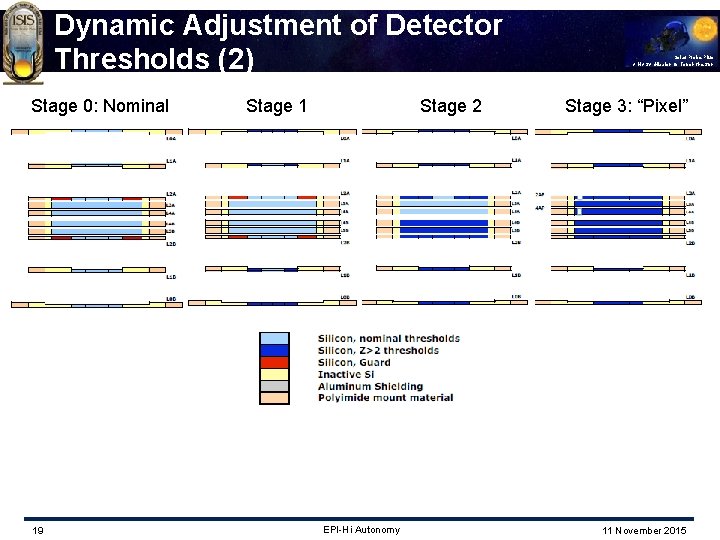
Dynamic Adjustment of Detector Thresholds (2) Stage 0: Nominal 19 Stage 1 Stage 2 EPI-Hi Autonomy Solar Probe Plus A NASA Mission to Touch the Sun Stage 3: “Pixel” 11 November 2015
Detector Leakage Current Monitoring and Balancing Solar Probe Plus A NASA Mission to Touch the Sun • The EPI-HI detector module FSW implements an algorithm for autonomously measuring and balancing detector segment leakage currents, as needed to maintain properation of the DC coupled preamplifiers attached to the detector segments. The algorithm runs continuously in the background, updating the leakage balance for all preamps once every 64 seconds, without incurring any dead-time. 20 EPI-Hi Autonomy 11 November 2015
Instrument Safety – Other Alarms and Monitors Solar Probe Plus A NASA Mission to Touch the Sun We are considering whethere are other instrument parameters that could trigger an autonomous response by the FSW. Currently considering: § Excessively-high detector singles rates (uncorrelated with other related rates) § Response would be to raise detector threshold § We have an algorithm performed a similar function on the Nu. STAR mission that we could adapt 21 EPI-Hi Autonomy 11 November 2015
Backup Slides 22 Solar Probe Plus A NASA Mission to Touch the Sun EPI-Hi Autonomy 11 November 2015
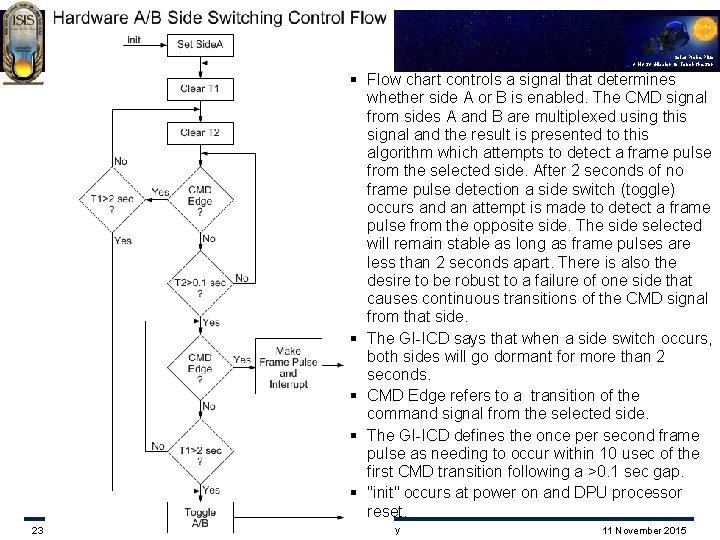
Solar Probe Plus A NASA Mission to Touch the Sun § Flow chart controls a signal that determines whether side A or B is enabled. The CMD signal from sides A and B are multiplexed using this signal and the result is presented to this algorithm which attempts to detect a frame pulse from the selected side. After 2 seconds of no frame pulse detection a side switch (toggle) occurs and an attempt is made to detect a frame pulse from the opposite side. The side selected will remain stable as long as frame pulses are less than 2 seconds apart. There is also the desire to be robust to a failure of one side that causes continuous transitions of the CMD signal from that side. § The GI-ICD says that when a side switch occurs, both sides will go dormant for more than 2 seconds. § CMD Edge refers to a transition of the command signal from the selected side. § The GI-ICD defines the once per second frame pulse as needing to occur within 10 usec of the first CMD transition following a >0. 1 sec gap. § "init" occurs at power on and DPU processor reset. 23 EPI-Hi Autonomy 11 November 2015
- Slides: 23