
Solar Probe Plus A NASA Mission to Touch
Solar Probe Plus A NASA Mission to Touch the Sun Integrated Science Investigation of the Sun Energetic Particles Preliminary Design Review 05 – 06 NOV 2013 EPI-Lo Calibration Don Mitchell EPI-Lo Scientist (JHU/APL) This document contains technical data that may be controlled by the International Traffic in Arms Regulations (22 CFR 120 -130) and may not be provided, disclosed or transferred in any manner to any person, whether in the U. S. or abroad, who is not 1) a citizen of the United States, 2) a lawful permanent resident of the United States, or 3) a protected individual as defined by 8 USC 1324 b(a)(3), without the written permission of the United States Department of State.
Outline § § § 2 Solar Probe Plus A NASA Mission to Touch the Sun Overview Species and Energy Ranges Facilities Calibration Plan Test Flow In-Flight Calibration ISIS PDR – 25 – EPI-Lo Calibration 05 - 06 NOV 2013
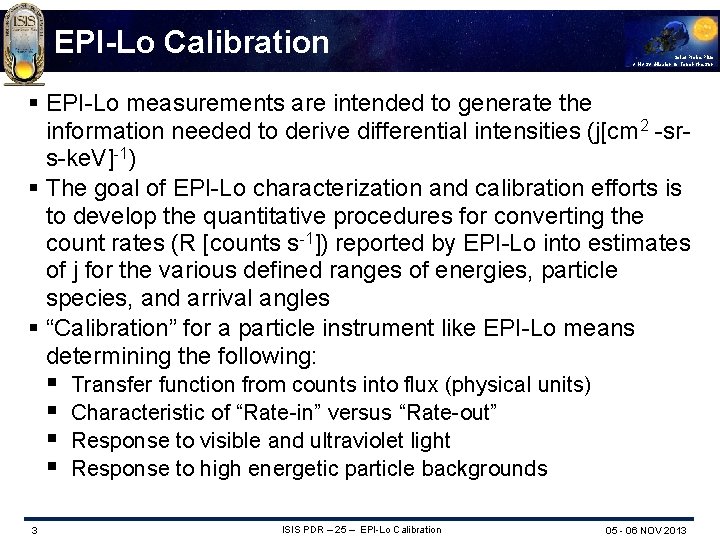
EPI-Lo Calibration Solar Probe Plus A NASA Mission to Touch the Sun § EPI-Lo measurements are intended to generate the information needed to derive differential intensities (j[cm 2 -srs-ke. V]-1) § The goal of EPI-Lo characterization and calibration efforts is to develop the quantitative procedures for converting the count rates (R [counts s-1]) reported by EPI-Lo into estimates of j for the various defined ranges of energies, particle species, and arrival angles § “Calibration” for a particle instrument like EPI-Lo means determining the following: § § 3 Transfer function from counts into flux (physical units) Characteristic of “Rate-in” versus “Rate-out” Response to visible and ultraviolet light Response to high energetic particle backgrounds ISIS PDR – 25 – EPI-Lo Calibration 05 - 06 NOV 2013
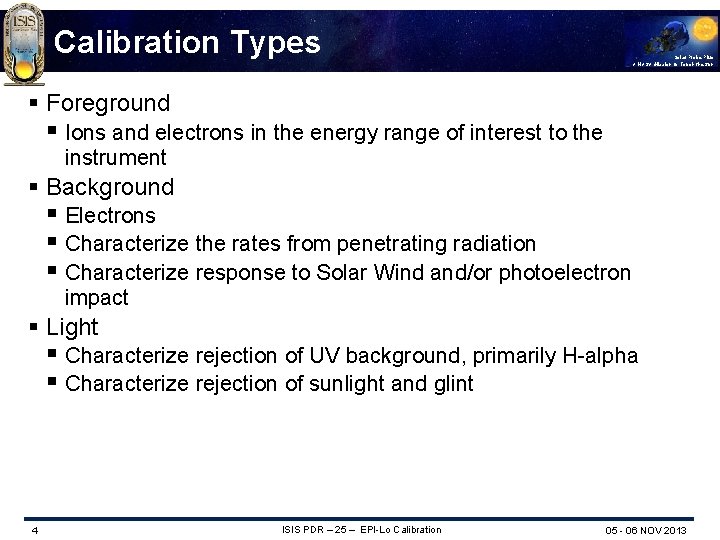
Calibration Types Solar Probe Plus A NASA Mission to Touch the Sun § Foreground § Ions and electrons in the energy range of interest to the instrument § Background § Electrons § Characterize the rates from penetrating radiation § Characterize response to Solar Wind and/or photoelectron impact § Light § Characterize rejection of UV background, primarily H-alpha § Characterize rejection of sunlight and glint 4 ISIS PDR – 25 – EPI-Lo Calibration 05 - 06 NOV 2013
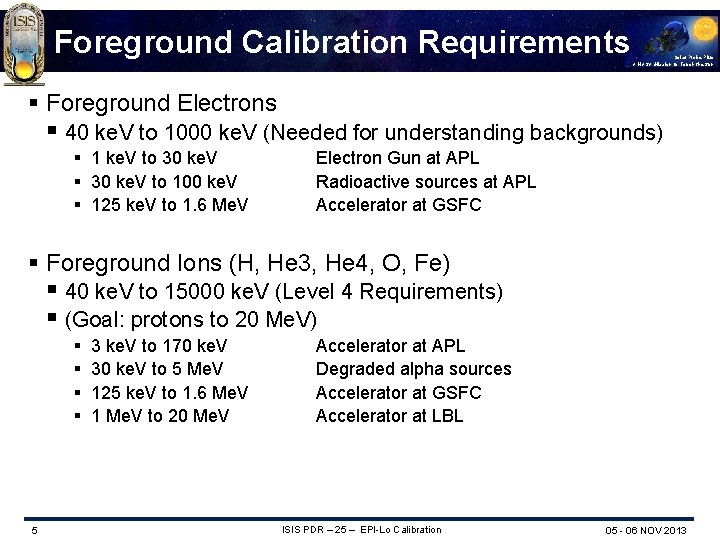
Foreground Calibration Requirements Solar Probe Plus A NASA Mission to Touch the Sun § Foreground Electrons § 40 ke. V to 1000 ke. V (Needed for understanding backgrounds) § 1 ke. V to 30 ke. V § 30 ke. V to 100 ke. V § 125 ke. V to 1. 6 Me. V Electron Gun at APL Radioactive sources at APL Accelerator at GSFC § Foreground Ions (H, He 3, He 4, O, Fe) § 40 ke. V to 15000 ke. V (Level 4 Requirements) § (Goal: protons to 20 Me. V) § § 5 3 ke. V to 170 ke. V 30 ke. V to 5 Me. V 125 ke. V to 1. 6 Me. V 1 Me. V to 20 Me. V Accelerator at APL Degraded alpha sources Accelerator at GSFC Accelerator at LBL ISIS PDR – 25 – EPI-Lo Calibration 05 - 06 NOV 2013
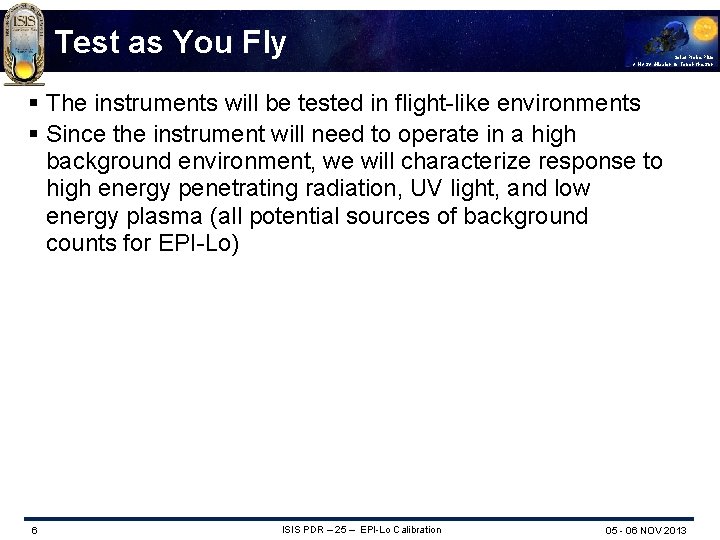
Test as You Fly Solar Probe Plus A NASA Mission to Touch the Sun § The instruments will be tested in flight-like environments § Since the instrument will need to operate in a high background environment, we will characterize response to high energy penetrating radiation, UV light, and low energy plasma (all potential sources of background counts for EPI-Lo) 6 ISIS PDR – 25 – EPI-Lo Calibration 05 - 06 NOV 2013
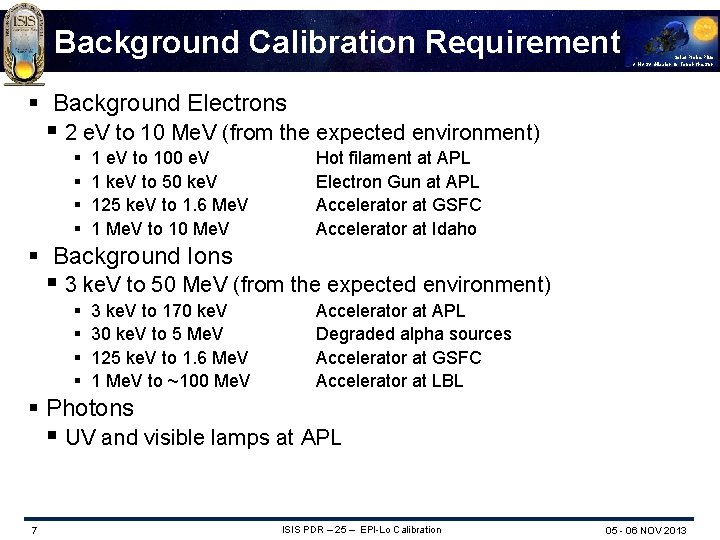
Background Calibration Requirement Solar Probe Plus A NASA Mission to Touch the Sun § Background Electrons § 2 e. V to 10 Me. V (from the expected environment) § § 1 e. V to 100 e. V 1 ke. V to 50 ke. V 125 ke. V to 1. 6 Me. V 1 Me. V to 10 Me. V Hot filament at APL Electron Gun at APL Accelerator at GSFC Accelerator at Idaho § Background Ions § 3 ke. V to 50 Me. V (from the expected environment) § § 3 ke. V to 170 ke. V 30 ke. V to 5 Me. V 125 ke. V to 1. 6 Me. V 1 Me. V to ~100 Me. V Accelerator at APL Degraded alpha sources Accelerator at GSFC Accelerator at LBL § Photons § UV and visible lamps at APL 7 ISIS PDR – 25 – EPI-Lo Calibration 05 - 06 NOV 2013
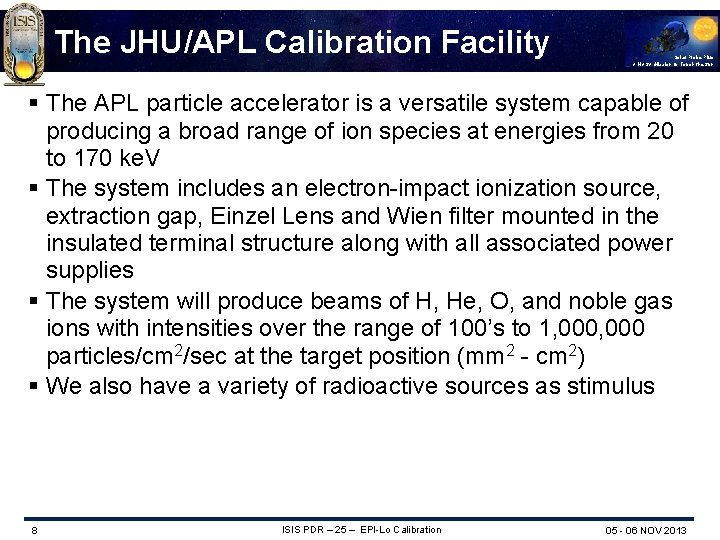
The JHU/APL Calibration Facility Solar Probe Plus A NASA Mission to Touch the Sun § The APL particle accelerator is a versatile system capable of producing a broad range of ion species at energies from 20 to 170 ke. V § The system includes an electron-impact ionization source, extraction gap, Einzel Lens and Wien filter mounted in the insulated terminal structure along with all associated power supplies § The system will produce beams of H, He, O, and noble gas ions with intensities over the range of 100’s to 1, 000 particles/cm 2/sec at the target position (mm 2 - cm 2) § We also have a variety of radioactive sources as stimulus 8 ISIS PDR – 25 – EPI-Lo Calibration 05 - 06 NOV 2013
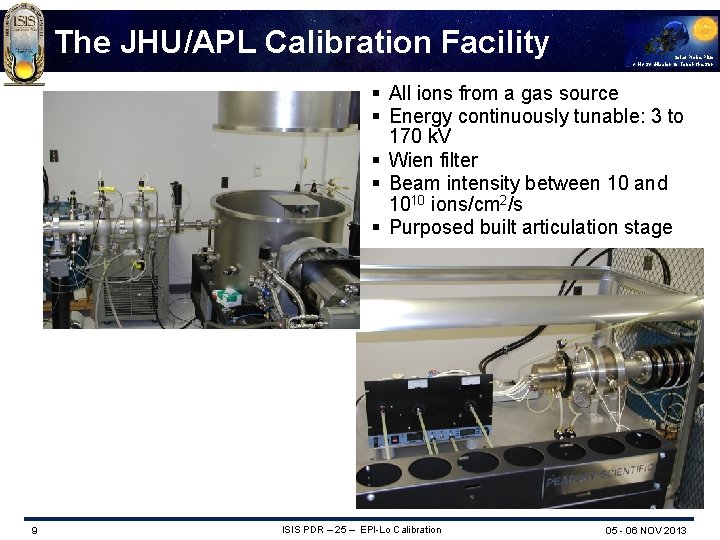
The JHU/APL Calibration Facility Solar Probe Plus A NASA Mission to Touch the Sun § All ions from a gas source § Energy continuously tunable: 3 to 170 k. V § Wien filter § Beam intensity between 10 and 1010 ions/cm 2/s § Purposed built articulation stage 9 ISIS PDR – 25 – EPI-Lo Calibration 05 - 06 NOV 2013
Beam Tests at GSFC Solar Probe Plus A NASA Mission to Touch the Sun § It is planned to have four calibration sessions at the accelerator at the Goddard Space Flight Center. Each session starts with a one-day setup, check, and pump: § Session 1: Exploratory run to characterize EPI-Lo § Session 2: Use H beam to scan both angles to complete characterization of the transfer function § Session 3: Characterize sensor response with e-beam from ~100 ke. V to 1 Me. V § Session 4: Use heavy ions (He, O, and Ar) to characterize the instrument response 10 ISIS PDR – 25 – EPI-Lo Calibration 05 - 06 NOV 2013
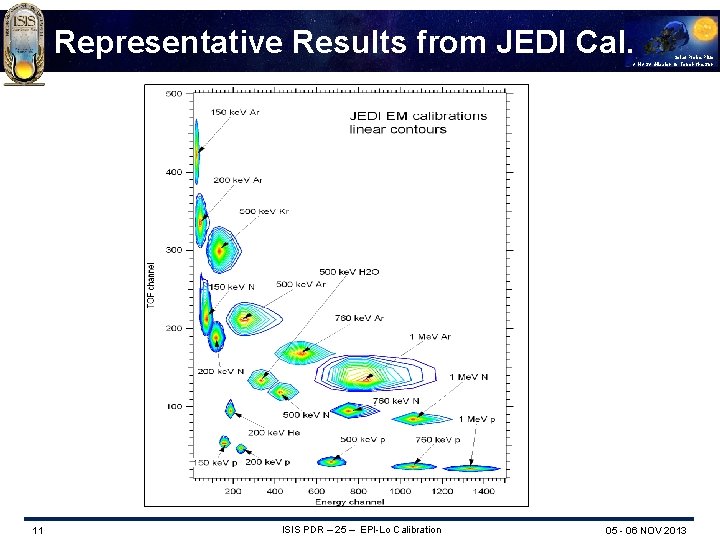
Representative Results from JEDI Cal. Solar Probe Plus A NASA Mission to Touch the Sun 11 ISIS PDR – 25 – EPI-Lo Calibration 05 - 06 NOV 2013
EPI-Lo Test Summary Solar Probe Plus A NASA Mission to Touch the Sun § Prototype “EM” Testing § Validate instrument design and performance § Energy response § Instrument efficiency § Instrument geometry factor § Establish testing procedures § Flight Model (FM) § Verify instrument design and performance § Energy response § Instrument efficiency § Instrument geometry factor 12 ISIS PDR – 25 – EPI-Lo Calibration 05 - 06 NOV 2013
Calibration Approach (Flight Units) Solar Probe Plus A NASA Mission to Touch the Sun § FM Unit § All instrument integration activities will be performed in a Class 5 clean room environment § Test in bell jar to characterize geometry, energy response, and sensitivity § Calibrate using particle sources and in Beam Facilities at APL to characterize energy response, sensitivity, dynamic range § Compare with EM results to cover gaps in energy coverage § Test Philosophy: § FM will be extensively calibrated, and performance compared with more extended energy range EM calibrations (LBL, GSFC) § Pre- and post-environmental qualification spot calibration § In-flight cross calibration between EPI-Lo and EPI-Hi 13 ISIS PDR – 25 – EPI-Lo Calibration 05 - 06 NOV 2013
EPI-Lo Calibration Schedule Solar Probe Plus A NASA Mission to Touch the Sun § Final calibration for FM slated for three weeks § Major calibration efforts will be performed at APL facility § Substantial understanding of the instrument performance will be made with the EPI-Lo EM characteristics 14 ISIS PDR – 25 – EPI-Lo Calibration 05 - 06 NOV 2013
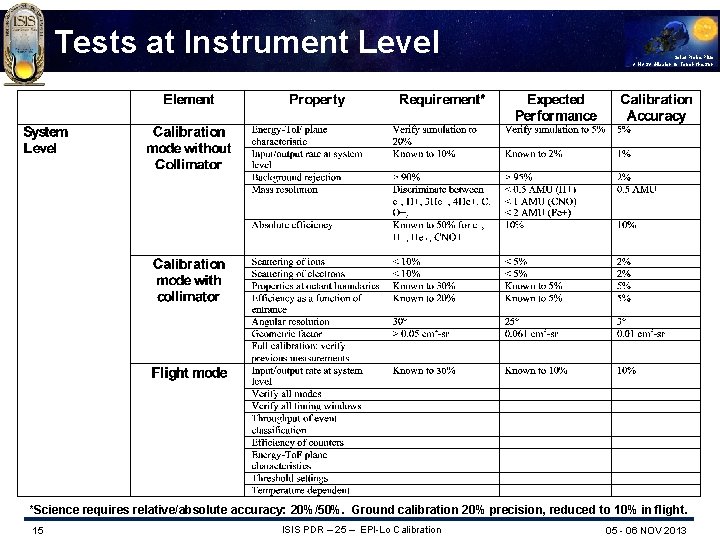
Tests at Instrument Level Solar Probe Plus A NASA Mission to Touch the Sun 30 *Science requires relative/absolute accuracy: 20%/50%. Ground calibration 20% precision, reduced to 10% in flight. 15 ISIS PDR – 25 – EPI-Lo Calibration 05 - 06 NOV 2013
In-Flight Calibration Solar Probe Plus A NASA Mission to Touch the Sun § On-orbit and cruise calibration achieves relative calibration to 10% precision § Uniformity confirmed by evolution of pitch angle distribution from onset to shock passage. § Such calibrations cover the entire energy and FOV coverage with linear instrument response (targeted rates, no pulse pileup) § Built-in features to determine on-orbit instrument ion performance § Measure pulse-height spectrum of secondary electrons from incident protons as function of time-of-flight § Unit has built-in stimulus to inject known pulse through the frontend electronics 16 ISIS PDR – 25 – EPI-Lo Calibration 05 - 06 NOV 2013
Summary Solar Probe Plus A NASA Mission to Touch the Sun § Calibration plan satisfies all Level IV requirements § Calibration facilities have been identified that meet EPI-Lo needs § APL operates and maintains the key EPI-Lo calibration facility which allows maximum flexibility 17 ISIS PDR – 25 – EPI-Lo Calibration 05 - 06 NOV 2013
Backup 18 Solar Probe Plus A NASA Mission to Touch the Sun ISIS PDR – 25 – EPI-Lo Calibration 05 - 06 NOV 2013
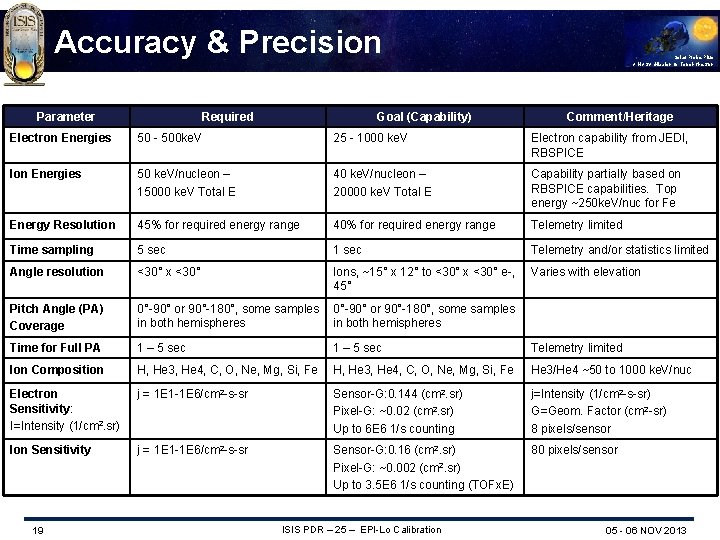
Accuracy & Precision Parameter Required Goal (Capability) Solar Probe Plus A NASA Mission to Touch the Sun Comment/Heritage Electron Energies 50 - 500 ke. V 25 - 1000 ke. V Electron capability from JEDI, RBSPICE Ion Energies 50 ke. V/nucleon – 15000 ke. V Total E 40 ke. V/nucleon – 20000 ke. V Total E Capability partially based on RBSPICE capabilities. Top energy ~250 ke. V/nuc for Fe Energy Resolution 45% for required energy range 40% for required energy range Telemetry limited Time sampling 5 sec 1 sec Telemetry and/or statistics limited Angle resolution <30° x <30° Ions, ~15° x 12° to <30° x <30° e-, 45° Varies with elevation Pitch Angle (PA) Coverage 0°-90° or 90°-180°, some samples in both hemispheres Time for Full PA 1 – 5 sec Telemetry limited Ion Composition H, He 3, He 4, C, O, Ne, Mg, Si, Fe He 3/He 4 ~50 to 1000 ke. V/nuc Electron Sensitivity: I=Intensity (1/cm 2. sr) j = 1 E 1 -1 E 6/cm 2 -s-sr Sensor-G: 0. 144 (cm 2. sr) Pixel-G: ~0. 02 (cm 2. sr) Up to 6 E 6 1/s counting j=Intensity (1/cm 2 -s-sr) G=Geom. Factor (cm 2 -sr) 8 pixels/sensor Ion Sensitivity j = 1 E 1 -1 E 6/cm 2 -s-sr Sensor-G: 0. 16 (cm 2. sr) Pixel-G: ~0. 002 (cm 2. sr) Up to 3. 5 E 6 1/s counting (TOFx. E) 80 pixels/sensor 19 ISIS PDR – 25 – EPI-Lo Calibration 05 - 06 NOV 2013
- Slides: 19