
Solar Photovoltaic Physics Basic Physics and Materials Science
Solar Photovoltaic Physics Basic Physics and Materials Science of Solar Cells Basic Physics of Solar Photovoltaic Cells Original Presentation by J. M. Pearce, 2006 Email: profpearce@gmail. com
What are Photovoltaics? • Photovoltaic (PV) systems convert light energy directly into electricity. • Commonly known as “solar cells. ” • The simplest systems power the small calculators we use every day. More complicated systems will provide a large portion of the electricity in the near future. • PV represents one of the most promising means of maintaining our energy intensive standard of living while not contributing to global warming and pollution. Basic Physics of Solar Photovoltaic Cells 2
A Brief History Photovoltaic Technology • • 1839 – Photovoltaic effect discovered by Becquerel. 1870 s – Hertz developed solid selenium PV (2%). 1905 – Photoelectric effect explained by A. Einstein. 1930 s – Light meters for photography commonly employed cells of copper oxide or selenium. • 1954 – Bell Laboratories developed the first crystalline silicon cell (4%). • 1958 – PV cells on the space satellite U. S. Vanguard (better than expected). Basic Physics of Solar Photovoltaic Cells 3
Things Start To Get Interesting. . . • mid 1970 s – World energy crisis = millions spent in research and development of cheaper more efficient solar cells. • 1976 – First amorphous silicon cell developed by Wronski and Carlson. • 1980’s - Steady progress towards higher efficiency and many new types introduced • 1990’s - Large scale production of solar cells more than 10% efficient with the following materials: – Ga-As and other III-V’s – Cu. In. Se 2 and Cd. Te – Ti. O 2 Dye-sensitized – Crystalline, Polycrystalline, and Amorphous Silicon • Today prices continue to drop and new “ 3 rd generation” solar cells are researched. Basic Physics of Solar Photovoltaic Cells 4
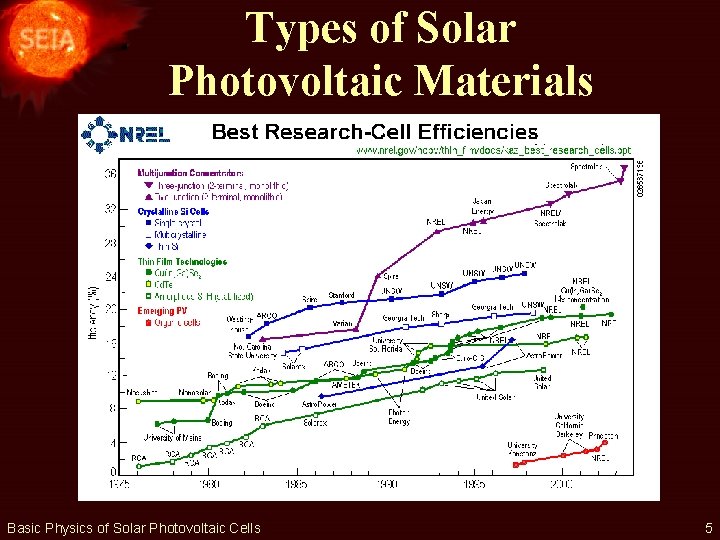
Types of Solar Photovoltaic Materials Basic Physics of Solar Photovoltaic Cells 5
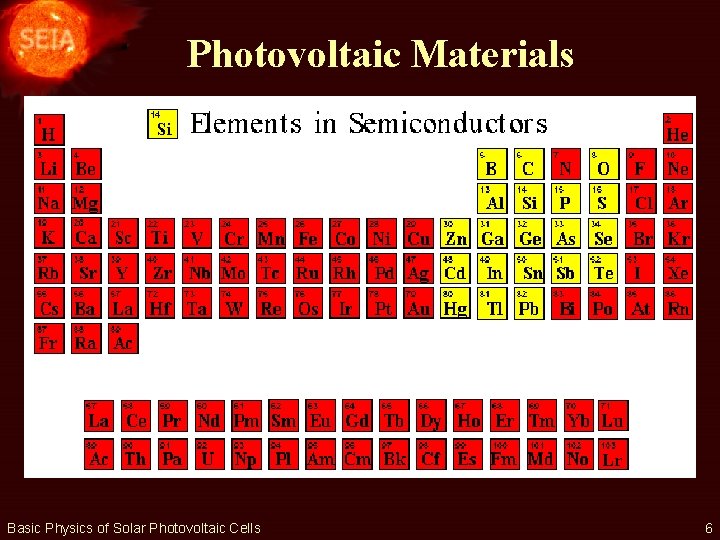
Photovoltaic Materials Basic Physics of Solar Photovoltaic Cells 6
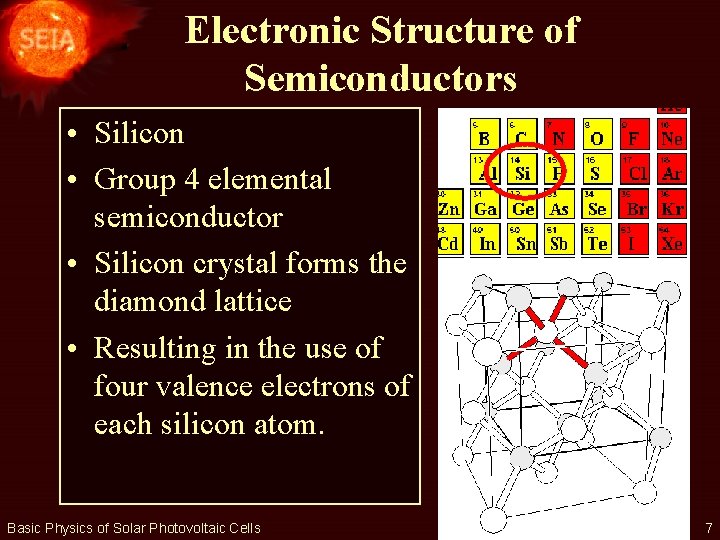
Electronic Structure of Semiconductors • Silicon • Group 4 elemental semiconductor • Silicon crystal forms the diamond lattice • Resulting in the use of four valence electrons of each silicon atom. Basic Physics of Solar Photovoltaic Cells 7
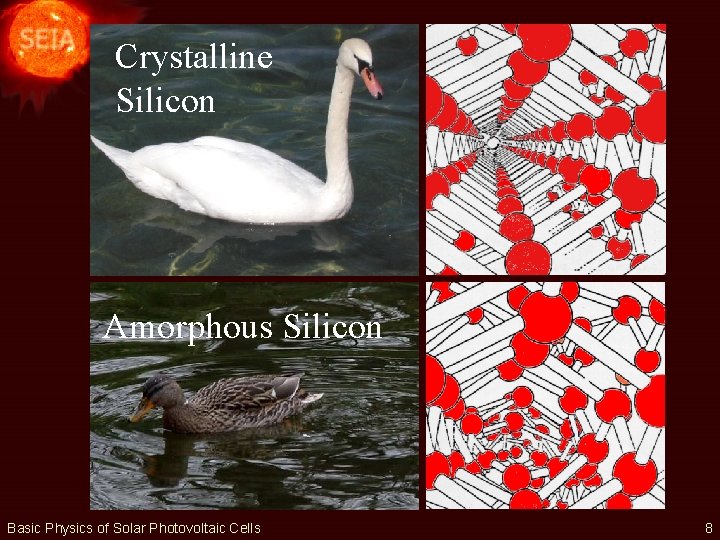
Crystalline Silicon Amorphous Silicon Basic Physics of Solar Photovoltaic Cells 8
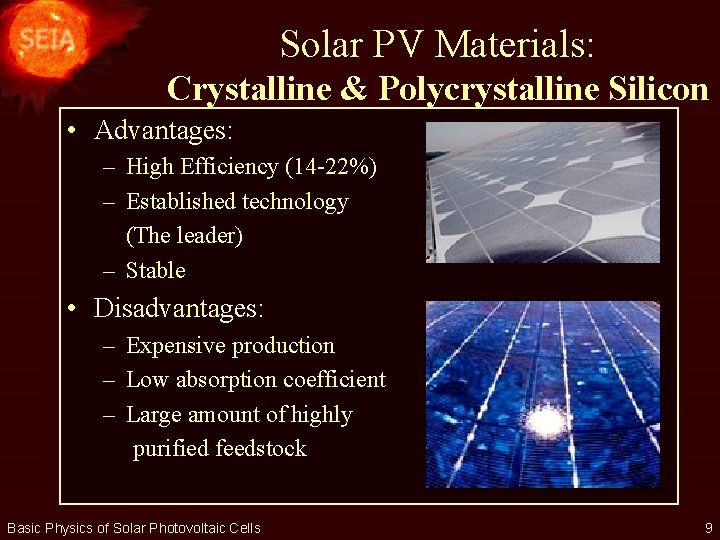
Solar PV Materials: Crystalline & Polycrystalline Silicon • Advantages: – High Efficiency (14 -22%) – Established technology (The leader) – Stable • Disadvantages: – Expensive production – Low absorption coefficient – Large amount of highly purified feedstock Basic Physics of Solar Photovoltaic Cells 9
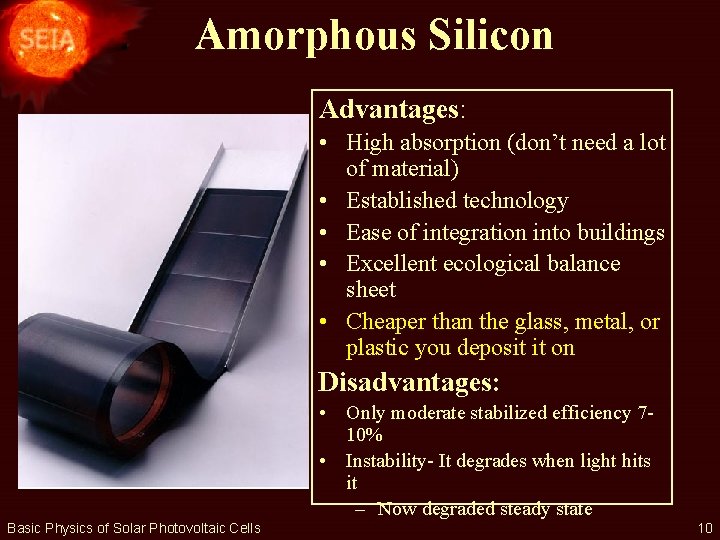
Amorphous Silicon Advantages: • High absorption (don’t need a lot of material) • Established technology • Ease of integration into buildings • Excellent ecological balance sheet • Cheaper than the glass, metal, or plastic you deposit it on Disadvantages: • Only moderate stabilized efficiency 710% • Instability- It degrades when light hits it – Now degraded steady state Basic Physics of Solar Photovoltaic Cells 10

How do they work? The physics view Basic Physics of Solar Photovoltaic Cells
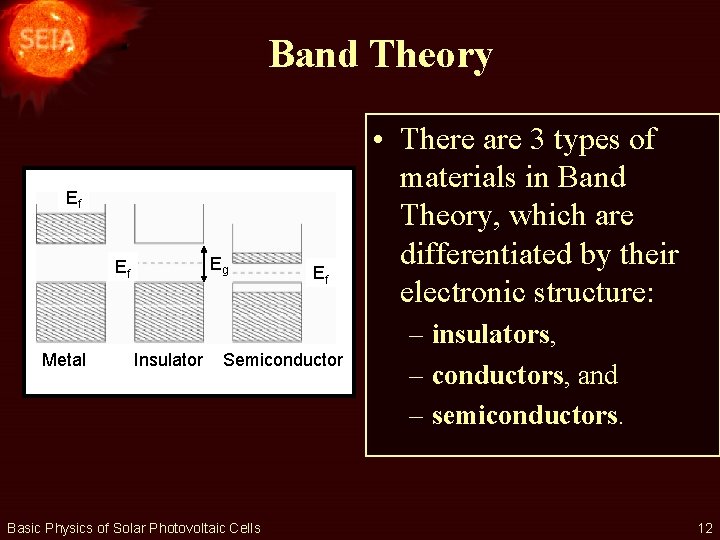
Band Theory Ef Eg Ef Metal Insulator Ef Semiconductor Basic Physics of Solar Photovoltaic Cells • There are 3 types of materials in Band Theory, which are differentiated by their electronic structure: – insulators, – conductors, and – semiconductors. 12
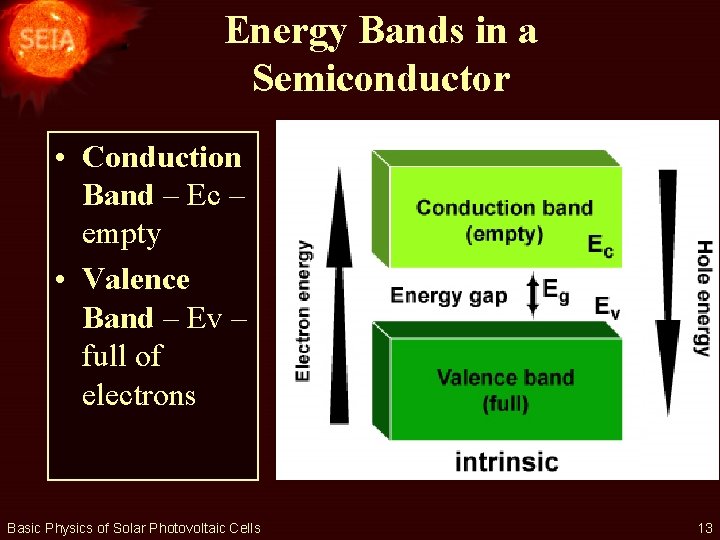
Energy Bands in a Semiconductor • Conduction Band – Ec – empty • Valence Band – Ev – full of electrons Basic Physics of Solar Photovoltaic Cells 13
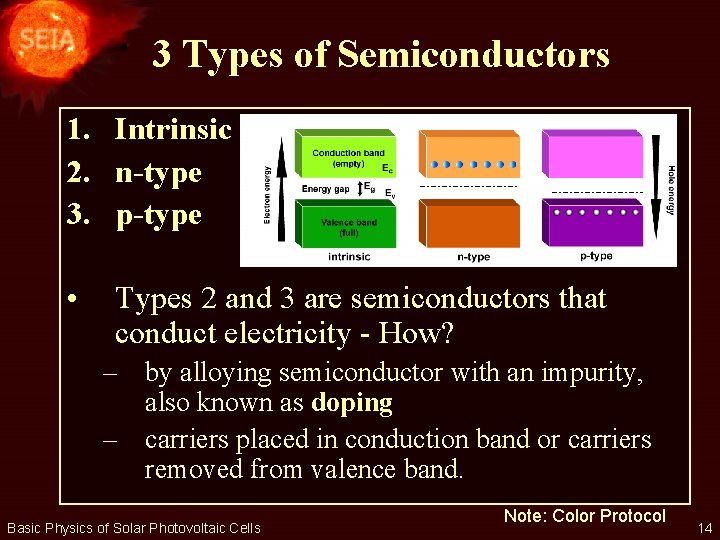
3 Types of Semiconductors 1. Intrinsic 2. n-type 3. p-type • Types 2 and 3 are semiconductors that conduct electricity - How? – by alloying semiconductor with an impurity, also known as doping – carriers placed in conduction band or carriers removed from valence band. Basic Physics of Solar Photovoltaic Cells Note: Color Protocol 14
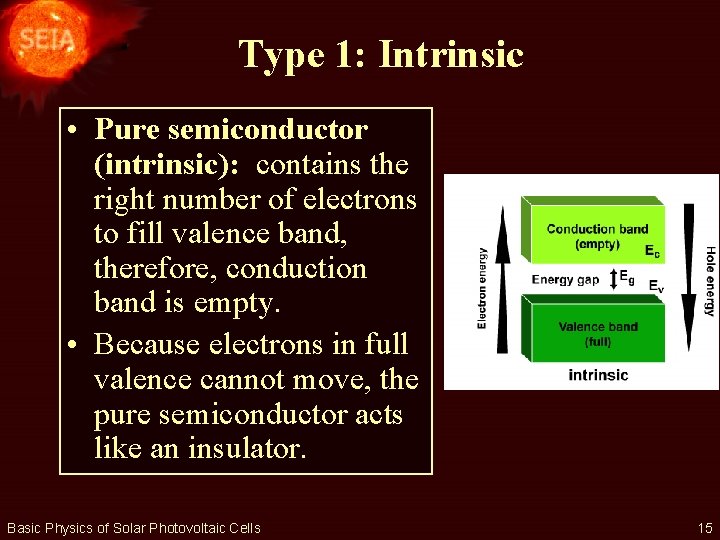
Type 1: Intrinsic • Pure semiconductor (intrinsic): contains the right number of electrons to fill valence band, therefore, conduction band is empty. • Because electrons in full valence cannot move, the pure semiconductor acts like an insulator. Basic Physics of Solar Photovoltaic Cells 15
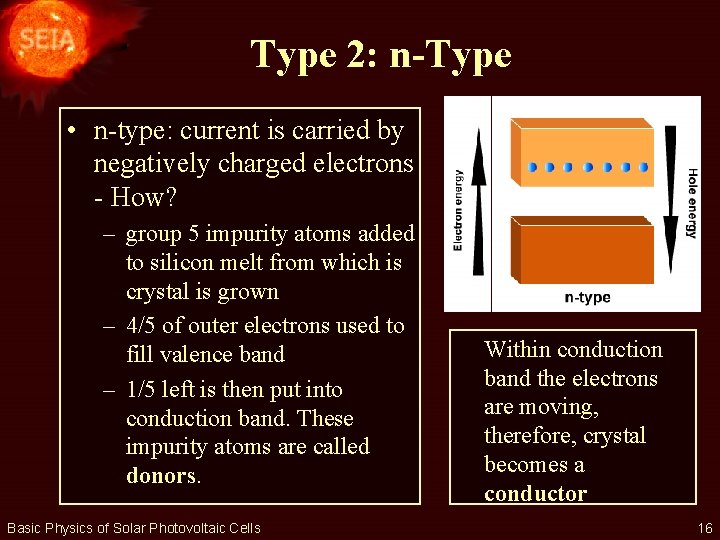
Type 2: n-Type • n-type: current is carried by negatively charged electrons - How? – group 5 impurity atoms added to silicon melt from which is crystal is grown – 4/5 of outer electrons used to fill valence band – 1/5 left is then put into conduction band. These impurity atoms are called donors. Basic Physics of Solar Photovoltaic Cells Within conduction band the electrons are moving, therefore, crystal becomes a conductor 16
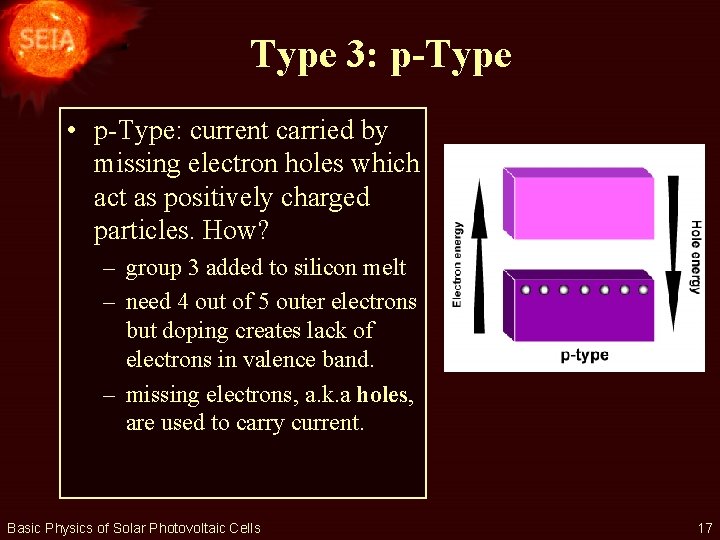
Type 3: p-Type • p-Type: current carried by missing electron holes which act as positively charged particles. How? – group 3 added to silicon melt – need 4 out of 5 outer electrons but doping creates lack of electrons in valence band. – missing electrons, a. k. a holes, are used to carry current. Basic Physics of Solar Photovoltaic Cells 17
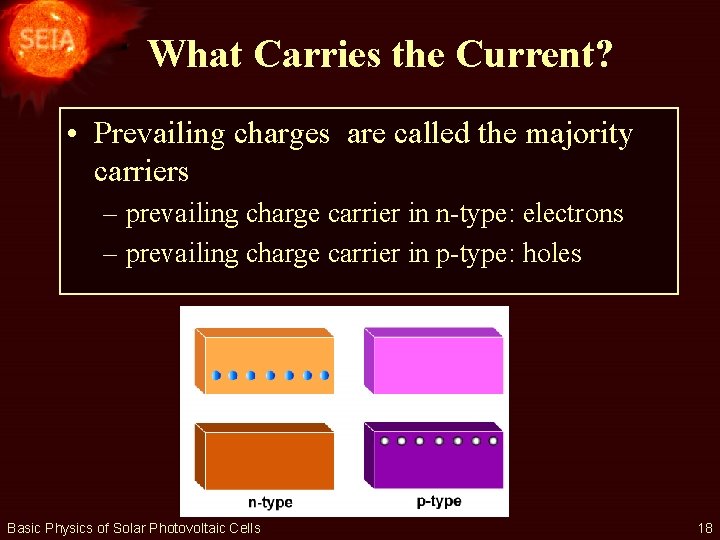
What Carries the Current? • Prevailing charges are called the majority carriers – prevailing charge carrier in n-type: electrons – prevailing charge carrier in p-type: holes Basic Physics of Solar Photovoltaic Cells 18
Creating a Junction • There are four main types of semiconductor junctions – p-n – p-i-n – Schottcky barrier – Heterojunction • Each has a built in potential Basic Physics of Solar Photovoltaic Cells 19
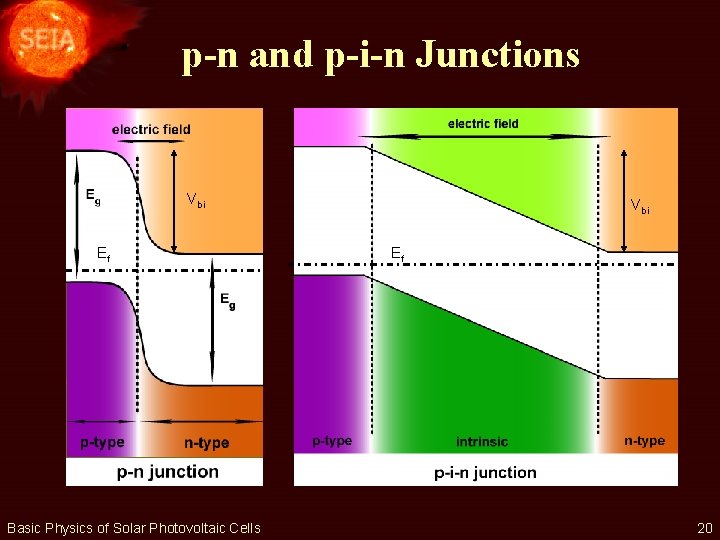
p-n and p-i-n Junctions Vbi Ef Basic Physics of Solar Photovoltaic Cells Vbi Ef 20
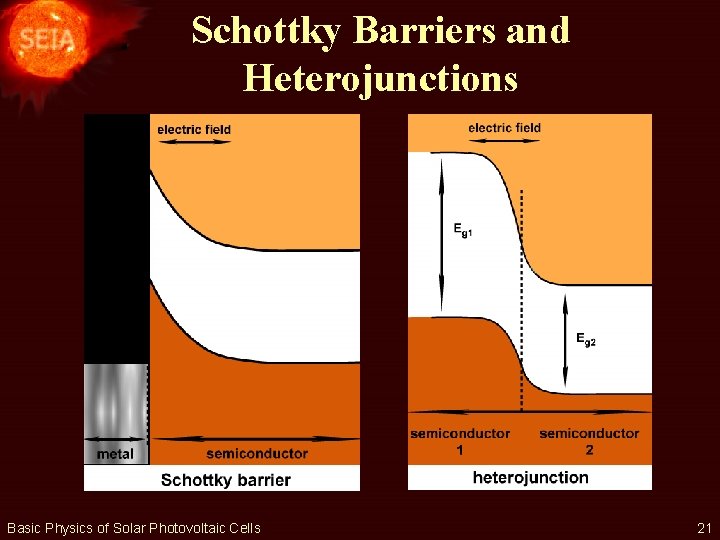
Schottky Barriers and Heterojunctions Basic Physics of Solar Photovoltaic Cells 21
Semiconductor Junctions • All the junctions contain strong electric field • How does the electric field occur? – When two semiconductors come into contact, electrons near interface from n-type, transfer over to p-type, leaving a positively charged area – Holes from p-type by interface transfer over to n-type leaving a negatively charged area. – Because electrons and holes are swapped, a middle potential barrier with no mobile charges, is formed. – This potential barrier created does not let any more electrons or holes flow through. • Electric field pulls electrons and holes in opposite directions. Basic Physics of Solar Photovoltaic Cells 22
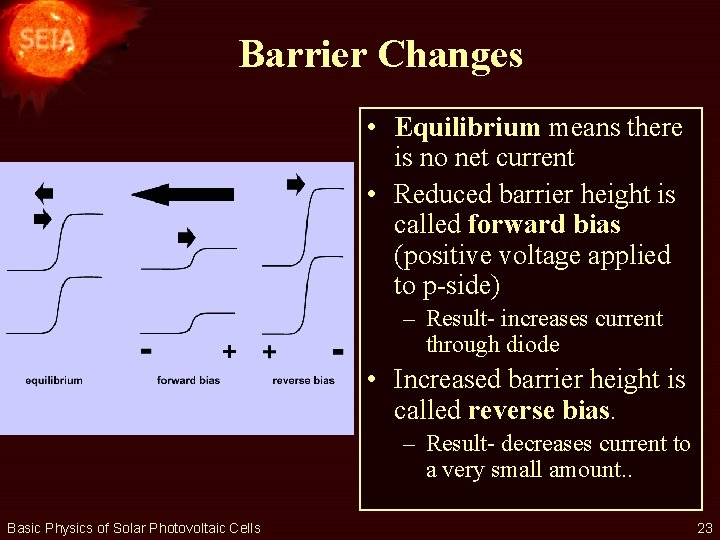
Barrier Changes • Equilibrium means there is no net current • Reduced barrier height is called forward bias (positive voltage applied to p-side) – Result- increases current through diode • Increased barrier height is called reverse bias. – Result- decreases current to a very small amount. . Basic Physics of Solar Photovoltaic Cells 23
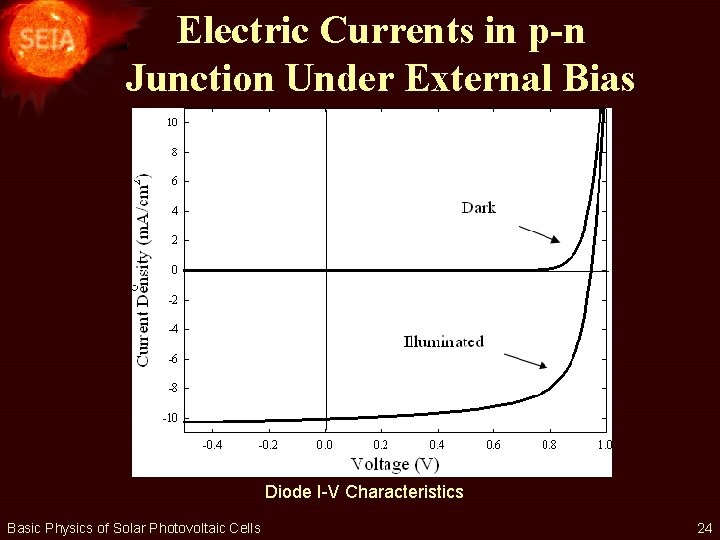
Electric Currents in p-n Junction Under External Bias Diode I-V Characteristics Basic Physics of Solar Photovoltaic Cells 24
![Current in a Solar Cell • Output current = Il-Io [ exp(q. V/k. T)-1]](http://slidetodoc.com/presentation_image_h2/07743deb6042b9d6986a6b61b7dc7b42/image-25.jpg "Current in a Solar Cell • Output current = Il-Io [ exp(q. V/k. T)-1]")
Current in a Solar Cell • Output current = Il-Io [ exp(q. V/k. T)-1] – – Il=light generated current q = electric charge V = voltage k = Boltzman’s constant = 1. 3807 × 10 -23 J/K • When in open circuit (I=0) all light generated current passes through diode • When in short circuit (V=0) all current passes through external load 2 Important points: 1) During open circuit the voltage of open circuit, Voc = (k. T/q) ln( Il/Io +1) 2) No power is generated under short and open circuit - but Pmax = Vm. Im=FFVoc. Isc Basic Physics of Solar Photovoltaic Cells 25
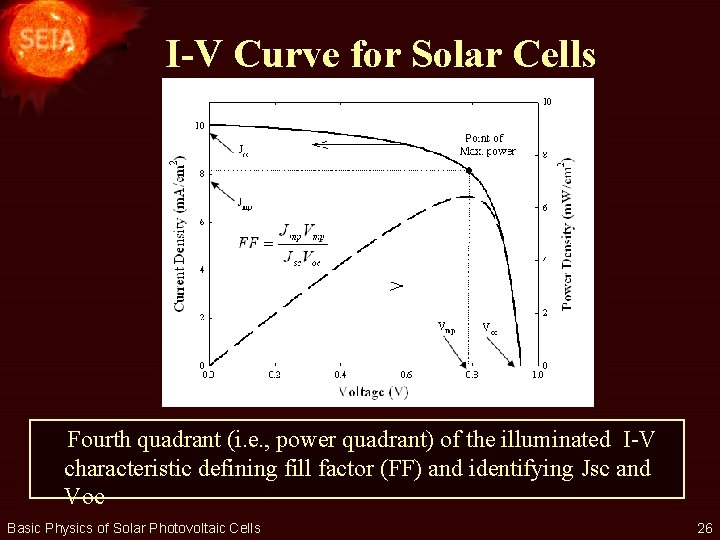
I-V Curve for Solar Cells Fourth quadrant (i. e. , power quadrant) of the illuminated I-V characteristic defining fill factor (FF) and identifying Jsc and Voc Basic Physics of Solar Photovoltaic Cells 26
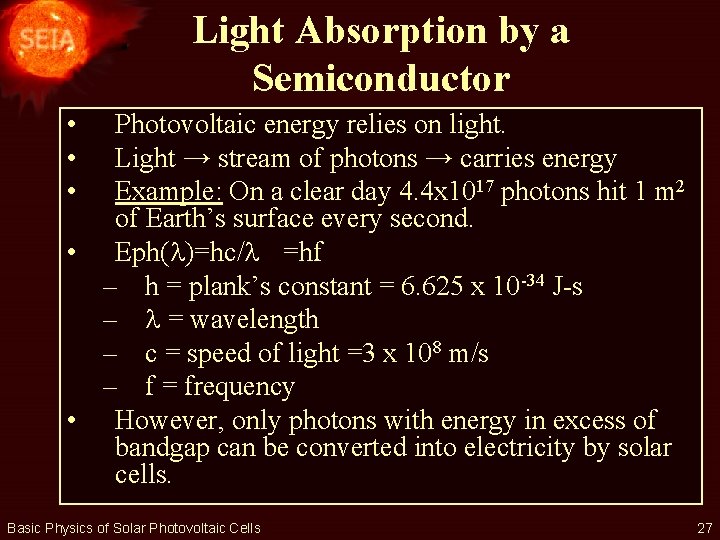
Light Absorption by a Semiconductor • • • Photovoltaic energy relies on light. Light → stream of photons → carries energy Example: On a clear day 4. 4 x 10¹⁷ photons hit 1 m 2 of Earth’s surface every second. • Eph( )=hc/ =hf – h = plank’s constant = 6. 625 x 10 -34 J-s – = wavelength – c = speed of light =3 x 10⁸ m/s – f = frequency • However, only photons with energy in excess of bandgap can be converted into electricity by solar cells. Basic Physics of Solar Photovoltaic Cells 27
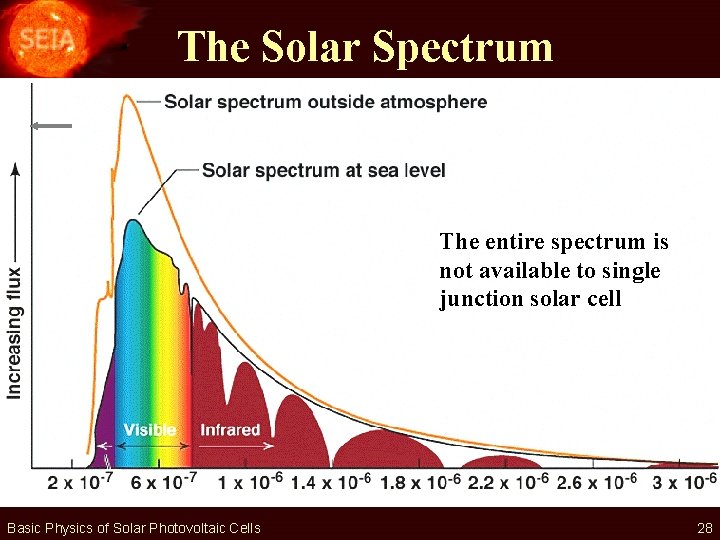
The Solar Spectrum The entire spectrum is not available to single junction solar cell Basic Physics of Solar Photovoltaic Cells 28
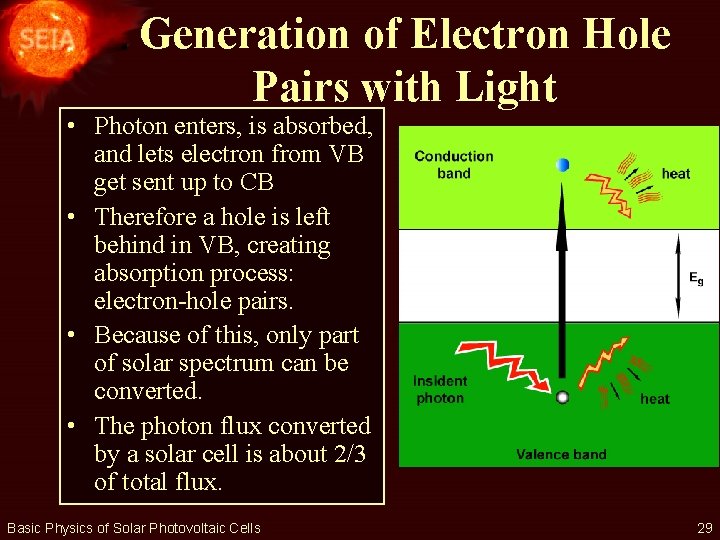
Generation of Electron Hole Pairs with Light • Photon enters, is absorbed, and lets electron from VB get sent up to CB • Therefore a hole is left behind in VB, creating absorption process: electron-hole pairs. • Because of this, only part of solar spectrum can be converted. • The photon flux converted by a solar cell is about 2/3 of total flux. Basic Physics of Solar Photovoltaic Cells 29
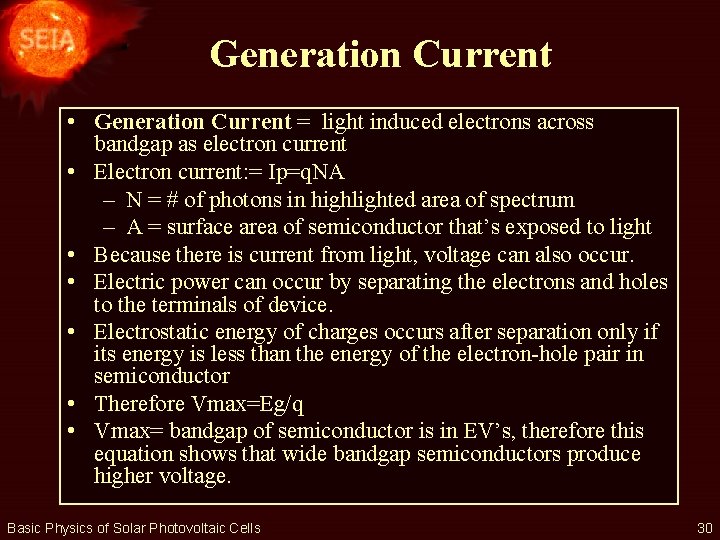
Generation Current • Generation Current = light induced electrons across bandgap as electron current • Electron current: = Ip=q. NA – N = # of photons in highlighted area of spectrum – A = surface area of semiconductor that’s exposed to light • Because there is current from light, voltage can also occur. • Electric power can occur by separating the electrons and holes to the terminals of device. • Electrostatic energy of charges occurs after separation only if its energy is less than the energy of the electron-hole pair in semiconductor • Therefore Vmax=Eg/q • Vmax= bandgap of semiconductor is in EV’s, therefore this equation shows that wide bandgap semiconductors produce higher voltage. Basic Physics of Solar Photovoltaic Cells 30
Direct vs Indirect Bandgap • Everything just talked about, where all energy in excess of bandgap of photons are absorbed, are called direct-bandgap semiconductors. • More complicated absorption process is the indirect-gap series – quantum of lattice vibrations, of crystalline silicon, are used in the conversion of a photon into electron-hole pair to conserve momentum there hindering the process and decreasing the absorption of light by semiconductor. Basic Physics of Solar Photovoltaic Cells 31
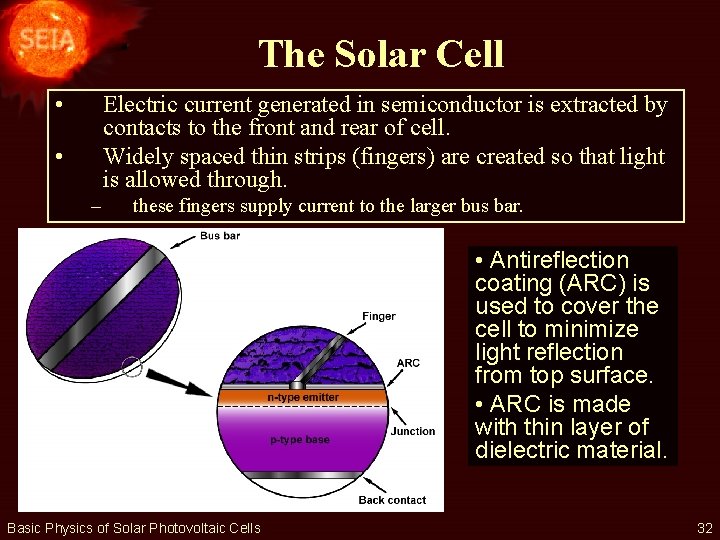
The Solar Cell • Electric current generated in semiconductor is extracted by contacts to the front and rear of cell. Widely spaced thin strips (fingers) are created so that light is allowed through. • – these fingers supply current to the larger bus bar. • Antireflection coating (ARC) is used to cover the cell to minimize light reflection from top surface. • ARC is made with thin layer of dielectric material. Basic Physics of Solar Photovoltaic Cells 32
Different Types of Photovoltaic Solar Cells Diffusion Drift Excitonic Basic Physics of Solar Photovoltaic Cells
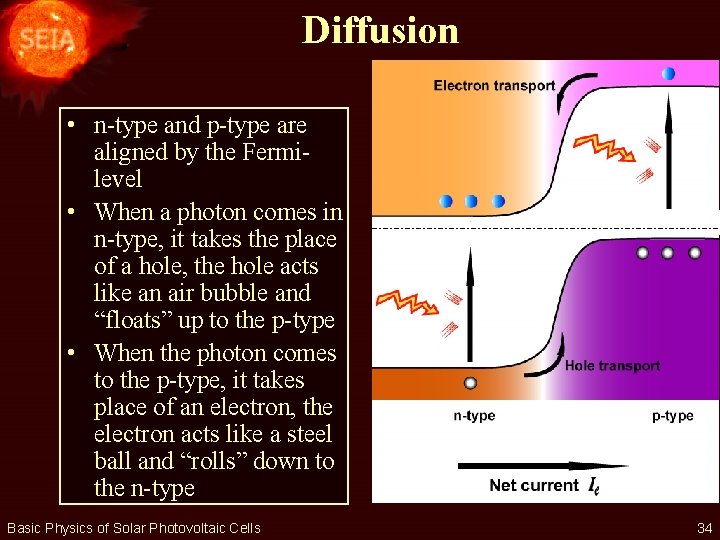
Diffusion • n-type and p-type are aligned by the Fermilevel • When a photon comes in n-type, it takes the place of a hole, the hole acts like an air bubble and “floats” up to the p-type • When the photon comes to the p-type, it takes place of an electron, the electron acts like a steel ball and “rolls” down to the n-type Basic Physics of Solar Photovoltaic Cells 34
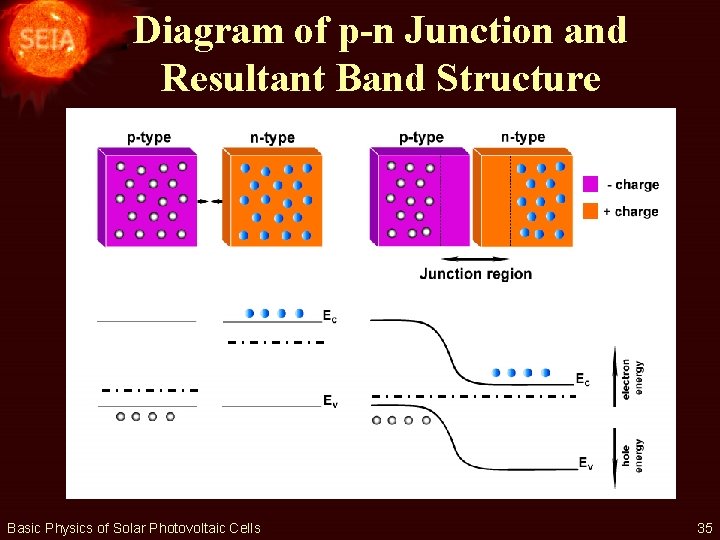
Diagram of p-n Junction and Resultant Band Structure Basic Physics of Solar Photovoltaic Cells 35
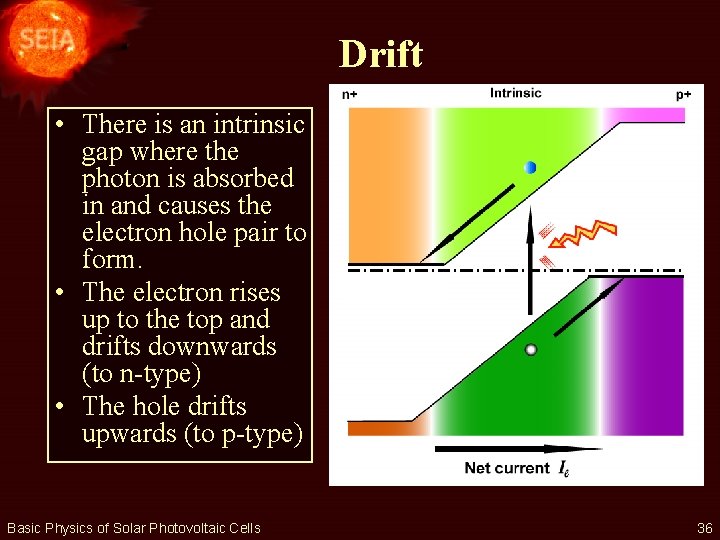
Drift • There is an intrinsic gap where the photon is absorbed in and causes the electron hole pair to form. • The electron rises up to the top and drifts downwards (to n-type) • The hole drifts upwards (to p-type) Basic Physics of Solar Photovoltaic Cells 36
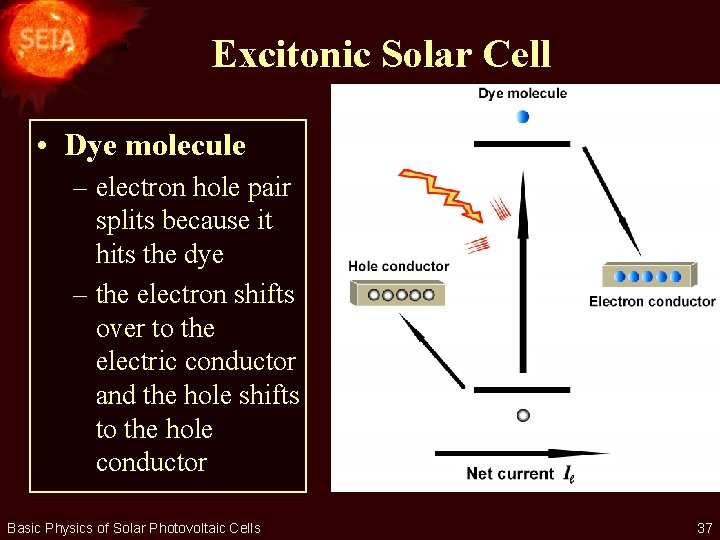
Excitonic Solar Cell • Dye molecule – electron hole pair splits because it hits the dye – the electron shifts over to the electric conductor and the hole shifts to the hole conductor Basic Physics of Solar Photovoltaic Cells 37
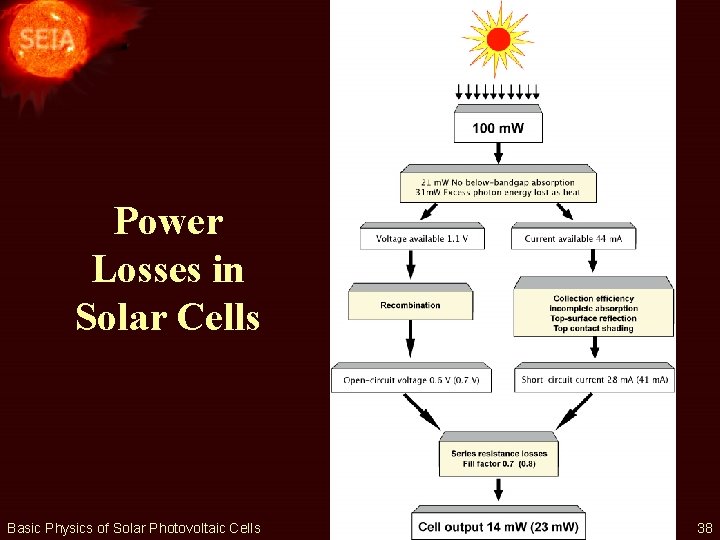
Power Losses in Solar Cells Basic Physics of Solar Photovoltaic Cells 38
Recombination • Opposite of carrier generation, where electron-hole pair is annihilated • Most common at: – impurities – defects of crystal structure – surface of semiconductor • Reducing both voltage and current Basic Physics of Solar Photovoltaic Cells 39
Series Resistance • Losses of resistance caused by transmission of electric current produced by the solar cell. • I-V characteristic of device: • I = Il-I 0 [exp(q. V+IRs / mk. T) – 1] • m= nonideality factor Basic Physics of Solar Photovoltaic Cells 40
Other Losses • Current losses- called collection efficiency, ratio b/w number of carriers generated by light by number that reaches the junction. • Temperature dependence of voltage – V decreases as T increases • Other losses – light reflection from top surface – shading of cell by top contacts – incomplete absorption of light Basic Physics of Solar Photovoltaic Cells 41
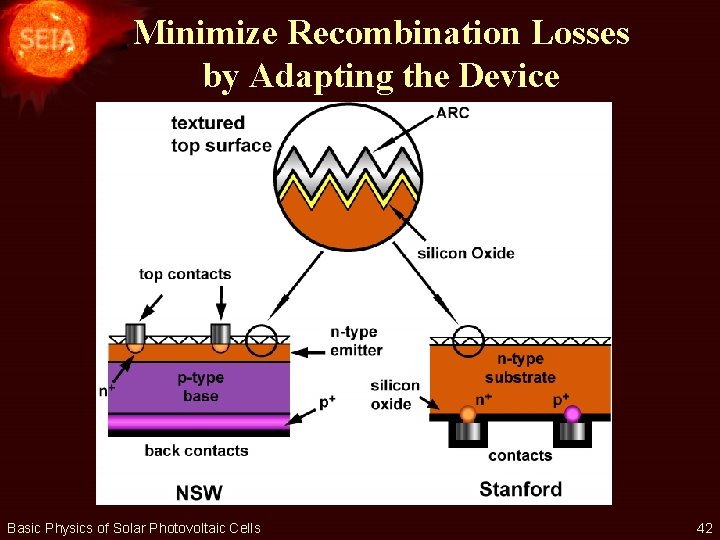
Minimize Recombination Losses by Adapting the Device Basic Physics of Solar Photovoltaic Cells 42
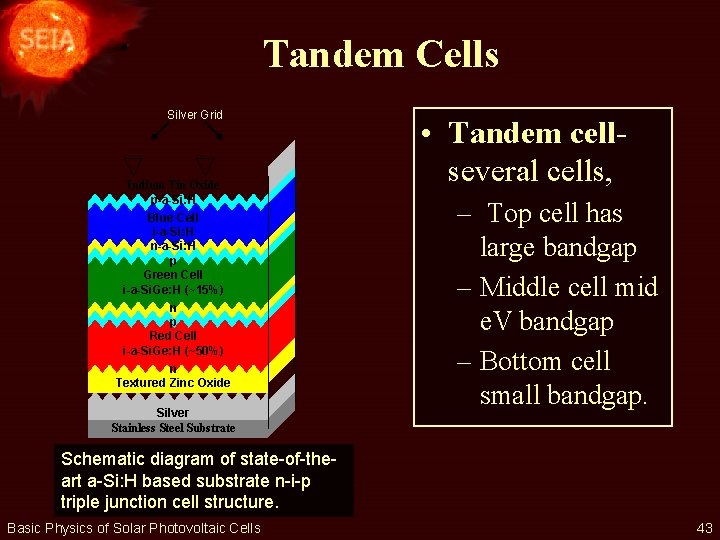
Tandem Cells Silver Grid Indium Tin Oxide p-a-Si: H Blue Cell i-a-Si: H n-a-Si: H p Green Cell i-a-Si. Ge: H (~15%) n p Red Cell i-a-Si. Ge: H (~50%) n Textured Zinc Oxide Silver Stainless Steel Substrate • Tandem cellseveral cells, – Top cell has large bandgap – Middle cell mid e. V bandgap – Bottom cell small bandgap. Schematic diagram of state-of-theart a-Si: H based substrate n-i-p triple junction cell structure. Basic Physics of Solar Photovoltaic Cells 43
Solar Photovoltaics is the Future Basic Physics of Solar Photovoltaic Cells
Acknowledgements • This is the first in a series of presentations created for the solar energy community to assist in the dissemination of information about solar photovoltaics. • This work was supported from a grant from the Pennsylvania State System of Higher Education. • The author would like to acknowledge assistance in creation of this presentation from Heather Zielonka, Scott Horengic and Jennifer Rockage. Basic Physics of Solar Photovoltaic Cells 45
- Slides: 45