
Solar Panels Past and Present By Aaron Mc
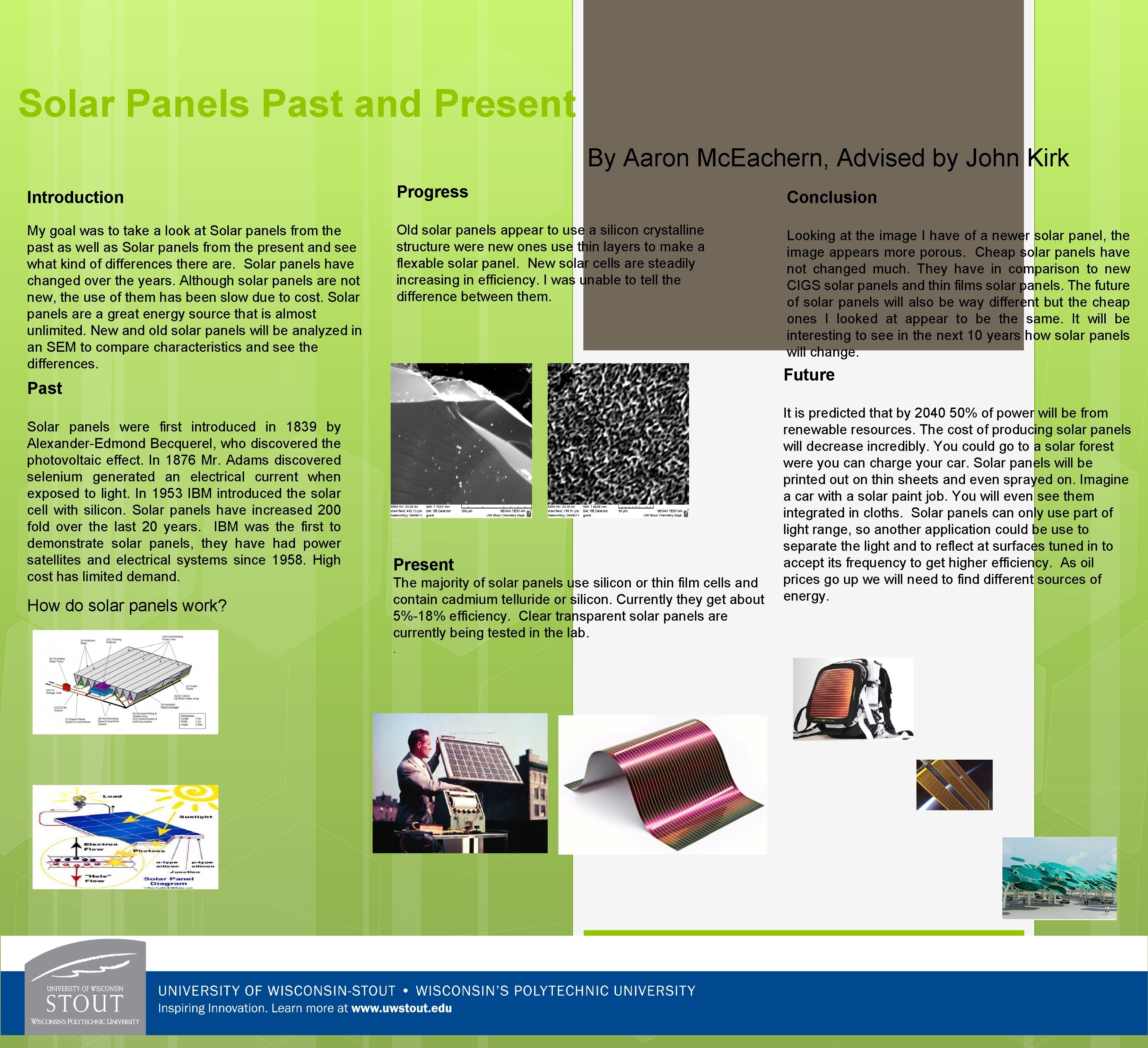
Solar Panels Past and Present By Aaron Mc. Eachern, Advised by John Kirk Introduction Progress Conclusion My goal was to take a look at Solar panels from the past as well as Solar panels from the present and see what kind of differences there are. Solar panels have changed over the years. Although solar panels are not new, the use of them has been slow due to cost. Solar panels are a great energy source that is almost unlimited. New and old solar panels will be analyzed in an SEM to compare characteristics and see the differences. Old solar panels appear to use a silicon crystalline structure were new ones use thin layers to make a flexable solar panel. New solar cells are steadily increasing in efficiency. I was unable to tell the difference between them. Looking at the image I have of a newer solar panel, the image appears more porous. Cheap solar panels have not changed much. They have in comparison to new CIGS solar panels and thin films solar panels. The future of solar panels will also be way different but the cheap ones I looked at appear to be the same. It will be interesting to see in the next 10 years how solar panels will change. Future Past Solar panels were first introduced in 1839 by Alexander-Edmond Becquerel, who discovered the photovoltaic effect. In 1876 Mr. Adams discovered selenium generated an electrical current when exposed to light. In 1953 IBM introduced the solar cell with silicon. Solar panels have increased 200 fold over the last 20 years. IBM was the first to demonstrate solar panels, they have had power satellites and electrical systems since 1958. High cost has limited demand. How do solar panels work? Present The majority of solar panels use silicon or thin film cells and contain cadmium telluride or silicon. Currently they get about 5%-18% efficiency. Clear transparent solar panels are currently being tested in the lab. . It is predicted that by 2040 50% of power will be from renewable resources. The cost of producing solar panels will decrease incredibly. You could go to a solar forest were you can charge your car. Solar panels will be printed out on thin sheets and even sprayed on. Imagine a car with a solar paint job. You will even see them integrated in cloths. Solar panels can only use part of light range, so another application could be use to separate the light and to reflect at surfaces tuned in to accept its frequency to get higher efficiency. As oil prices go up we will need to find different sources of energy.
- Slides: 1