
Solar Neutrons A New Window into Solar Acceleration
- Slides: 24
Solar Neutrons: A New Window into Solar Acceleration Processes David J. Lawrence The Johns Hopkins University Applied Physics Laboratory 3/2/2021 1
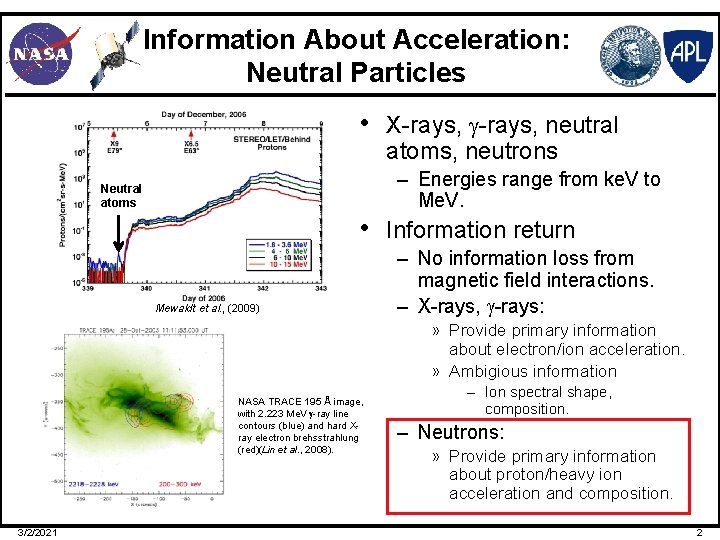
Information About Acceleration: Neutral Particles • X-rays, g-rays, neutral atoms, neutrons – Energies range from ke. V to Me. V. Neutral atoms • Information return Mewaldt et al. , (2009) – No information loss from magnetic field interactions. – X-rays, g-rays: » Provide primary information about electron/ion acceleration. » Ambigious information NASA TRACE 195 Å image, with 2. 223 Me. V g-ray line contours (blue) and hard Xray electron brehsstrahlung (red)(Lin et al. , 2008). 3/2/2021 – Ion spectral shape, composition. – Neutrons: » Provide primary information about proton/heavy ion acceleration and composition. 2
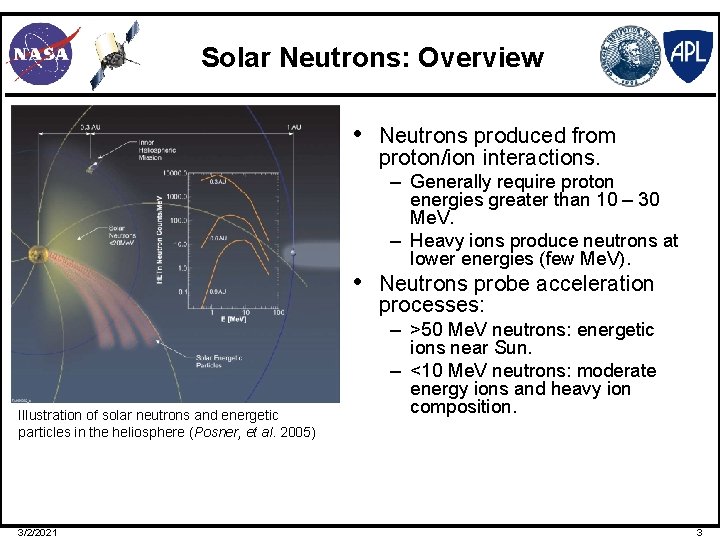
Solar Neutrons: Overview • Neutrons produced from proton/ion interactions. – Generally require proton energies greater than 10 – 30 Me. V. – Heavy ions produce neutrons at lower energies (few Me. V). • Neutrons probe acceleration processes: Illustration of solar neutrons and energetic particles in the heliosphere (Posner, et al. 2005) 3/2/2021 – >50 Me. V neutrons: energetic ions near Sun. – <10 Me. V neutrons: moderate energy ions and heavy ion composition. 3
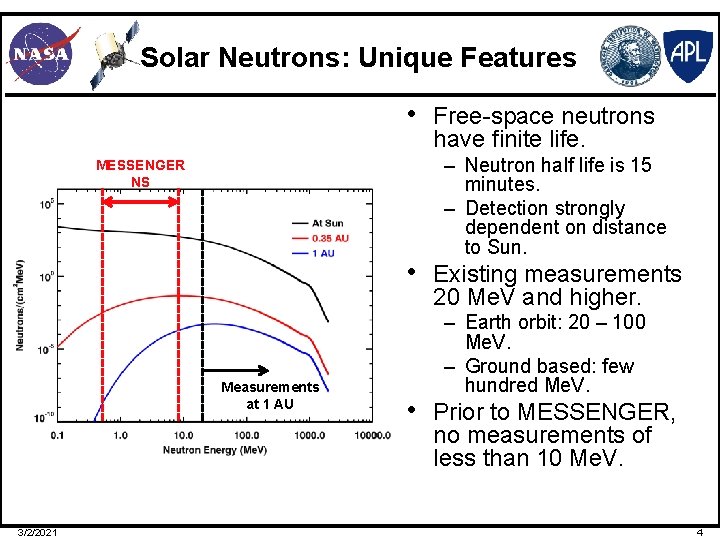
Solar Neutrons: Unique Features • Free-space neutrons have finite life. – Neutron half life is 15 minutes. – Detection strongly dependent on distance to Sun. MESSENGER NS • Existing measurements 20 Me. V and higher. Measurements at 1 AU – Earth orbit: 20 – 100 Me. V. – Ground based: few hundred Me. V. • Prior to MESSENGER, no measurements of less than 10 Me. V. 3/2/2021 4
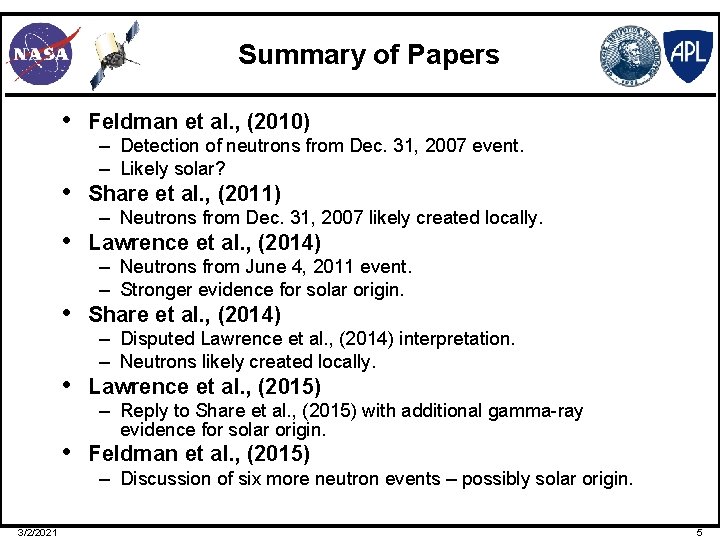
Summary of Papers • Feldman et al. , (2010) – Detection of neutrons from Dec. 31, 2007 event. – Likely solar? • Share et al. , (2011) – Neutrons from Dec. 31, 2007 likely created locally. • Lawrence et al. , (2014) – Neutrons from June 4, 2011 event. – Stronger evidence for solar origin. • Share et al. , (2014) – Disputed Lawrence et al. , (2014) interpretation. – Neutrons likely created locally. • Lawrence et al. , (2015) – Reply to Share et al. , (2015) with additional gamma-ray evidence for solar origin. • Feldman et al. , (2015) – Discussion of six more neutron events – possibly solar origin. 3/2/2021 5
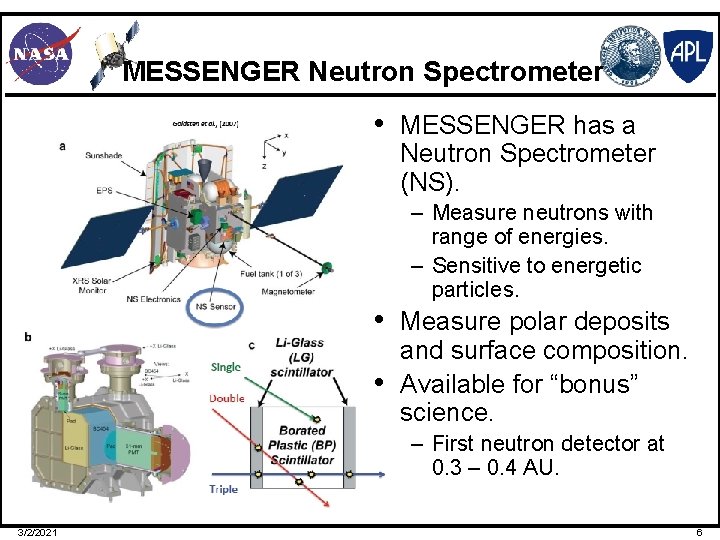
MESSENGER Neutron Spectrometer • MESSENGER has a Neutron Spectrometer (NS). – Measure neutrons with range of energies. – Sensitive to energetic particles. • Measure polar deposits • and surface composition. Available for “bonus” science. – First neutron detector at 0. 3 – 0. 4 AU. 3/2/2021 6
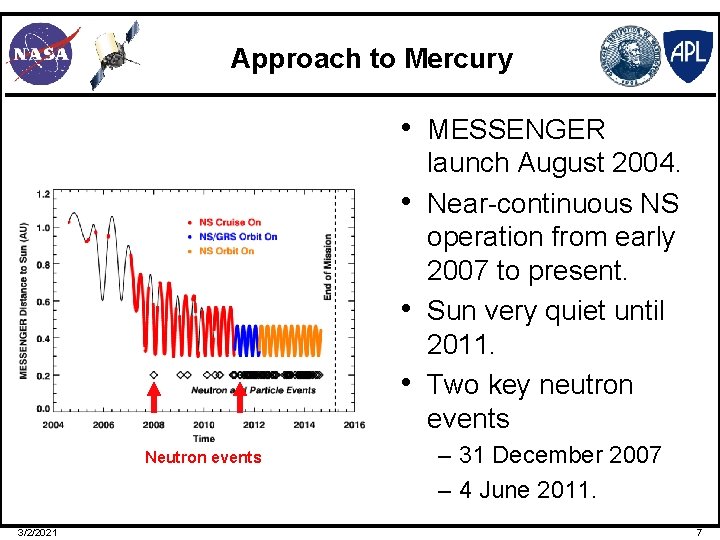
Approach to Mercury • MESSENGER • • • Neutron events 3/2/2021 launch August 2004. Near-continuous NS operation from early 2007 to present. Sun very quiet until 2011. Two key neutron events – 31 December 2007 – 4 June 2011. 7
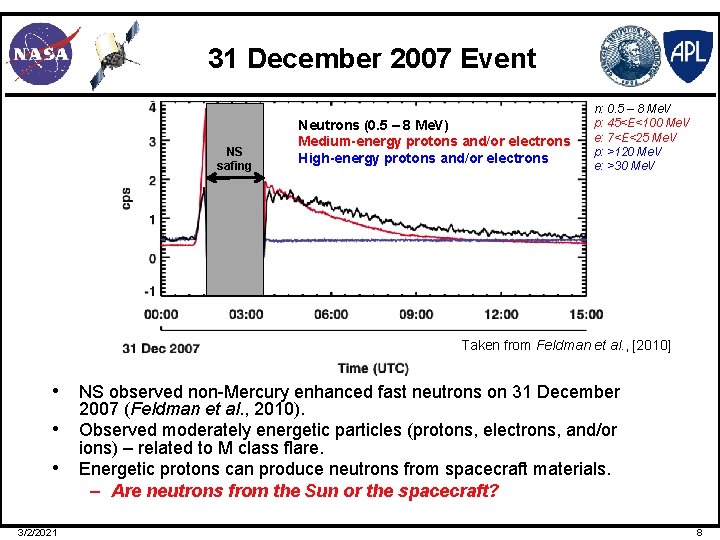
31 December 2007 Event NS safing Neutrons (0. 5 – 8 Me. V) Medium-energy protons and/or electrons High-energy protons and/or electrons n: 0. 5 – 8 Me. V p: 45<E<100 Me. V e: 7<E<25 Me. V p: >120 Me. V e: >30 Me. V Taken from Feldman et al. , [2010] • NS observed non-Mercury enhanced fast neutrons on 31 December • • 3/2/2021 2007 (Feldman et al. , 2010). Observed moderately energetic particles (protons, electrons, and/or ions) – related to M class flare. Energetic protons can produce neutrons from spacecraft materials. – Are neutrons from the Sun or the spacecraft? 8
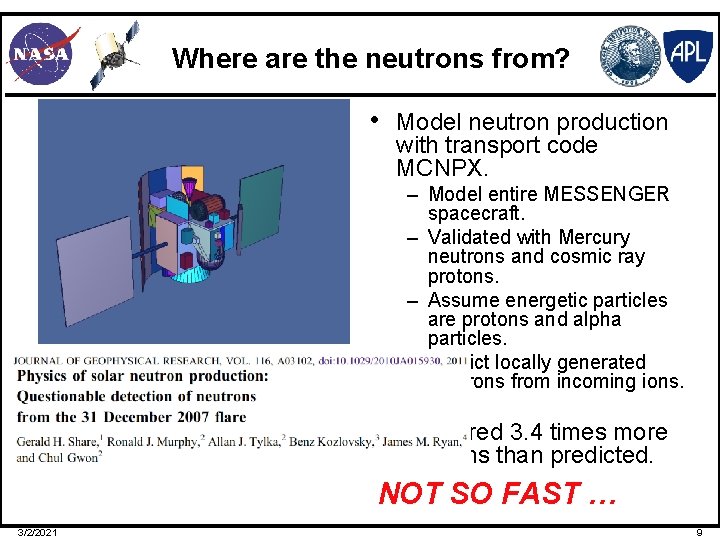
Where are the neutrons from? • Model neutron production with transport code MCNPX. Geometry model of MESSENGER spacecraft for MCNPX particle transport code – Model entire MESSENGER spacecraft. – Validated with Mercury neutrons and cosmic ray protons. – Assume energetic particles are protons and alpha particles. – Predict locally generated neutrons from incoming ions. • Measured 3. 4 times more neutrons than predicted. – Likely solar origin? NOT SO FAST … 3/2/2021 9
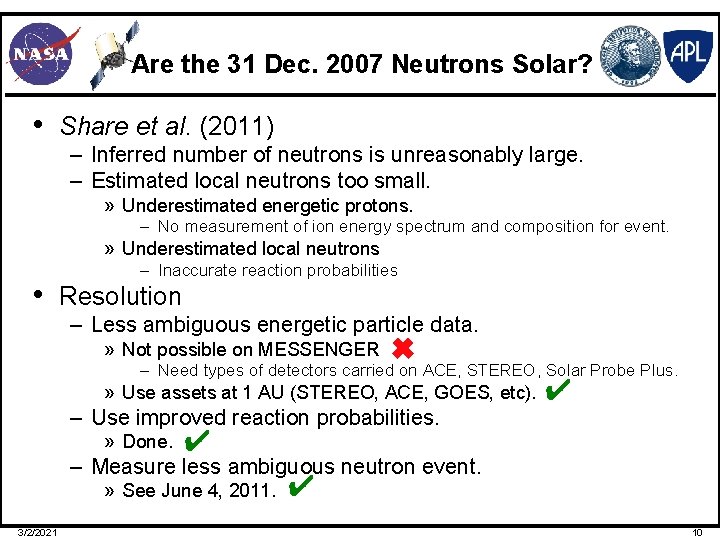
Are the 31 Dec. 2007 Neutrons Solar? • Share et al. (2011) – Inferred number of neutrons is unreasonably large. – Estimated local neutrons too small. » Underestimated energetic protons. – No measurement of ion energy spectrum and composition for event. » Underestimated local neutrons – Inaccurate reaction probabilities • Resolution – Less ambiguous energetic particle data. » Not possible on MESSENGER ✖ – Need types of detectors carried on ACE, STEREO, Solar Probe Plus. » Use assets at 1 AU (STEREO, ACE, GOES, etc). – Use improved reaction probabilities. » Done. ✔ ✔ – Measure less ambiguous neutron event. » See June 4, 2011. 3/2/2021 ✔ 10
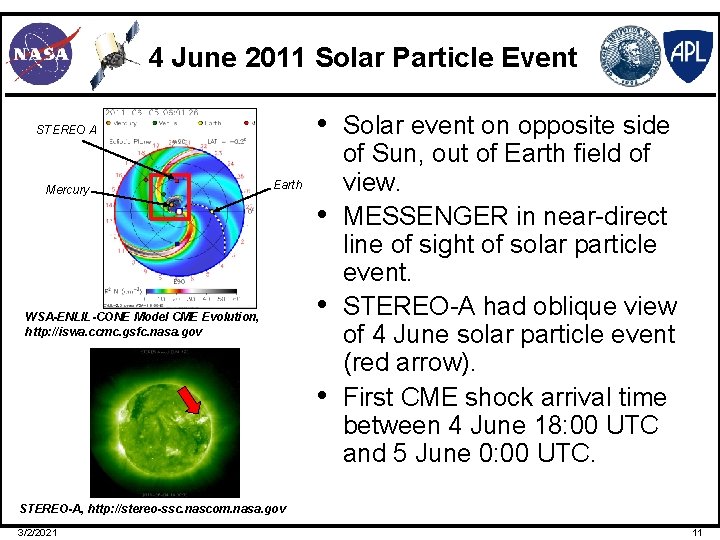
4 June 2011 Solar Particle Event • Solar event on opposite side STEREO A Mercury Earth WSA-ENLIL-CONE Model CME Evolution, http: //iswa. ccmc. gsfc. nasa. gov • • • of Sun, out of Earth field of view. MESSENGER in near-direct line of sight of solar particle event. STEREO-A had oblique view of 4 June solar particle event (red arrow). First CME shock arrival time between 4 June 18: 00 UTC and 5 June 0: 00 UTC. STEREO-A, http: //stereo-ssc. nascom. nasa. gov 3/2/2021 11
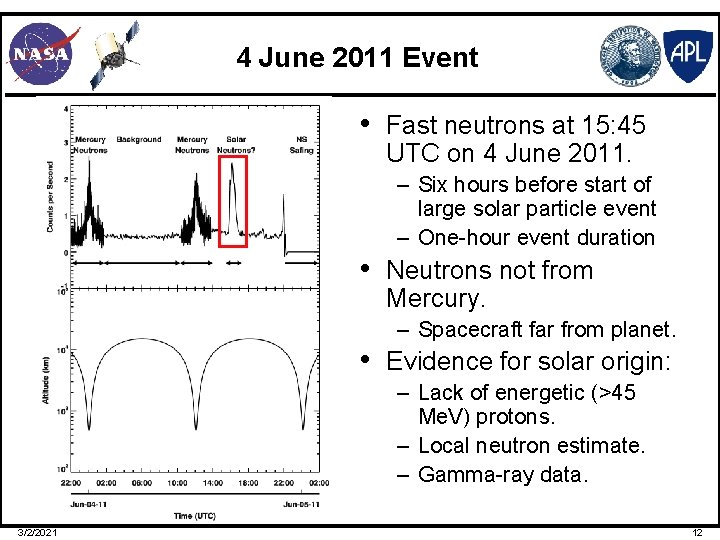
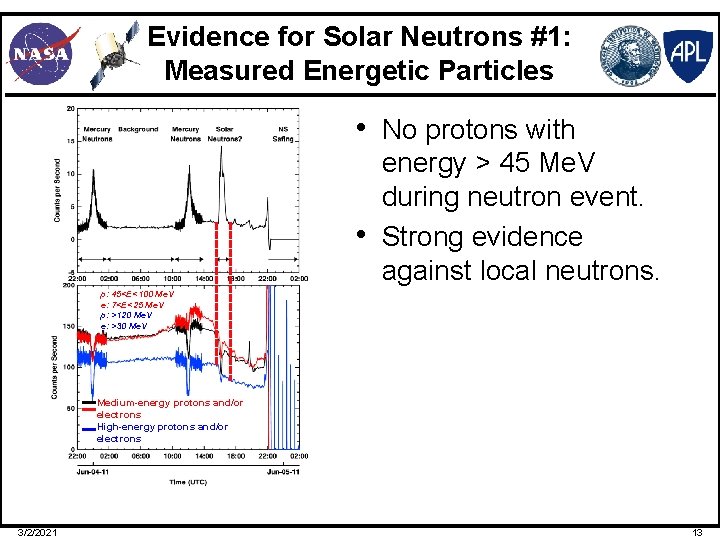
4 June 2011 Event • Fast neutrons at 15: 45 UTC on 4 June 2011. – Six hours before start of large solar particle event – One-hour event duration • Neutrons not from Mercury. – Spacecraft far from planet. • Evidence for solar origin: – Lack of energetic (>45 Me. V) protons. – Local neutron estimate. – Gamma-ray data. 3/2/2021 12
Evidence for Solar Neutrons #1: Measured Energetic Particles • No protons with • energy > 45 Me. V during neutron event. Strong evidence against local neutrons. p: 45<E<100 Me. V e: 7<E<25 Me. V p: >120 Me. V e: >30 Me. V Medium-energy protons and/or electrons High-energy protons and/or electrons 3/2/2021 13
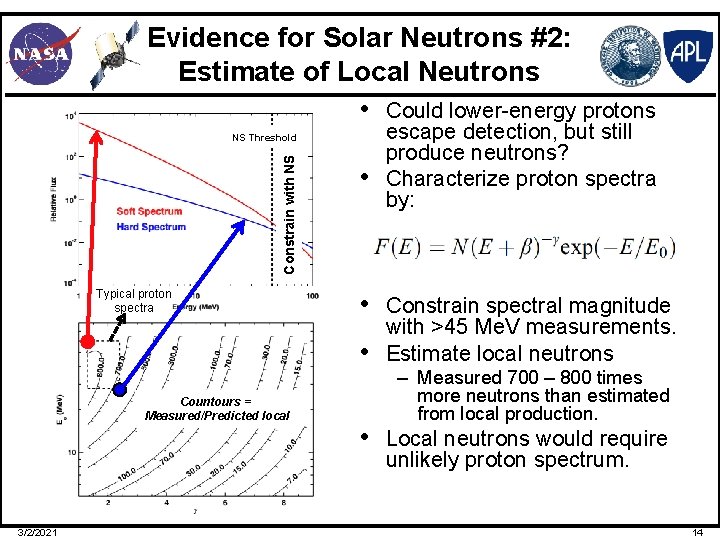
Evidence for Solar Neutrons #2: Estimate of Local Neutrons • Could lower-energy protons Constrain with NS NS Threshold Typical proton spectra • • Constrain spectral magnitude • Countours = Measured/Predicted local escape detection, but still produce neutrons? Characterize proton spectra by: with >45 Me. V measurements. Estimate local neutrons – Measured 700 – 800 times more neutrons than estimated from local production. • Local neutrons would require unlikely proton spectrum. 3/2/2021 14
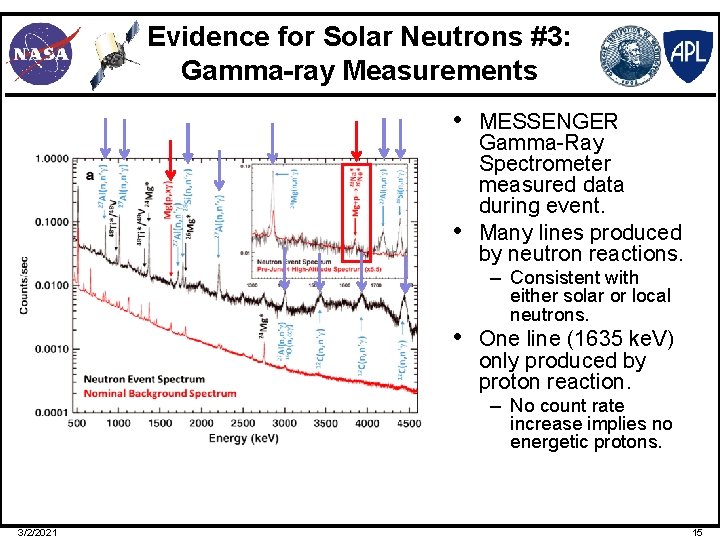
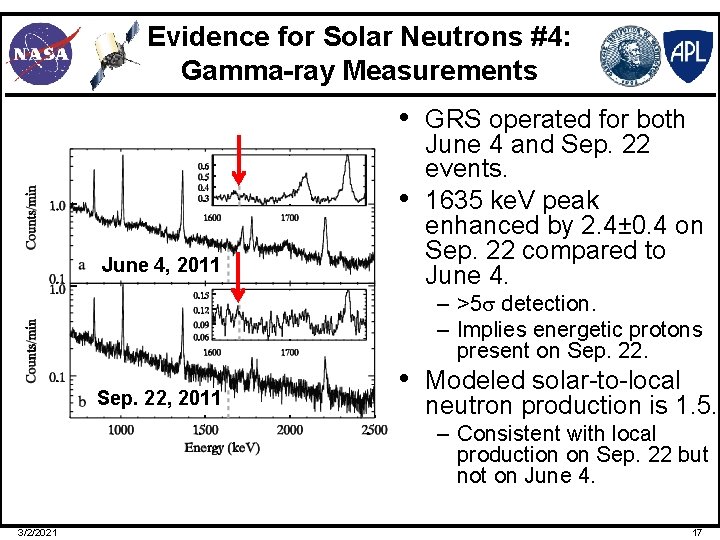
Evidence for Solar Neutrons #3: Gamma-ray Measurements • MESSENGER • Gamma-Ray Spectrometer measured data during event. Many lines produced by neutron reactions. – Consistent with either solar or local neutrons. • One line (1635 ke. V) only produced by proton reaction. – No count rate increase implies no energetic protons. 3/2/2021 15
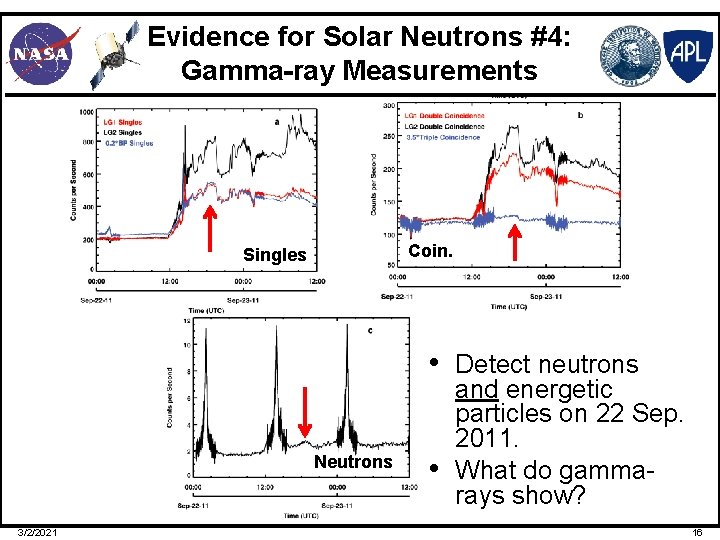
Evidence for Solar Neutrons #4: Gamma-ray Measurements Coin. Singles • Detect neutrons Neutrons 3/2/2021 • and energetic particles on 22 Sep. 2011. What do gammarays show? 16
Evidence for Solar Neutrons #4: Gamma-ray Measurements • GRS operated for both • June 4, 2011 June 4 and Sep. 22 events. 1635 ke. V peak enhanced by 2. 4± 0. 4 on Sep. 22 compared to June 4. – >5 s detection. – Implies energetic protons present on Sep. 22, 2011 • Modeled solar-to-local neutron production is 1. 5. – Consistent with local production on Sep. 22 but not on June 4. 3/2/2021 17
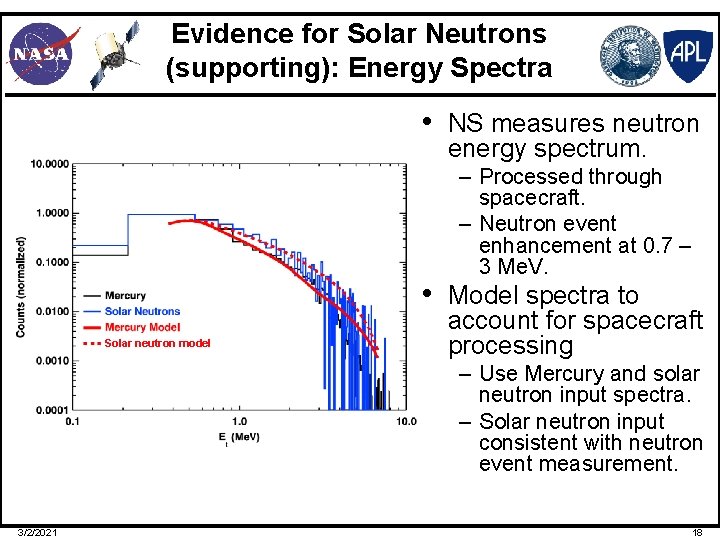
Evidence for Solar Neutrons (supporting): Energy Spectra • NS measures neutron energy spectrum. – Processed through spacecraft. – Neutron event enhancement at 0. 7 – 3 Me. V. • Model spectra to Solar neutron model account for spacecraft processing – Use Mercury and solar neutron input spectra. – Solar neutron input consistent with neutron event measurement. 3/2/2021 18
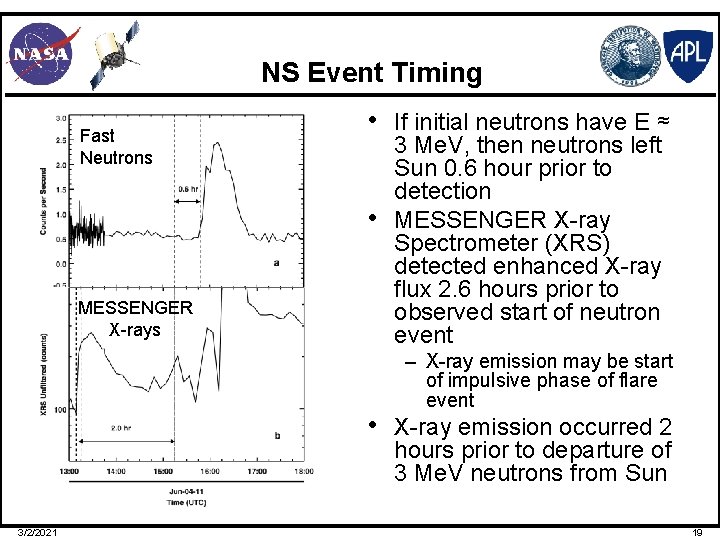
NS Event Timing Fast Neutrons • If initial neutrons have E ≈ • MESSENGER X-rays 3 Me. V, then neutrons left Sun 0. 6 hour prior to detection MESSENGER X-ray Spectrometer (XRS) detected enhanced X-ray flux 2. 6 hours prior to observed start of neutron event – X-ray emission may be start of impulsive phase of flare event • X-ray emission occurred 2 hours prior to departure of 3 Me. V neutrons from Sun 3/2/2021 19
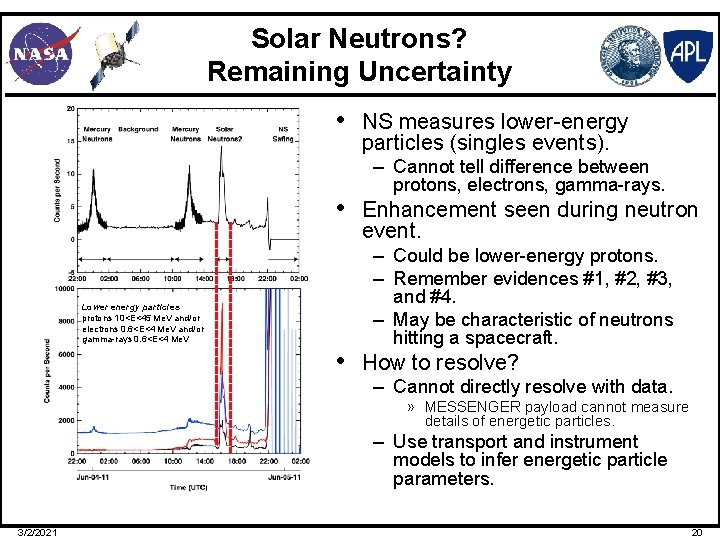
Solar Neutrons? Remaining Uncertainty • NS measures lower-energy particles (singles events). – Cannot tell difference between protons, electrons, gamma-rays. • Enhancement seen during neutron event. Lower energy particles protons 10<E<45 Me. V and/or electrons 0. 6<E<4 Me. V and/or gamma-rays 0. 6<E<4 Me. V – Could be lower-energy protons. – Remember evidences #1, #2, #3, and #4. – May be characteristic of neutrons hitting a spacecraft. • How to resolve? – Cannot directly resolve with data. » MESSENGER payload cannot measure details of energetic particles. – Use transport and instrument models to infer energetic particle parameters. 3/2/2021 20
Implications of June 4, 2011 Event • Multiple lines of evidence argue for solar origin. • Large number of neutrons at the Sun. – Scale from modeled fluence @ Sun (Murphy et al. , 2012) Maybe not 31 – Neutrons (0. 5 – 10 Me. V): 2 x 10 n/Sr. too large? – Scale 0. 05 – 1. 5 Ge. V Earth-based measurements (Vilmer et al. , 2011) from large flare to 0. 5 – 10 Me. V: » 2. 8 x 1032 – 5. 8 x 1034 n/Sr. • Neutrons produced by heavy ions? – Heavy ions have low-energy threshold for neutron production. » Information about soft ion spectra and low-density environments (Vilmer et al. , 2011). • New type of event? – New information about solar acceleration and composition? 3/2/2021 21
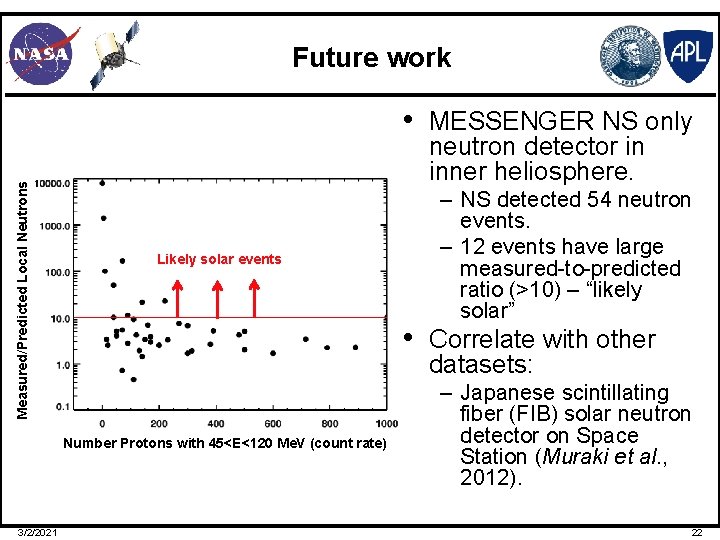
Future work Measured/Predicted Local Neutrons • MESSENGER NS only neutron detector in inner heliosphere. Likely solar events • Correlate with other datasets: Number Protons with 45<E<120 Me. V (count rate) 3/2/2021 – NS detected 54 neutron events. – 12 events have large measured-to-predicted ratio (>10) – “likely solar” – Japanese scintillating fiber (FIB) solar neutron detector on Space Station (Muraki et al. , 2012). 22
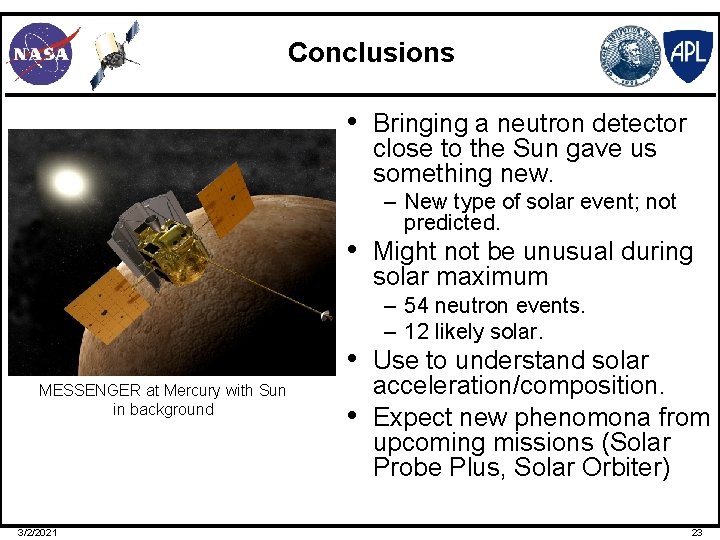
Conclusions • Bringing a neutron detector close to the Sun gave us something new. – New type of solar event; not predicted. • Might not be unusual during solar maximum – 54 neutron events. – 12 likely solar. • Use to understand solar MESSENGER at Mercury with Sun in background 3/2/2021 • acceleration/composition. Expect new phenomona from upcoming missions (Solar Probe Plus, Solar Orbiter) 23
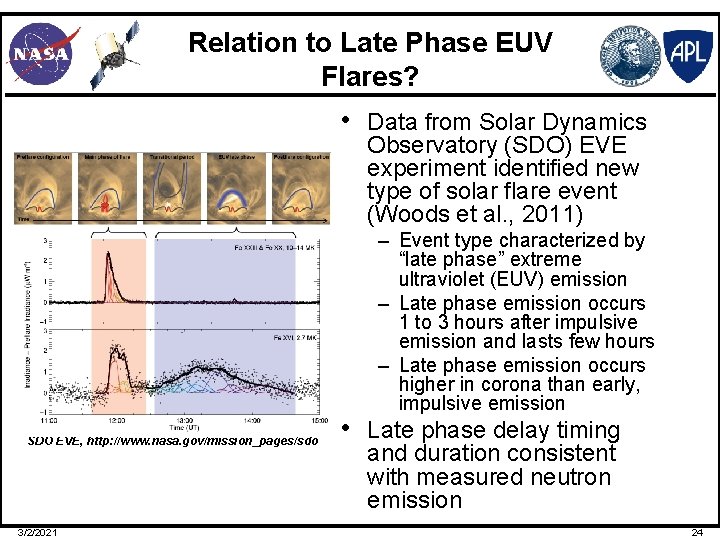
Relation to Late Phase EUV Flares? • Data from Solar Dynamics Observatory (SDO) EVE experiment identified new type of solar flare event (Woods et al. , 2011) – Event type characterized by “late phase” extreme ultraviolet (EUV) emission – Late phase emission occurs 1 to 3 hours after impulsive emission and lasts few hours – Late phase emission occurs higher in corona than early, impulsive emission SDO EVE, http: //www. nasa. gov/mission_pages/sdo 3/2/2021 • Late phase delay timing and duration consistent with measured neutron emission 24