
Solar neutrinos and oscillations Diego Cauz 18 luglio
- Slides: 54
Solar neutrinos and oscillations Diego Cauz 18 luglio 2018
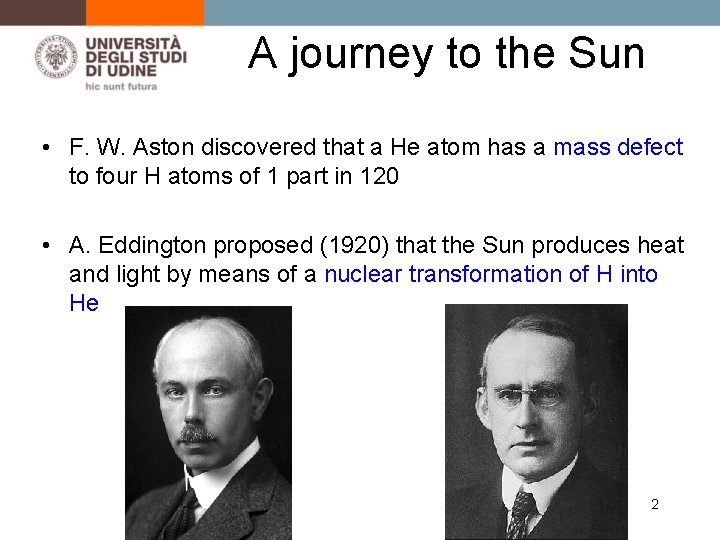
A journey to the Sun • F. W. Aston discovered that a He atom has a mass defect to four H atoms of 1 part in 120 • A. Eddington proposed (1920) that the Sun produces heat and light by means of a nuclear transformation of H into He 2
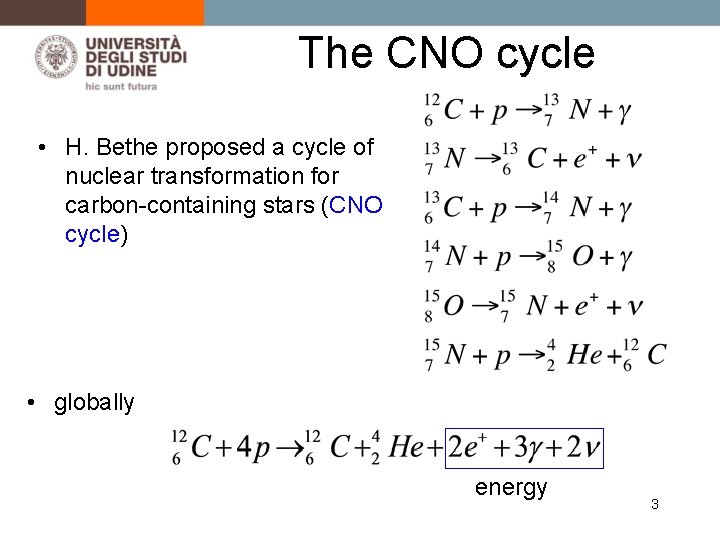
The CNO cycle • H. Bethe proposed a cycle of nuclear transformation for carbon-containing stars (CNO cycle) • globally energy 3
Sun-like stars • The CNO cycle, works only if the star contains carbon and its T > 20 millions K • In the Sun carbon is rare and T ~ 15 millions K a different process is necessary • Bethe found a solution (1939): – for Sun-like stars, H atoms are decomposed into protons and electrons – when two protons collide, the nuclear fusion of the two is possible 4
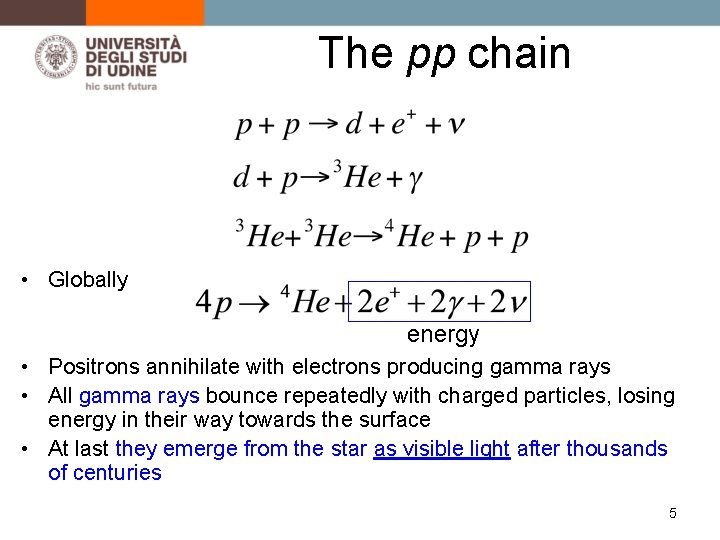
The pp chain • Globally energy • Positrons annihilate with electrons producing gamma rays • All gamma rays bounce repeatedly with charged particles, losing energy in their way towards the surface • At last they emerge from the star as visible light after thousands of centuries 5
Solar neutrinos • The neutrinos, instead, would traverse the Sun unimpeded and reach the Earth in about eigth minutes • Bethe’s theory explained the facts and predicted the production of neutrinos • But in 1939 the neutrino was still considered just a theoretical construction • This changed after Pontecorvo’s 1946 paper and Cowan and Reines’ 1956 antineutrino discovery • The possibility to verify Bethe’s theory, searching for solar neutrinos was considered 6
Another ‘failure’ of Davis’ • If solar neutrinos were produced in the CNO cycle, Davis’ apparatus could detect them • But Davis’ try failed so – either the idea of solar neutrinos was wrong – or the CNO cycle was not important to the Sun • Actually in the Sun the dominant process is the pp chain whose neutrinos have insufficient energy (less than one half) for the Cl reaction (860 ke. V) in Davis’ experiment 7
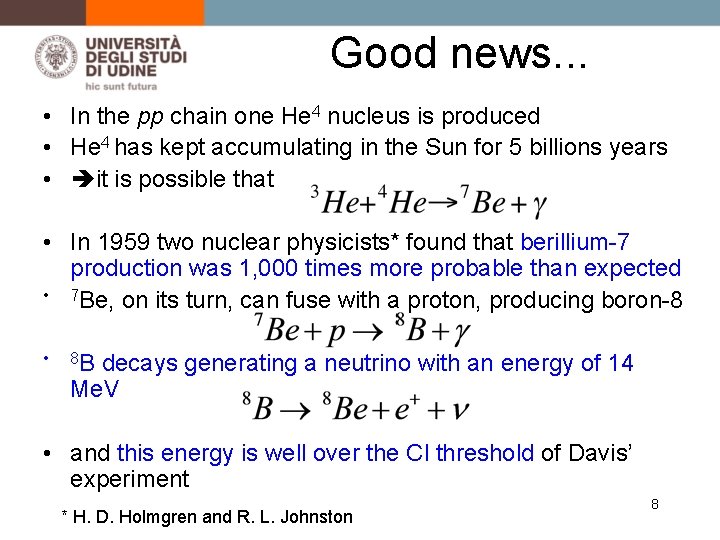
Good news. . . • In the pp chain one He 4 nucleus is produced • He 4 has kept accumulating in the Sun for 5 billions years • it is possible that • In 1959 two nuclear physicists* found that berillium-7 production was 1, 000 times more probable than expected • 7 Be, on its turn, can fuse with a proton, producing boron-8 • 8 B decays generating a neutrino with an energy of 14 Me. V • and this energy is well over the Cl threshold of Davis’ experiment * H. D. Holmgren and R. L. Johnston 8
. . . and bad news • This encouraged Davis and Calvin to start a new experiment (1959), with the Savannah River detector • To reduce the cosmic-ray background, the experiment moved in a mine 700 meters underground • Unfortunately nuclear physics experiments found that the probability for Be 7 -p fusion was very small • and Davis again could not find any convincing evidence of solar neutrinos 9
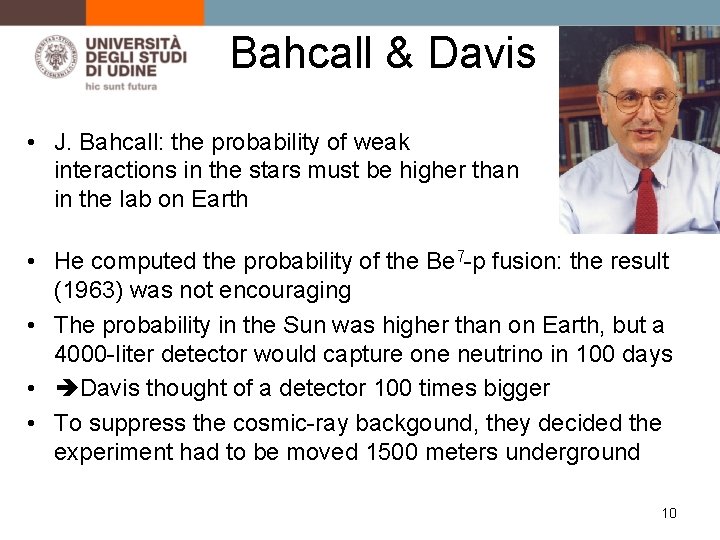
Bahcall & Davis • J. Bahcall: the probability of weak interactions in the stars must be higher than in the lab on Earth • He computed the probability of the Be 7 -p fusion: the result (1963) was not encouraging • The probability in the Sun was higher than on Earth, but a 4000 -liter detector would capture one neutrino in 100 days • Davis thought of a detector 100 times bigger • To suppress the cosmic-ray backgound, they decided the experiment had to be moved 1500 meters underground 10
Good news again • B. Mottelson noticed that solar neutrinos should have enough energy to form the Ar nucleus in an excited state. . . • So Bahcall computed the new process, finding that neutrino capture by Cl was increased 20 times 11
Homestake, 1966 • The new experiment was built in the Homestake gold mine in Lead, SD • The tank contained 615 tons of C 2 Cl 4 , a normal cleaning agent • By September 1966 it was ready to start making the history of physics 12
How many solar neutrinos? • On the basis of the Standard Solar Model (SSM), Bahcall calculated the solar neutrinos flux on Earth, finding a total of 66 x 109 s-1 cm-2 • Unfortunately most of the times the neutrinos have insufficient energy to react with Cl • Moreover nearly all of them would pass through the detector without interaction 13
The SNU • Bahcall expressed the probability that a solar neutrino interacts with a Cl nucleus introducing the Solar Neutrino Unit: 1 SNU=10 -36 reactions/nucleus/s • In 400, 000 liters of detergent there about 2 x 1030 Cl nuclei the mean neutrino capture time is 6 days per SNU • Bahcall’s result was 7. 5+-3 SNU and about 6 of these were produced by B 8, the ones which Davis’ experiment was able to detect 14
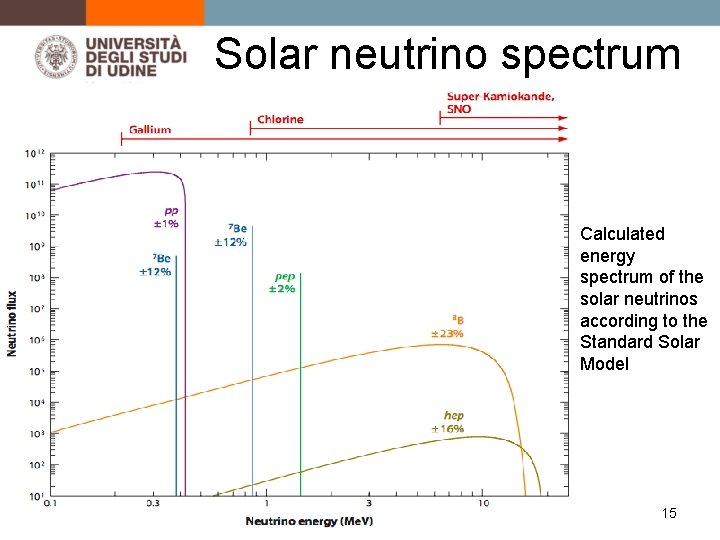
Solar neutrino spectrum Calculated energy spectrum of the solar neutrinos according to the Standard Solar Model 15
Neutrinos eventually! (but too few) • 1968: first results published: the production frequency of neutrinos was too small, 3 SNU at best • In the following years the cosmic-ray background was reduced, the SSM reexamined, while the statistics was slowly accumulating. . . but neutrinos kept missing • Solar neutrino problem • 1978: at the Brookhaven conference it was realized that a new experiment was necessary to detect the neutrinos from the dominant pp fusion • From 1968 to 1988 Davis’ experiment was the only active experiment investigating solar neutrinos 16
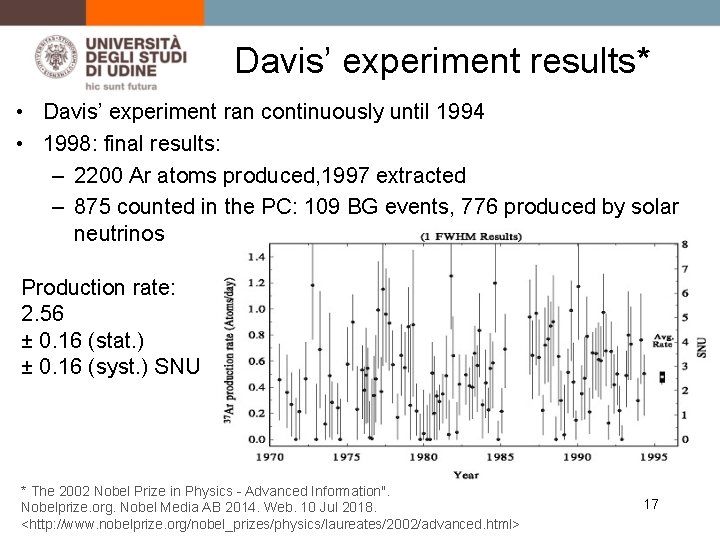
Davis’ experiment results* • Davis’ experiment ran continuously until 1994 • 1998: final results: – 2200 Ar atoms produced, 1997 extracted – 875 counted in the PC: 109 BG events, 776 produced by solar neutrinos Production rate: 2. 56 ± 0. 16 (stat. ) ± 0. 16 (syst. ) SNU * The 2002 Nobel Prize in Physics - Advanced Information". Nobelprize. org. Nobel Media AB 2014. Web. 10 Jul 2018. <http: //www. nobelprize. org/nobel_prizes/physics/laureates/2002/advanced. html> 17
The ignored solution • In 1968, when Davis’ first results appeared, Pontecorvo and Gribov proposed the right solution to the missing neutrinos • The idea of neutrino oscillations had been first proposed by Pontecorvo (1957) as neutrino-antineutrino transitions • This was later developed to theory of neutrino flavor oscillation, by Maki, Nakagawa and Sakata (1962) and Pontecorvo (1967) • The theory is based on the existence of two neutrino states • Quantum mechanics allows neutrinos to oscillate between the two states, provided they have mass • The idea that neutrinos have mass, went against the Standard Model of the elementary particles and for this reason the idea was simply ignored 18
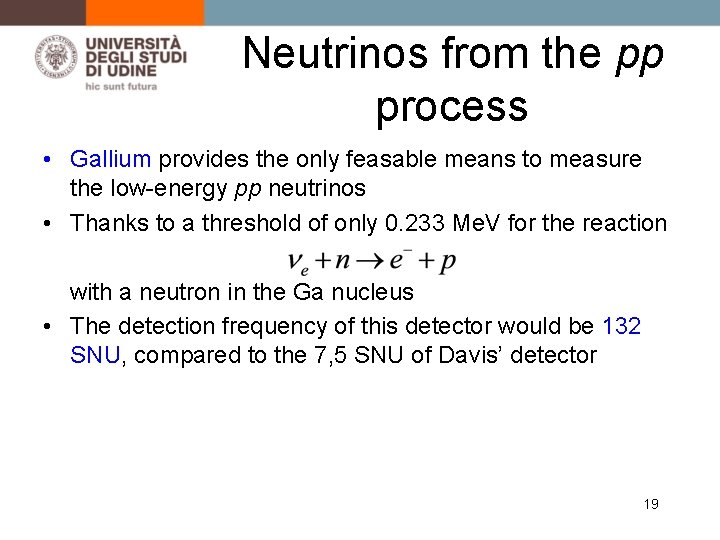
Neutrinos from the pp process • Gallium provides the only feasable means to measure the low-energy pp neutrinos • Thanks to a threshold of only 0. 233 Me. V for the reaction with a neutron in the Ga nucleus • The detection frequency of this detector would be 132 SNU, compared to the 7, 5 SNU of Davis’ detector 19
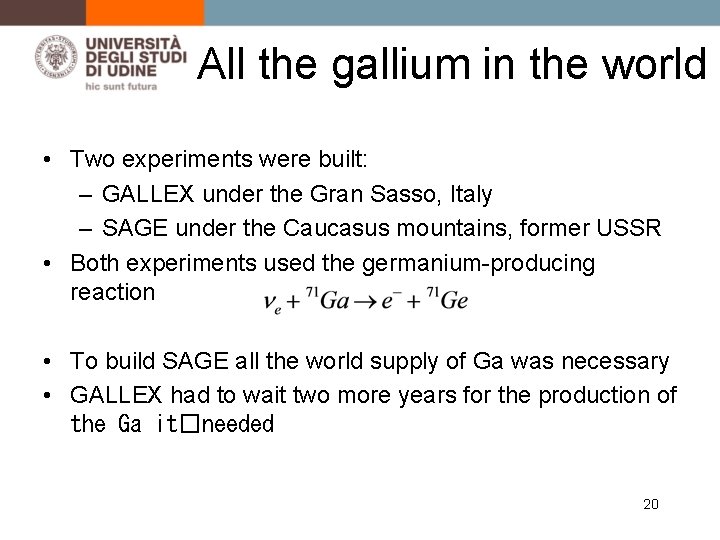
All the gallium in the world • Two experiments were built: – GALLEX under the Gran Sasso, Italy – SAGE under the Caucasus mountains, former USSR • Both experiments used the germanium-producing reaction • To build SAGE all the world supply of Ga was necessary • GALLEX had to wait two more years for the production of the Ga it�needed 20
Why two experiments? • Both experiments used the same reaction • The composition of the Ga target was metallic gallium for SAGE and a liquid gallium chloride solution for GALLEX • The different forms of the gallium are susceptible to very different types of backgrounds, and thus the two experiments provided a check for each other 21
SAGE (1989 -2010) • The target was 57 tonnes of liquid Ga metal • Once a month Ge was chemically extracted from the Ga • 71 Ge undergoes electron capture (T = 11. 43 days) 1/2 • The extracted amount of Ge can be determined with a proportional counter by measuring the activity of the resulting Ga atom in an excited state • The excess energy is carried off by low-energy Auger electrons and by X-rays, which, taken together, make for a characteristic decay signature 22
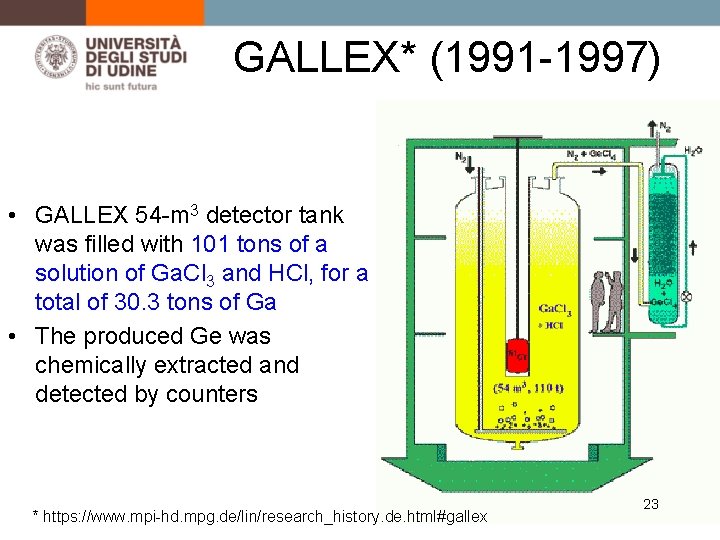
GALLEX* (1991 -1997) • GALLEX 54 -m 3 detector tank was filled with 101 tons of a solution of Ga. Cl 3 and HCl, for a total of 30. 3 tons of Ga • The produced Ge was chemically extracted and detected by counters * https: //www. mpi-hd. mpg. de/lin/research_history. de. html#gallex 23
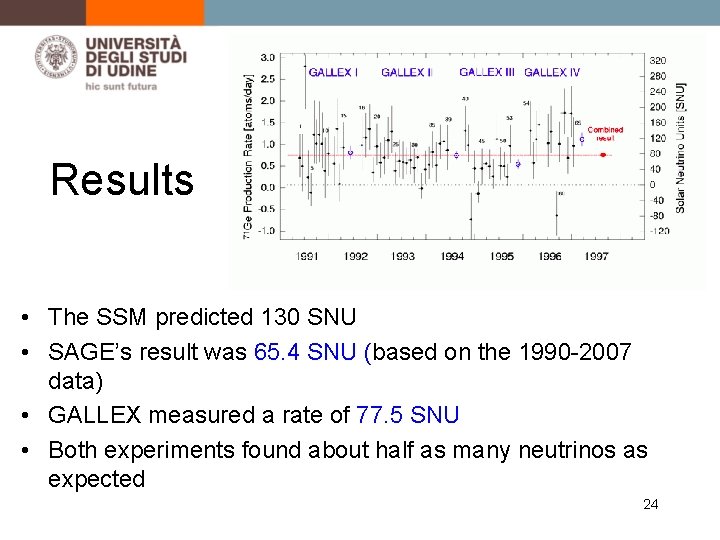
Results • The SSM predicted 130 SNU • SAGE’s result was 65. 4 SNU (based on the 1990 -2007 data) • GALLEX measured a rate of 77. 5 SNU • Both experiments found about half as many neutrinos as expected 24
Kamioka. NDE (1983) • The detector was a tank 16. 0 m in height and 15. 6 m in width, containing 3, 048 tonnes of ultra-pure water and about 1, 000 PMTs • The aim of the experiment was to find whether the proton decays • Since neutrinos are a major background to the search for proton decay, the study of neutrinos became a major effort • Kamiokande could detect neutrinos in real time, with an obvious advantage on chlorine and gallium detectors • There neutrinos were counted one month after interaction, after radiochemical extraction of the produced Ar or Ge atoms 25
Kamioka. NDE II • The detector was upgraded, starting in 1985 to allow it to observe solar neutrinos • As a result the detector Kamioka. NDE-II had become sensitive enough to detect neutrinos from SN 1987 A • 1988: K-II observes solar neutrinos produced by B 8 • The ability of the experiment to observe the direction of electrons produced in solar neutrino interactions, demonstrated for the first time that the Sun was a source of neutrinos • The number of detected neutrinos resulted too low also for this reaction, about half of what was expected 26
Super-Kamiokande (1996) • Kamiokande failed to detect proton decay, and this led to the construction of Super-Kamiokande • Super-K is a large water Cherenkov detector used to study proton decay and neutrinos from different sources including the Sun, supernovae, the atmosphere and accelerators • The detector is located 1, 000 meter underground in the Kamioka mine, Gifu, Japan 27
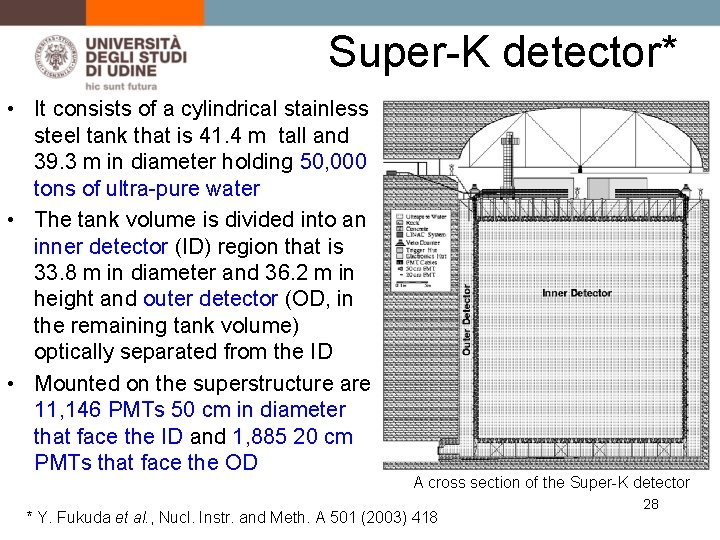
Super-K detector* • It consists of a cylindrical stainless steel tank that is 41. 4 m tall and 39. 3 m in diameter holding 50, 000 tons of ultra-pure water • The tank volume is divided into an inner detector (ID) region that is 33. 8 m in diameter and 36. 2 m in height and outer detector (OD, in the remaining tank volume) optically separated from the ID • Mounted on the superstructure are 11, 146 PMTs 50 cm in diameter that face the ID and 1, 885 20 cm PMTs that face the OD A cross section of the Super-K detector * Y. Fukuda et al. , Nucl. Instr. and Meth. A 501 (2003) 418 28
Principle of operation • A neutrino interaction with the electrons or nuclei of water can produce a charged particle that moves faster than the speed of light in water • This creates a cone of light known as Cherenkov radiation • The Cherenkov light is projected as a ring on the wall of the detector and recorded by the PMTs • Using the timing and charge information recorded by each PMT, the interaction vertex and particle direction is determined 29
Flavor identification • From the sharpness of the edge of the ring the type of particle can be inferred • The multiply scattered electrons produce fuzzy rings • Highly relativistic muons, in contrast, travel almost straight through the detector and produce rings with sharp edges 30
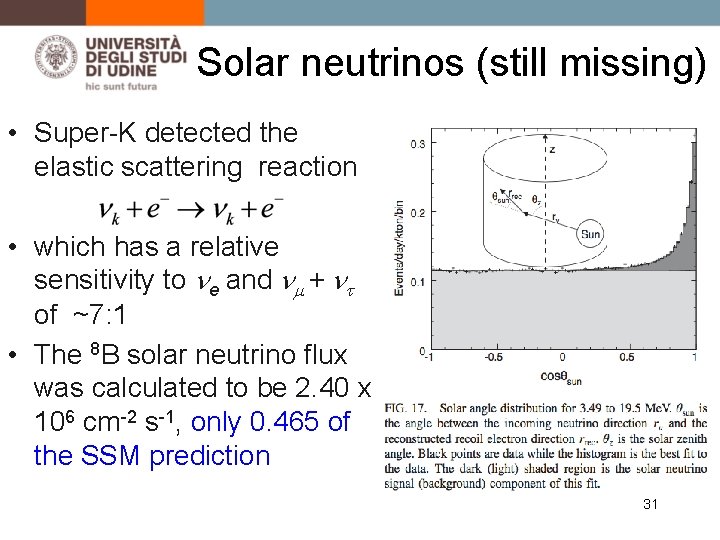
Solar neutrinos (still missing) • Super-K detected the elastic scattering reaction • which has a relative sensitivity to ne and nm + nt of ~7: 1 • The 8 B solar neutrino flux was calculated to be 2. 40 x 106 cm-2 s-1, only 0. 465 of the SSM prediction 31
Atmospheric neutrinos • Atmospheric neutrinos have an energy from tens to several hundred times bigger than solar neutrinos • Neutrino production by cosmic rays and charge conjugates is 1 e-neutrino every 2 mu-neutrinos • Since 1985 it was known that the measured ratio of atmospheric muonic to electronic neutrinos was nearer to one than to the expected value of two 32
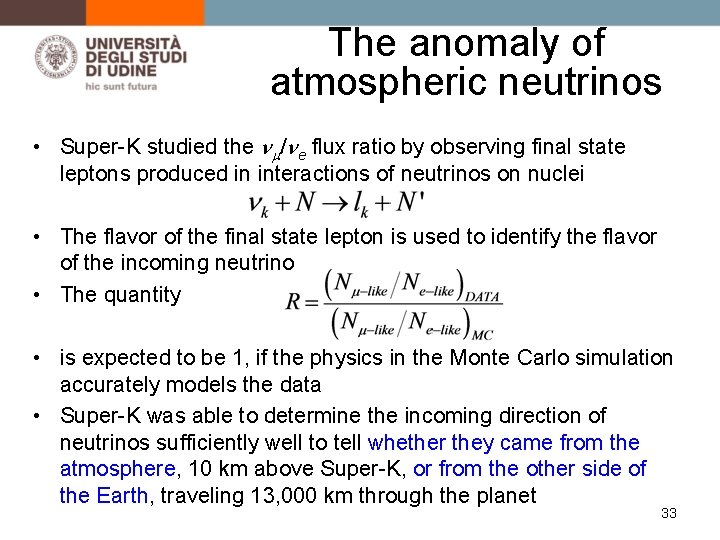
The anomaly of atmospheric neutrinos • Super-K studied the nm/ne flux ratio by observing final state leptons produced in interactions of neutrinos on nuclei • The flavor of the final state lepton is used to identify the flavor of the incoming neutrino • The quantity • is expected to be 1, if the physics in the Monte Carlo simulation accurately models the data • Super-K was able to determine the incoming direction of neutrinos sufficiently well to tell whether they came from the atmosphere, 10 km above Super-K, or from the other side of the Earth, traveling 13, 000 km through the planet 33
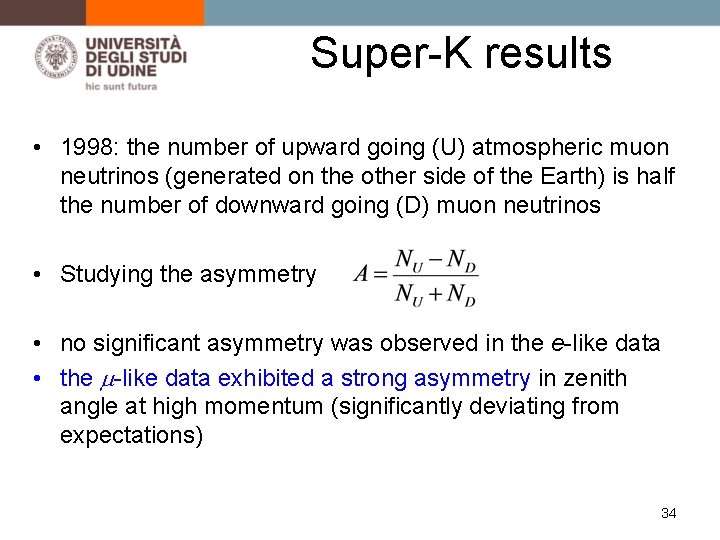
Super-K results • 1998: the number of upward going (U) atmospheric muon neutrinos (generated on the other side of the Earth) is half the number of downward going (D) muon neutrinos • Studying the asymmetry • no significant asymmetry was observed in the e-like data • the m-like data exhibited a strong asymmetry in zenith angle at high momentum (significantly deviating from expectations) 34
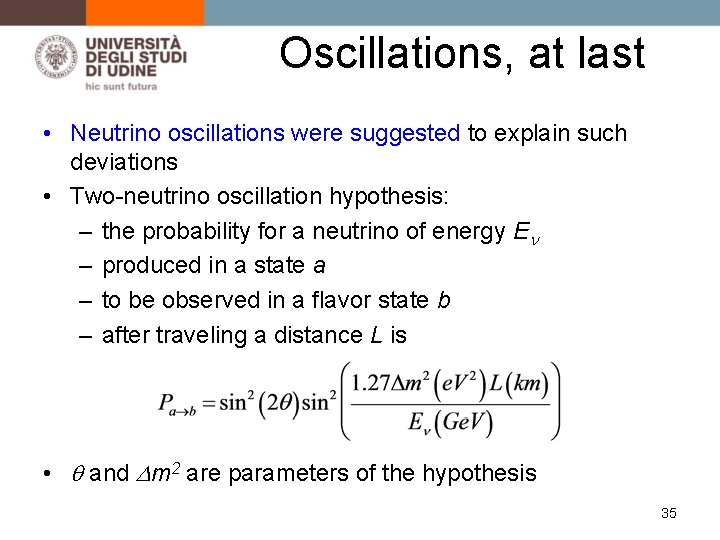
Oscillations, at last • Neutrino oscillations were suggested to explain such deviations • Two-neutrino oscillation hypothesis: – the probability for a neutrino of energy En – produced in a state a – to be observed in a flavor state b – after traveling a distance L is • q and Dm 2 are parameters of the hypothesis 35
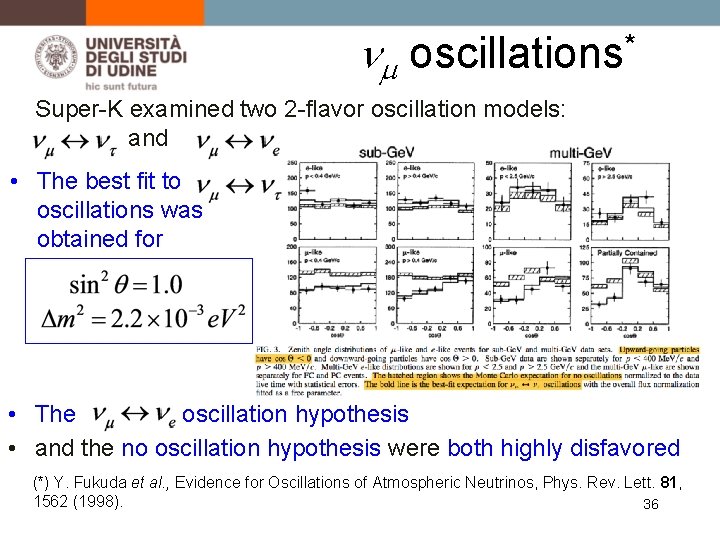
nm * oscillations Super-K examined two 2 -flavor oscillation models: and • The best fit to oscillations was obtained for • The oscillation hypothesis • and the no oscillation hypothesis were both highly disfavored (*) Y. Fukuda et al. , Evidence for Oscillations of Atmospheric Neutrinos, Phys. Rev. Lett. 81, 1562 (1998). 36
nm oscillations • The explanation of the atmospheric neutrino anomaly is: • upward-going muon neutrinos have oscillated into a third neutrino type, the tau neutrino • downward-going muon neutrinos, on the other hand, interacted inside of Super-K before they had traveled far enough to change types 37
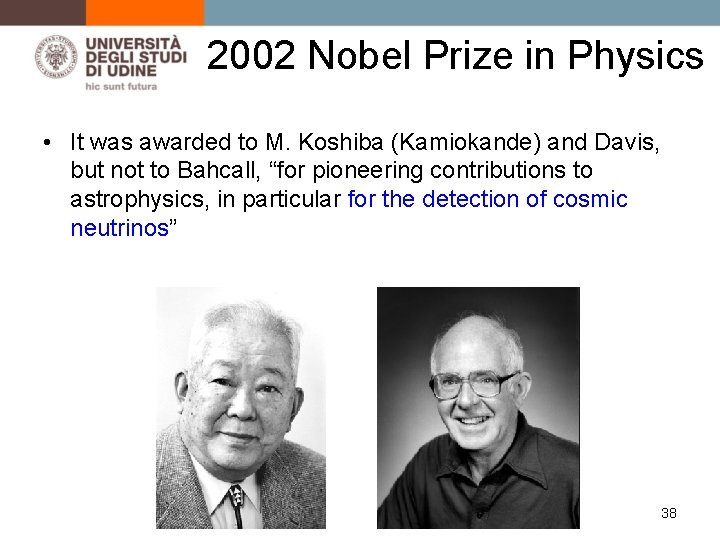
2002 Nobel Prize in Physics • It was awarded to M. Koshiba (Kamiokande) and Davis, but not to Bahcall, “for pioneering contributions to astrophysics, in particular for the detection of cosmic neutrinos” 38
Back to the Solar Neutrino Problem • Was Davis’ problem with electron neutrinos also due to neutrino oscillations? • Pontecorvo and Gribov and Maki, Nakagawa and Sakata explained the solar neutrino problem from the existence of more than one kind of neutrinos • If an electronic neutrino turns muonic in the way between Sun and Earth, it will traverse Davis’ detector without interacting • To verify this idea, a new experiment was built 2100 m underground in a nickel mine in Sudbury, Ontario, Canada: the Sudbury Neutrino Observatory (SNO) 39
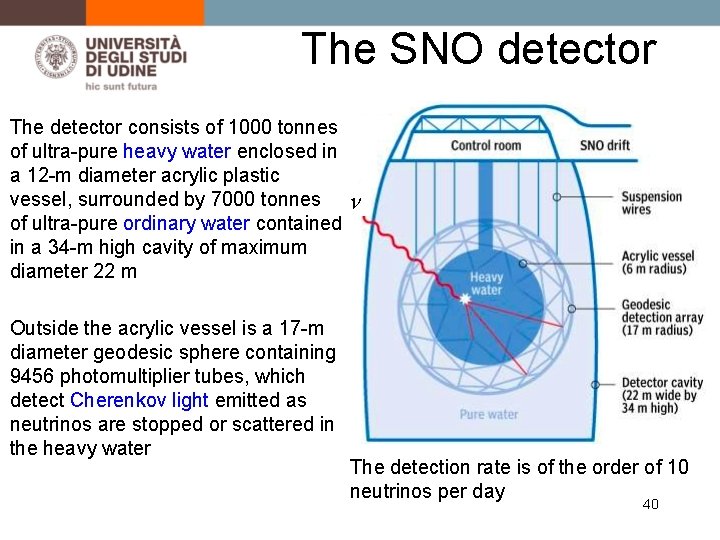
The SNO detector The detector consists of 1000 tonnes of ultra-pure heavy water enclosed in a 12 -m diameter acrylic plastic vessel, surrounded by 7000 tonnes n of ultra-pure ordinary water contained in a 34 -m high cavity of maximum diameter 22 m Outside the acrylic vessel is a 17 -m diameter geodesic sphere containing 9456 photomultiplier tubes, which detect Cherenkov light emitted as neutrinos are stopped or scattered in the heavy water The detection rate is of the order of 10 neutrinos per day 40
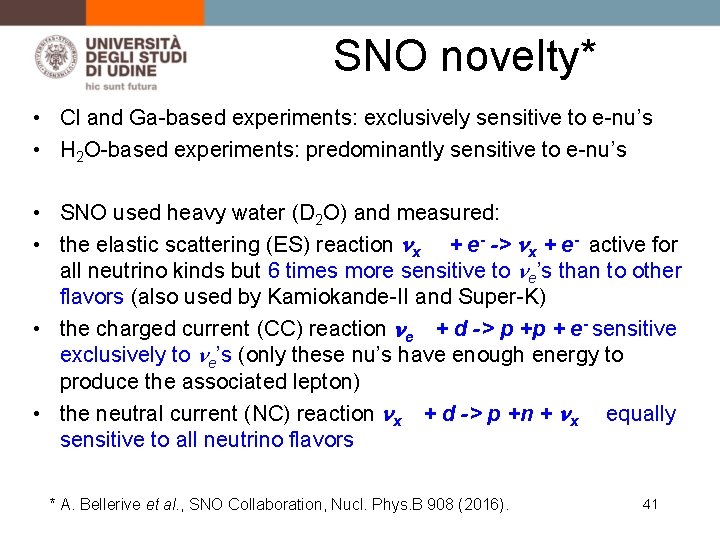
SNO novelty* • Cl and Ga-based experiments: exclusively sensitive to e-nu’s • H 2 O-based experiments: predominantly sensitive to e-nu’s • SNO used heavy water (D 2 O) and measured: • the elastic scattering (ES) reaction nx + e- -> nx + e- active for all neutrino kinds but 6 times more sensitive to ne’s than to other flavors (also used by Kamiokande-II and Super-K) • the charged current (CC) reaction ne + d -> p +p + e- sensitive exclusively to ne’s (only these nu’s have enough energy to produce the associated lepton) • the neutral current (NC) reaction nx + d -> p +n + nx equally sensitive to all neutrino flavors * A. Bellerive et al. , SNO Collaboration, Nucl. Phys. B 908 (2016). 41
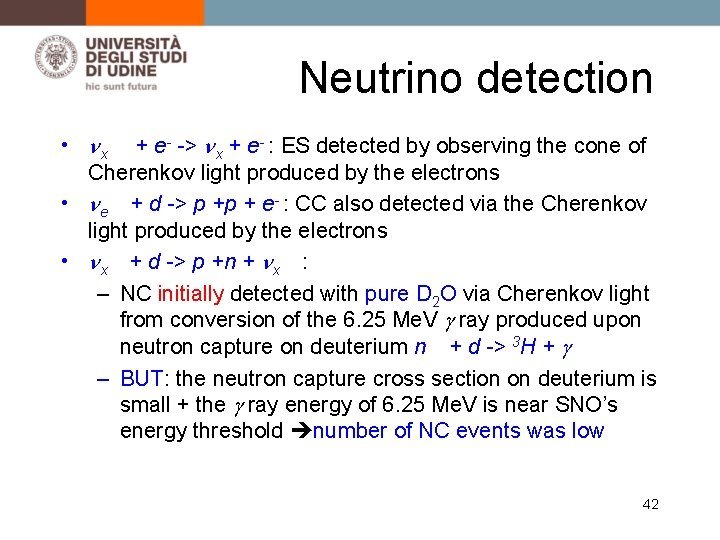
Neutrino detection • nx + e- -> nx + e- : ES detected by observing the cone of Cherenkov light produced by the electrons • ne + d -> p +p + e- : CC also detected via the Cherenkov light produced by the electrons • nx + d -> p +n + nx : – NC initially detected with pure D 2 O via Cherenkov light from conversion of the 6. 25 Me. V g ray produced upon neutron capture on deuterium n + d -> 3 H + g – BUT: the neutron capture cross section on deuterium is small + the g ray energy of 6. 25 Me. V is near SNO’s energy threshold number of NC events was low 42
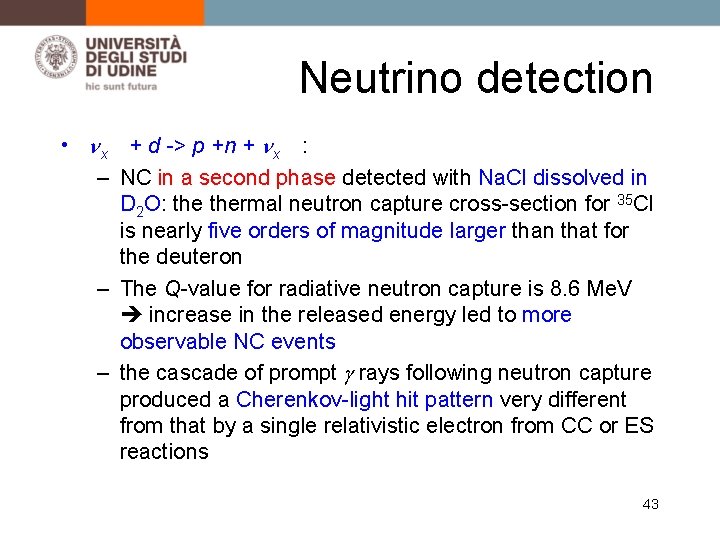
Neutrino detection • nx + d -> p +n + nx : – NC in a second phase detected with Na. Cl dissolved in D 2 O: thermal neutron capture cross-section for 35 Cl is nearly five orders of magnitude larger than that for the deuteron – The Q-value for radiative neutron capture is 8. 6 Me. V increase in the released energy led to more observable NC events – the cascade of prompt g rays following neutron capture produced a Cherenkov-light hit pattern very different from that by a single relativistic electron from CC or ES reactions 43
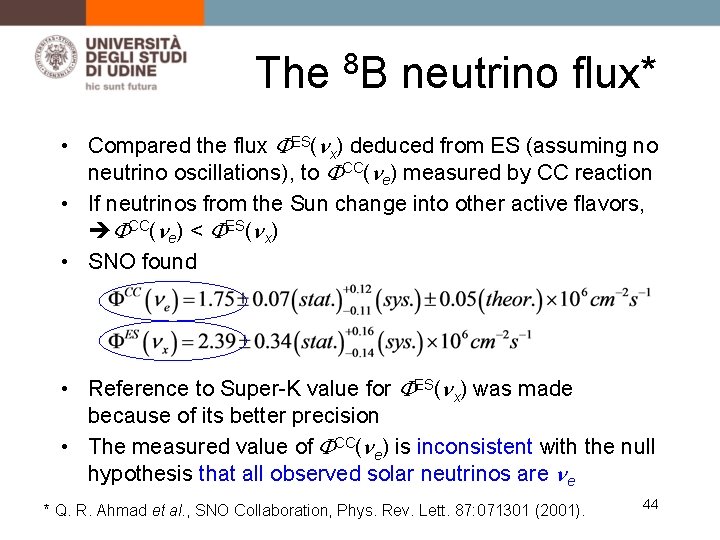
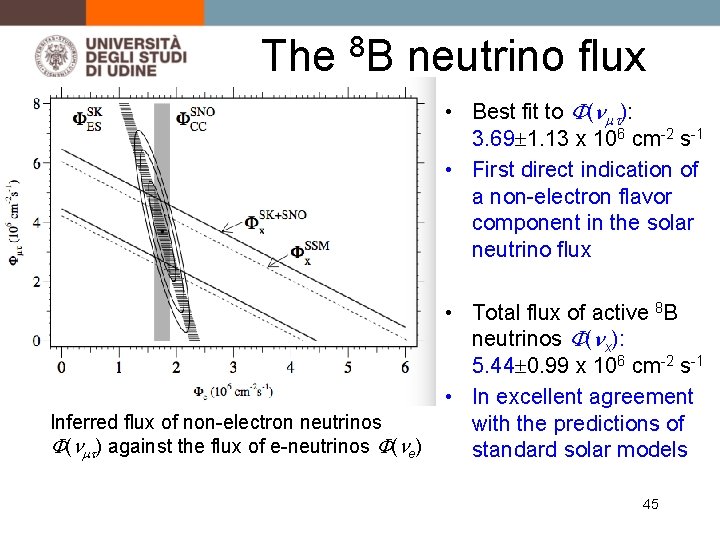
The 8 B neutrino flux* • Compared the flux FES(nx) deduced from ES (assuming no neutrino oscillations), to FCC(ne) measured by CC reaction • If neutrinos from the Sun change into other active flavors, FCC(ne) < FES(nx) • SNO found • Reference to Super-K value for FES(nx) was made because of its better precision • The measured value of FCC(ne) is inconsistent with the null hypothesis that all observed solar neutrinos are ne * Q. R. Ahmad et al. , SNO Collaboration, Phys. Rev. Lett. 87: 071301 (2001). 44
The 8 B neutrino flux • Best fit to F(nmt): 3. 69 1. 13 x 106 cm-2 s-1 • First direct indication of a non-electron flavor component in the solar neutrino flux • Total flux of active 8 B neutrinos F(nx): 5. 44 0. 99 x 106 cm-2 s-1 • In excellent agreement Inferred flux of non-electron neutrinos with the predictions of F(nmt) against the flux of e-neutrinos F(ne) standard solar models 45
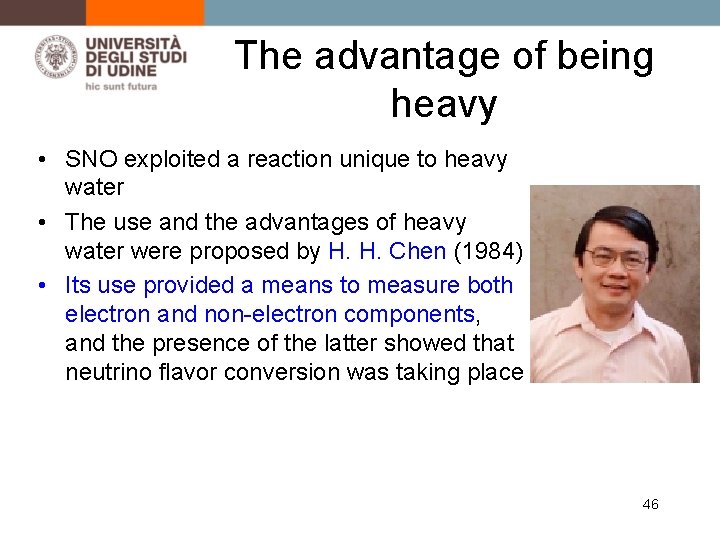
The advantage of being heavy • SNO exploited a reaction unique to heavy water • The use and the advantages of heavy water were proposed by H. H. Chen (1984) • Its use provided a means to measure both electron and non-electron components, and the presence of the latter showed that neutrino flavor conversion was taking place 46
SNO (1999 -2006) • During 2002 and 2003 the detector was upgraded any reference to Super-K was no longer necessary • Although Super-K had beaten SNO on time, having published evidence for neutrino oscillation as early as 1998 • the Super-K results were not conclusive and did not specifically deal with solar neutrinos • SNO's results were the first to directly demonstrate oscillations in solar neutrinos • The final results were published in 2003: • e-neutrino flux: 1. 75 x 106 cm-2 s-1 • total flux: 5. 21 x 106 cm-2 s-1, about three times as much 47
Solar Neutrino Problem conclusions* • Davis had been correctly measuring solar neutrinos for 30 years • For 30 years people had doubted Bahcall, regarding him as ‘the guy who wrongly calculated the flux of neutrinos from the Sun’ • His calculation of solar neutrino production was correct; in his words, the agreement was ‘so close that it was embarrasingly close’ * F. Close, Neutrino, Oxford University Press, 2012 48
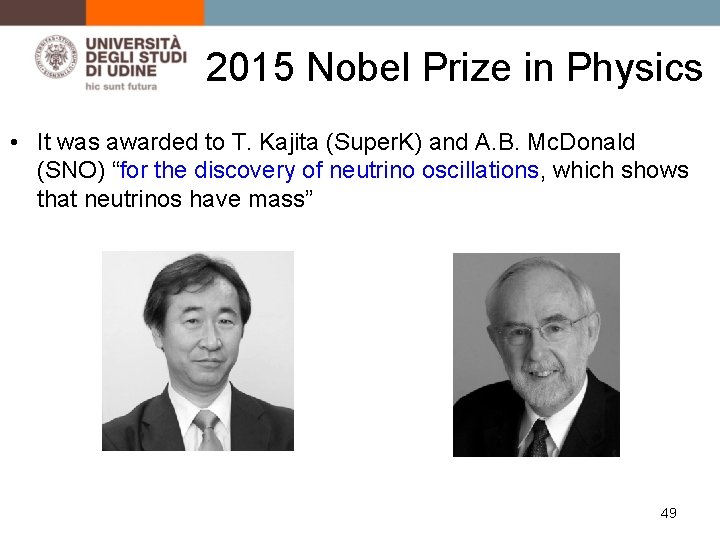
2015 Nobel Prize in Physics • It was awarded to T. Kajita (Super. K) and A. B. Mc. Donald (SNO) “for the discovery of neutrino oscillations, which shows that neutrinos have mass” 49
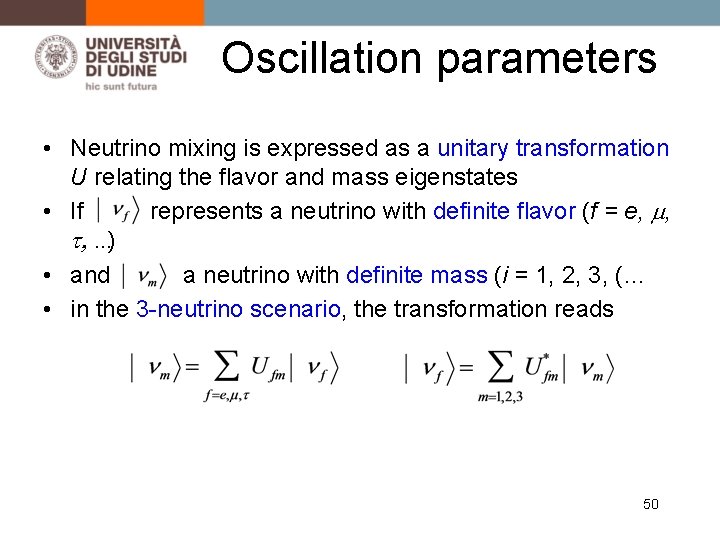
Oscillation parameters • Neutrino mixing is expressed as a unitary transformation U relating the flavor and mass eigenstates • If represents a neutrino with definite flavor (f = e, m, t, …) • and a neutrino with definite mass (i = 1, 2, 3, (… • in the 3 -neutrino scenario, the transformation reads 50
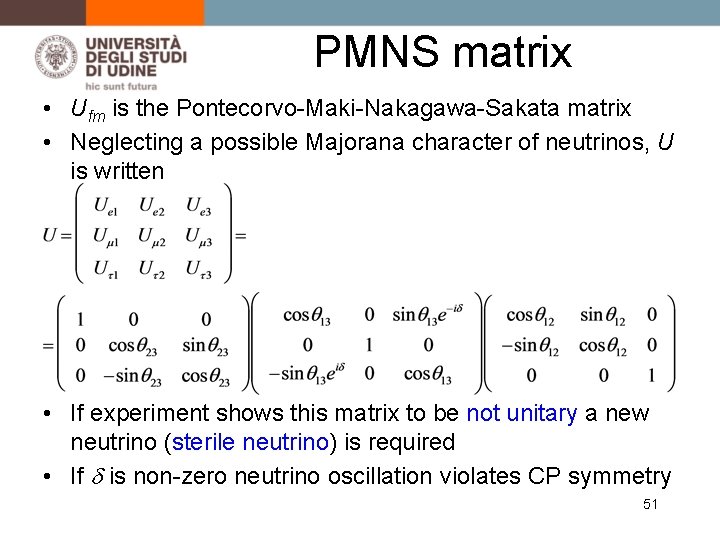
PMNS matrix • Ufm is the Pontecorvo-Maki-Nakagawa-Sakata matrix • Neglecting a possible Majorana character of neutrinos, U is written • If experiment shows this matrix to be not unitary a new neutrino (sterile neutrino) is required • If d is non-zero neutrino oscillation violates CP symmetry 51
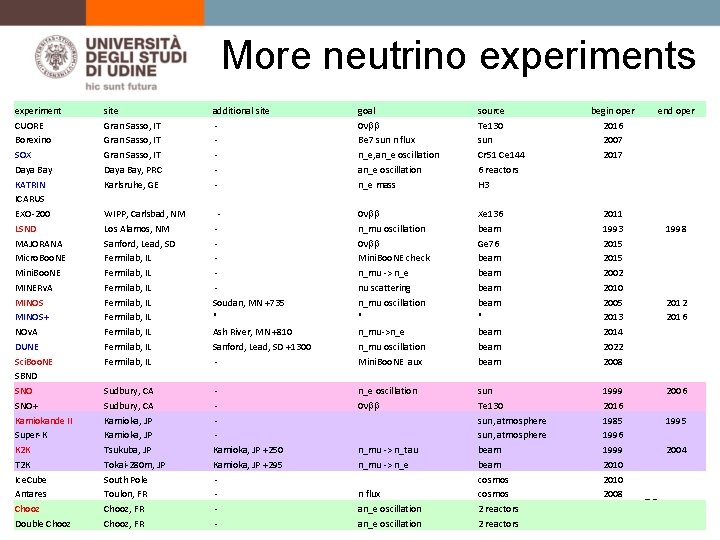
New parameters, new experiments • The existence of oscillations brought into physics 9 new parameters in a stroke: – the three neutrino masses: m 1 , m 2 , m 3 – the three mixing angles: q 12 , q 23 , q 13 – the CP-violation phase: d – and two Majorana phases • All these parameters are absent from the Standard Model for elementary particles, which, for this reason needs to be reformulated • A host of new experiments was conceived, reactor, accelerator and cosmic neutrino experiments, aimed at studying the new parameters 52
More neutrino experiments experiment CUORE Borexino SOX Daya Bay KATRIN ICARUS EXO-200 LSND MAJORANA Micro. Boo. NE Mini. Boo. NE MINERv. A MINOS+ NOv. A DUNE Sci. Boo. NE SBND SNO+ Kamiokande II Super-K K 2 K T 2 K Ice. Cube Antares Chooz Double Chooz site Gran Sasso, IT Daya Bay, PRC Karlsruhe, GE additional site - - - goal 0 nbb Be 7 sun n flux n_e, an_e oscillation n_e mass source Te 130 sun Cr 51 Ce 144 6 reactors H 3 WIPP, Carlsbad, NM Los Alamos, NM Sanford, Lead, SD Fermilab, IL Fermilab, IL - - - Soudan, MN +735 " Ash River, MN +810 Sanford, Lead, SD +1300 - 0 nbb n_mu oscillation 0 nbb Mini. Boo. NE check n_mu -> n_e nu scattering n_mu oscillation " n_mu->n_e n_mu oscillation Mini. Boo. NE aux Xe 136 beam Ge 76 beam " beam 2011 1993 2015 2002 2010 2005 2013 2014 2022 2008 Sudbury, CA Kamioka, JP Tsukuba, JP Tokai-280 m, JP South Pole Toulon, FR Chooz, FR - - Kamioka, JP +250 Kamioka, JP +295 - - n_e oscillation 0 nbb n_mu -> n_tau n_mu -> n_e sun Te 130 sun, atmosphere beam cosmos 2 reactors 1999 2016 1985 1996 1999 2010 2008 n flux an_e oscillation begin oper 2016 2007 2017 end oper 1998 2012 2016 2006 1995 2004 53
References • Most of the material in the presentation was found in the beautiful book ‘Neutrino’ by Frank Close, Oxford University Press • Physicist portraits were downloded from the web • Much useful information was found on Wikipedia pages –support Wikipedia! 54