
Solar flare distributions lognormal instead of power law
Solar flare distributions: lognormal instead of power law? Cis Verbeeck, Emil Kraaikamp, Lena Podladchikova Royal Observatory of Belgium SDO Workshop, Ghent, Belgium, October 29, 2018 Solar-Terrestrial Centre of Excellence
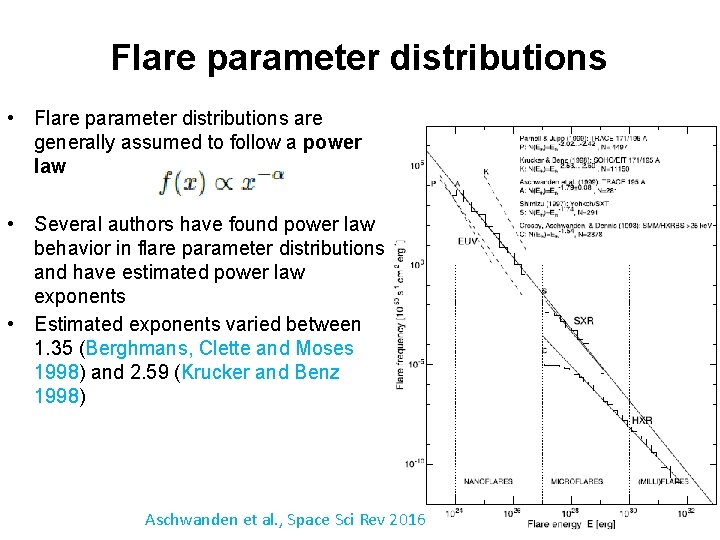
Flare parameter distributions • Flare parameter distributions are generally assumed to follow a power law • Several authors have found power law behavior in flare parameter distributions and have estimated power law exponents • Estimated exponents varied between 1. 35 (Berghmans, Clette and Moses 1998) and 2. 59 (Krucker and Benz 1998) Aschwanden et al. , Space Sci Rev 2016
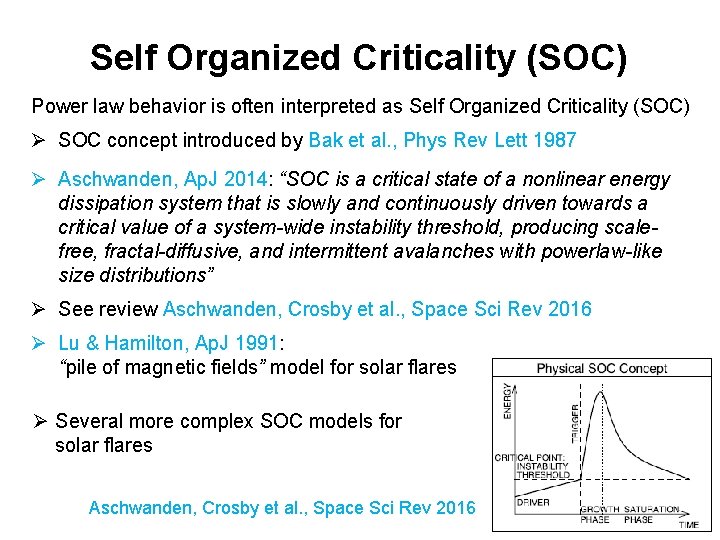
Self Organized Criticality (SOC) Power law behavior is often interpreted as Self Organized Criticality (SOC) Ø SOC concept introduced by Bak et al. , Phys Rev Lett 1987 Ø Aschwanden, Ap. J 2014: “SOC is a critical state of a nonlinear energy dissipation system that is slowly and continuously driven towards a critical value of a system-wide instability threshold, producing scalefree, fractal-diffusive, and intermittent avalanches with powerlaw-like size distributions” Ø See review Aschwanden, Crosby et al. , Space Sci Rev 2016 Ø Lu & Hamilton, Ap. J 1991: “pile of magnetic fields” model for solar flares Ø Several more complex SOC models for solar flares Aschwanden, Crosby et al. , Space Sci Rev 2016
New data set: SDO/AIA 94 Å flares detected by Solar Demon • Solar Demon flare detection operates on SDO/AIA 94 Å synoptic level 1. 5 science data @ 2 minute cadence • On average, detects GOES B 5 flares and above • Accurate flare location and shape information (no macro-pixels, accurate on pixel-level) Ø Able to distinguish simultaneous flares at different locations (unlike e. g. , GOES flares) Ø Background solar intensity does not affect the measured flare intensity Ø Allows to filter the data, e. g. , only consider flares that were entirely on-disk • Big science catalog: Ø 8 274 events in current data set (May 13, 2010 - March 16, 2018) Solar Demon – an approach to detecting flares, dimmings, and EUV waves on SDO/AIA images, Kraaikamp and Verbeeck 2015, http: //dx. doi. org/10. 1051/swsc/2015019
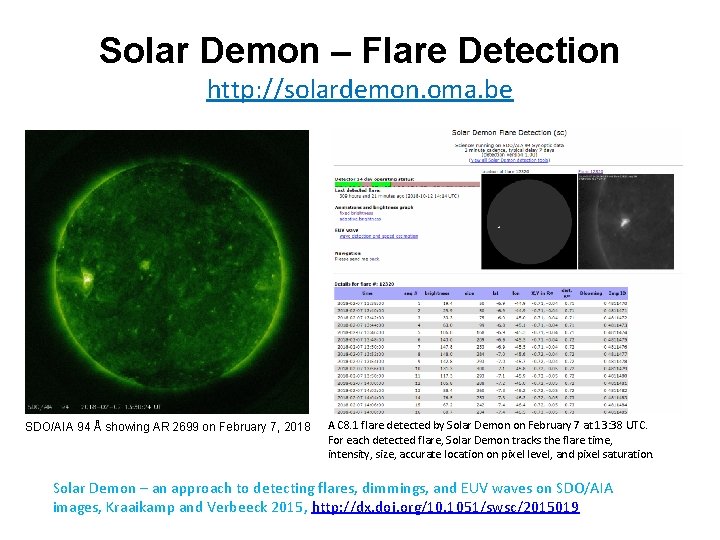
Solar Demon – Flare Detection http: //solardemon. oma. be SDO/AIA 94 Å showing AR 2699 on February 7, 2018 A C 8. 1 flare detected by Solar Demon on February 7 at 13: 38 UTC. For each detected flare, Solar Demon tracks the flare time, intensity, size, accurate location on pixel level, and pixel saturation. Solar Demon – an approach to detecting flares, dimmings, and EUV waves on SDO/AIA images, Kraaikamp and Verbeeck 2015, http: //dx. doi. org/10. 1051/swsc/2015019
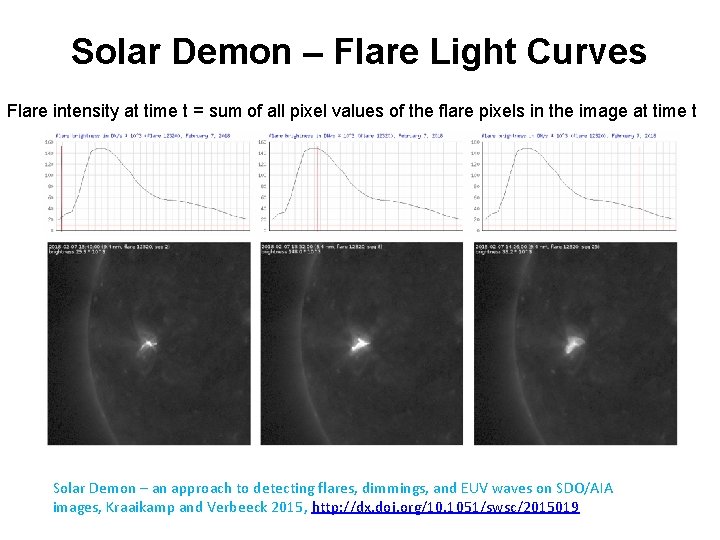
Solar Demon – Flare Light Curves Flare intensity at time t = sum of all pixel values of the flare pixels in the image at time t Solar Demon – an approach to detecting flares, dimmings, and EUV waves on SDO/AIA images, Kraaikamp and Verbeeck 2015, http: //dx. doi. org/10. 1051/swsc/2015019
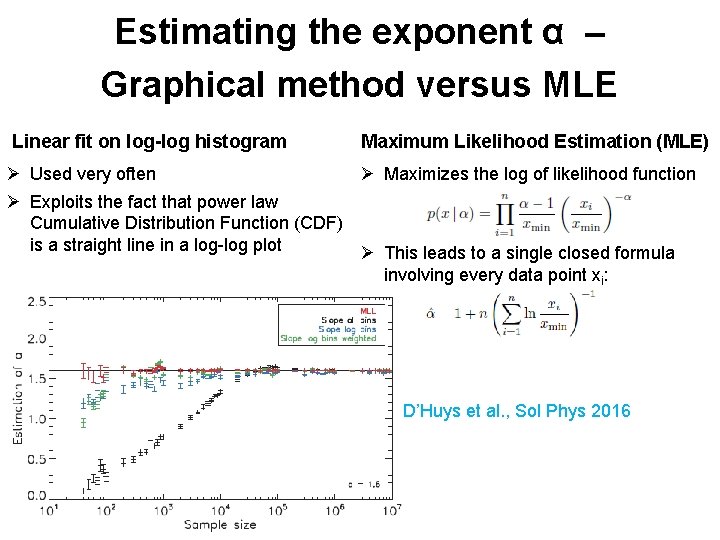
Estimating the exponent α – Graphical method versus MLE Linear fit on log-log histogram Maximum Likelihood Estimation (MLE) Ø Used very often Ø Exploits the fact that power law Cumulative Distribution Function (CDF) is a straight line in a log-log plot Ø Maximizes the log of likelihood function Ø This leads to a single closed formula involving every data point xi: D’Huys et al. , Sol Phys 2016
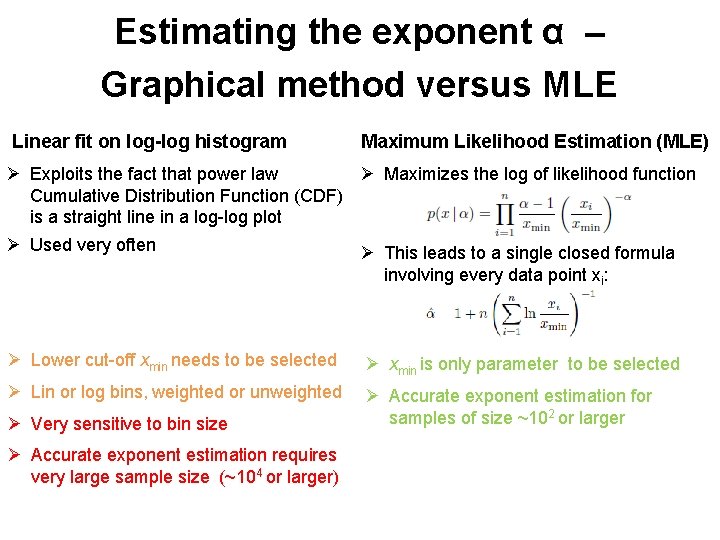
Estimating the exponent α – Graphical method versus MLE Linear fit on log-log histogram Maximum Likelihood Estimation (MLE) Ø Exploits the fact that power law Cumulative Distribution Function (CDF) is a straight line in a log-log plot Ø Used very often Ø Maximizes the log of likelihood function Ø Lower cut-off xmin needs to be selected Ø xmin is only parameter to be selected Ø Lin or log bins, weighted or unweighted Ø Accurate exponent estimation for samples of size ~102 or larger Ø Very sensitive to bin size Ø Accurate exponent estimation requires very large sample size (~104 or larger) Ø This leads to a single closed formula involving every data point xi:
Robust statistical analysis of SDO/AIA 94 Å flare parameters In the present study, we follow the approach suggested by Clauset et al. , SIAM Review 2009: Ø Finding optimal value of xmin: for every value of xmin, calculate MLE fit(xmin), then minimize the Kolmogorov-Smirnov distance between the empirical distribution and the MLE fit(xmin) Ø If xmin_s is the selected value of xmin, our best MLE fit to the data is MLE fit(xmin_s) Ø Goodness-of-fit p is provided by bootstrapping. The hypothesis that the model is a reasonable fit to the data, is rejected if p < 0. 1 Ø Implementation: R package “powe. Rlaw” based on Clauset et al. method (Gillespie, J Stat Software 2015)
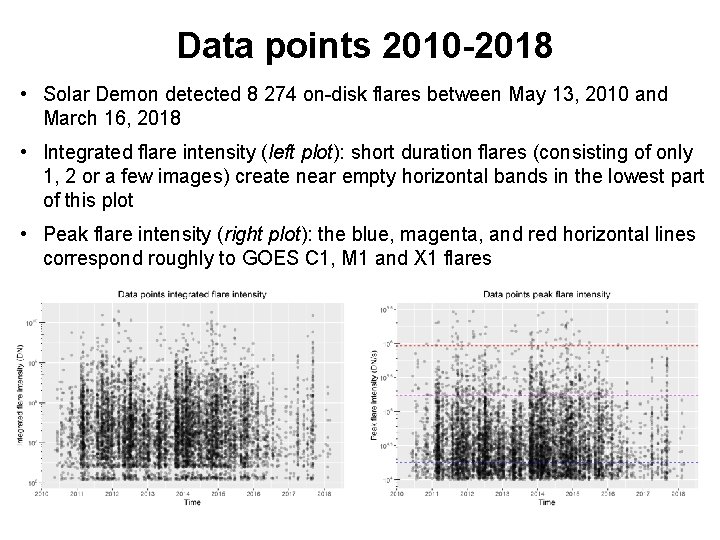
Data points 2010 -2018 • Solar Demon detected 8 274 on-disk flares between May 13, 2010 and March 16, 2018 • Integrated flare intensity (left plot): short duration flares (consisting of only 1, 2 or a few images) create near empty horizontal bands in the lowest part of this plot • Peak flare intensity (right plot): the blue, magenta, and red horizontal lines correspond roughly to GOES C 1, M 1 and X 1 flares
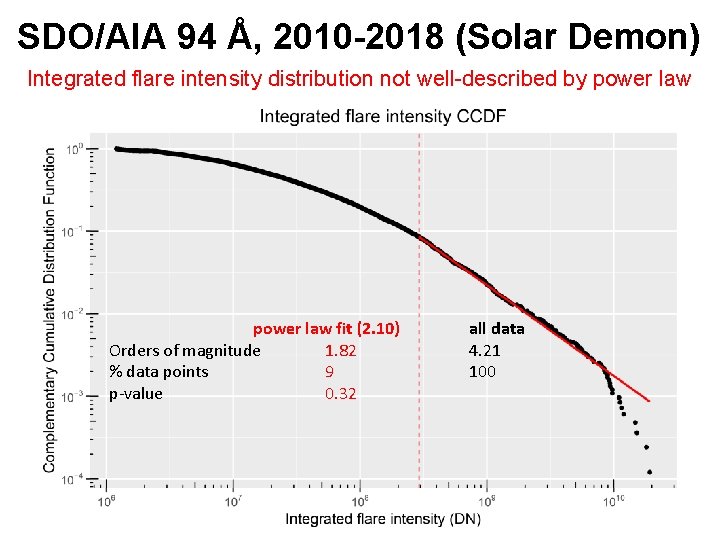
SDO/AIA 94 Å, 2010 -2018 (Solar Demon) Integrated flare intensity distribution not well-described by power law fit (2. 10) Orders of magnitude 1. 82 % data points 9 p-value 0. 32 all data 4. 21 100
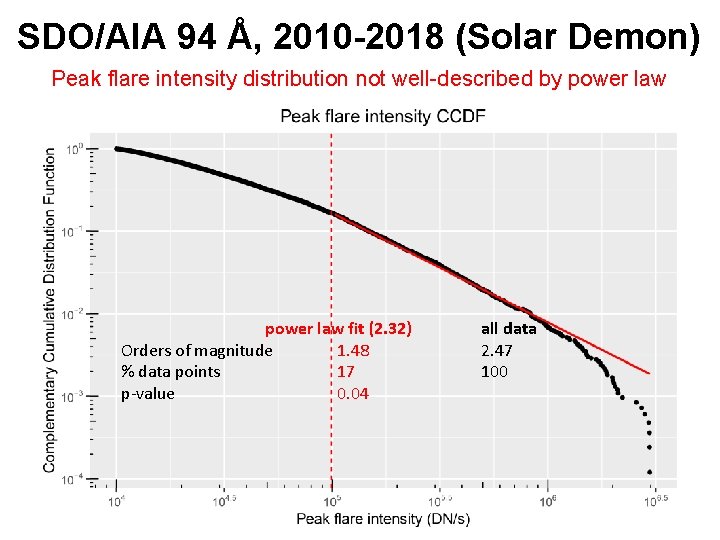
SDO/AIA 94 Å, 2010 -2018 (Solar Demon) Peak flare intensity distribution not well-described by power law fit (2. 32) Orders of magnitude 1. 48 % data points 17 p-value 0. 04 all data 2. 47 100
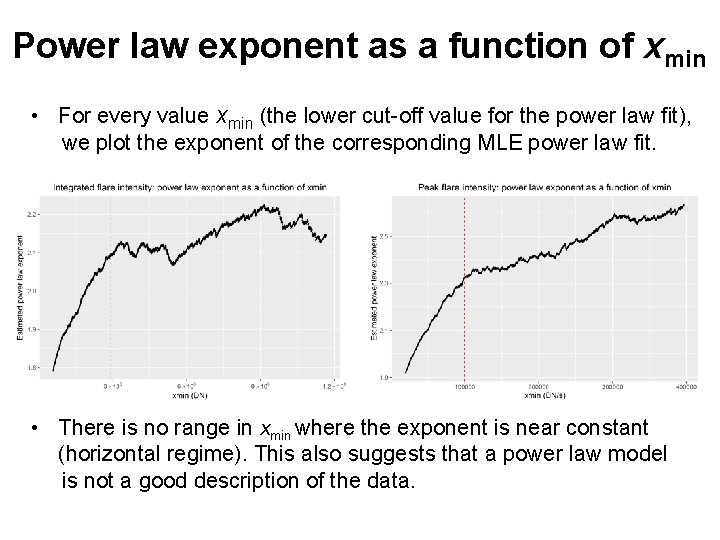
Power law exponent as a function of xmin • For every value xmin (the lower cut-off value for the power law fit), we plot the exponent of the corresponding MLE power law fit. • There is no range in xmin where the exponent is near constant (horizontal regime). This also suggests that a power law model is not a good description of the data.
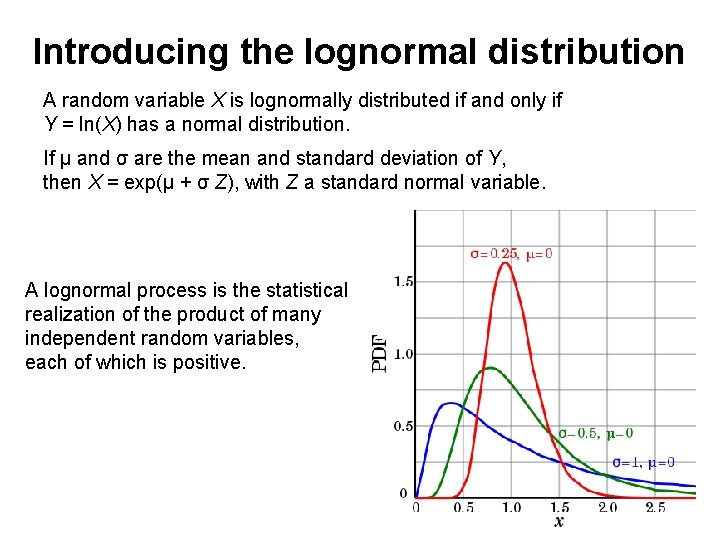
Introducing the lognormal distribution A random variable X is lognormally distributed if and only if Y = ln(X) has a normal distribution. If µ and σ are the mean and standard deviation of Y, then X = exp(µ + σ Z), with Z a standard normal variable. A lognormal process is the statistical realization of the product of many independent random variables, each of which is positive.
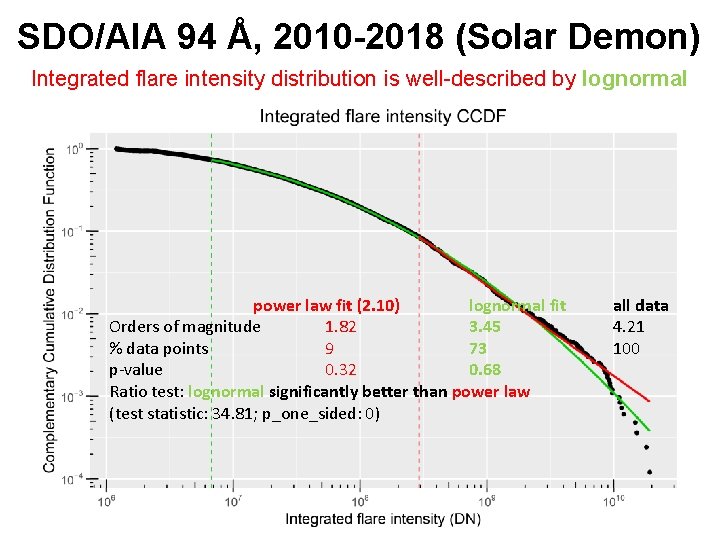
SDO/AIA 94 Å, 2010 -2018 (Solar Demon) Integrated flare intensity distribution is well-described by lognormal power law fit (2. 10) lognormal fit Orders of magnitude 1. 82 3. 45 % data points 9 73 p-value 0. 32 0. 68 Ratio test: lognormal significantly better than power law (test statistic: 34. 81; p_one_sided: 0) all data 4. 21 100
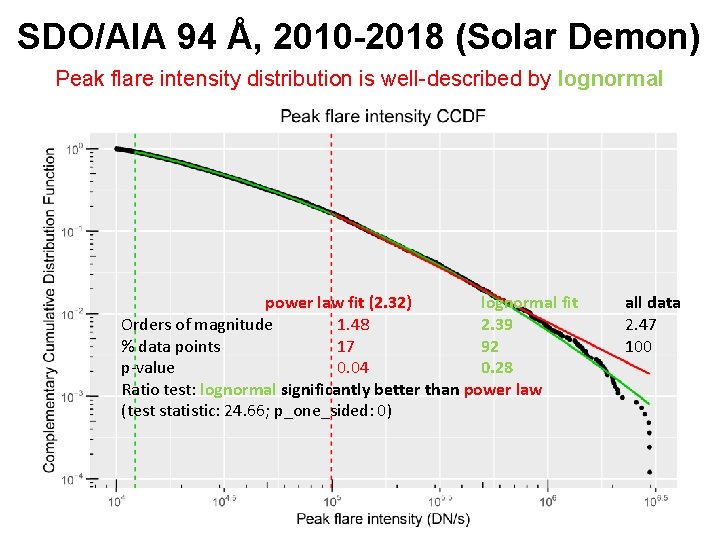
SDO/AIA 94 Å, 2010 -2018 (Solar Demon) Peak flare intensity distribution is well-described by lognormal power law fit (2. 32) lognormal fit Orders of magnitude 1. 48 2. 39 % data points 17 92 p-value 0. 04 0. 28 Ratio test: lognormal significantly better than power law (test statistic: 24. 66; p_one_sided: 0) all data 2. 47 100
Discussion • How can this result be reconciled with the many papers that describe the power law distribution of flare parameters as observed in various data sets? Ø Different studies do not agree on the actual power law exponent, finding a whole range of exponents both below and above 2 Ø This divergence of exponent values may be partly due to pollution of the data sets by the solar background Ø Data sets lacking spatial information about flares will typically classify simultaneous flares in different regions of the Sun as a single flare, adding bias to the data set Ø It has been shown that first justifying and then fitting a power law model to data via graphical methods can be misleading (Clauset et al. 2009; D’Huys et al. 2016) o Implications of lognormal instead of power law flare distributions: Ø SOC paradigm for solar flares needs to be revisited. See next talk by Podladchikova et al. Ø Do flares provide enough energy for coronal heating? The sufficiency criterion needs to be revisited.
Conclusion • Flare data set detected by Solar Demon on SDO/AIA 94 Å synoptic level 1. 5 science data Ø 8 274 events (May 13, 2010 - March 16, 2018) Ø Separate detection of simultaneous flares at different locations Ø Background solar intensity does not affect the measured flare intensity • Robust statistical analysis (MLE) of integrated and peak flare intensity distribution • Comparing CCDF of data and power law fit, goodness-of-fit, and exponent stability plot all indicate that power law fit does not describe the data well • Comparing CCDF of data and lognormal fit and goodness-of-fit indicate that lognormal fit does describe the data well • Direct comparison (likelihood ratio) indicates that lognormal fit describes the data better than power law • Lognormal fit is valid over much wider domain than power law fit (92% vs. 17% and 73% vs. 9% for peak and integrated intensity resp. ) • This work was submitted to Ap. J

Thank you for your attention! Questions?

Reserve slides
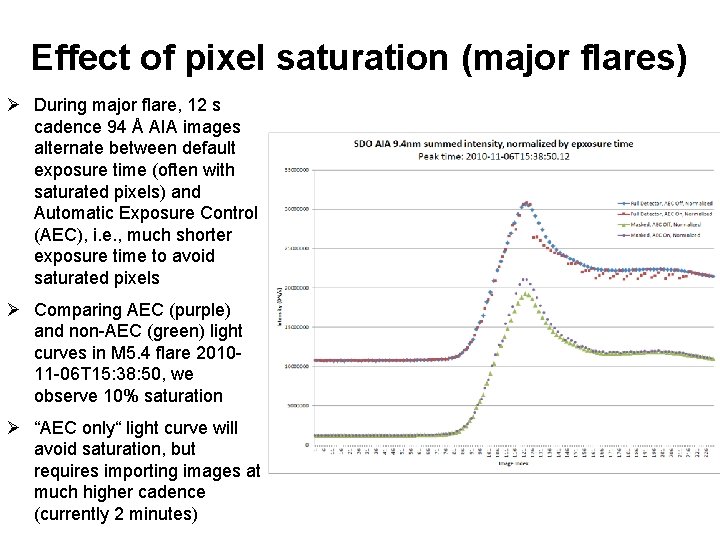
Effect of pixel saturation (major flares) Ø During major flare, 12 s cadence 94 Å AIA images alternate between default exposure time (often with saturated pixels) and Automatic Exposure Control (AEC), i. e. , much shorter exposure time to avoid saturated pixels Ø Comparing AEC (purple) and non-AEC (green) light curves in M 5. 4 flare 201011 -06 T 15: 38: 50, we observe 10% saturation Ø “AEC only“ light curve will avoid saturation, but requires importing images at much higher cadence (currently 2 minutes)
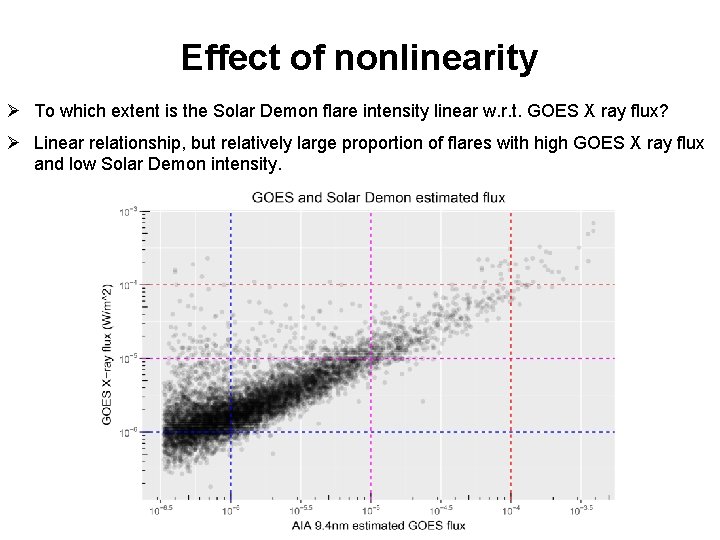
Effect of nonlinearity Ø To which extent is the Solar Demon flare intensity linear w. r. t. GOES X ray flux? Ø Linear relationship, but relatively large proportion of flares with high GOES X ray flux and low Solar Demon intensity.
Future ideas • Take into account gradual degradation of AIA 94 Å channel over time • Employ high cadence (12 s) AIA data for Solar Demon flare detections Ø Removes effect of saturation in major flares Ø More accurate parameter estimates such as peak intensity Ø Investigate the effect of high cadence on the detection of faint, short duration flares • Perform a similar analysis on other flare datasets, e. g. , backgroundsubtracted GOES X ray flares Ø Compare power law and lognormal fits
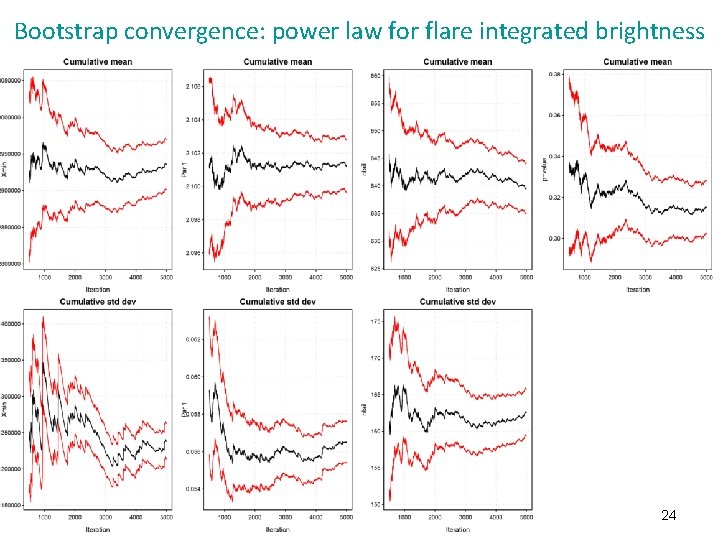
Bootstrap convergence: power law for flare integrated brightness 24
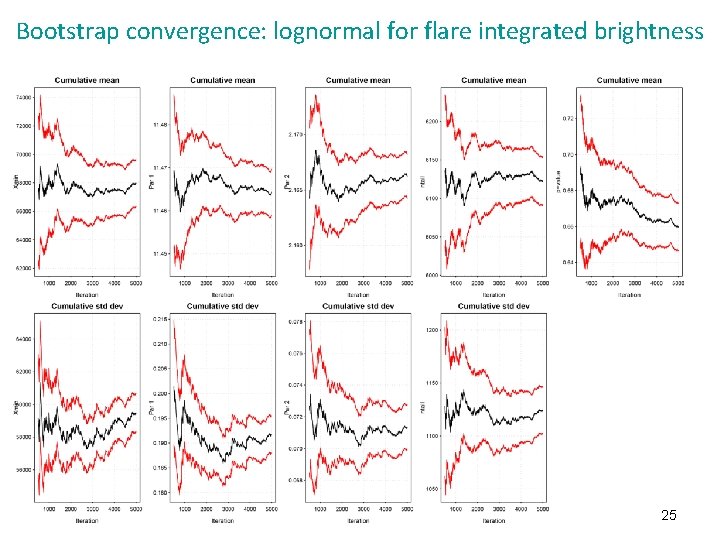
Bootstrap convergence: lognormal for flare integrated brightness 25
- Slides: 25