
Solar coronal magnetic fields Source of Space weather
- Slides: 37
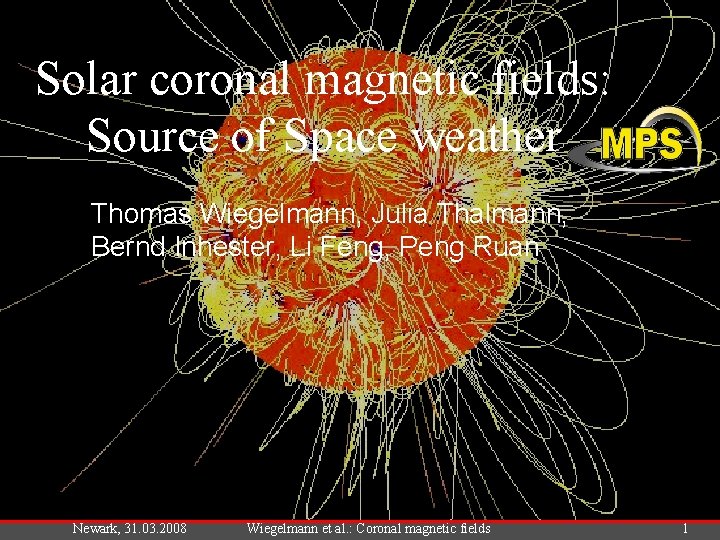
Solar coronal magnetic fields: Source of Space weather Thomas Wiegelmann, Julia Thalmann, Bernd Inhester, Li Feng, Peng Ruan Newark, 31. 03. 2008 Wiegelmann et al. : Coronal magnetic fields 1
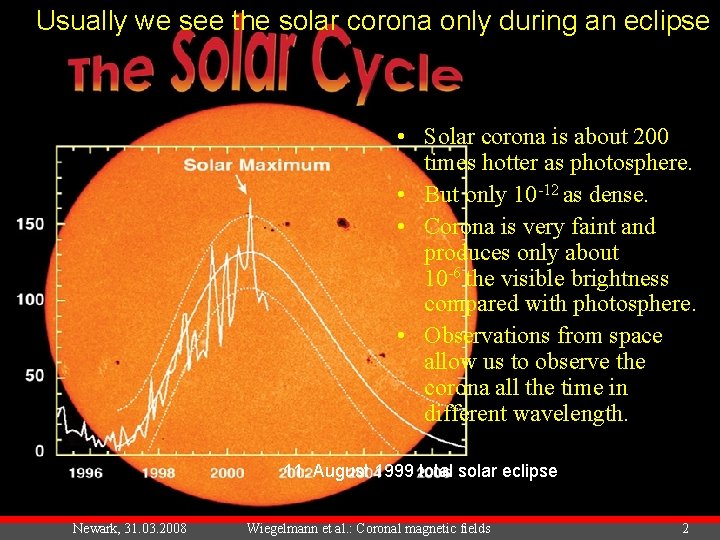
Usually we see the solar corona only during an eclipse • Solar corona is about 200 times hotter as photosphere. • But only 10 -12 as dense. • Corona is very faint and produces only about 10 -6 the visible brightness compared with photosphere. • Observations from space allow us to observe the corona all the time in different wavelength. 11. August 1999 total solar eclipse Newark, 31. 03. 2008 Wiegelmann et al. : Coronal magnetic fields 2
Coronal activity Observation from is. Space driven by with SOHO/EIT magnetic fields! Newark, 31. 03. 2008 Wiegelmann et al. : Coronal magnetic fields 3
Newark, 31. 03. 2008 Wiegelmann et al. : Coronal magnetic fields 4
Newark, 31. 03. 2008 Wiegelmann et al. : Coronal magnetic fields 5
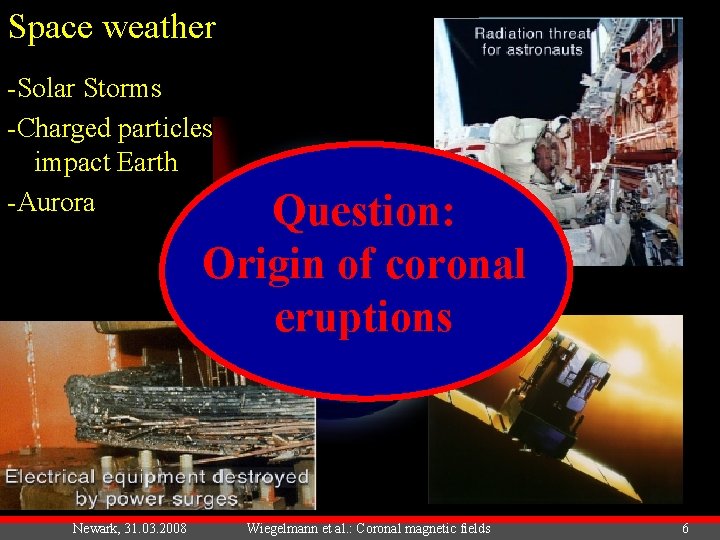
Space weather -Solar Storms -Charged particles impact Earth -Aurora Question: Origin of coronal eruptions Newark, 31. 03. 2008 Wiegelmann et al. : Coronal magnetic fields 6
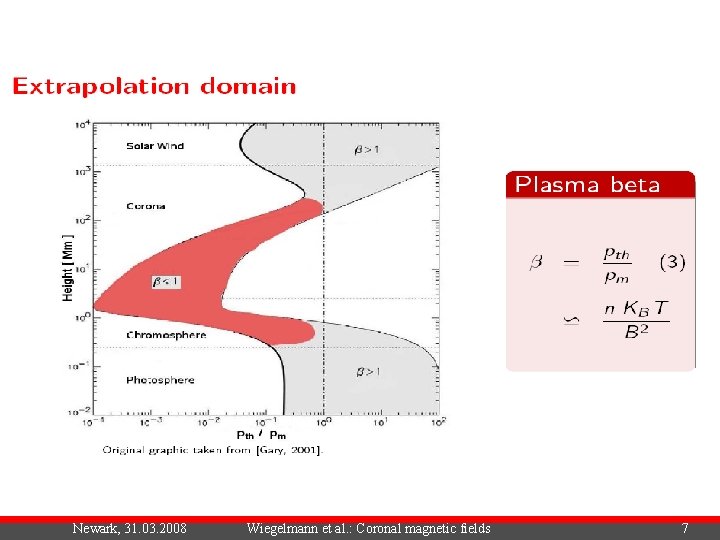
Newark, 31. 03. 2008 Wiegelmann et al. : Coronal magnetic fields 7
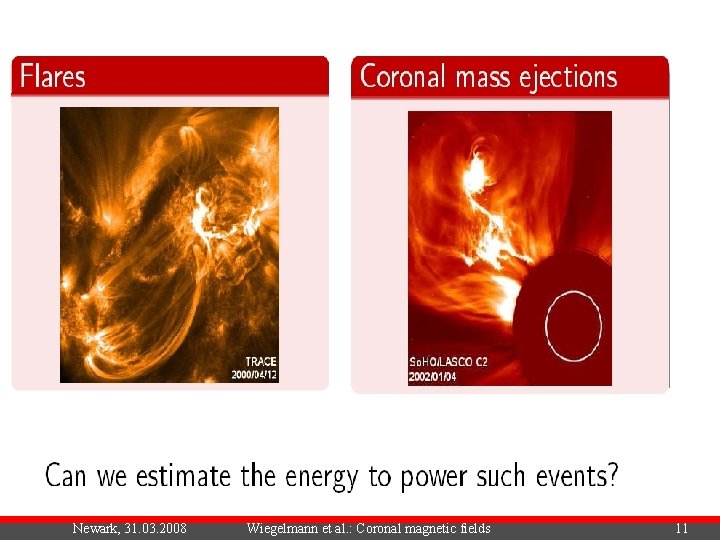
Coronal mass ejections and flares are assumed to occur due to instabilities in the coronal magnetic field configuration. It is important to investigate the coronal magnetic field Newark, 31. 03. 2008 Wiegelmann et al. : Coronal magnetic fields 8
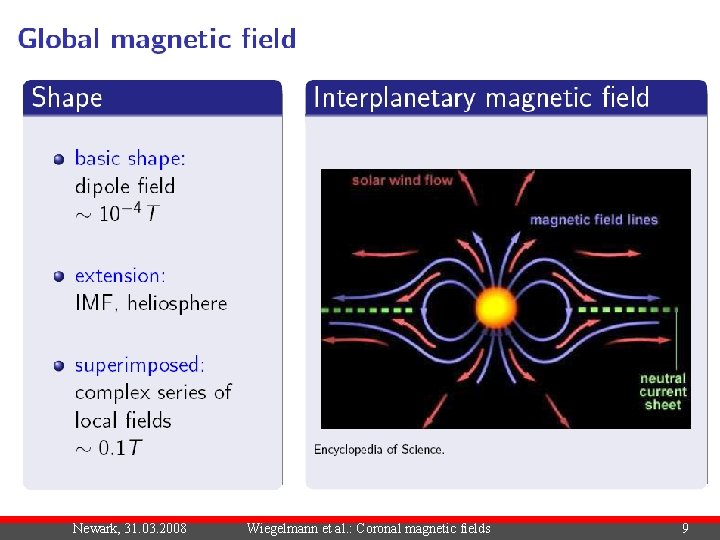
Newark, 31. 03. 2008 Wiegelmann et al. : Coronal magnetic fields 9
Solar magnetic field measured routinely only in photosphere Newark, 31. 03. 2008 Wiegelmann et al. : Coronal magnetic fields 10
Newark, 31. 03. 2008 Wiegelmann et al. : Coronal magnetic fields 11
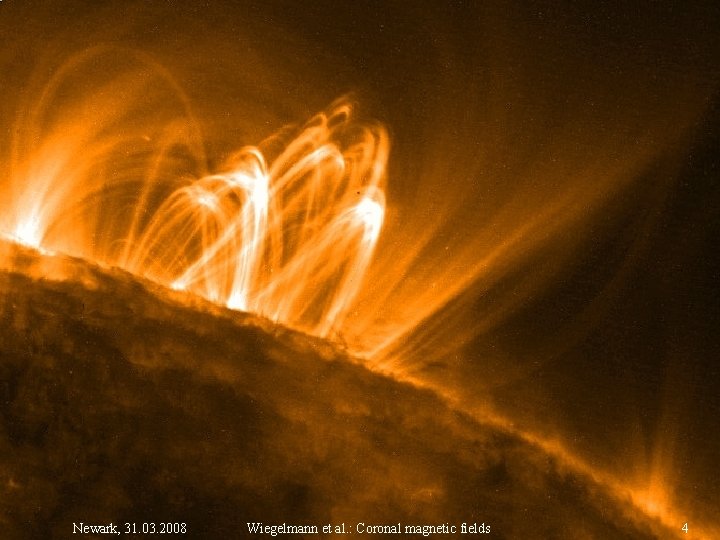
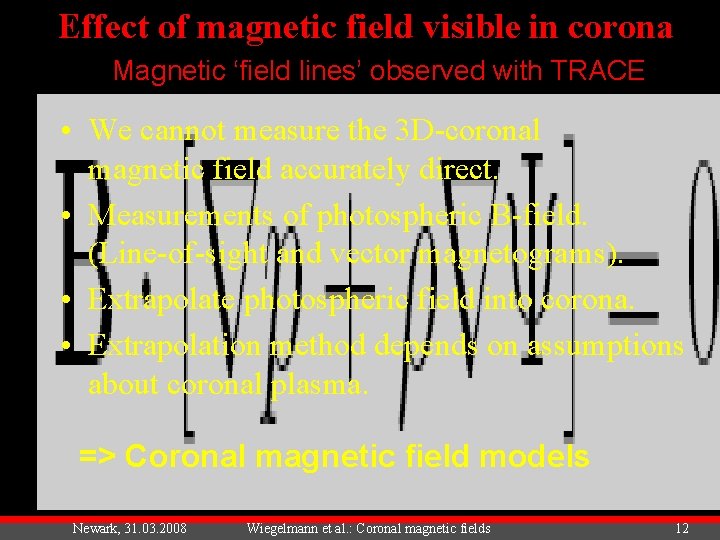
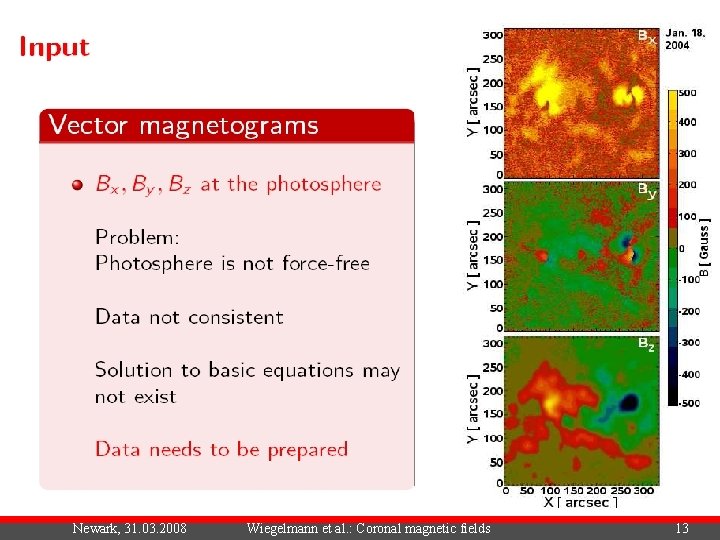
Effect of magnetic field visible in corona Magnetic ‘field lines’ observed with TRACE • We cannot measure the 3 D-coronal magnetic field accurately direct. • Measurements of photospheric B-field. (Line-of-sight and vector magnetograms). • Extrapolate photospheric field into corona. • Extrapolation method depends on assumptions about coronal plasma. => Coronal magnetic field models Newark, 31. 03. 2008 Wiegelmann et al. : Coronal magnetic fields 12
Newark, 31. 03. 2008 Wiegelmann et al. : Coronal magnetic fields 13
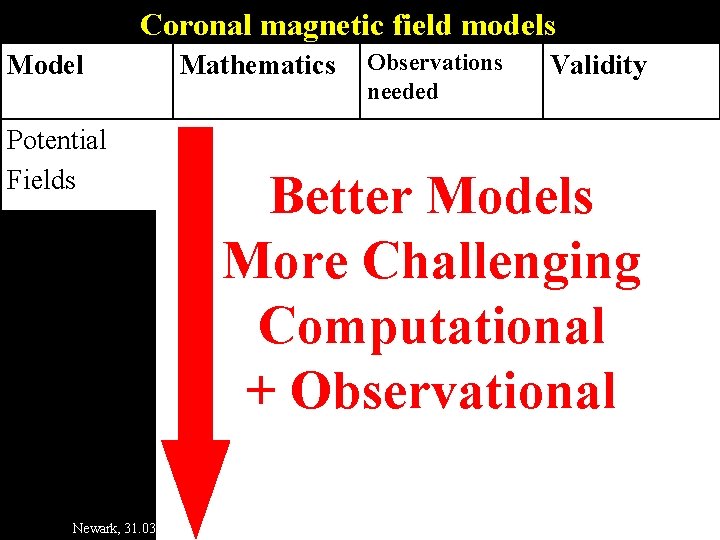
Coronal magnetic field models Model Mathematics Potential Fields Linear Force-Free Nonlinear Force-Free MHS Equilibrium Newark, 31. 03. 2008 Observations needed Validity Line of sight magnetogram (Global) current free regions, quiet sun LOS mag. + observations of plasma structures Local in active regions, low-beta plasma Vectormag. (Noise, ambiguity Preprocessing) Active regions, low beta plasma in low corona Vectormag. + Tomography Helmet streamer, finite beta plasma, full solar corona Better Models More Challenging Computational + Observational Wiegelmann et al. : Coronal magnetic fields 14
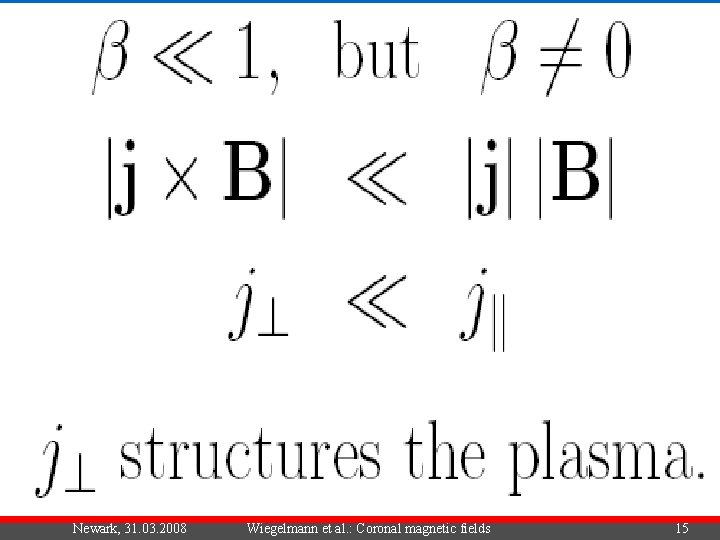
Newark, 31. 03. 2008 Wiegelmann et al. : Coronal magnetic fields 15
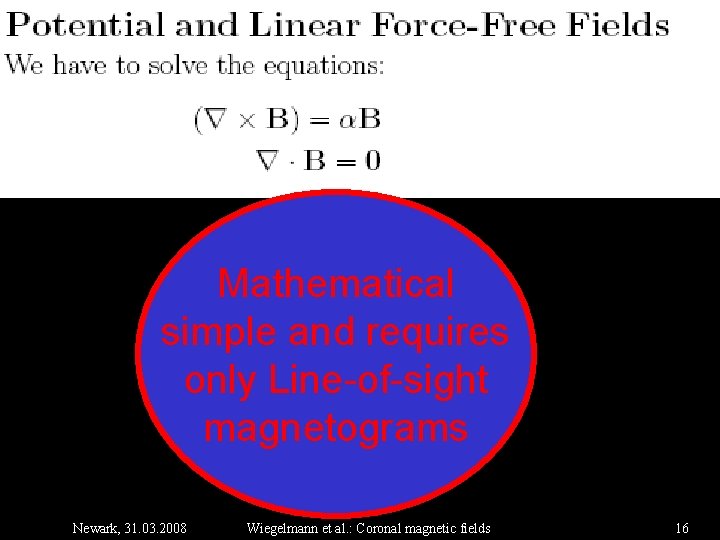
Mathematical simple and requires only Line-of-sight magnetograms Newark, 31. 03. 2008 Wiegelmann et al. : Coronal magnetic fields 16
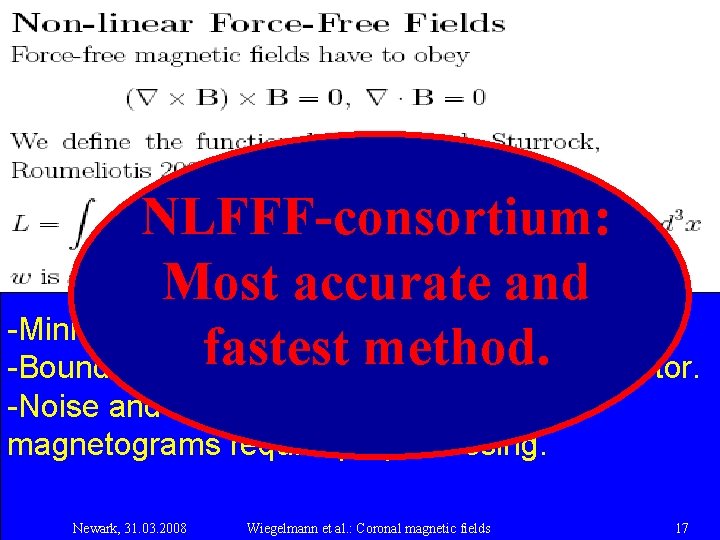
NLFFF-consortium: Most accurate and -Minimize L numerically. fastest method. -Boundary condition: Photospheric B-field vector. -Noise and inconsistencies in vector magnetograms require preprocessing. Newark, 31. 03. 2008 Wiegelmann et al. : Coronal magnetic fields 17
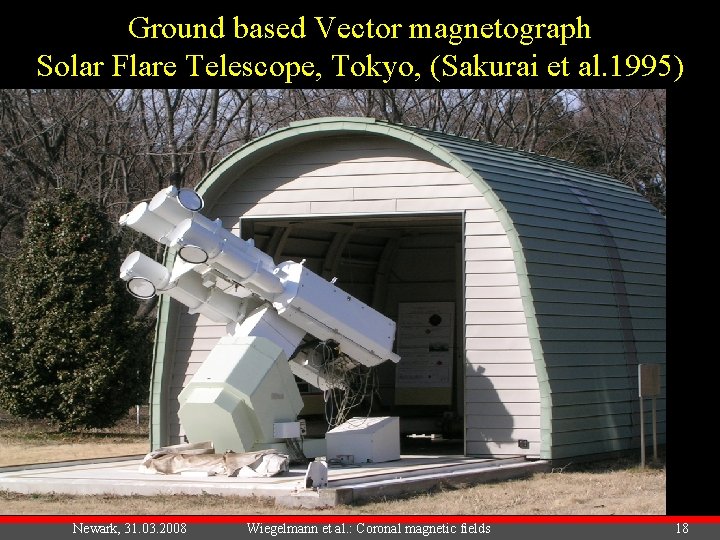
Ground based Vector magnetograph Solar Flare Telescope, Tokyo, (Sakurai et al. 1995) Newark, 31. 03. 2008 Wiegelmann et al. : Coronal magnetic fields 18
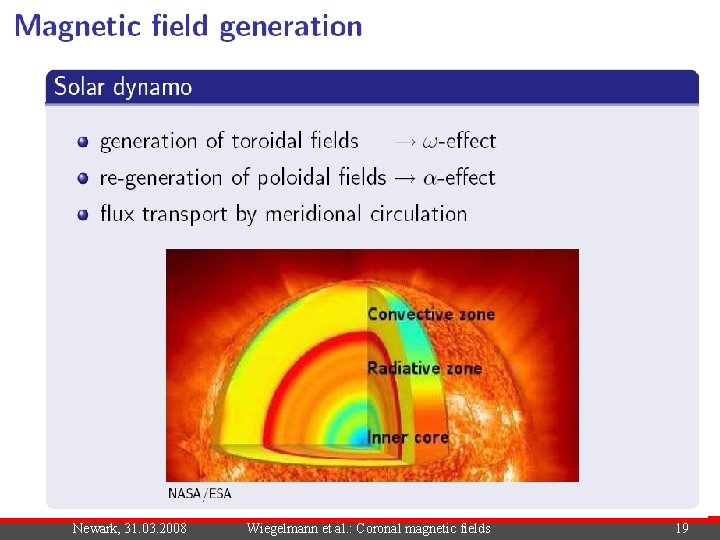
Newark, 31. 03. 2008 Wiegelmann et al. : Coronal magnetic fields 19
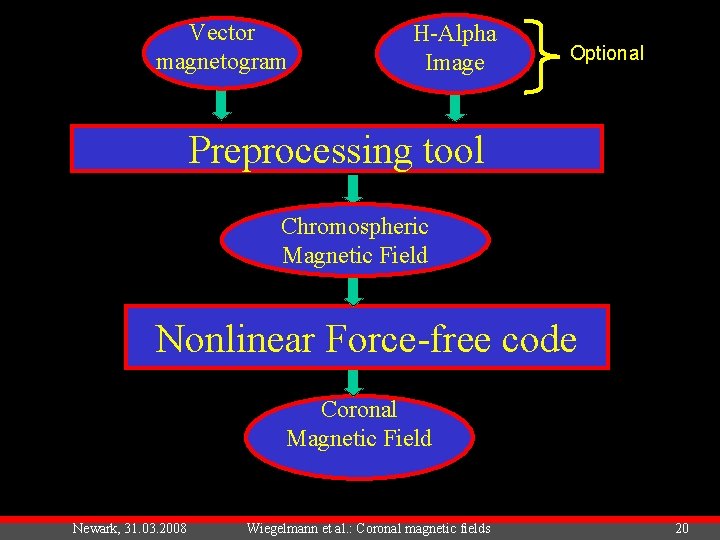
Vector magnetogram H-Alpha Image Optional Preprocessing tool Chromospheric Magnetic Field Nonlinear Force-free code Coronal Magnetic Field Newark, 31. 03. 2008 Wiegelmann et al. : Coronal magnetic fields 20
Evolution of Flaring Active Region NOAA 10540 (Thalmann and Wiegelmann, A&A 2008, in press) Flare seen in Trace and H-Alpha, Jan. 2004, (from Goff, van Driel-Gesztelyi, Demoulin, Sol. Phys. 2007) Newark, 31. 03. 2008 Wiegelmann et al. : Coronal magnetic fields 21
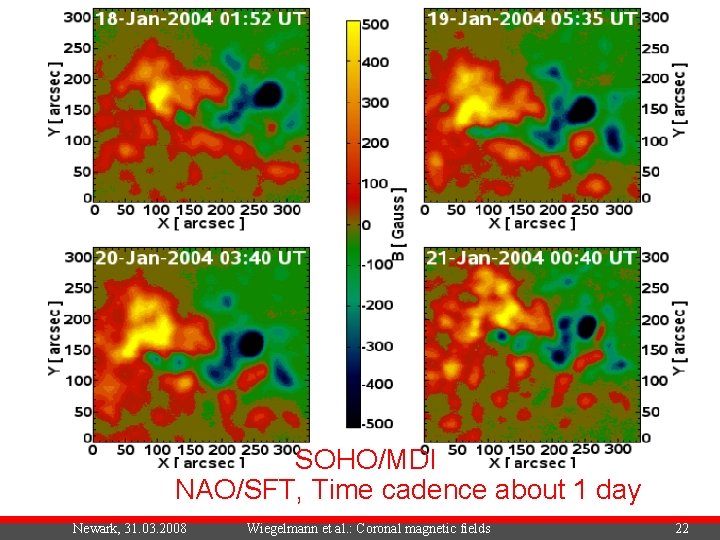
SOHO/MDI NAO/SFT, Time cadence about 1 day Newark, 31. 03. 2008 Wiegelmann et al. : Coronal magnetic fields 22
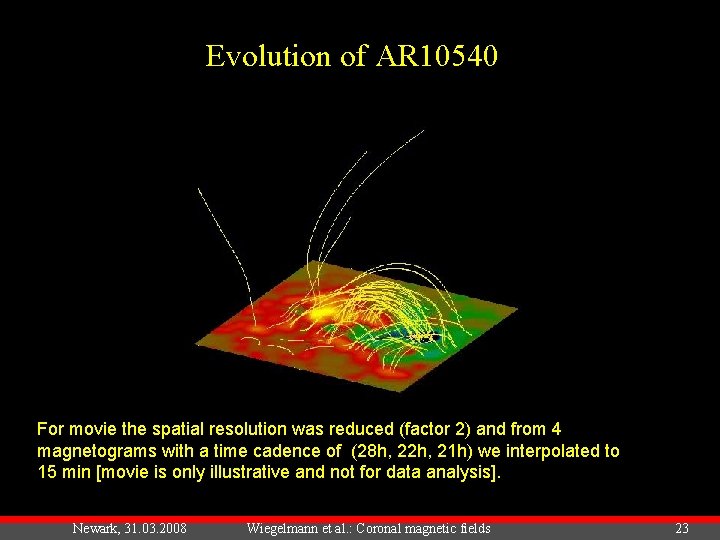
Evolution of AR 10540 For movie the spatial resolution was reduced (factor 2) and from 4 magnetograms with a time cadence of (28 h, 22 h, 21 h) we interpolated to 15 min [movie is only illustrative and not for data analysis]. Newark, 31. 03. 2008 Wiegelmann et al. : Coronal magnetic fields 23
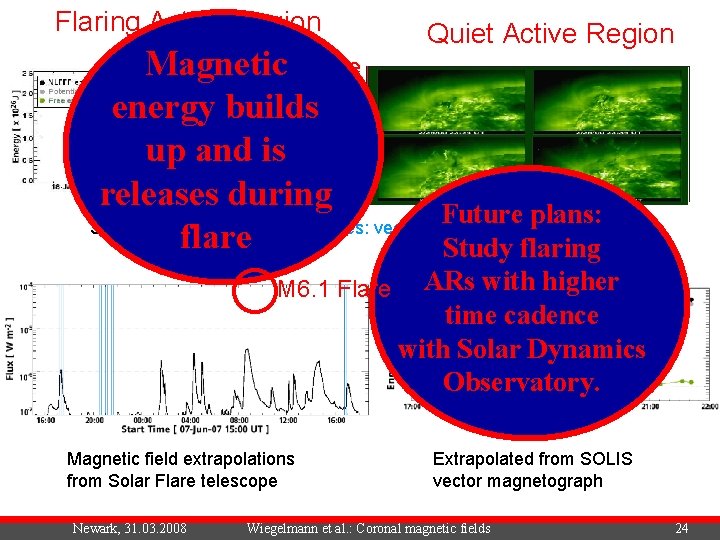
Flaring Active Region Quiet Active Region M 6. 1 Flare Magnetic energy builds up and is releases during Future plans: Solar X-ray flux. Vertical blue lines: vector magnetograms available flare Study flaring M 6. 1 Flare Magnetic field extrapolations from Solar Flare telescope Newark, 31. 03. 2008 ARs with higher time cadence with Solar Dynamics Observatory. Extrapolated from SOLIS vector magnetograph Wiegelmann et al. : Coronal magnetic fields 24
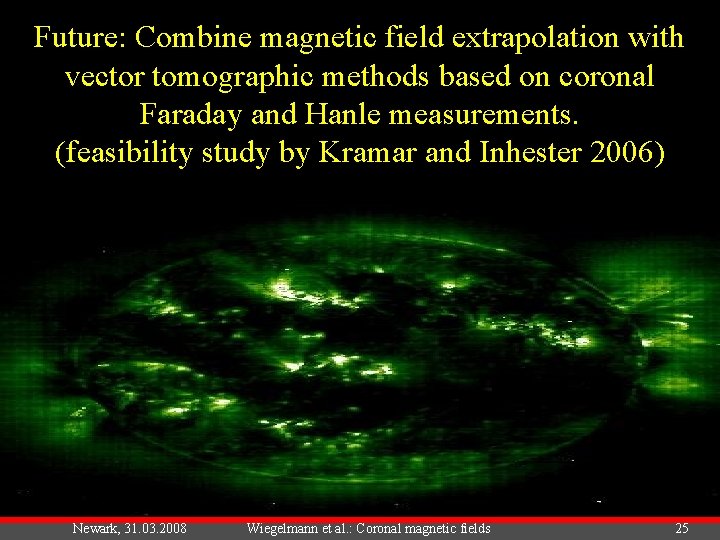
Future: Combine magnetic field extrapolation with vector tomographic methods based on coronal Faraday and Hanle measurements. (feasibility study by Kramar and Inhester 2006) Newark, 31. 03. 2008 Wiegelmann et al. : Coronal magnetic fields 25
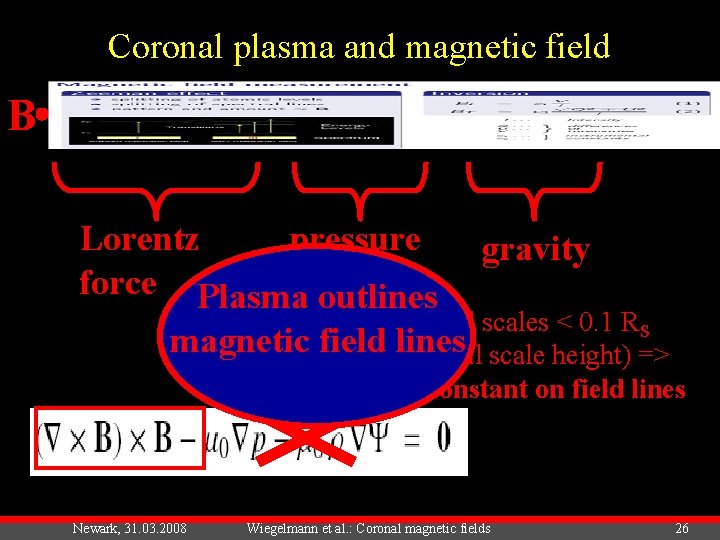
Coronal plasma and magnetic field B Lorentz pressure force Plasma gradient outlines gravity for vertical scales < 0. 1 RS magnetic field lines (gravitational scale height) => Pressure constant on field lines Newark, 31. 03. 2008 Wiegelmann et al. : Coronal magnetic fields 26
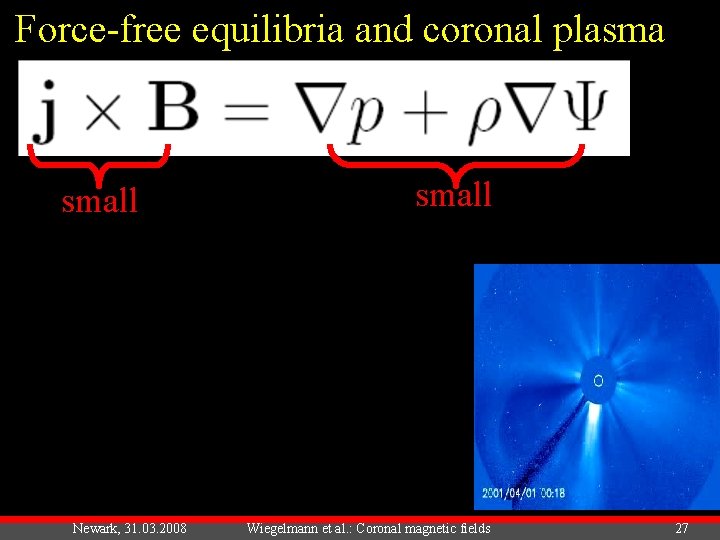
Force-free equilibria and coronal plasma small Newark, 31. 03. 2008 small Wiegelmann et al. : Coronal magnetic fields 27
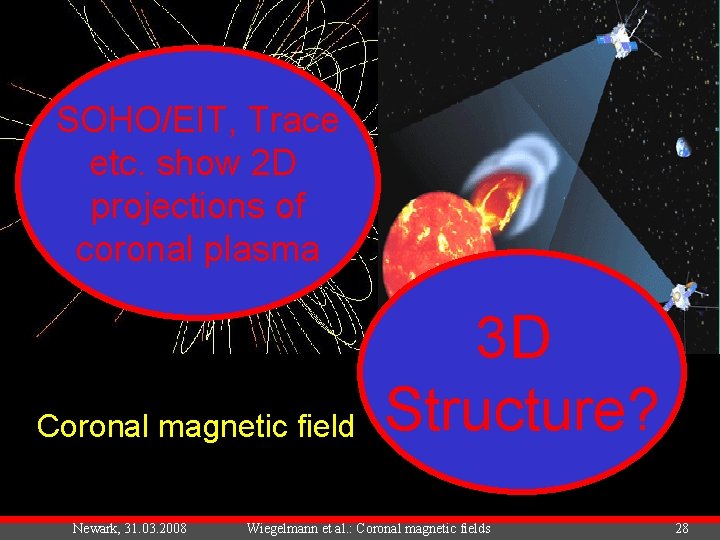
SOHO/EIT, Trace etc. show 2 D projections of coronal plasma Coronal magnetic field Newark, 31. 03. 2008 3 D Structure? Plasma in EUV Wiegelmann et al. : Coronal magnetic fields 28
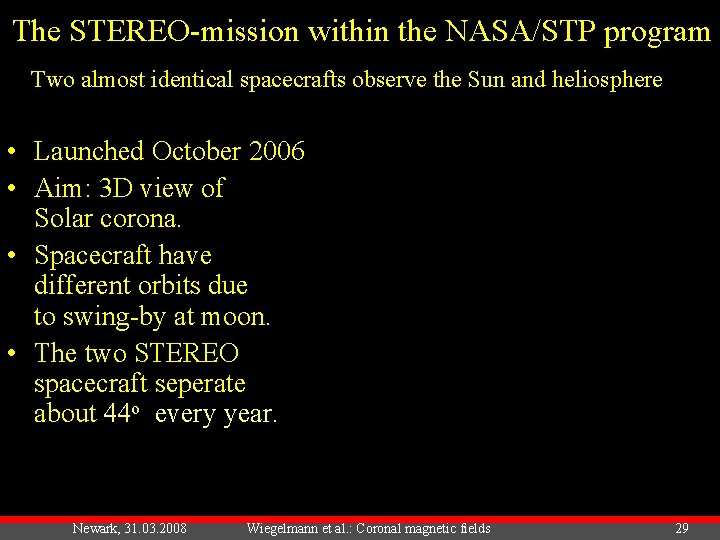
The STEREO-mission within the NASA/STP program Two almost identical spacecrafts observe the Sun and heliosphere • Launched October 2006 • Aim: 3 D view of Solar corona. • Spacecraft have different orbits due to swing-by at moon. • The two STEREO spacecraft seperate about 44 o every year. Newark, 31. 03. 2008 Wiegelmann et al. : Coronal magnetic fields 29
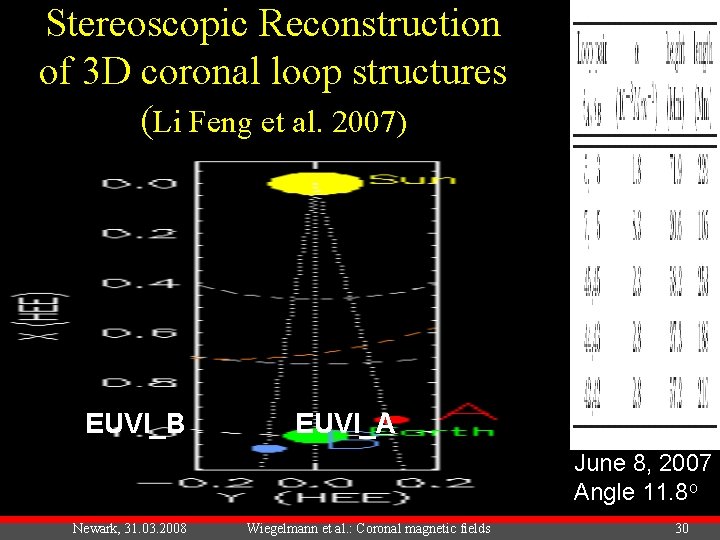
Stereoscopic Reconstruction of 3 D coronal loop structures (Li Feng et al. 2007) EUVI_B EUVI_A June 8, 2007 Angle 11. 8 o Newark, 31. 03. 2008 Wiegelmann et al. : Coronal magnetic fields 30
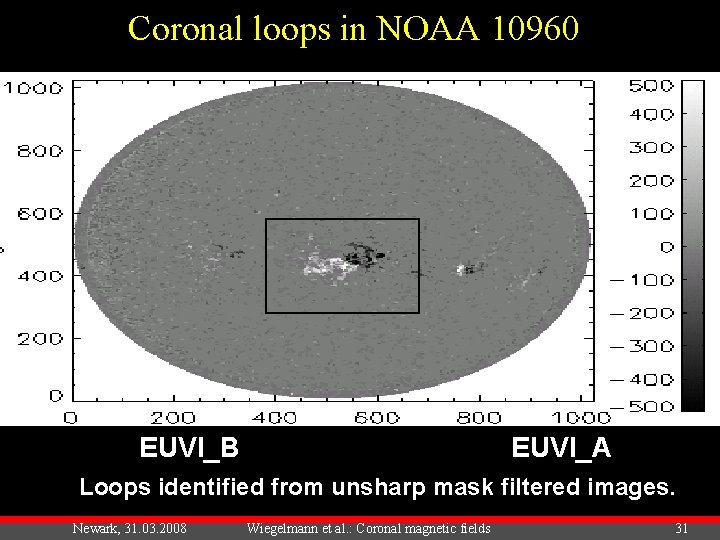
Coronal loops in NOAA 10960 EUVI_B EUVI_A Loops identified from unsharp mask filtered images. Newark, 31. 03. 2008 Wiegelmann et al. : Coronal magnetic fields 31
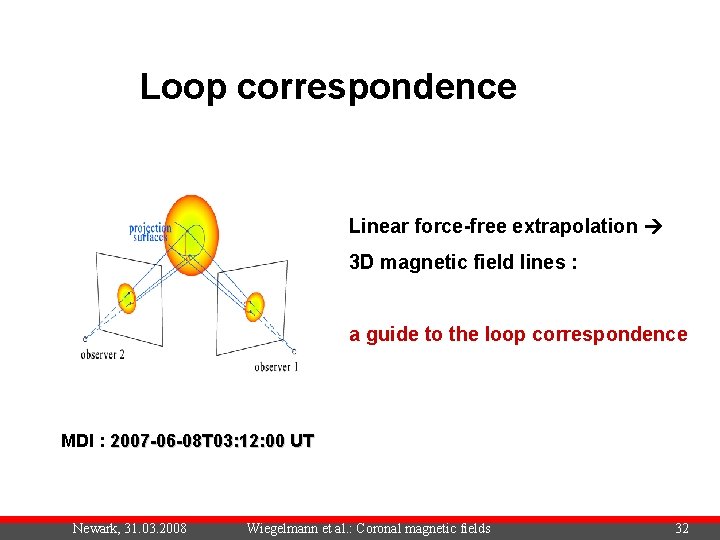
Loop correspondence Linear force-free extrapolation 3 D magnetic field lines : a guide to the loop correspondence MDI : 2007 -06 -08 T 03: 12: 00 UT Newark, 31. 03. 2008 Wiegelmann et al. : Coronal magnetic fields 32
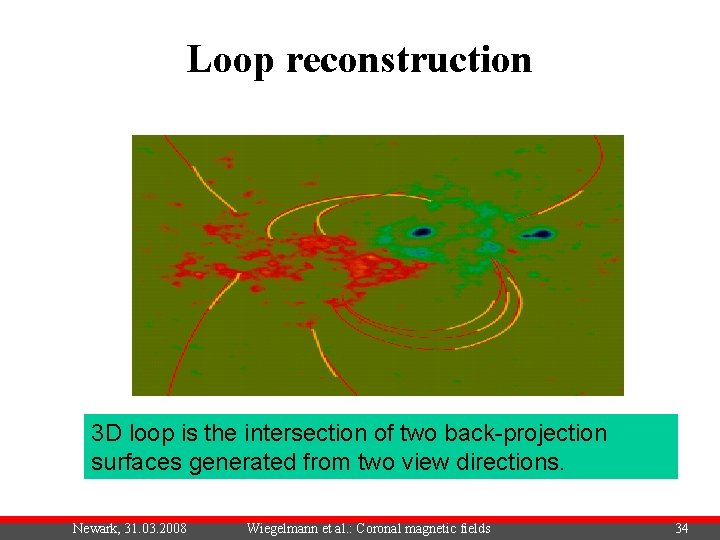
Loop reconstruction 3 D loop is the intersection of two back-projection surfaces generated from two view directions. Newark, 31. 03. 2008 Wiegelmann et al. : Coronal magnetic fields 34
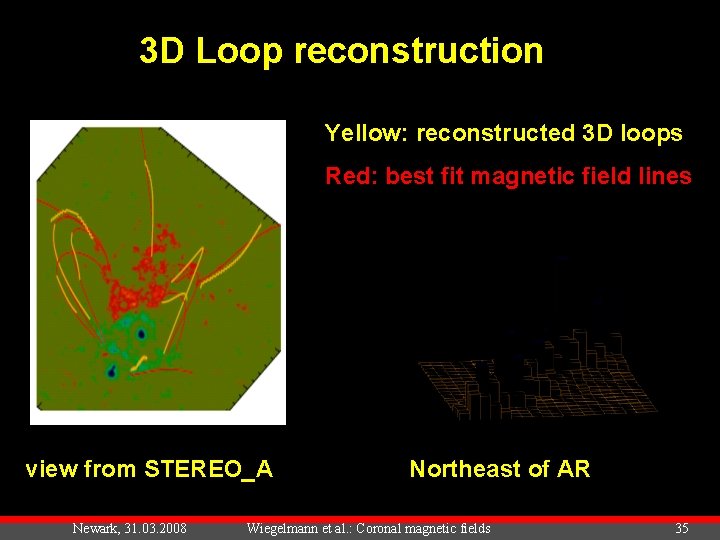
3 D Loop reconstruction Yellow: reconstructed 3 D loops Red: best fit magnetic field lines view from STEREO_A Newark, 31. 03. 2008 Northeast of AR Wiegelmann et al. : Coronal magnetic fields 35
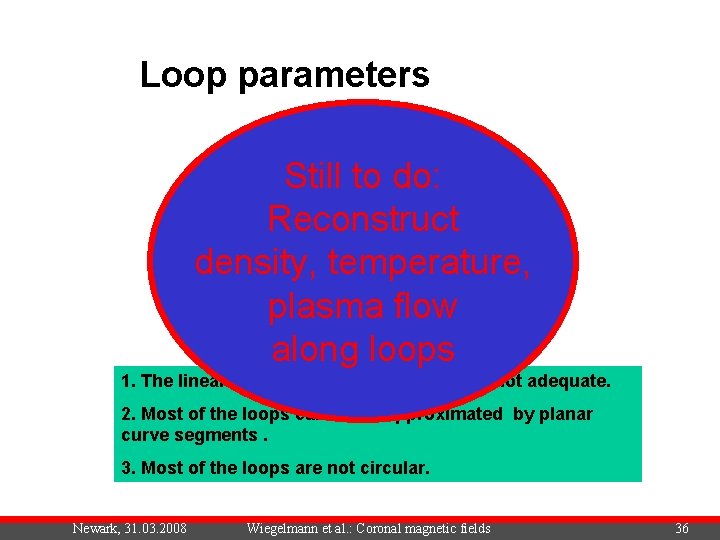
Loop parameters Still to do: Reconstruct density, temperature, plasma flow along loops 1. The linear force-free assumption is often not adequate. 2. Most of the loops cannot be approximated by planar curve segments. 3. Most of the loops are not circular. Newark, 31. 03. 2008 Wiegelmann et al. : Coronal magnetic fields 36
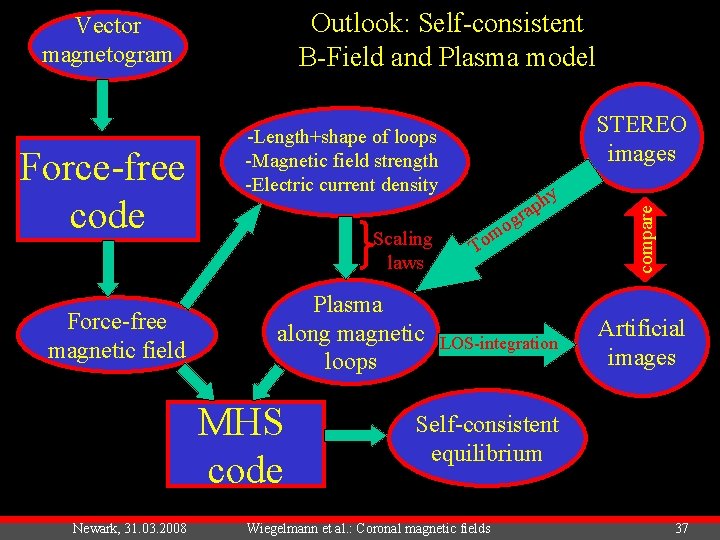
Outlook: Self-consistent B-Field and Plasma model Force-free code Force-free magnetic field Scaling laws Plasma along magnetic loops MHS code Newark, 31. 03. 2008 STEREO images -Length+shape of loops -Magnetic field strength -Electric current density y h p a r g o m To LOS-integration compare Vector magnetogram Artificial images Self-consistent equilibrium Wiegelmann et al. : Coronal magnetic fields 37
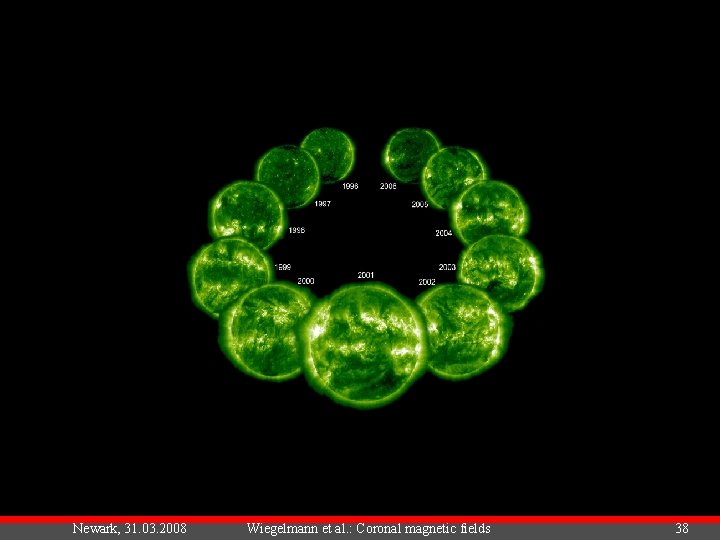
Newark, 31. 03. 2008 Wiegelmann et al. : Coronal magnetic fields 38