
Solar Cells in 2009 and Beyond Mike Mc
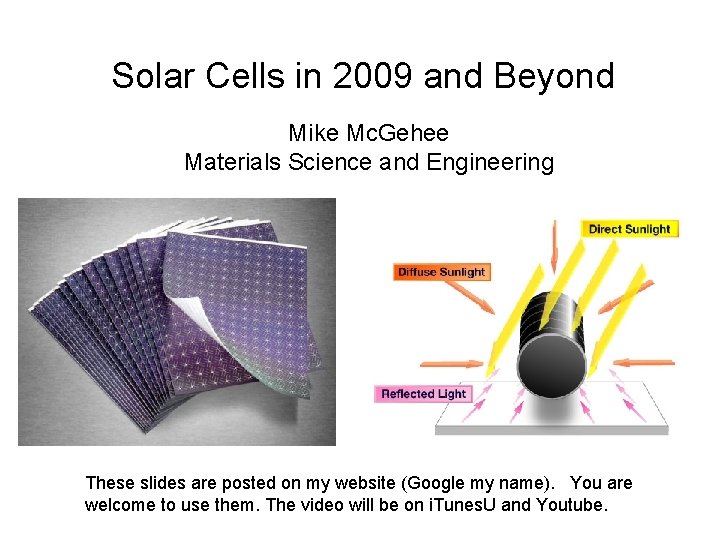
Solar Cells in 2009 and Beyond Mike Mc. Gehee Materials Science and Engineering These slides are posted on my website (Google my name). You are welcome to use them. The video will be on i. Tunes. U and Youtube.
To provide the world with 10 TW of solar electricity by 2030 • We need to grow the industry by ~ 35 %/year. • Not run out of essential materials. • Make enough money in 2 years to double the factory size. • Get energy payback within two years so that we generate more power than we use.
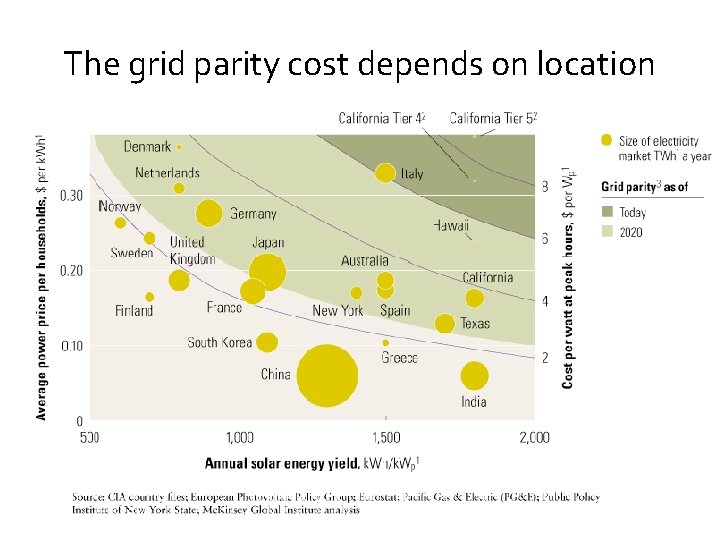
The grid parity cost depends on location
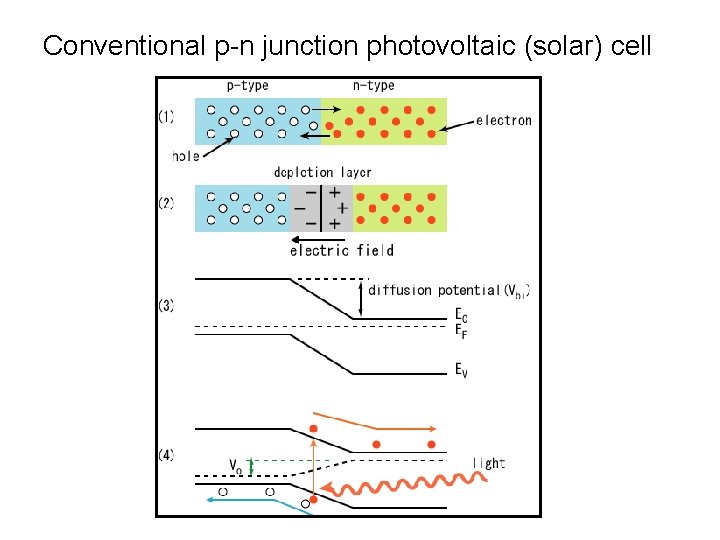
Conventional p-n junction photovoltaic (solar) cell
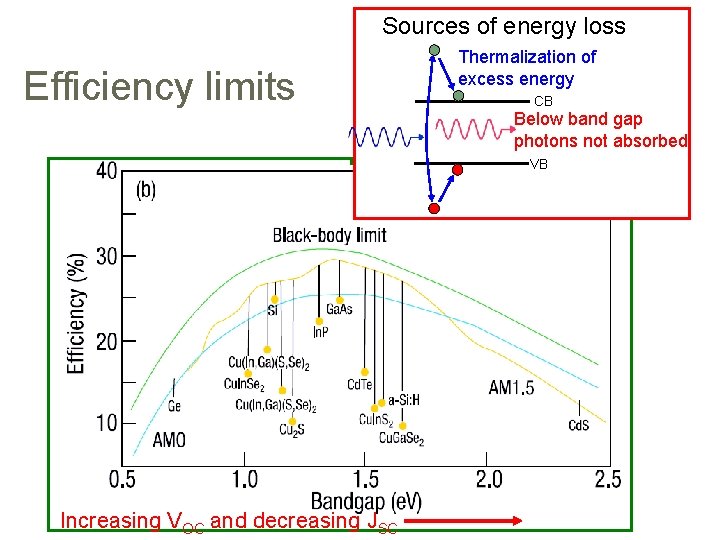
Sources of energy loss Efficiency limits Thermalization of excess energy CB Below band gap photons not absorbed VB Increasing VOC and decreasing JSC
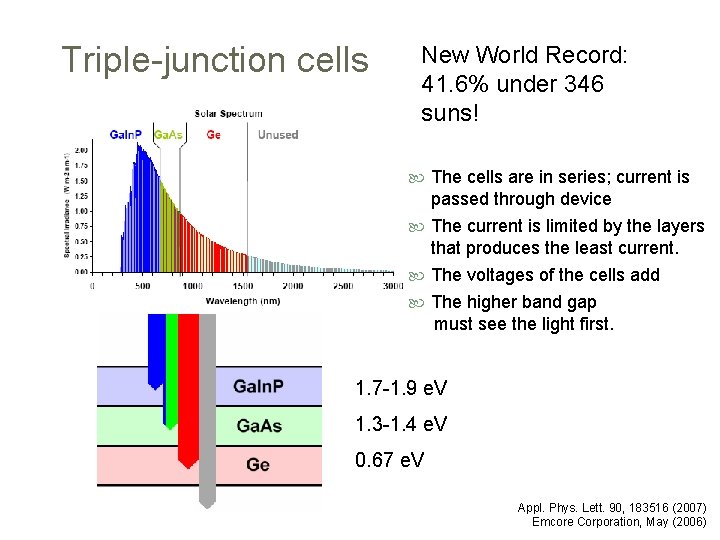
Triple-junction cells New World Record: 41. 6% under 346 suns! The cells are in series; current is passed through device The current is limited by the layers that produces the least current. The voltages of the cells add The higher band gap must see the light first. 1. 7 -1. 9 e. V 1. 3 -1. 4 e. V 0. 67 e. V Appl. Phys. Lett. 90, 183516 (2007) Emcore Corporation, May (2006)
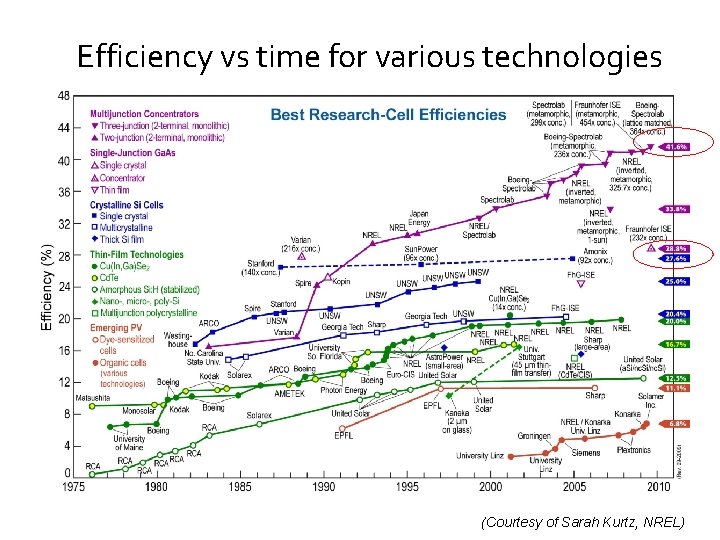
Efficiency vs time for various technologies 7 (Courtesy of Sarah Kurtz, NREL)
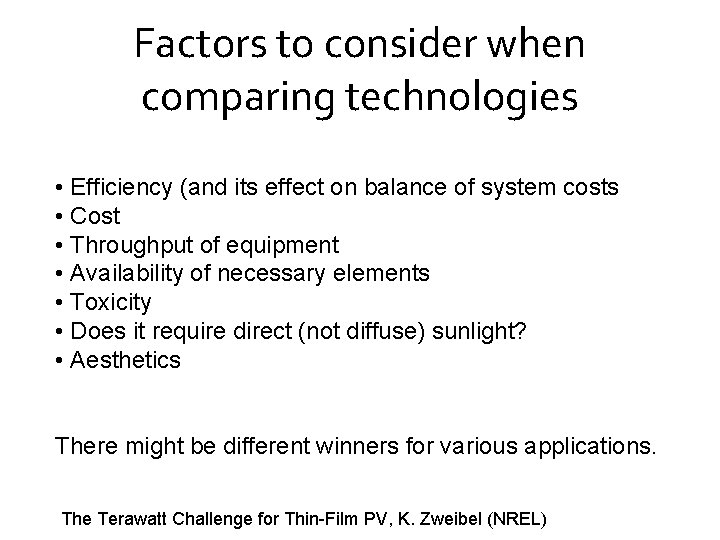
Factors to consider when comparing technologies • Efficiency (and its effect on balance of system costs • Cost • Throughput of equipment • Availability of necessary elements • Toxicity • Does it require direct (not diffuse) sunlight? • Aesthetics There might be different winners for various applications. The Terawatt Challenge for Thin-Film PV, K. Zweibel (NREL)
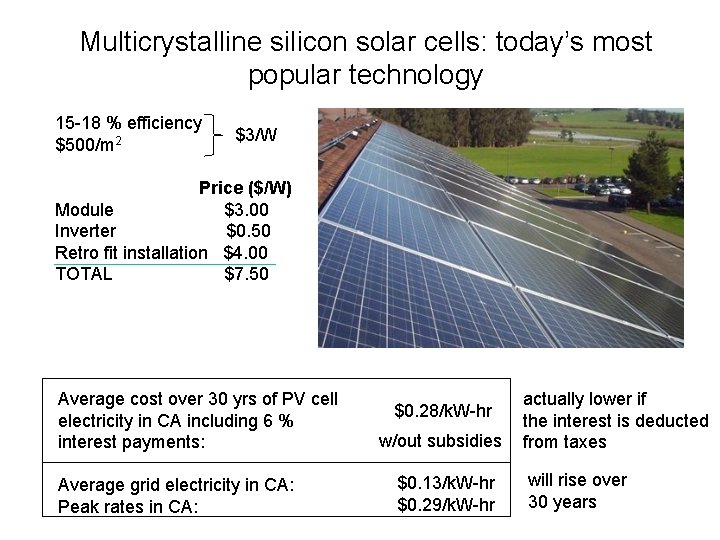
Multicrystalline silicon solar cells: today’s most popular technology 15 -18 % efficiency $500/m 2 $3/W Price ($/W) Module $3. 00 Inverter $0. 50 Retro fit installation $4. 00 TOTAL $7. 50 Average cost over 30 yrs of PV cell electricity in CA including 6 % interest payments: Average grid electricity in CA: Peak rates in CA: $0. 28/k. W-hr w/out subsidies $0. 13/k. W-hr $0. 29/k. W-hr actually lower if the interest is deducted from taxes will rise over 30 years
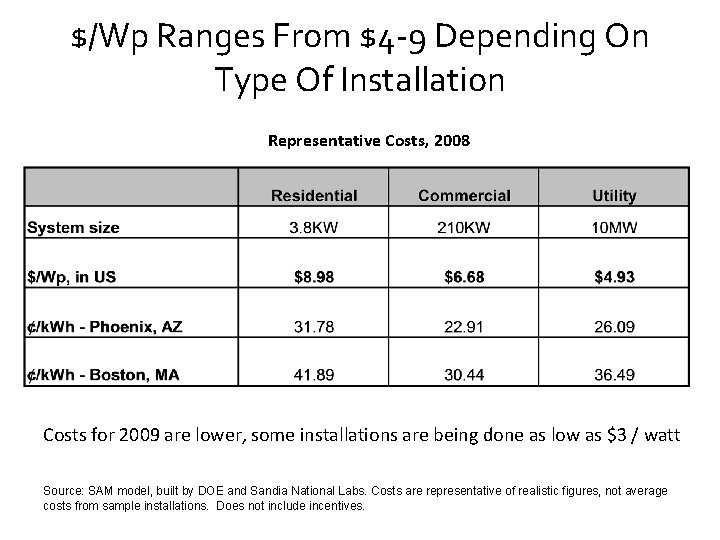
$/Wp Ranges From $4 -9 Depending On Type Of Installation Representative Costs, 2008 Costs for 2009 are lower, some installations are being done as low as $3 / watt Source: SAM model, built by DOE and Sandia National Labs. Costs are representative of realistic figures, not average costs from sample installations. Does not include incentives.
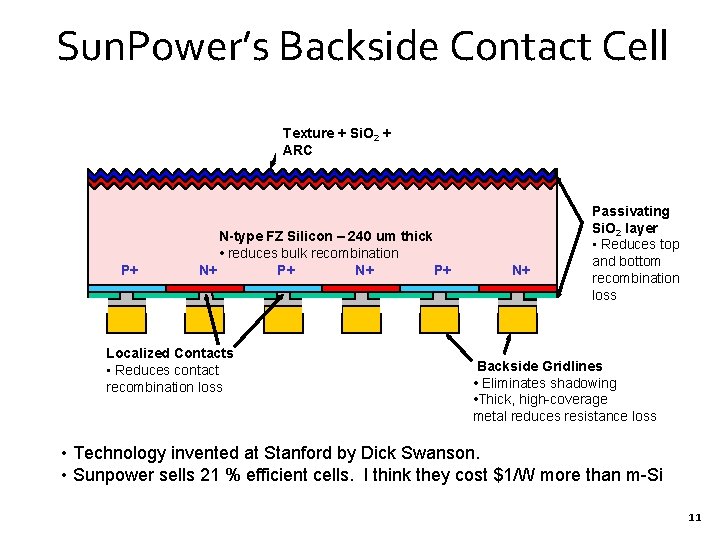
Sun. Power’s Backside Contact Cell Texture + Si. O Texture + Oxide 2 + ARC P+ N-type Silicon – 270 um thick N-type FZ Silicon – 240 um thick • reduces bulk recombination N+ P+ Localized Contacts • Reduces contact recombination loss N+ Passivating Si. O 2 layer • Reduces top and bottom recombination loss Backside Gridlines • Eliminates shadowing • Thick, high-coverage metal reduces resistance loss • Technology invented at Stanford by Dick Swanson. • Sunpower sells 21 % efficient cells. I think they cost $1/W more than m-Si 11
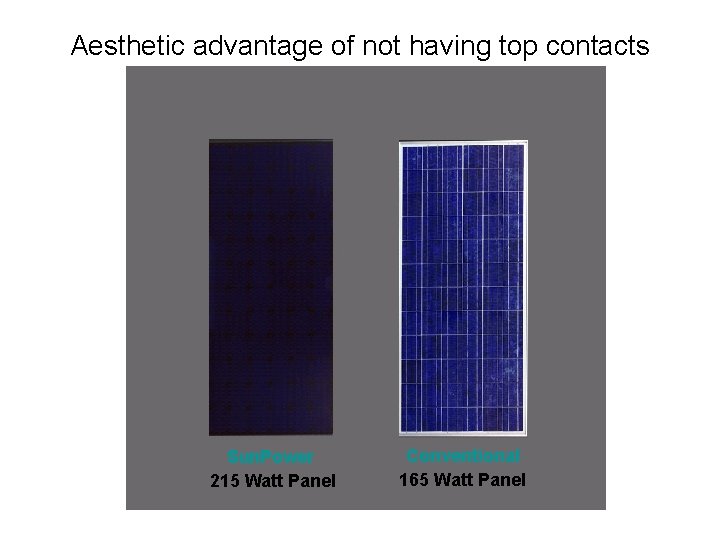
Aesthetic advantage of not having top contacts Sun. Power 215 Watt Panel Conventional 165 Watt Panel
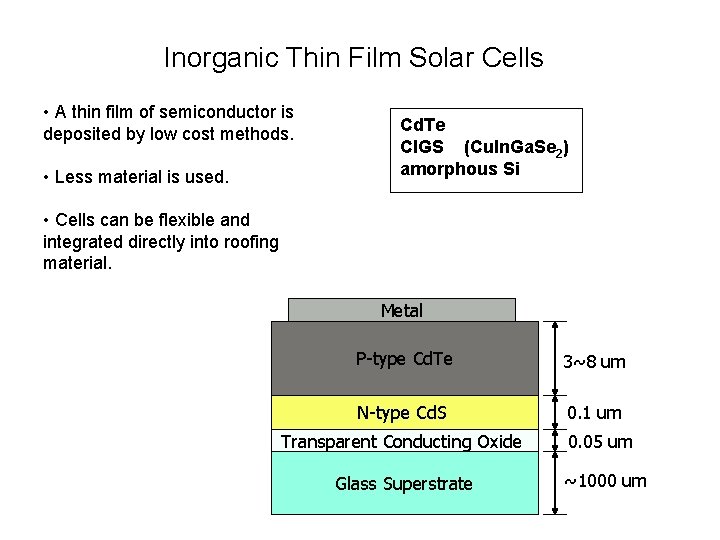
Inorganic Thin Film Solar Cells • A thin film of semiconductor is deposited by low cost methods. • Less material is used. Cd. Te CIGS (Cu. In. Ga. Se 2) amorphous Si • Cells can be flexible and integrated directly into roofing material. Metal P-type Cd. Te 3~8 um N-type Cd. S 0. 1 um Transparent Conducting Oxide Glass Superstrate 0. 05 um ~1000 um
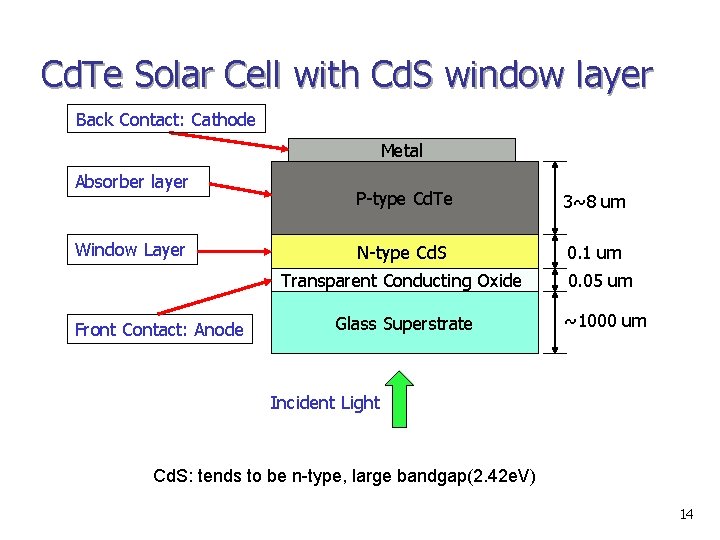
Cd. Te Solar Cell with Cd. S window layer Back Contact: Cathode Metal Absorber layer Window Layer P-type Cd. Te 3~8 um N-type Cd. S 0. 1 um Transparent Conducting Oxide Front Contact: Anode Glass Superstrate 0. 05 um ~1000 um Incident Light Cd. S: tends to be n-type, large bandgap(2. 42 e. V) 14
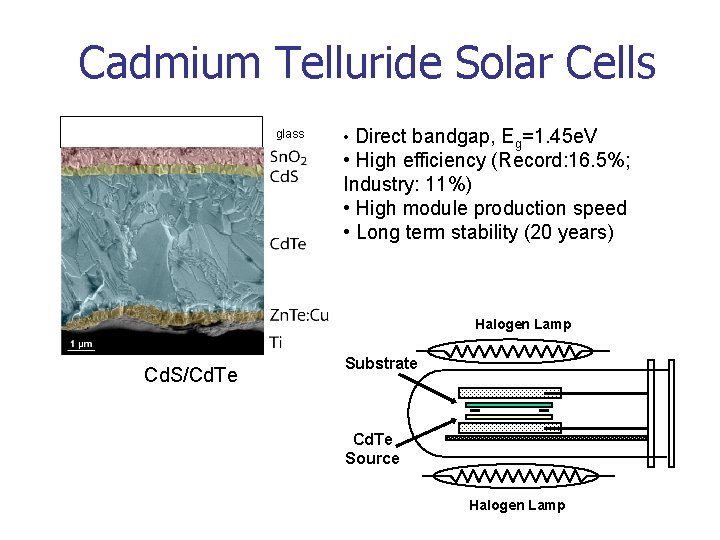
Cadmium Telluride Solar Cells glass • Direct bandgap, Eg=1. 45 e. V • High efficiency (Record: 16. 5%; Industry: 11%) • High module production speed • Long term stability (20 years) Halogen Lamp Cd. S/Cd. Te Substrate Cd. Te Source Halogen Lamp
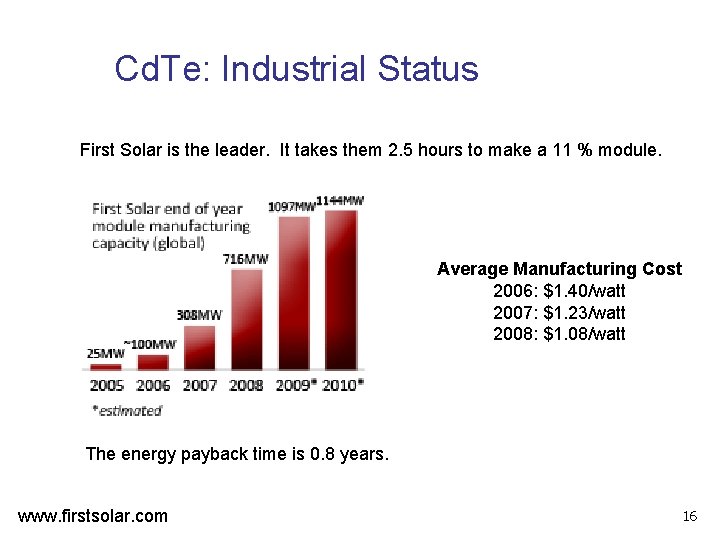
Cd. Te: Industrial Status First Solar is the leader. It takes them 2. 5 hours to make a 11 % module. Average Manufacturing Cost 2006: $1. 40/watt 2007: $1. 23/watt 2008: $1. 08/watt The energy payback time is 0. 8 years. www. firstsolar. com 16
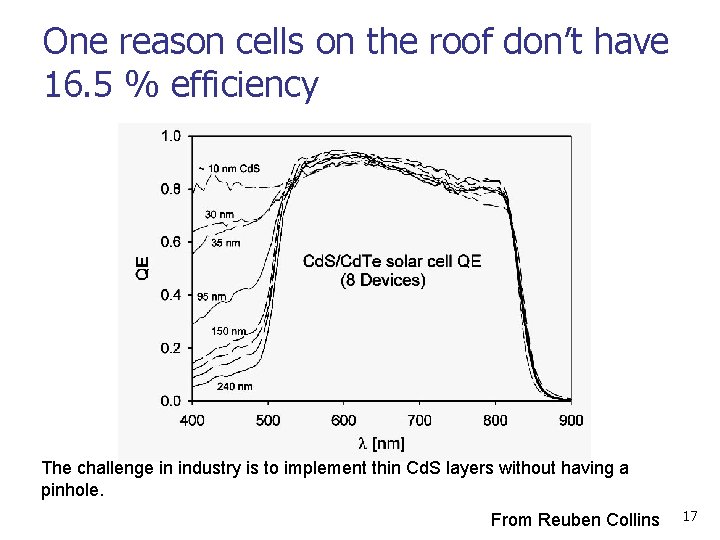
One reason cells on the roof don’t have 16. 5 % efficiency The challenge in industry is to implement thin Cd. S layers without having a pinhole. From Reuben Collins 17
How much of a problem is the toxicity of Cd? • It is probably manageable. First Solar will recycle the panels when the customer is done with them. • Ask John Benner next week. 18
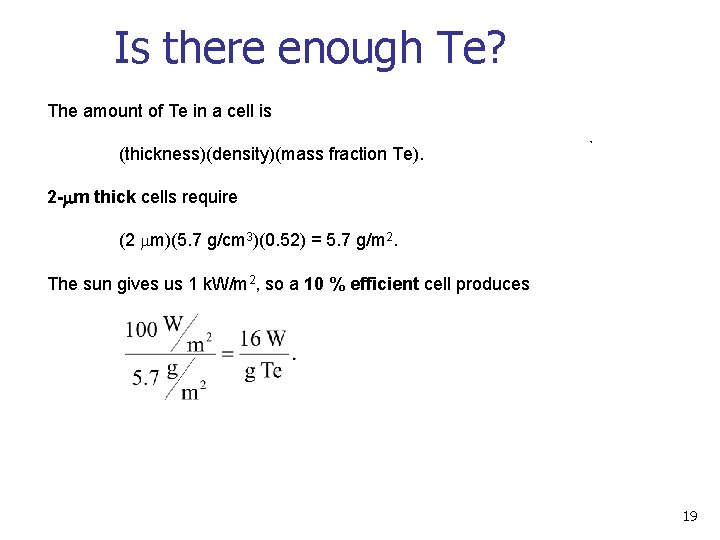
Is there enough Te? The amount of Te in a cell is (thickness)(density)(mass fraction Te). 2 -mm thick cells require (2 mm)(5. 7 g/cm 3)(0. 52) = 5. 7 g/m 2. The sun gives us 1 k. W/m 2, so a 10 % efficient cell produces 19
The Reserve of Te • According to the United States Geologic Survey, the world reserve of Te is 47, 000 tons. • If all of it was used to make solar cells, we could generate 0. 68 TW during peak conditions or about 0. 14 TW averaged throughout the day. • We want >5 TW. • The Reserve is defined as the amount that can be economically recovered. 20
The cost of Te • In 2008 Te cost $250/kg. Continuing the example from before, that translates to 0. 015 $/W • The cost of Te could go up a lot before affecting the price of solar cells • By my estimate, First Solar used half of the world’s annual production of Te last year. The near future should be interesting. 21
Can we find more Te? • Te is a byproduct of Cu mining. • As the price goes up, more Cu plants will install equipment to capture the Te. • Until recently, no known Te ores were known. • We might find a lot more Te when we look for it. • Martin Green, “Estimates of Te and In Prices from Direct Mining of Known Ores, ” Prog in PV 17 (2009) p. 347. • Cyrus Wadia, Paul Alivisatos and Dan Kammens, “Materials Availability Expands the Opportunity for Large-Scale Photovoltaics Deployment, ” Environmental Science and Technology, (2009) 22
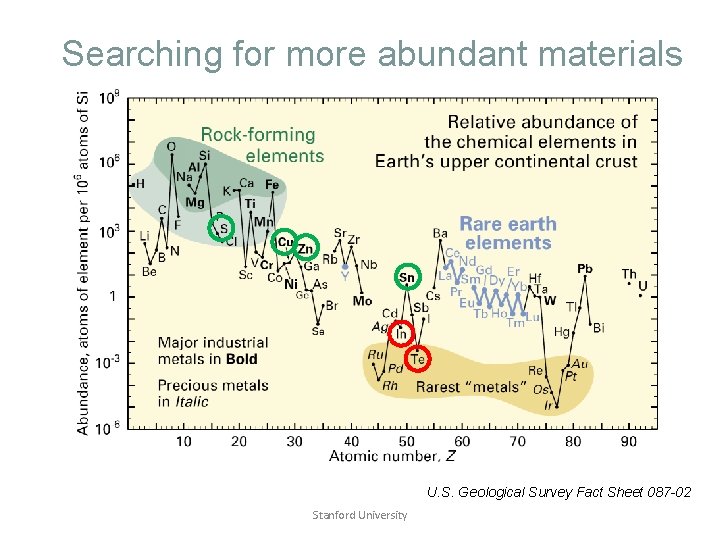
Searching for more abundant materials U. S. Geological Survey Fact Sheet 087 -02 Stanford University
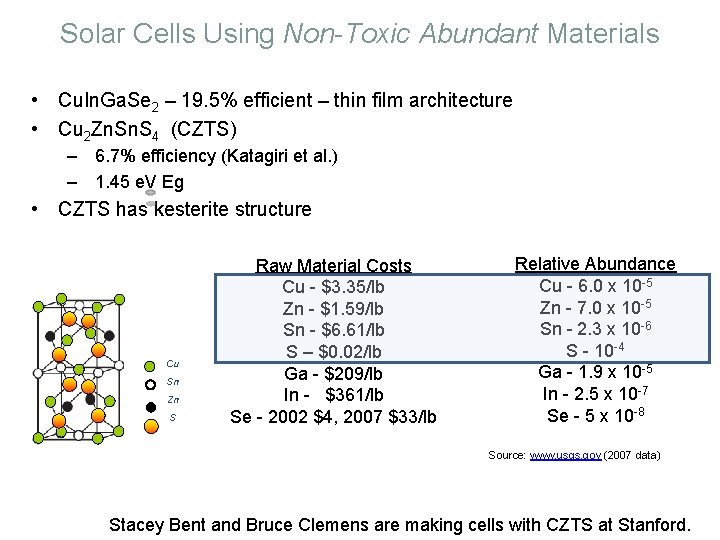
Solar Cells Using Non-Toxic Abundant Materials • Cu. In. Ga. Se 2 – 19. 5% efficient – thin film architecture • Cu 2 Zn. S 4 (CZTS) – 6. 7% efficiency (Katagiri et al. ) – 1. 45 e. V Eg • CZTS has kesterite structure Cu Sn Zn S Raw Material Costs Cu - $3. 35/lb Zn - $1. 59/lb Sn - $6. 61/lb S – $0. 02/lb Ga - $209/lb In - $361/lb Se - 2002 $4, 2007 $33/lb Relative Abundance Cu - 6. 0 x 10 -5 Zn - 7. 0 x 10 -5 Sn - 2. 3 x 10 -6 S - 10 -4 Ga - 1. 9 x 10 -5 In - 2. 5 x 10 -7 Se - 5 x 10 -8 Source: www. usgs. gov (2007 data) Stacey Bent and Bruce Clemens are making cells with CZTS at Stanford.
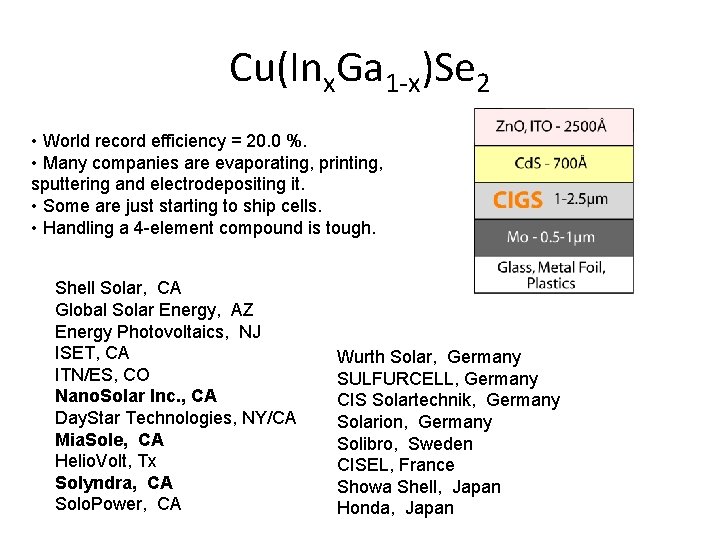
Cu(Inx. Ga 1 -x)Se 2 • World record efficiency = 20. 0 %. • Many companies are evaporating, printing, sputtering and electrodepositing it. • Some are just starting to ship cells. • Handling a 4 -element compound is tough. Shell Solar, CA Global Solar Energy, AZ Energy Photovoltaics, NJ ISET, CA ITN/ES, CO Nano. Solar Inc. , CA Day. Star Technologies, NY/CA Mia. Sole, CA Helio. Volt, Tx Solyndra, CA Solo. Power, CA Wurth Solar, Germany SULFURCELL, Germany CIS Solartechnik, Germany Solarion, Germany Solibro, Sweden CISEL, France Showa Shell, Japan Honda, Japan
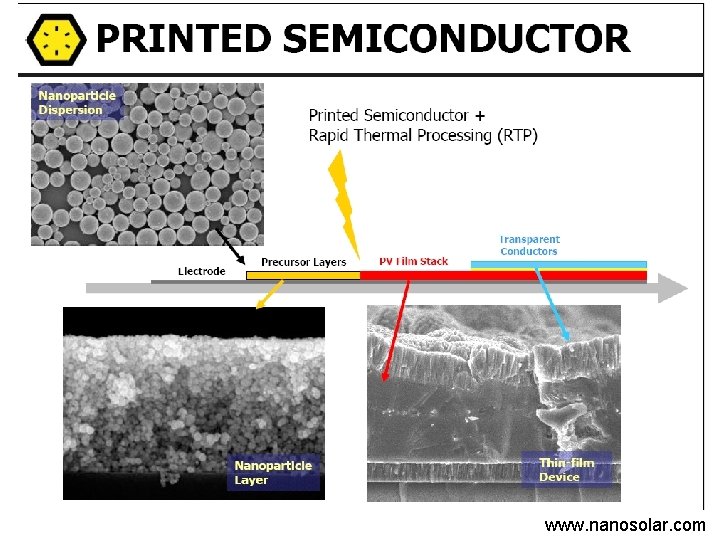
www. nanosolar. com
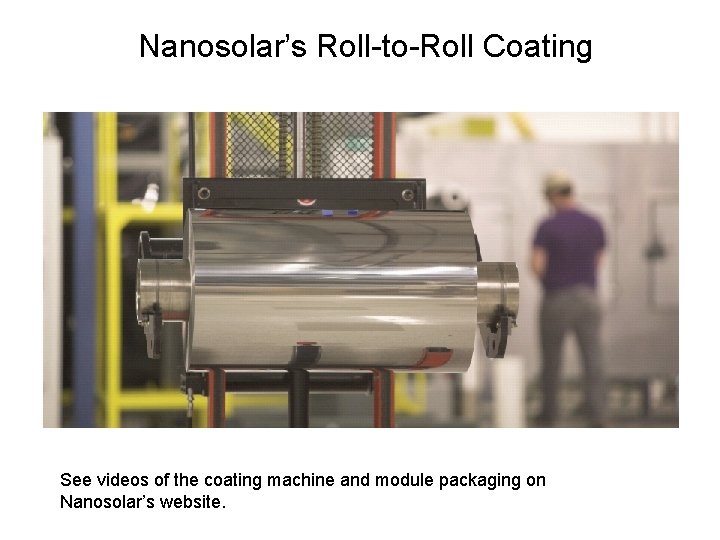
Nanosolar’s Roll-to-Roll Coating See videos of the coating machine and module packaging on Nanosolar’s website.
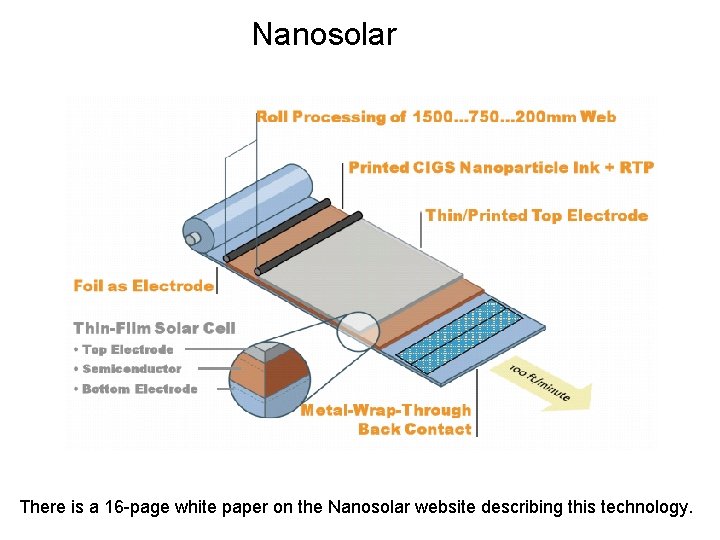
Nanosolar There is a 16 -page white paper on the Nanosolar website describing this technology.
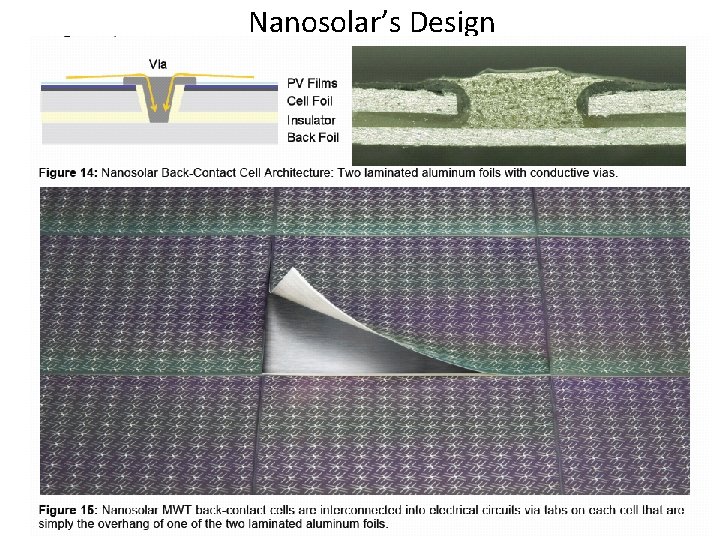
Nanosolar’s Design
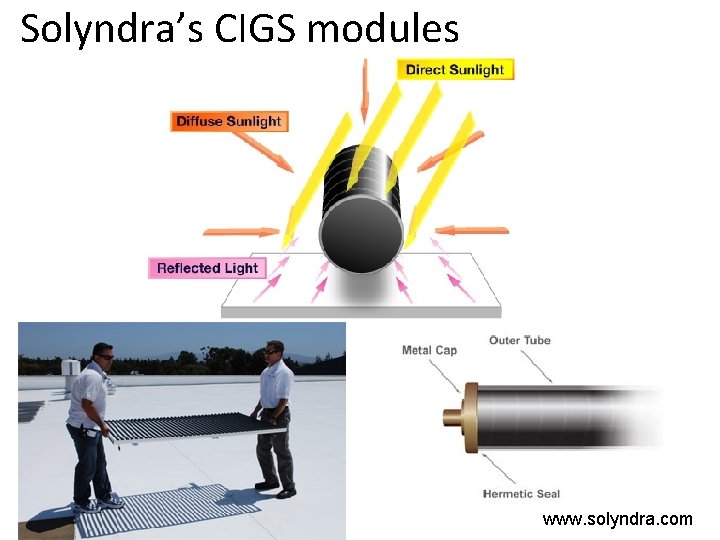
Solyndra’s CIGS modules www. solyndra. com
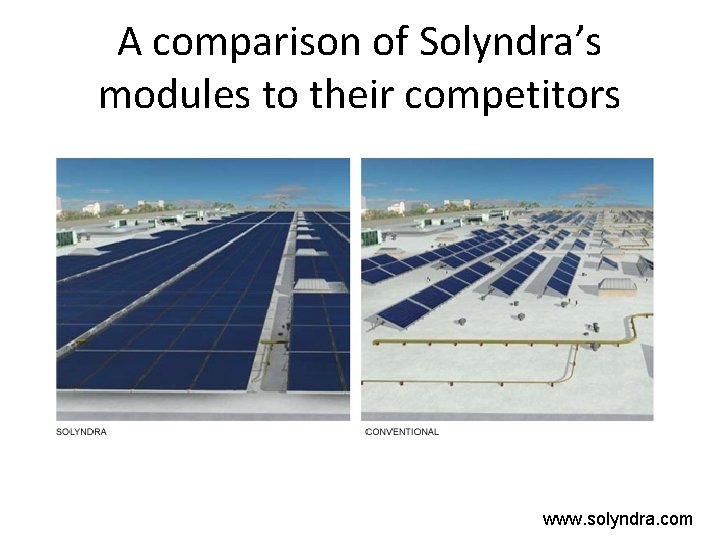
A comparison of Solyndra’s modules to their competitors www. solyndra. com
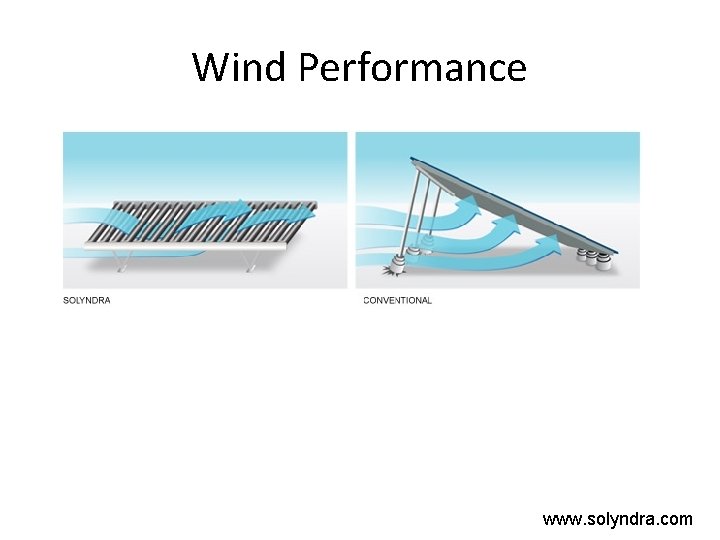
Wind Performance www. solyndra. com
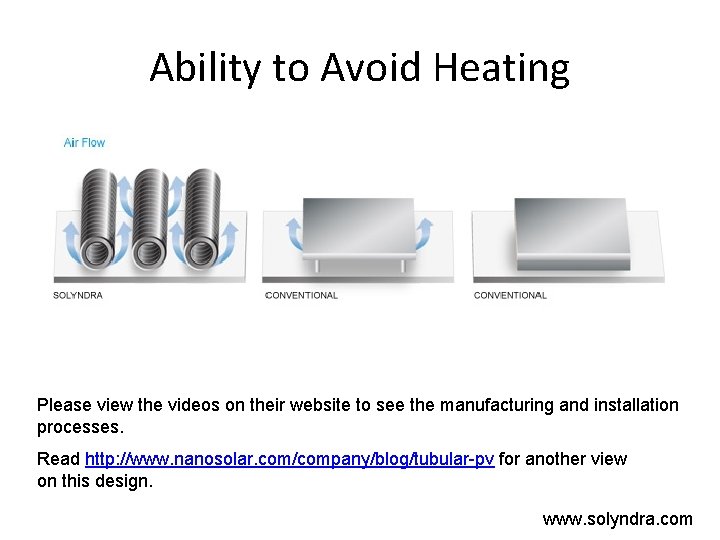
Ability to Avoid Heating Please view the videos on their website to see the manufacturing and installation processes. Read http: //www. nanosolar. com/company/blog/tubular-pv for another view on this design. www. solyndra. com
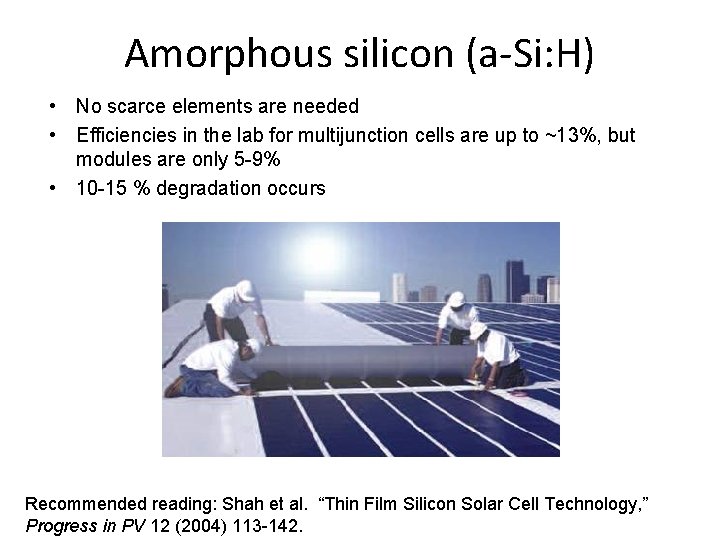
Amorphous silicon (a-Si: H) • No scarce elements are needed • Efficiencies in the lab for multijunction cells are up to ~13%, but modules are only 5 -9% • 10 -15 % degradation occurs Recommended reading: Shah et al. “Thin Film Silicon Solar Cell Technology, ” Progress in PV 12 (2004) 113 -142.
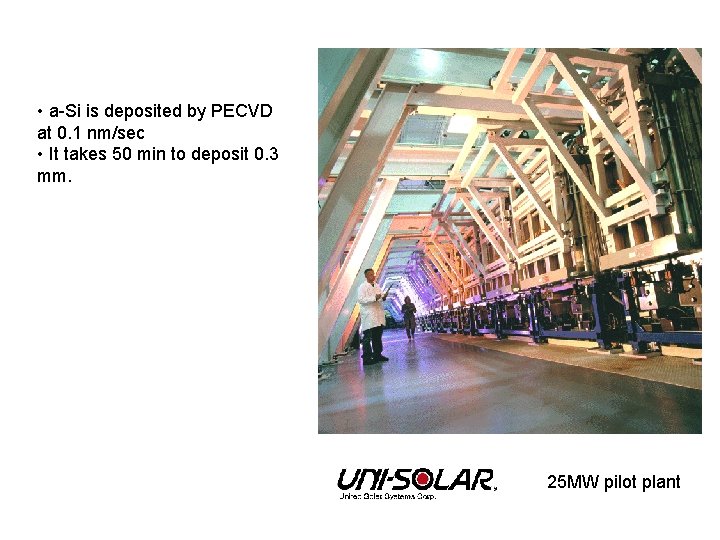
• a-Si is deposited by PECVD at 0. 1 nm/sec • It takes 50 min to deposit 0. 3 mm. 25 MW pilot plant
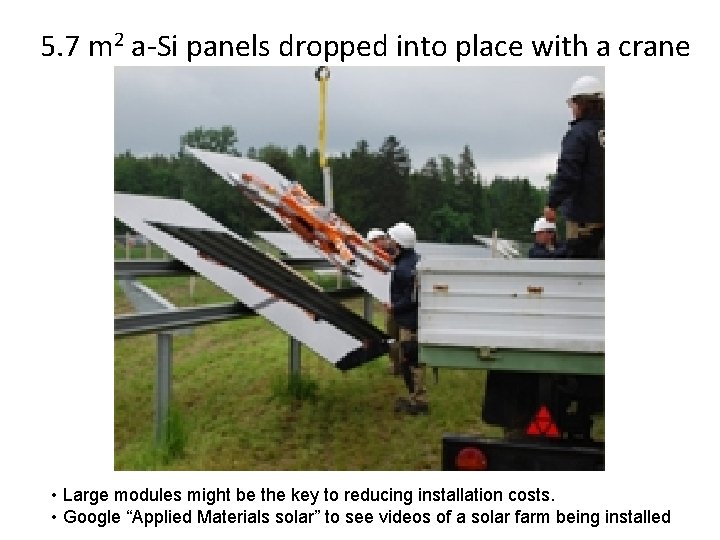
5. 7 m 2 a-Si panels dropped into place with a crane • Large modules might be the key to reducing installation costs. • Google “Applied Materials solar” to see videos of a solar farm being installed
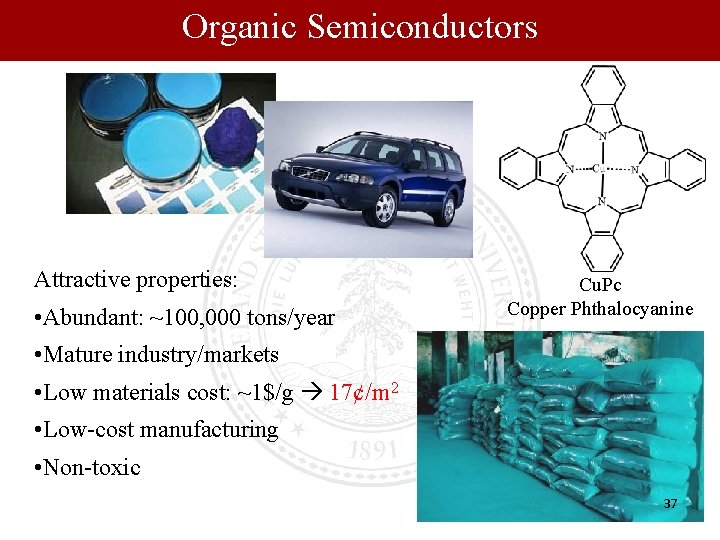
Organic Semiconductors Attractive properties: • Abundant: ~100, 000 tons/year Cu. Pc Copper Phthalocyanine • Mature industry/markets • Low materials cost: ~1$/g 17¢/m 2 • Low-cost manufacturing • Non-toxic 37
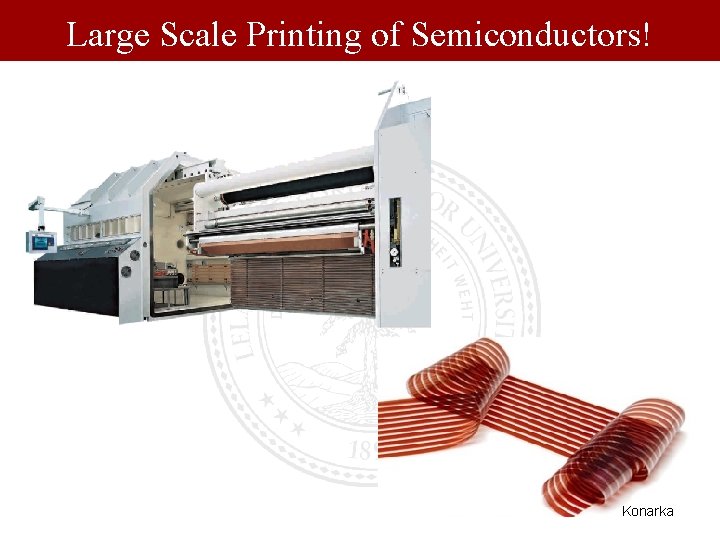
Large Scale Printing of Semiconductors! Konarka
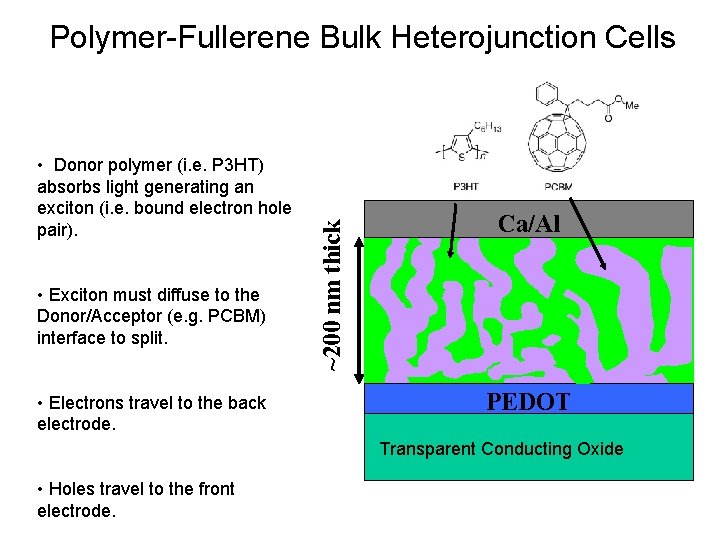
• Donor polymer (i. e. P 3 HT) absorbs light generating an exciton (i. e. bound electron hole pair). • Exciton must diffuse to the Donor/Acceptor (e. g. PCBM) interface to split. • Electrons travel to the back electrode. ~200 nm thick Polymer-Fullerene Bulk Heterojunction Cells Ca/Al PEDOT Transparent Conducting Oxide • Holes travel to the front electrode. 39
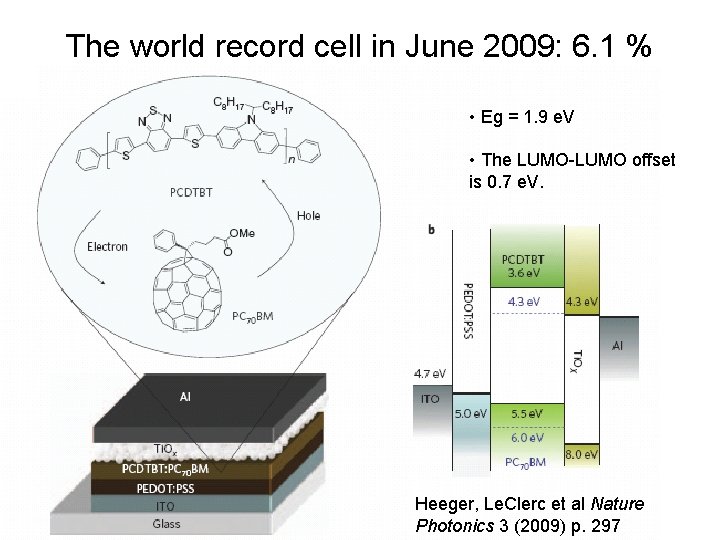
The world record cell in June 2009: 6. 1 % • Eg = 1. 9 e. V • The LUMO-LUMO offset is 0. 7 e. V. Heeger, Le. Clerc et al Nature Photonics 3 (2009) p. 297
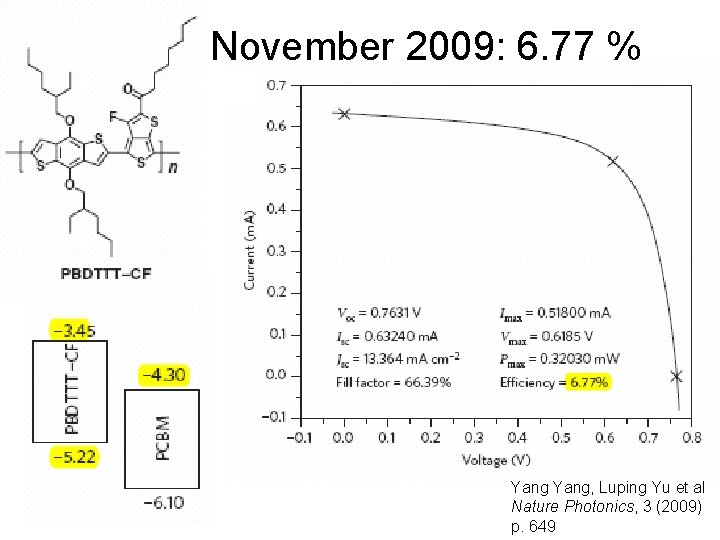
November 2009: 6. 77 % Yang, Luping Yu et al Nature Photonics, 3 (2009) p. 649
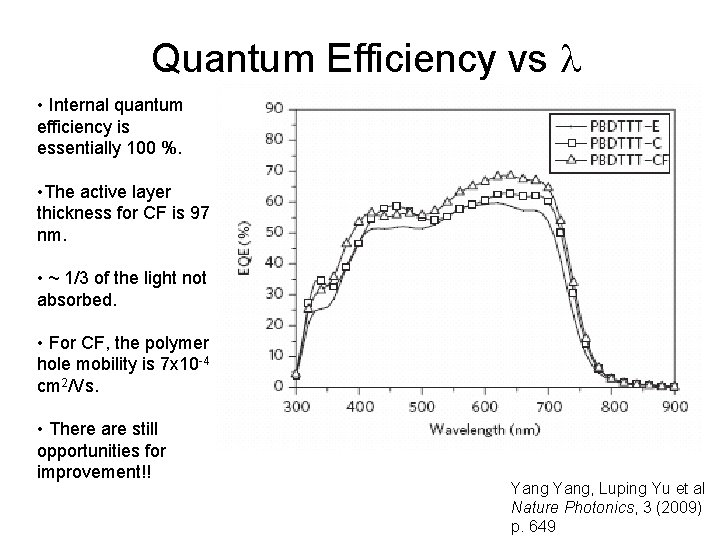
Quantum Efficiency vs l • Internal quantum efficiency is essentially 100 %. • The active layer thickness for CF is 97 nm. • ~ 1/3 of the light not absorbed. • For CF, the polymer hole mobility is 7 x 10 -4 cm 2/Vs. • There are still opportunities for improvement!! Yang, Luping Yu et al Nature Photonics, 3 (2009) p. 649
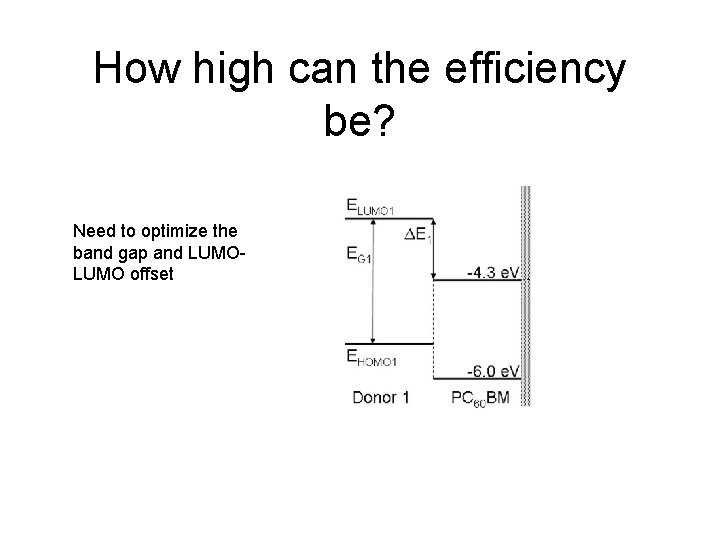
How high can the efficiency be? Need to optimize the band gap and LUMO offset
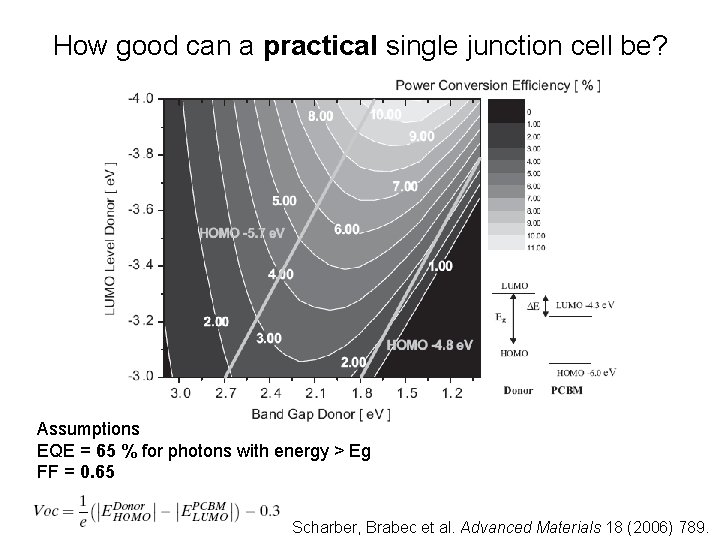
How good can a practical single junction cell be? Assumptions EQE = 65 % for photons with energy > Eg FF = 0. 65 Scharber, Brabec et al. Advanced Materials 18 (2006) 789.
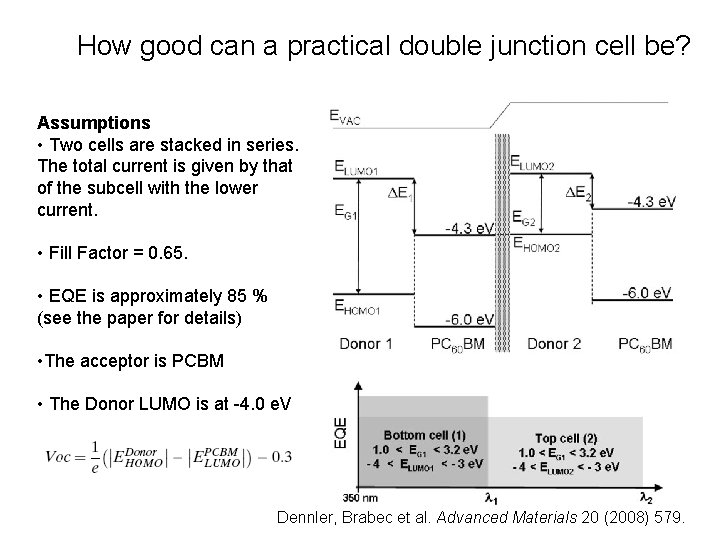
How good can a practical double junction cell be? Assumptions • Two cells are stacked in series. The total current is given by that of the subcell with the lower current. • Fill Factor = 0. 65. • EQE is approximately 85 % (see the paper for details) • The acceptor is PCBM • The Donor LUMO is at -4. 0 e. V Dennler, Brabec et al. Advanced Materials 20 (2008) 579.
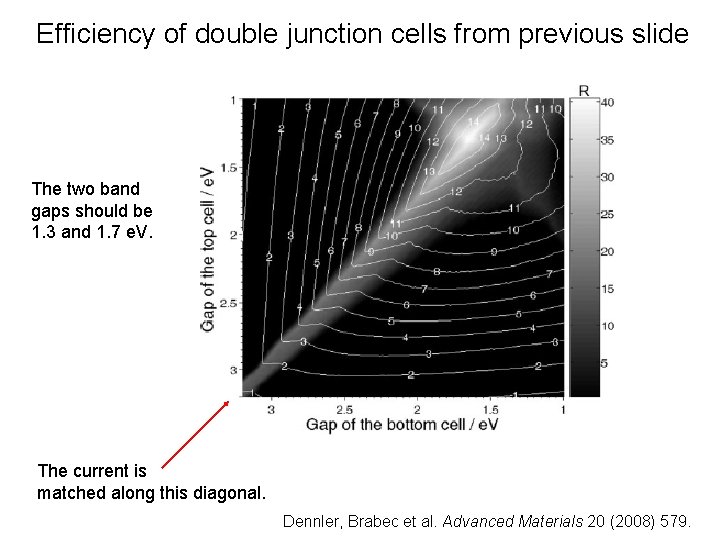
Efficiency of double junction cells from previous slide The two band gaps should be 1. 3 and 1. 7 e. V. The current is matched along this diagonal. Dennler, Brabec et al. Advanced Materials 20 (2008) 579.
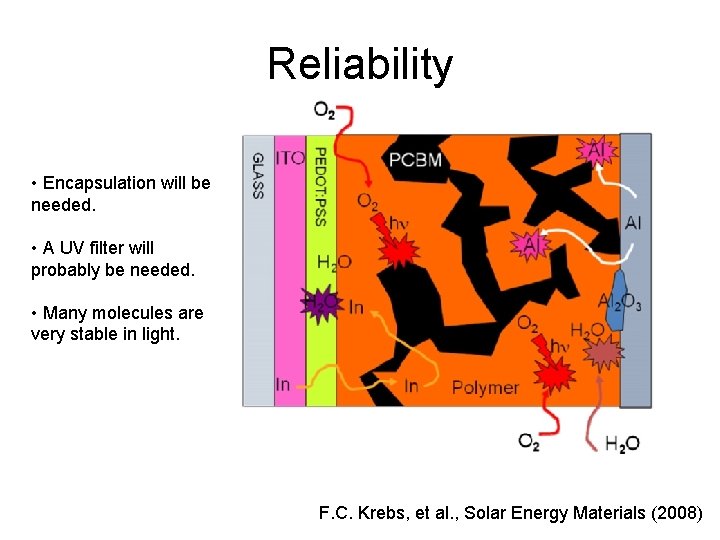
Reliability • Encapsulation will be needed. • A UV filter will probably be needed. • Many molecules are very stable in light. F. C. Krebs, et al. , Solar Energy Materials (2008)
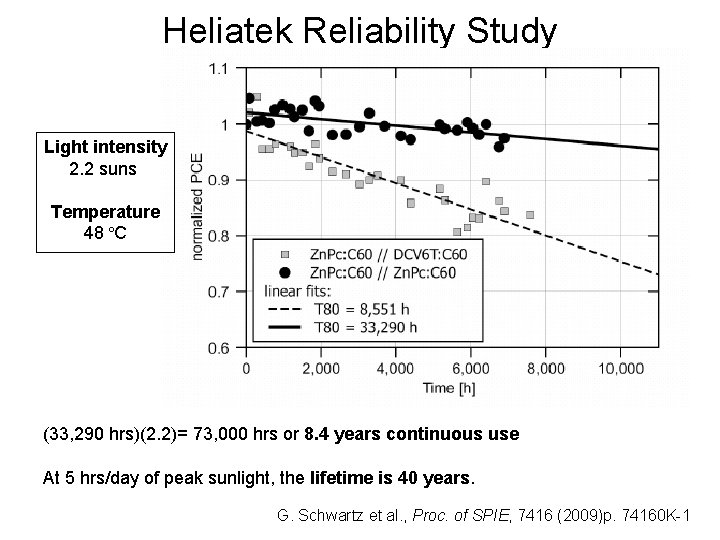
Heliatek Reliability Study Light intensity 2. 2 suns Temperature 48 ºC (33, 290 hrs)(2. 2)= 73, 000 hrs or 8. 4 years continuous use At 5 hrs/day of peak sunlight, the lifetime is 40 years. G. Schwartz et al. , Proc. of SPIE, 7416 (2009)p. 74160 K-1
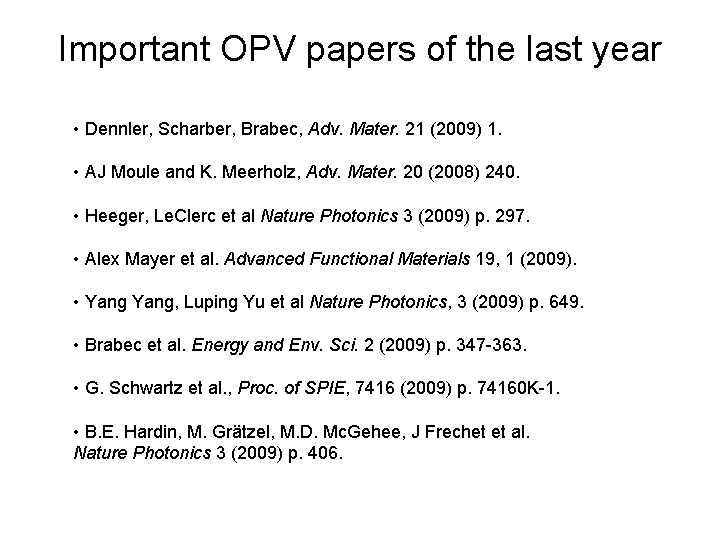
Important OPV papers of the last year • Dennler, Scharber, Brabec, Adv. Mater. 21 (2009) 1. • AJ Moule and K. Meerholz, Adv. Mater. 20 (2008) 240. • Heeger, Le. Clerc et al Nature Photonics 3 (2009) p. 297. • Alex Mayer et al. Advanced Functional Materials 19, 1 (2009). • Yang, Luping Yu et al Nature Photonics, 3 (2009) p. 649. • Brabec et al. Energy and Env. Sci. 2 (2009) p. 347 -363. • G. Schwartz et al. , Proc. of SPIE, 7416 (2009) p. 74160 K-1. • B. E. Hardin, M. Grätzel, M. D. Mc. Gehee, J Frechet et al. Nature Photonics 3 (2009) p. 406.
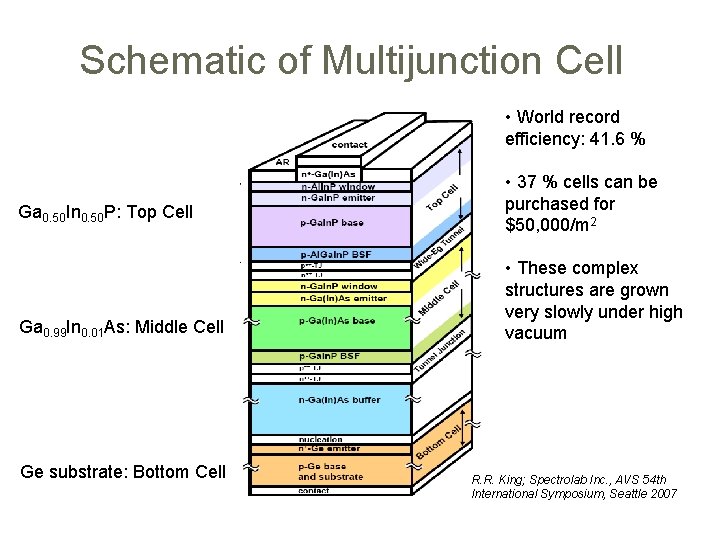
Schematic of Multijunction Cell • World record efficiency: 41. 6 % Ga 0. 50 In 0. 50 P: Top Cell Ga 0. 99 In 0. 01 As: Middle Cell Ge substrate: Bottom Cell • 37 % cells can be purchased for $50, 000/m 2 • These complex structures are grown very slowly under high vacuum R. R. King; Spectrolab Inc. , AVS 54 th International Symposium, Seattle 2007
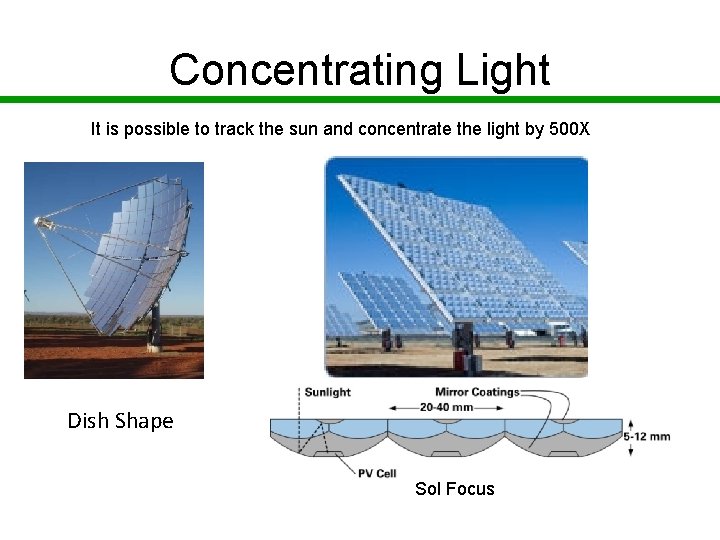
Concentrating Light It is possible to track the sun and concentrate the light by 500 X Dish Shape Sol Focus
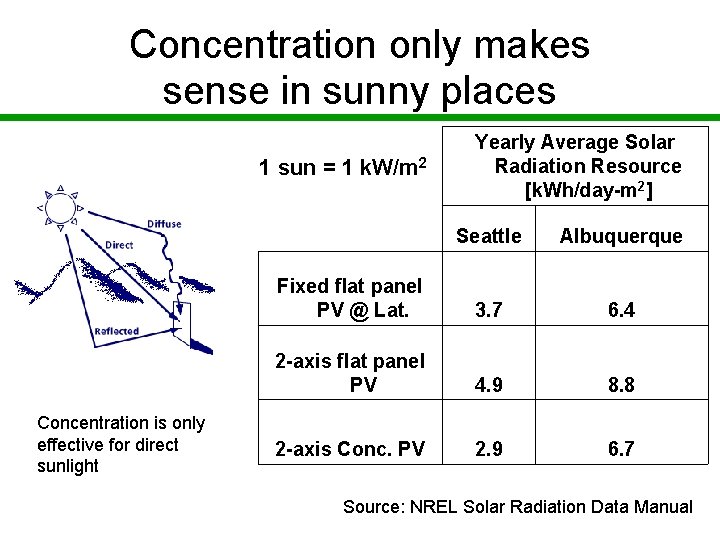
Concentration only makes sense in sunny places 1 sun = 1 k. W/m 2 Concentration is only effective for direct sunlight Yearly Average Solar Radiation Resource [k. Wh/day-m 2] Seattle Albuquerque Fixed flat panel PV @ Lat. 3. 7 6. 4 2 -axis flat panel PV 4. 9 8. 8 2 -axis Conc. PV 2. 9 6. 7 Source: NREL Solar Radiation Data Manual
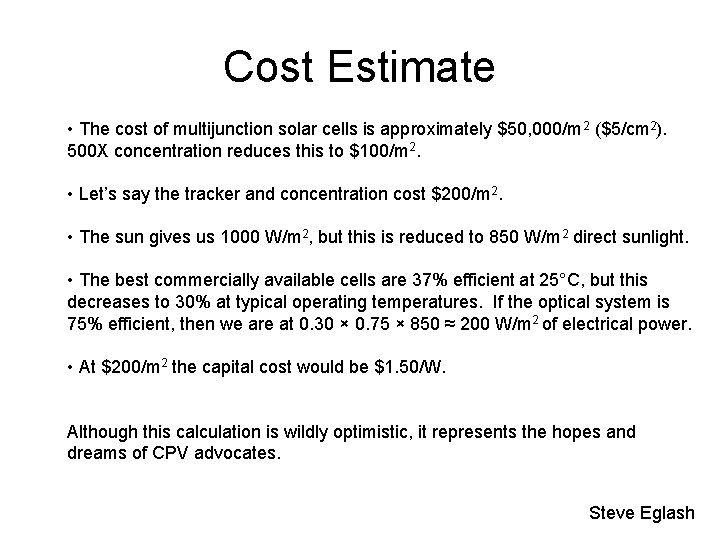
Cost Estimate • The cost of multijunction solar cells is approximately $50, 000/m 2 ($5/cm 2). 500 X concentration reduces this to $100/m 2. • Let’s say the tracker and concentration cost $200/m 2. • The sun gives us 1000 W/m 2, but this is reduced to 850 W/m 2 direct sunlight. • The best commercially available cells are 37% efficient at 25°C, but this decreases to 30% at typical operating temperatures. If the optical system is 75% efficient, then we are at 0. 30 × 0. 75 × 850 ≈ 200 W/m 2 of electrical power. • At $200/m 2 the capital cost would be $1. 50/W. Although this calculation is wildly optimistic, it represents the hopes and dreams of CPV advocates. Steve Eglash
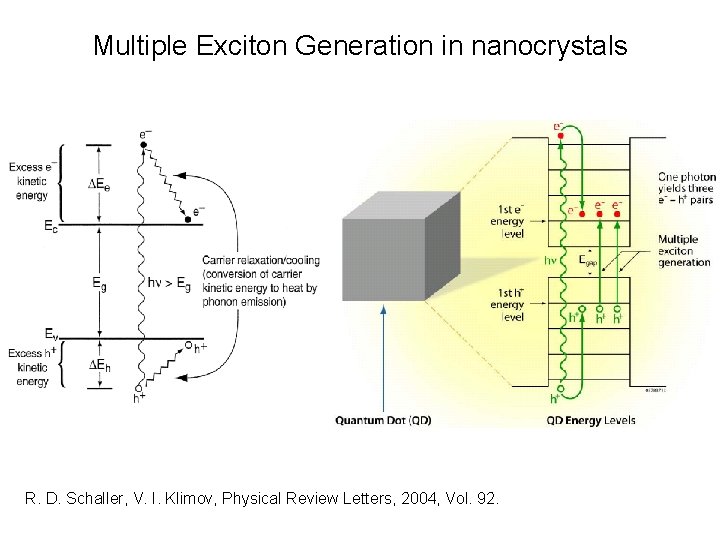
Multiple Exciton Generation in nanocrystals R. D. Schaller, V. I. Klimov, Physical Review Letters, 2004, Vol. 92.
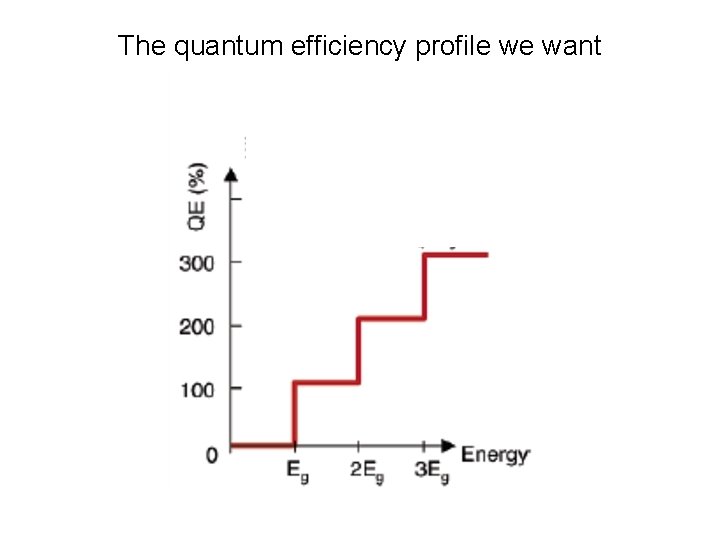
The quantum efficiency profile we want
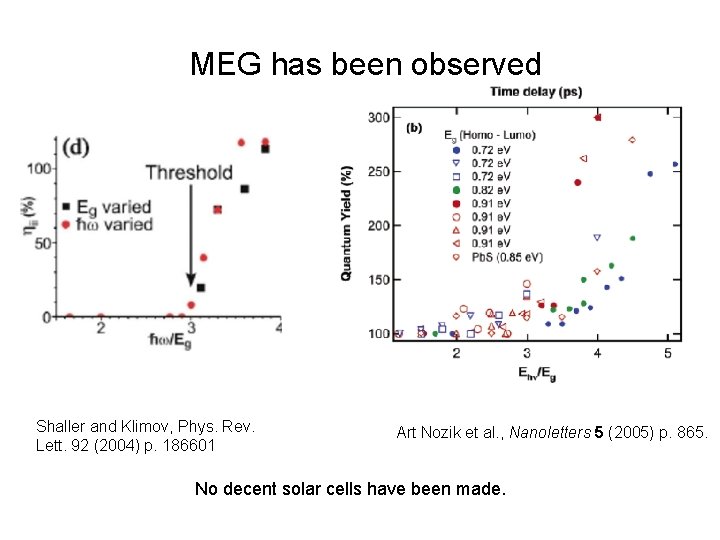
MEG has been observed Shaller and Klimov, Phys. Rev. Lett. 92 (2004) p. 186601 Art Nozik et al. , Nanoletters 5 (2005) p. 865. No decent solar cells have been made.
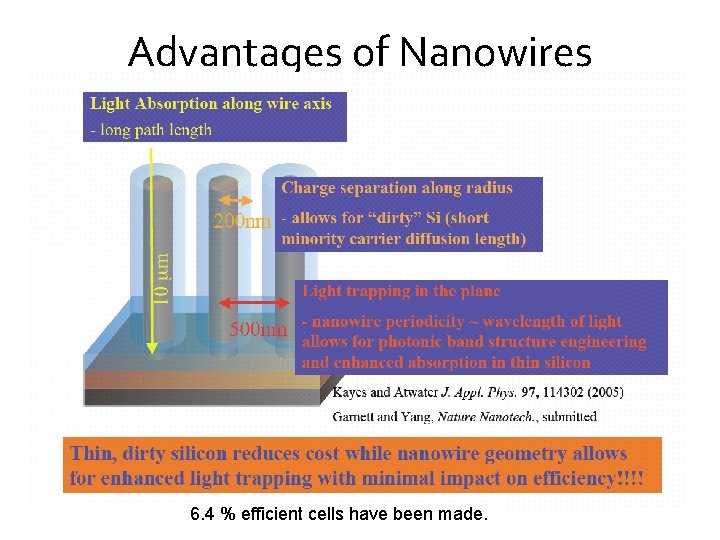
Advantages of Nanowires 6. 4 % efficient cells have been made.
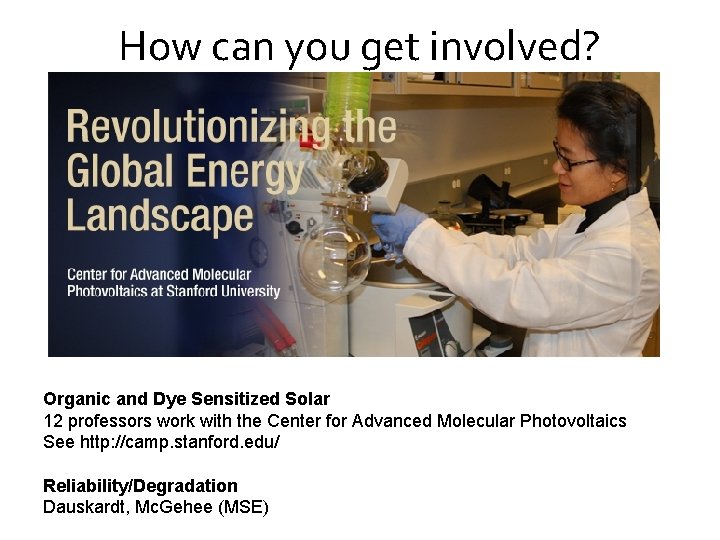
How can you get involved? Organic and Dye Sensitized Solar 12 professors work with the Center for Advanced Molecular Photovoltaics See http: //camp. stanford. edu/ Reliability/Degradation Dauskardt, Mc. Gehee (MSE)
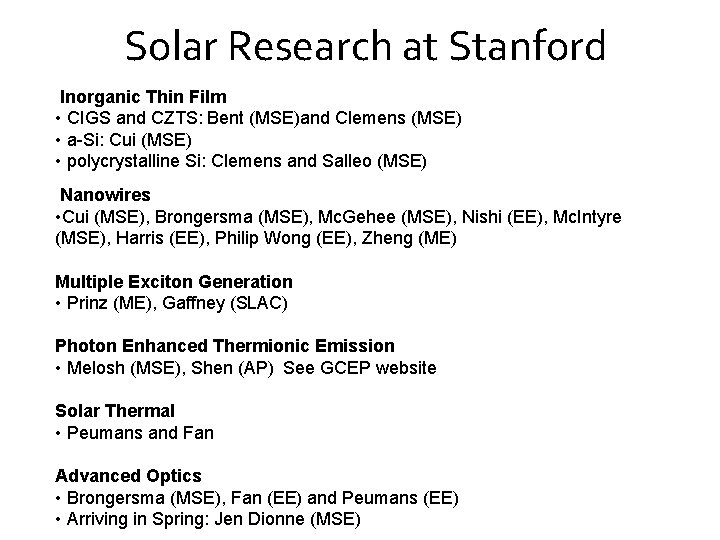
Solar Research at Stanford Inorganic Thin Film • CIGS and CZTS: Bent (MSE)and Clemens (MSE) • a-Si: Cui (MSE) • polycrystalline Si: Clemens and Salleo (MSE) Nanowires • Cui (MSE), Brongersma (MSE), Mc. Gehee (MSE), Nishi (EE), Mc. Intyre (MSE), Harris (EE), Philip Wong (EE), Zheng (ME) Multiple Exciton Generation • Prinz (ME), Gaffney (SLAC) Photon Enhanced Thermionic Emission • Melosh (MSE), Shen (AP) See GCEP website Solar Thermal • Peumans and Fan Advanced Optics • Brongersma (MSE), Fan (EE) and Peumans (EE) • Arriving in Spring: Jen Dionne (MSE)
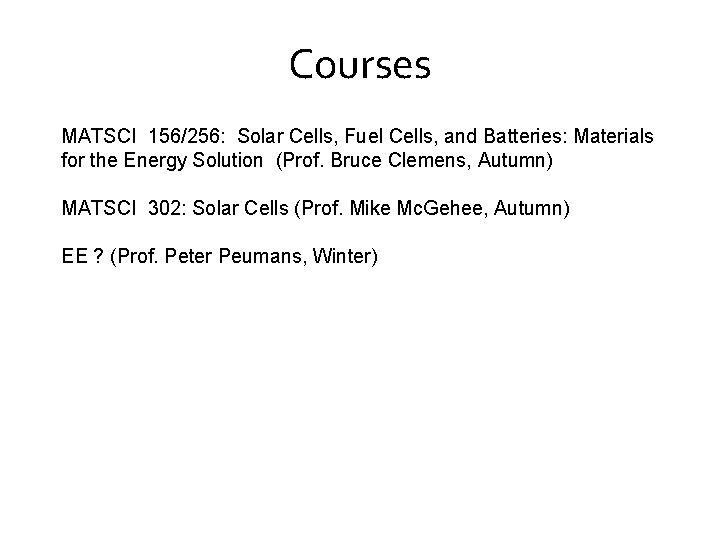
Courses MATSCI 156/256: Solar Cells, Fuel Cells, and Batteries: Materials for the Energy Solution (Prof. Bruce Clemens, Autumn) MATSCI 302: Solar Cells (Prof. Mike Mc. Gehee, Autumn) EE ? (Prof. Peter Peumans, Winter)
Acknowledgements Kevin Coakley (Thin Silicon) David Jackrel, Martin Roscheisen, Brian Sager (Nanosolar) Chris Eberspacher (Applied Materials) Dick Swanson (Sun. Power) Dave Eaglesham (First Solar) Richard King (Spectrolab) Alan Fahrenbruch (Stanford) David Ginley, Rommel Noufi, Howard Branz, Sean Shaheen, Garry Rumbles, Sarah Kurtz (NREL) Brian Hardin, Craig Peters, Eric Hoke, Mike Rowell and my other students Annie Hazlehurst (Stanford GSB) Steve Eglash
The Center for Advanced Molecular Photovoltaics (CAMP) Director: Mike Mc. Gehee Executive Director: Alan Sellinger Deputy Director: Peter Peumans
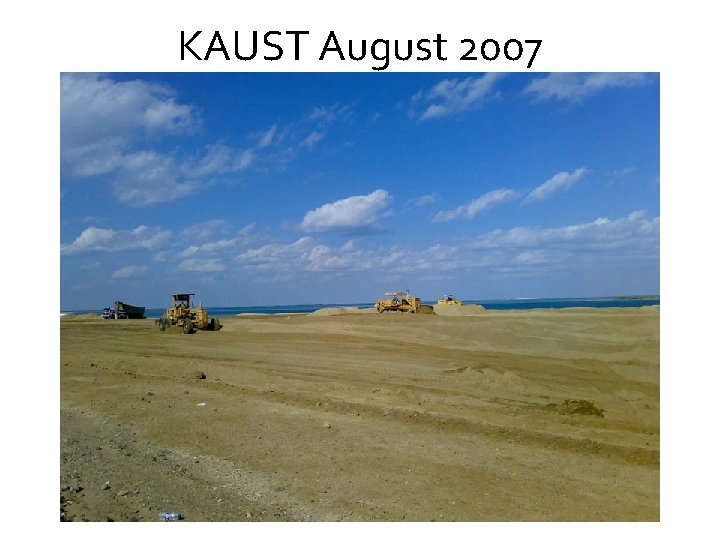
KAUST August 2007
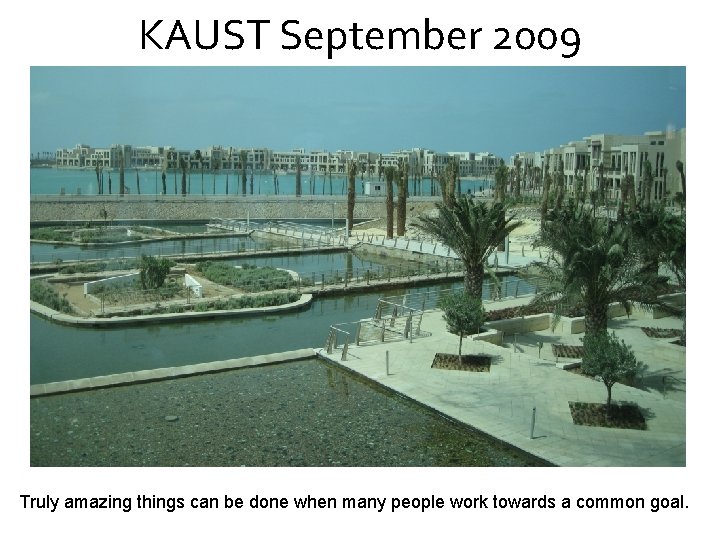
KAUST September 2009 Truly amazing things can be done when many people work towards a common goal.
- Slides: 64