
Solar and Space Physics and the Vision for
- Slides: 22
Solar and Space Physics and the Vision for Space Exploration Wintergreen Resort, VA 16 -20 October 2005 Ionospheric and Magnetospheric Plasma (and Neutral Density) Effects David Cooke Gregory Ginet Air Force Research Laboratory Space Vehicles Directorate Hanscom AFB, MA
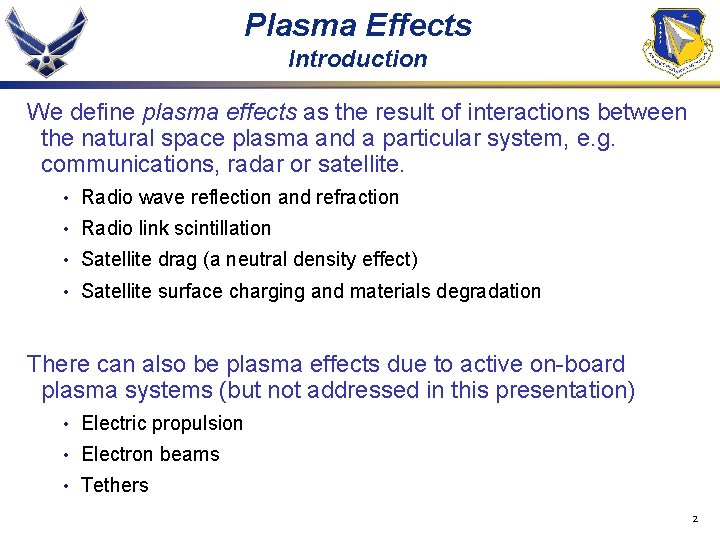
Plasma Effects Introduction We define plasma effects as the result of interactions between the natural space plasma and a particular system, e. g. communications, radar or satellite. • Radio wave reflection and refraction • Radio link scintillation • Satellite drag (a neutral density effect) • Satellite surface charging and materials degradation There can also be plasma effects due to active on-board plasma systems (but not addressed in this presentation) • Electric propulsion • Electron beams • Tethers 2
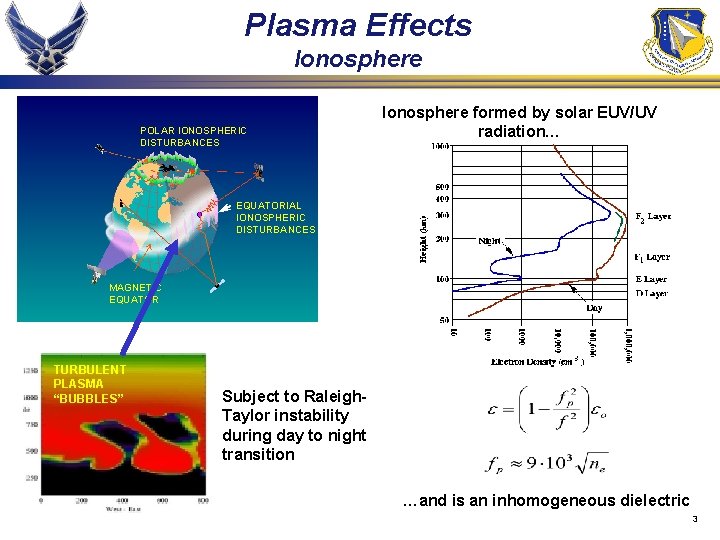
Plasma Effects Ionosphere POLAR IONOSPHERIC DISTURBANCES Ionosphere formed by solar EUV/UV radiation… EQUATORIAL IONOSPHERIC DISTURBANCES MAGNETIC EQUATOR TURBULENT PLASMA “BUBBLES” Subject to Raleigh. Taylor instability during day to night transition …and is an inhomogeneous dielectric 3
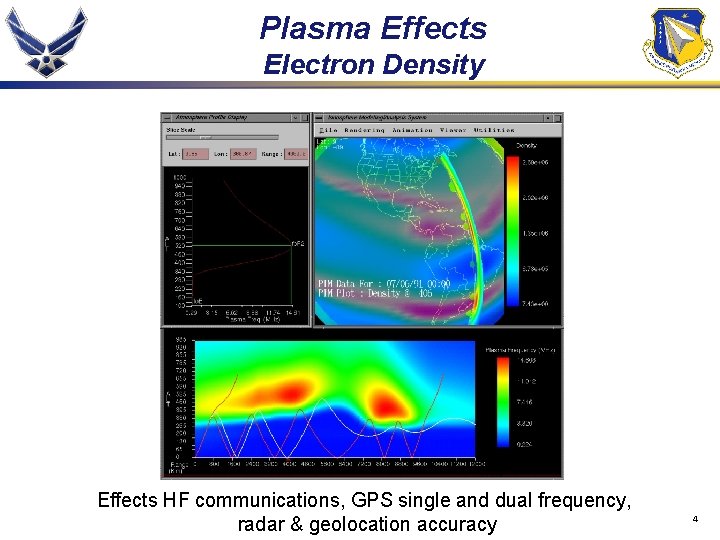
Plasma Effects Electron Density Effects HF communications, GPS single and dual frequency, radar & geolocation accuracy 4
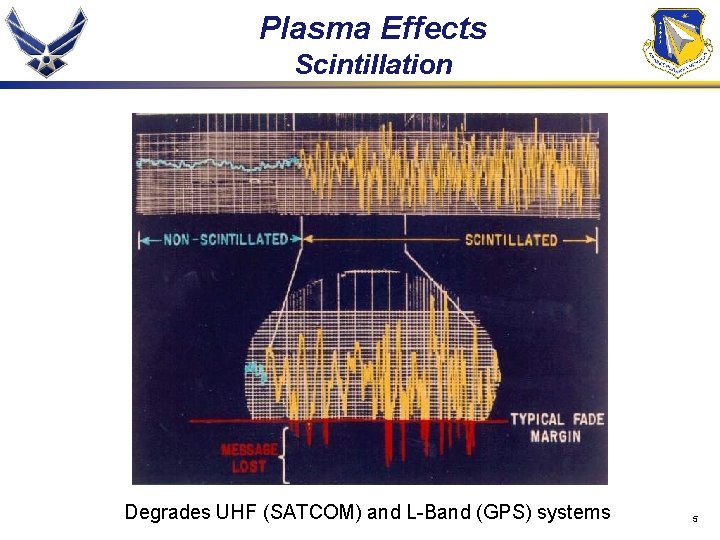
Plasma Effects Scintillation Degrades UHF (SATCOM) and L-Band (GPS) systems 5
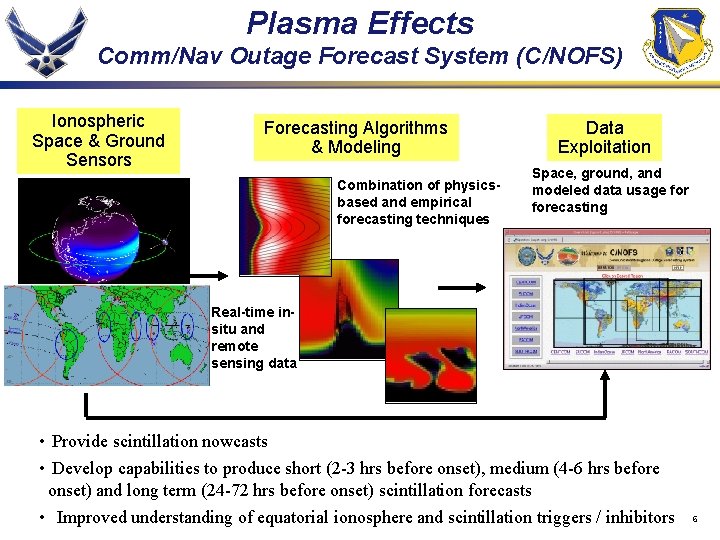
Plasma Effects Comm/Nav Outage Forecast System (C/NOFS) Ionospheric Space & Ground Sensors Forecasting Algorithms & Modeling Combination of physicsbased and empirical forecasting techniques Data Exploitation Space, ground, and modeled data usage forecasting Real-time insitu and remote sensing data • Provide scintillation nowcasts • Develop capabilities to produce short (2 -3 hrs before onset), medium (4 -6 hrs before onset) and long term (24 -72 hrs before onset) scintillation forecasts • Improved understanding of equatorial ionosphere and scintillation triggers / inhibitors 6
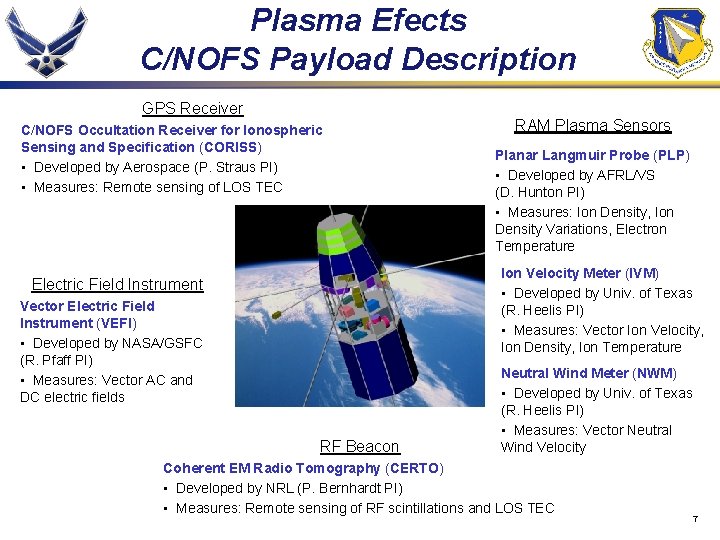
Plasma Efects C/NOFS Payload Description GPS Receiver C/NOFS Occultation Receiver for Ionospheric Sensing and Specification (CORISS) • Developed by Aerospace (P. Straus PI) • Measures: Remote sensing of LOS TEC RAM Plasma Sensors Planar Langmuir Probe (PLP) • Developed by AFRL/VS (D. Hunton PI) • Measures: Ion Density, Ion Density Variations, Electron Temperature Ion Velocity Meter (IVM) • Developed by Univ. of Texas (R. Heelis PI) • Measures: Vector Ion Velocity, Ion Density, Ion Temperature Electric Field Instrument Vector Electric Field Instrument (VEFI) • Developed by NASA/GSFC (R. Pfaff PI) • Measures: Vector AC and DC electric fields RF Beacon Neutral Wind Meter (NWM) • Developed by Univ. of Texas (R. Heelis PI) • Measures: Vector Neutral Wind Velocity Coherent EM Radio Tomography (CERTO) • Developed by NRL (P. Bernhardt PI) • Measures: Remote sensing of RF scintillations and LOS TEC 7
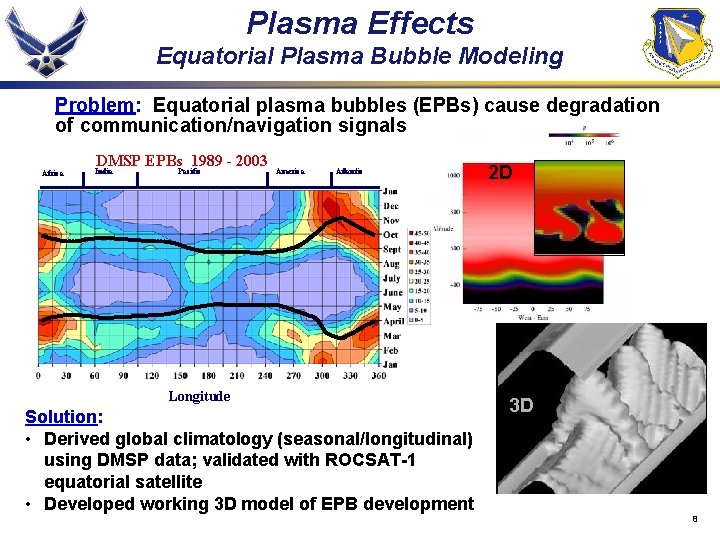
Plasma Effects Equatorial Plasma Bubble Modeling Problem: Equatorial plasma bubbles (EPBs) cause degradation of communication/navigation signals Africa DMSP EPBs 1989 - 2003 India Pacific America Atlantic Longitude Solution: • Derived global climatology (seasonal/longitudinal) using DMSP data; validated with ROCSAT-1 equatorial satellite • Developed working 3 D model of EPB development 2 D 3 D 8
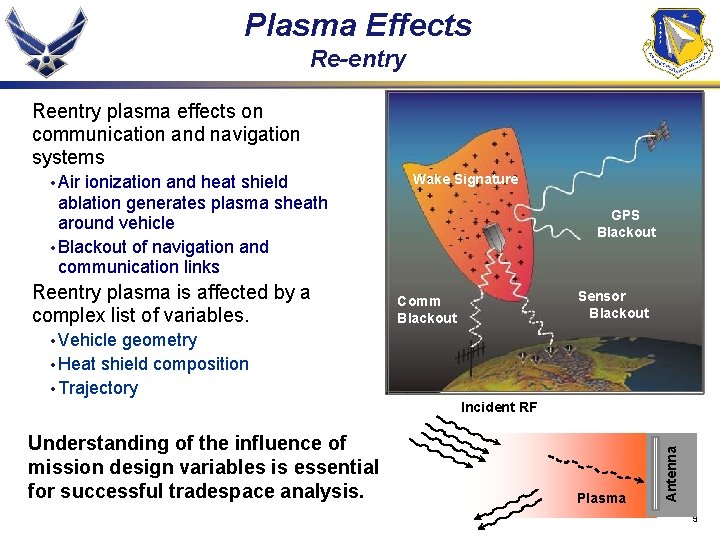
Plasma Effects Re-entry Reentry plasma effects on communication and navigation systems • Air ionization and heat shield ablation generates plasma sheath around vehicle • Blackout of navigation and communication links Reentry plasma is affected by a complex list of variables. Wake Signature GPS Blackout Sensor Blackout Comm Blackout • Vehicle geometry • Heat shield composition • Trajectory Understanding of the influence of mission design variables is essential for successful tradespace analysis. Plasma Antenna Incident RF 9
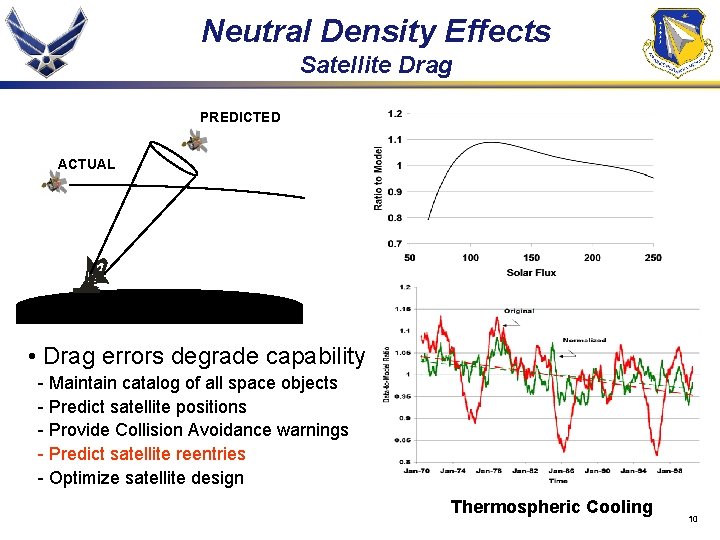
Neutral Density Effects Satellite Drag PREDICTED ACTUAL • Drag errors degrade capability - Maintain catalog of all space objects - Predict satellite positions - Provide Collision Avoidance warnings - Predict satellite reentries - Optimize satellite design Thermospheric Cooling 10
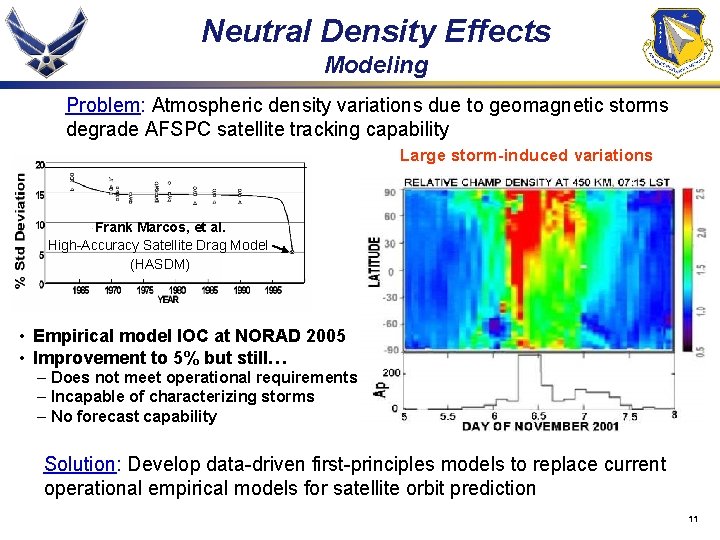
Neutral Density Effects Modeling Problem: Atmospheric density variations due to geomagnetic storms degrade AFSPC satellite tracking capability Large storm-induced variations Frank Marcos, et al. High-Accuracy Satellite Drag Model (HASDM) • Empirical model IOC at NORAD 2005 • Improvement to 5% but still… – Does not meet operational requirements – Incapable of characterizing storms – No forecast capability Solution: Develop data-driven first-principles models to replace current operational empirical models for satellite orbit prediction 11
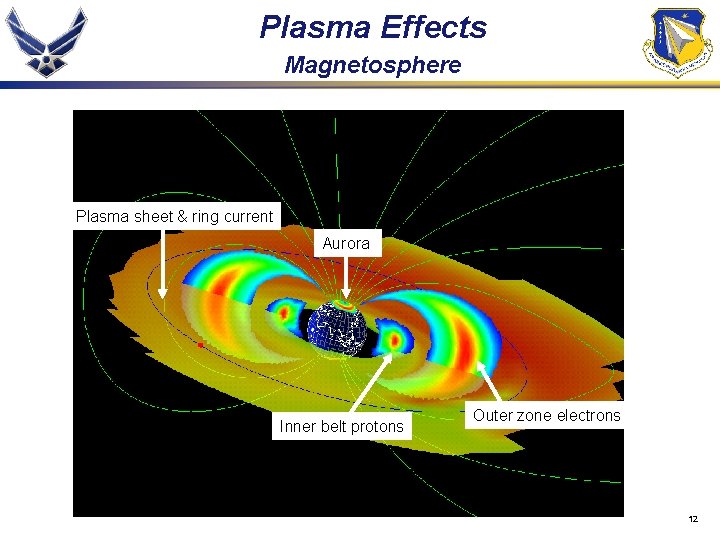
Plasma Effects Magnetosphere Plasma sheet & ring current Aurora Inner belt protons Outer zone electrons 12
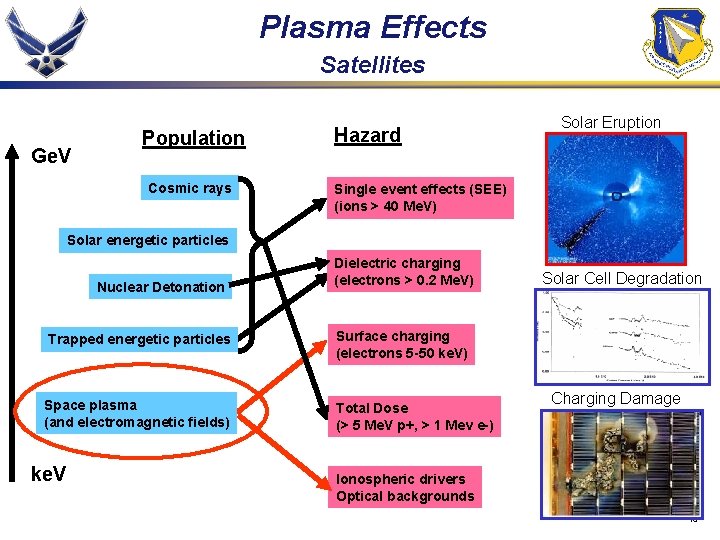
Plasma Effects Satellites Ge. V Population Cosmic rays Hazard Solar Eruption Single event effects (SEE) (ions > 40 Me. V) Solar energetic particles Nuclear Detonation Trapped energetic particles Space plasma (and electromagnetic fields) ke. V Dielectric charging (electrons > 0. 2 Me. V) Solar Cell Degradation Surface charging (electrons 5 -50 ke. V) Total Dose (> 5 Me. V p+, > 1 Mev e-) Charging Damage Ionospheric drivers Optical backgrounds 13
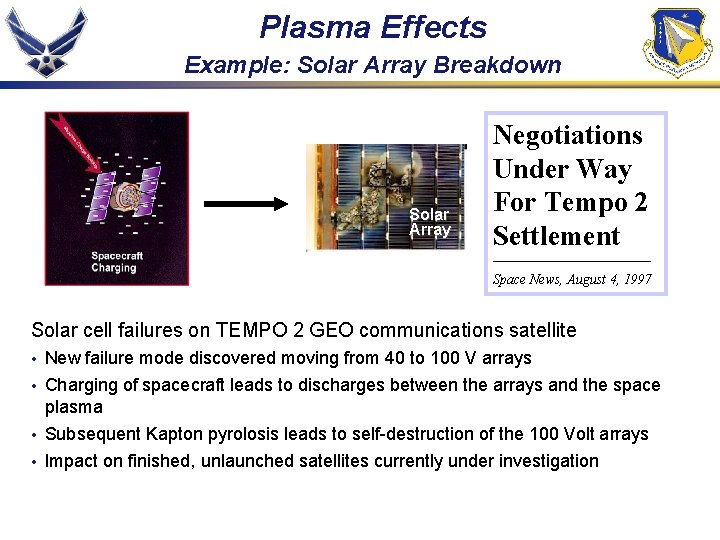
Plasma Effects Example: Solar Array Breakdown Solar Array Negotiations Under Way For Tempo 2 Settlement __________________ Space News, August 4, 1997 Solar cell failures on TEMPO 2 GEO communications satellite New failure mode discovered moving from 40 to 100 V arrays • Charging of spacecraft leads to discharges between the arrays and the space plasma • Subsequent Kapton pyrolosis leads to self-destruction of the 100 Volt arrays • Impact on finished, unlaunched satellites currently under investigation • 14
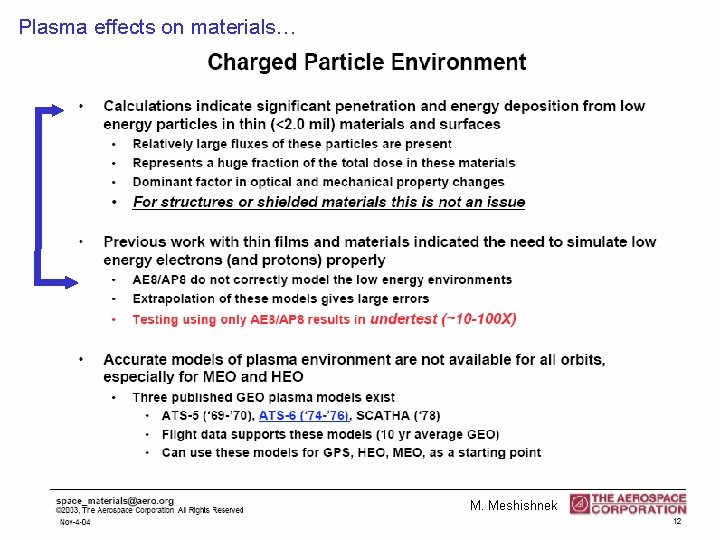
Plasma effects on materials… M. Meshishnek 15
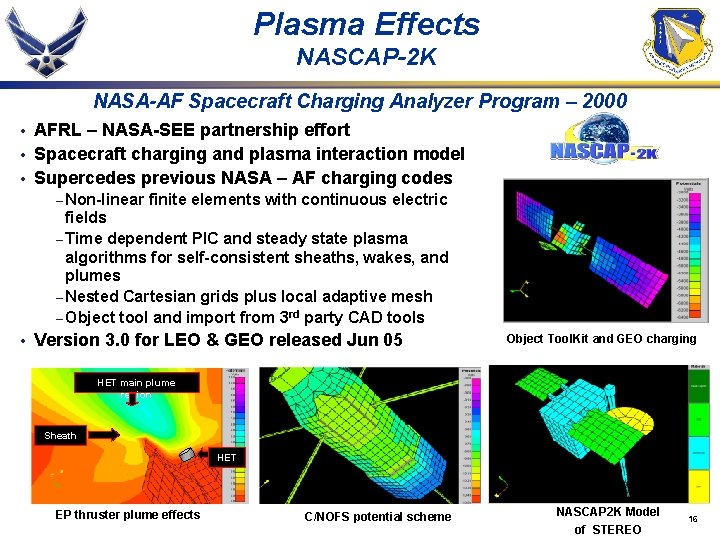
Plasma Effects NASCAP-2 K NASA-AF Spacecraft Charging Analyzer Program – 2000 AFRL – NASA-SEE partnership effort • Spacecraft charging and plasma interaction model • Supercedes previous NASA – AF charging codes • – Non-linear finite elements with continuous electric fields – Time dependent PIC and steady state plasma algorithms for self-consistent sheaths, wakes, and plumes – Nested Cartesian grids plus local adaptive mesh – Object tool and import from 3 rd party CAD tools • Version 3. 0 for LEO & GEO released Jun 05 Object Tool. Kit and GEO charging HET main plume region Sheath HET EP thruster plume effects C/NOFS potential scheme NASCAP 2 K Model of STEREO 16
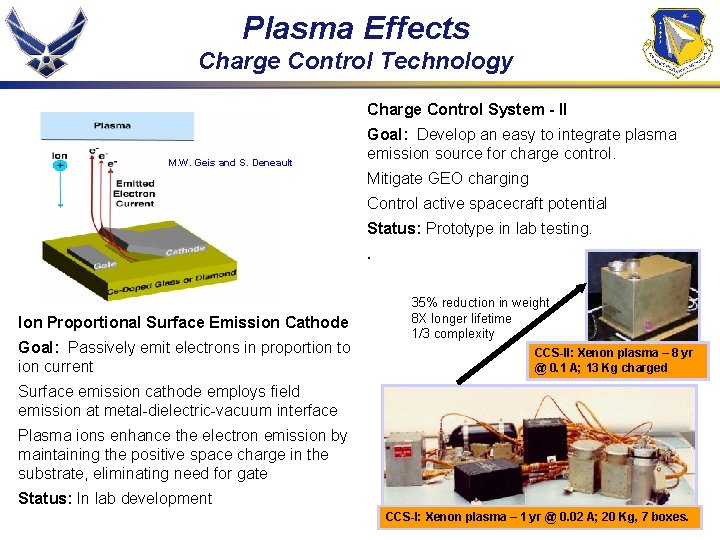
Plasma Effects Charge Control Technology Charge Control System - II M. W. Geis and S. Deneault Goal: Develop an easy to integrate plasma emission source for charge control. Mitigate GEO charging Control active spacecraft potential Status: Prototype in lab testing. . Ion Proportional Surface Emission Cathode Goal: Passively emit electrons in proportion to ion current 35% reduction in weight 8 X longer lifetime 1/3 complexity CCS-II: Xenon plasma – 8 yr @ 0. 1 A; 13 Kg charged Surface emission cathode employs field emission at metal-dielectric-vacuum interface Plasma ions enhance the electron emission by maintaining the positive space charge in the substrate, eliminating need for gate Status: In lab development CCS-I: Xenon plasma – 1 yr @ 0. 02 A; 20 Kg, 7 boxes. 17
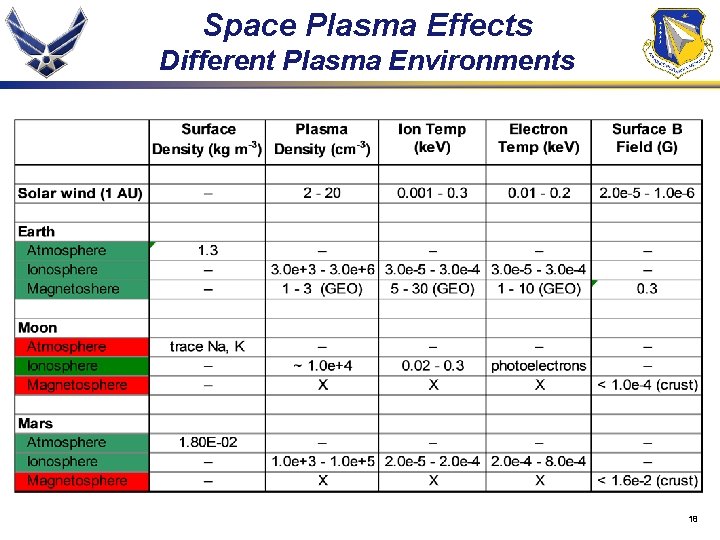
Space Plasma Effects Different Plasma Environments 18
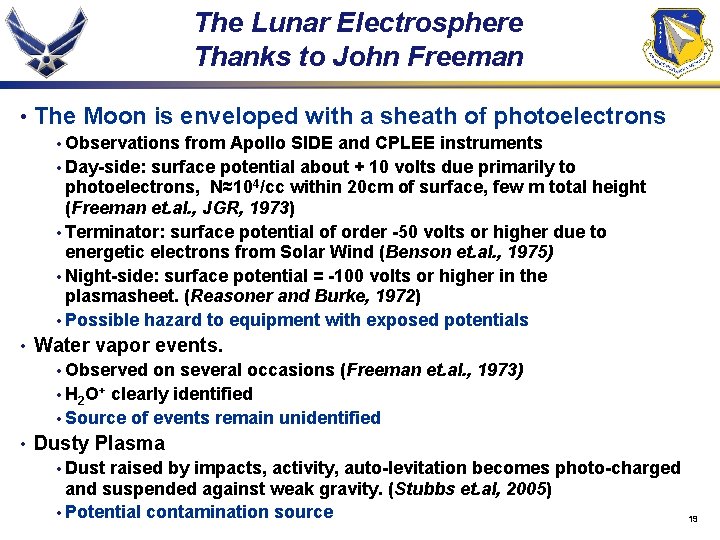
The Lunar Electrosphere Thanks to John Freeman • The Moon is enveloped with a sheath of photoelectrons • Observations from Apollo SIDE and CPLEE instruments • Day-side: surface potential about + 10 volts due primarily to photoelectrons, N≈104/cc within 20 cm of surface, few m total height (Freeman et. al. , JGR, 1973) • Terminator: surface potential of order -50 volts or higher due to energetic electrons from Solar Wind (Benson et. al. , 1975) • Night-side: surface potential = -100 volts or higher in the plasmasheet. (Reasoner and Burke, 1972) • Possible hazard to equipment with exposed potentials • Water vapor events. • Observed on several occasions (Freeman et. al. , 1973) • H 2 O+ clearly identified • Source of events remain unidentified • Dusty Plasma • Dust raised by impacts, activity, auto-levitation becomes photo-charged and suspended against weak gravity. (Stubbs et. al, 2005) • Potential contamination source 19
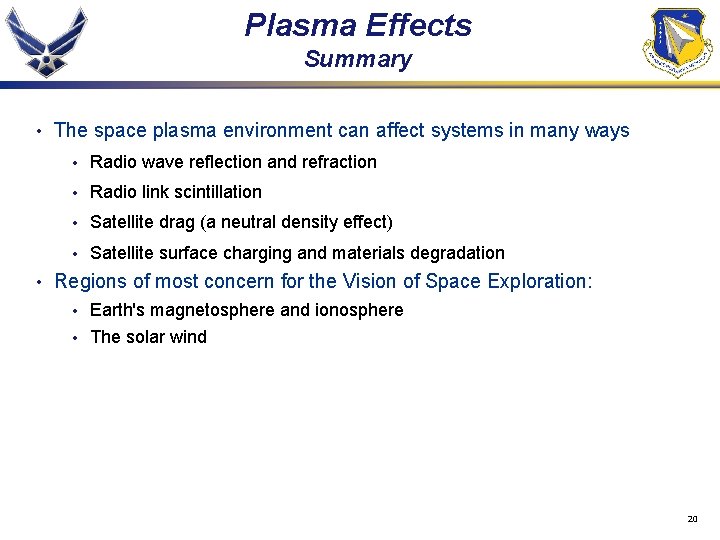
Plasma Effects Summary • • The space plasma environment can affect systems in many ways • Radio wave reflection and refraction • Radio link scintillation • Satellite drag (a neutral density effect) • Satellite surface charging and materials degradation Regions of most concern for the Vision of Space Exploration: Earth's magnetosphere and ionosphere • The solar wind • 20
Backups 21
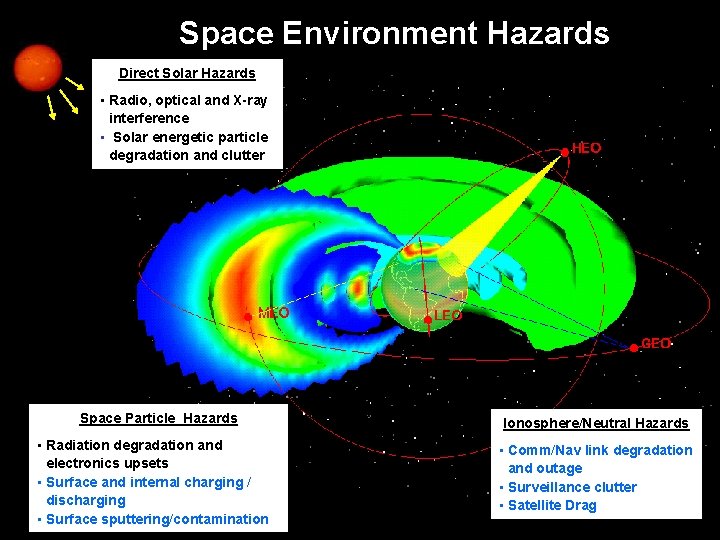
Space Environment Hazards Direct Solar Hazards • Radio, optical and X-ray interference • Solar energetic particle degradation and clutter Space Particle Hazards • Radiation degradation and electronics upsets • Surface and internal charging / discharging • Surface sputtering/contamination Ionosphere/Neutral Hazards • Comm/Nav link degradation and outage • Surveillance clutter • Satellite Drag 22