
Solano EMS Cooperative 2020 2030 EMS RFP Process




- Slides: 41
Solano EMS Cooperative 2020 -2030 EMS RFP Process EMS SYSTEM REVIEW AND BLUEPRINT REPORT Presented by Doug Wolfberg Page, Wolfberg & Wirth, LLC
Overview n Project Summary and Timeline n EMS System Review n Revenues, Costs and Oversight n EMS System Blueprint • Our recommendations for 2020 -2030
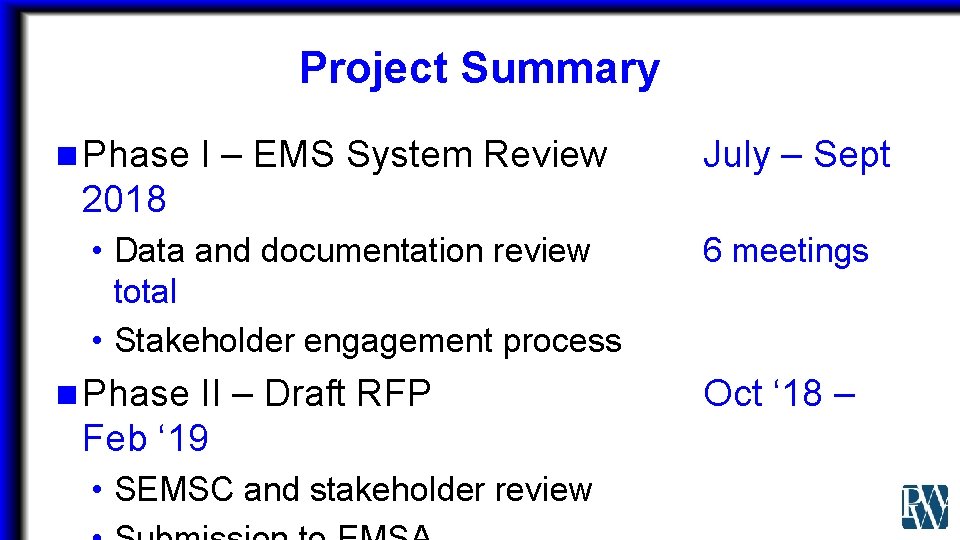
Project Summary n Phase I – EMS System Review July – Sept 2018 • Data and documentation review total • Stakeholder engagement process n Phase II – Draft RFP Feb ‘ 19 • SEMSC and stakeholder review 6 meetings Oct ‘ 18 –
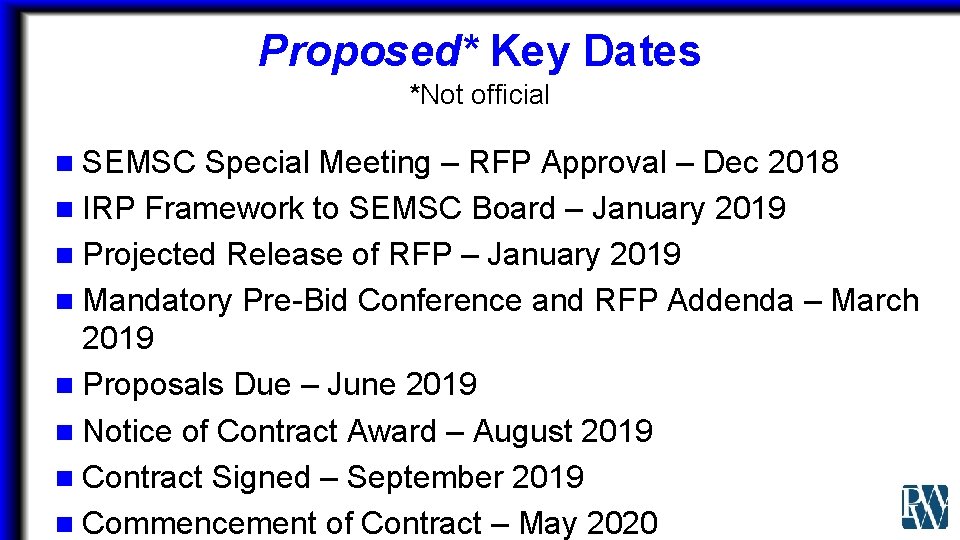
Proposed* Key Dates *Not official n SEMSC Special Meeting – RFP Approval – Dec 2018 n IRP Framework to SEMSC Board – January 2019 n Projected Release of RFP – January 2019 n Mandatory Pre-Bid Conference and RFP Addenda – March 2019 n Proposals Due – June 2019 n Notice of Contract Award – August 2019 n Contract Signed – September 2019 n Commencement of Contract – May 2020
Project Methodology n Document and Data Review • PWW made extensive requests for information from SEMSC and Contractor staff n Stakeholder Listening Sessions • 6 sessions held between July – September • Two open forums and four focus groups n Literature Search and Review • To allow EMS system design to reflect evidence-based and national consensus-based best practices
EMS System Review n High-functioning system n Exceptional compliance with performance standards n Effective public-private collaboration n Quality and innovation in clinical care n Robust and facilitative EMS Agency oversight n History of financial sustainability
EMS System Review n The fact that the Solano County EMS System is high-functioning is what allows us to make “next level” recommendations n Do not construe the presence of recommendations as a rejection of all the things that are good in Solano County
To put it another way: We can’t plan for excellence in 2020 -2030 if all we do is talk about how excellent we all were from 2010 - 2018
Why Change is Vital n The 2020 -30 landscape is markedly different than the last procurement cycle • ACA and instability in insurance markets • Increase in self-pay through high-deductible plans • Shifts from FFS to pay-for-performance and valuebased reimbursement • Evidence-based medicine – paying only for what works
The Two Guiding Principles Incorporating evidence-based, clinical best practices to optimize outcomes 2) Maintaining and ensuring ongoing EMS system sustainability during the contract term 1)
Revenues, Costs and Oversight n An EMS System can only do what its revenues permit it to do n This is really a process of optimizing a system along a continuum
Example n. A system with a mobile intensive care unit with a physician, critical care nurse and paramedic for every square mile is desirable but unaffordable n A system with one BLS ambulance for every 100, 000 people is affordable but undesirable n The ideal system configuration is somewhere along this continuum
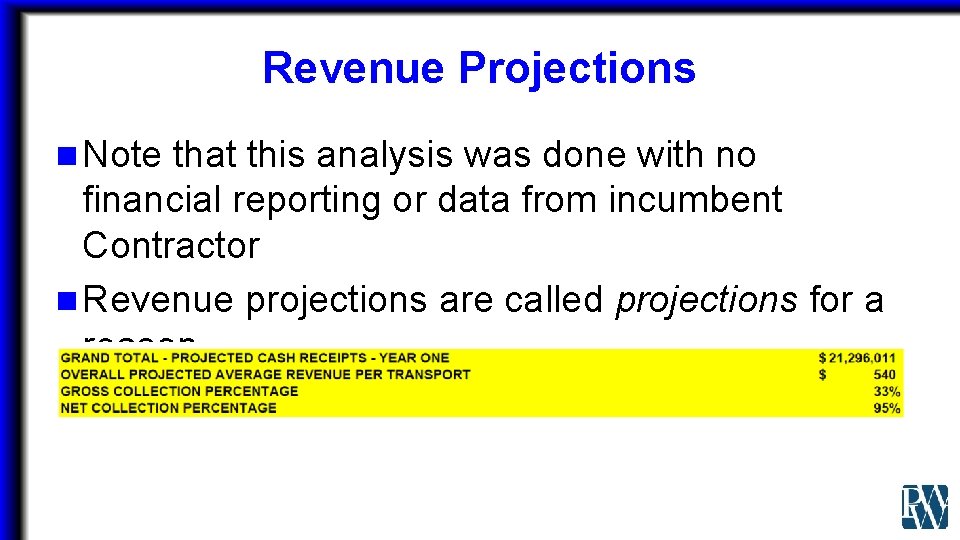
Revenue Projections n Note that this analysis was done with no financial reporting or data from incumbent Contractor n Revenue projections are called projections for a reason
Revenues, Costs and Oversight n Any Local EMS Agency preparing for a new procurement cycle must be mindful of the Alameda and Santa Clara case studies n To prevent EMS System collapse, both Counties were compelled to pay subsidies to their contractors during the contract term in what were supposed to be zero-subsidy systems
Revenues, Costs and Oversight n Alameda - $4 million subsidy in 2015 n Santa Clara - $7 million subsidy in 2016 n As your consultants, we believe it is our professional obligation to present to you a sustainable EMS System configuration
Revenues, Costs and Oversight n What does sustainable mean? • Eliminating costly practices with no patient benefit • Ensuring that penalties are not incentivized into the system by the LEMSA coming to depend on them for its operating budget • Utilizing penalties only to reinforce and incentivize the avoidance of patient-critical “never events”
Revenues, Costs and Oversight n What does sustainable mean? • Minimizing the stakeholder “wish lists” of costly contractor obligations • Ensuring that LEMSA-imposed fees are reasonable and limited to its documented costs of oversight • Incorporating flexibility in light of changed circumstances that may affect both sides of the ledger – ten years is a long time in health care
Key Recommendations Note: many additional issues will be proposed for inclusion in the RFP, but in the Blueprint report we are highlighting the major EMS system structural issues
Visual Diagrams of Current and Proposed System Configurations
1. Implement Centralized EMD n Require Contractor to implement a secondary PSAP for transfer of all incoming 911 calls requiring EMS n Utilize NAED-compliant EMD protocols n Implement pre-arrival instructions n Use call processing time standards n Utilize EMD response determinants n Optional Emergency Communication Nurse
Note: many of the major recommendations for EMS system configuration in the 2020 -2030 procurement cycle are dependent upon EMD implementation.
2. Implement Tiered EMS Response n With EMD implementation, differential response can be achieved • Charlie/Delta/Echo-level calls n ALS Amb + ALS FR • Alpha/Bravo-level calls n BLS or ALS Amb + ALS FR “Response Optional” • “Omega Protocol” option n For low-acuity or non-medical calls
3. Reduce Red Lights and Siren Use n Substantial data make it clear that RLS use is a hazard to crew, patients and the public n National benhmarks • <50% RLS for response • <5% RLS for transport n Limit calls Code 3 responses to Delta and Echo-level
4. Reconfigure Response Times n Data clearly show that response times do not affect positive outcomes for the overwhelming majority of EMS calls • Yet, response times are the single most expensive component of an EMS system n With EMD implementation, there is little reason to run Code 3 “as fast as possible” on a large subset of calls
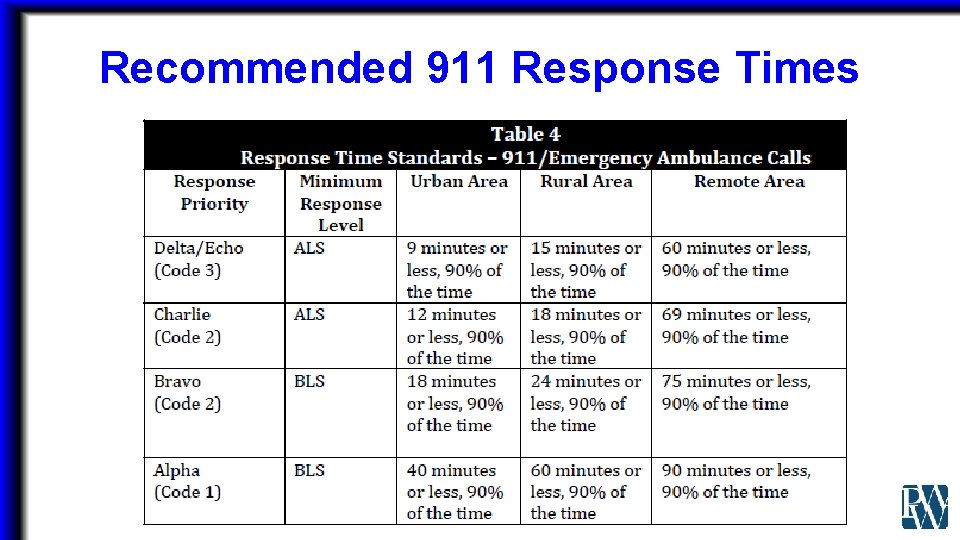
Recommended 911 Response Times
5. Maintain, Modify and Expand PPP n Maintain the unit-hour savings formula for ALS-level calls (Charlie, Delta, Echo) n Modify Alpha-Bravo level calls to “ALS FR optional” n Expand the PPP agreement to include per-call compensation for use of PPP medics during transport and for certain on-scene services n Implement automatic increase = to Contractor CPI
6. Interfacility Transports n Incorporate CCTs into the EOA • Permit Contractor to subcontract if desired • Maintain options and standards from Resolution 12001 n We believe that including CCT in the EOA is critical • The implementation of ALS+RN led to the (proper) reclassification of calls as ALS vs. CCT
6. Interfacility Transports n As a result, some permitted CCT providers have stopped providing these services altogether in Solano County n Including CCTs in the EOA is the only reliable way to ensure that these critical services will be available, accountable and responsive
6. Interfacility Transports n Implement a retriage transport (RTT) program • This would allow for rapid interfacility transport of patients brought into an ED who are identified as requiring rapid transfer to another facility • We recommend that Contractor (or a subcontractor) be given a 15 -minute right of first refusal • If Contractor/subcontractor not available within 15 minutes, ED can utilize the incoming ambulance for the RTT
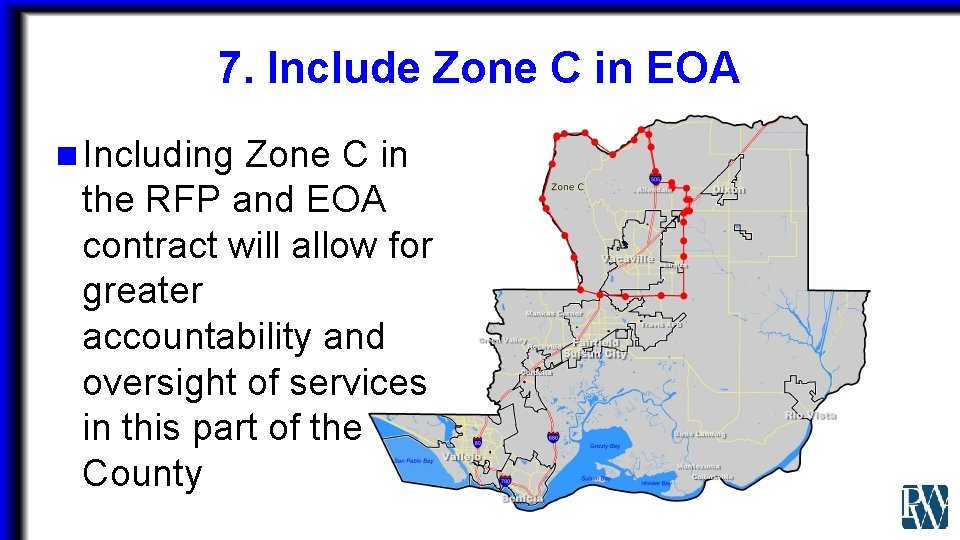
7. Include Zone C in EOA n Including Zone C in the RFP and EOA contract will allow for greater accountability and oversight of services in this part of the County
8. Restructure Fees & Liquidated Damages n Increase annual franchise fee to $600, 000 n Ensure that the system design incentivizes the right things • Clinical quality and outcomes vs. speed • De-emphasize response time penalties and focus on aligning incentives with quality care • Do not permit penalties to become a necessary revenue stream to fund LEMSA activities
Examples n STEMI Patients • Time to 12 -lead for CP patients • Recognition of ST elevation • Time to STEMI alert • Transport to STEMI center n Stroke Patients • Documentation of prehospital stroke score • Time to stroke alert • Transport to stroke center
9. Patient Charges n Implement a scored, relative weighted formula in the RFP process for evaluating patient charges for service n Require the adoption of consumer protections such as hardship eligibility criteria and collections safeguards n Permit automatic annual increases up to Medical CPI
10. Workforce Provisions n Preferential hiring to incumbent EMTs/medics if change in Contractor n Implement turnover disincentives compared to national benchmarks n Require the promotion of diversity in the workforce n Assure training on infrequently-used skills (data driven)
11. Financial Reporting n Increase financial transparency with regular financial reporting of specified metrics n Require annual revenue cycle audits (billing, coding) n Require submission of annual financials
12. Contract Modification Option n Recommend including provisions expressly allowing for modifications for changed circumstances • Alameda, Santa Clara case studies
13. Experience Requirement n Require Contractor to possess current + 5 years’ experience serving an EOA population of at least 300, 000
Summary and Conclusion