
SOL Review 5 Imperialism Definition the domination by
SOL Review 5
Imperialism � Definition- the domination by one country of the political, cultural, or economic life of another country.
Imperialism Types � Colonies- most expensive + most control (ex. India was a colony of Great Britain> � Protectorates- leave local rulers in place but tell them what to do ( ex. Egypt was a protectorate of Great Britain) � Spheres of Influence- an area in which an outside power claimed exclusive investment or trading privileges + least restrictive (ex. China)
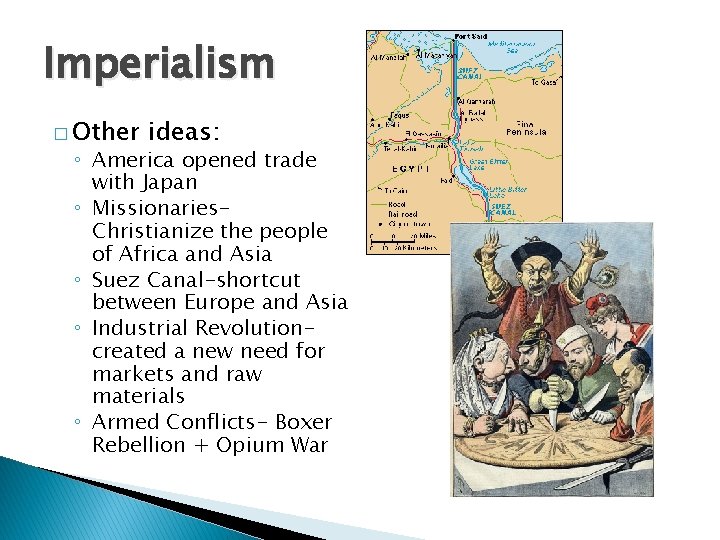
Imperialism � Other ideas: ◦ America opened trade with Japan ◦ Missionaries. Christianize the people of Africa and Asia ◦ Suez Canal-shortcut between Europe and Asia ◦ Industrial Revolutioncreated a new need for markets and raw materials ◦ Armed Conflicts- Boxer Rebellion + Opium War
World War 1 - Causes--IMANASS � Imperialism- competition for the colonies � Militarism-European countries competed with one another to see which one could have the best army and navy � Alliances- Central Powers (Austria-Hungary, Germany, Bulgaria, and Ottoman Empire) vs. Allies (France, Britain, and Russia) � Nationalism- people of the same ethnic background want a homeland � Assassination of Archduke Ferdinand-spark to start the war
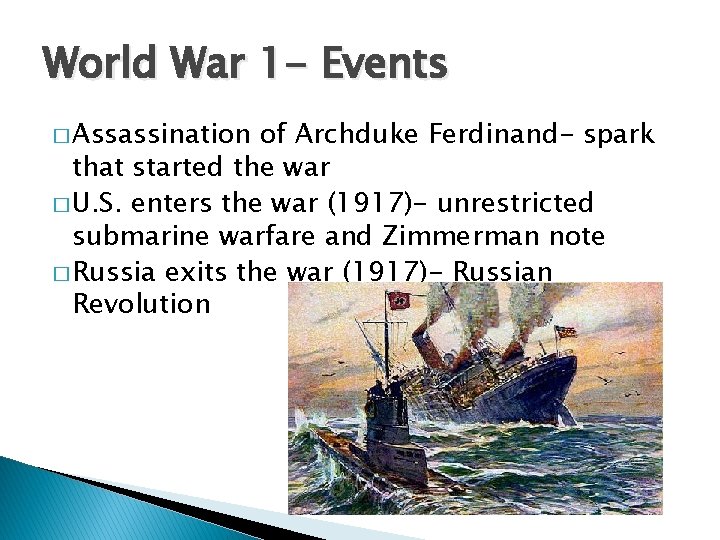
World War 1 - Events � Assassination of Archduke Ferdinand- spark that started the war � U. S. enters the war (1917)- unrestricted submarine warfare and Zimmerman note � Russia exits the war (1917)- Russian Revolution
World War 1 - Major Leaders � Woodrow Wilson- President of the U. S. (Fourteen Points/League of Nations) � Kaiser Wilhelm II- leader of Germany
World War 1 - Outcomes � Colonies participated in the war- Increased demands for independence (ex. India wanted independence from Great Britain) � End of Russian, Ottoman, German, and Austro -Hungarian Empires � Lots of destruction, lives lost, and social disruption � Treaty of Versailles- forced Germany to accept guilt for war and loss of territory+ pay reparations+ limited German military
World War 1 - League Of Nations � Peacekeeping organization established to prevent future wars � Failed organization- could not enforce its decisions � U. S. never joined League of Nations (isolated) - did not sign Treaty of Versailles
World War 1 - Mandate System � France and Great Britain became mandatory powers in the Middle East � Divided Ottoman Empire into new countries (Lebanon, Syria, Iraq, and Palestine) � British controlled Iraq, Palestine, and Transjordan and France controlled Syria and Lebanon
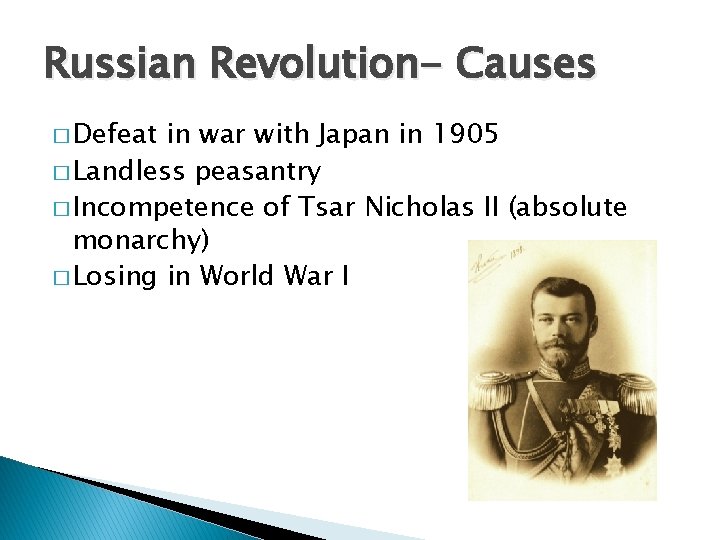
Russian Revolution- Causes � Defeat in war with Japan in 1905 � Landless peasantry � Incompetence of Tsar Nicholas II (absolute monarchy) � Losing in World War I
Russian Revolution- Lenin � Led Russian Revolution � New Economic Policy- goal (improve Russia’s economy) – socialism (meant to be temporary)
Russian Revolution- Stalin � Five Year Plan- make Soviet Union a modern industrial power- command economy, production improved while standard of living remained poor � Collectivization of Farms- no more private ownership-government farms or collectives (work as a group)- did not improve farm output (grain production grew slightly while meat, vegetables, and fruits remained in short supply) � Secret Police+ Great Purge ( destroy enemies)
- Slides: 13