
SOILS What is a Soil Can be defined
SOILS
What is a Soil? • Can be defined in many ways • Soil scientists: Solid earth material that has been altered by physical, chemical, and biologic processes such that it can support rooted plant life • Engineer: Solid earth material that can be removed without blasting • Both definitions important
Soil Issues • It appears soils are being eroded faster than they are being produced by soil forming processes
Environmental Issues with Soils • The suitability for a particular piece of land is often determined, in part, by the soil present • Soils are critical when considering waste disposal problems • Aids land use planners evaluate natural hazards, including floods, landslides, and earthquakes • Soils can carry a “climatic signal”; an indication into what past climate conditions were like

Soil Development • A complex process • Weathered rocks provide the raw materials for a soil • Mixing with air and water enhances the soil • Organic materials and processes further enriches the soil • A soil is a function of five core components − Parent material − Climate − Topography − Biologic materials − Time

Soil Profile • Vertical and horizontal movement of materials produces distinctive layering called the soil profile • The layers are referred to as horizons
Soil Horizons • O Horizon − Contains a high concentration of organic material (plant litter and other organic material) • A Horizon − Contains organic material and mineral matter • E Horizon − Zone of leaching − Usually light in color − Usually devoid of soil nutrients − Not always found in a profile
Soil Horizons • B Horizon − Zone of accumulation − Contains an abundance of mineral matter which has been transported from overlying horizons • C Horizon − Partially weathered parent material • There are many different types of soils • Some have each type of horizon, some have a few horizons • Thicknesses of the horizons can vary greatly
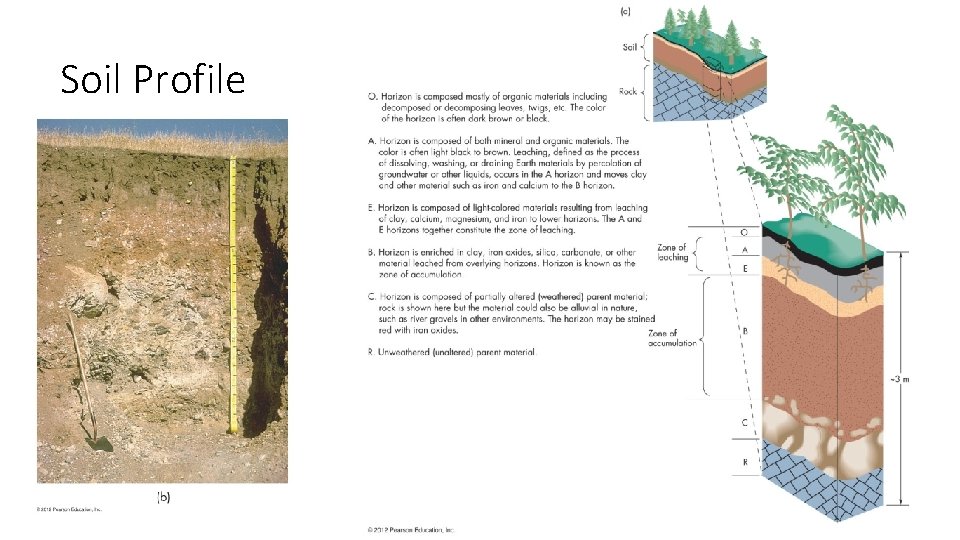
Soil Profile
Soil Properties • Color − O and A horizons tend to be dark in color − E horizons tend to be light in color − B horizons have a wide array of colors − Soil color can be an indicator for how well a soil drains − Well-drained soils are aerated and prone to oxidation − Poorly drained soils are wet and typically have a yellowish color − Poorly drained soils can also be an indicator for some environmental problems
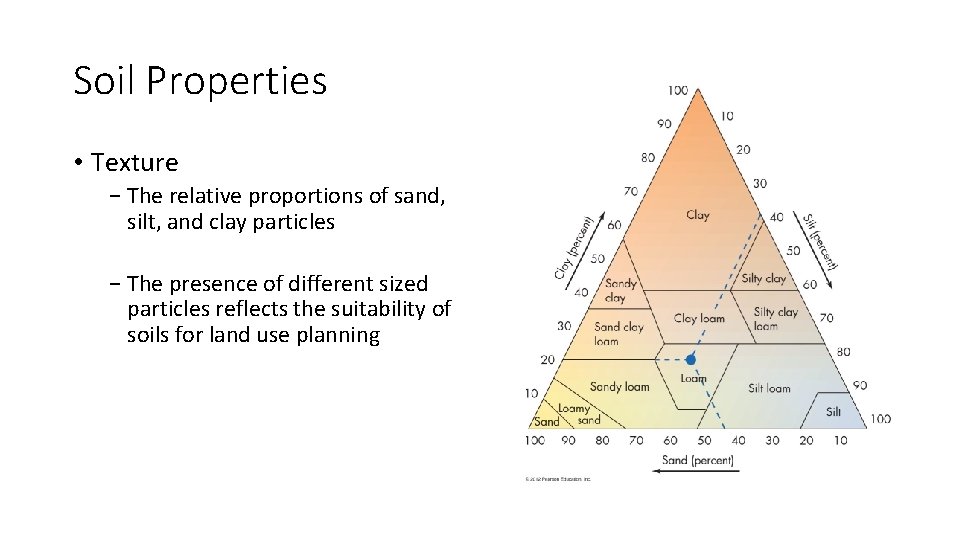
Soil Properties • Texture − The relative proportions of sand, silt, and clay particles − The presence of different sized particles reflects the suitability of soils for land use planning

Soil Properties • Structure − Soil particles often cling together in aggregates called peds − The type of structure present reflects on the soil forming process − The structure also is useful in evaluating the development and approximate age of the soil
Soil Fertility • A complex ecosystem • Within a single cubic meter, there are millions of living things − Rodents − Insects − Worms − Algae − Fungi − Bacteria • These things are essential for mixing and aerating the soil. They also release or convert nutrients in the soil that are useful for plants
Soil Fertility • Soils developed on floodplains or on glacial deposits tend to have good fertility • Soils developed on highly leached bedrock or with low organic material have low fertility • Soil fertility increase with the addition of nutrients or stabilizing the texture for moisture retention • Soil fertility decreases with soil erosion and leaching

Engineering Properties • Soil Strength − The ability of a soil to resist deformation − A function of cohesion and friction • Soil Sensitivity − Measures the change in soil strength resulting from disturbances such as vibrations or excavations − Sand gravel with no clay are least sensitivity − An increase in fine material leads to an increase in sensitivity
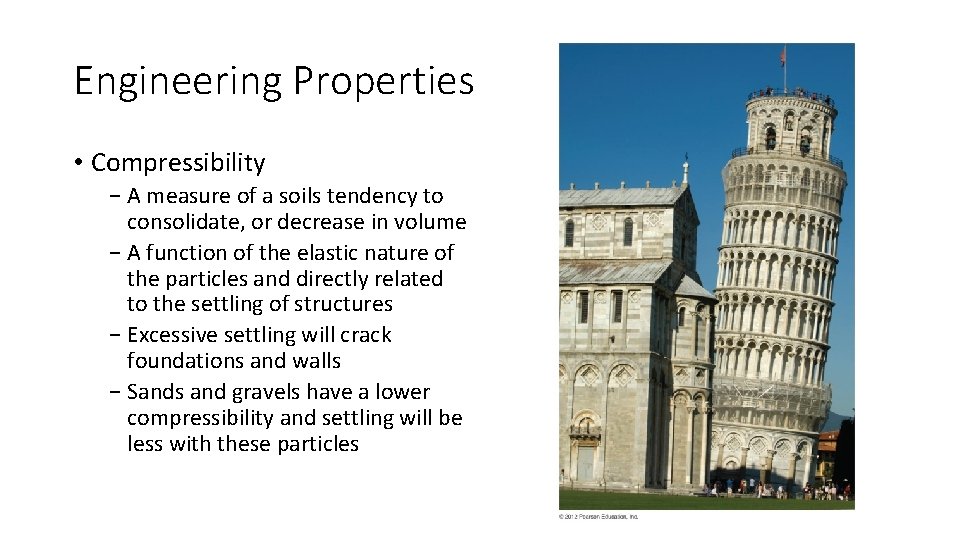
Engineering Properties • Compressibility − A measure of a soils tendency to consolidate, or decrease in volume − A function of the elastic nature of the particles and directly related to the settling of structures − Excessive settling will crack foundations and walls − Sands and gravels have a lower compressibility and settling will be less with these particles
Engineering Properties • Erodibility − The ease by which particles can be removed by wind or water − Moderately sized particles (silts and sands) have the highest erodibility • Hydraulic Conductivity − A measure of the ease by which water moves through the material − Clean gravels and sands have the highest hydraulic conductivity while finer particles have a lower conductivity − Very important when analyzing soil drainage issues, the movement of pollutants, and land use potential
Engineering Properties • Corrosion Potential − A measure of the rate by which buried objects will undergo corrosion − Dependent upon the chemistry of the soil, the buried material, and the amount of water available • Ease of Excavation − Pertains to the equipment and procedures required to remove soils during construction − Common − Rippable − Blasting
Engineering Properties • Shrink-Swell Potential − Refers to the ability of a soil to gain or lose water − Expansive soils increase or decrease in volume with the addition or subtraction of water − Swelling is caused by the chemical attraction of water molecules to certain clay particles − Can cause significant environmental problems and one of the most costly natural hazards (billions of dollars annually to highways, buildings, and other structures) • Factors that affect the moisture content of an expansive soil include − Climate − Vegetation − Topography − Drainage − Quality of construction
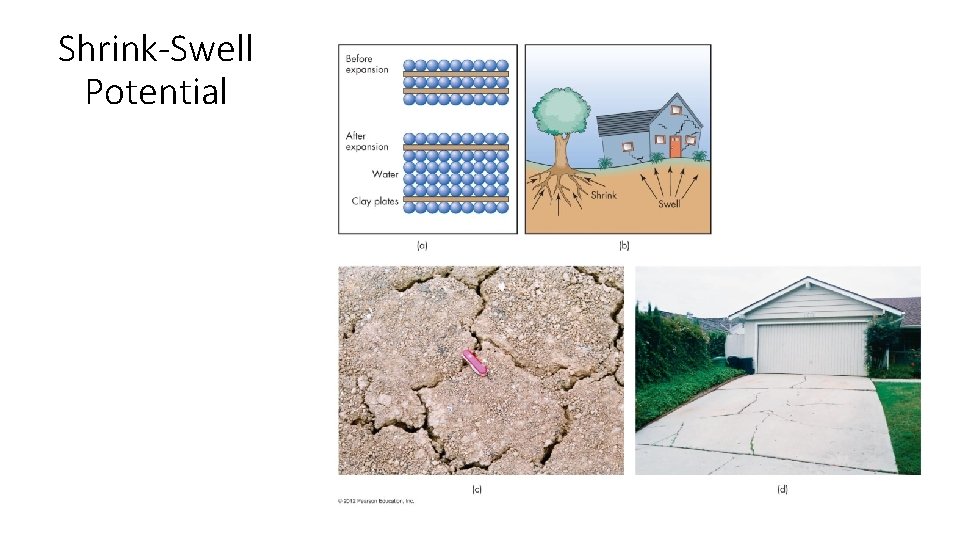
Shrink-Swell Potential
Engineering Properties • Some soils are more desirable for certain purposes than others • Land use planners are better prepared to take advantage of geologic conditions by minding the types of soils present • Two general principles that should be heeded − Because of low strength, high sensitivity, high compressibility, low permeability, and variable shrink-swell potential, clay soils should be avoided in projects with heavy structures, minimal settling, and good drainage − Soils that have a high corrosion potential should be avoided
Land Use and Environmental Soil Issues • Human activities affect soils by influencing the pattern, amount, and intensity of surface water runoff, erosion and sedimentation • The most important human influence is the conversion of natural areas to various land uses • Streams and forested areas are assumed to be relatively stable • A land use change that converts forested land into agricultural land generally increases runoff and erosion − This may make local rivers more muddy − If rivers cannot transport this additional sediment, the rivers may aggrade (fill with sediment − This may increase the frequency and magnitude of flooding
Agriculture • In the past 50 years, soil erosion and overuse of soils caused by intensive agriculture have damaged about 10% of the world’s best agricultural land • In the US, it is estimated that 10% of the topsoil has been lost to erosion • Traditional agriculture is especially damaging • The key to sustaining soil resources is to reduce erosion to a rate less than the rate by which soils form • Activities to support this include increases − − Contour plowing No till agriculture Slope terracing Planting more than one crop
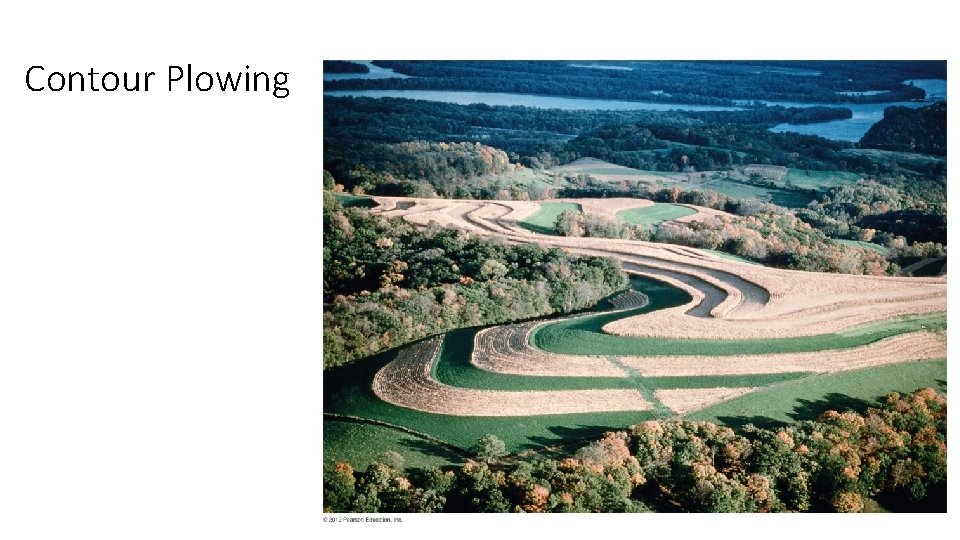
Contour Plowing
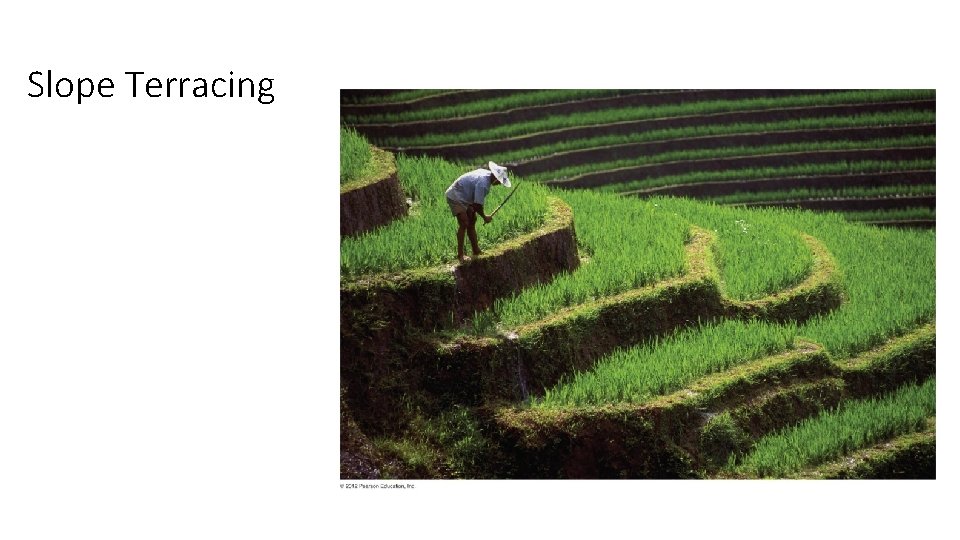
Slope Terracing
Urbanization • Dramatic changes can be seen when natural land is converted to urbanized land • During construction, there is a tremendous increase in sediment production and runoff • River channel responses are complex but commonly see increased flood occurrences • Other direct results − Soils may be lost to erosion − Material brought in during construction may be very different from the indigenous soil − Draining soils to remove water may increase desiccation (drying out) − Greater susceptibility to soil pollution
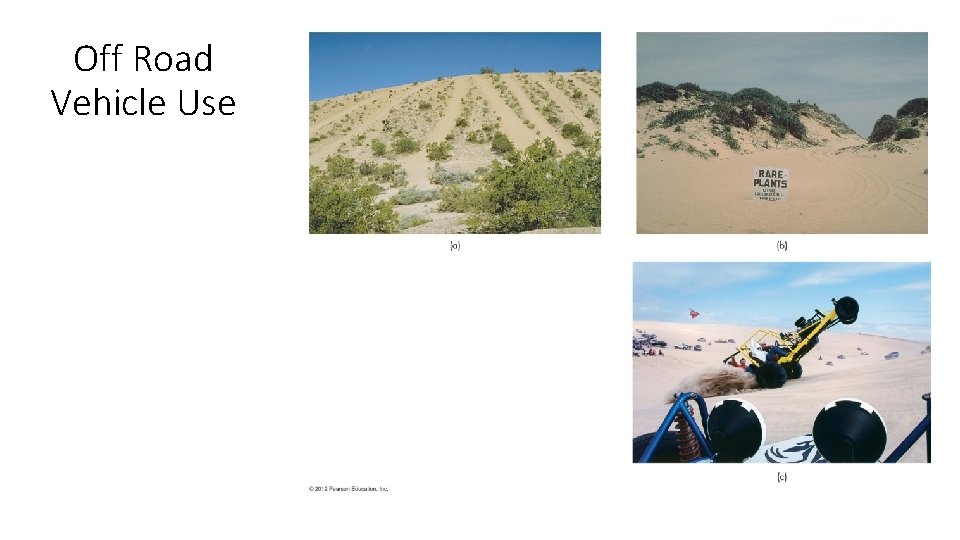
Off-Road Vehicles • The popularity of off-road vehicles has increased greatly • A single motorcycle needs to only drive ~5 miles before having a substantial impact on the environment (a four-wheel vehicle ~1. 5 miles) • Major issues with these vehicles include − Soil erosion (can also facilitate erosion by loosening particles) − Changes in hydrology by near surface compaction of soil decreasing the ability of the soil to absorb water − Damage to plants and animals by decreasing water availability and increasing temperature of the soil • Tank tracks produced in the Mojave Desert 50 years ago can still be seen on the surface
Off-Road Vehicles • Intensive off road vehicle use is incompatible with nearly all other land uses and is difficult to restrict to a specific site • The demand for mountain bike trails has also increased but may also contribute problems • While effect on the environment is less than that of a horse, there are more people on bikes than horses • The cumulative effect of mountain bikes can be damaging
Off Road Vehicle Use
- Slides: 29