
Soils Learning outcomes Soil is made up of
- Slides: 27
Soils Learning outcomes ØSoil is made up of 5 main ingredients ØSoil is formed by a number of factors ØA soil profile consists of 3 horizons ØIreland has 4 main soil types ØSoil and vegetation influence each other
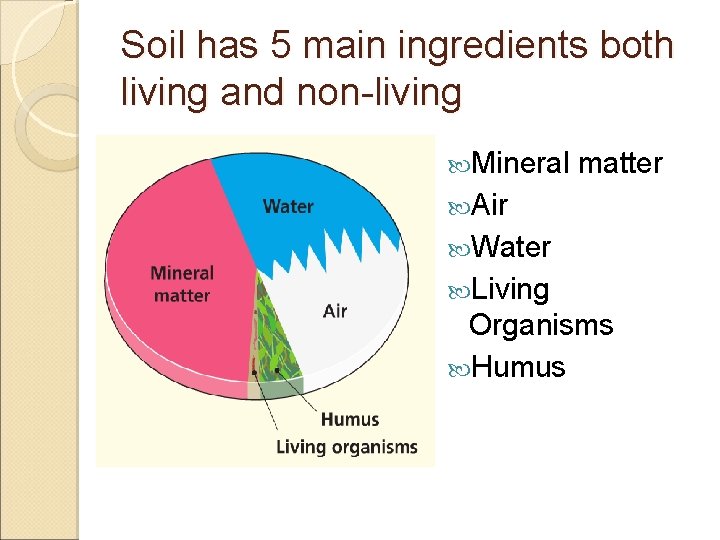
Soil has 5 main ingredients both living and non-living Mineral matter Air Water Living Organisms Humus
Mineral Matter Mineral matter is the biggest ingredient in soil Consists of the remains of rocks that have been broken down into smaller particles by Weathering and Erosion It includes stones, sand, silt and clay
Air fills the pores between the mineral particles Air contains oxygen and nitrogen which are vital for the growth of plants Air allows living organisms to survive in the soil
Water helps bind the soil particles together Water Plants contains dissolved minerals absorb these minerals through their roots
Living organisms Soil is home to creatures such as earthworms, woodlice and slugs It is also home to micro organisms that include bacteria and fungi When worms burrow through the soil they mix it making it easier for water and air to pass through it Micro organisms help breakdown dead plants in humus
Humus is the dark, partly decayed organic matter found in soil It is produced from the remains of dead creatures and plants These are broken down and mixed in the soil by the living organisms Humus It provides nutrients that make the soil fertile also helps to bind the soil particles together
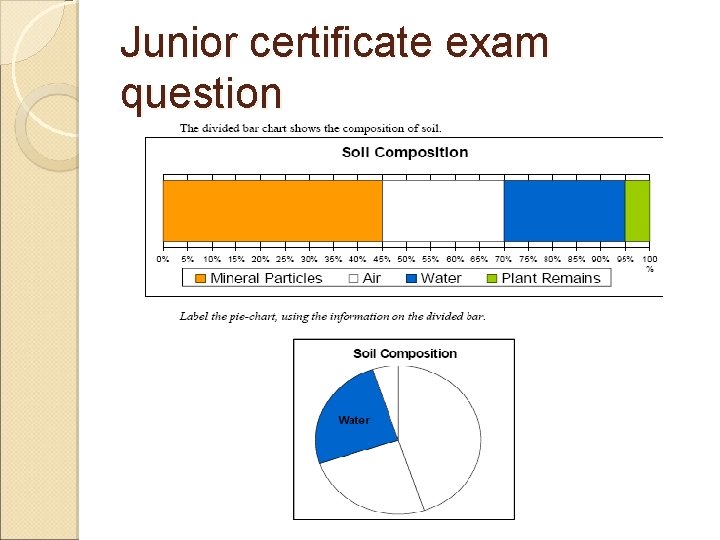
Junior certificate exam question
How soils are formed A number of factors work together to form soil ØClimate ØParent material ØVegetation ØLiving organisms ØLandscape ØTime
Climate Temperature and rainfall influence the rate at which parent rock is broken down by weathering Hot climates experience chemical weathering Cold climates experience freeze thaw
Parent material The type of rock in an area also affects soil formation Granite is slow to break down by weathering, while sandstone breaks down easily and forms soil quickly Soils that develop from limestone are more fertile than those that develop from granite and sandstone
Vegetation When vegetation dies, it is broken down and decays to add humus and nutrients to the soil Deciduous vegetation provides mire leaf fall than coniferous vegetation
Living organisms • Micro organisms such as bacteria and fungi break down dead plant and animal life in the soil turning it into humus • Animals such as earthworms dig through the soil breaking it up allowing more water and air to enter it • When these creatures die, their remains add nutrients to the soil
Landscape • Upland areas are cold and wet so soils are often water logged • There is little plant life so there is less humus • Lowland soils are generally deeper and well drained. • They have more humus as there is a lot of plant and animal life
Time is one of the most important factors in soil formation The longer a rock is exposed to the forces of weathering, the more it is broken down It may take up to 400 years for 1 cm of soil to form
Soil Profiles
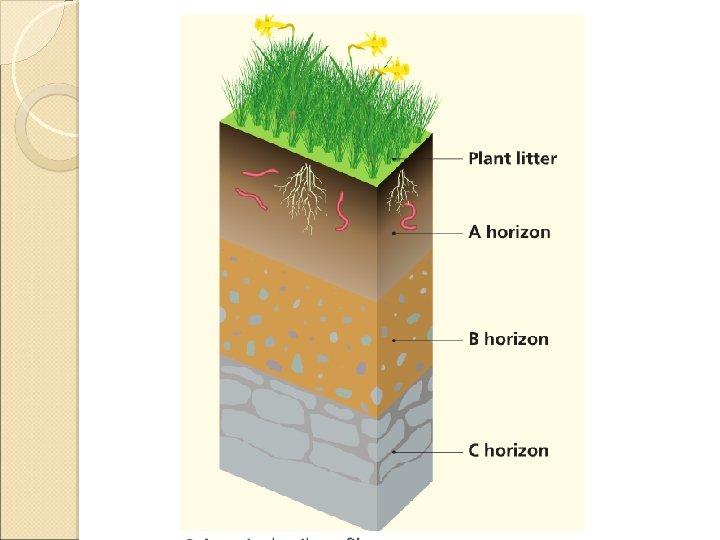
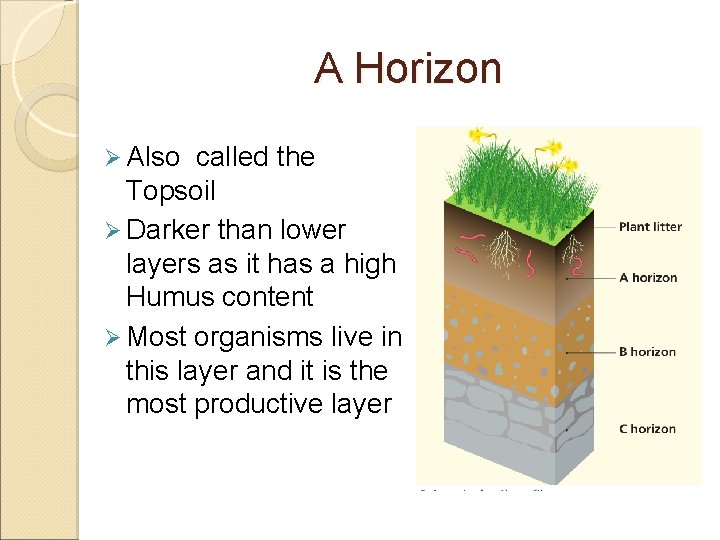
A Horizon Ø Also called the Topsoil Ø Darker than lower layers as it has a high Humus content Ø Most organisms live in this layer and it is the most productive layer
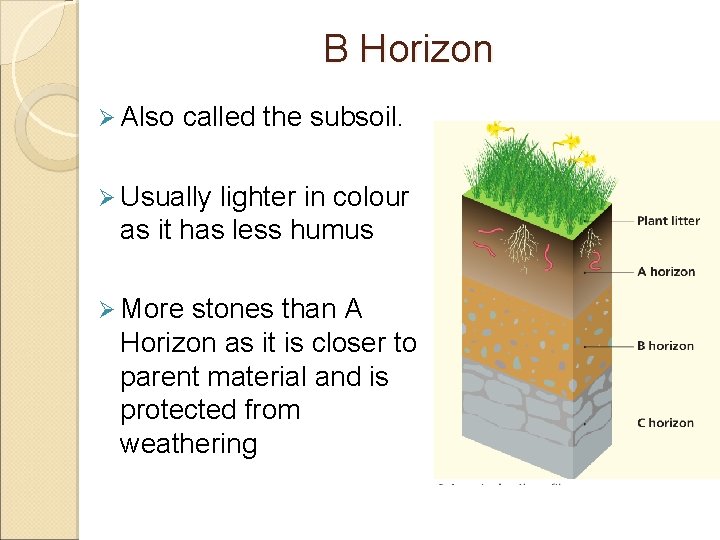
B Horizon Ø Also called the subsoil. Ø Usually lighter in colour as it has less humus Ø More stones than A Horizon as it is closer to parent material and is protected from weathering
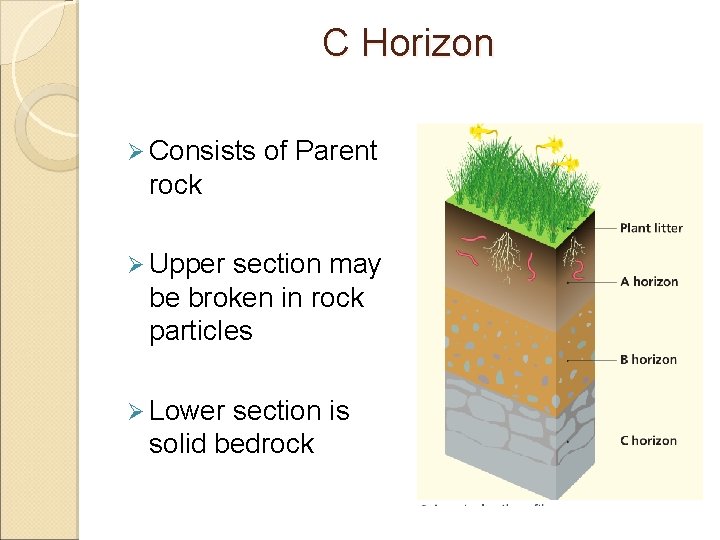
C Horizon Ø Consists of Parent rock Ø Upper section may be broken in rock particles Ø Lower section is solid bedrock
Leaching
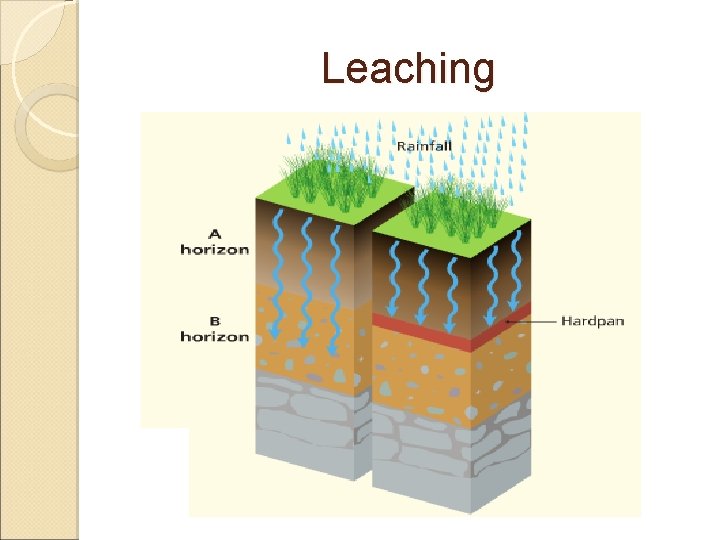
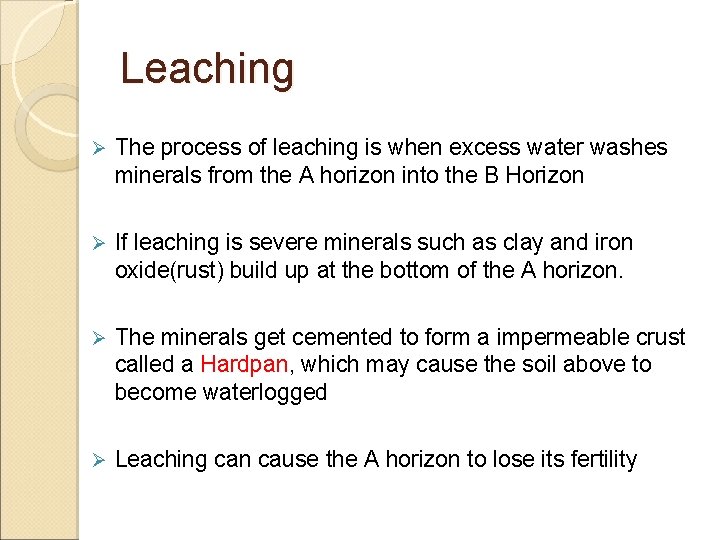
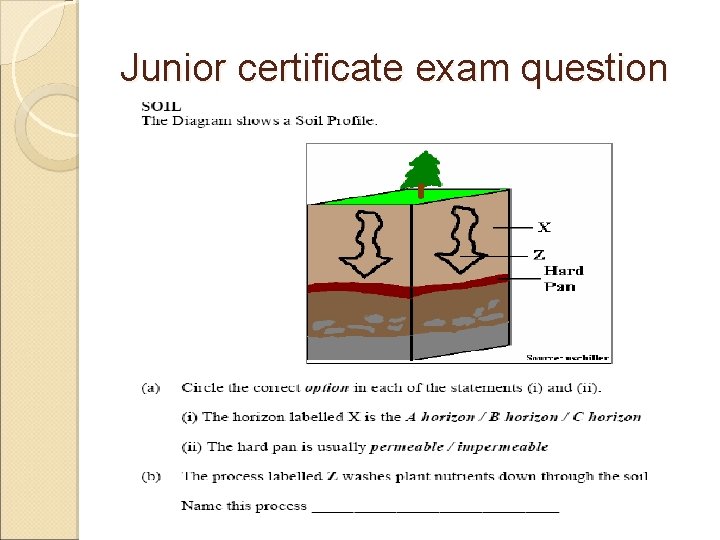
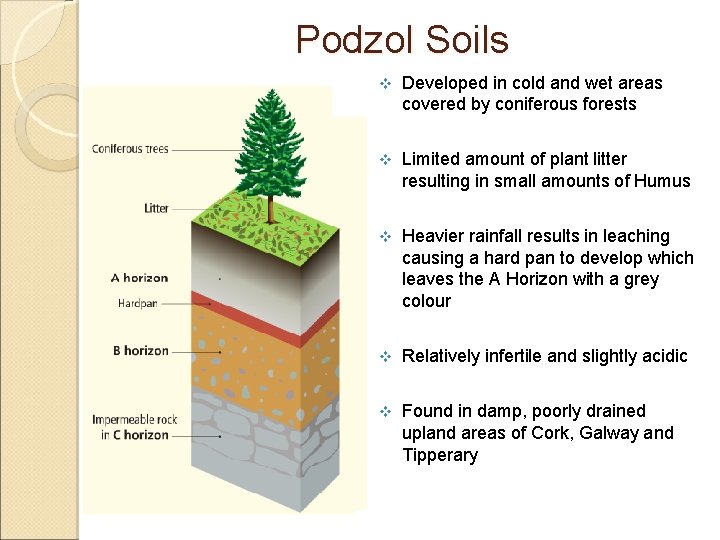
Leaching Ø The process of leaching is when excess water washes minerals from the A horizon into the B Horizon Ø If leaching is severe minerals such as clay and iron oxide(rust) build up at the bottom of the A horizon. Ø The minerals get cemented to form a impermeable crust called a Hardpan, which may cause the soil above to become waterlogged Ø Leaching can cause the A horizon to lose its fertility
Junior certificate exam question
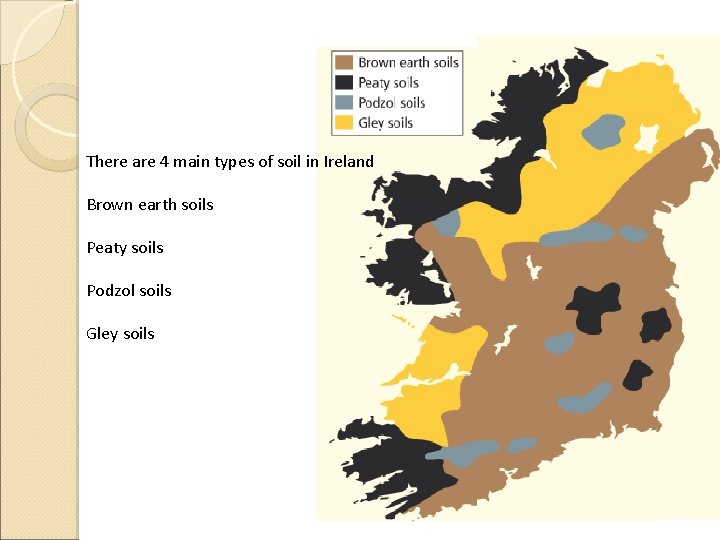
There are 4 main types of soil in Ireland Brown earth soils Peaty soils Podzol soils Gley soils
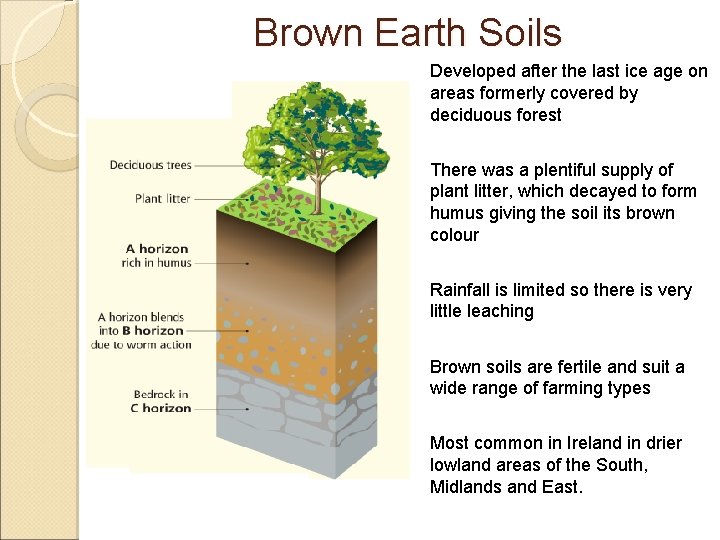
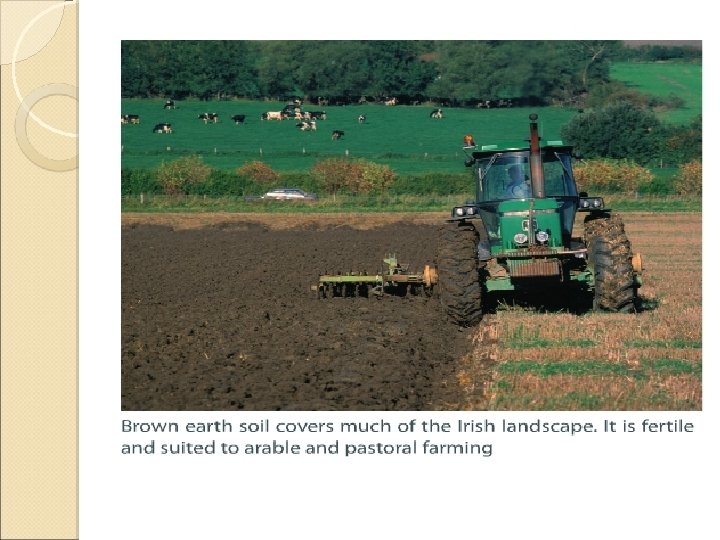
Brown Earth Soils v Developed after the last ice age on areas formerly covered by deciduous forest v There was a plentiful supply of plant litter, which decayed to form humus giving the soil its brown colour v Rainfall is limited so there is very little leaching v Brown soils are fertile and suit a wide range of farming types v Most common in Ireland in drier lowland areas of the South, Midlands and East.
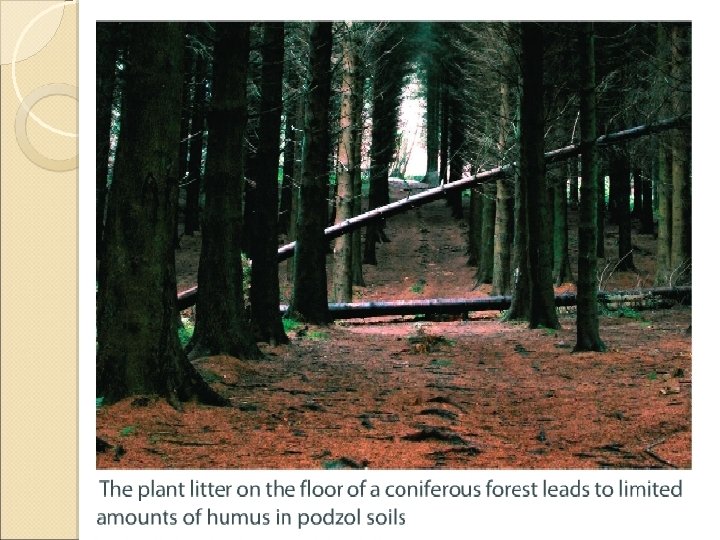
Podzol Soils v Developed in cold and wet areas covered by coniferous forests v Limited amount of plant litter resulting in small amounts of Humus v Heavier rainfall results in leaching causing a hard pan to develop which leaves the A Horizon with a grey colour v Relatively infertile and slightly acidic v Found in damp, poorly drained upland areas of Cork, Galway and Tipperary