
Soils C USDA Classification for fine soils Based
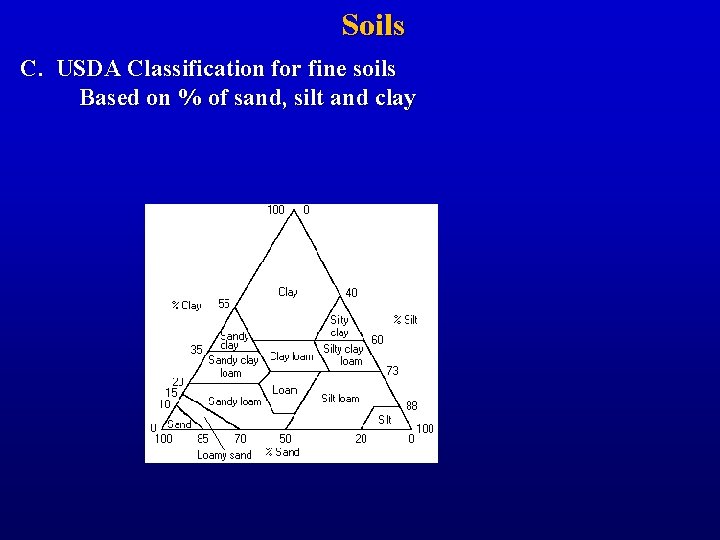
Soils C. USDA Classification for fine soils Based on % of sand, silt and clay

Soils C. USDA Classification for fine soils Based on % of sand, silt and clay Example – Fine Soils 40% sand 40% silt 20% clay Loam
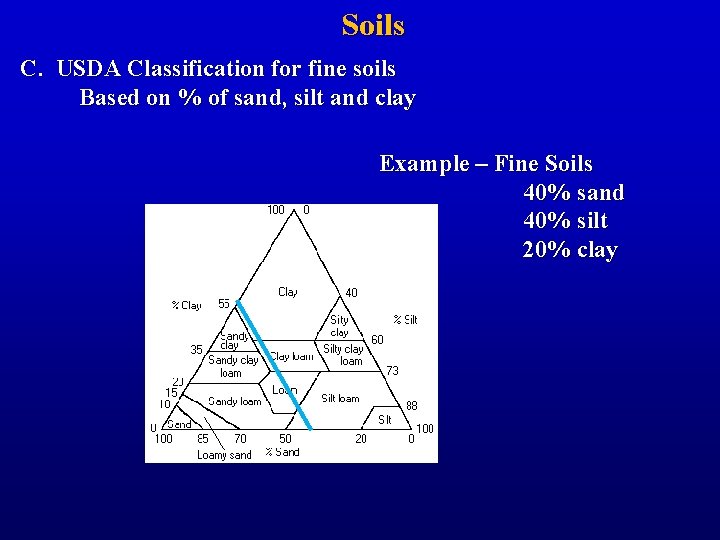
Soils C. USDA Classification for fine soils Based on % of sand, silt and clay Example – Fine Soils 40% sand 40% silt 20% clay
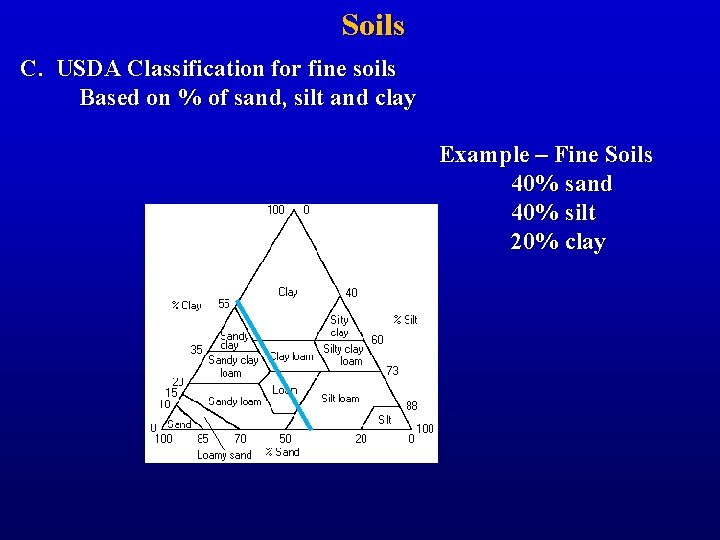
Soils C. USDA Classification for fine soils Based on % of sand, silt and clay Example – Fine Soils 40% sand 40% silt 20% clay
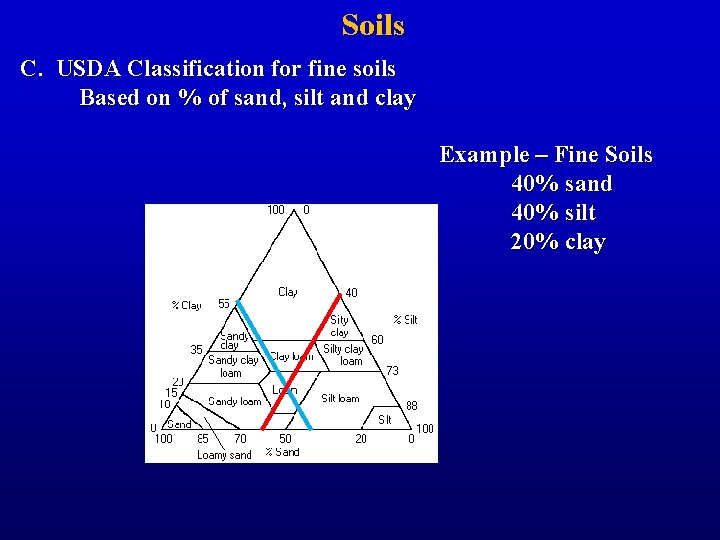
Soils C. USDA Classification for fine soils Based on % of sand, silt and clay Example – Fine Soils 40% sand 40% silt 20% clay
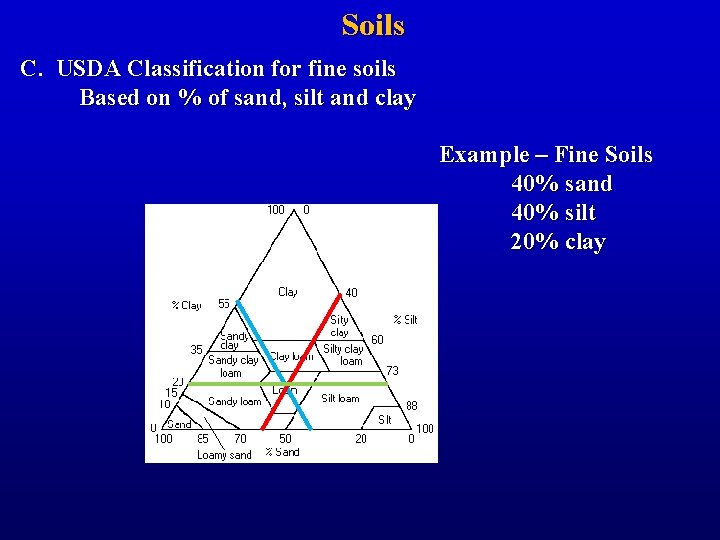
Soils C. USDA Classification for fine soils Based on % of sand, silt and clay Example – Fine Soils 40% sand 40% silt 20% clay
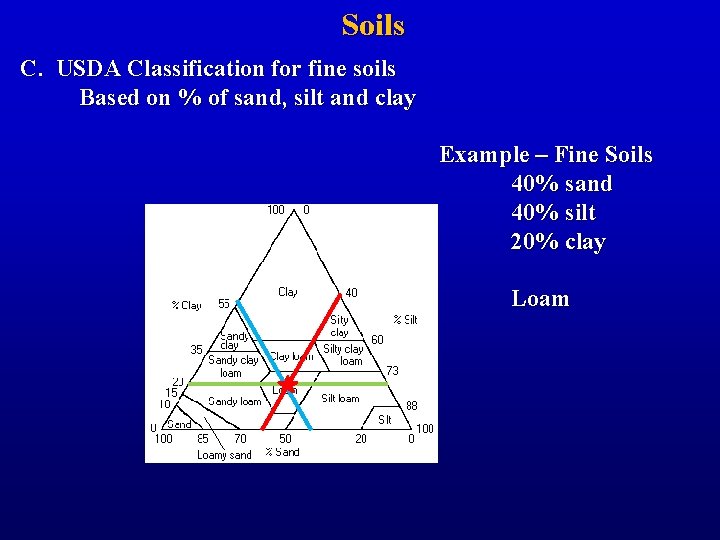
Soils C. USDA Classification for fine soils Based on % of sand, silt and clay Example – Fine Soils 40% sand 40% silt 20% clay Loam
Energy I. Definition of Energy A. Your definitions
Energy I. Definition of Energy A. Your definitions B. Physics - ability to do work
Energy I. Definition of Energy A. Your definitions B. Physics - ability to do work C. Am I working?
Energy I. Definition of Energy A. Your definitions B. Physics - ability to do work C. Am I working? D. Did I use energy?
Energy I. Definition of Energy A. Your definitions B. Physics - ability to do work C. Am I working? D. Did I use energy? E. Is my body working?
Energy I. Definition of Energy A. Your definitions B. Physics - ability to do work C. Am I working? D. Did I use energy? E. Is my body working? F. Physical vs Mental work?
Energy I. Definition of Energy A. Your definitions B. Physics - ability to do work C. Am I working? D. Did I use energy? E. Is my body working? F. Physical vs Mental work? II. Your list of ways you use energy
Energy I. Definition of Energy A. Your definitions B. Physics - ability to do work C. Am I working? D. Did I use energy? E. Is my body working? F. Physical vs Mental work? II. Your list of ways you use energy III. Where does this energy come from?
Introduction to Environmental Geoscience IV. Some basic Physics - again! A. What is mass?
Introduction to Environmental Geoscience IV. Some basic Physics - again! A. What is mass? B. Difference between mass and weight Mass is the amount of stuff – measured in grams or kg
Introduction to Environmental Geoscience IV. Some basic Physics - again! A. What is mass? B. Difference between mass and weight Mass is the amount of stuff – measured in grams or kg Weight is the effect gravity has on mass
Introduction to Environmental Geoscience IV. Some basic Physics - again! A. What is mass? B. Difference between mass and weight Mass is the amount of stuff – measured in grams or kg Weight is the effect gravity has on mass If no gravity, mass doesn’t weigh anything
Introduction to Environmental Geoscience IV. Some basic Physics - again! A. What is mass? B. Difference between mass and weight Mass is the amount of stuff – measured in grams or kg Weight is the effect gravity has on mass If no gravity, mass doesn’t weigh anything 5 kg on Mars is not as heavy as on Earth
Introduction to Environmental Geoscience IV. Some basic Physics - again! A. What is mass? B. Difference between mass and weight Mass is the amount of stuff – measured in grams or kg Weight is the effect gravity has on mass If no gravity, mass doesn’t weigh anything 5 kg on Mars is not as heavy as on Earth On Earth, 1 kg weighs 2. 2 pounds
Introduction to Environmental Geoscience IV. Some basic Physics - again! A. What is mass? B. Difference between mass and weight Mass is the amount of stuff – measured in grams or kg Weight is the effect gravity has on mass If no gravity, mass doesn’t weigh anything 5 kg on Mars is not as heavy as on Earth On Earth, 1 kg weighs 2. 2 pounds On Mars 1 kg weighs about 1/10 of that
Introduction to Environmental Geoscience IV. Some basic Physics - again! A. What is mass? B. Difference between mass and weight Mass is the amount of stuff – measured in grams or kg Weight is the effect gravity has on mass If no gravity, mass doesn’t weigh anything 5 kg on Mars is not as heavy as on Earth On Earth, 1 kg weighs 2. 2 pounds On Mars 1 kg weighs about 1/10 of that C. What is force? F = ma (m = mass, a = acceleration)
Introduction to Environmental Geoscience IV. Some basic Physics - again! A. What is mass? B. Difference between mass and weight Mass is the amount of stuff – measured in grams or kg Weight is the effect gravity has on mass If no gravity, mass doesn’t weigh anything 5 kg on Mars is not as heavy as on Earth On Earth, 1 kg weighs 2. 2 pounds On Mars 1 kg weighs about 1/10 of that C. What is force? F = ma (m = mass, a = acceleration) D. What is stress or pressure? Pressure = force/area
Introduction to Environmental Geoscience IV. Some basic Physics - again! A. What is mass? B. Difference between mass and weight Mass is the amount of stuff – measured in grams or kg Weight is the effect gravity has on mass If no gravity, mass doesn’t weigh anything 5 kg on Mars is not as heavy as on Earth On Earth, 1 kg weighs 2. 2 pounds On Mars 1 kg weighs about 1/10 of that C. What is force? F = ma (m = mass, a = acceleration) D. What is stress or pressure? Pressure = force/area Hydrostatic and Lithostatic Pressure
Introduction to Environmental Geoscience F. What is work? Your definitions.
Introduction to Environmental Geoscience F. What is work? Your definitions. 1. Force x Distance – push 10 kg (or 22 pounds on Earth) 100 feet
Introduction to Environmental Geoscience F. What is work? Your definitions. 1. Force x Distance – push 10 kg (or 22 pounds on Earth) 100 feet G. What is power? Your definitions.
Introduction to Environmental Geoscience F. What is work? Your definitions. 1. Force x Distance – push 10 kg (or 22 pounds on Earth) 100 feet G. What is power? Your definitions. 1. Power = How quickly we use energy to do work a. push that 10 pound box 1000 ft in 10 seconds or 1 second?
Introduction to Environmental Geoscience F. What is work? Your definitions. 1. Force x Distance – push 10 kg (or 22 pounds on Earth) 100 feet G. What is power? Your definitions. 1. Power = How quickly we use energy to do work a. push that 10 pound box 1000 ft in 10 seconds or 1 second? Other measures of power – How do we measure how powerful a car engine is?
Introduction to Environmental Geoscience F. What is work? Your definitions. 1. Force x Distance – push 10 kg (or 22 pounds on Earth) 100 feet G. What is power? Your definitions. 1. Power = How quickly we use energy to do work a. push that 10 pound box 1000 ft in 10 seconds or 1 second? Other measures of power – How do we measure how powerful a car engine is? 1. Horsepower – 1 HP = 746 watts
Introduction to Environmental Geoscience F. What is work? Your definitions. 1. Force x Distance – push 10 kg (or 22 pounds on Earth) 100 feet G. What is power? Your definitions. 1. Power = How quickly we use energy to do work a. push that 10 pound box 1000 ft in 10 seconds or 1 second? Other measures of power – How do we measure how powerful a car engine is? 1. Horsepower – 1 HP = 746 watts 2. 1 HP is the same as raising a 55 pound weight 10 feet every second. Even strongest person can’t do this for more than a second or two - an impressive number
Introduction to Environmental Geoscience V. Types of Energy A. List some types of energy – something that enables you to do work?
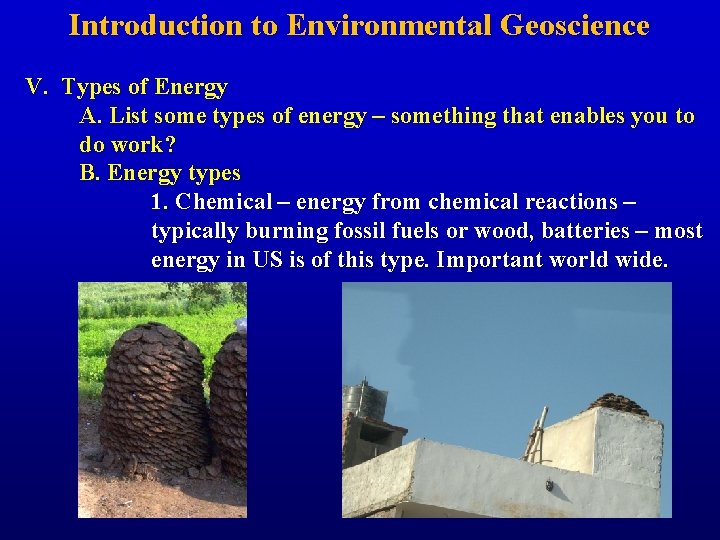
Introduction to Environmental Geoscience V. Types of Energy A. List some types of energy – something that enables you to do work? B. Energy types 1. Chemical – energy from chemical reactions – typically burning fossil fuels or wood, batteries – most energy in US is of this type. Important world wide.
Introduction to Environmental Geoscience 2. Heat – from molecular movement – chemical energy is typically transformed into heat energy. So can friction.
Introduction to Environmental Geoscience 2. Heat – from molecular movement – chemical energy is typically transformed into heat energy. So can friction. 3. Energy from Mass
Introduction to Environmental Geoscience 2. Heat – from molecular movement – chemical energy is typically transformed into heat energy. So can friction. 3. Energy from Mass a. Einstein’s enormous contribution to mankind
Introduction to Environmental Geoscience 2. Heat – from molecular movement – chemical energy is typically transformed into heat energy. So can friction. 3. Energy from Mass a. Einstein’s enormous contribution to mankind b. E = mc 2 – enormous potential – nuclear energy
Introduction to Environmental Geoscience 2. Heat – from molecular movement – chemical energy is typically transformed into heat energy. So can friction. 3. Energy from Mass a. Einstein’s enormous contribution to mankind b. E = mc 2 – enormous potential – nuclear energy c. Speed of light = 3 x 10⁸ m/s, 671 million miles/hour – small mass leads to huge energy production
Introduction to Environmental Geoscience 2. Heat – from molecular movement – chemical energy is typically transformed into heat energy. So can friction. 3. Energy from Mass a. Einstein’s enormous contribution to mankind b. E = mc 2 – enormous potential – nuclear energy c. Speed of light = 3 x 10⁸ m/s, 671 million miles/hour – small mass leads to huge energy production d. basis for nuclear energy
Introduction to Environmental Geoscience 2. Heat – from molecular movement – chemical energy is typically transformed into heat energy. So can friction. 3. Energy from Mass a. Einstein’s enormous contribution to mankind b. E = mc 2 – enormous potential – nuclear energy c. Speed of light = 3 x 10⁸ m/s, 671 million miles/hour – small mass leads to huge energy production d. basis for nuclear energy 4. Kinetic – energy of movement
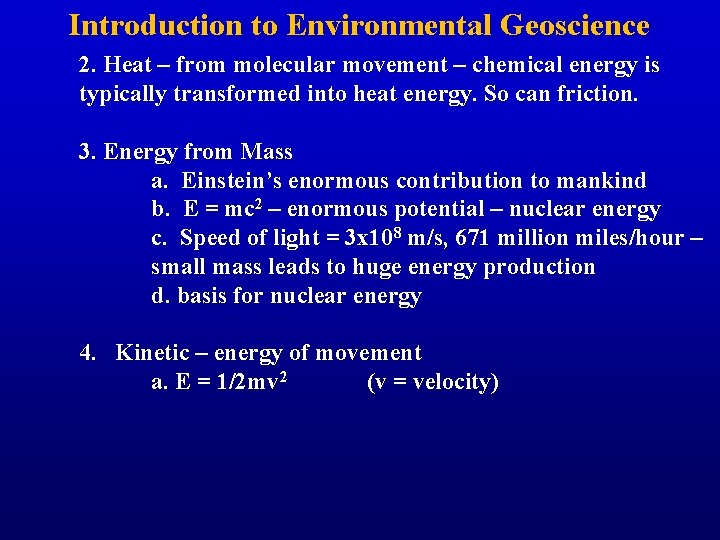
Introduction to Environmental Geoscience 2. Heat – from molecular movement – chemical energy is typically transformed into heat energy. So can friction. 3. Energy from Mass a. Einstein’s enormous contribution to mankind b. E = mc 2 – enormous potential – nuclear energy c. Speed of light = 3 x 10⁸ m/s, 671 million miles/hour – small mass leads to huge energy production d. basis for nuclear energy 4. Kinetic – energy of movement a. E = 1/2 mv 2 (v = velocity)
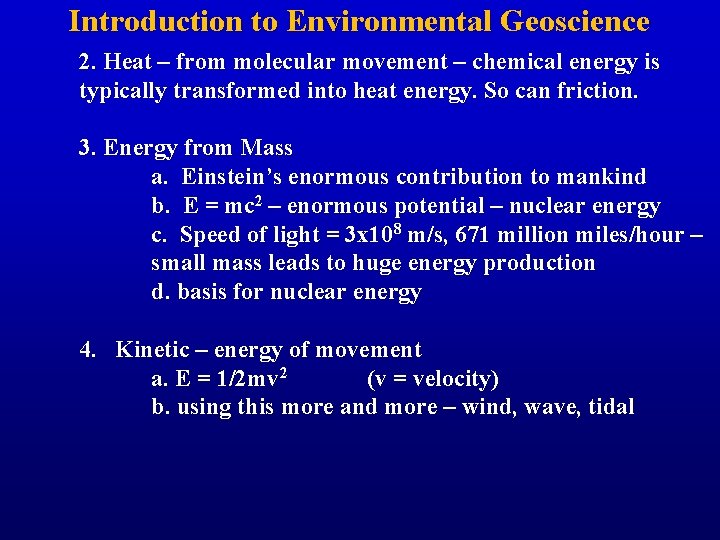
Introduction to Environmental Geoscience 2. Heat – from molecular movement – chemical energy is typically transformed into heat energy. So can friction. 3. Energy from Mass a. Einstein’s enormous contribution to mankind b. E = mc 2 – enormous potential – nuclear energy c. Speed of light = 3 x 10⁸ m/s, 671 million miles/hour – small mass leads to huge energy production d. basis for nuclear energy 4. Kinetic – energy of movement a. E = 1/2 mv 2 (v = velocity) b. using this more and more – wind, wave, tidal
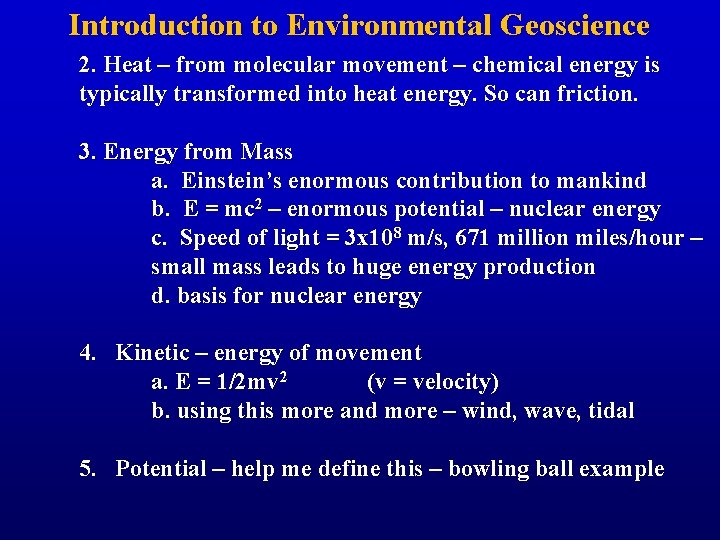
Introduction to Environmental Geoscience 2. Heat – from molecular movement – chemical energy is typically transformed into heat energy. So can friction. 3. Energy from Mass a. Einstein’s enormous contribution to mankind b. E = mc 2 – enormous potential – nuclear energy c. Speed of light = 3 x 10⁸ m/s, 671 million miles/hour – small mass leads to huge energy production d. basis for nuclear energy 4. Kinetic – energy of movement a. E = 1/2 mv 2 (v = velocity) b. using this more and more – wind, wave, tidal 5. Potential – help me define this – bowling ball example
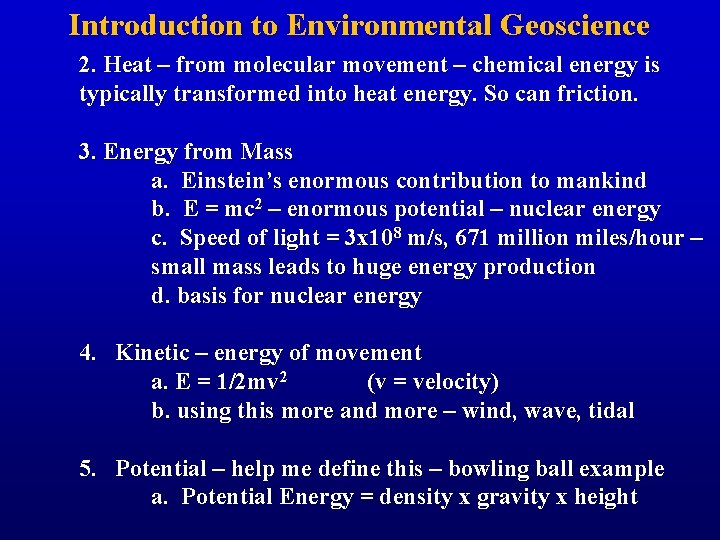
Introduction to Environmental Geoscience 2. Heat – from molecular movement – chemical energy is typically transformed into heat energy. So can friction. 3. Energy from Mass a. Einstein’s enormous contribution to mankind b. E = mc 2 – enormous potential – nuclear energy c. Speed of light = 3 x 10⁸ m/s, 671 million miles/hour – small mass leads to huge energy production d. basis for nuclear energy 4. Kinetic – energy of movement a. E = 1/2 mv 2 (v = velocity) b. using this more and more – wind, wave, tidal 5. Potential – help me define this – bowling ball example a. Potential Energy = density x gravity x height
Introduction to Environmental Geoscience 6. Electric = used extensively by humans
Introduction to Environmental Geoscience 6. Electric = used extensively by humans a. Especially for non-transportation energy needs
Introduction to Environmental Geoscience 6. Electric = used extensively by humans a. Especially for non-transportation energy needs b. Creeping into transportation
Introduction to Environmental Geoscience 6. Electric = used extensively by humans a. Especially for non-transportation energy needs b. Creeping into transportation c. Hard to store – batteries – big tech challenge
Introduction to Environmental Geoscience 6. Electric = used extensively by humans a. b. c. d. Especially for non-transportation energy needs Creeping into transportation Hard to store – batteries – big tech challenge Nothing can be seen happening
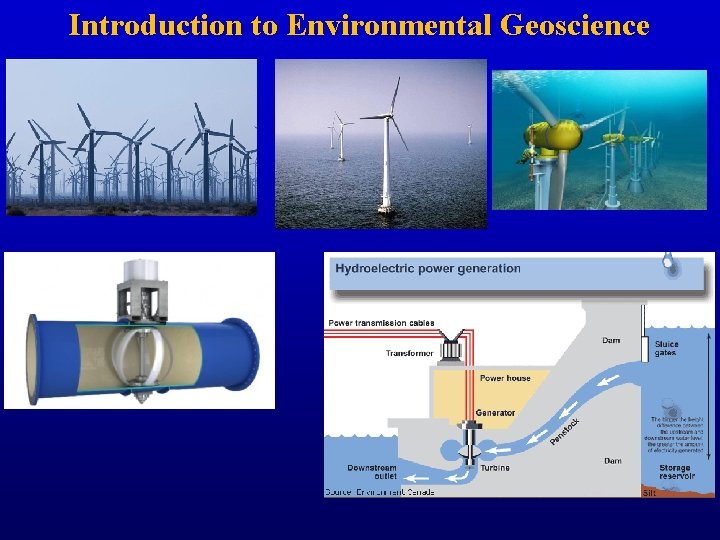
Introduction to Environmental Geoscience 6. Electric = used extensively by humans a. b. c. d. e. f. Especially for non-transportation energy needs Creeping into transportation Hard to store – batteries – big tech challenge Nothing can be seen happening Flow of electrons – current Faraday discovered that passing a magnet near a coiled wire induced a current in the wire – made the electrons move in a current – basis for today’s electric motors – think of wind/water turbines – move a magnet around a coiled wire, or vice versa
Introduction to Environmental Geoscience 6. Electric = used extensively by humans a. b. c. d. e. f. Especially for non-transportation energy needs Creeping into transportation Hard to store – batteries – big tech challenge Nothing can be seen happening Flow of electrons – current Faraday discovered that passing a magnet near a coiled wire induced a current in the wire – made the electrons move in a current – basis for today’s electric motors – think of wind/water turbines – move a magnet around a coiled wire, or vice versa g. Many forms of energy are transformed into electricity 1. In US, coal burning, nuclear, hyd – electricity 2. Chemical energy in coal – heat energy – kinetic energy as water expands to steam – kinetic as steam moves turbine – turbine moves magnets around wires to produce electrical energy 3. Some energy is lost to environment in each step. Not efficient
Introduction to Environmental Geoscience
Introduction to Environmental Geoscience 7. Electromagnetic Radiation – light energy
- Slides: 54