
Soil Today we produce more food person By
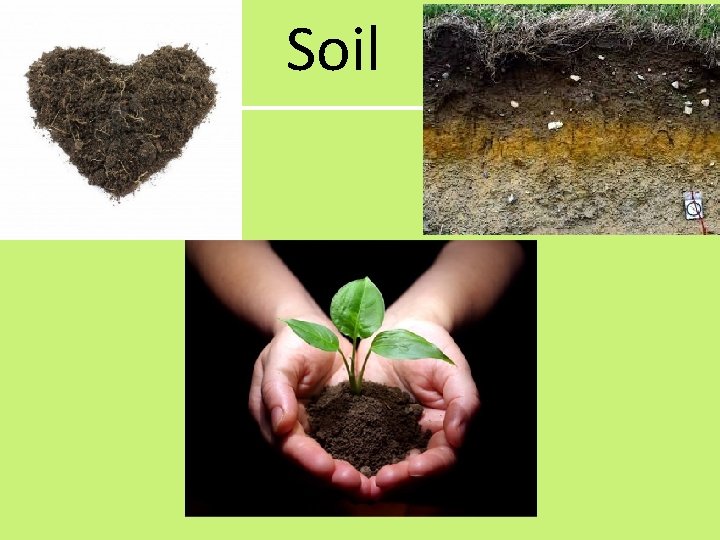
Soil
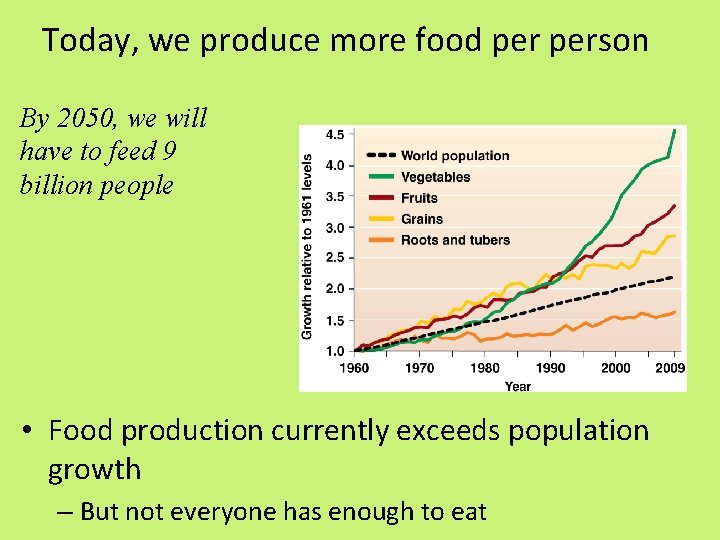
Today, we produce more food person By 2050, we will have to feed 9 billion people • Food production currently exceeds population growth – But not everyone has enough to eat
Food security and undernutrition • Food security: guarantee of an adequate, safe, nutritious, and reliable food supply – Providing food security to everyone will be one of our greatest challenges • Undernutrition: receiving fewer calories than one’s minimum dietary energy requirements – 925 million people do not have enough to eat – Every 5 seconds a child starves to death – Is due to poverty, politics, conflict, and inefficiencies in distribution
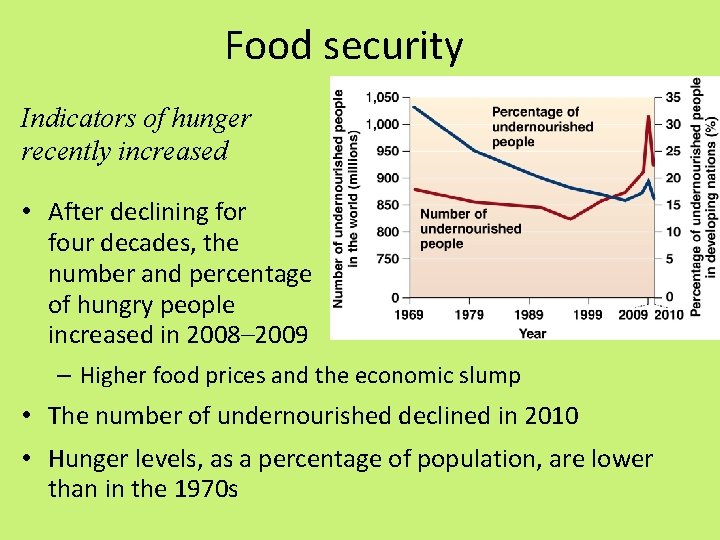
Food security Indicators of hunger recently increased • After declining for four decades, the number and percentage of hungry people increased in 2008– 2009 – Higher food prices and the economic slump • The number of undernourished declined in 2010 • Hunger levels, as a percentage of population, are lower than in the 1970 s

Overnutrition and malnutrition • Overnutrition: receiving too many calories each day – Leads to heart disease, diabetes, etc. – In the U. S. , 60% of adults are overweight, 25% are obese – Worldwide, over 500 million people are obese – These numbers will rise to 2. 3 billion overweight and 700 million obese by 2015 • Malnutrition: a shortage of nutrients the body needs – The diet lacks adequate vitamins and minerals – Can lead to diseases
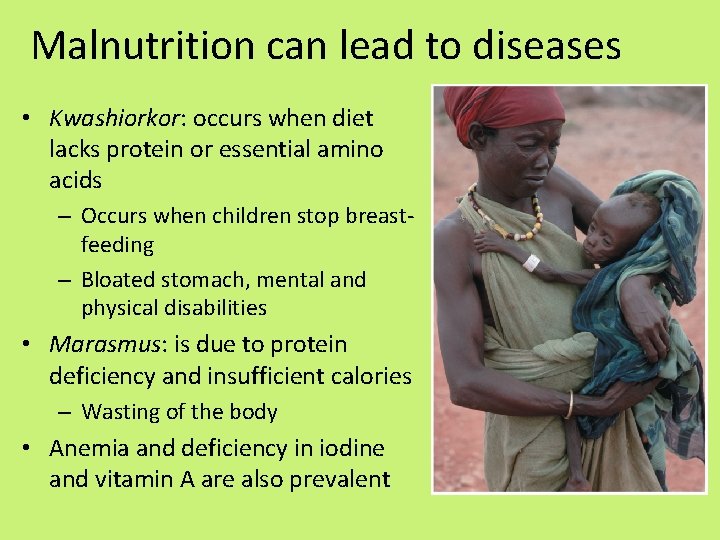
Malnutrition can lead to diseases • Kwashiorkor: occurs when diet lacks protein or essential amino acids – Occurs when children stop breastfeeding – Bloated stomach, mental and physical disabilities • Marasmus: is due to protein deficiency and insufficient calories – Wasting of the body • Anemia and deficiency in iodine and vitamin A are also prevalent
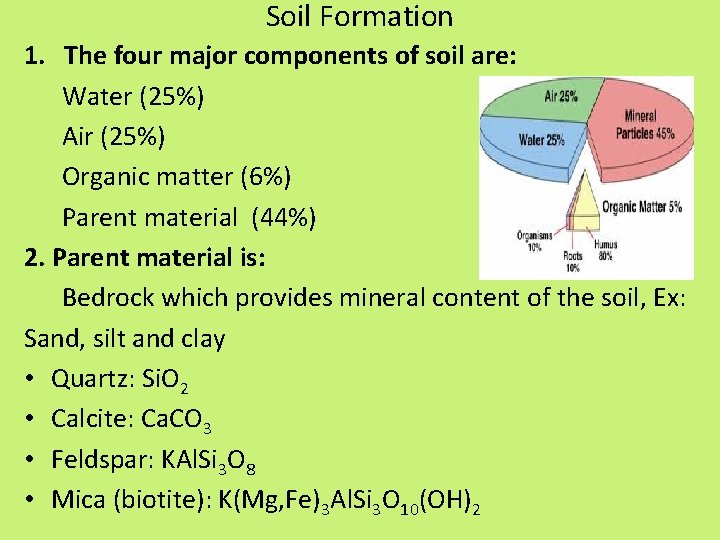
Soil Formation 1. The four major components of soil are: Water (25%) Air (25%) Organic matter (6%) Parent material (44%) 2. Parent material is: Bedrock which provides mineral content of the soil, Ex: Sand, silt and clay • Quartz: Si. O 2 • Calcite: Ca. CO 3 • Feldspar: KAl. Si 3 O 8 • Mica (biotite): K(Mg, Fe)3 Al. Si 3 O 10(OH)2
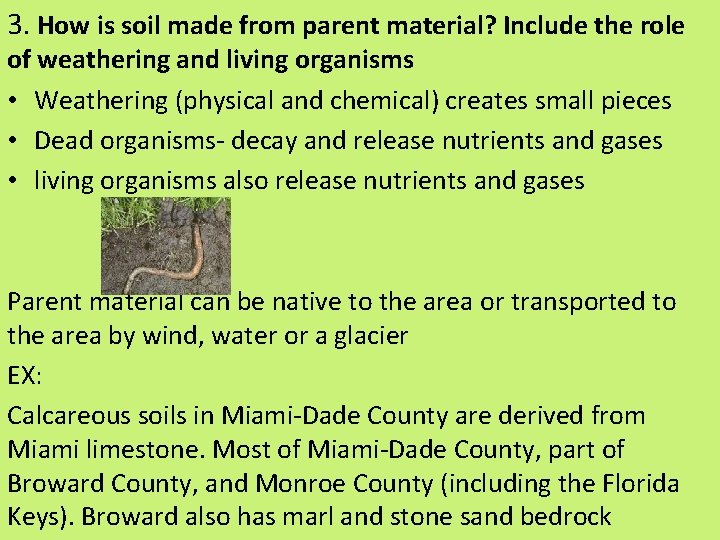
3. How is soil made from parent material? Include the role of weathering and living organisms • Weathering (physical and chemical) creates small pieces • Dead organisms- decay and release nutrients and gases • living organisms also release nutrients and gases Parent material can be native to the area or transported to the area by wind, water or a glacier EX: Calcareous soils in Miami-Dade County are derived from Miami limestone. Most of Miami-Dade County, part of Broward County, and Monroe County (including the Florida Keys). Broward also has marl and stone sand bedrock
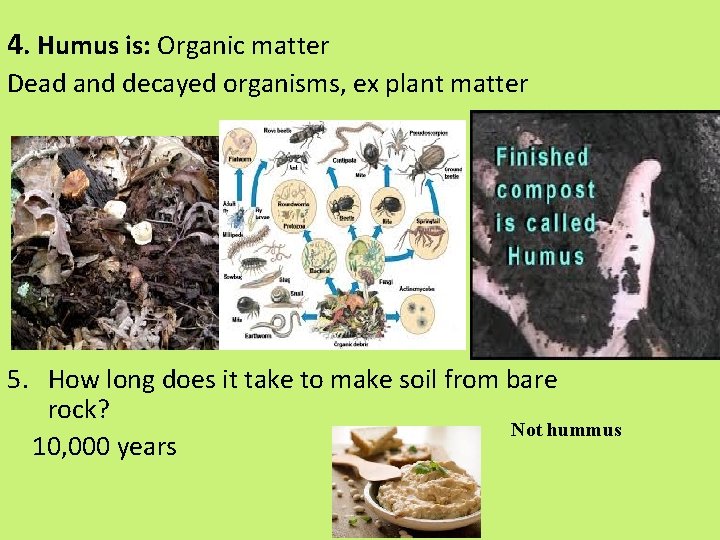
4. Humus is: Organic matter Dead and decayed organisms, ex plant matter 5. How long does it take to make soil from bare rock? Not hummus 10, 000 years
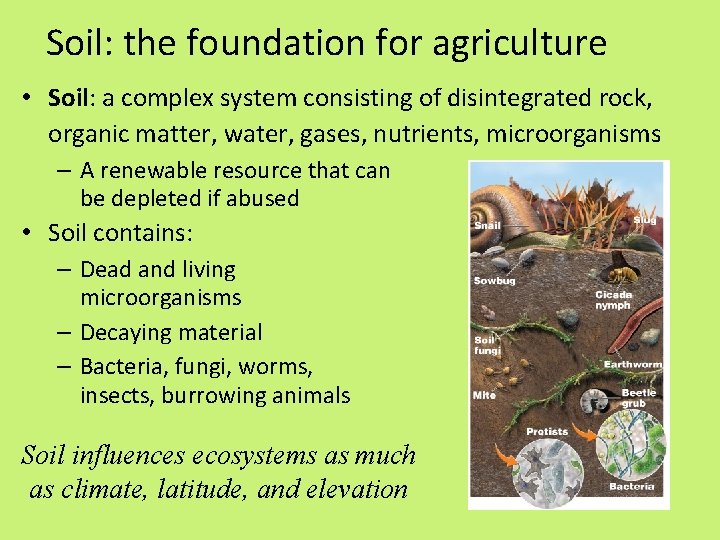
Soil: the foundation for agriculture • Soil: a complex system consisting of disintegrated rock, organic matter, water, gases, nutrients, microorganisms – A renewable resource that can be depleted if abused • Soil contains: – Dead and living microorganisms – Decaying material – Bacteria, fungi, worms, insects, burrowing animals Soil influences ecosystems as much as climate, latitude, and elevation
Soil forms slowly • Parent material: the base geologic material of soil – Lava, volcanic ash, rock, dunes – Bedrock: solid rock comprising Earth’s crust • Weathering: physical, chemical, and biological processes that form that convert rocks into soil – Biological deposition, decomposition, and accumulation provide organic matter and nutrients • Humus: spongy, fertile material formed by partial decomposition of organic matter – Holds moisture and is productive for plants
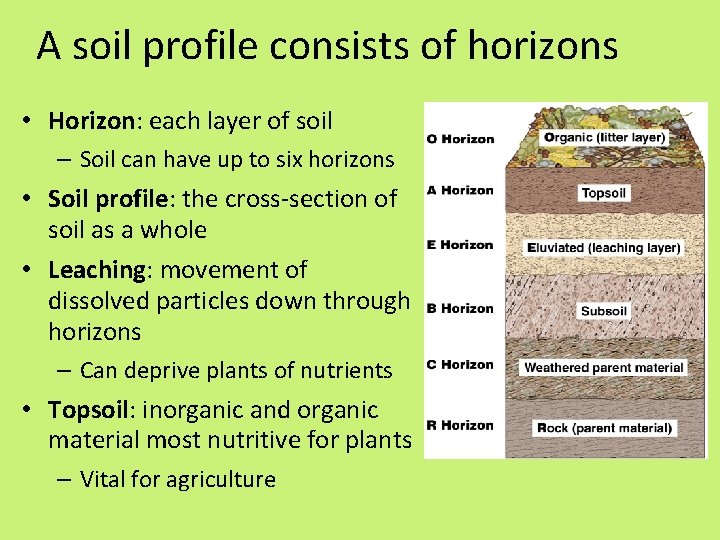
A soil profile consists of horizons • Horizon: each layer of soil – Soil can have up to six horizons • Soil profile: the cross-section of soil as a whole • Leaching: movement of dissolved particles down through horizons – Can deprive plants of nutrients • Topsoil: inorganic and organic material most nutritive for plants – Vital for agriculture

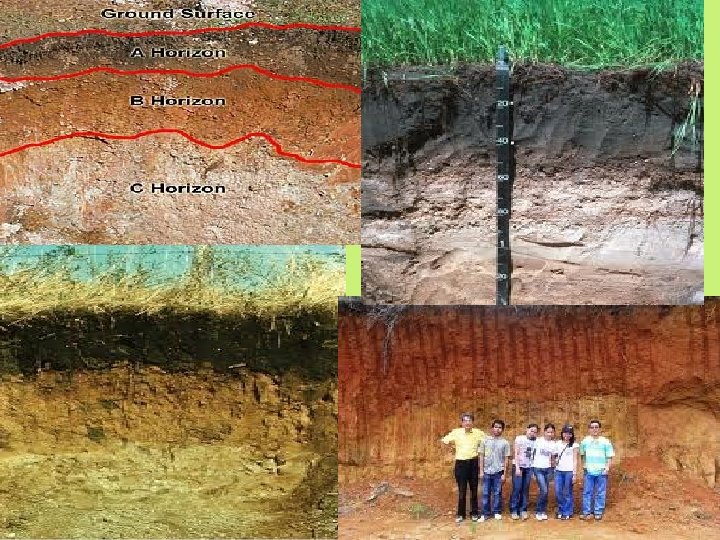
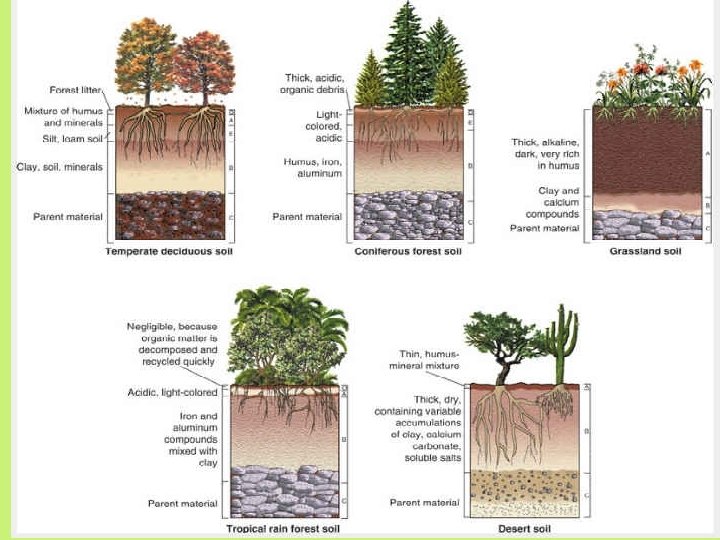
Soil Profile 1. Describe the 5 Soil horizons • O- Organic matter, leaf litter (duff), dead animals, decomposed litter • A- Surface soil, decomposed organic matter and minerals, humus (fertile) • B- Subsoil, leached nutrients • C- Parent rock, weathered large unbroken rocks • R (Bedrock)- mostly a continuous mass of hard rock
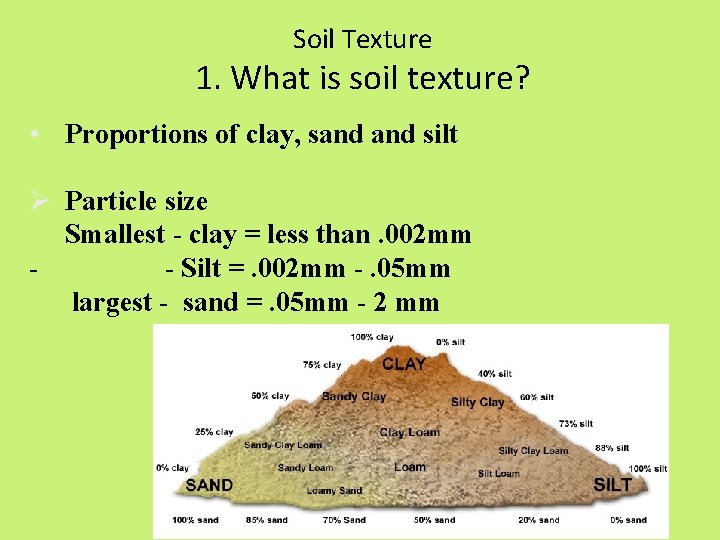
Soil Texture 1. What is soil texture? • Proportions of clay, sand silt Ø Particle size Smallest - clay = less than. 002 mm - Silt =. 002 mm -. 05 mm largest - sand =. 05 mm - 2 mm
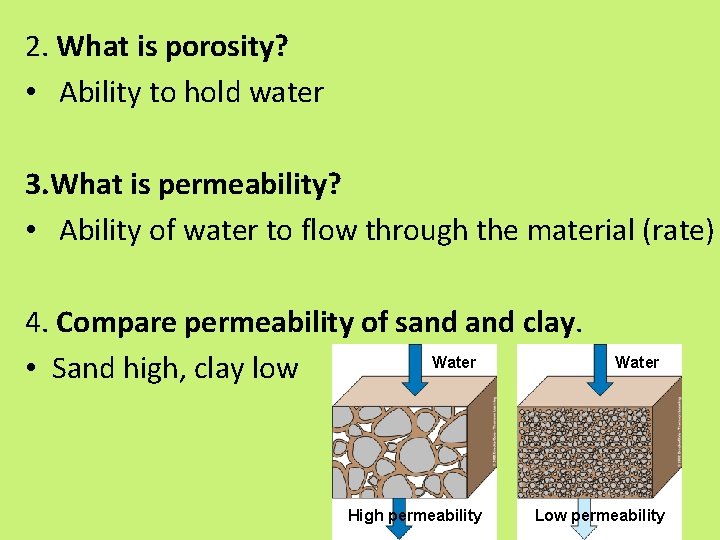
2. What is porosity? • Ability to hold water 3. What is permeability? • Ability of water to flow through the material (rate) 4. Compare permeability of sand clay. Water • Sand high, clay low High permeability Water Low permeability
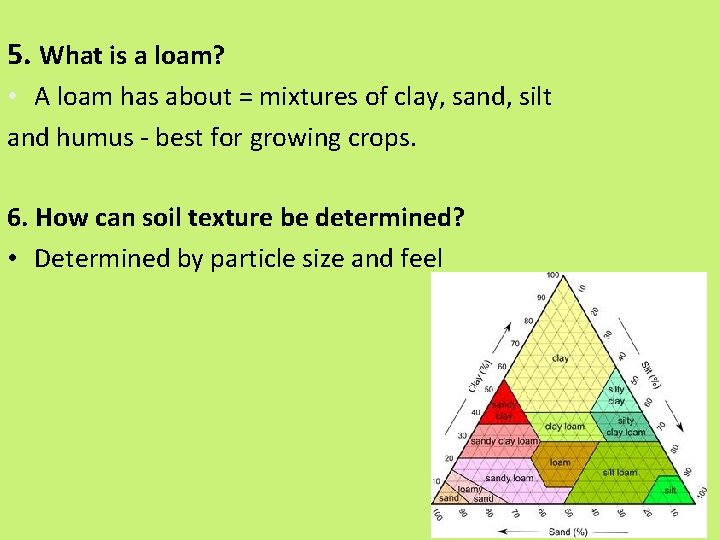
5. What is a loam? • A loam has about = mixtures of clay, sand, silt and humus - best for growing crops. 6. How can soil texture be determined? • Determined by particle size and feel
Soil type 1. What are the main Soil types? There are six main types of soil usually discussed in agriculture, distinguished by the size of the particle matter that makes up the soil. • Sandy (water/minerals easily flow) • Clay (no drainage) • Silty (fertile, good drainage) • Loamy (a mixture of soils) • Chalky (alkaline) • Peaty (acidic , undecomposed organic matter)
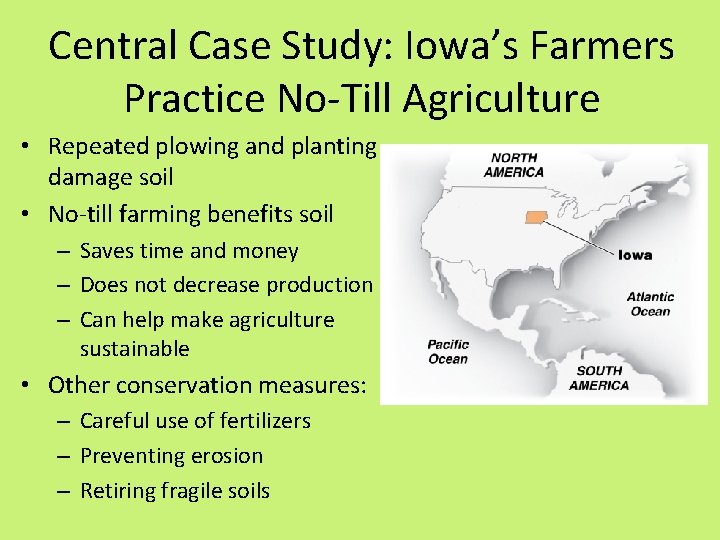
Central Case Study: Iowa’s Farmers Practice No-Till Agriculture • Repeated plowing and planting damage soil • No-till farming benefits soil – Saves time and money – Does not decrease production – Can help make agriculture sustainable • Other conservation measures: – Careful use of fertilizers – Preventing erosion – Retiring fragile soils
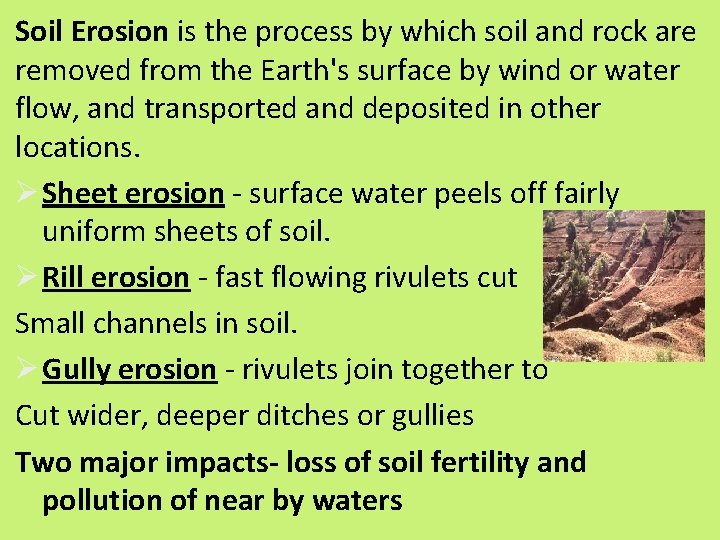
Soil Erosion is the process by which soil and rock are removed from the Earth's surface by wind or water flow, and transported and deposited in other locations. Ø Sheet erosion - surface water peels off fairly uniform sheets of soil. Ø Rill erosion - fast flowing rivulets cut Small channels in soil. Ø Gully erosion - rivulets join together to Cut wider, deeper ditches or gullies Two major impacts- loss of soil fertility and pollution of near by waters
Soil erosion • Soil degradation: loss of soil quality and productivity – Has caused 13% loss of grain production • Each year, we lose 12– 17 million acres of cropland – Erosion, nutrient depletion, water scarcity, salinization, waterlogging, pollution, loss of organic matter • Erosion: removal of material from one place to another – By wind or water – A problem when it happens faster than soil formation • Deposition: arrival of eroded material at a new place
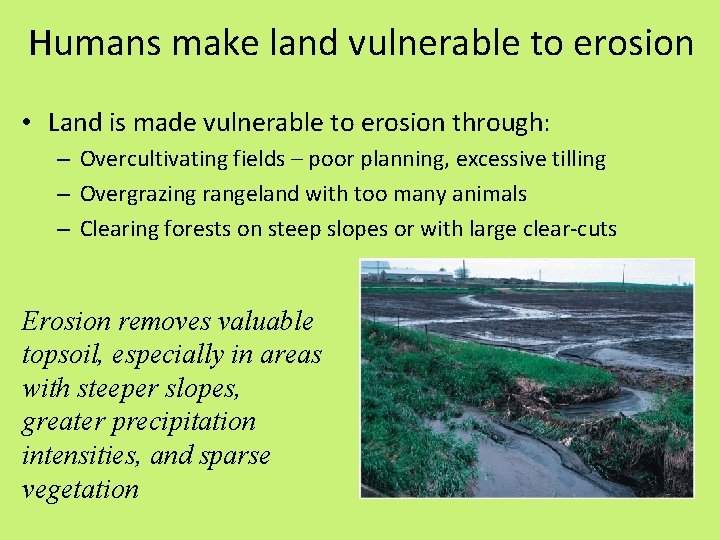
Humans make land vulnerable to erosion • Land is made vulnerable to erosion through: – Overcultivating fields – poor planning, excessive tilling – Overgrazing rangeland with too many animals – Clearing forests on steep slopes or with large clear-cuts Erosion removes valuable topsoil, especially in areas with steeper slopes, greater precipitation intensities, and sparse vegetation
Soil erosion is a global problem • Humans are the primary cause of erosion – It is occurring at unnaturally high rates • In Africa, erosion could reduce crop yields by 50% over the next 40 years • The U. S. loses 5 tons of soil for every ton of grain harvested Degradation of topsoil and decreased crop yields, added to population growth are leading agriculture’s future to a crisis situation
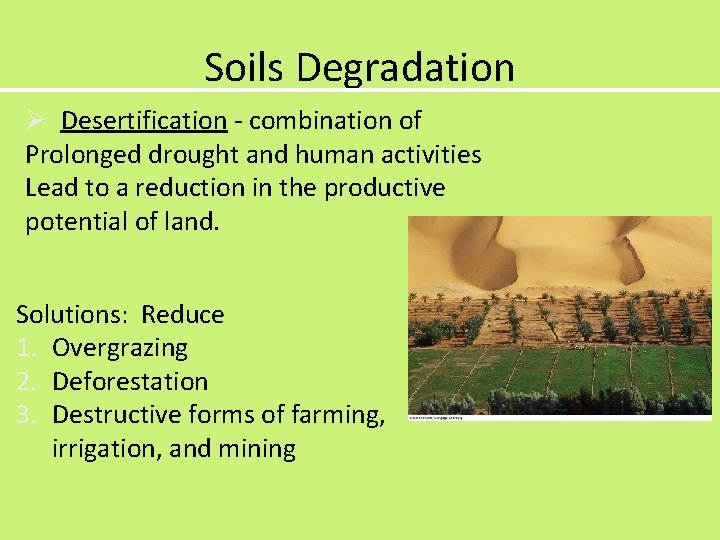
Soils Degradation Ø Desertification - combination of Prolonged drought and human activities Lead to a reduction in the productive potential of land. Solutions: Reduce 1. Overgrazing 2. Deforestation 3. Destructive forms of farming, irrigation, and mining
Desertification reduces productivity • Desertification: a loss of more than 10% productivity – Erosion, soil compaction, deforestation, overgrazing – Drought, salinization, water depletion, climate change • Most prone areas: arid and semi-arid lands (drylands) • Desertification endangers the food supply of 1 billion people in over 100 countries – Costing tens of billions of dollars each year • Climate change will worsen desertification by changing rainfall patterns – 50 million people will be displaced in 10 years
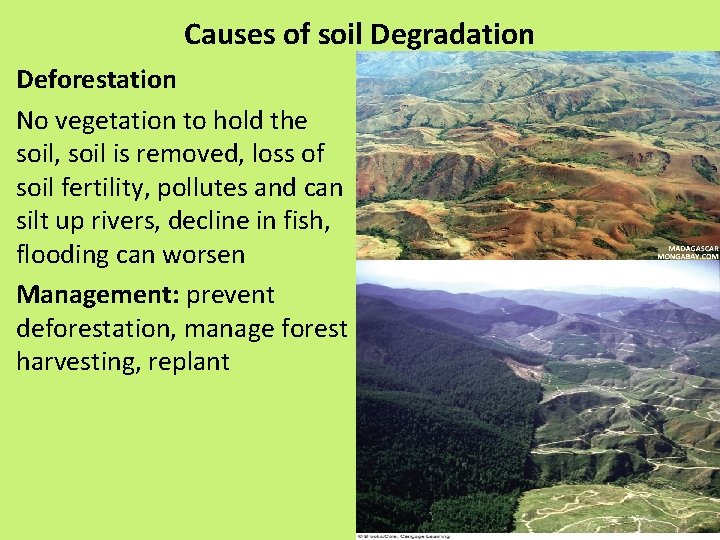
Causes of soil Degradation Deforestation No vegetation to hold the soil, soil is removed, loss of soil fertility, pollutes and can silt up rivers, decline in fish, flooding can worsen Management: prevent deforestation, manage forest harvesting, replant
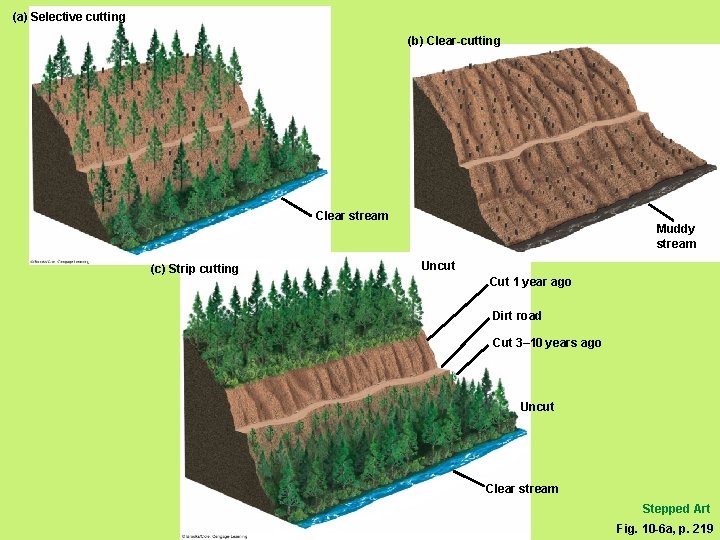
(a) Selective cutting (b) Clear-cutting Clear stream (c) Strip cutting Muddy stream Uncut Cut 1 year ago Dirt road Cut 3– 10 years ago Uncut Clear stream Stepped Art Fig. 10 -6 a, p. 219
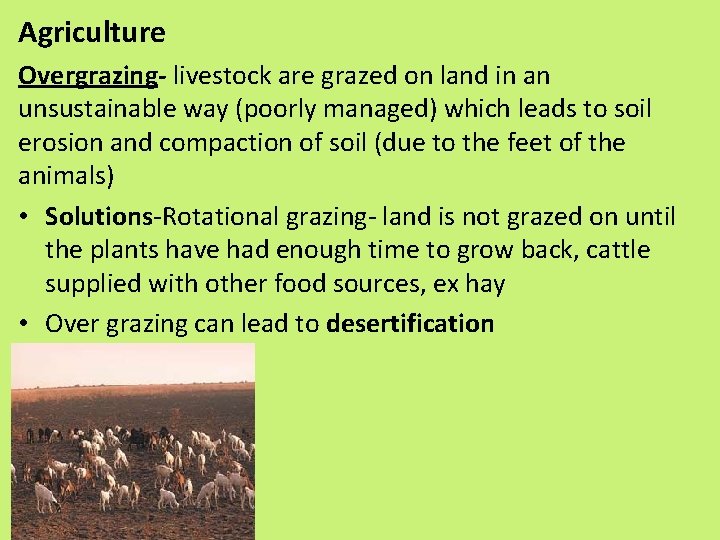
Agriculture Overgrazing- livestock are grazed on land in an unsustainable way (poorly managed) which leads to soil erosion and compaction of soil (due to the feet of the animals) • Solutions-Rotational grazing- land is not grazed on until the plants have had enough time to grow back, cattle supplied with other food sources, ex hay • Over grazing can lead to desertification
Overgrazing causes soil degradation • Humans keep over 3. 4 billion cows, sheep, and goats • Overgrazing: too many animals eat too much of the plant cover and impede plant regrowth – Soil is degraded and compacted – Increased erosion makes it hard for plants to grow – Non-native plants invade, which are less palatable to livestock and outcompete native vegetation • Ranchers in the western U. S. are finding ways to ranch more sustainably and protect the land’s health 70% of the world’s rangeland is degraded, costing $23. 3 billion/year
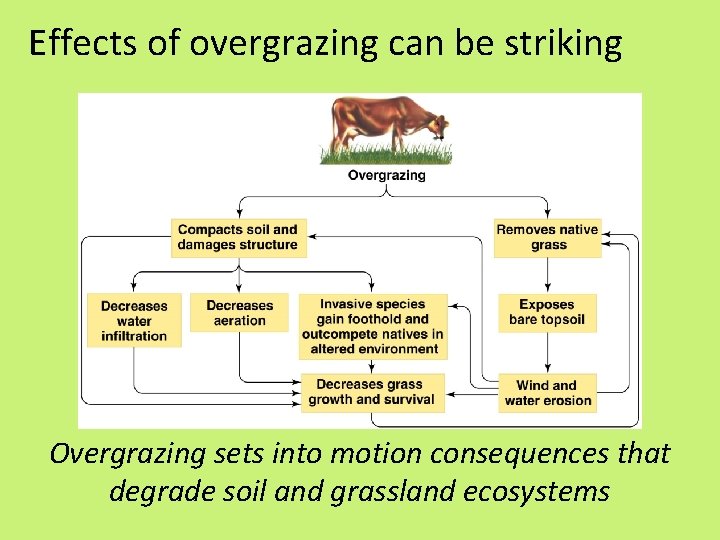
Effects of overgrazing can be striking Overgrazing sets into motion consequences that degrade soil and grassland ecosystems
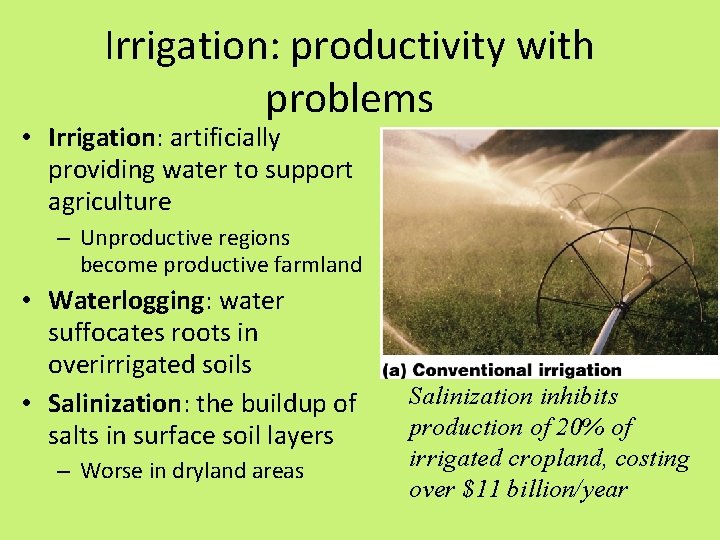
Irrigation: productivity with problems • Irrigation: artificially providing water to support agriculture – Unproductive regions become productive farmland • Waterlogging: water suffocates roots in overirrigated soils • Salinization: the buildup of salts in surface soil layers – Worse in dryland areas Salinization inhibits production of 20% of irrigated cropland, costing over $11 billion/year
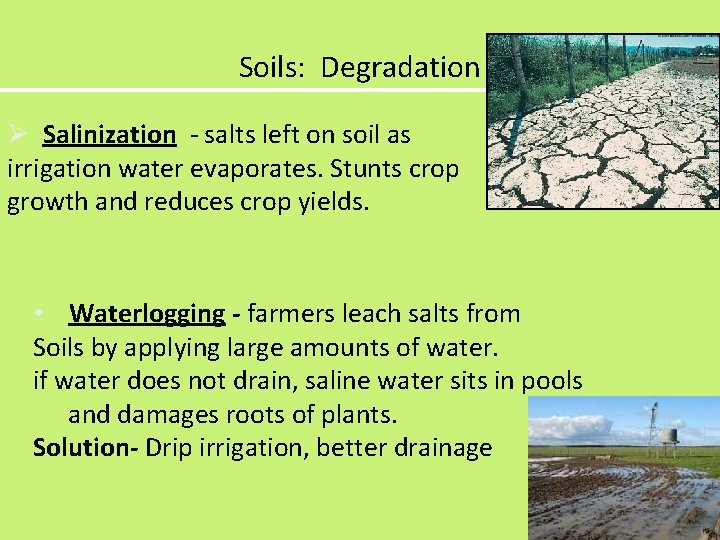
Soils: Degradation Ø Salinization - salts left on soil as irrigation water evaporates. Stunts crop growth and reduces crop yields. • Waterlogging - farmers leach salts from Soils by applying large amounts of water. if water does not drain, saline water sits in pools and damages roots of plants. Solution- Drip irrigation, better drainage
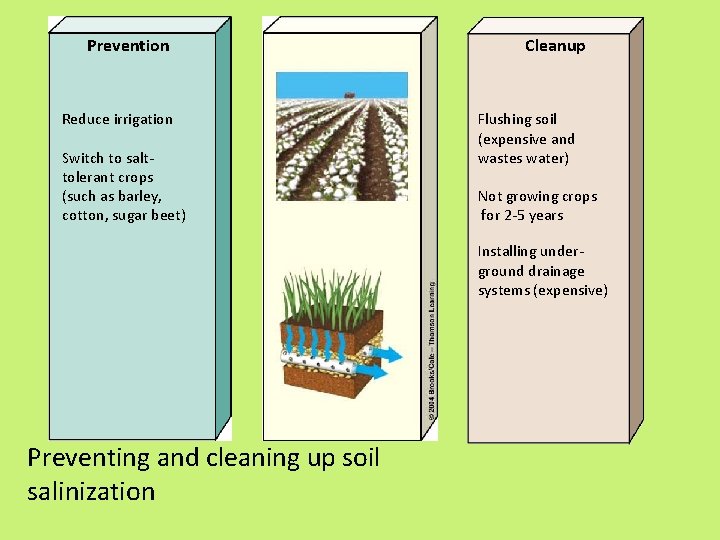
Prevention Reduce irrigation Switch to salttolerant crops (such as barley, cotton, sugar beet) Cleanup Flushing soil (expensive and wastes water) Not growing crops for 2 -5 years Installing underground drainage systems (expensive) Preventing and cleaning up soil salinization
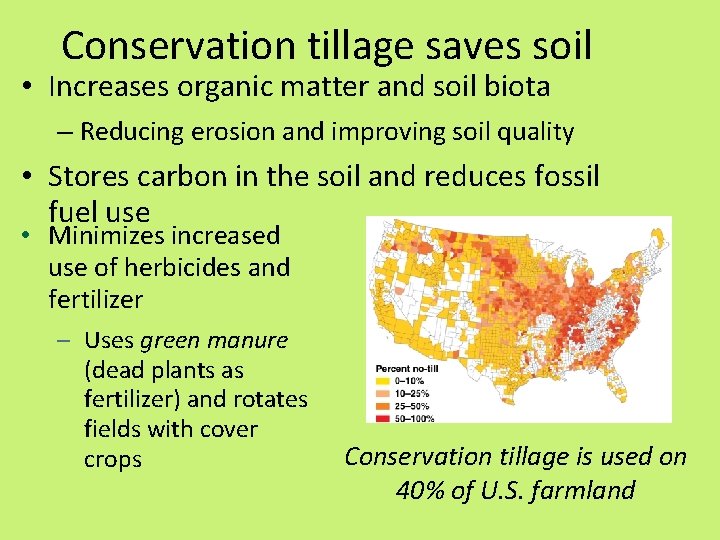
Conservation tillage saves soil • Increases organic matter and soil biota – Reducing erosion and improving soil quality • Stores carbon in the soil and reduces fossil fuel use • Minimizes increased use of herbicides and fertilizer – Uses green manure (dead plants as fertilizer) and rotates fields with cover crops Conservation tillage is used on 40% of U. S. farmland
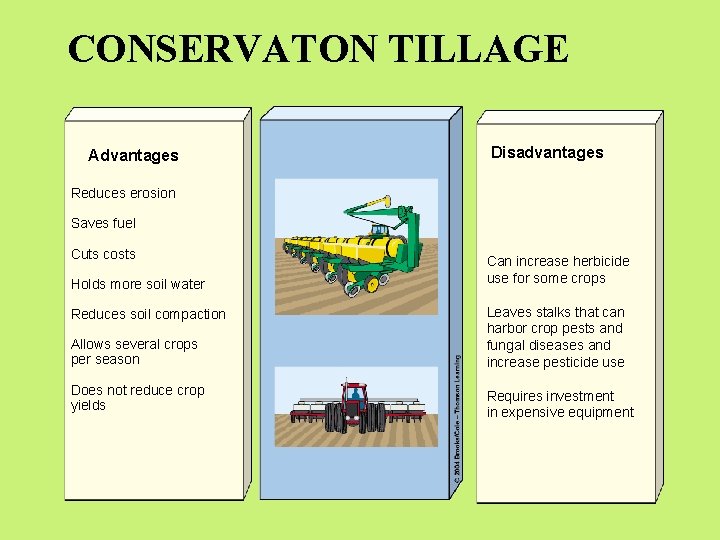
CONSERVATON TILLAGE Advantages Disadvantages Reduces erosion Saves fuel Cuts costs Holds more soil water Reduces soil compaction Allows several crops per season Does not reduce crop yields Can increase herbicide use for some crops Leaves stalks that can harbor crop pests and fungal diseases and increase pesticide use Requires investment in expensive equipment
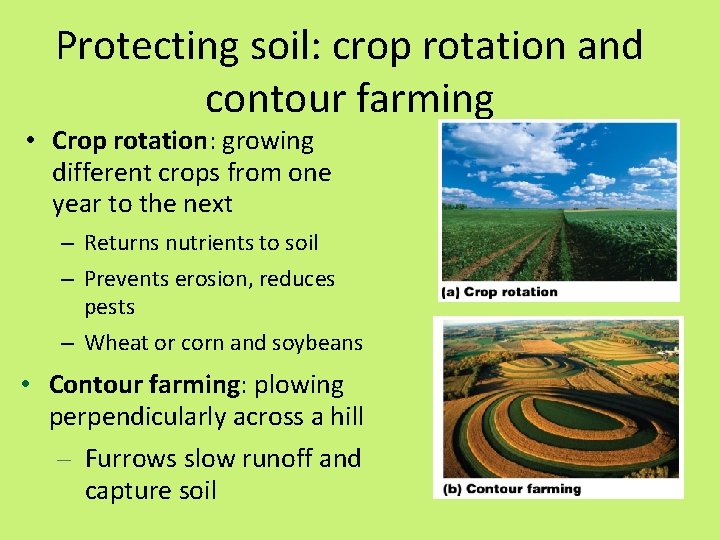
Protecting soil: crop rotation and contour farming • Crop rotation: growing different crops from one year to the next – Returns nutrients to soil – Prevents erosion, reduces pests – Wheat or corn and soybeans • Contour farming: plowing perpendicularly across a hill – Furrows slow runoff and capture soil
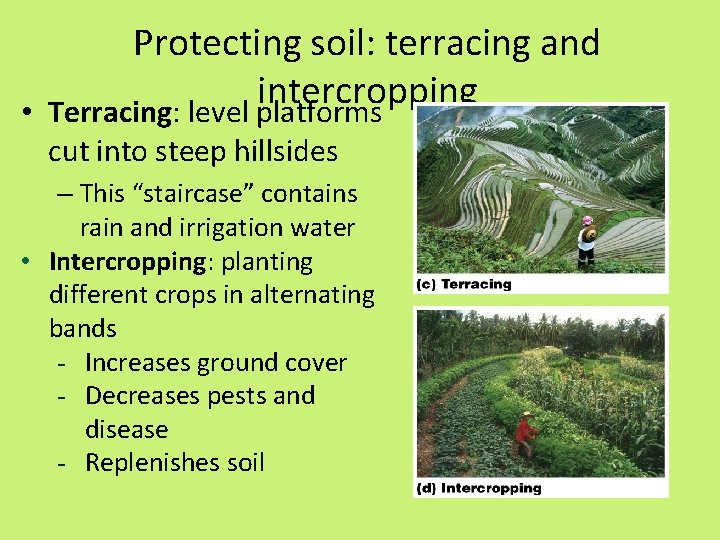
Protecting soil: terracing and intercropping • Terracing: level platforms cut into steep hillsides – This “staircase” contains rain and irrigation water • Intercropping: planting different crops in alternating bands - Increases ground cover - Decreases pests and disease - Replenishes soil
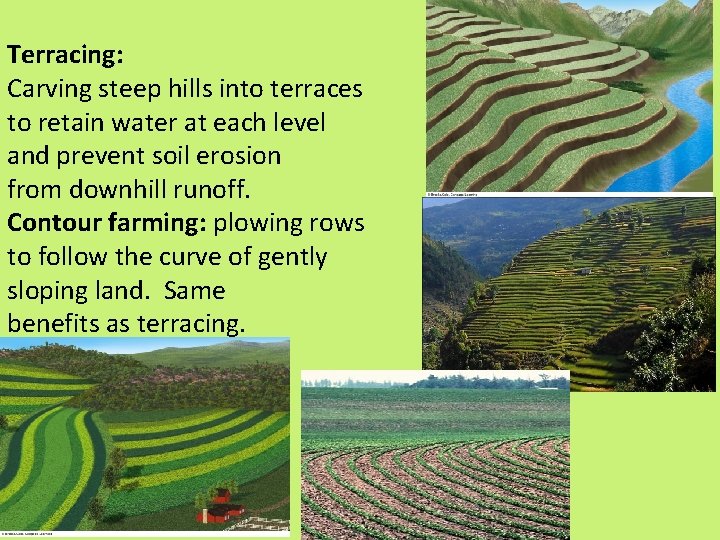
Terracing: Carving steep hills into terraces to retain water at each level and prevent soil erosion from downhill runoff. Contour farming: plowing rows to follow the curve of gently sloping land. Same benefits as terracing. Terracing
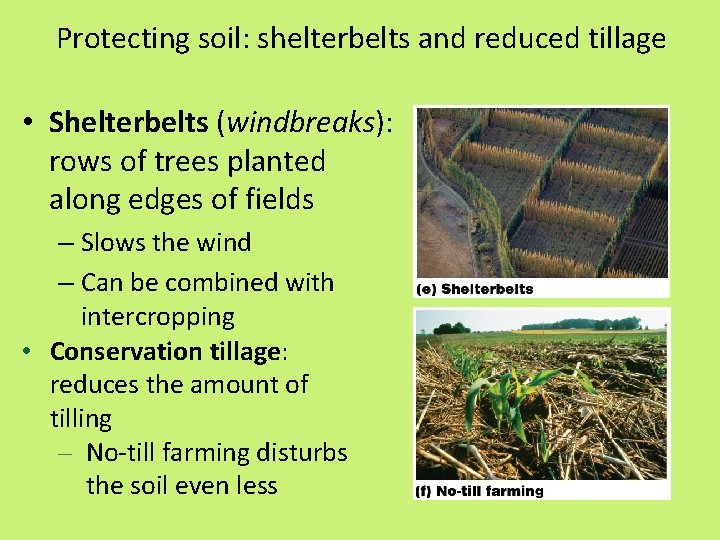
Protecting soil: shelterbelts and reduced tillage • Shelterbelts (windbreaks): rows of trees planted along edges of fields – Slows the wind – Can be combined with intercropping • Conservation tillage: reduces the amount of tilling – No-till farming disturbs the soil even less
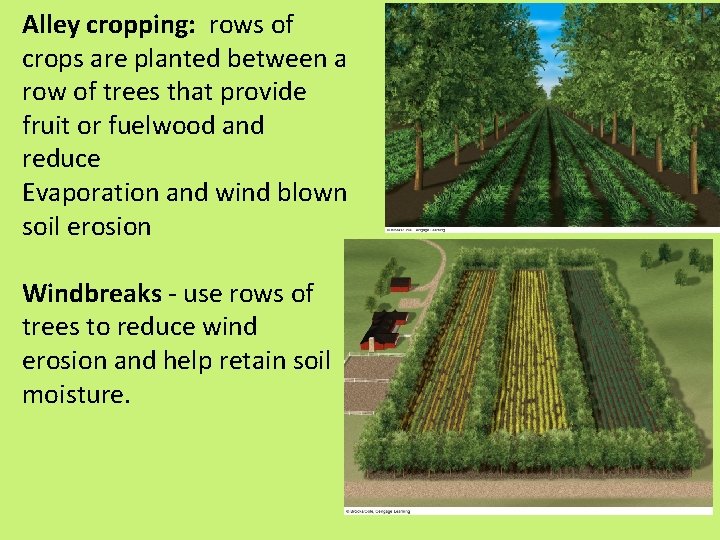
Alley cropping: rows of crops are planted between a row of trees that provide fruit or fuelwood and reduce Evaporation and wind blown soil erosion Windbreaks - use rows of trees to reduce wind erosion and help retain soil moisture.
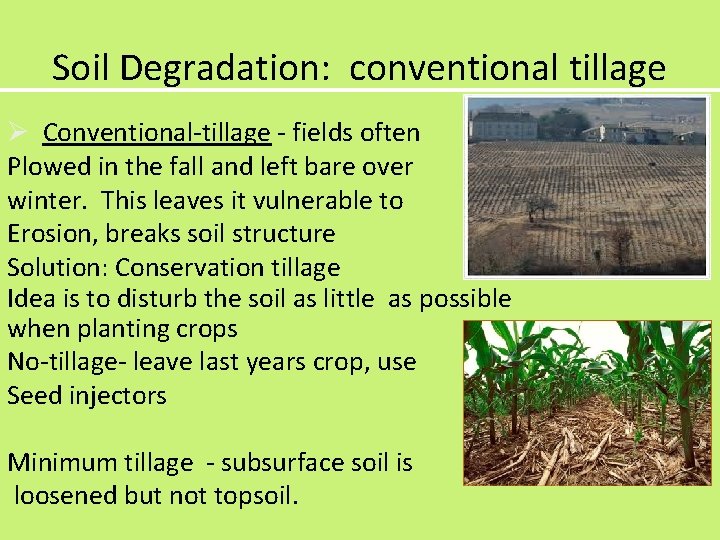
Soil Degradation: conventional tillage Ø Conventional-tillage - fields often Plowed in the fall and left bare over winter. This leaves it vulnerable to Erosion, breaks soil structure Solution: Conservation tillage Idea is to disturb the soil as little as possible when planting crops No-tillage- leave last years crop, use Seed injectors Minimum tillage - subsurface soil is loosened but not topsoil.
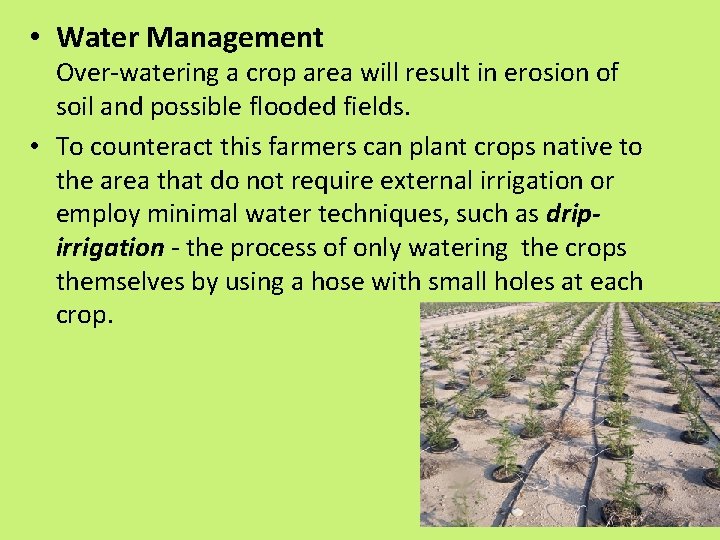
• Water Management Over-watering a crop area will result in erosion of soil and possible flooded fields. • To counteract this farmers can plant crops native to the area that do not require external irrigation or employ minimal water techniques, such as dripirrigation - the process of only watering the crops themselves by using a hose with small holes at each crop.
The changing face of agriculture • 10, 000 years ago, people in different cultures began to raise plants for food and to domesticate animals • Agriculture: practice of raising crops and livestock for human use and consumption • Cropland: land used to raise plants for human use • Rangeland: land used for grazing livestock • Land devoted to agriculture now covers 38% of Earth’s land
The changing face of agriculture • Traditional agriculture: uses human and animal power – Hand tools, simple machines – Polyculture: different crops are planted in one field • Industrial agriculture: uses large-scale machines and fossil fuels to boost yields – Also uses irrigation, fertilizers, and pesticides • Monoculture: planting a single, genetically similar crop – More efficient but reduces diversity, is disease prone – Narrows the human diet – Used in industrial agriculture
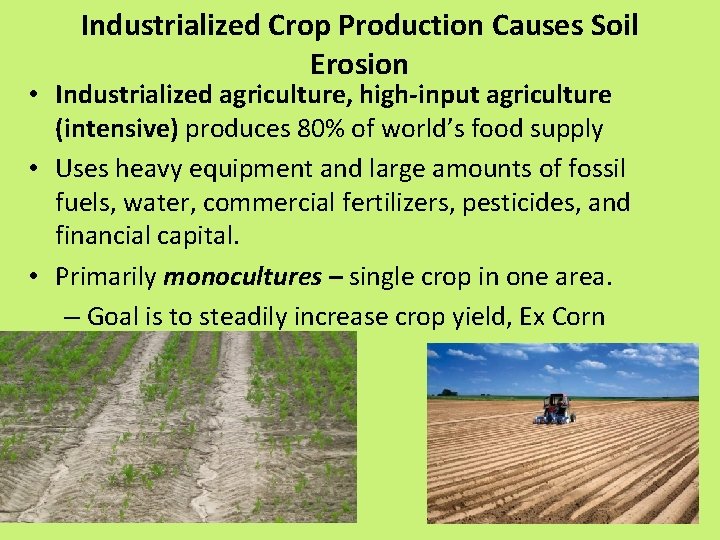
Industrialized Crop Production Causes Soil Erosion • Industrialized agriculture, high-input agriculture (intensive) produces 80% of world’s food supply • Uses heavy equipment and large amounts of fossil fuels, water, commercial fertilizers, pesticides, and financial capital. • Primarily monocultures – single crop in one area. – Goal is to steadily increase crop yield, Ex Corn
The effects of industrialized agriculture • Industrial agriculture has allowed food production to keep pace with population growth – But it has many bad environmental and social effects • Benefits: increases crop yields while reducing pressure to develop natural areas for new farms • Drawbacks: water, fossil fuels, fertilizers, pesticides worsen pollution, erosion, and desertification – Requires far more energy than traditional methods – Displaces low-income farmers who can’t afford the technology, forcing them to move to cities
Sustainable agriculture • Suitable farmland is disappearing – We must improve the efficiency of production • It is better to raise animals and crops that pollute less, require less fuels, and have less impact on natural systems • Sustainable agriculture: maintains healthy soil, clean water, and genetic diversity – Treats agricultural systems as ecosystems • Low-input agriculture: uses smaller amounts of – Pesticide, fertilizers, growth hormones, antibiotics, water, and fossil fuels than industrial agriculture
- Slides: 48