
SOIL PROFILE This is the vertical crosssection through
- Slides: 10
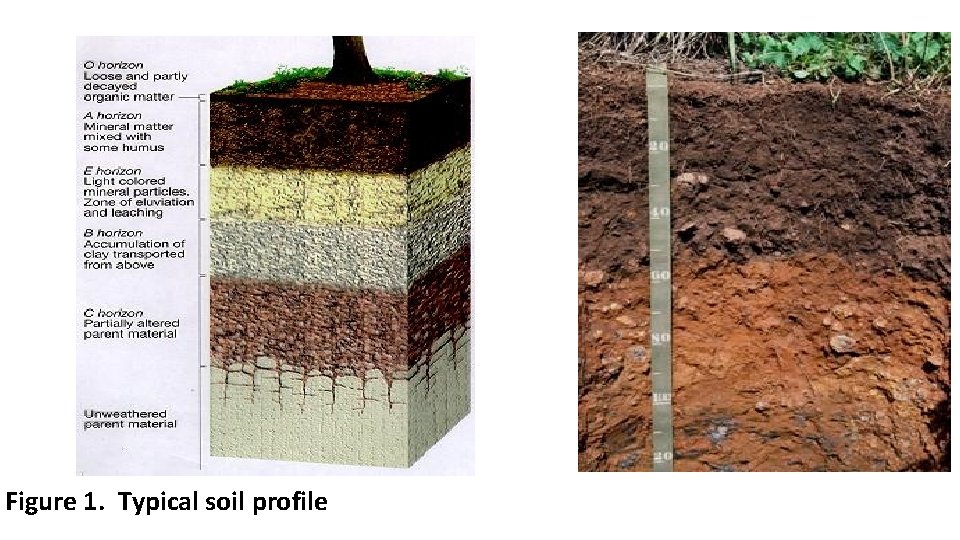
SOIL PROFILE Ø This is the vertical cross-section through a soil typically represented by a layered pattern. Ø These individual layers are also called "horizons". Ø The uppermost layer includes the "surface soil" or "topsoil" and is designated the A horizon; a layer which is most subject to climatic and biological influence. It is usually the layer of maximum organic accumulation, has a darker color, and has less clay than subsoil. Ø The next successive horizon is called the "subsoil" or B horizon; it is a layer which commonly accumulates materials that have migrated downward from the surface Ø Materials such as clay particles, iron and aluminum oxides, calcium carbonate, calcium sulfate e. t. c. ; accumulation of these materials creates a layer which is normally more compact and has more clay than the surface Ø The parent material (C horizon) is the least affected by physical, chemical and biological weathering agents ; It is very similar in chemical composition to the original material from which the A and B horizons were formed. Ø The soil profile is an important consideration in terms of plant growth. The depth of the soil, its texture and structure, its chemical nature as well as the soil position on the landscape and slope of the land largely determine crop production potential
Figure 1. Typical soil profile
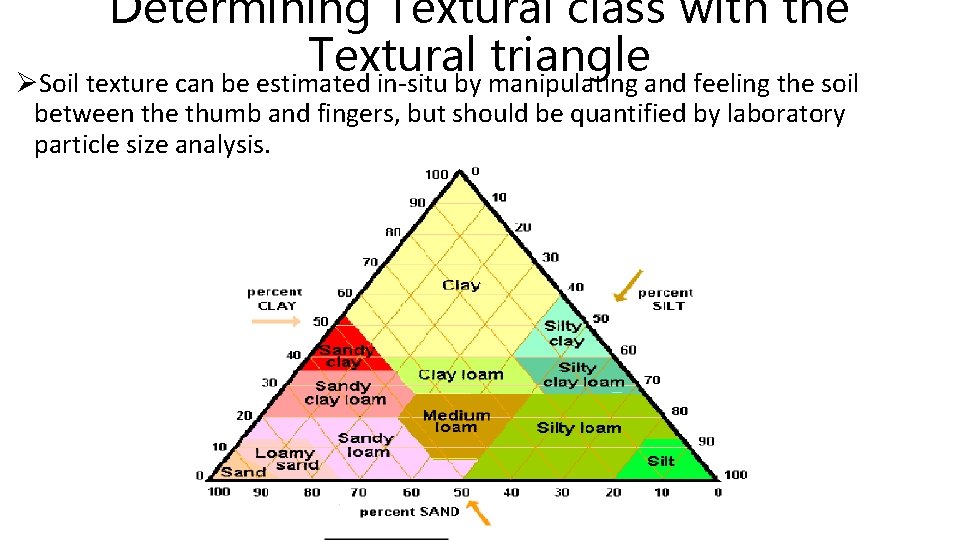
Texture; ØThe fineness or coarseness of the mineral particles in the soil is referred to as soil texture. ØSoil texture is determined by the relative amounts of sand, silt and clay in the fine earth (≤ 2 mm) fraction; a) Sand particles vary in size from very fine (0. 05 mm) to very coarse (2. 0 mm) in average diameter. b) Silt particles range in size from 0. 05 mm – 0. 002 mm. When moistened, silt feels smooth but not slick/sticky. When dry it is smooth and floury c) Clay is the finest soil particle class. Individual particles are finer than 0. 002 mm. Extremely smooth or powdery when dry and become plastic and sticky when wet.
Determining Textural class with the Textural triangle ØSoil texture can be estimated in-situ by manipulating and feeling the soil between the thumb and fingers, but should be quantified by laboratory particle size analysis.
Effect of texture on Soil Properties ØWater infiltrates more quickly and moves more freely in coarse-textured or sandy soils, which increases the potential for leaching of mobile nutrients. ØSandy soils holds less water and fewer nutrients for plants than fine textured soils. ØThe relatively low water holding capacity and the larger amount of air present in sandy soils allows them to warm faster than fine-textured soils. ØSandy and loamy soils are also more easily tilled than clayey soils, which tend to be denser (compact). ØFine-textured soils hold more water and plant nutrients and thus require less frequent applications of water, lime and fertilizer. ØSoils with high clay content (more than 40%), however, actually hold less plantavailable water than loamy soils.
ØFine textured soils have a narrower range of moisture conditions under which they can be worked satisfactorily than sandy soils. ØSoils high in silt and clay may form surface crust after rains impeding seedling emergence. ØHigh clay soils often break up into large clods when worked either too dry or too wet.
Aggregate; Ø Soil aggregate is the cementing of several soil particles into a secondary unit or aggregate. ØSoil particles can be arranged or grouped together during the aggregation process to form structural units (peds). These units vary in size, shape and distinctness (strength/grade). ØStructure type and Pictorial description :
Effect of structure on Soil ØThe structure of the soil affects. Properties pore space size, distribution, rates of water and air movement. ØA well developed structure allows favourable movement of air and water. ØA well developed structure also encourages extensive root development ØWater enters a soil surface that has granular structure more rapidly than one with relatively little structure ØSurface soil structure is usually granular, but this granules may become absent if the soil is continuously tilled or if organic matter is low. [s, s, & s] ØSandy soils generally have poorly developed structure relative to fine textured soils
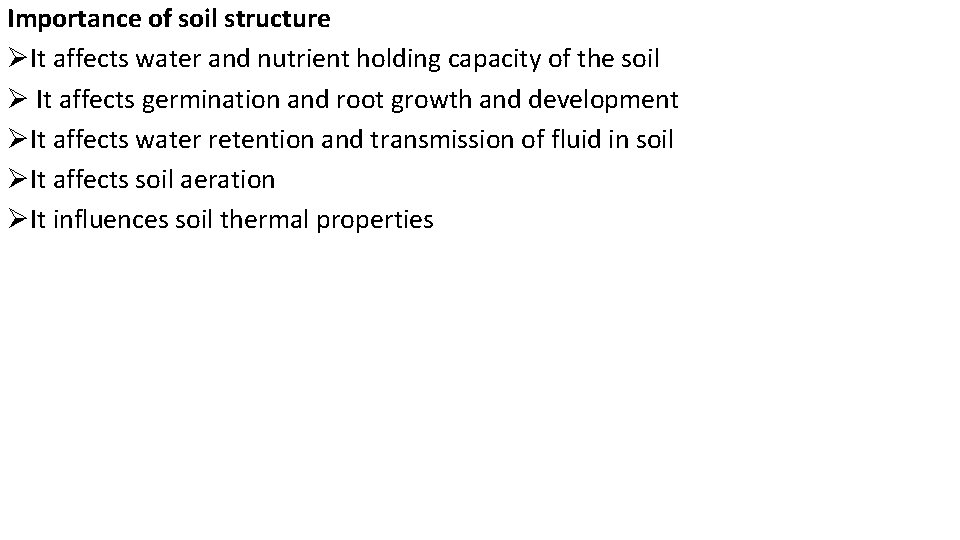
Importance of soil structure ØIt affects water and nutrient holding capacity of the soil Ø It affects germination and root growth and development ØIt affects water retention and transmission of fluid in soil ØIt affects soil aeration ØIt influences soil thermal properties
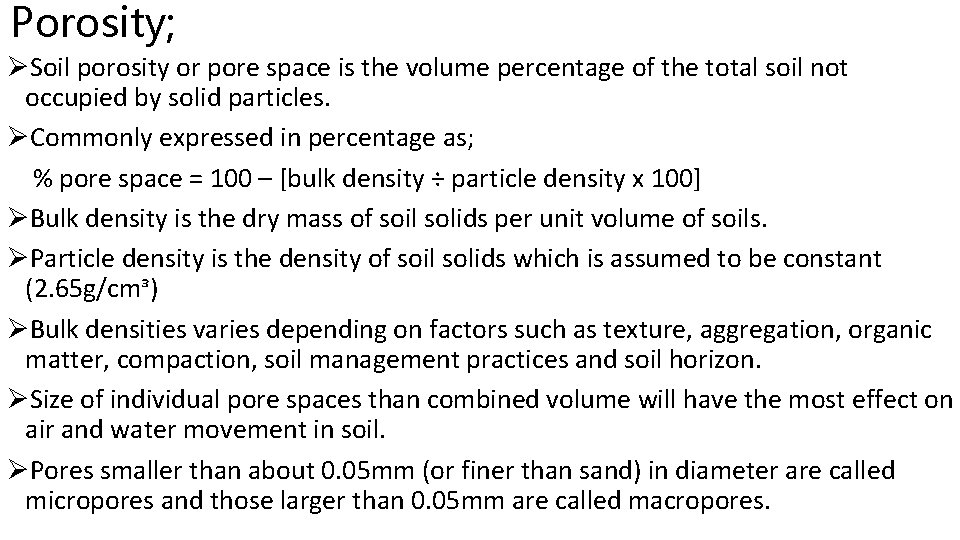
Porosity; ØSoil porosity or pore space is the volume percentage of the total soil not occupied by solid particles. ØCommonly expressed in percentage as; % pore space = 100 – [bulk density ÷ particle density x 100] ØBulk density is the dry mass of soil solids per unit volume of soils. ØParticle density is the density of soil solids which is assumed to be constant (2. 65 g/cmᵌ) ØBulk densities varies depending on factors such as texture, aggregation, organic matter, compaction, soil management practices and soil horizon. ØSize of individual pore spaces than combined volume will have the most effect on air and water movement in soil. ØPores smaller than about 0. 05 mm (or finer than sand) in diameter are called micropores and those larger than 0. 05 mm are called macropores.