
Soil Moisture from Remote Sensing METOP ASCAT Soil
- Slides: 37
Soil Moisture from Remote Sensing: METOP ASCAT Soil Moisture Retrieval Sebastian Hahn shahn@ipf. tuwien. ac. at Research Group Photogrammetry and Remote Sensing Department of Geodesy and Geoinformation Vienna University of Technology www. ipf. tuwien. ac. at/radar
Outline § § § Introduction to Soil Moisture Microwave properties Remote Sensing of soil moisture • • • § TU Wien Soil Moisture Retrieval • • • § SMOS SMAP METOP ASCAT Assumption Processing steps Limitations Conclusion 2
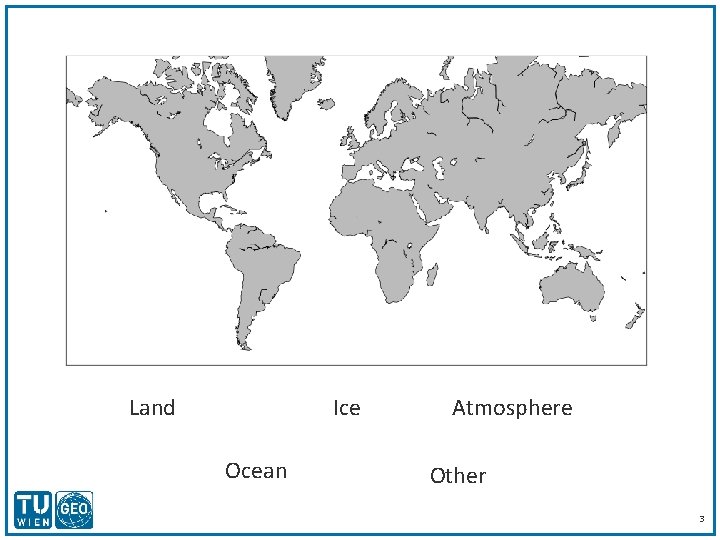
Land Ice Ocean Atmosphere Other 3
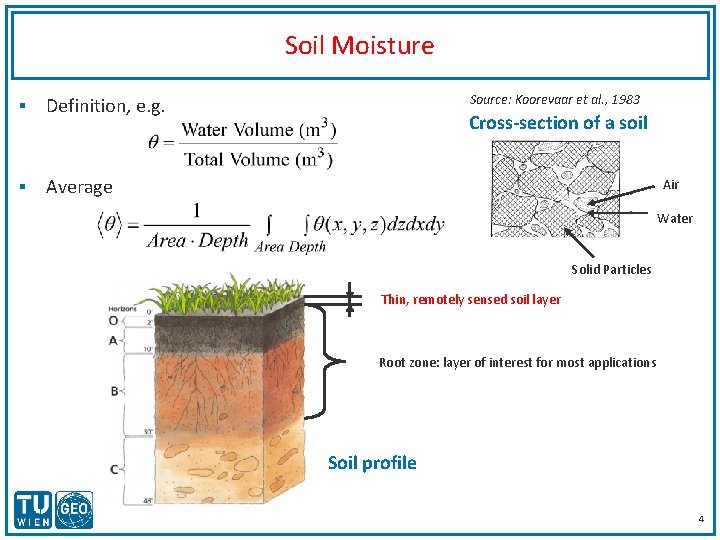
Soil Moisture § Definition, e. g. § Average Source: Koorevaar et al. , 1983 Cross-section of a soil Air Water Solid Particles Thin, remotely sensed soil layer Root zone: layer of interest for most applications Soil profile 4
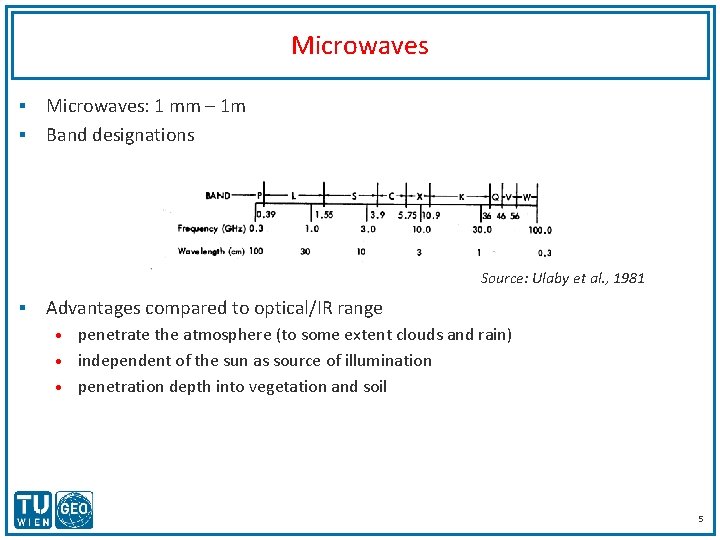
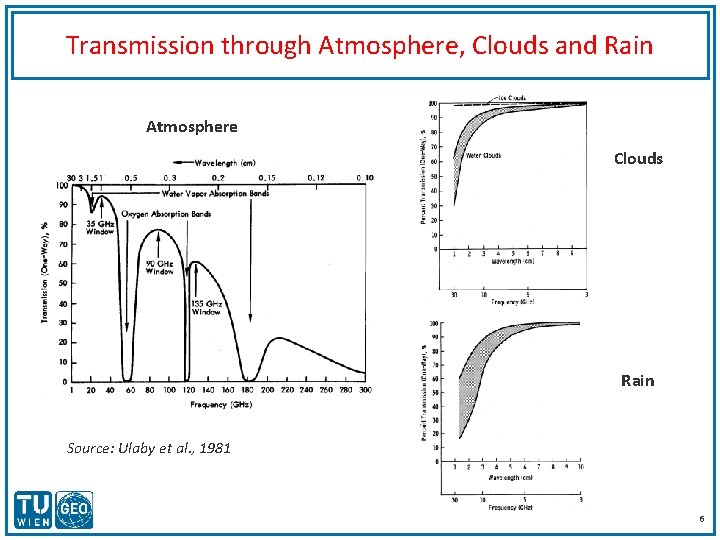
Microwaves: 1 mm – 1 m § Band designations § Source: Ulaby et al. , 1981 § Advantages compared to optical/IR range penetrate the atmosphere (to some extent clouds and rain) • independent of the sun as source of illumination • penetration depth into vegetation and soil • 5
Transmission through Atmosphere, Clouds and Rain Atmosphere Clouds Rain Source: Ulaby et al. , 1981 6
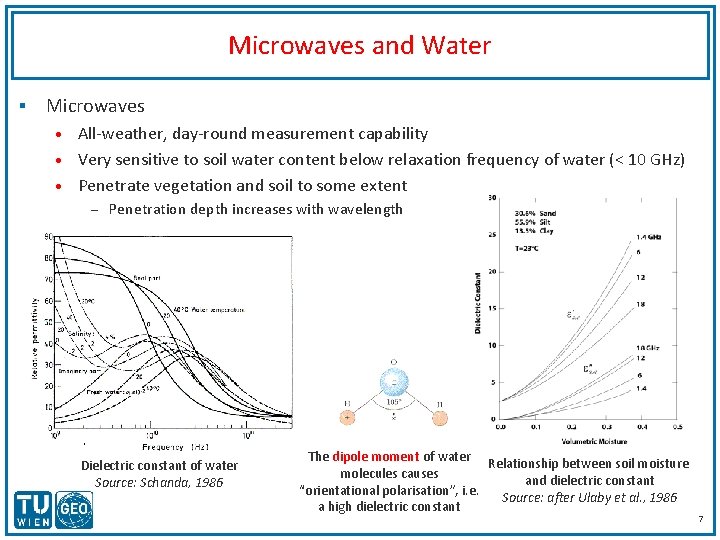
Microwaves and Water § Microwaves All-weather, day-round measurement capability • Very sensitive to soil water content below relaxation frequency of water (< 10 GHz) • Penetrate vegetation and soil to some extent • – Penetration depth increases with wavelength Dielectric constant of water Source: Schanda, 1986 The dipole moment of water Relationship between soil moisture molecules causes and dielectric constant “orientational polarisation”, i. e. Source: after Ulaby et al. , 1986 a high dielectric constant 7
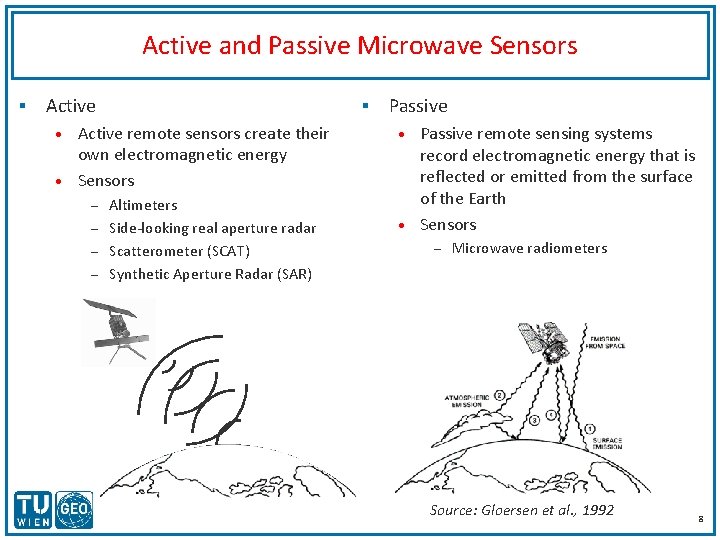
Active and Passive Microwave Sensors § Active remote sensors create their own electromagnetic energy • Sensors • – – Altimeters Side-looking real aperture radar Scatterometer (SCAT) Synthetic Aperture Radar (SAR) Passive remote sensing systems record electromagnetic energy that is reflected or emitted from the surface of the Earth • Sensors • – Microwave radiometers Source: Gloersen et al. , 1992 8
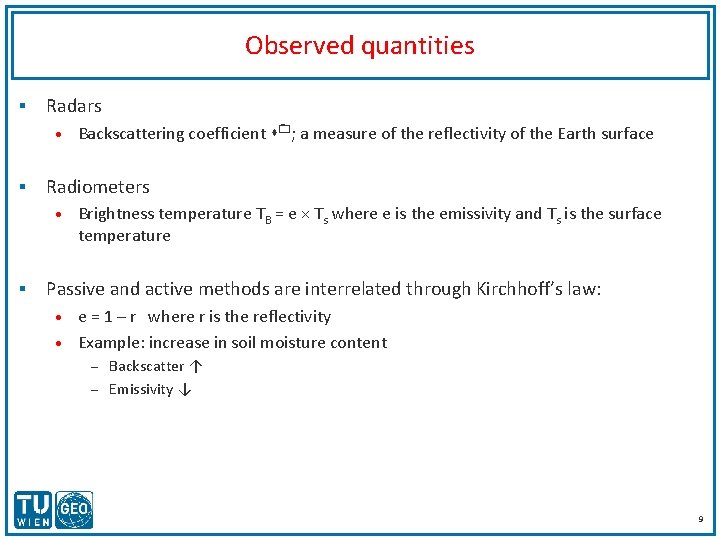
Observed quantities § Radars • § Radiometers • § Backscattering coefficient s 0; a measure of the reflectivity of the Earth surface Brightness temperature TB = e × Ts where e is the emissivity and Ts is the surface temperature Passive and active methods are interrelated through Kirchhoff’s law: e = 1 – r where r is the reflectivity • Example: increase in soil moisture content • – – Backscatter ↑ Emissivity ↓ 9
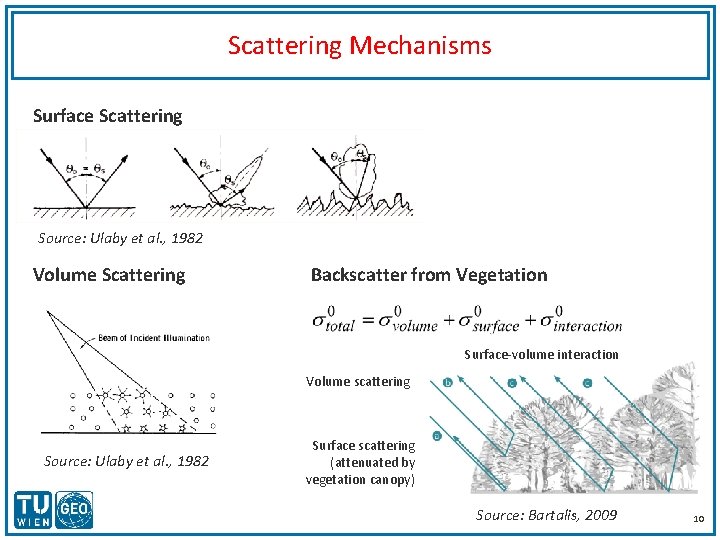
Scattering Mechanisms Surface Scattering Source: Ulaby et al. , 1982 Volume Scattering Backscatter from Vegetation Surface-volume interaction Volume scattering Source: Ulaby et al. , 1982 Surface scattering (attenuated by vegetation canopy) Source: Bartalis, 2009 10
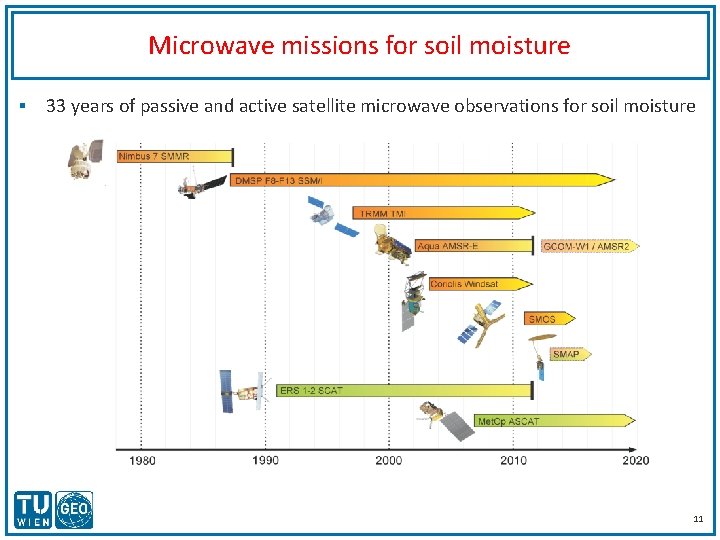
Microwave missions for soil moisture § 33 years of passive and active satellite microwave observations for soil moisture 11
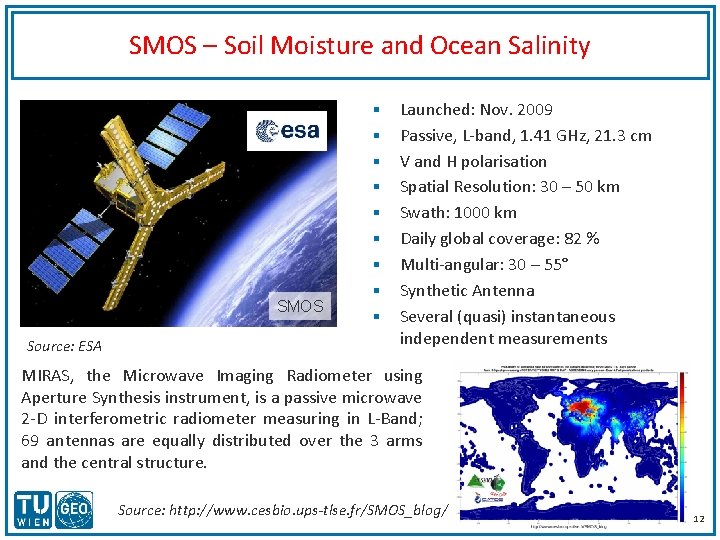
SMOS – Soil Moisture and Ocean Salinity § § § § SMOS Source: ESA § § Launched: Nov. 2009 Passive, L-band, 1. 41 GHz, 21. 3 cm V and H polarisation Spatial Resolution: 30 – 50 km Swath: 1000 km Daily global coverage: 82 % Multi-angular: 30 – 55° Synthetic Antenna Several (quasi) instantaneous independent measurements MIRAS, the Microwave Imaging Radiometer using Aperture Synthesis instrument, is a passive microwave 2 -D interferometric radiometer measuring in L-Band; 69 antennas are equally distributed over the 3 arms and the central structure. Source: http: //www. cesbio. ups-tlse. fr/SMOS_blog/ 12
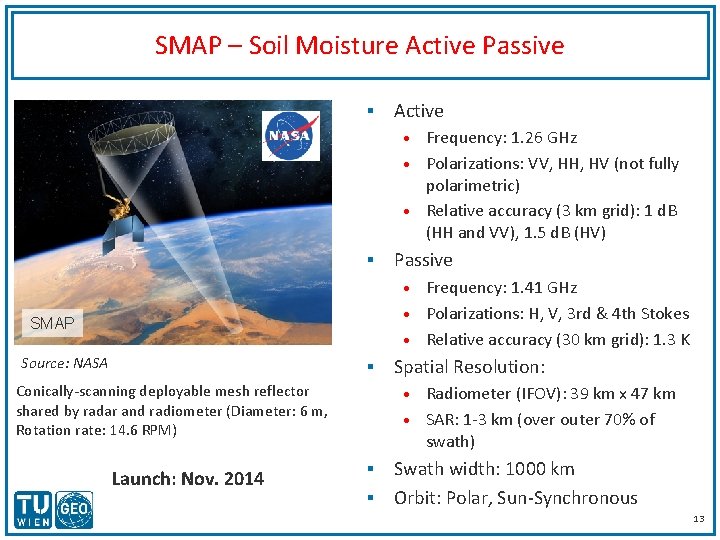
SMAP – Soil Moisture Active Passive § Active Frequency: 1. 26 GHz • Polarizations: VV, HH, HV (not fully polarimetric) • Relative accuracy (3 km grid): 1 d. B (HH and VV), 1. 5 d. B (HV) • § Passive Frequency: 1. 41 GHz • Polarizations: H, V, 3 rd & 4 th Stokes • Relative accuracy (30 km grid): 1. 3 K • SMAP Source: NASA § Conically-scanning deployable mesh reflector shared by radar and radiometer (Diameter: 6 m, Rotation rate: 14. 6 RPM) Launch: Nov. 2014 Spatial Resolution: Radiometer (IFOV): 39 km x 47 km • SAR: 1 -3 km (over outer 70% of swath) • Swath width: 1000 km § Orbit: Polar, Sun-Synchronous § 13
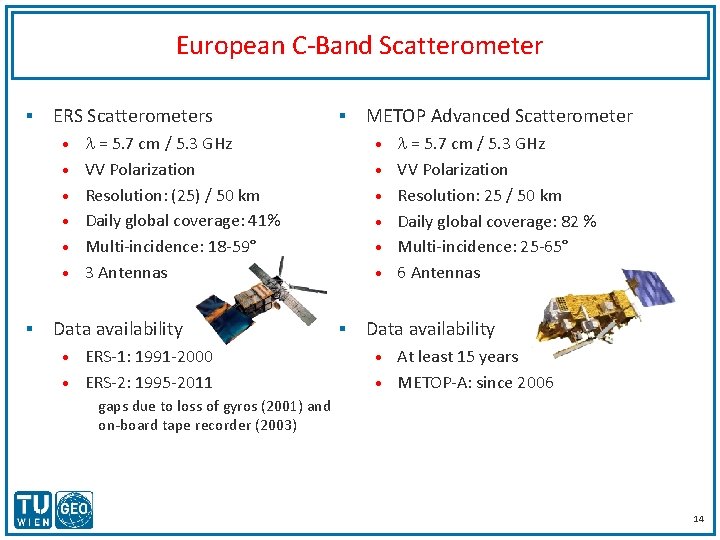
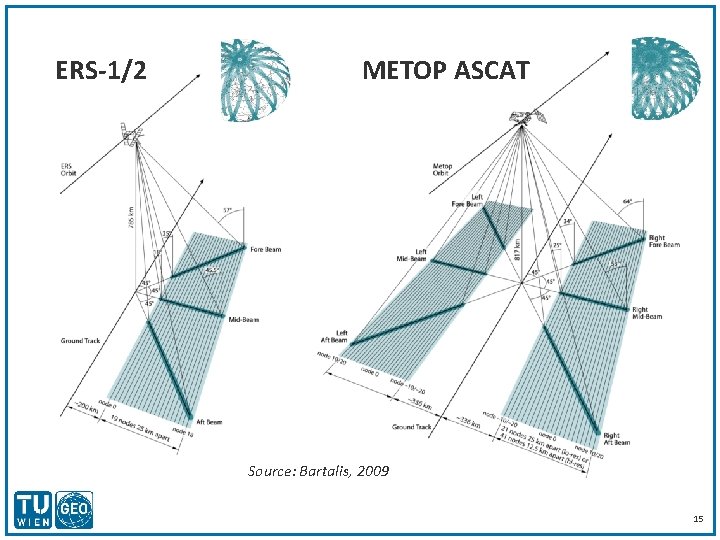
European C-Band Scatterometer § ERS Scatterometers • • • § § = 5. 7 cm / 5. 3 GHz VV Polarization Resolution: (25) / 50 km Daily global coverage: 41% Multi-incidence: 18 -59° 3 Antennas Data availability ERS-1: 1991 -2000 • ERS-2: 1995 -2011 • METOP Advanced Scatterometer • • • § = 5. 7 cm / 5. 3 GHz VV Polarization Resolution: 25 / 50 km Daily global coverage: 82 % Multi-incidence: 25 -65° 6 Antennas Data availability At least 15 years • METOP-A: since 2006 • gaps due to loss of gyros (2001) and on-board tape recorder (2003) 14
ERS-1/2 METOP ASCAT Source: Bartalis, 2009 15
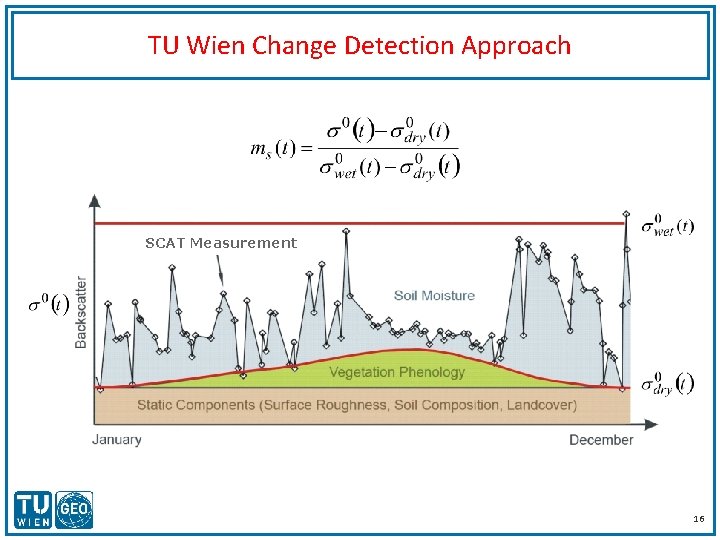
TU Wien Change Detection Approach SCAT Measurement 16
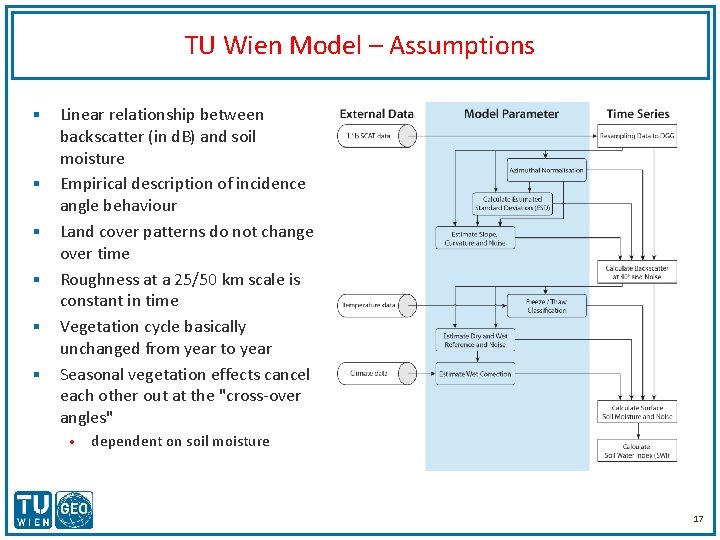
TU Wien Model – Assumptions § § § Linear relationship between backscatter (in d. B) and soil moisture Empirical description of incidence angle behaviour Land cover patterns do not change over time Roughness at a 25/50 km scale is constant in time Vegetation cycle basically unchanged from year to year Seasonal vegetation effects cancel each other out at the "cross-over angles" • dependent on soil moisture 17
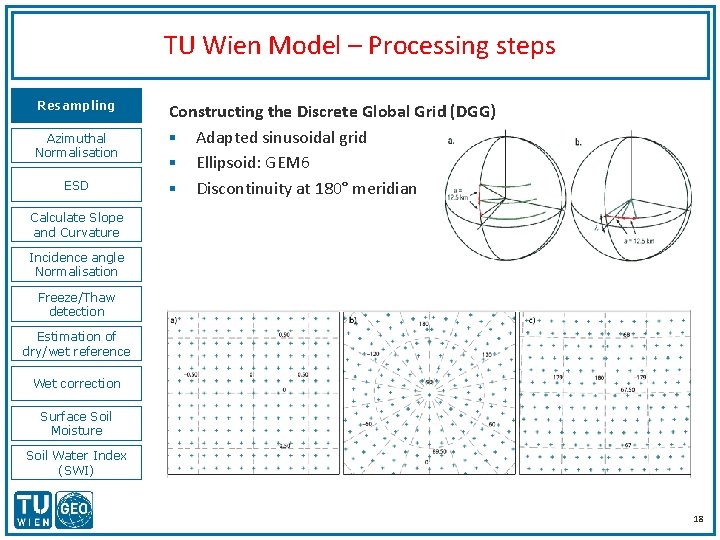
TU Wien Model – Processing steps Resampling Azimuthal Normalisation ESD Constructing the Discrete Global Grid (DGG) § Adapted sinusoidal grid § Ellipsoid: GEM 6 § Discontinuity at 180° meridian Calculate Slope and Curvature Incidence angle Normalisation Freeze/Thaw detection Estimation of dry/wet reference Wet correction Surface Soil Moisture Soil Water Index (SWI) 18
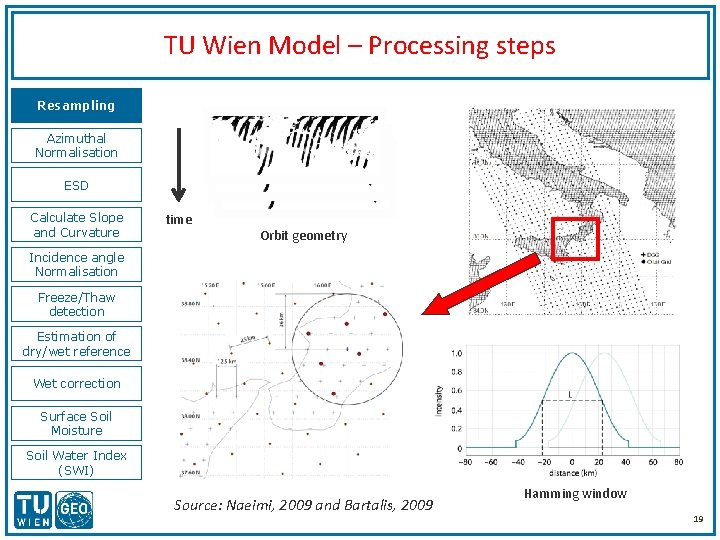
TU Wien Model – Processing steps Resampling Azimuthal Normalisation ESD Calculate Slope and Curvature time Orbit geometry Incidence angle Normalisation Freeze/Thaw detection Estimation of dry/wet reference Wet correction Surface Soil Moisture Soil Water Index (SWI) Source: Naeimi, 2009 and Bartalis, 2009 Hamming window 19
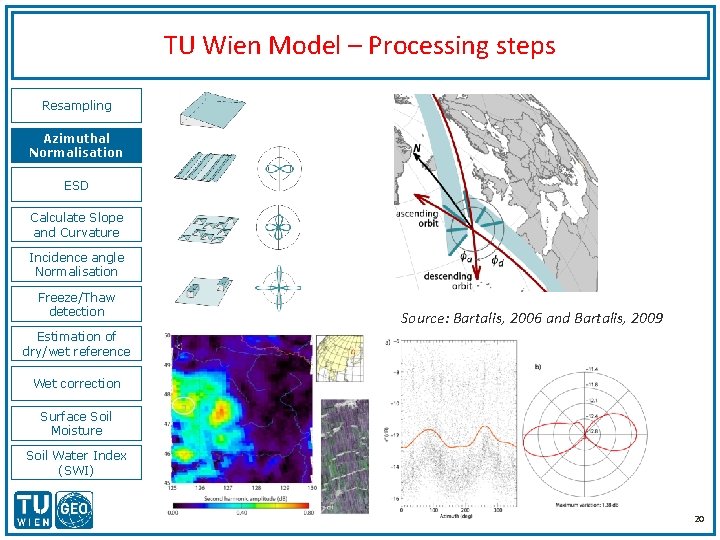
TU Wien Model – Processing steps Resampling Azimuthal Normalisation ESD Calculate Slope and Curvature Incidence angle Normalisation Freeze/Thaw detection Source: Bartalis, 2006 and Bartalis, 2009 Estimation of dry/wet reference Wet correction Surface Soil Moisture Soil Water Index (SWI) 20
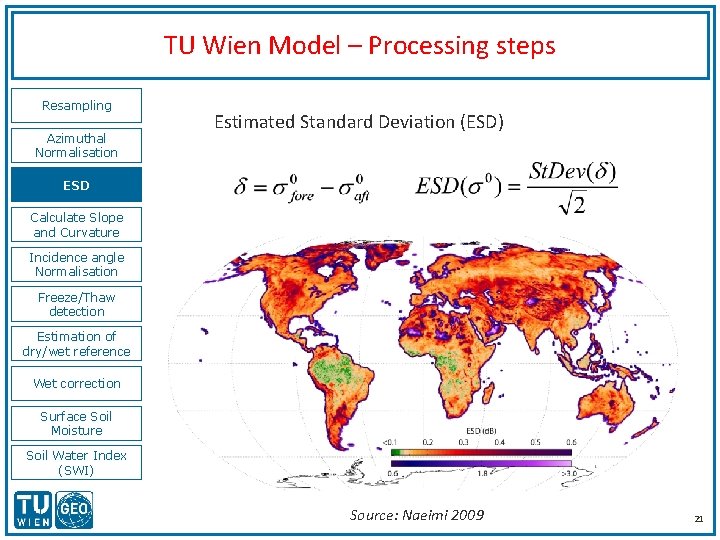
TU Wien Model – Processing steps Resampling Azimuthal Normalisation Estimated Standard Deviation (ESD) ESD Calculate Slope and Curvature Incidence angle Normalisation Freeze/Thaw detection Estimation of dry/wet reference Wet correction Surface Soil Moisture Soil Water Index (SWI) Source: Naeimi 2009 21
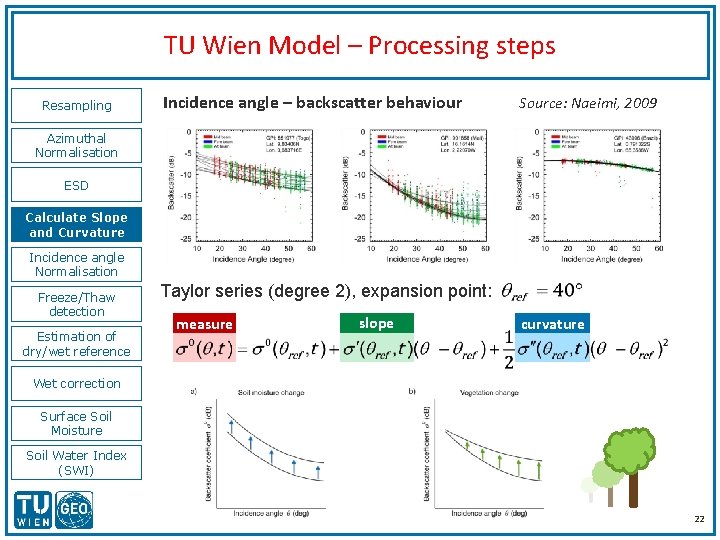
TU Wien Model – Processing steps Resampling Incidence angle – backscatter behaviour Source: Naeimi, 2009 Azimuthal Normalisation ESD Calculate Slope and Curvature Incidence angle Normalisation Freeze/Thaw detection Estimation of dry/wet reference Taylor series (degree 2), expansion point: measure slope curvature Wet correction Surface Soil Moisture Soil Water Index (SWI) 22
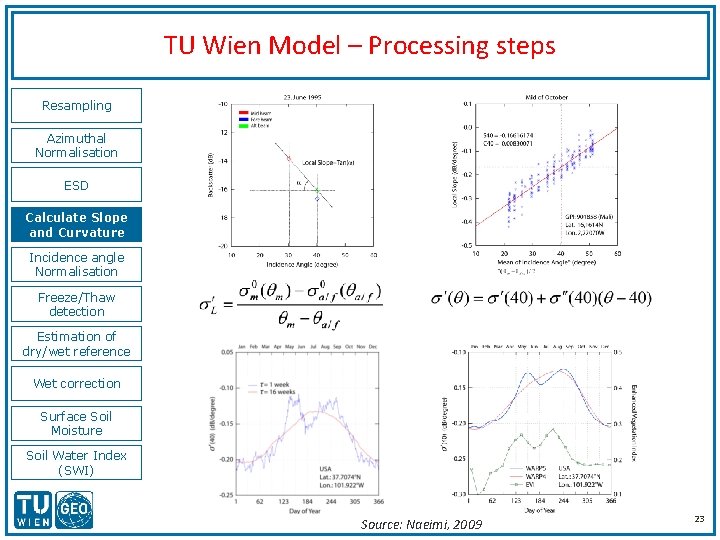
TU Wien Model – Processing steps Resampling Azimuthal Normalisation ESD Calculate Slope and Curvature Incidence angle Normalisation Freeze/Thaw detection Estimation of dry/wet reference Wet correction Surface Soil Moisture Soil Water Index (SWI) Source: Naeimi, 2009 23
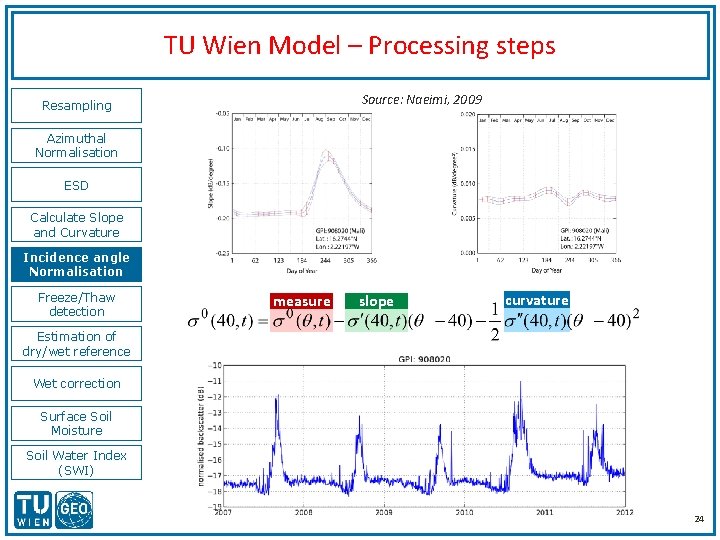
TU Wien Model – Processing steps Source: Naeimi, 2009 Resampling Azimuthal Normalisation ESD Calculate Slope and Curvature Incidence angle Normalisation Freeze/Thaw detection measure slope curvature Estimation of dry/wet reference Wet correction Surface Soil Moisture Soil Water Index (SWI) 24
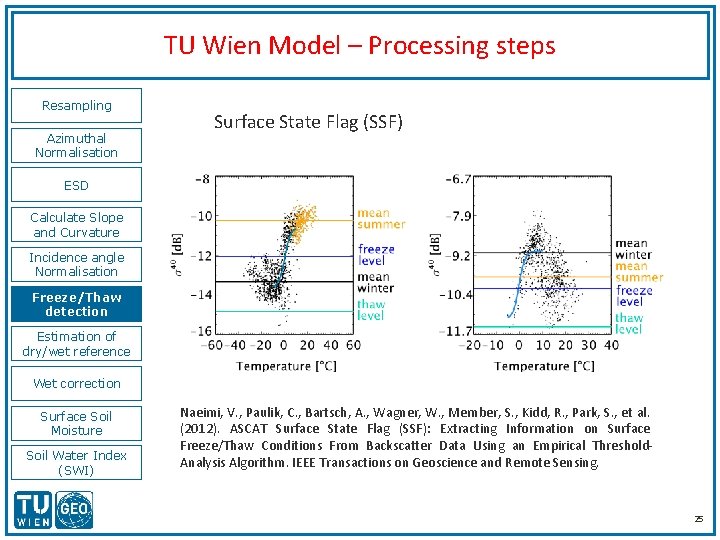
TU Wien Model – Processing steps Resampling Azimuthal Normalisation Surface State Flag (SSF) ESD Calculate Slope and Curvature Incidence angle Normalisation Freeze/Thaw detection Estimation of dry/wet reference Wet correction Surface Soil Moisture Soil Water Index (SWI) Naeimi, V. , Paulik, C. , Bartsch, A. , Wagner, W. , Member, S. , Kidd, R. , Park, S. , et al. (2012). ASCAT Surface State Flag (SSF): Extracting Information on Surface Freeze/Thaw Conditions From Backscatter Data Using an Empirical Threshold. Analysis Algorithm. IEEE Transactions on Geoscience and Remote Sensing. 25
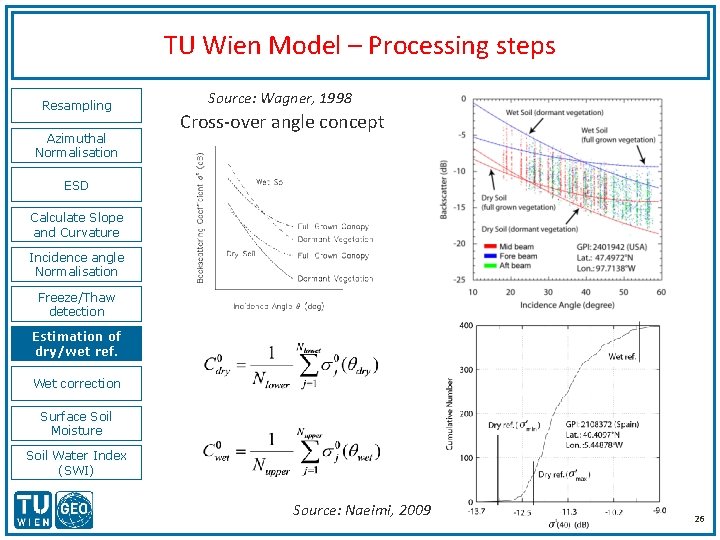
TU Wien Model – Processing steps Resampling Azimuthal Normalisation Source: Wagner, 1998 Cross-over angle concept ESD Calculate Slope and Curvature Incidence angle Normalisation Freeze/Thaw detection Estimation of dry/wet ref. Wet correction Surface Soil Moisture Soil Water Index (SWI) Source: Naeimi, 2009 26
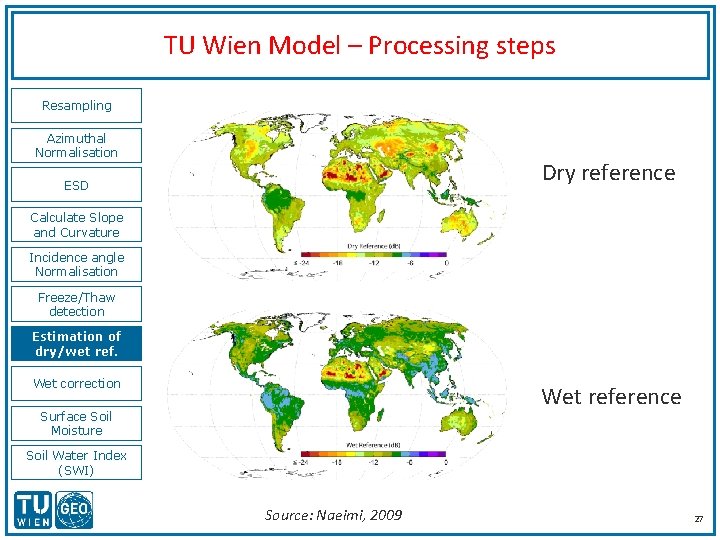
TU Wien Model – Processing steps Resampling Azimuthal Normalisation Dry reference ESD Calculate Slope and Curvature Incidence angle Normalisation Freeze/Thaw detection Estimation of dry/wet ref. Wet correction Wet reference Surface Soil Moisture Soil Water Index (SWI) Source: Naeimi, 2009 27
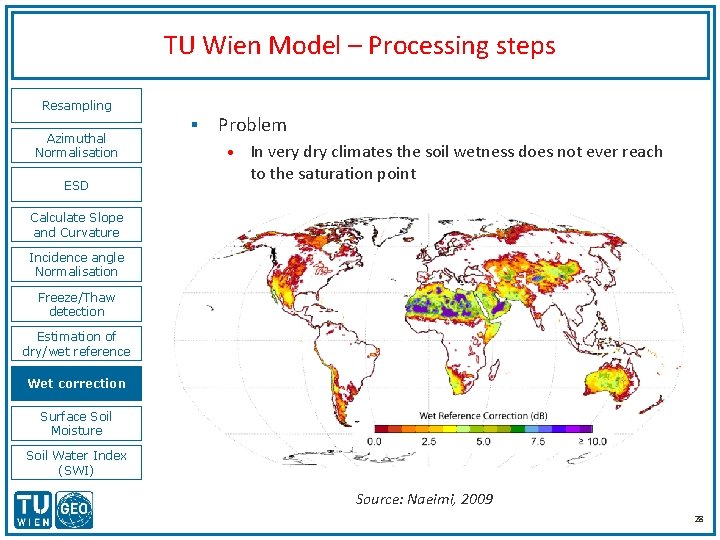
TU Wien Model – Processing steps Resampling Azimuthal Normalisation ESD § Problem • In very dry climates the soil wetness does not ever reach to the saturation point Calculate Slope and Curvature Incidence angle Normalisation Freeze/Thaw detection Estimation of dry/wet reference Wet correction Surface Soil Moisture Soil Water Index (SWI) Source: Naeimi, 2009 28
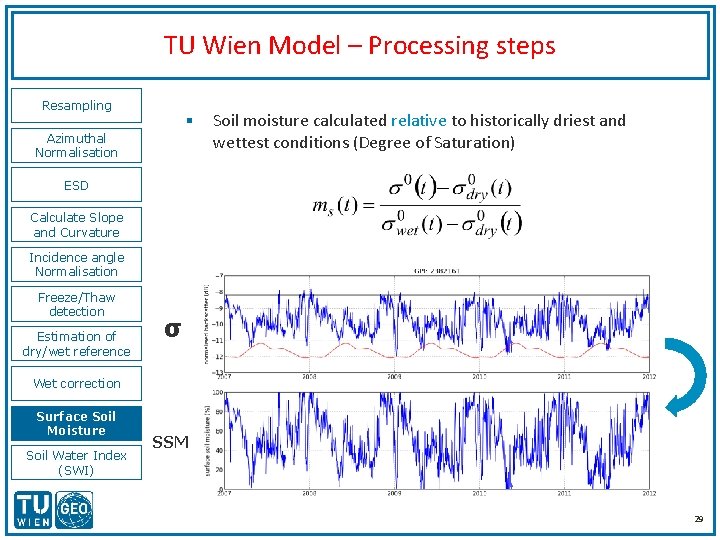
TU Wien Model – Processing steps Resampling § Azimuthal Normalisation Soil moisture calculated relative to historically driest and wettest conditions (Degree of Saturation) ESD Calculate Slope and Curvature Incidence angle Normalisation Freeze/Thaw detection Estimation of dry/wet reference σ Wet correction Surface Soil Moisture Soil Water Index (SWI) SSM 29
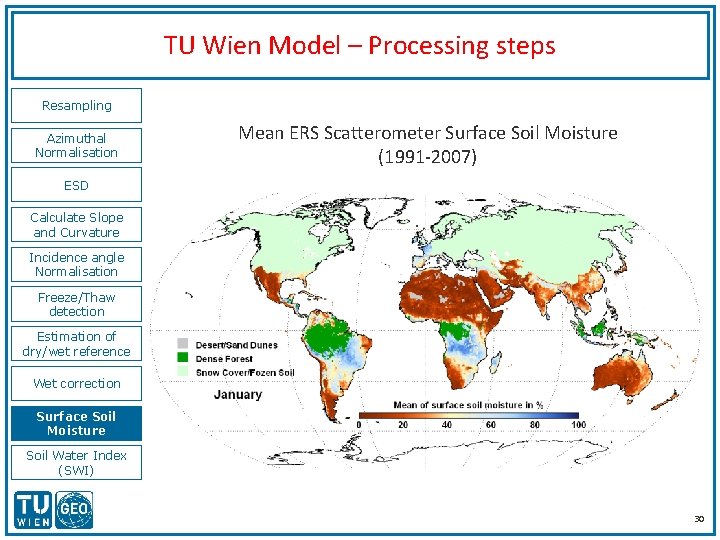
TU Wien Model – Processing steps Resampling Azimuthal Normalisation Mean ERS Scatterometer Surface Soil Moisture (1991 -2007) ESD Calculate Slope and Curvature Incidence angle Normalisation Freeze/Thaw detection Estimation of dry/wet reference Wet correction Surface Soil Moisture Soil Water Index (SWI) 30
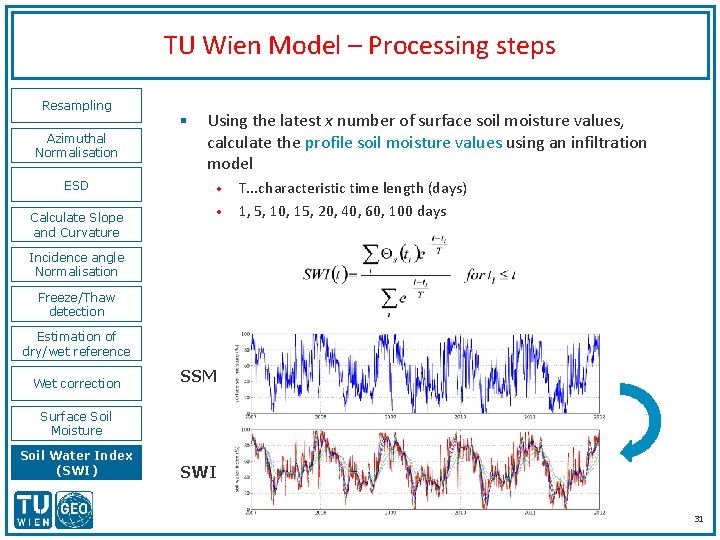
TU Wien Model – Processing steps Resampling Azimuthal Normalisation ESD Calculate Slope and Curvature § Using the latest x number of surface soil moisture values, calculate the profile soil moisture values using an infiltration model T. . . characteristic time length (days) • 1, 5, 10, 15, 20, 40, 60, 100 days • Incidence angle Normalisation Freeze/Thaw detection Estimation of dry/wet reference Wet correction SSM Surface Soil Moisture Soil Water Index (SWI) SWI 31
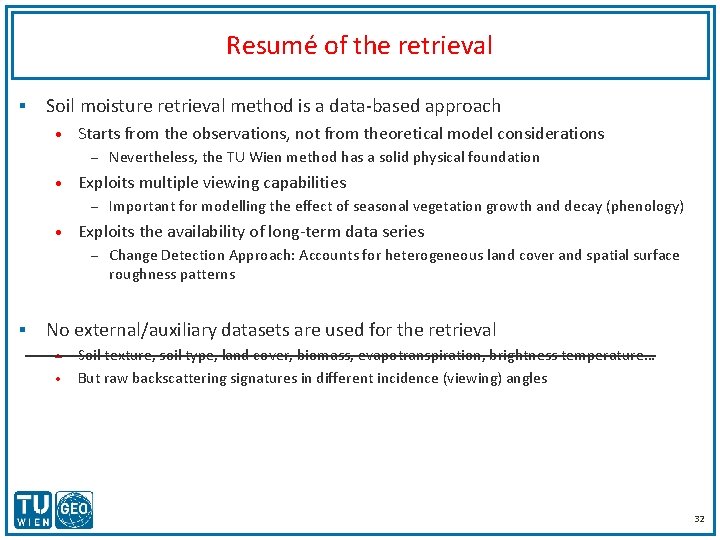
Resumé of the retrieval § Soil moisture retrieval method is a data-based approach • Starts from the observations, not from theoretical model considerations – • Exploits multiple viewing capabilities – • Important for modelling the effect of seasonal vegetation growth and decay (phenology) Exploits the availability of long-term data series – § Nevertheless, the TU Wien method has a solid physical foundation Change Detection Approach: Accounts for heterogeneous land cover and spatial surface roughness patterns No external/auxiliary datasets are used for the retrieval Soil texture, soil type, land cover, biomass, evapotranspiration, brightness temperature… • But raw backscattering signatures in different incidence (viewing) angles • 32
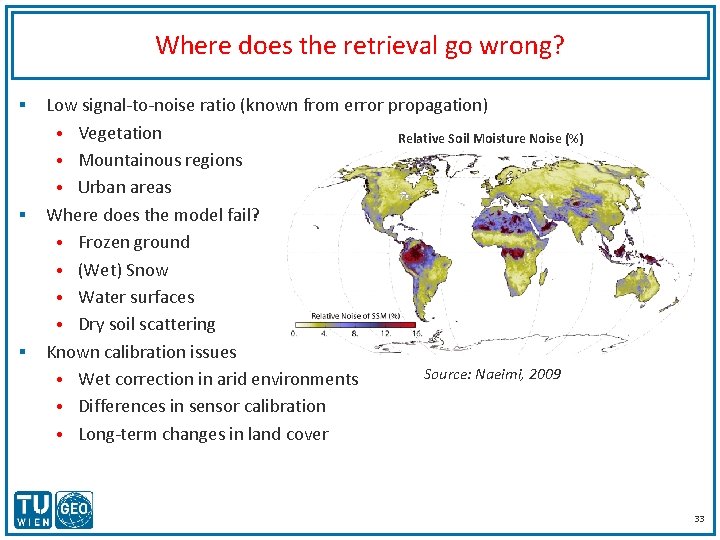
Where does the retrieval go wrong? § § § Low signal-to-noise ratio (known from error propagation) • Vegetation Relative Soil Moisture Noise (%) • Mountainous regions • Urban areas Where does the model fail? • Frozen ground • (Wet) Snow • Water surfaces • Dry soil scattering Known calibration issues Source: Naeimi, 2009 • Wet correction in arid environments • Differences in sensor calibration • Long-term changes in land cover 33
ASCAT Soil Moisture Product Families § Surface (< 2 cm) soil moisture (SSM) 25 km / 50 km in near-real-time (~135 min) in orbit geometry (EUMETSAT) • 25 km irregularly updated off-line time series at a fixed discrete global grid (H-SAF/TU Wien) • § Profile (~2 -100 cm) soil moisture = Soil Water Index (SWI) 25 km off-line (TU Wien) • 50 km assimilated soil moisture at fixed grid for Europe (H-SAF/ECMWF) • § Downscaled ASCAT-ASAR soil moisture • 1 km near real-time on fixed grid for Europe (H-SAF/ZAMG/TU Wien) http: //www. eumetsat. int http: //hsaf. meteoam. it http: //www. zamg. at 34
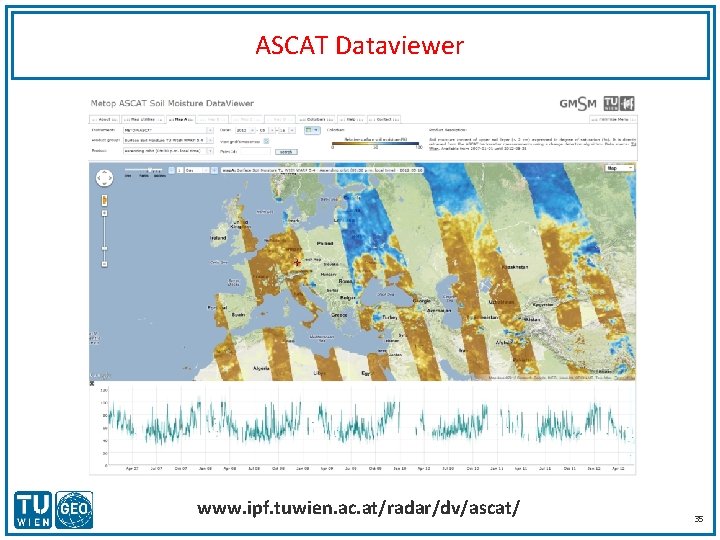
ASCAT Dataviewer www. ipf. tuwien. ac. at/radar/dv/ascat/ 35
Conclusion § Soil moisture is currently topic of international agendas • § Large and diverse user community ASCAT offers the first operational soil moisture product distributed by EUMETSAT over EUMETCast Many positive validation and application studies • Still, product quality can much improved by further developing and improving the algorithms & software • § Validation, Intercomparisons and Merging • International Soil Moisture Network – http: //www. ipf. tuwien. ac. at/insitu/ Intercomparisons with SMOS, AMSR-E, SMAP, GLDAS, ERA-Interim, . . . • Combined soil moisture products • – http: //www. esa-soilmoisture-cci. org/ 36
Further Reading Publications Wagner, W. , Lemoine, G. , Rott, H. (1999): A Method for Estimating Soil Moisture from ERS Scatterometer and Soil Data. Rem. Sens. Environ. 70: 191 -207. Wagner, W. , Naeimi, V. , Scipal, K. , de Jeu, R. , and Martínez-Fernández, J. (2007): Soil moisture from operational meteorological satellites, Hydrogeology Journal, vol. 15, no. 1, pp. 121– 131. Naeimi, V. , K. Scipal, Z. Bartalis, S. Hasenauer and W. Wagner (2009), An improved soil moisture retrieval algorithm for ERS and METOP scatterometer observations, IEEE Transactions on Geoscience and Remote Sensing, Vol. 47, pp. 555 -563. Naeimi, V. , Z. Bartalis, and W. Wagner, (2009) ASCAT soil moisture: An assessment of the data quality and consistency with the ERS scatterometer heritage, Journal of Hydrometeorology, Vol. 10, pp. 555 -563, DOI: 10. 1175/2008 JHM 1051. 1. Technical Reports (www. ipf. tuwien. ac. at/radar) ASCAT Soil Moisture Product Handbook (Z. Bartalis, V. Naeimi, S. Hasenauer and W. Wagner, 2008) WARP NRT Reference Manual (Z. Bartalis, S. Hasenauer, V. Naeimi and W. Wagner, 2007) Definition of Quality Flags (K. Scipal, V. Naeimi and S. Hasenauer, 2005) 37