
Soil Mechanics I Lecture 5 Chapter 2 Soil

- Slides: 50
Soil Mechanics - I Lecture # 5 Chapter # 2. Soil Classification Prepared by: Mamoon Kareem Department of Civil Engineering Swedish College Of Engg & Tech Wah Cantt.
Chapter Outlines Ø Ø Ø Importance of Soil Classification Atterberg Limits Grain Size Distribution Sieve Analysis Hydrometer Analysis Unified (USCS) and AASHTO Classification of Soil
1. Importance of Soil Classification § Main types of soil i. e. , Clay, Silt, Sand, Gravels, Boulders are seldom exist separately in nature. § Natural soil deposits comprise mixture of above types in varying proportions § Soil classification means to arrange soil in groups and label them based on their properties and behaviour. § Soil Classification Systems have been developed by different organizations.
Basis for Soil Classification § Classification is based on the following physical properties: § Grain Size Distribution (GSD) § Liquid limit (LL) § Plasticity Index (PI) § Classification systems give some idea about the general behaviour of soil. § However to predict true behaviour additional information based on geotechnical properties are yet required.
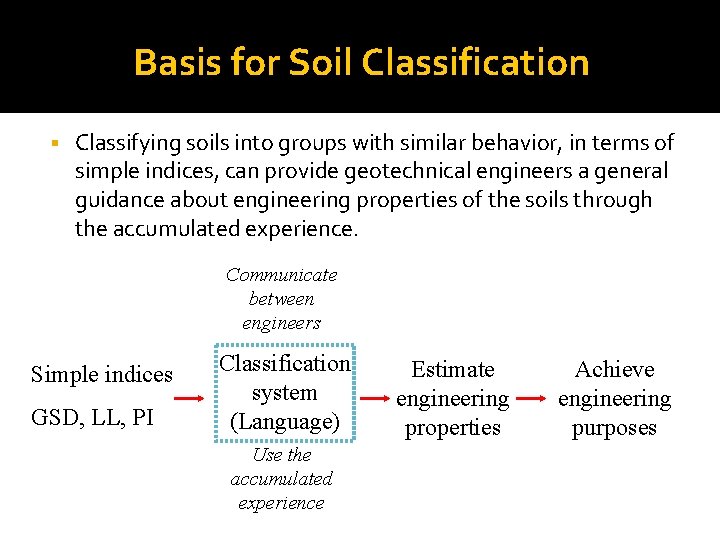
Basis for Soil Classification § Classifying soils into groups with similar behavior, in terms of simple indices, can provide geotechnical engineers a general guidance about engineering properties of the soils through the accumulated experience. Communicate between engineers Simple indices GSD, LL, PI Classification system (Language) Use the accumulated experience Estimate engineering properties Achieve engineering purposes
Soil Classification System § Classification systems developed by different organizations. § Unified soil classification system. § AASHTO (American Association of state Highway and Transportation Officials) soil classification system. § USDA (U. S. Department of Agriculture) soil classification system. § FAA (Federal Aviation Administration) soil classification system. § Textural soil classification system.
Soil Classification System § Two commonly used systems: § Unified Soil Classification System (USCS). § Most widely used to classify soil for use in foundation & dam engineering. § American Association of State Highways and Transportation Officials (AASHTO) System § Most widely and exclusively used for highways and airfields
Unified Soil Classification System (USCS) § Origin of USCS: § This system was first developed by Professor A. Casagrande (1948) for the purpose of airfield construction during World War II. Afterwards, it was modified by Professor Casagrande, the U. S. Bureau of Reclamation, and the U. S. Army Corps of Engineers to enable the system to be applicable to dams, foundations, and other construction § Four major divisions: 1. 2. 3. 4. Coarse-grained Fine-grained Organic soils Peat
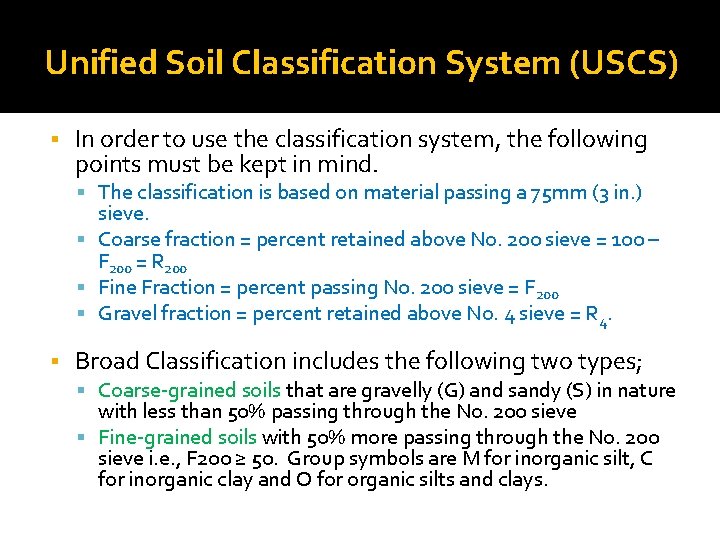
Unified Soil Classification System (USCS) § In order to use the classification system, the following points must be kept in mind. § The classification is based on material passing a 75 mm (3 in. ) sieve. § Coarse fraction = percent retained above No. 200 sieve = 100 – F 200 = R 200 § Fine Fraction = percent passing N 0. 200 sieve = F 200 § Gravel fraction = percent retained above No. 4 sieve = R 4. § Broad Classification includes the following two types; § Coarse-grained soils that are gravelly (G) and sandy (S) in nature with less than 50% passing through the No. 200 sieve § Fine-grained soils with 50% more passing through the No. 200 sieve i. e. , F 200 ≥ 50. Group symbols are M for inorganic silt, C for inorganic clay and O for organic silts and clays.
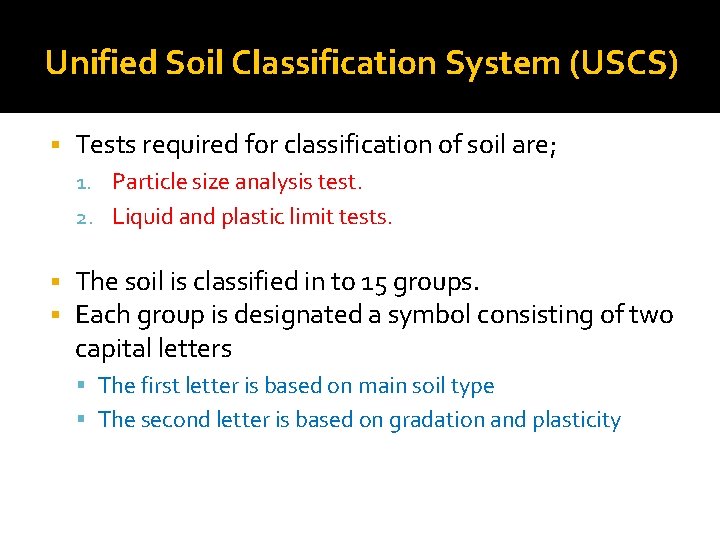
Unified Soil Classification System (USCS) § Tests required for classification of soil are; 1. Particle size analysis test. 2. Liquid and plastic limit tests. § § The soil is classified in to 15 groups. Each group is designated a symbol consisting of two capital letters § The first letter is based on main soil type § The second letter is based on gradation and plasticity
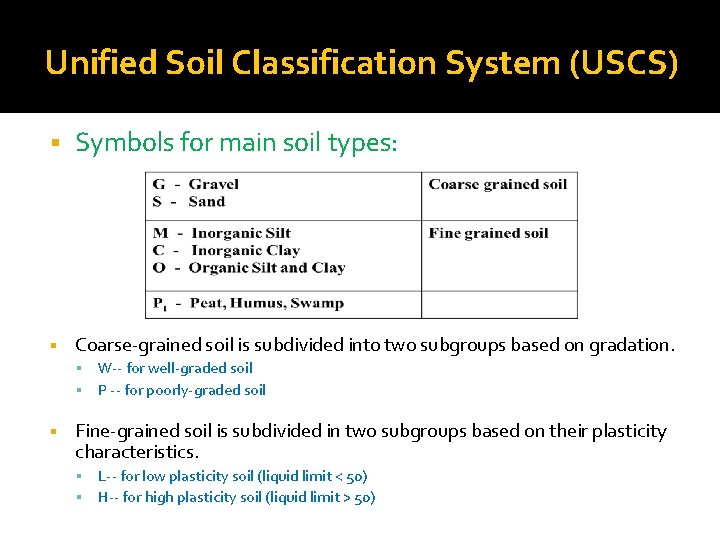
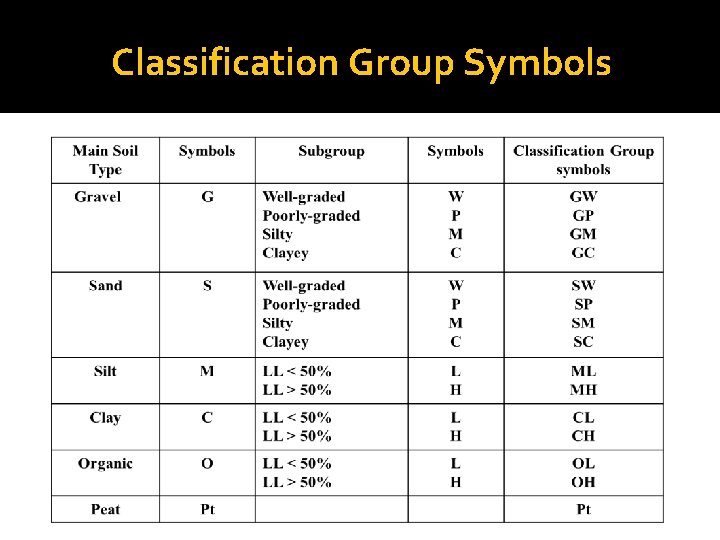
Unified Soil Classification System (USCS) § Symbols for main soil types: § Coarse-grained soil is subdivided into two subgroups based on gradation. § W-- for well-graded soil § P -- for poorly-graded soil § Fine-grained soil is subdivided in two subgroups based on their plasticity characteristics. § L-- for low plasticity soil (liquid limit < 50) § H-- for high plasticity soil (liquid limit > 50)
Classification Group Symbols
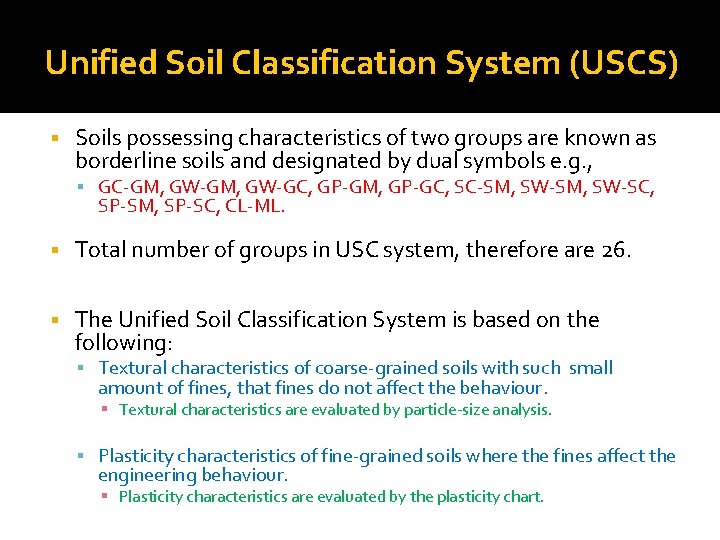
Unified Soil Classification System (USCS) § Soils possessing characteristics of two groups are known as borderline soils and designated by dual symbols e. g. , § GC-GM, GW-GC, GP-GM, GP-GC, SC-SM, SW-SC, SP-SM, SP-SC, CL-ML. § Total number of groups in USC system, therefore are 26. § The Unified Soil Classification System is based on the following: § Textural characteristics of coarse-grained soils with such small amount of fines, that fines do not affect the behaviour. § Textural characteristics are evaluated by particle-size analysis. § Plasticity characteristics of fine-grained soils where the fines affect the engineering behaviour. § Plasticity characteristics are evaluated by the plasticity chart.
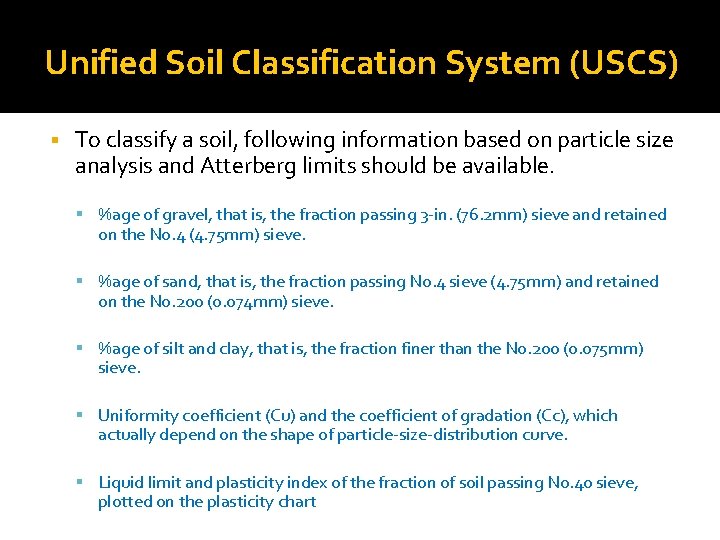
Unified Soil Classification System (USCS) § To classify a soil, following information based on particle size analysis and Atterberg limits should be available. § %age of gravel, that is, the fraction passing 3 -in. (76. 2 mm) sieve and retained on the No. 4 (4. 75 mm) sieve. § %age of sand, that is, the fraction passing No. 4 sieve (4. 75 mm) and retained on the No. 200 (0. 074 mm) sieve. § %age of silt and clay, that is, the fraction finer than the No. 200 (0. 075 mm) sieve. § Uniformity coefficient (Cu) and the coefficient of gradation (Cc), which actually depend on the shape of particle-size-distribution curve. § Liquid limit and plasticity index of the fraction of soil passing No. 40 sieve, plotted on the plasticity chart
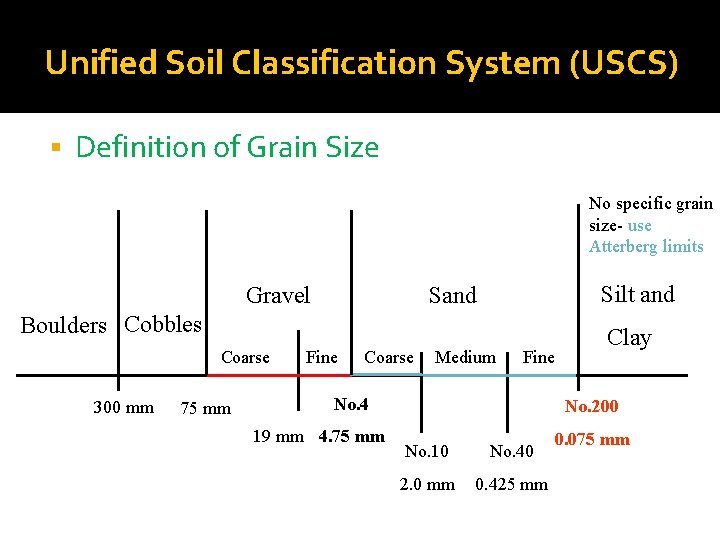
Unified Soil Classification System (USCS) § Definition of Grain Size No specific grain size- use Atterberg limits Gravel Silt and Sand Boulders Cobbles Coarse 300 mm 75 mm Fine Coarse Medium Fine No. 4 19 mm 4. 75 mm Clay No. 200 No. 10 No. 40 2. 0 mm 0. 425 mm 0. 075 mm
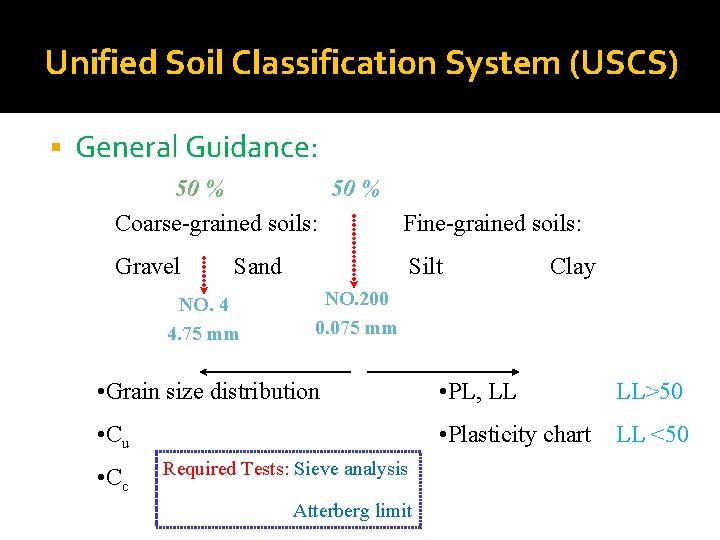
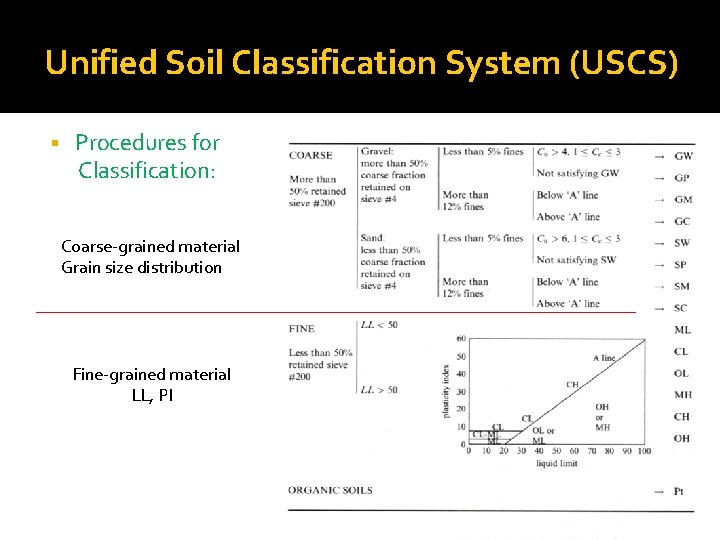
Unified Soil Classification System (USCS) § General Guidance: 50 % Coarse-grained soils: Fine-grained soils: Gravel Sand NO. 4 4. 75 mm Silt Clay NO. 200 0. 075 mm • Grain size distribution • PL, LL LL>50 • C u • Plasticity chart LL <50 • C c Required Tests: Sieve analysis Atterberg limit
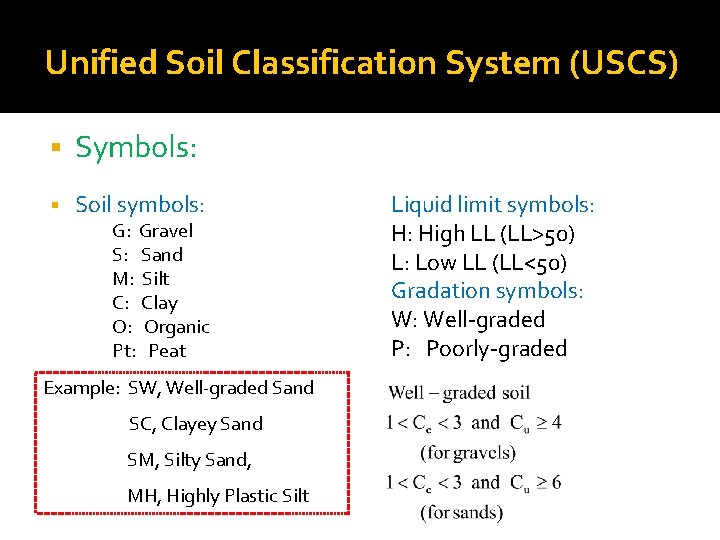
Unified Soil Classification System (USCS) § Symbols: § Soil symbols: G: Gravel S: Sand M: Silt C: Clay O: Organic Pt: Peat Example: SW, Well-graded Sand SC, Clayey Sand SM, Silty Sand, MH, Highly Plastic Silt Liquid limit symbols: H: High LL (LL>50) L: Low LL (LL<50) Gradation symbols: W: Well-graded P: Poorly-graded
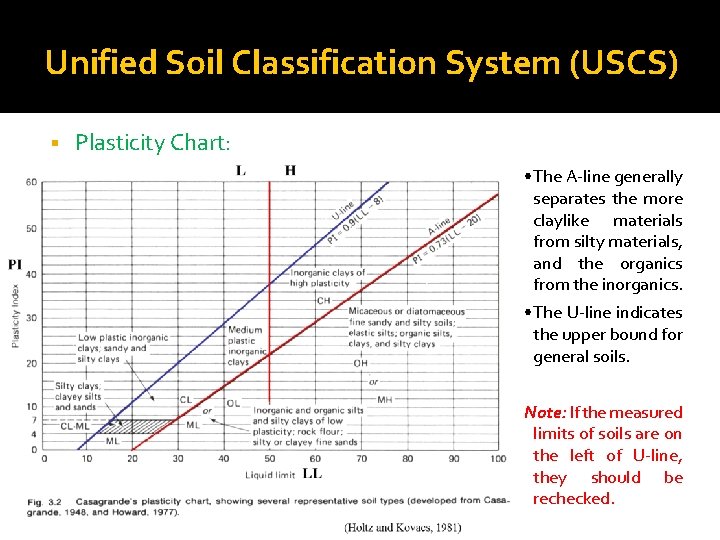
Unified Soil Classification System (USCS) § Plasticity Chart: • The A-line generally separates the more claylike materials from silty materials, and the organics from the inorganics. • The U-line indicates the upper bound for general soils. Note: If the measured limits of soils are on the left of U-line, they should be rechecked.
Unified Soil Classification System (USCS) § Procedures for Classification: Coarse-grained material Grain size distribution Fine-grained material LL, PI
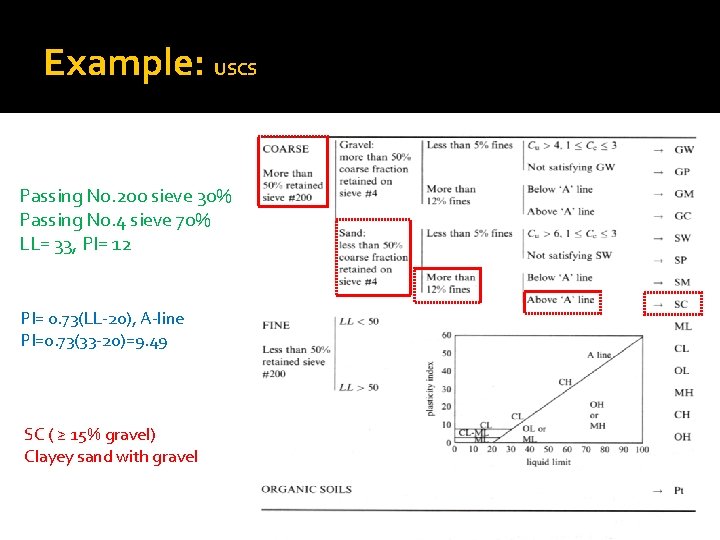
Example: USCS Passing No. 200 sieve 30% Passing No. 4 sieve 70% LL= 33, PI= 12 PI= 0. 73(LL-20), A-line PI=0. 73(33 -20)=9. 49 SC ( ≥ 15% gravel) Clayey sand with gravel
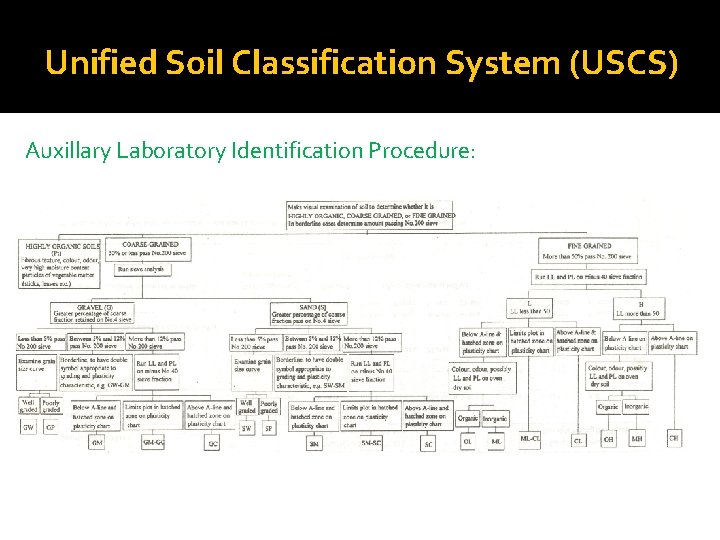
Unified Soil Classification System (USCS) Auxillary Laboratory Identification Procedure:
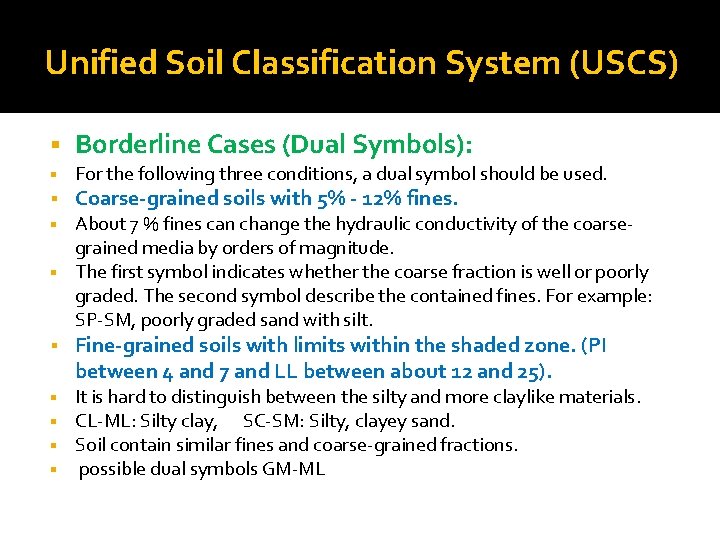
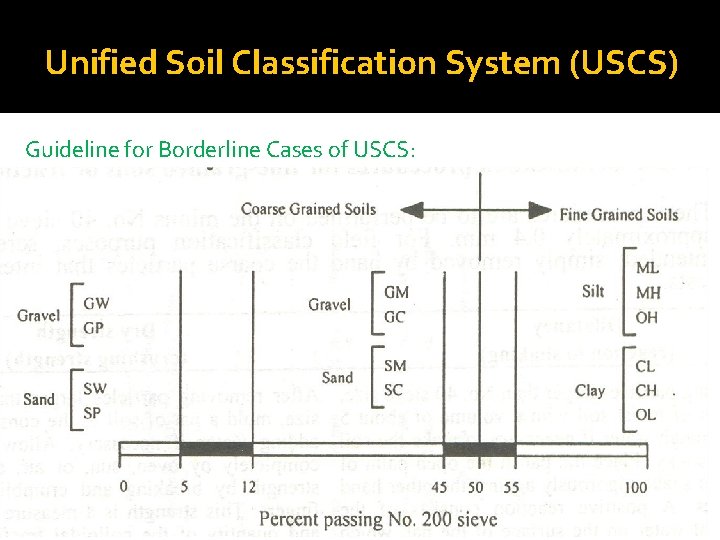
Unified Soil Classification System (USCS) § § § Borderline Cases (Dual Symbols): For the following three conditions, a dual symbol should be used. Coarse-grained soils with 5% - 12% fines. About 7 % fines can change the hydraulic conductivity of the coarsegrained media by orders of magnitude. § The first symbol indicates whether the coarse fraction is well or poorly graded. The second symbol describe the contained fines. For example: SP-SM, poorly graded sand with silt. § § § Fine-grained soils with limits within the shaded zone. (PI between 4 and 7 and LL between about 12 and 25). It is hard to distinguish between the silty and more claylike materials. CL-ML: Silty clay, SC-SM: Silty, clayey sand. Soil contain similar fines and coarse-grained fractions. possible dual symbols GM-ML
Unified Soil Classification System (USCS) Guideline for Borderline Cases of USCS:
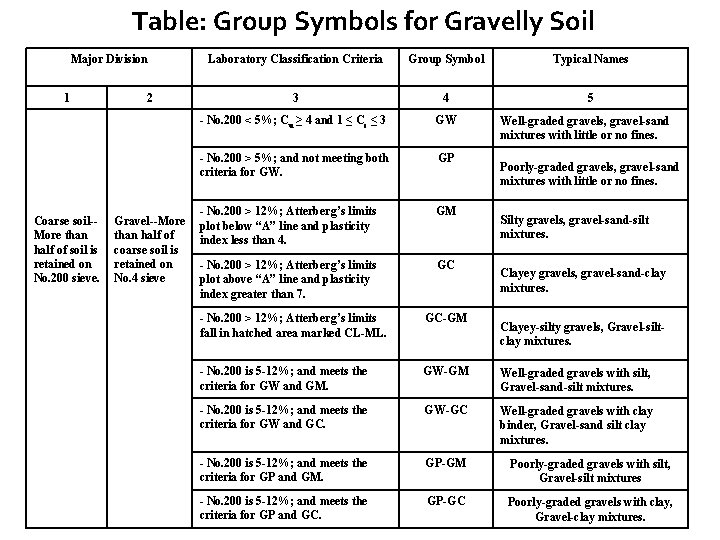
Table: Group Symbols for Gravelly Soil Major Division 1 Coarse soil-More than half of soil is retained on No. 200 sieve. 2 Gravel--More than half of coarse soil is retained on No. 4 sieve Laboratory Classification Criteria Group Symbol Typical Names 3 4 5 - No. 200 < 5%; Cu ≥ 4 and 1 ≤ Cc ≤ 3 GW - No. 200 > 5%; and not meeting both criteria for GW. GP - No. 200 > 12%; Atterberg’s limits plot below “A” line and plasticity index less than 4. GM - No. 200 > 12%; Atterberg’s limits plot above “A” line and plasticity index greater than 7. GC Well-graded gravels, gravel-sand mixtures with little or no fines. Poorly-graded gravels, gravel-sand mixtures with little or no fines. Silty gravels, gravel-sand-silt mixtures. Clayey gravels, gravel-sand-clay mixtures. - No. 200 > 12%; Atterberg’s limits fall in hatched area marked CL-ML. GC-GM - No. 200 is 5 -12%; and meets the criteria for GW and GM. GW-GM Well-graded gravels with silt, Gravel-sand-silt mixtures. - No. 200 is 5 -12%; and meets the criteria for GW and GC. GW-GC Well-graded gravels with clay binder, Gravel-sand silt clay mixtures. - No. 200 is 5 -12%; and meets the criteria for GP and GM. GP-GM Poorly-graded gravels with silt, Gravel-silt mixtures - No. 200 is 5 -12%; and meets the criteria for GP and GC. GP-GC Poorly-graded gravels with clay, Gravel-clay mixtures. Clayey-silty gravels, Gravel-siltclay mixtures.
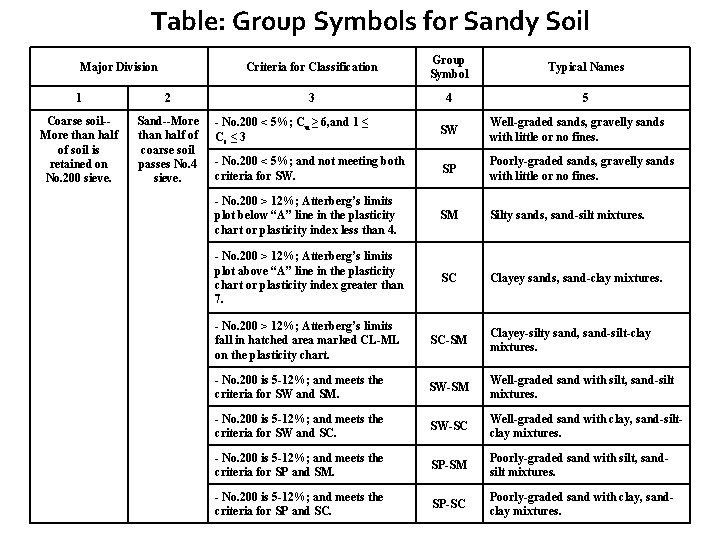
Table: Group Symbols for Sandy Soil Major Division 1 2 Coarse soil-More than half of soil is retained on No. 200 sieve. Sand--More than half of coarse soil passes No. 4 sieve. Criteria for Classification Group Symbol Typical Names 3 4 5 - No. 200 < 5%; Cu ≥ 6, and 1 ≤ Cc ≤ 3 SW Well-graded sands, gravelly sands with little or no fines. - No. 200 < 5%; and not meeting both criteria for SW. SP Poorly-graded sands, gravelly sands with little or no fines. - No. 200 > 12%; Atterberg’s limits plot below “A” line in the plasticity chart or plasticity index less than 4. SM Silty sands, sand-silt mixtures. - No. 200 > 12%; Atterberg’s limits plot above “A” line in the plasticity chart or plasticity index greater than 7. SC Clayey sands, sand-clay mixtures. - No. 200 > 12%; Atterberg’s limits fall in hatched area marked CL-ML on the plasticity chart. SC-SM Clayey-silty sand, sand-silt-clay mixtures. - No. 200 is 5 -12%; and meets the criteria for SW and SM. SW-SM Well-graded sand with silt, sand-silt mixtures. - No. 200 is 5 -12%; and meets the criteria for SW and SC. SW-SC Well-graded sand with clay, sand-siltclay mixtures. - No. 200 is 5 -12%; and meets the criteria for SP and SM. SP-SM Poorly-graded sand with silt, sandsilt mixtures. - No. 200 is 5 -12%; and meets the criteria for SP and SC. SP-SC Poorly-graded sand with clay, sandclay mixtures.
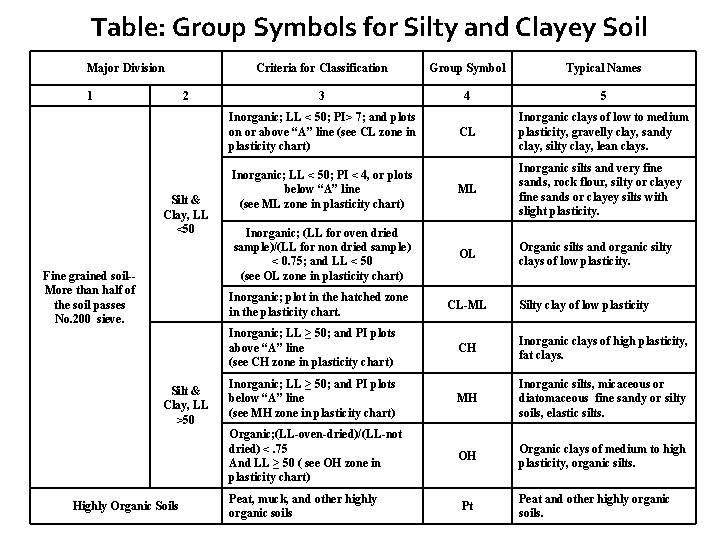
Table: Group Symbols for Silty and Clayey Soil Major Division 1 2 Silt & Clay, LL <50 Fine grained soil-More than half of the soil passes No. 200 sieve. Criteria for Classification Group Symbol Typical Names 3 4 5 Inorganic; LL < 50; PI> 7; and plots on or above “A” line (see CL zone in plasticity chart) CL Inorganic clays of low to medium plasticity, gravelly clay, sandy clay, silty clay, lean clays. Inorganic; LL < 50; PI < 4, or plots below “A” line (see ML zone in plasticity chart) ML Inorganic silts and very fine sands, rock flour, silty or clayey fine sands or clayey silts with slight plasticity. Inorganic; (LL for oven dried sample)/(LL for non dried sample) < 0. 75; and LL < 50 (see OL zone in plasticity chart) OL Organic silts and organic silty clays of low plasticity. Inorganic; plot in the hatched zone in the plasticity chart. CL-ML Inorganic; LL ≥ 50; and PI plots above “A” line (see CH zone in plasticity chart) Silt & Clay, LL >50 Highly Organic Soils Silty clay of low plasticity CH Inorganic clays of high plasticity, fat clays. Inorganic; LL ≥ 50; and PI plots below “A” line (see MH zone in plasticity chart) MH Inorganic silts, micaceous or diatomaceous fine sandy or silty soils, elastic silts. Organic; (LL-oven-dried)/(LL-not dried) <. 75 And LL ≥ 50 ( see OH zone in plasticity chart) OH Organic clays of medium to high plasticity, organic silts. Peat, muck, and other highly organic soils Pt Peat and other highly organic soils.
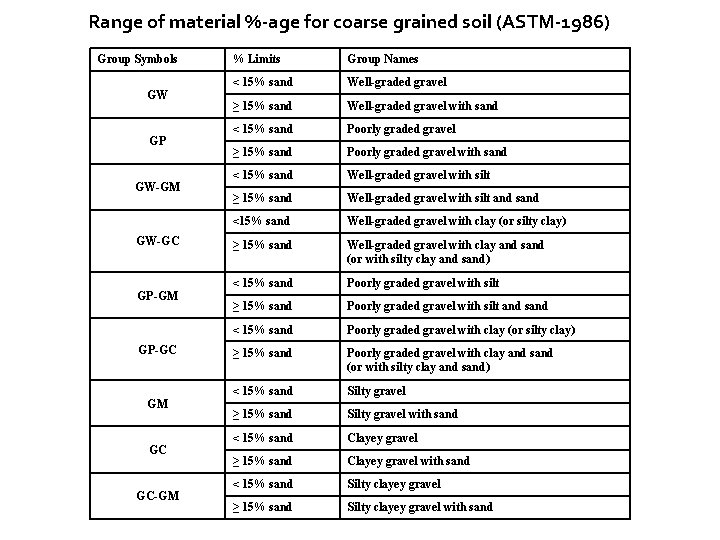
Range of material %-age for coarse grained soil (ASTM-1986) Group Symbols GW GP GW-GM GW-GC GP-GM GP-GC GM GC GC-GM % Limits Group Names < 15% sand Well-graded gravel ≥ 15% sand Well-graded gravel with sand < 15% sand Poorly graded gravel ≥ 15% sand Poorly graded gravel with sand < 15% sand Well-graded gravel with silt ≥ 15% sand Well-graded gravel with silt and sand <15% sand Well-graded gravel with clay (or silty clay) ≥ 15% sand Well-graded gravel with clay and sand (or with silty clay and sand) < 15% sand Poorly graded gravel with silt ≥ 15% sand Poorly graded gravel with silt and sand < 15% sand Poorly graded gravel with clay (or silty clay) ≥ 15% sand Poorly graded gravel with clay and sand (or with silty clay and sand) < 15% sand Silty gravel ≥ 15% sand Silty gravel with sand < 15% sand Clayey gravel ≥ 15% sand Clayey gravel with sand < 15% sand Silty clayey gravel ≥ 15% sand Silty clayey gravel with sand
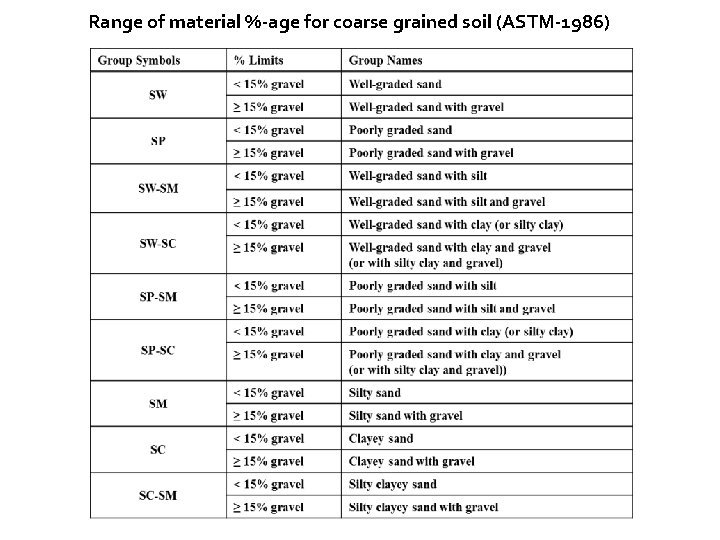
Range of material %-age for coarse grained soil (ASTM-1986)
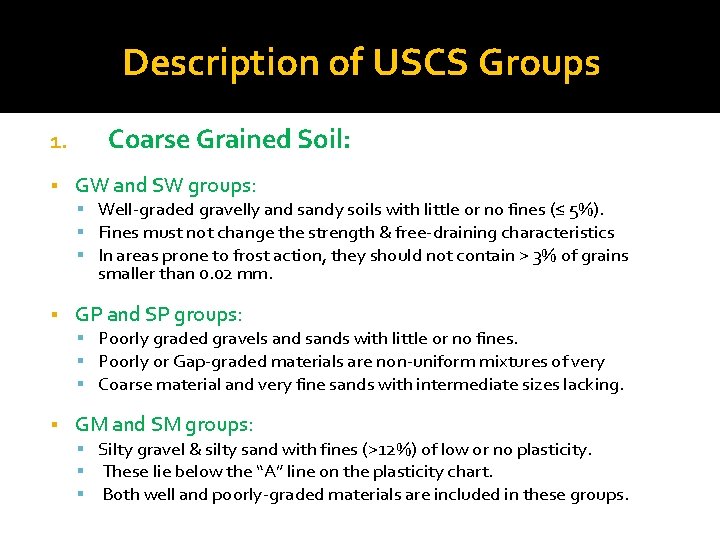
Description of USCS Groups 1. § Coarse Grained Soil: GW and SW groups: § Well-graded gravelly and sandy soils with little or no fines (≤ 5%). § Fines must not change the strength & free-draining characteristics § In areas prone to frost action, they should not contain > 3% of grains smaller than 0. 02 mm. § GP and SP groups: § Poorly graded gravels and sands with little or no fines. § Poorly or Gap-graded materials are non-uniform mixtures of very § Coarse material and very fine sands with intermediate sizes lacking. § GM and SM groups: § Silty gravel & silty sand with fines (>12%) of low or no plasticity. § These lie below the “A” line on the plasticity chart. § Both well and poorly-graded materials are included in these groups.
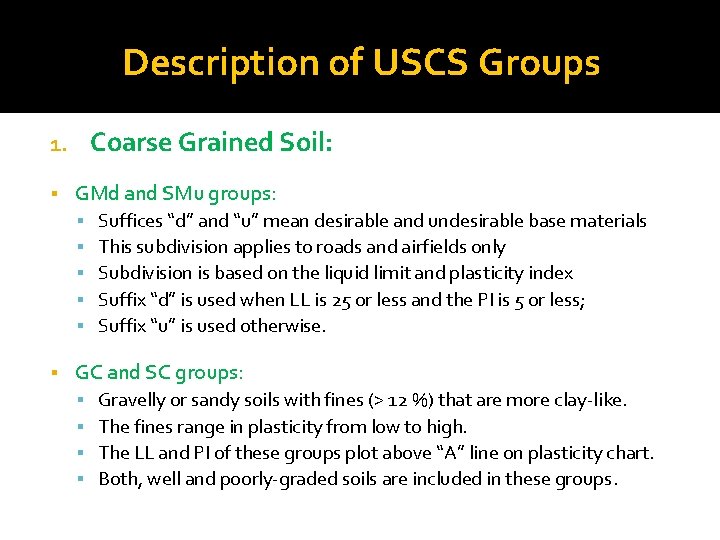
Description of USCS Groups Coarse Grained Soil: 1. § GMd and SMu groups: § § § Suffices “d” and “u” mean desirable and undesirable base materials This subdivision applies to roads and airfields only Subdivision is based on the liquid limit and plasticity index Suffix “d” is used when LL is 25 or less and the PI is 5 or less; Suffix “u” is used otherwise. GC and SC groups: § § Gravelly or sandy soils with fines (> 12 %) that are more clay-like. The fines range in plasticity from low to high. The LL and PI of these groups plot above “A” line on plasticity chart. Both, well and poorly-graded soils are included in these groups.
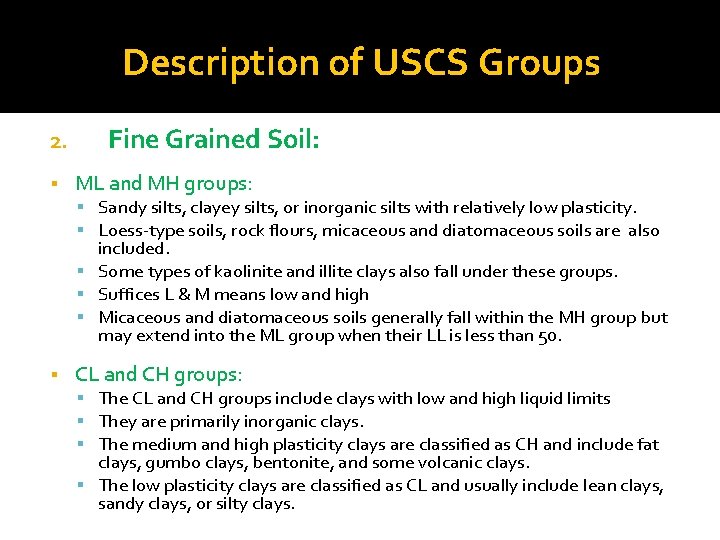
Description of USCS Groups 2. § Fine Grained Soil: ML and MH groups: § Sandy silts, clayey silts, or inorganic silts with relatively low plasticity. § Loess-type soils, rock flours, micaceous and diatomaceous soils are also included. § Some types of kaolinite and illite clays also fall under these groups. § Suffices L & M means low and high § Micaceous and diatomaceous soils generally fall within the MH group but may extend into the ML group when their LL is less than 50. § CL and CH groups: § The CL and CH groups include clays with low and high liquid limits § They are primarily inorganic clays. § The medium and high plasticity clays are classified as CH and include fat clays, gumbo clays, bentonite, and some volcanic clays. § The low plasticity clays are classified as CL and usually include lean clays, sandy clays, or silty clays.
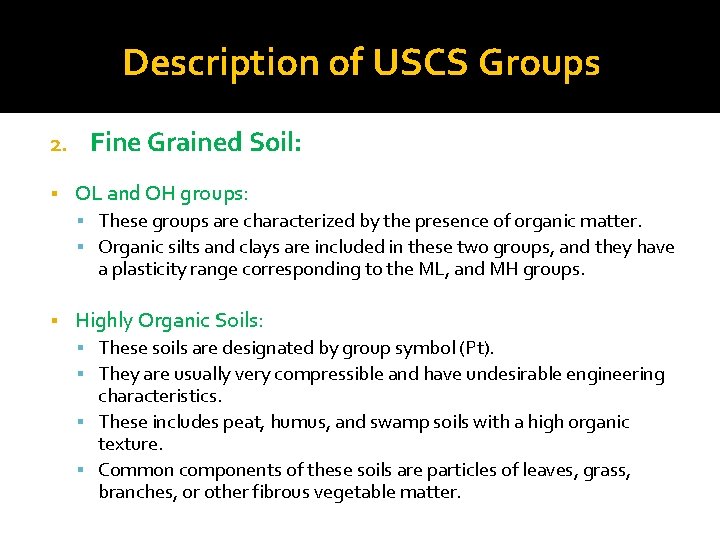
Description of USCS Groups 2. § Fine Grained Soil: OL and OH groups: § These groups are characterized by the presence of organic matter. § Organic silts and clays are included in these two groups, and they have a plasticity range corresponding to the ML, and MH groups. § Highly Organic Soils: § These soils are designated by group symbol (Pt). § They are usually very compressible and have undesirable engineering characteristics. § These includes peat, humus, and swamp soils with a high organic texture. § Common components of these soils are particles of leaves, grass, branches, or other fibrous vegetable matter.
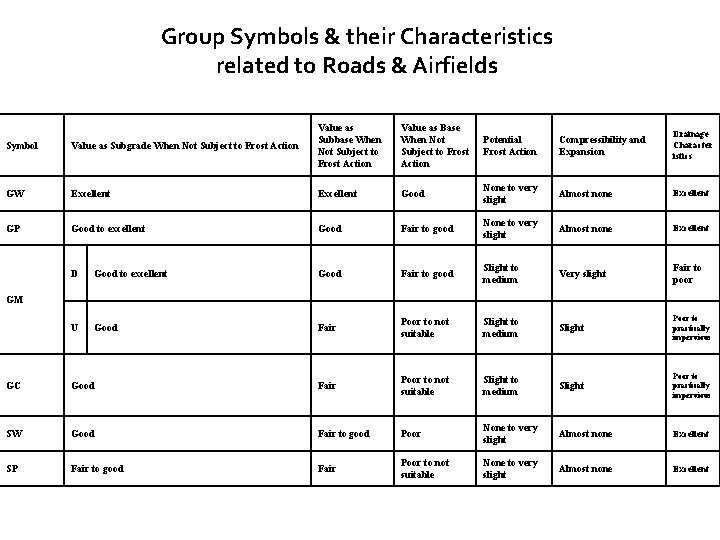
Group Symbols & their Characteristics related to Roads & Airfields Symbol Value as Subgrade When Not Subject to Frost Action Value as Subbase When Not Subject to Frost Action Value as Base When Not Subject to Frost Action Potential Frost Action Compressibility and Expansion Drainage Character istics GW Excellent Good None to very slight Almost none Excellent GP Good to excellent Good Fair to good None to very slight Almost none Excellent D Good to excellent Good Fair to good Slight to medium Very slight Fair to poor U Good Fair Poor to not suitable Slight to medium Slight Poor to practically impervious GM GC Good Fair Poor to not suitable Slight to medium Slight Poor to practically impervious SW Good Fair to good Poor None to very slight Almost none Excellent SP Fair to good Fair Poor to not suitable None to very slight Almost none Excellent
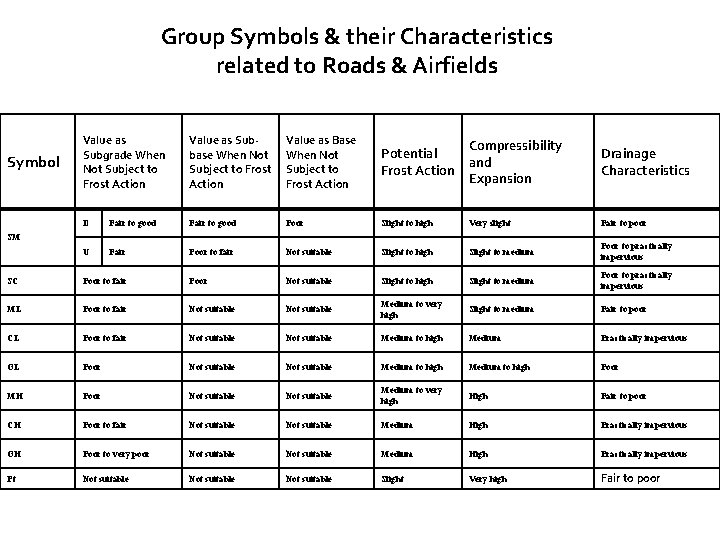
Group Symbols & their Characteristics related to Roads & Airfields Symbol Value as Subgrade When Not Subject to Frost Action Value as Subbase When Not Subject to Frost Action Value as Base When Not Subject to Frost Action Compressibility Potential and Frost Action Expansion Drainage Characteristics D Fair to good Poor Slight to high Very slight Fair to poor U Fair Poor to fair Not suitable Slight to high Slight to medium Poor to practically impervious SM SC Poor to fair Poor Not suitable Slight to high Slight to medium Poor to practically impervious ML Poor to fair Not suitable Medium to very high Slight to medium Fair to poor CL Poor to fair Not suitable Medium to high Medium Practically impervious OL Poor Not suitable Medium to high Poor MH Poor Not suitable Medium to very high High Fair to poor CH Poor to fair Not suitable Medium High Practically impervious OH Poor to very poor Not suitable Medium High Practically impervious Pt Not suitable Slight Very high Fair to poor
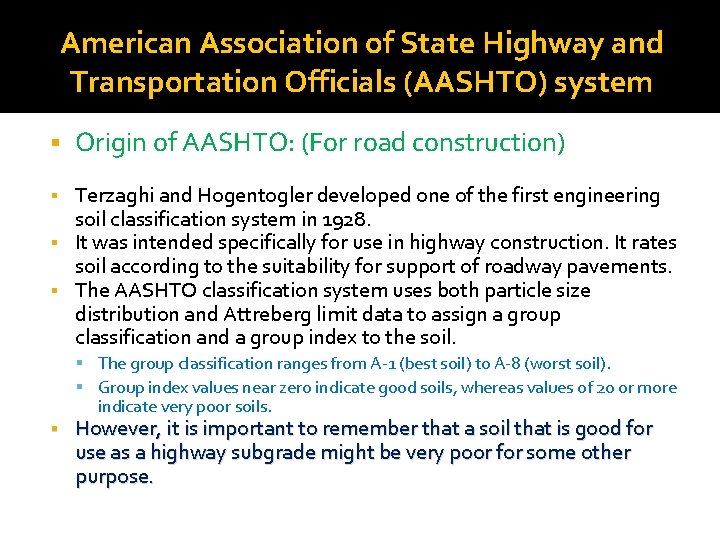
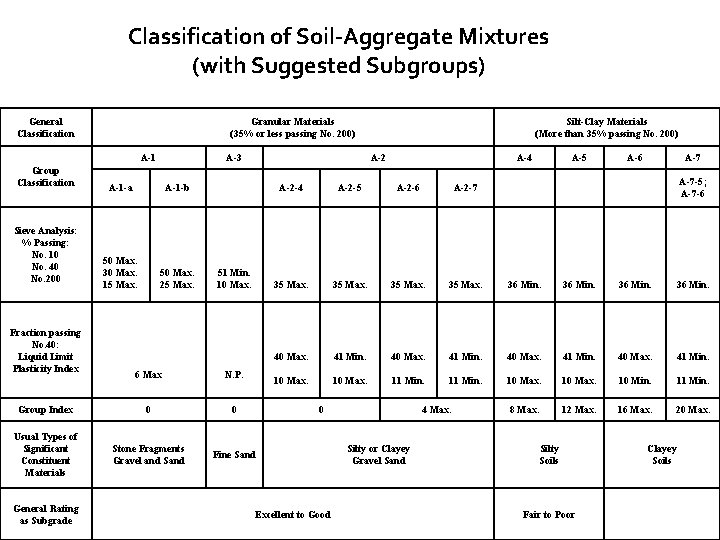
American Association of State Highway and Transportation Officials (AASHTO) system § Origin of AASHTO: (For road construction) Terzaghi and Hogentogler developed one of the first engineering soil classification system in 1928. § It was intended specifically for use in highway construction. It rates soil according to the suitability for support of roadway pavements. § The AASHTO classification system uses both particle size distribution and Attreberg limit data to assign a group classification and a group index to the soil. § § The group classification ranges from A-1 (best soil) to A-8 (worst soil). § Group index values near zero indicate good soils, whereas values of 20 or more indicate very poor soils. § However, it is important to remember that a soil that is good for use as a highway subgrade might be very poor for some other purpose.
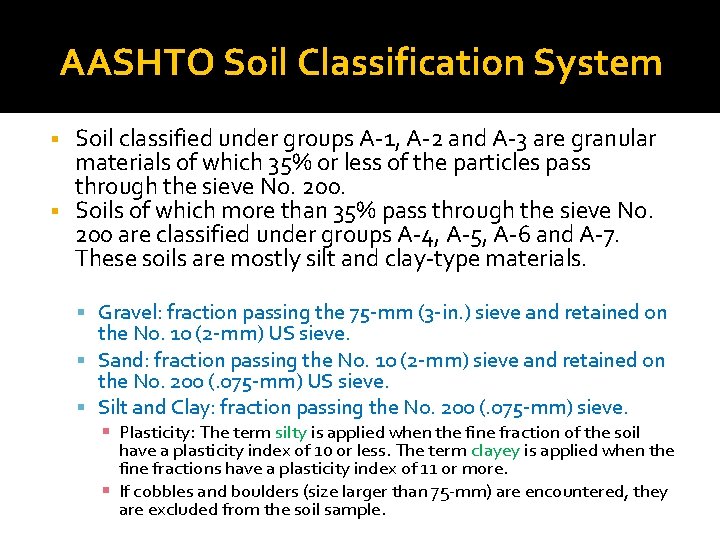
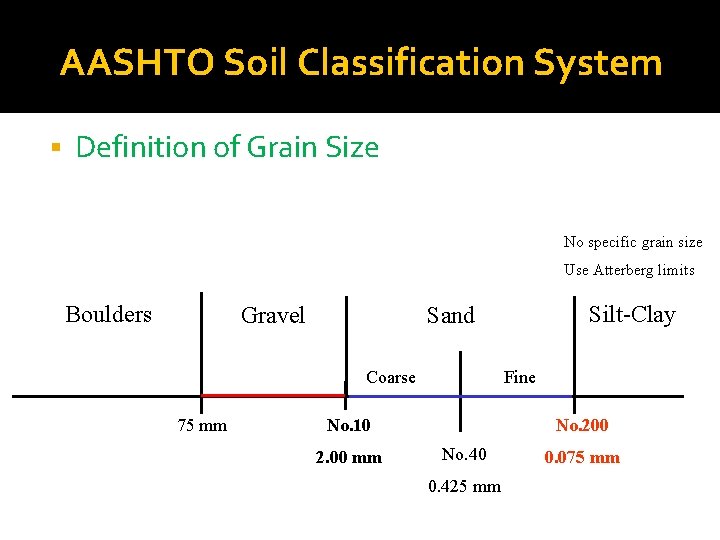
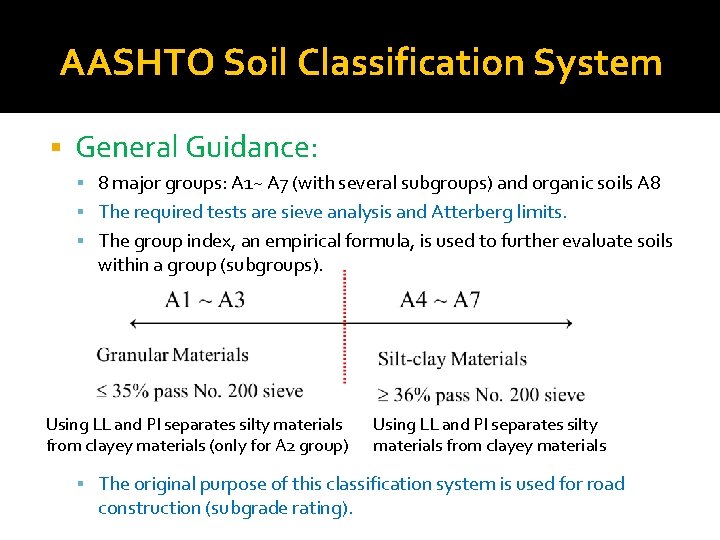
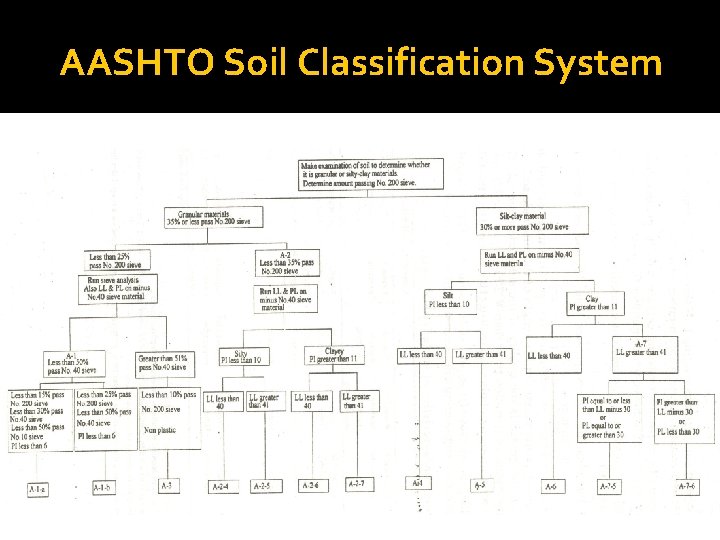
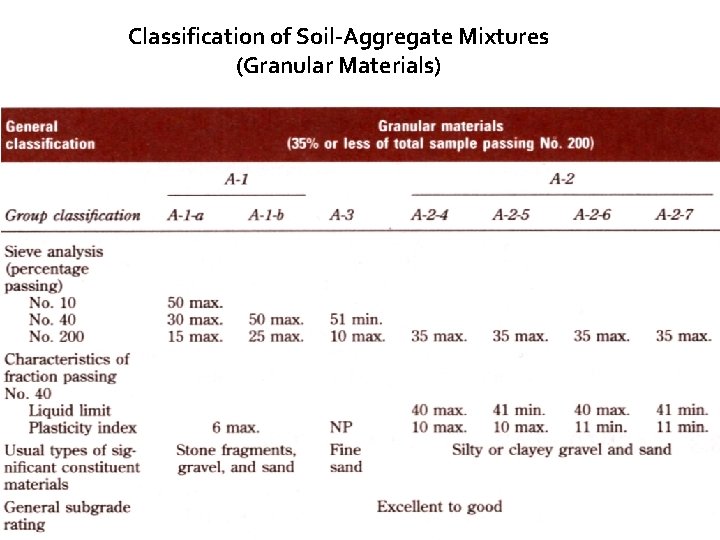
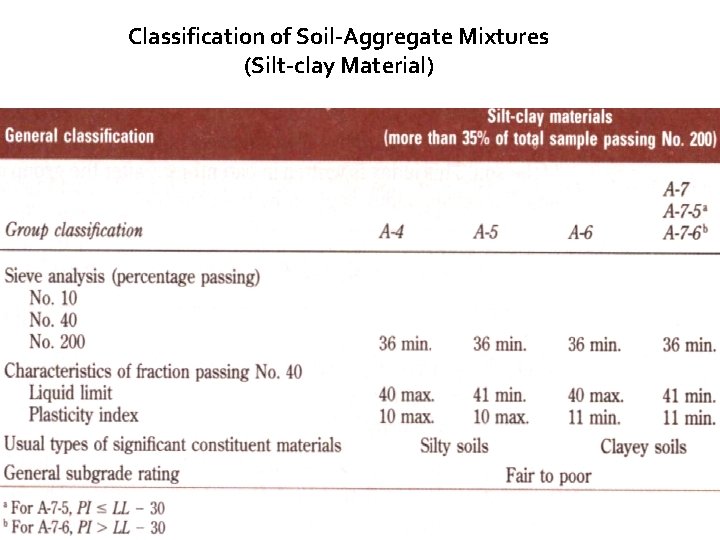
AASHTO Soil Classification System Soil classified under groups A-1, A-2 and A-3 are granular materials of which 35% or less of the particles pass through the sieve No. 200. § Soils of which more than 35% pass through the sieve No. 200 are classified under groups A-4, A-5, A-6 and A-7. These soils are mostly silt and clay-type materials. § § Gravel: fraction passing the 75 -mm (3 -in. ) sieve and retained on the No. 10 (2 -mm) US sieve. § Sand: fraction passing the No. 10 (2 -mm) sieve and retained on the No. 200 (. 075 -mm) US sieve. § Silt and Clay: fraction passing the No. 200 (. 075 -mm) sieve. § Plasticity: The term silty is applied when the fine fraction of the soil have a plasticity index of 10 or less. The term clayey is applied when the fine fractions have a plasticity index of 11 or more. § If cobbles and boulders (size larger than 75 -mm) are encountered, they are excluded from the soil sample.
AASHTO Soil Classification System § Definition of Grain Size No specific grain size Use Atterberg limits Boulders Gravel Coarse 75 mm Silt-Clay Sand Fine No. 10 2. 00 mm No. 200 No. 40 0. 425 mm 0. 075 mm
AASHTO Soil Classification System § General Guidance: § 8 major groups: A 1~ A 7 (with several subgroups) and organic soils A 8 § The required tests are sieve analysis and Atterberg limits. § The group index, an empirical formula, is used to further evaluate soils within a group (subgroups). Using LL and PI separates silty materials from clayey materials (only for A 2 group) Using LL and PI separates silty materials from clayey materials § The original purpose of this classification system is used for road construction (subgrade rating).
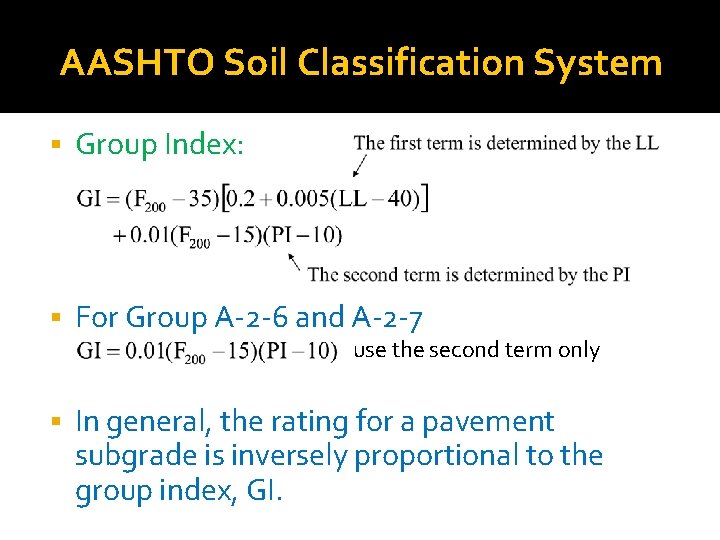
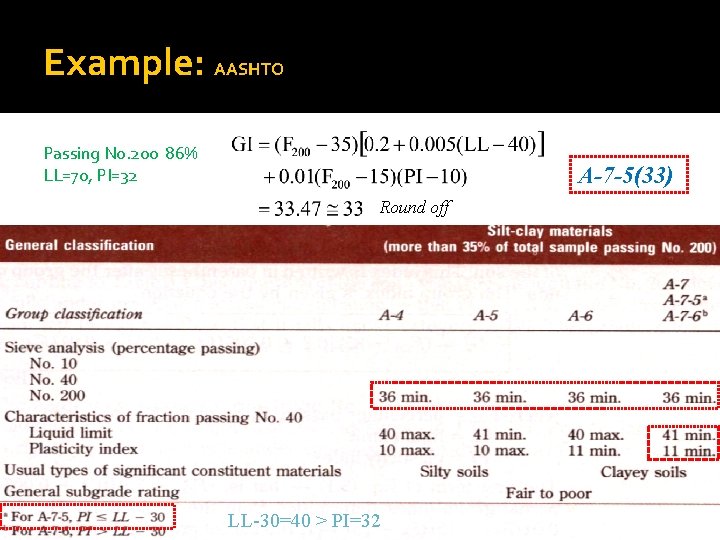
AASHTO Soil Classification System § Group Index: § For Group A-2 -6 and A-2 -7 use the second term only § In general, the rating for a pavement subgrade is inversely proportional to the group index, GI.
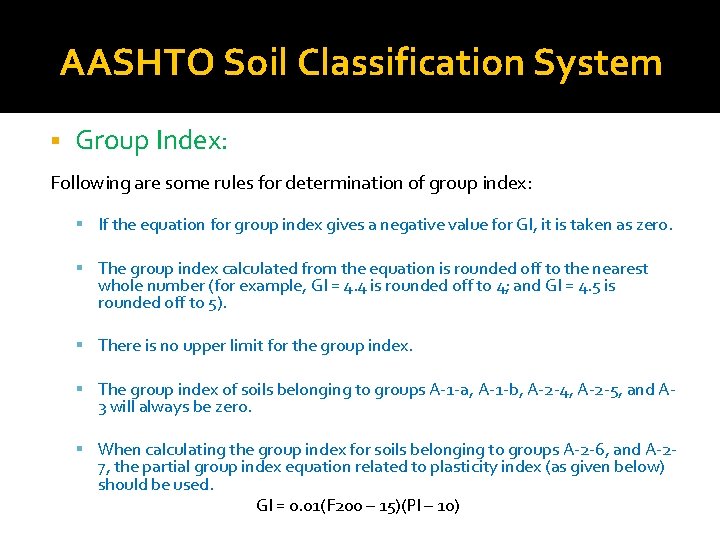
AASHTO Soil Classification System § Group Index: Following are some rules for determination of group index: § If the equation for group index gives a negative value for GI, it is taken as zero. § The group index calculated from the equation is rounded off to the nearest whole number (for example, GI = 4. 4 is rounded off to 4; and GI = 4. 5 is rounded off to 5). § There is no upper limit for the group index. § The group index of soils belonging to groups A-1 -a, A-1 -b, A-2 -4, A-2 -5, and A- 3 will always be zero. § When calculating the group index for soils belonging to groups A-2 -6, and A-2 - 7, the partial group index equation related to plasticity index (as given below) should be used. GI = 0. 01(F 200 – 15)(PI – 10)
Classification of Soil-Aggregate Mixtures (with Suggested Subgroups) General Classification Granular Materials (35% or less passing No. 200) A-1 Group Classification Sieve Analysis: % Passing: No. 10 No. 40 No. 200 Fraction passing No. 40: Liquid Limit Plasticity Index A-3 A-1 -a A-1 -b 50 Max. 30 Max. 15 Max. 50 Max. 25 Max. A-2 51 Min. 10 Max. 6 Max N. P. Group Index 0 0 Usual Types of Significant Constituent Materials Stone Fragments Gravel and Sand Fine Sand General Rating as Subgrade Silt-Clay Materials (More than 35% passing No. 200) A-4 A-5 A-6 A-7 -5; A-7 -6 A-2 -4 A-2 -5 A-2 -6 A-2 -7 35 Max. 36 Min. 40 Max. 41 Min. 10 Max. 11 Min. 10 Max. 10 Min. 11 Min. 8 Max. 12 Max. 16 Max. 20 Max. 0 Excellent to Good 4 Max. Silty or Clayey Gravel Sand Silty Soils Fair to Poor Clayey Soils
AASHTO Soil Classification System
Classification of Soil-Aggregate Mixtures (Granular Materials)
Classification of Soil-Aggregate Mixtures (Silt-clay Material)
Example: AASHTO Passing No. 200 86% LL=70, PI=32 A-7 -5(33) Round off LL-30=40 > PI=32
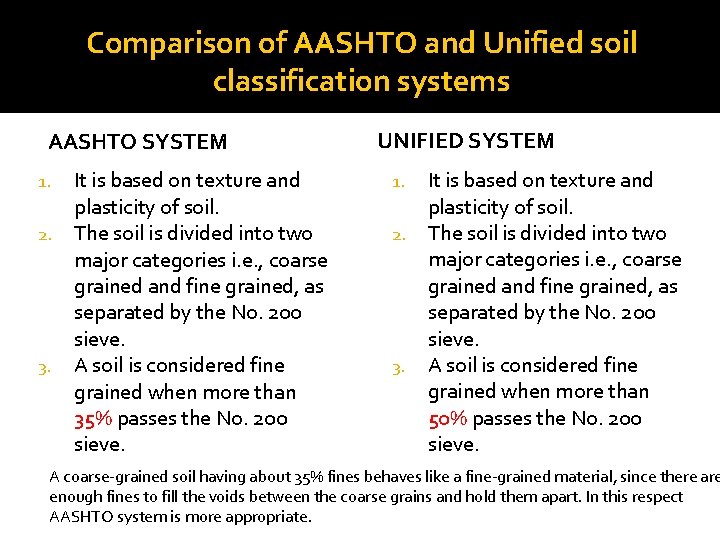
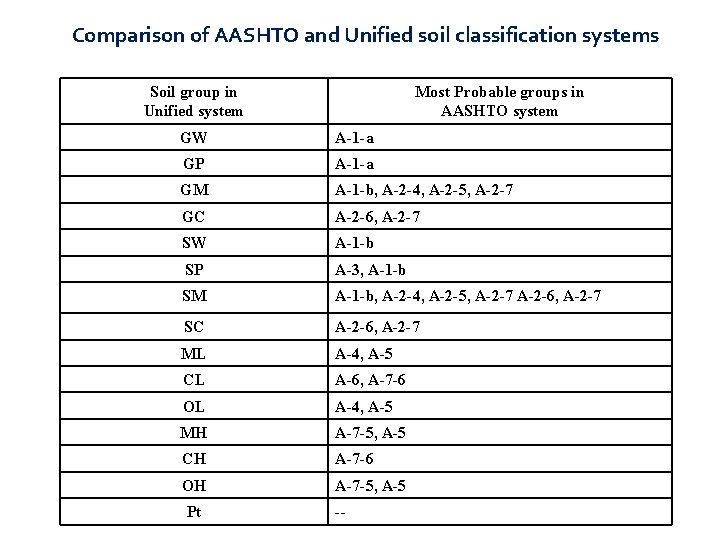
Comparison of AASHTO and Unified soil classification systems AASHTO SYSTEM 1. 2. 3. It is based on texture and plasticity of soil. The soil is divided into two major categories i. e. , coarse grained and fine grained, as separated by the No. 200 sieve. A soil is considered fine grained when more than 35% passes the No. 200 sieve. UNIFIED SYSTEM 1. 2. 3. It is based on texture and plasticity of soil. The soil is divided into two major categories i. e. , coarse grained and fine grained, as separated by the No. 200 sieve. A soil is considered fine grained when more than 50% passes the No. 200 sieve. A coarse-grained soil having about 35% fines behaves like a fine-grained material, since there are enough fines to fill the voids between the coarse grains and hold them apart. In this respect AASHTO system is more appropriate.
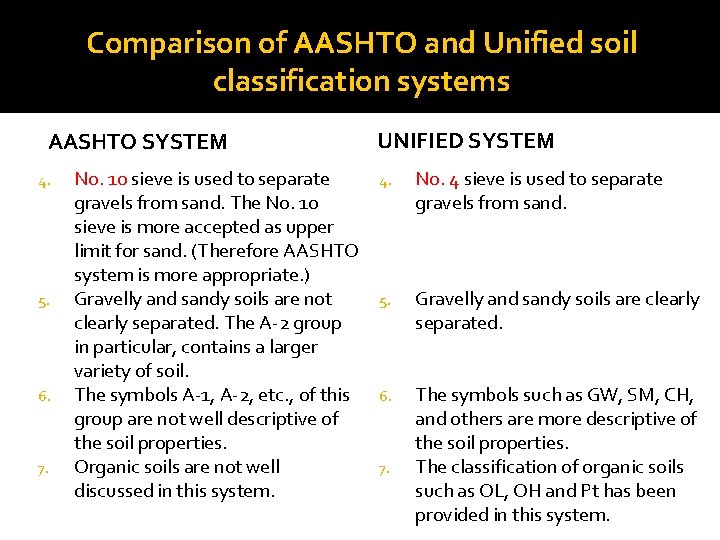
Comparison of AASHTO and Unified soil classification systems AASHTO SYSTEM 4. 5. 6. 7. No. 10 sieve is used to separate gravels from sand. The No. 10 sieve is more accepted as upper limit for sand. (Therefore AASHTO system is more appropriate. ) Gravelly and sandy soils are not clearly separated. The A-2 group in particular, contains a larger variety of soil. The symbols A-1, A-2, etc. , of this group are not well descriptive of the soil properties. Organic soils are not well discussed in this system. UNIFIED SYSTEM 4. No. 4 sieve is used to separate gravels from sand. 5. Gravelly and sandy soils are clearly separated. 6. The symbols such as GW, SM, CH, and others are more descriptive of the soil properties. The classification of organic soils such as OL, OH and Pt has been provided in this system. 7.
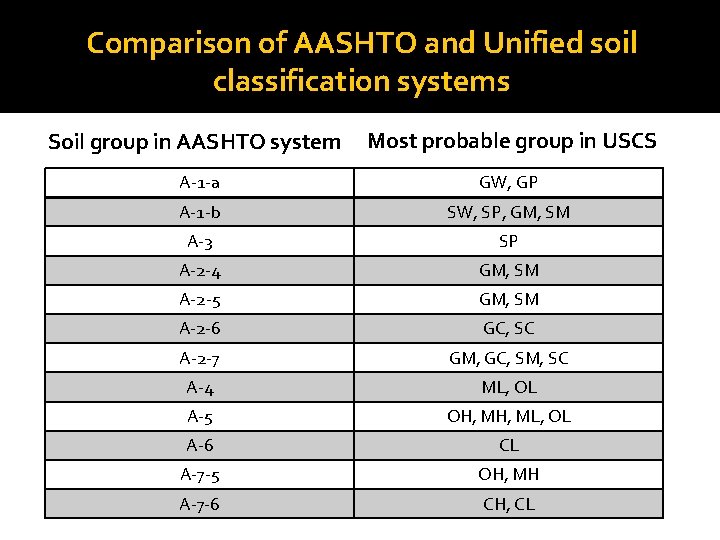
Comparison of AASHTO and Unified soil classification systems Soil group in AASHTO system Most probable group in USCS A-1 -a GW, GP A-1 -b SW, SP, GM, SM A-3 SP A-2 -4 GM, SM A-2 -5 GM, SM A-2 -6 GC, SC A-2 -7 GM, GC, SM, SC A-4 ML, OL A-5 OH, ML, OL A-6 CL A-7 -5 OH, MH A-7 -6 CH, CL
Comparison of AASHTO and Unified soil classification systems Soil group in Unified system Most Probable groups in AASHTO system GW A-1 -a GP A-1 -a GM A-1 -b, A-2 -4, A-2 -5, A-2 -7 GC A-2 -6, A-2 -7 SW A-1 -b SP A-3, A-1 -b SM A-1 -b, A-2 -4, A-2 -5, A-2 -7 A-2 -6, A-2 -7 SC A-2 -6, A-2 -7 ML A-4, A-5 CL A-6, A-7 -6 OL A-4, A-5 MH A-7 -5, A-5 CH A-7 -6 OH A-7 -5, A-5 Pt --
Any Question…? ? ? Thank You … for paying your attention