
SOIL GAS SAMPLING DRILLING PROCESS AND TECHNIQUES PRESENTED

- Slides: 13
SOIL GAS SAMPLING DRILLING PROCESS AND TECHNIQUES PRESENTED BY EARTH SOLUTIONS, INC.
TALKING POINTS • Information from the IEPA • Types of soil gas samples • Equipment used for sampling • Materials used for sampling • Drilling process for each type of sample • Client Checklist • Resources • Q&A
SOIL GAS SAMPLING • Requirements o Sample locations determined by the Program under which the remediation is being conducted o Soil gas samples collected at least 3 feet below the ground surface, above the saturated zone and within the area of contamination o No soil gas sampling shall take place within 48 hours after a ½ inch or greater rainfall o No soil gas sampling in standing or ponded water areas or soil constantly watered by an irrigation system
SOIL GAS SAMPLING • Soil Gas Collection Requirements o A direct push method should be used to advance a heavy-gauge decontaminated steel probe, with an expendable tip, to the desired depth. o Rigid-wall tubing made of nylon, Teflon®, or material approved by the Illinois EPA o Use gas-tight inert containers o Purge three volumes o Flow rate limited to 200 ml/minute o Helium tracer gas or other leak apparatus detection approved by the Illinois EPA must be used during the sampling
SOIL GAS SAMPLING PROTOCOL Soil gas samples should be collected in areas where volatile chemical contamination in the soil or groundwater has been identified. Soil gas samples must be collected from a depth at least three feet below the ground surface or building foundation, but above the saturated zone. No soil gas sampling should take place within 48 hours after a rainfall event of ½ inch or greater, in standing or ponded water areas and where soil is constantly watered by an irrigation system. Utilities should be identified to assess possible man-made pathways. A direct push method should be used to advance a heavy-gauge decontaminated steel probe, with an expendable tip, to the desired depth. Once the desired depth (greater than three feet below ground surface or building foundation) is reached, connect the 1/8” to ¼” inch outside diameter post-run tubing of either Teflon® or nylon to the expendable point holder. Pull the rods up three to six inches to create a cavity to collect the soil gas sample. Seal the rods at the surface with bentonite, clay, or use a water dam to prevent air from entering around the rods. Purge the tubing of three volumes prior to the collection of the soil gas sample. Information provided by Illinois EPA - Bureau of Land http: /www. epa. state. il. us/land/taco/soil-gas-sampling-protocol. html
SOIL GAS SAMPLING PROTOCOL A helium tracer gas (or another tracer gas or other leak apparatus detection system approved by the Illinois EPA) must be used during the sampling to confirm there are no leaks around the soil gas sampling train. It may be beneficial to conduct a shut-in test on the sampling train prior to purging or sampling. If using Tedlar bags or Summa canisters, they must be certified clean by the laboratory prior to sample collection. The holding times for soil gas samples are no more than 30 days for Summa canisters and no more than 48 hours for Tedlar bags. For light sensitive or halogenated volatile chemical, the sample container must be opaque or dark-colored. Samples in transparent containers can be protected from light degradation either by placing the containers in a dark receptacle (such as a box) or by wrapping the container with aluminum foil. For example, glass PUF casings may be wrapped with foil. Information provided by Illinois EPA - Bureau of Land http: /www. epa. state. il. us/land/taco/soil-gas-sampling-protocol. html
TYPES OF SOIL GAS SAMPLES • Temporary or one time event sampling • Soil gas extraction through the rods with helium detector test • Sub slab soil gas sample • Permanent or multiple event sampling • • • Stainless steel soil gas implant PVC soil gas installation Sub slab soil gas sample
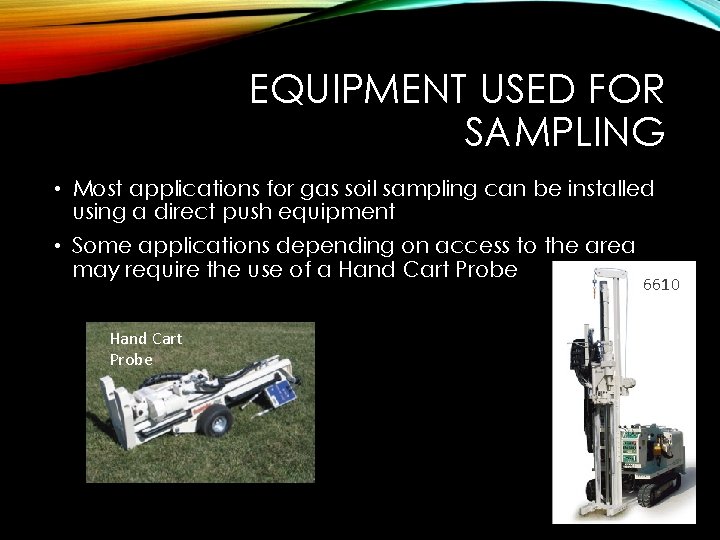
EQUIPMENT USED FOR SAMPLING • Most applications for gas soil sampling can be installed using a direct push equipment • Some applications depending on access to the area may require the use of a Hand Cart Probe 6610
MATERIALS USED FOR SAMPLING Our clients typically supply: • Helium Detector • Summa Canister • Purging Pump (hand held) • Responsible for writing data on the canister • All electronic test instruments/meters Earth Solutions typically supplies: • Teflon or Nylon Tubing • Soil Implants (stainless steel or PVC) and all materials to install the implants • Shroud • Helium
DRILLING PROCESS • Soil gas sample through the rods (aka post run tubing) • Soil gas sample through the rods with helium test (aka post run tubing) • Sub slab soil gas sample • Permanent stainless steel soil gas implant • Permanent PVC soil gas sampling
CLIENT CHECKLIST • Do you need a one time (temporary) sample or multiple (permanent) samples? • What size fitting is on your summa canister? Typical size is 1/4” OD. Also available 1/8”, 3/16” OD • Do you need soil gas implants? If so, what size implants? 3” , 6”, 21” • At what depth are the samples being taken? • Outside or inside? • What are the surface conditions?
RESOURCES • Link to the IEPA vapor intrusion information: www. epa. state. il. us/land/taco/indoor-inhalationamendments. html • Link to J&E 1 and J&E 2 Values www. epa. state. il. us/land/taco/indoor-air-ros. pdf • Gregg Dunn, Manager IEPA Site Remediation Program greg. dunn@Illinois. gov
GOT GAS …? Earth Solutions can solve your problems!