
Soil Formation Pedogenesis The pedogenic processes Term Brief
Soil Formation Pedogenesis


The pedogenic processes Term Brief definition Eluviation Movement of material out of a portion of a soil profile as in an albic horizon. Illuviation Movement of material into a portion of soil profile as in an argillic or spodic horizon. Leaching (depletion) General term for washing out or eluviating soluble materials from the solum. Enrichment General term for addition of materials to a soil body. Erosion, surficial Removal of material from the surface layer of a soil. Cumulization Aeolian & hydrologic addition of mineral particles to the surface of a soil solum.
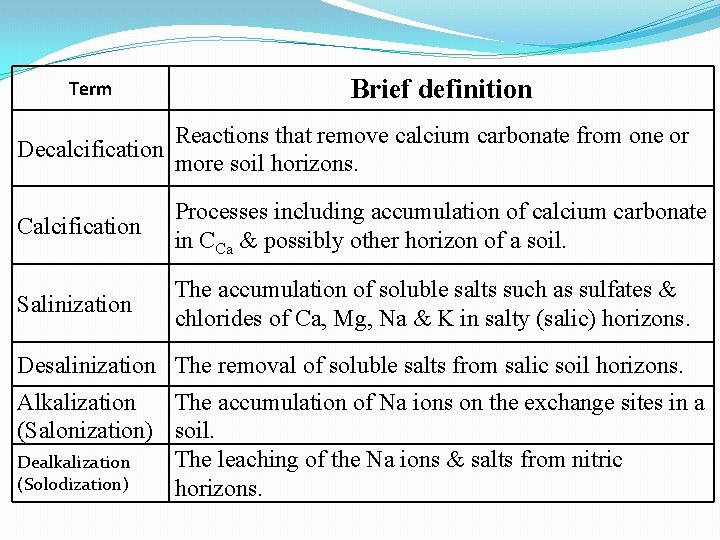
Term Brief definition Reactions that remove calcium carbonate from one or Decalcification more soil horizons. Calcification Processes including accumulation of calcium carbonate in CCa & possibly other horizon of a soil. Salinization The accumulation of soluble salts such as sulfates & chlorides of Ca, Mg, Na & K in salty (salic) horizons. Desalinization The removal of soluble salts from salic soil horizons. Alkalization The accumulation of Na ions on the exchange sites in a (Salonization) soil. The leaching of the Na ions & salts from nitric Dealkalization (Solodization) horizons.
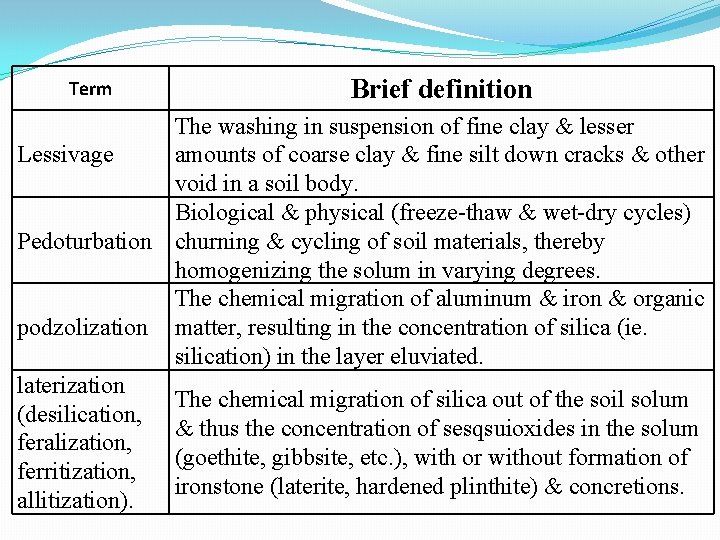
Term Brief definition The washing in suspension of fine clay & lesser Lessivage amounts of coarse clay & fine silt down cracks & other void in a soil body. Biological & physical (freeze-thaw & wet-dry cycles) Pedoturbation churning & cycling of soil materials, thereby homogenizing the solum in varying degrees. The chemical migration of aluminum & iron & organic podzolization matter, resulting in the concentration of silica (ie. silication) in the layer eluviated. laterization The chemical migration of silica out of the soil solum (desilication, & thus the concentration of sesqsuioxides in the solum feralization, (goethite, gibbsite, etc. ), with or without formation of ferritization, ironstone (laterite, hardened plinthite) & concretions. allitization).
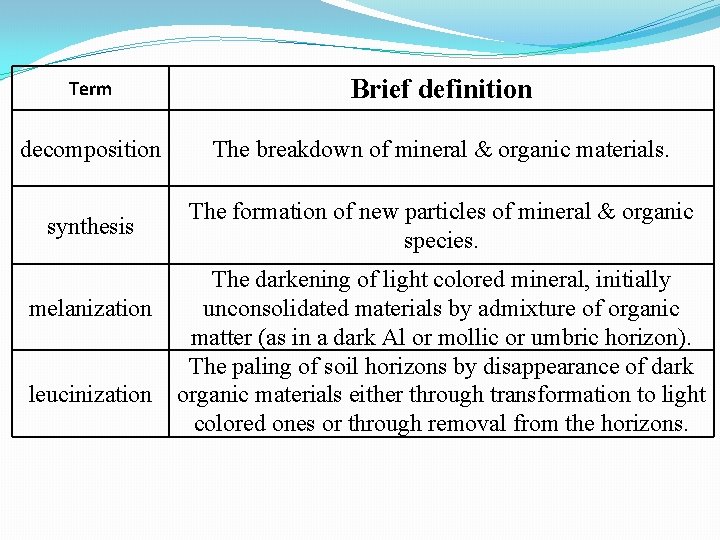
Term Brief definition decomposition The breakdown of mineral & organic materials. synthesis The formation of new particles of mineral & organic species. melanization leucinization The darkening of light colored mineral, initially unconsolidated materials by admixture of organic matter (as in a dark Al or mollic or umbric horizon). The paling of soil horizons by disappearance of dark organic materials either through transformation to light colored ones or through removal from the horizons.
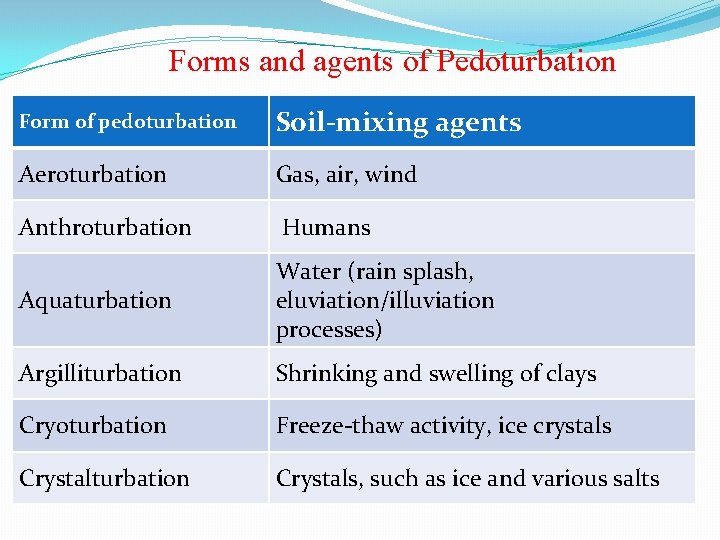
Forms and agents of Pedoturbation Form of pedoturbation Soil-mixing agents Aeroturbation Gas, air, wind Anthroturbation Humans Aquaturbation Water (rain splash, eluviation/illuviation processes) Argilliturbation Shrinking and swelling of clays Cryoturbation Freeze-thaw activity, ice crystals Crystalturbation Crystals, such as ice and various salts
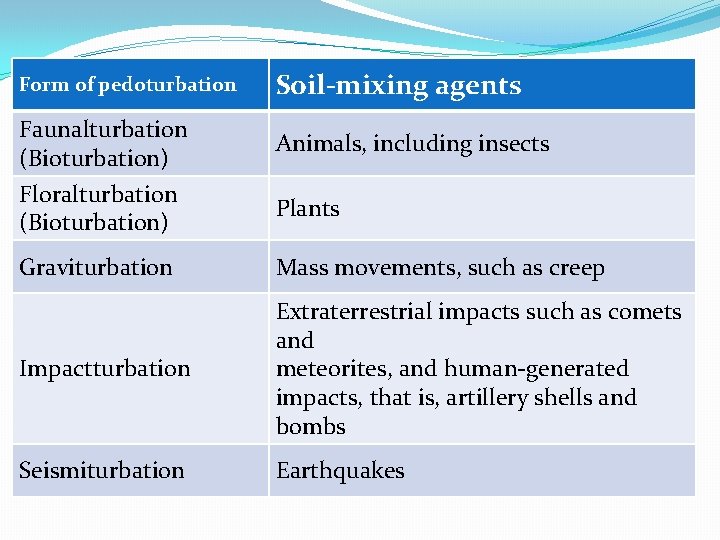
Form of pedoturbation Faunalturbation (Bioturbation) Floralturbation (Bioturbation) Soil-mixing agents Animals, including insects Plants Graviturbation Mass movements, such as creep Impactturbation Extraterrestrial impacts such as comets and meteorites, and human-generated impacts, that is, artillery shells and bombs Seismiturbation Earthquakes
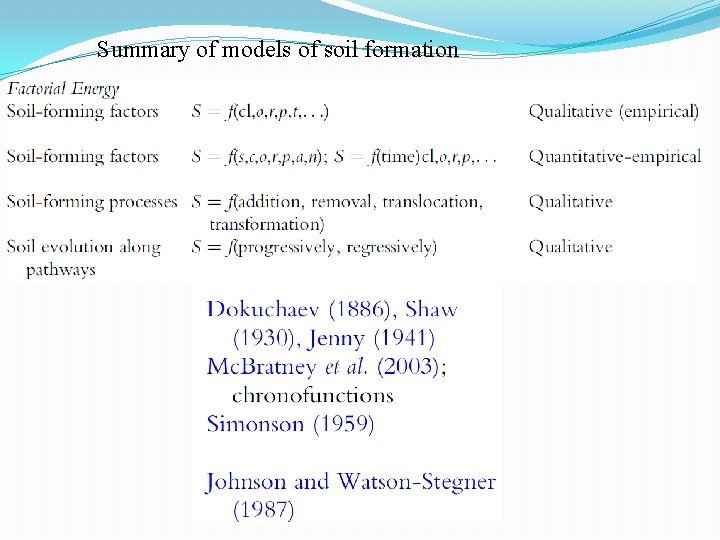
Summary of models of soil formation
Soil formation Soils are formed from rock, loose unconsolidated materials (may be transported), or organic residues. Two processes of soil formation: 1. Weathering 2. Horizon development.
Soil formation Weathering of soil minerals: Physical and chemical breakdown of rock unable to support plant life to smaller size material able to support plants. During chemical weathering, primary minerals are dissolved and form secondary minerals.
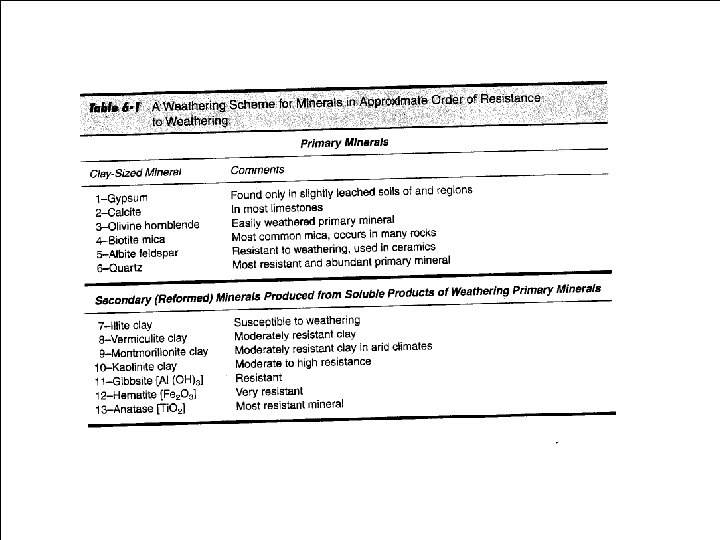
Soil formation Chemical weathering of soil minerals: This is accomplished by: 1. Hydrolysis (H+ and OH- from water) 2. Hydration (taking on water) 3. Carbonation (carbonic acid) 4. Organic acids (which are very important and effective because they chelate) 5. Oxidation and reduction (losing or gaining of electrons).
Soil formation Weathering of soil minerals: Soluble products of weathering (such as Na, Si, Ca, K HCO 3 -) leach away, less soluble products (like Fe 2 O 3) stay behind.
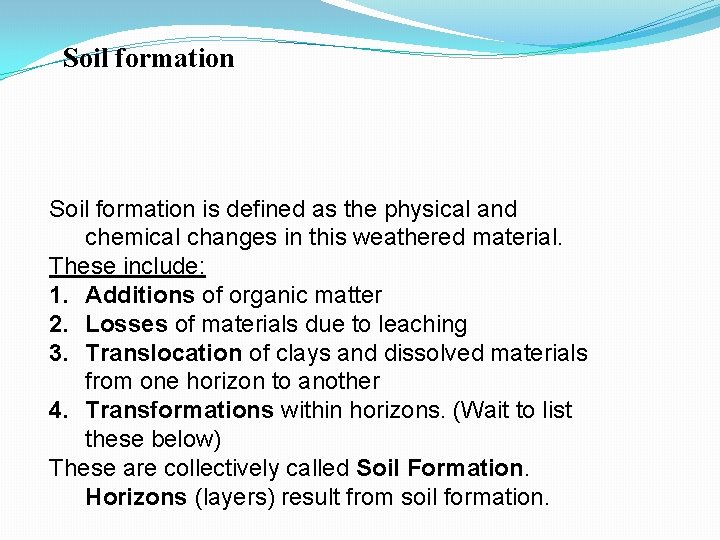
Soil formation is defined as the physical and chemical changes in this weathered material. These include: 1. Additions of organic matter 2. Losses of materials due to leaching 3. Translocation of clays and dissolved materials from one horizon to another 4. Transformations within horizons. (Wait to list these below) These are collectively called Soil Formation. Horizons (layers) result from soil formation.
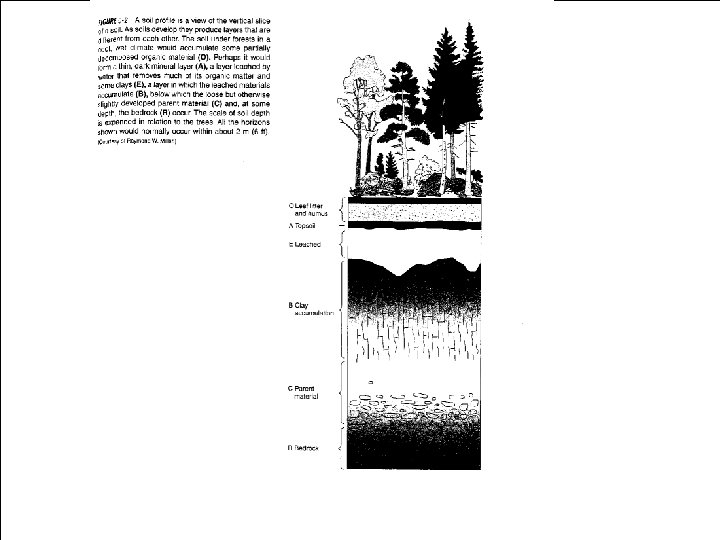
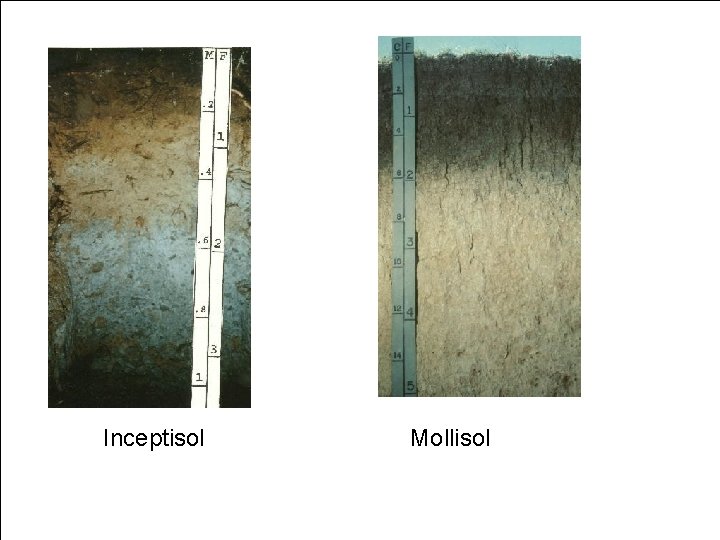
Photo of soil profile Inceptisol Mollisol
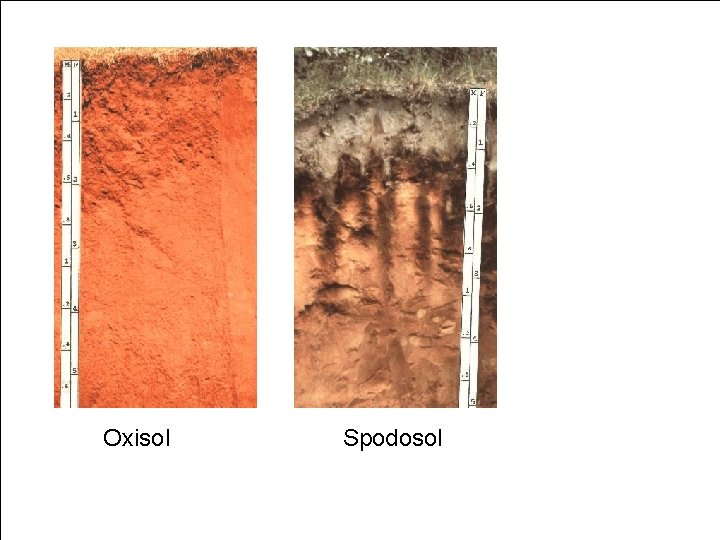
Photo of soil profile Oxisol Spodosol
Pedogenic (soil forming) processes: Think of what would happen if you took a sand, silt, and clay parent material fresh from a borrow pit and put it out and left it for 10, 000 years in: 1) boreal forest, 2) temperate forest, 3) grassland, 4) desert, 5) tropical forest. What kinds of processes would affect the development of these materials into soils?
Pedogenic (soil forming) processes: 1) Additions (organic matter, particles, dust, chemicals) from: A. Water (rain and irrigation) B. Sediment from wind (aeolian deposition resulting in loess deposits) and water (alluvium) C. Organic matter (most important addition)
Pedogenic (soil forming) processes: 2) Losses A. Leaching of chemicals organic matter, and ions B. Erosion C. Gaseous (organic matter, N, S; especially during fire and in in flooded soils for N and S)
Pedogenic (soil forming) processes: 3) Tranformations (within horizons): A. Dissolution and precipitation B. Organic matter decay and stabilization
Pedogenic (soil forming) processes: 4. Translocation Movement of clays, organic matter, dissolved ions (Fe, Al) from one horizon to another
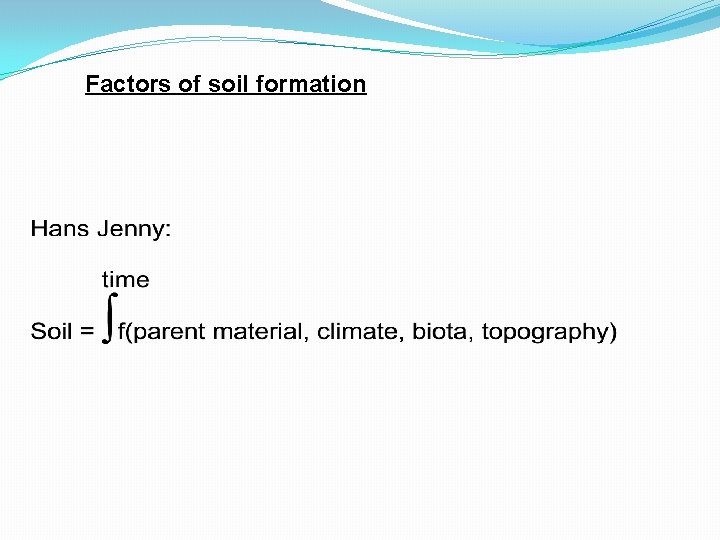
Factors of soil formation
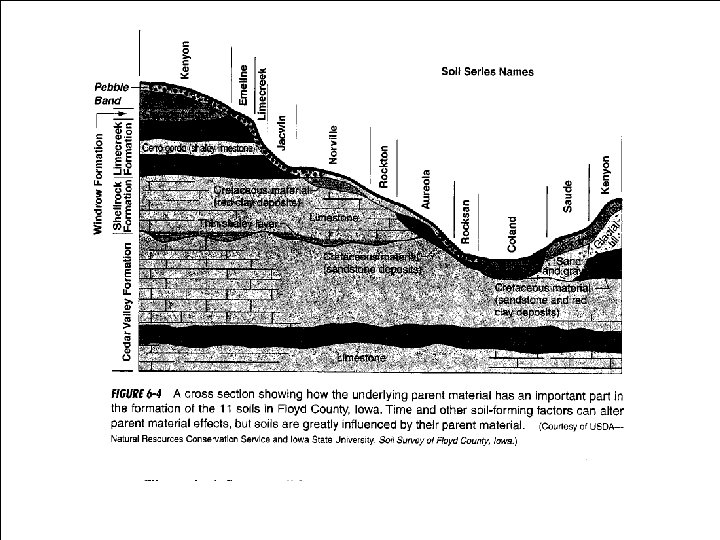
Factors of soil formation 1) Parent material: • Especially important in early soil development, less so in older soils. • Influences nutrients (other than N) by both total content and rate of weathering • Influences initial texture (particle size dist).
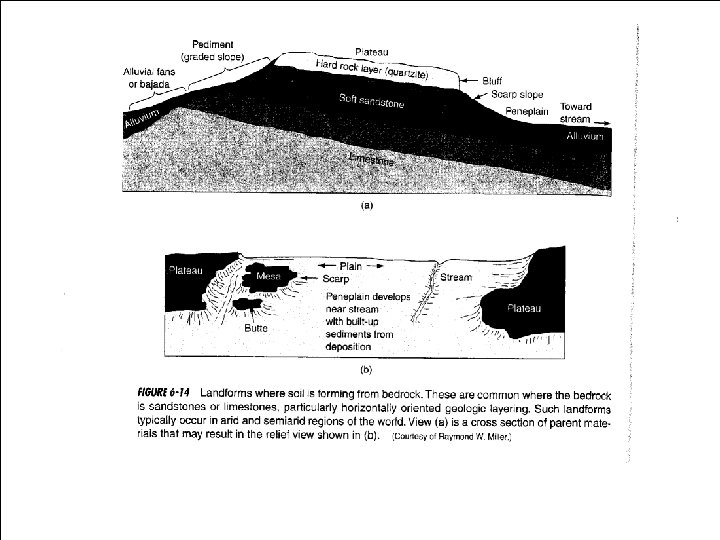
Factors of soil formation 1) Parent material: Examples: granitic rock, glacial till, lacustrine clay, mixed colluvium, limestone. Landforms: characteristic mineral or organic masses (e. g. , mesa, butte, plateau, plain, terraces, etc). More on landforms later
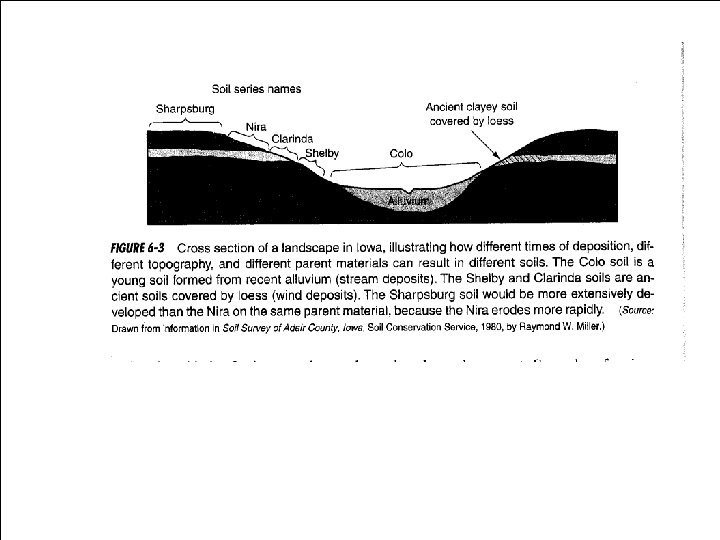
Factors of soil formation 2) Climate A. Influences chemical weathering: rainfall rate affects dissolution and leaching 1. Accumulation of carbonates and salts in arid soils (calcareous or alkaline soils). a) A result of low water availability b) For example: dissolved calcium and sulfate precipitate to form calcium sulfate (gypsum): Ca 2+ + SO 42 - Ca. SO 4
Factors of soil formation 2) Climate A. Influences chemical weathering: rainfall rate affects dissolution and leaching 2. Acidic soils from high leaching rates. -Dissolution (carbonates, easily weatherable minerals) -Carbonic acid production (acidifying): • Carbon dioxide + water forms carbonic acid: • CO 2 + H 2 O ----> H 2 CO 3 • Carbonic acid dissociates to hydrogen and bicarbonate: • H 2 CO 3 H+ + HCO 3 -
Factors of soil formation 2) Climate B. Influences physical weathering 1. Erosion 2. Colluviation (downslope movement) a) Stronger in warm regions than in cold regions. b) Important after fire – Gondola example
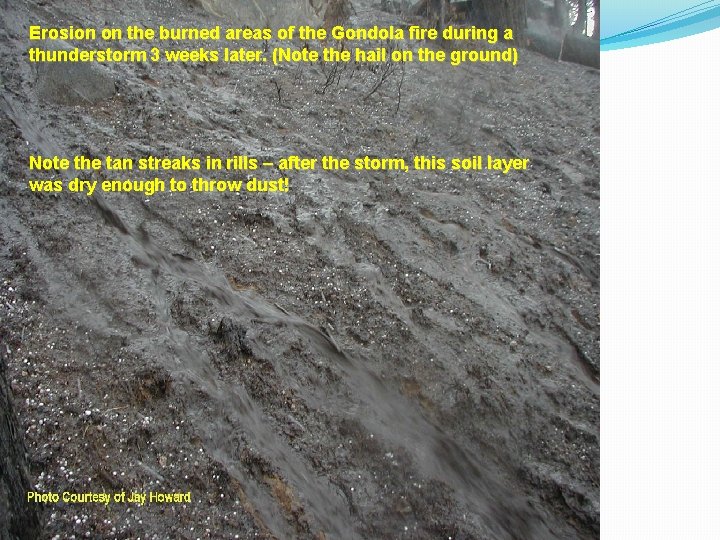
Erosion on the burned areas of the Gondola fire during a thunderstorm 3 weeks later. (Note the hail on the ground) Note the tan streaks in rills – after the storm, this soil layer was dry enough to throw dust!
Factors of soil formation 2) Climate B. Influences physical weathering 1. Not in book: -temperature fluctuations -frost cracking
Factors of soil formation 2) Climate C. Influences organic matter indirectly via plant productivity and decomposition
Factors of soil formation 3) Biota 1. Influences the rate and nature of organic inputs: A. High inputs in tropical forests B. Low in deserts. 2. Organic matter accumulation rates vary with climate
Factors of soil formation 3) Biota • Islands of fertility in deserts caused by far-separated plants (photo) • Tree roots breaking rocks • Burrowing animals (esp. earthworms) • Micro-organisms (extremely important) • Lichens: symbiotic relationship between algae and fungi, first to colonize rocks
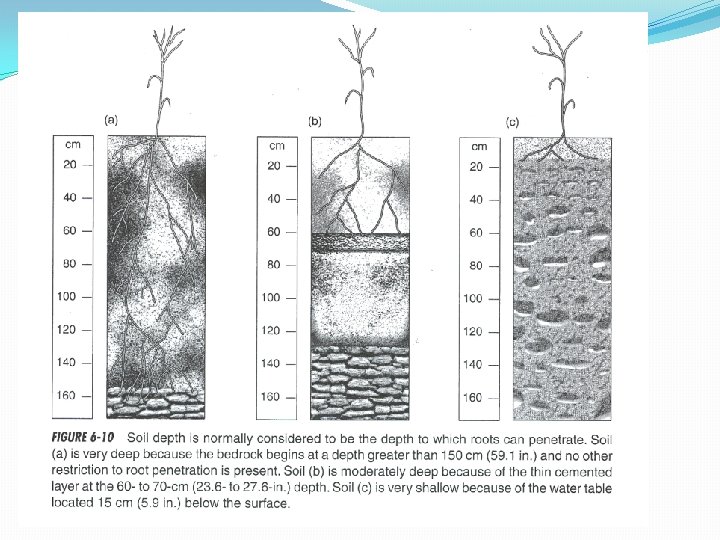
Factors of soil formation 4) Topography: • Aspect and temperature • Drainage, precipitation, redox potential. • Erosion, alluvial, colluvial activity (Figures 6 -20, 6 -21) • Slide Mountain example
Factors of soil formation 5) Time • Soil development may occur in less than 200 years in humid climates, but can continue for thousands. • Rate of development depends upon intensity of climate and biota factors and weatherability of parent materials.
Factors of soil formation Interactions of soil forming factors • Low rainfall: low leaching --> calcareous, salt buildup, high p. H; low production --> low SOM • High rainfall: high leaching --> loss of Ca. CO 3, base cations, acidification more horizon buidups; high production ---> higher SOM, less patchy.
Factors of soil formation Factors that may retard soil development: 1. Low rainfall 2. Low RH 3. High Ca. CO 3 content (soil materials less mobile) 4. Sandy parent material (often ends up as Entisol) 5. High clay (poor aeration, slow water movement). 6. Resistant parent material (quartzite) 7. Steep slopes - lots of erosional renewel
Factors of soil formation Factors that may retard soil development: 8. High water tables (slow leaching, decomp). 9. Cold temps (low biota, slow chemical reactions) 10. Constant deposition (like steep slopes, alluvial, aeolian deposits) 11. Severe wind or water erosion (similar to 10) 12. Mixing by animals (but can also create mollisols) 13. Toxics - serpentine, etc.

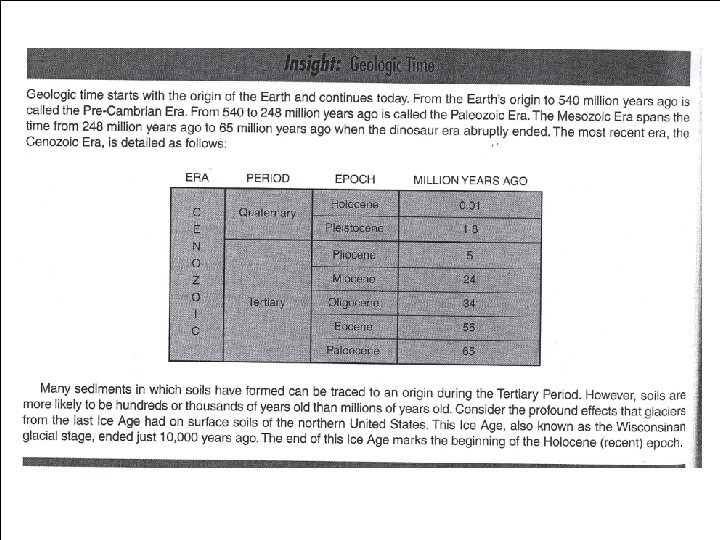
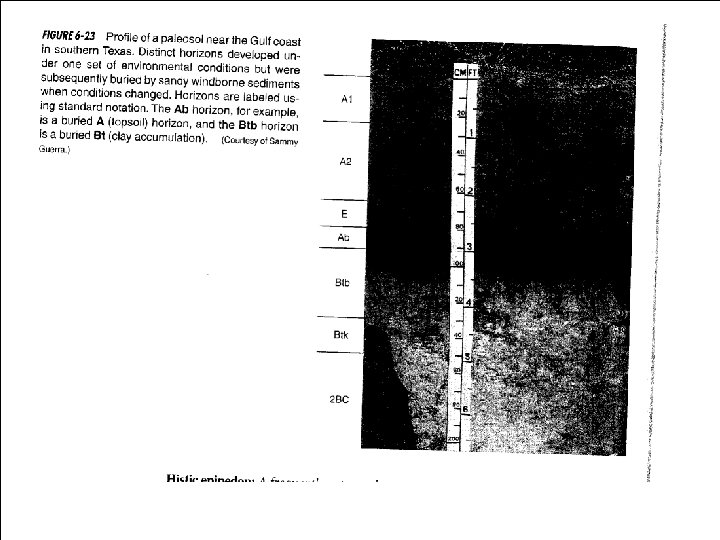
Paleosols (Ancient soils): Soils formed under previous climate, vegetation. Mostly during the Quarternary (since beginning of last ice age) Relict soils: exposed paleosols, quite different from those currently exitsing. Example: near Ultisols in the middle of aridisols near Pyramid lake Fossil soils: Relict soils that are buried and preserved.
Paleosols (Ancient soils): • 14 C dating: 14 C/12 C ratio in atmosphere is constant until bomb testing in the 60’s. • 14 C decays to 14 N, emitting beta. • 1/2 life of 14 C is 5568 yr
Landforms and soil development Different parent materials often have a distinctive landform. “Most soils form on rocks in place (residual soils). ”
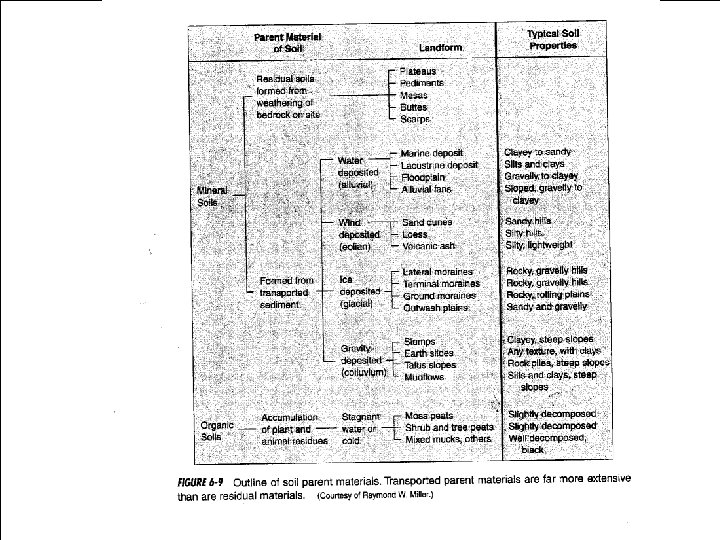
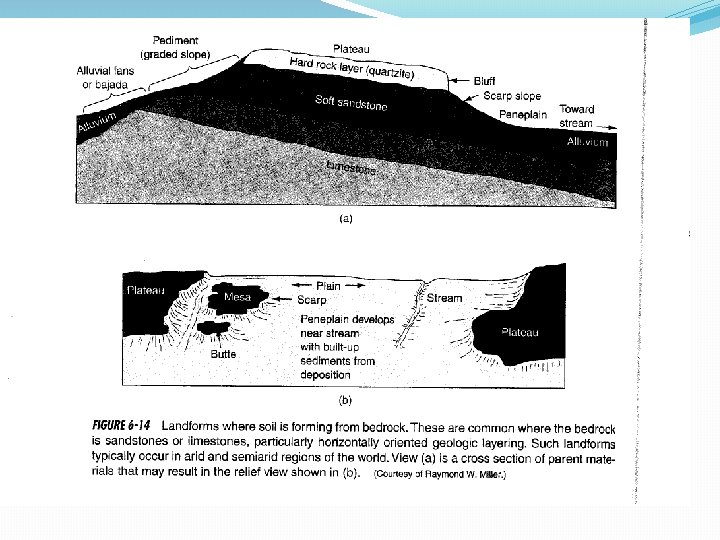
Landforms and soil development • Erosion tends to level off parent rock and leave a layer of soil behind. • This landform is called a pediment. • Water then can cut these up, leaving behind plateaus (large flat areas) or mesas (smaller flat areas) or buttes (even smaller areas). • These are cut up with bluffs and scarps on the sides.
Materials deposited by water are called alluvium. • Floodplains: low flat deposits (floods) • River Terraces: Somewhat less flat areas deposited by rivers at flood stage or in previous channels. • Alluvial Fans: Not flat; material carried down mountain canyons land left during flood events. • Bajadas: Coalesced alluvial fans at base of mountains
Materials deposited by water are called alluvium. • Peneplains: Nearly level areas near streams from low flooding. • Playa: Dried up lake bed (lacustrine deposit) • Marine Sediments: make up limestone and dolomite deposits, beaches, deltas
Materials deposited by winds are Aeolian deposits: • Fine silts, sands, clays. • A lot of this during the last glacial period forming loess soils. • Loess soils in the midwest are some of the best for farming because of optimal particle size (silt) • Also much aeolian activity in desert systems today. • You have seen this in Nevada; good examples near Honey Lake and Washoe Lake, for example.
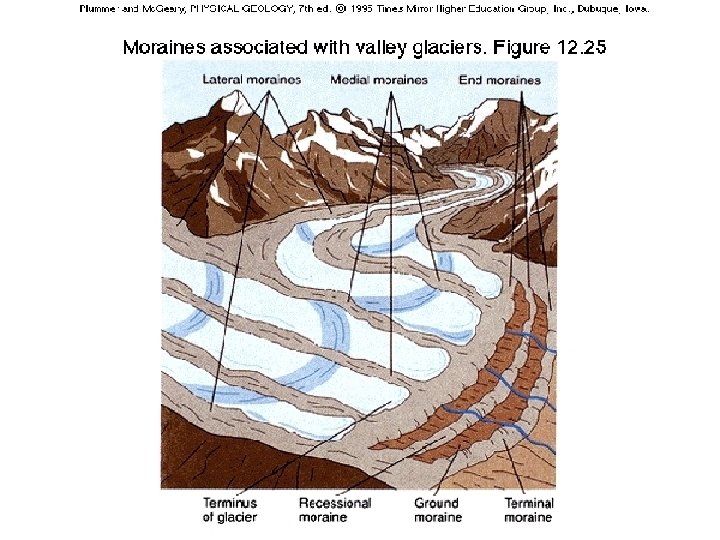
Materials deposited by ice: Ice sheet during Pleistocene. Glacial till: general name for glacial deposits. Terminal moraine: ice melted as fast as it formed, leaving a sort of dike Lateral moraine: On the sides of glacier, melting and deposition Ground moraine: ice melted faster than it formed, leaving a flatter deposit from material within the ice.
Materials deposited by ice: Outwash plains: near edges of glaciers, water borne. Eskers: tunnels beneath the ice, filled up with sand other deposits. Kettle: block of ice left, sediment washed around it, then ice melted leaving a hole. Erratics: large boulders left behind. Basal till: book failes to mention this. It is what was under the ice and very compacted (cement-like). Holds water.
Sediments moved by gravity are called colluvium • Talus: rocky material • Soil creep: slow movement • Solifluction: slow movement (few cm per day) • Debris flow, mudflow, earthflow: self-explanatory. • Avalanche: rapid flow
Development of soil horizons • Think again of what would happen to our parent materials laid out in different climates. • Materials move downward, forming • Soil layers that are often approximately parallel with the soil’s surface. • Boundaries can be abrupt (distinct) or indistinct • Boundaries can also be smooth (even thickness) or tonguing • Horizons form by physical and chemical movement, sometimes also by animals (Mollisols).
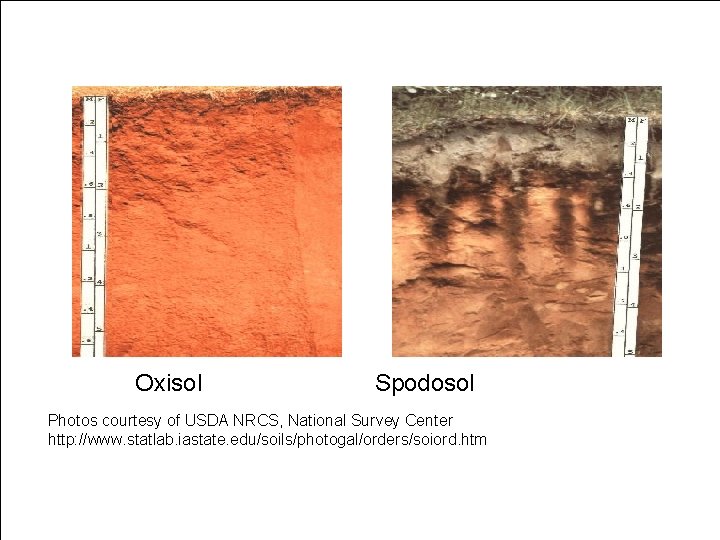
Oxisol Spodosol Photos courtesy of USDA NRCS, National Survey Center http: //www. statlab. iastate. edu/soils/photogal/orders/soiord. htm
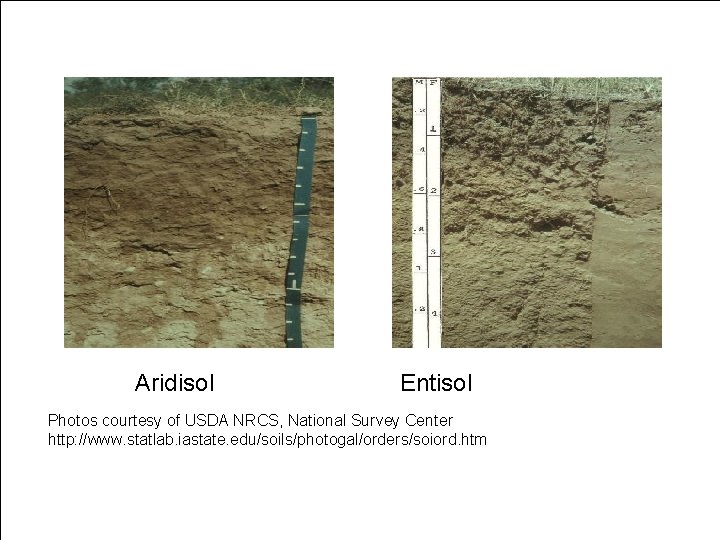
Aridisol Entisol Photos courtesy of USDA NRCS, National Survey Center http: //www. statlab. iastate. edu/soils/photogal/orders/soiord. htm
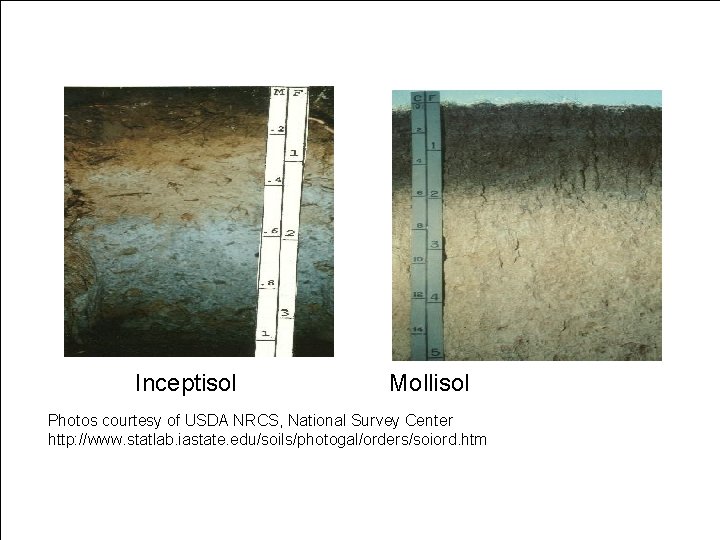
Inceptisol Mollisol Photos courtesy of USDA NRCS, National Survey Center http: //www. statlab. iastate. edu/soils/photogal/orders/soiord. htm
Soil Horizons: • Letters are used to designate horizons: A, B, C, R. • Capitals are master horizons • Small letters are suffixes for characteristics of master horizons (e. g. , Bt) • Arabic numerials after master indicate vertical subdivisions • Arabic numerals before master indicate discontinuities (i. e. , buried horizons)
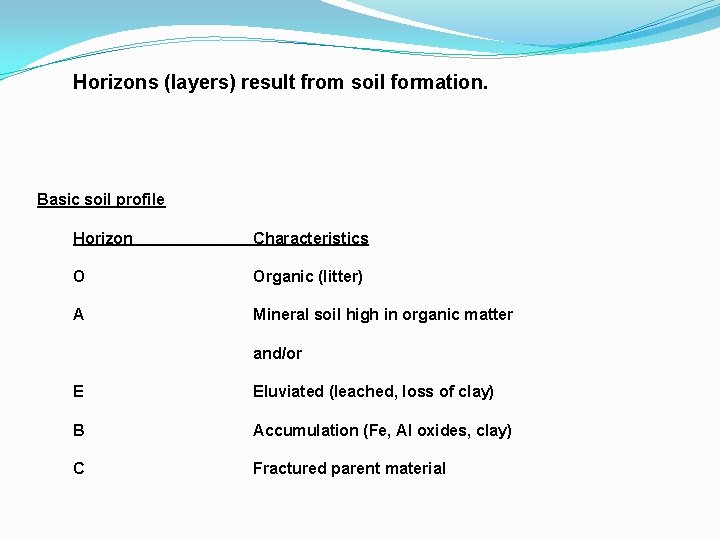
Horizons (layers) result from soil formation. Basic soil profile Horizon Characteristics O Organic (litter) A Mineral soil high in organic matter and/or E Eluviated (leached, loss of clay) B Accumulation (Fe, Al oxides, clay) C Fractured parent material
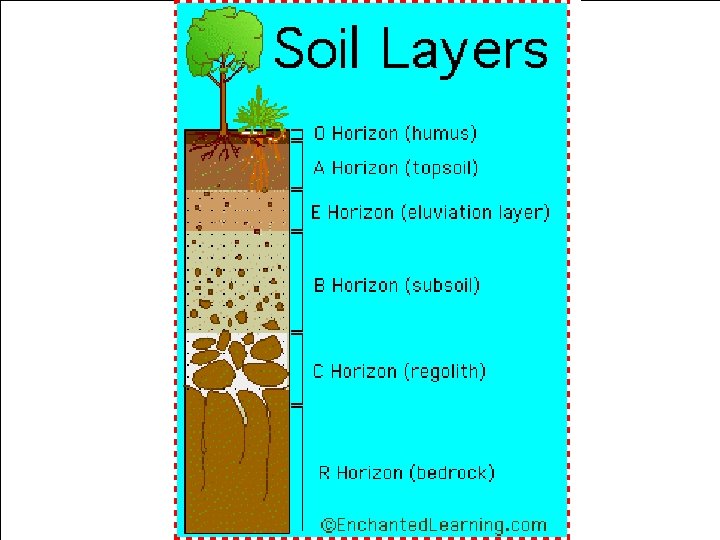
Photo of soil profile
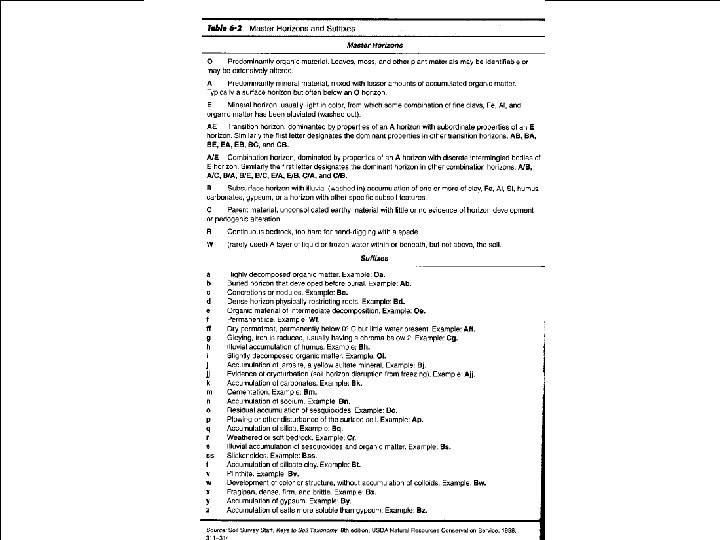
Photo of soil profile
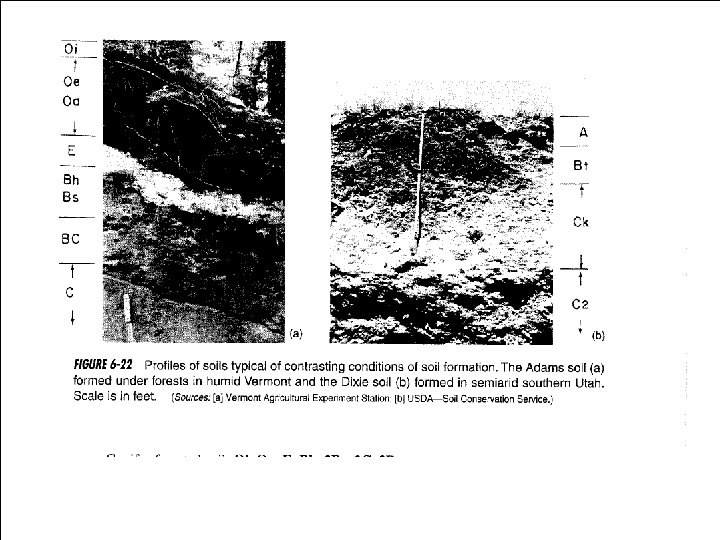
Photo of soil profile
Diagnostic horizons: used to differentiate and classify. • Epipedon: upper profile • Endopedon: lower profile
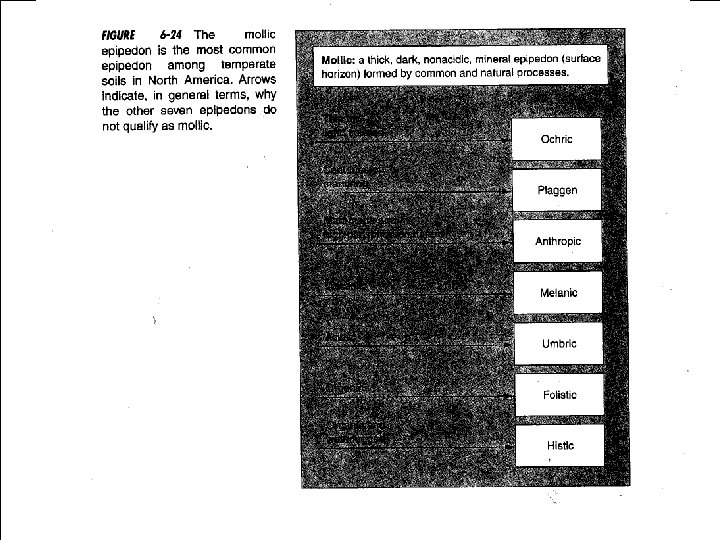
Epipedon: Surface Horizon Anthropic: Affected by People (e. g. , plough layer) Folistic: Infrequently saturated organic horizon. Histic: Frequently saturated organic horizon. Melanic: Thick, humus rich (black). Mollic: Rich in organic matter, dark brown-black, not very acidic Ochric: Light-colored; Low in organic matter Plaggen: People-caused high humus. (Manuring) Umbric: Dark, but more acidic than Mollic Relationships among horizons (VG Fig 2 -21)
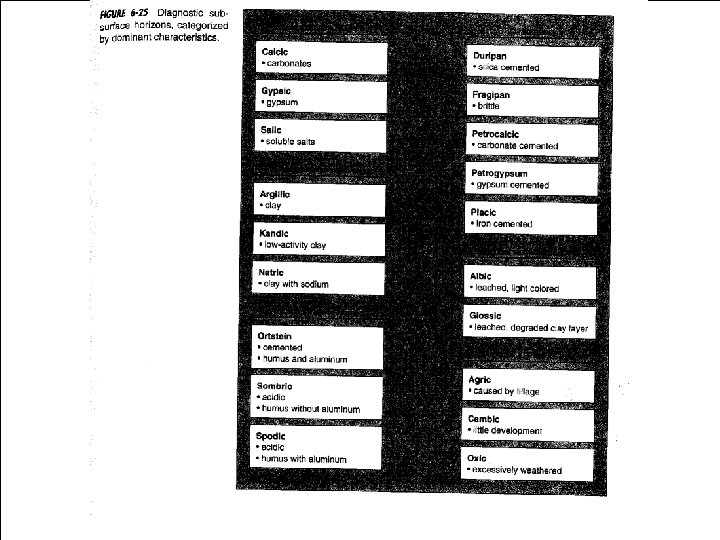
Endopedon: Subsurface horizon • Agric: Clay and humus rich due to ploughing • Albic: Strongly leached, whitish colored • Argillic: Clay-rich due to migration • Calcic: Calcium carbonate • Cambic: Altered horizon but not one of the above. Occupies B horizon position • Duripan: Cemented pan by caused by silica • Fragipan: Physically hard compacted pan; Not chemically cemented
Endopedon: Subsurface horizon • Glossic: Degraded clay accumulation (used to be argillic, kandic, or natric) • Gypsic: Calcium sulfate • Kandic: Argillic horizon of kaolinite clays (lower CEC than Argillic) • Natric: Argillic horizon with high sodium or other base • Orstein: Thick, cemented illuvial horizon • Oxic: Highly-weathered, rich in Fe and Al oxides. Often reddish
Endopedon: Subsurface horizon • Petrocalcic: Carbonate-cemented • Petrogypsic: Gypsum cemented • Placic: Reddish, thin cemented pan of Fe, Mg and organic matter complexes • Salic: Salty • Sombric: Acidic, humus accumulation, tropical B horizon • Spodic: High in organic matter, iron, and aluminum oxides due to podzolization
Soils as Mapping units • Pedons: smallest unit of soil that can be called an individual. • Polypedons: contiguous soils having the same thickness, humus, p. H. Adjacent pedons which are similar, relate to series. • GIS is critical to mapping these days. Read this section.
- Slides: 75