
Soil Conservation Practices How to Build and Use
Soil Conservation Practices: How to Build and Use an A-frame L. Robert Barber & Frank Cruz, University of Guam Cooperative Extension Service For More Information Contact: 735 -2080
Causes of Soil Erosion • No Cover on the soil (plants or mulch) – Fire – Clearing • Sloping lands – water movement • Wind • Organic matter loss due to intensive production without replacement

Conservation Practices For: Erosion Control on Sloping Lands • Production practices following the contour – Contour tillage – Contour Plantings – Vegetative Barriers & Filter strips – Contour (hillside) ditches – Contour hedgerows • Soil Cover and Anchoring – Mulching – Cover crops – Grass Waterways
What is a Contour Line? • A contour line is a level line across a slope. • Contour practices help prevent soil erosion – Stops or slows downhill flow of water carrying soil particles • Marking contour lines indicate where to place barriers like: – Contour canals – Orchard plantings and hedgerows – Vegetative barriers – Row Crops
What is an A-frame • A simple cheap technology for marking contour lines. • Three pieces of wood assembled into an A with a plumb bob. • Once the plumb line is calibrated it shows when the two points of each leg are level.
Materials: • 3 relatively straight pieces of wood • Machete or Saw & drill • String, Nails or bolts • Stakes or other marking method • Stone or plumb bob • Pencil
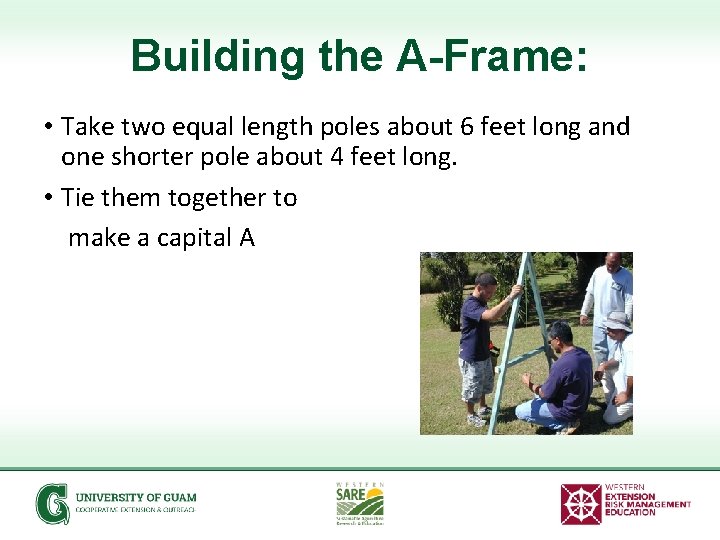
Building the A-Frame: • Take two equal length poles about 6 feet long and one shorter pole about 4 feet long. • Tie them together to make a capital A
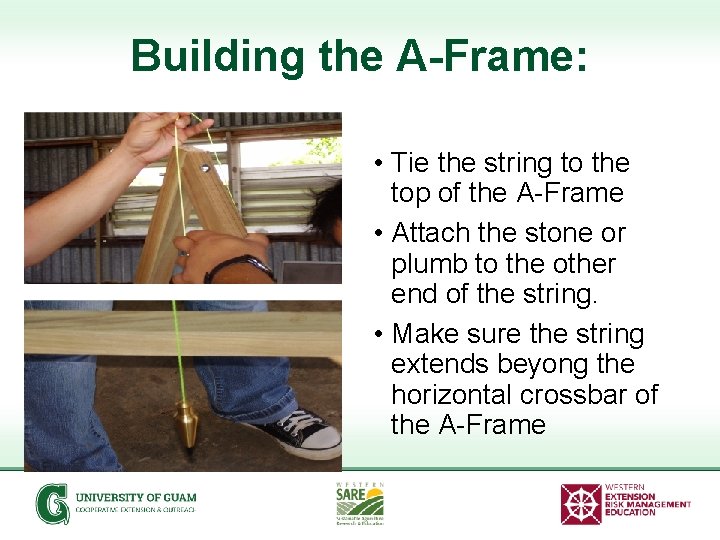
Building the A-Frame: • Tie the string to the top of the A-Frame • Attach the stone or plumb to the other end of the string. • Make sure the string extends beyong the horizontal crossbar of the A-Frame
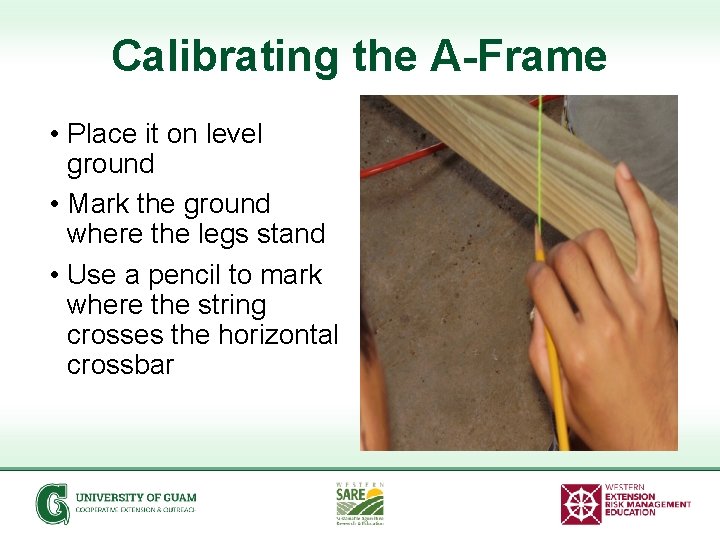
Calibrating the A-Frame • Place it on level ground • Mark the ground where the legs stand • Use a pencil to mark where the string crosses the horizontal crossbar
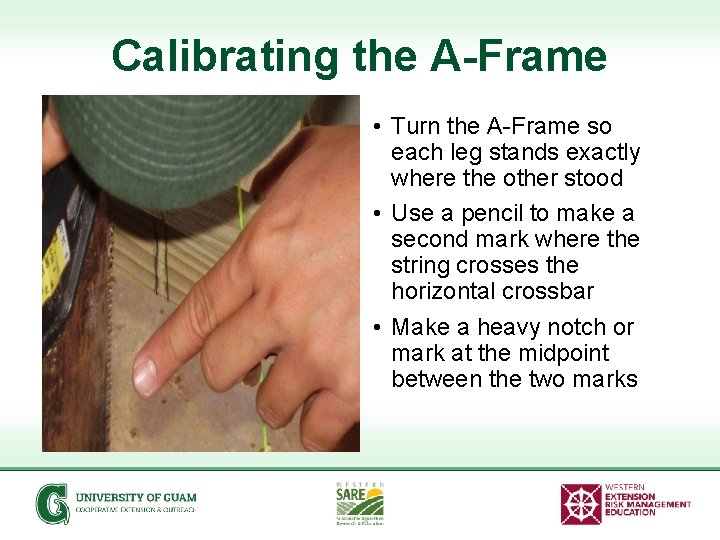
Calibrating the A-Frame • Turn the A-Frame so each leg stands exactly where the other stood • Use a pencil to make a second mark where the string crosses the horizontal crossbar • Make a heavy notch or mark at the midpoint between the two marks
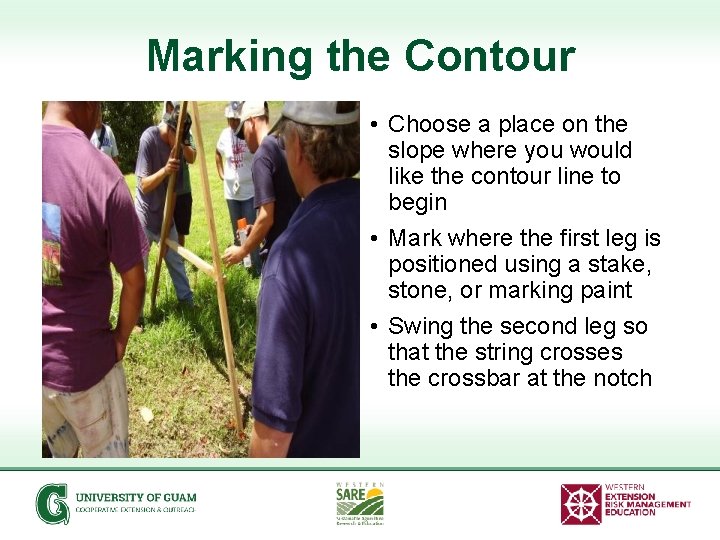
Marking the Contour • Choose a place on the slope where you would like the contour line to begin • Mark where the first leg is positioned using a stake, stone, or marking paint • Swing the second leg so that the string crosses the crossbar at the notch

Marking the Contour • The two points of the A-frame legs are level. This is the beginning of the contour line. • Now mark the spot where the second leg stands. • Keeping the second leg in place pivot the first leg around. • Move the first leg up or down the slope until the string aligns with the notch. • Mark the new location of the first leg and continue this process until you reach the end of the field or where you want the line to end. • The marks on the field will show a contour line across the slope.
Contour Practices The following contour practices increase water retention and reduce soil erosion – Contour trenches – Vegetative barriers and filter strips – Contour tillage – Contour planting of a crop – Contour plantings of nitrogen fixing hedgerows – Contour plantings of windbreaks and orchard trees
Closing Thoughts • Key to success of each practice is to locate the contour lines • The A-Frame is simple and inexpensive tool that can be built and utilized in almost any situation to identify contour lines
- Slides: 14