
Soil Colloidal Chemistry and Surface Reaction 8 1

- Slides: 50
和表面反应 Soil Colloidal Chemistry and Surface Reaction 8. 1 Surface properties of soil colloid 土壤胶体的表面性质 8. 2 Adsorption and exchange of cations by soil colloids 土壤胶体对阳离子的吸附交 换反应 8. 3 Adsorption and exchange of anions by soil colloids
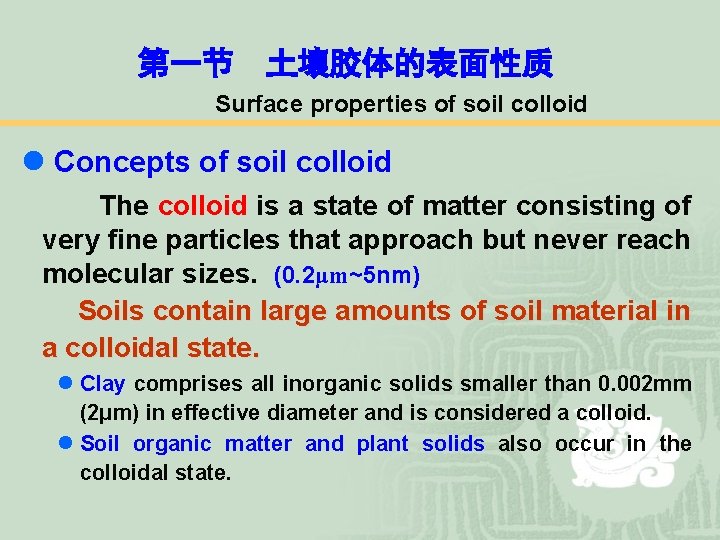
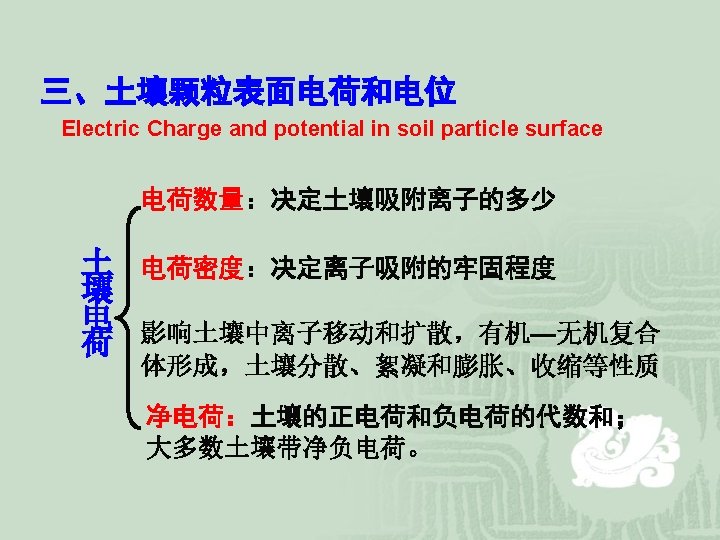
第一节 土壤胶体的表面性质 Surface properties of soil colloid l Concepts of soil colloid The colloid is a state of matter consisting of very fine particles that approach but never reach molecular sizes. (0. 2μm~5 nm) Soils contain large amounts of soil material in a colloidal state. l Clay comprises all inorganic solids smaller than 0. 002 mm (2μm) in effective diameter and is considered a colloid. l Soil organic matter and plant solids also occur in the colloidal state.
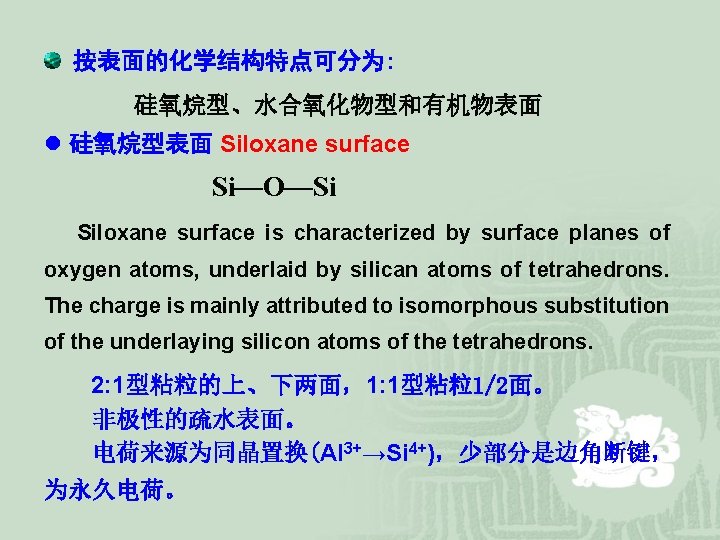
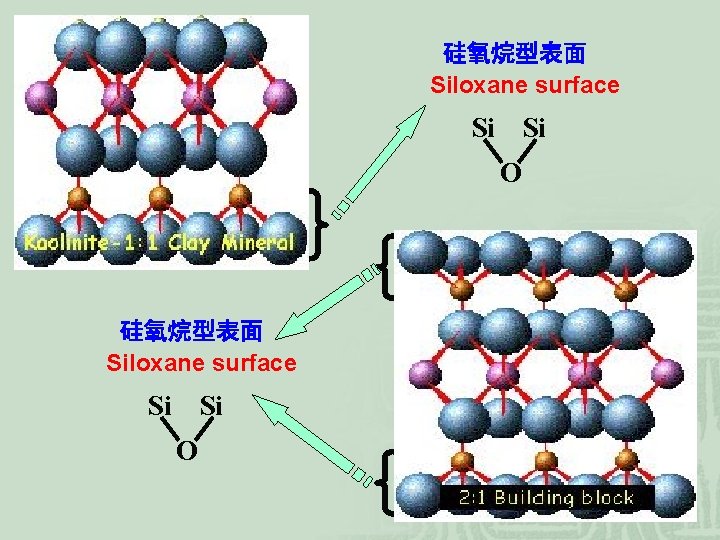
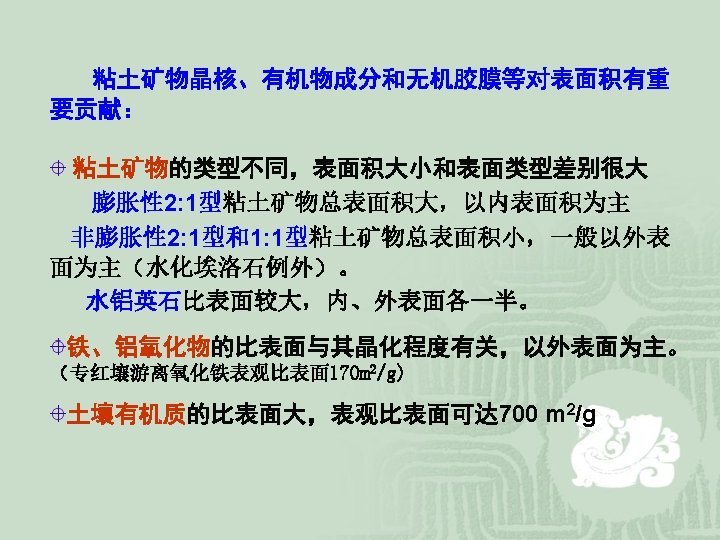
按表面的化学结构特点可分为: 硅氧烷型、水合氧化物型和有机物表面 l 硅氧烷型表面 Siloxane surface Si—O—Si Siloxane surface is characterized by surface planes of oxygen atoms, underlaid by silican atoms of tetrahedrons. The charge is mainly attributed to isomorphous substitution of the underlaying silicon atoms of the tetrahedrons. 2: 1型粘粒的上、下两面,1: 1型粘粒 1/2面。 非极性的疏水表面。 电荷来源为同晶置换(Al 3+→Si 4+),少部分是边角断键, 为永久电荷。
硅氧烷型表面 Siloxane surface Si Si O
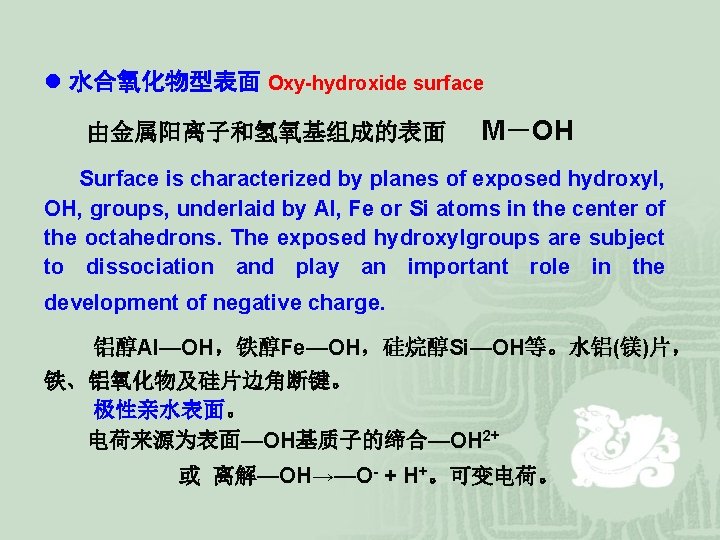
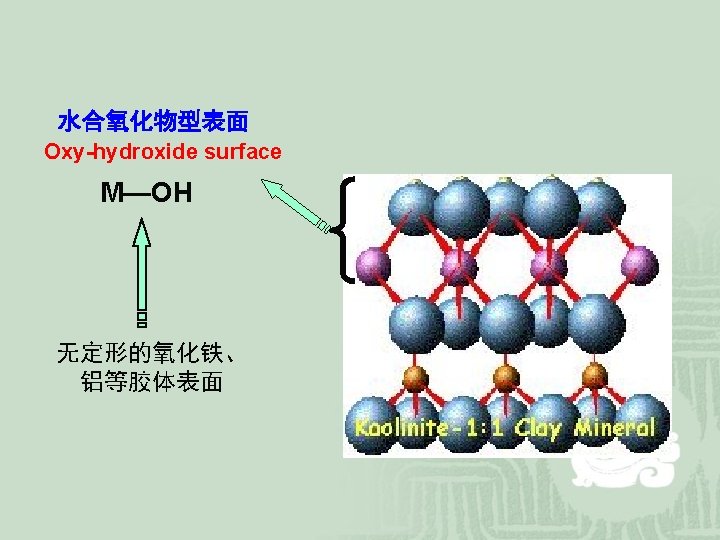
l 水合氧化物型表面 Oxy-hydroxide surface 由金属阳离子和氢氧基组成的表面 M-OH Surface is characterized by planes of exposed hydroxyl, OH, groups, underlaid by Al, Fe or Si atoms in the center of the octahedrons. The exposed hydroxylgroups are subject to dissociation and play an important role in the development of negative charge. 铝醇Al—OH,铁醇Fe—OH,硅烷醇Si—OH等。水铝(镁)片, 铁、铝氧化物及硅片边角断键。 极性亲水表面。 电荷来源为表面—OH基质子的缔合—OH 2+ 或 离解—OH→—O- + H+。可变电荷。
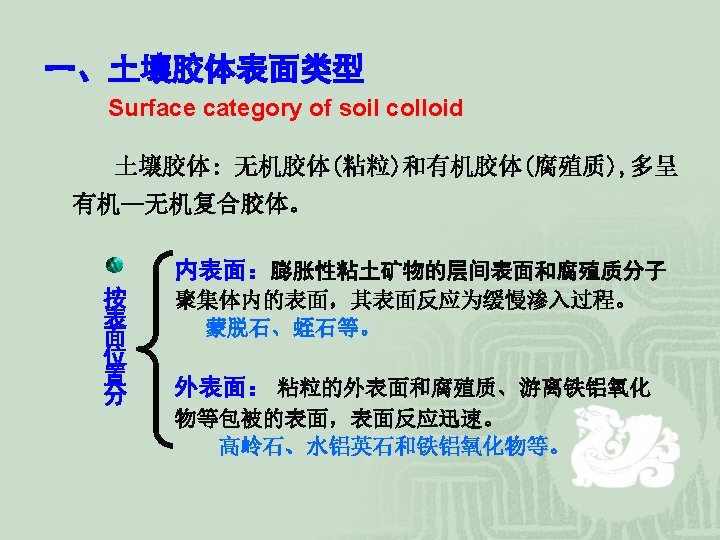
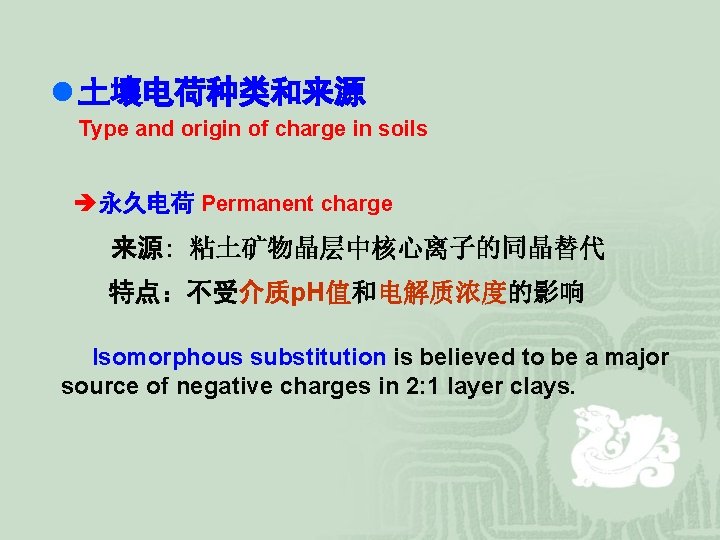
l 土壤电荷种类和来源 Type and origin of charge in soils è永久电荷 Permanent charge 来源: 粘土矿物晶层中核心离子的同晶替代 特点:不受介质p. H值和电解质浓度的影响 Isomorphous substitution is believed to be a major source of negative charges in 2: 1 layer clays.
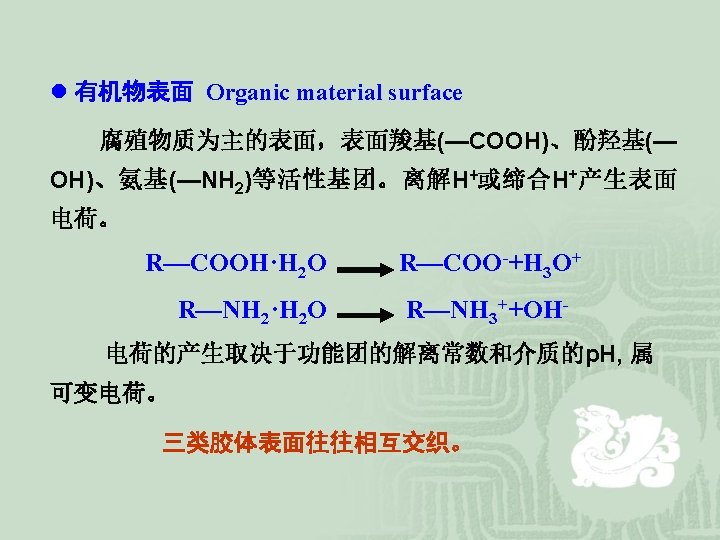
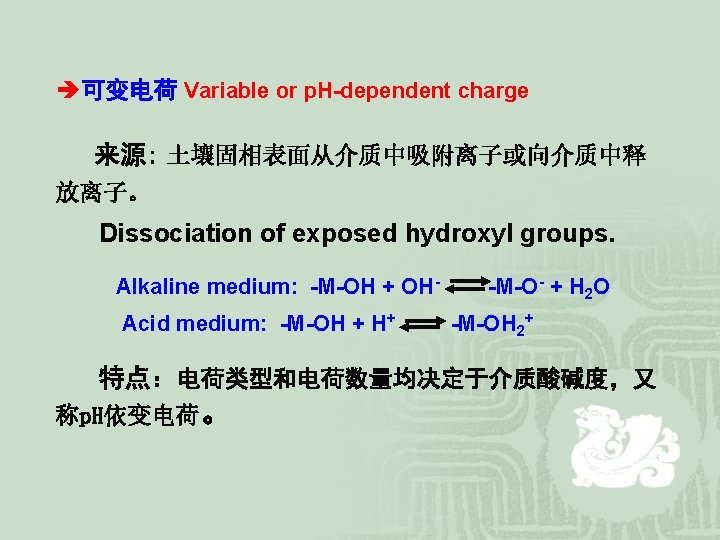
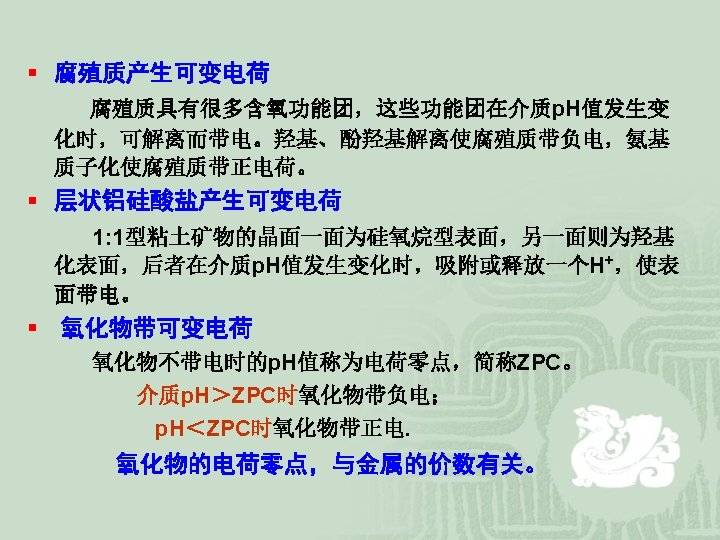
è可变电荷 Variable or p. H-dependent charge 来源: 土壤固相表面从介质中吸附离子或向介质中释 放离子。 Dissociation of exposed hydroxyl groups. Alkaline medium: -M-OH + OHAcid medium: -M-OH + H+ -M-O- + H 2 O -M-OH 2+ 特点:电荷类型和电荷数量均决定于介质酸碱度,又 称p. H依变电荷。
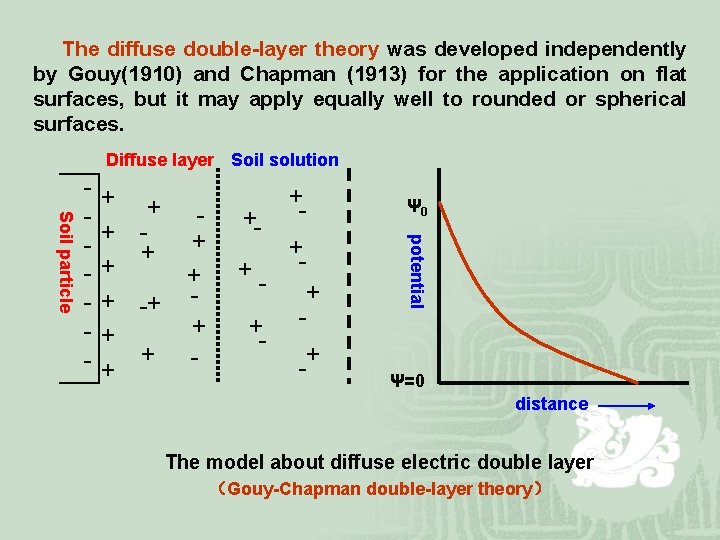
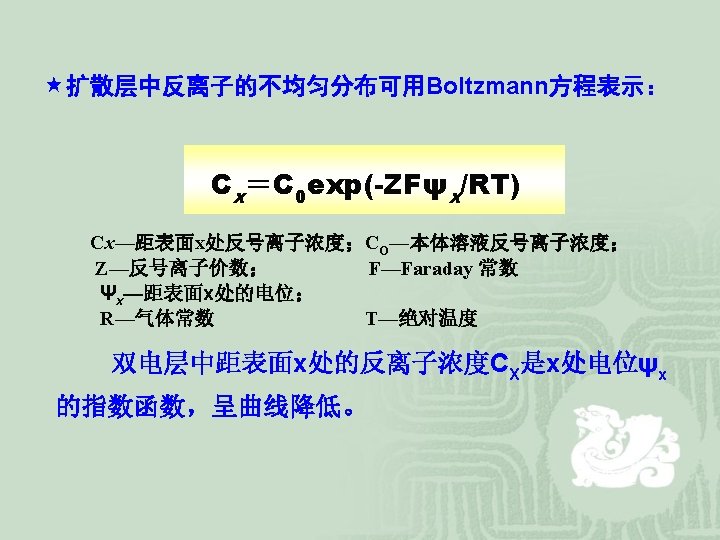
The diffuse double-layer theory was developed independently by Gouy(1910) and Chapman (1913) for the application on flat surfaces, but it may apply equally well to rounded or spherical surfaces. Diffuse layer Soil solution + + potential - Ψ 0 + - - + + - + + + + + Soil particle - - Ψ=0 distance The model about diffuse electric double layer (Gouy-Chapman double-layer theory)
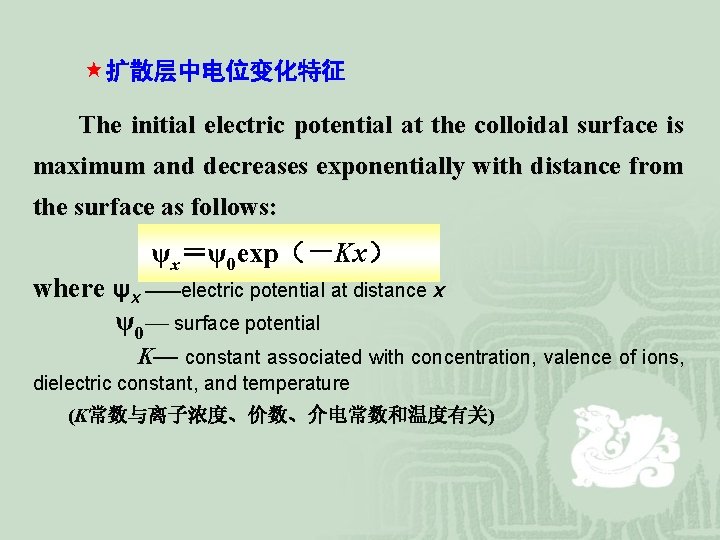
«扩散层中电位变化特征 The initial electric potential at the colloidal surface is maximum and decreases exponentially with distance from the surface as follows: ψx=ψ0 exp(-Kx) where ψx ——electric potential at distance x ψ0— surface potential K— constant associated with concentration, valence of ions, dielectric constant, and temperature (K常数与离子浓度、价数、介电常数和温度有关)
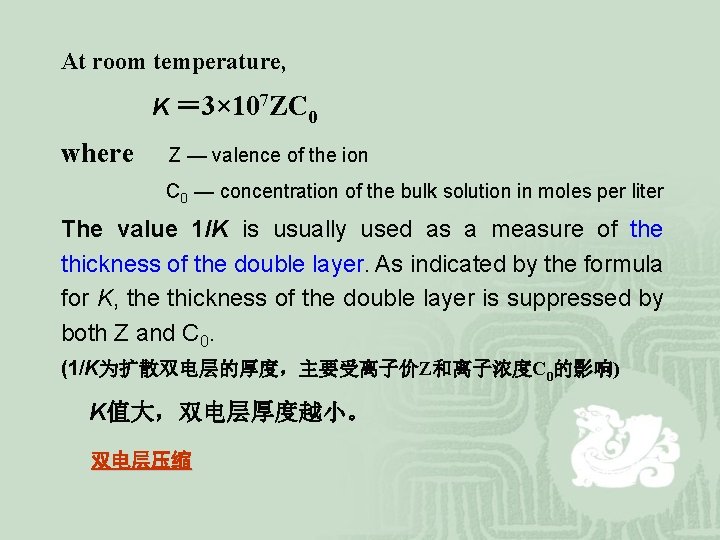
At room temperature, K = 3× 10⁷ ZC 0 where Z — valence of the ion C 0 — concentration of the bulk solution in moles per liter The value 1/K is usually used as a measure of the thickness of the double layer. As indicated by the formula for K, the thickness of the double layer is suppressed by both Z and C 0. (1/K为扩散双电层的厚度,主要受离子价Z和离子浓度C 0的影响) K值大,双电层厚度越小。 双电层压缩
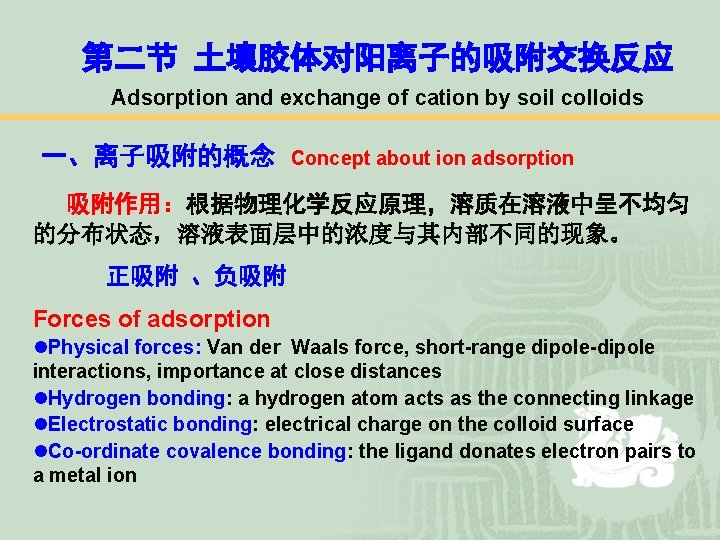
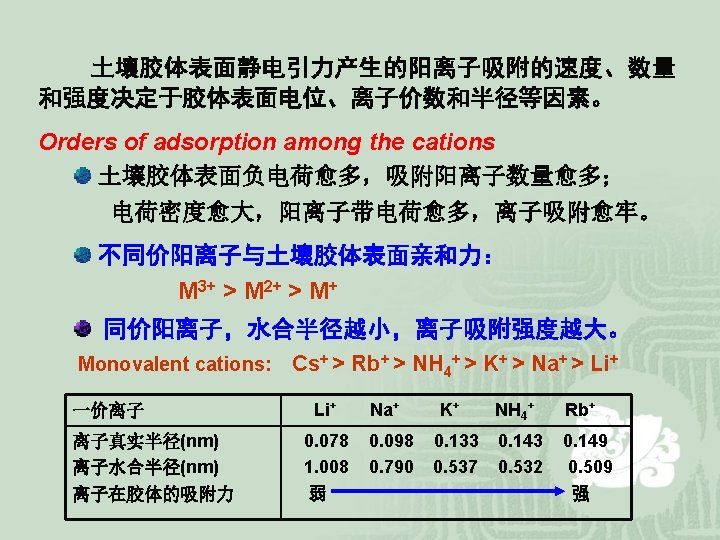
第二节 土壤胶体对阳离子的吸附交换反应 Adsorption and exchange of cation by soil colloids 一、离子吸附的概念 Concept about ion adsorption 吸附作用:根据物理化学反应原理,溶质在溶液中呈不均匀 的分布状态,溶液表面层中的浓度与其内部不同的现象。 正吸附 、负吸附 Forces of adsorption l. Physical forces: Van der Waals force, short-range dipole-dipole interactions, importance at close distances l. Hydrogen bonding: a hydrogen atom acts as the connecting linkage l. Electrostatic bonding: electrical charge on the colloid surface l. Co-ordinate covalence bonding: the ligand donates electron pairs to a metal ion
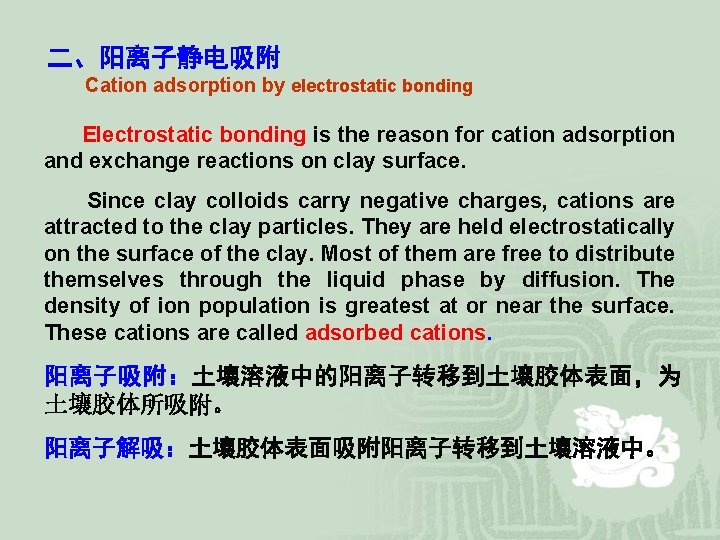
二、阳离子静电吸附 Cation adsorption by electrostatic bonding Electrostatic bonding is the reason for cation adsorption and exchange reactions on clay surface. Since clay colloids carry negative charges, cations are attracted to the clay particles. They are held electrostatically on the surface of the clay. Most of them are free to distribute themselves through the liquid phase by diffusion. The density of ion population is greatest at or near the surface. These cations are called adsorbed cations. 阳离子吸附:土壤溶液中的阳离子转移到土壤胶体表面,为 土壤胶体所吸附。 阳离子解吸:土壤胶体表面吸附阳离子转移到土壤溶液中。
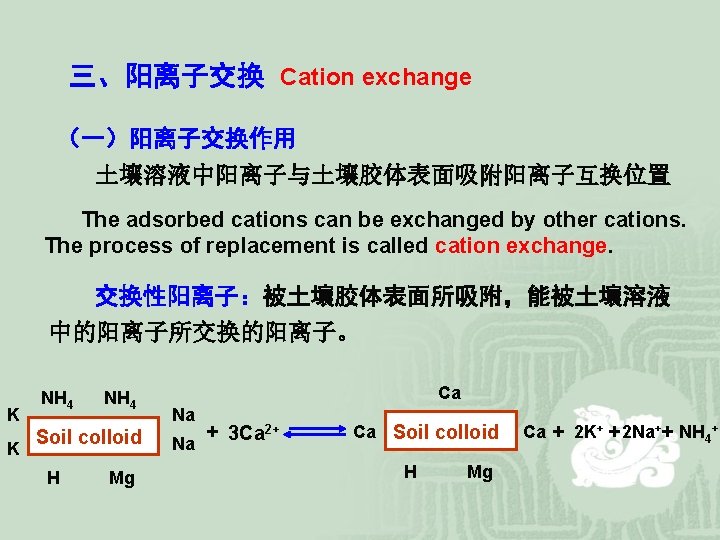
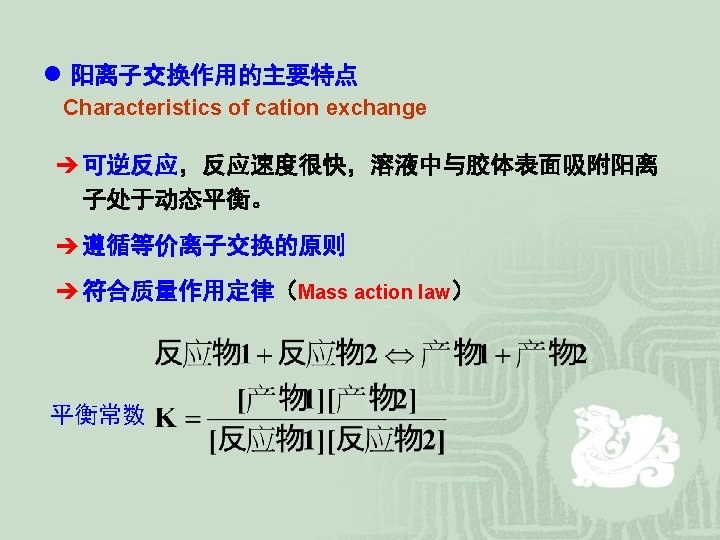
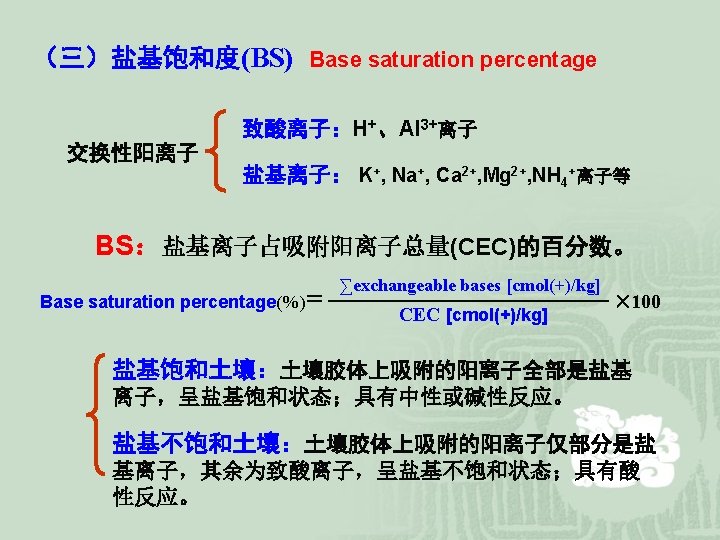
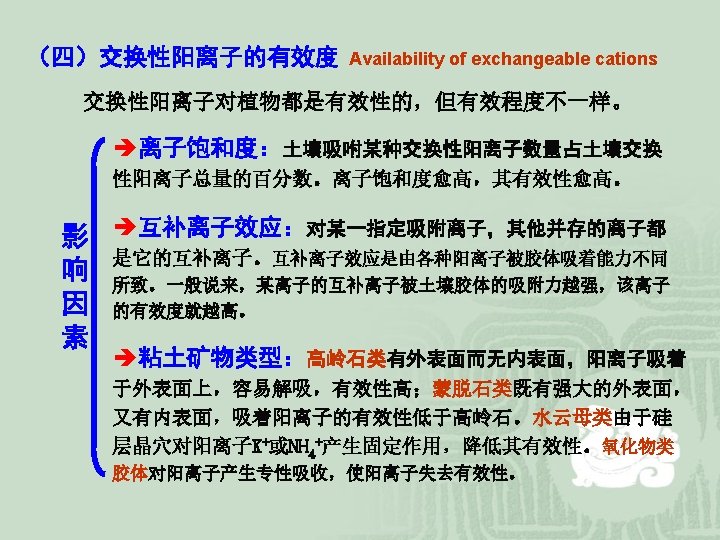
三、阳离子交换 Cation exchange (一)阳离子交换作用 土壤溶液中阳离子与土壤胶体表面吸附阳离子互换位置 The adsorbed cations can be exchanged by other cations. The process of replacement is called cation exchange. 交换性阳离子:被土壤胶体表面所吸附,能被土壤溶液 中的阳离子所交换的阳离子。 K K NH 4 Soil colloid H Mg Ca Na Na + 3 Ca 2+ Ca Soil colloid H Mg Ca + 2 K+ +2 Na++ NH 4+
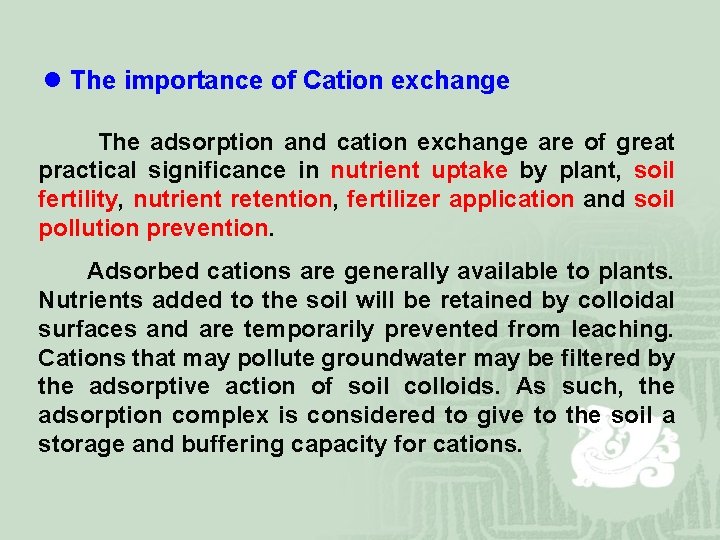
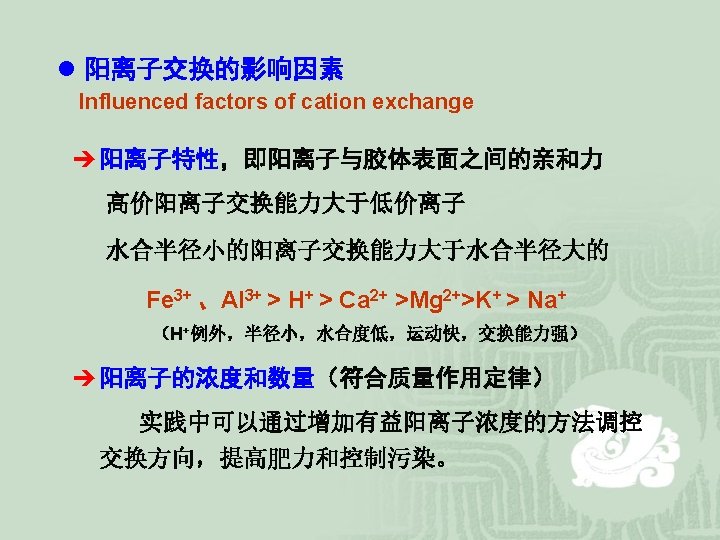
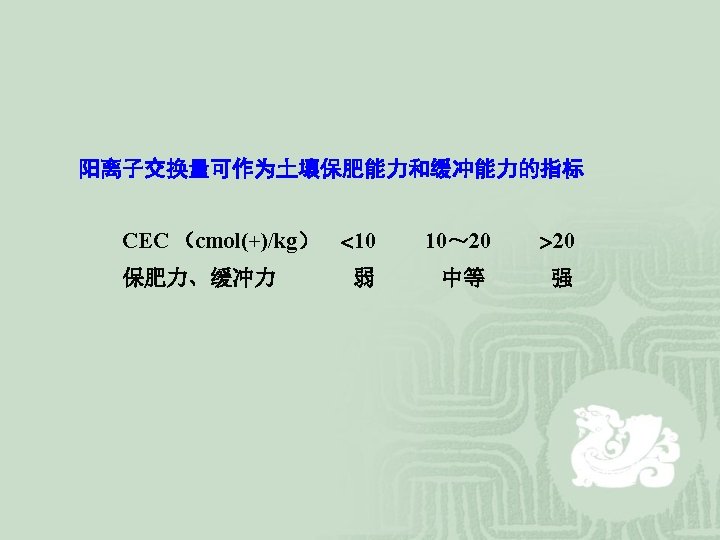
l The importance of Cation exchange The adsorption and cation exchange are of great practical significance in nutrient uptake by plant, soil fertility, nutrient retention, fertilizer application and soil pollution prevention. Adsorbed cations are generally available to plants. Nutrients added to the soil will be retained by colloidal surfaces and are temporarily prevented from leaching. Cations that may pollute groundwater may be filtered by the adsorptive action of soil colloids. As such, the adsorption complex is considered to give to the soil a storage and buffering capacity for cations.
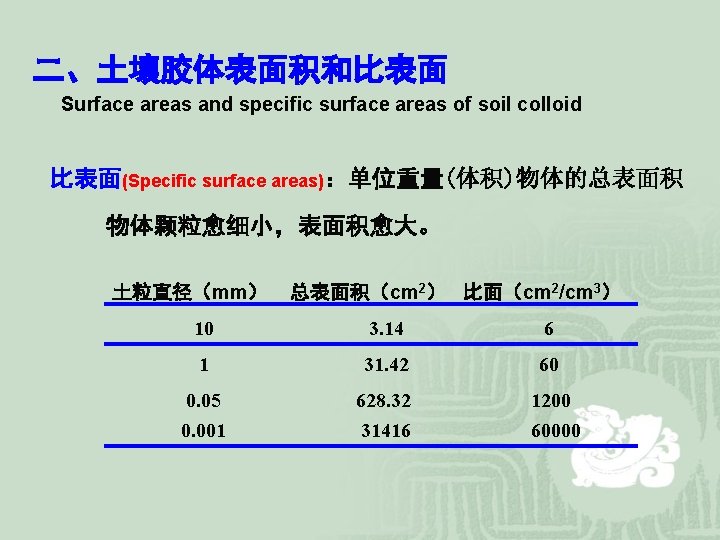
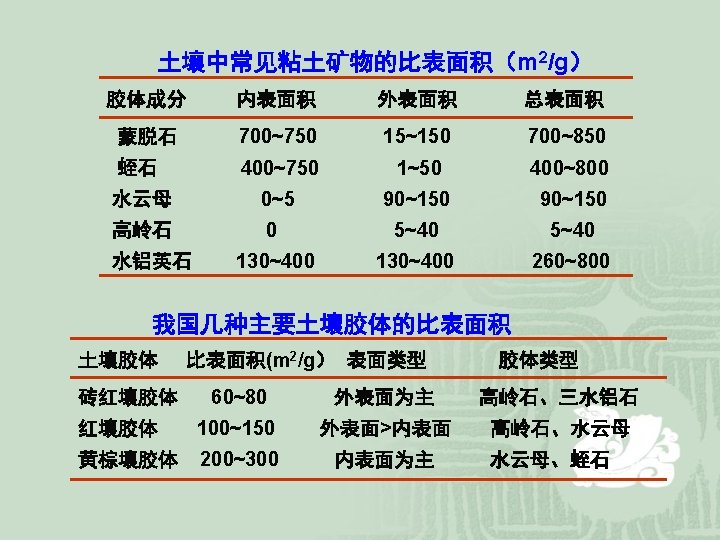
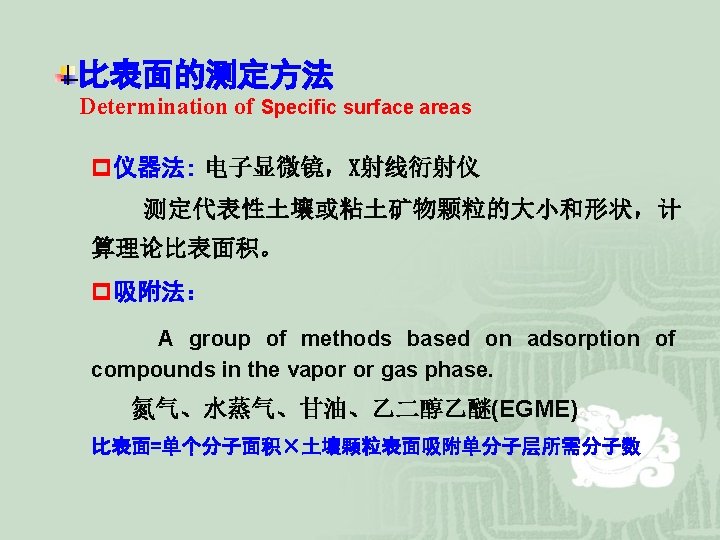
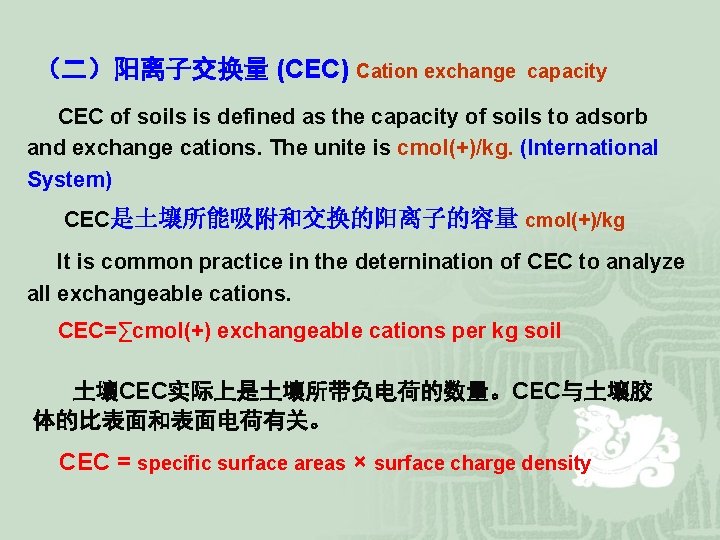
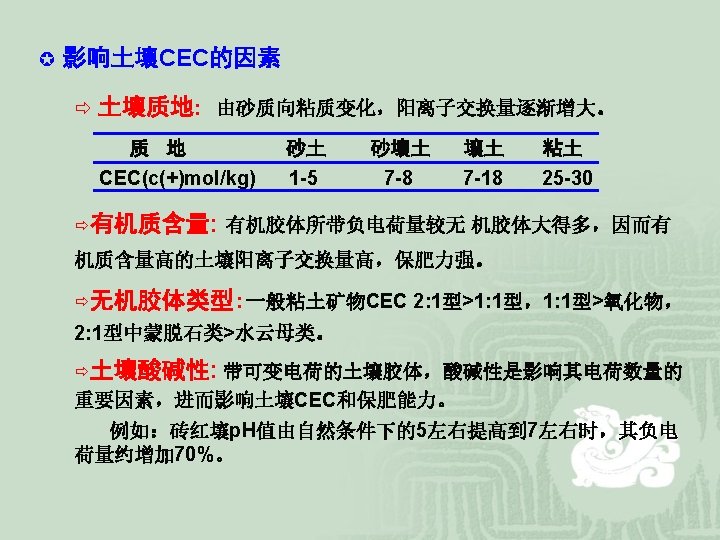
(二)阳离子交换量 (CEC) Cation exchange capacity CEC of soils is defined as the capacity of soils to adsorb and exchange cations. The unite is cmol(+)/kg. (International System) CEC是土壤所能吸附和交换的阳离子的容量 cmol(+)/kg It is common practice in the deternination of CEC to analyze all exchangeable cations. CEC=∑cmol(+) exchangeable cations per kg soil 土壤CEC实际上是土壤所带负电荷的数量。CEC与土壤胶 体的比表面和表面电荷有关。 CEC = specific surface areas × surface charge density
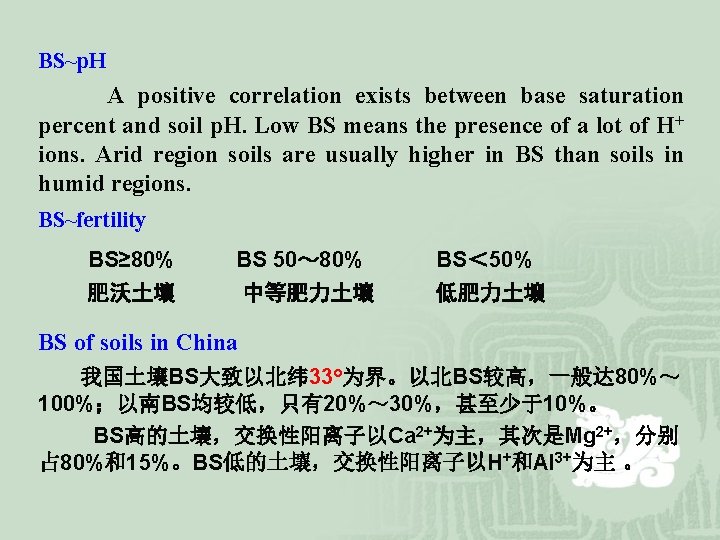
BS~p. H A positive correlation exists between base saturation percent and soil p. H. Low BS means the presence of a lot of H+ ions. Arid region soils are usually higher in BS than soils in humid regions. BS~fertility BS≥ 80% BS 50~ 80% BS< 50% 肥沃土壤 中等肥力土壤 低肥力土壤 BS of soils in China 我国土壤BS大致以北纬 33 为界。以北BS较高,一般达 80%~ 100%;以南BS均较低,只有20%~ 30%,甚至少于10%。 BS高的土壤,交换性阳离子以Ca 2+为主,其次是Mg 2+,分别 占 80%和15%。BS低的土壤,交换性阳离子以H+和Al 3+为主 。