
Soil and Plant Growth What is soil As
- Slides: 32
Soil and Plant Growth What is soil? – As a medium for plant growth, soil can be described as a complex natural material derived from disintegrated and decomposed rocks, and organic materials, which provides nutrients, moisture, and anchorage for land plants
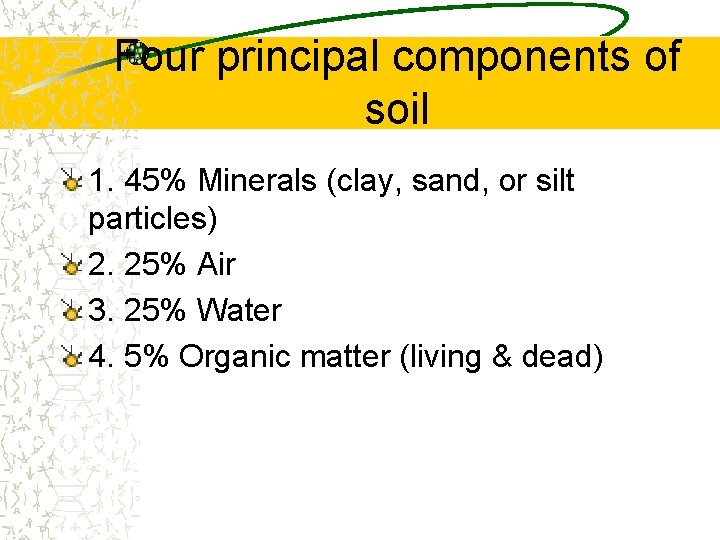
Four principal components of soil 1. 45% Minerals (clay, sand, or silt particles) 2. 25% Air 3. 25% Water 4. 5% Organic matter (living & dead)
How soils are formed? This is a long term process that involves both physical & chemical weathering, along with biological activity. It can take 100+ years to form 1” of topsoil
Characteristics involved in forming soil. Parent Material – material from which soils are formed. Climate – Temperature and moisture. Living Organisms – microscopic & macroscopic plants and animals. Topography – shape & position of the land surface. Time – period during which parent material has been subjected to soil formation.
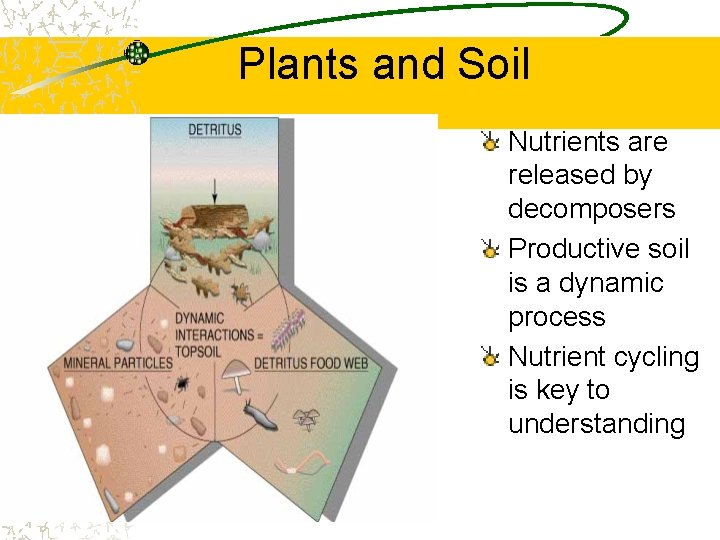
Plants and Soil Nutrients are released by decomposers Productive soil is a dynamic process Nutrient cycling is key to understanding
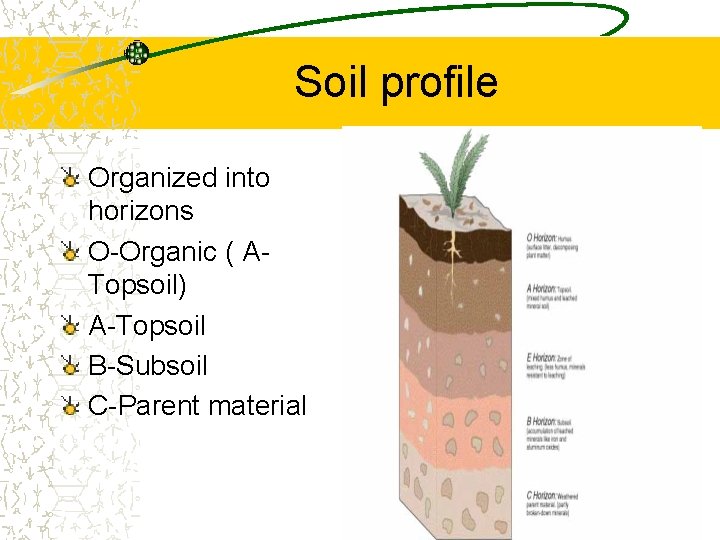
Soil profile Organized into horizons O-Organic ( ATopsoil) A-Topsoil B-Subsoil C-Parent material
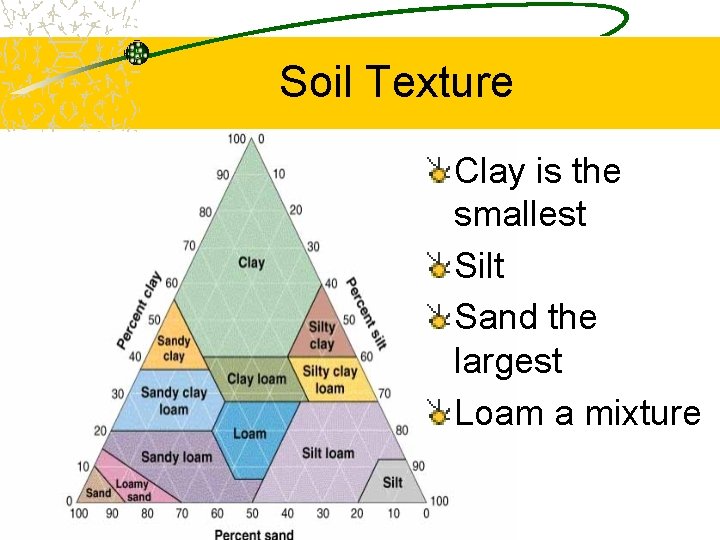
Soil Texture Clay is the smallest Silt Sand the largest Loam a mixture
Spheroidal Granular & Crumb (organic matter content is high)
Prism-Like Prismatic & Columnar (found in subsoils and common in arid & semiarid regions)
Plate-Like Platy (can occur in any part of the profile)
Block-Like Blocky (most common in subsoils, particularly those in humid regions)
others Massive & single grain
Soil structures influence? Soil moisture relationship Aeration Heat transfer Root growth
Soil Reaction (p. H) Soil reaction (acidic, neutral, alkaline) refers to the relative concentration of hydrogen ions (H+) and hydroxyl ions (OH-) in the soil
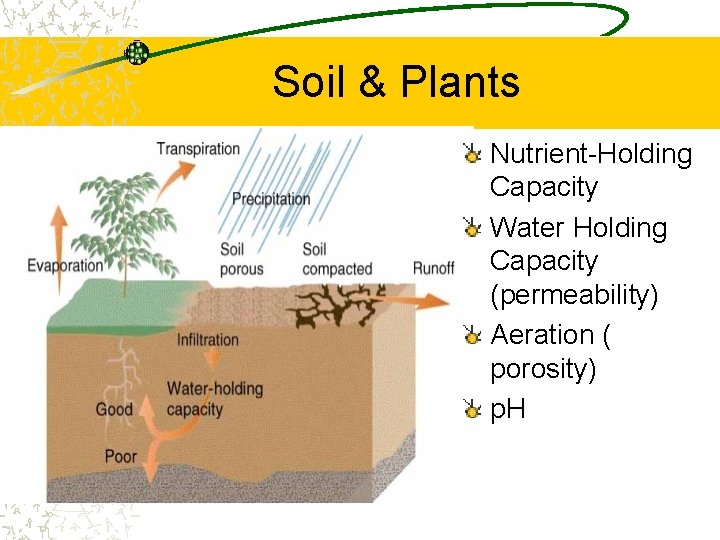
Soil & Plants Nutrient-Holding Capacity Water Holding Capacity (permeability) Aeration ( porosity) p. H
p. H The acidity or alkalinity of the soil p. H is not a fixed characteristic of the soil and, depending on a number of conditions, varies over time. Soils in climates with high rainfall & humidity generally tend to be acid. (This is due to the leaching of base elements as well as by harvested crops usage of sodium, potassium, calcium, & magnesium) Soils in arid climates tend to be alkaline.
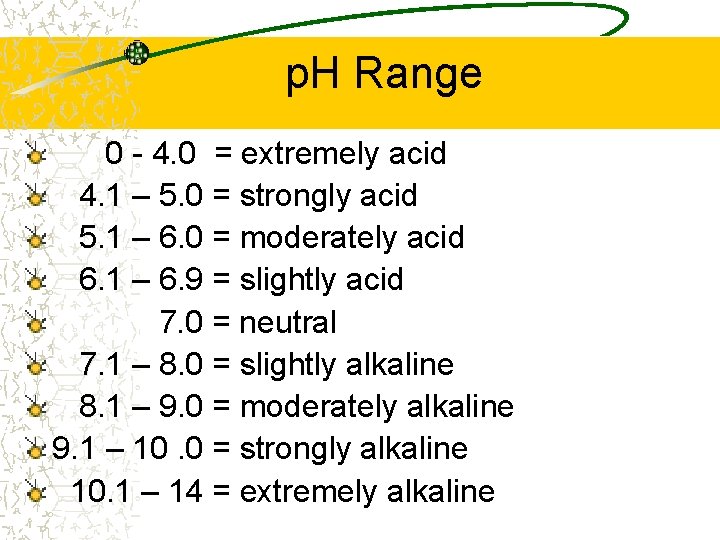
p. H Range 0 - 4. 0 = extremely acid 4. 1 – 5. 0 = strongly acid 5. 1 – 6. 0 = moderately acid 6. 1 – 6. 9 = slightly acid 7. 0 = neutral 7. 1 – 8. 0 = slightly alkaline 8. 1 – 9. 0 = moderately alkaline 9. 1 – 10. 0 = strongly alkaline 10. 1 – 14 = extremely alkaline
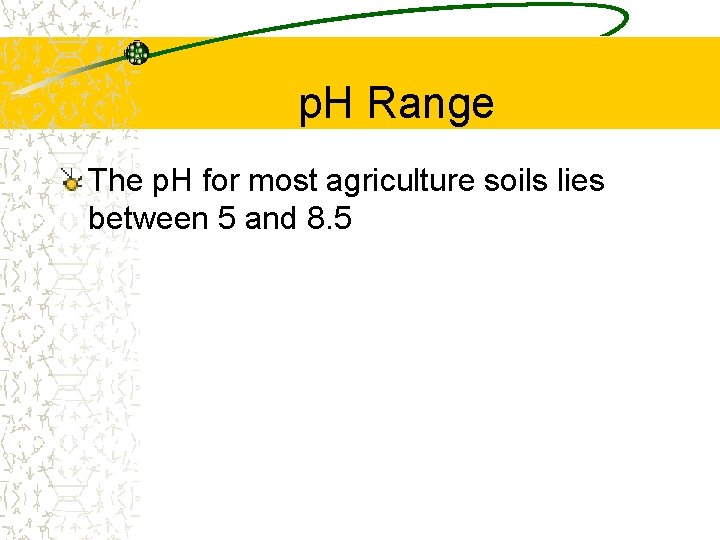
p. H Range The p. H for most agriculture soils lies between 5 and 8. 5
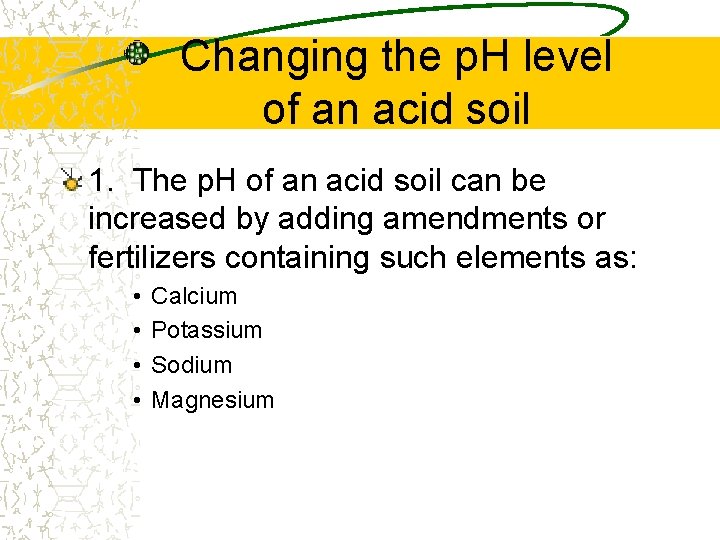
Changing the p. H level of an acid soil 1. The p. H of an acid soil can be increased by adding amendments or fertilizers containing such elements as: • • Calcium Potassium Sodium Magnesium
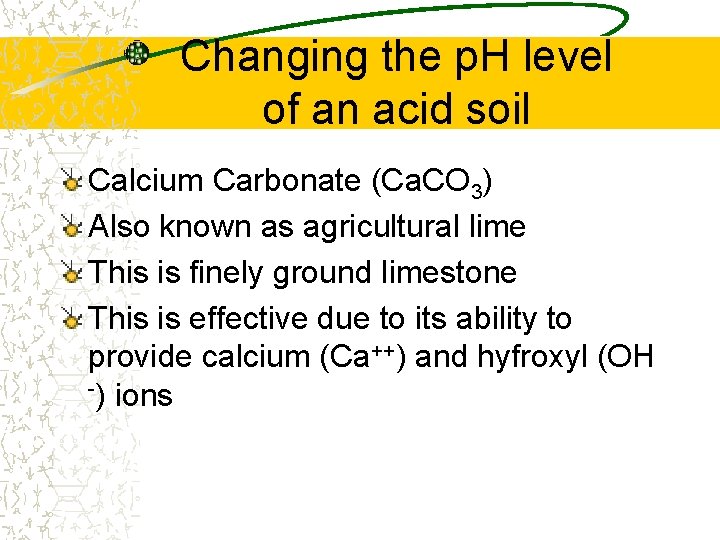
Changing the p. H level of an acid soil Calcium Carbonate (Ca. CO 3) Also known as agricultural lime This is finely ground limestone This is effective due to its ability to provide calcium (Ca++) and hyfroxyl (OH -) ions
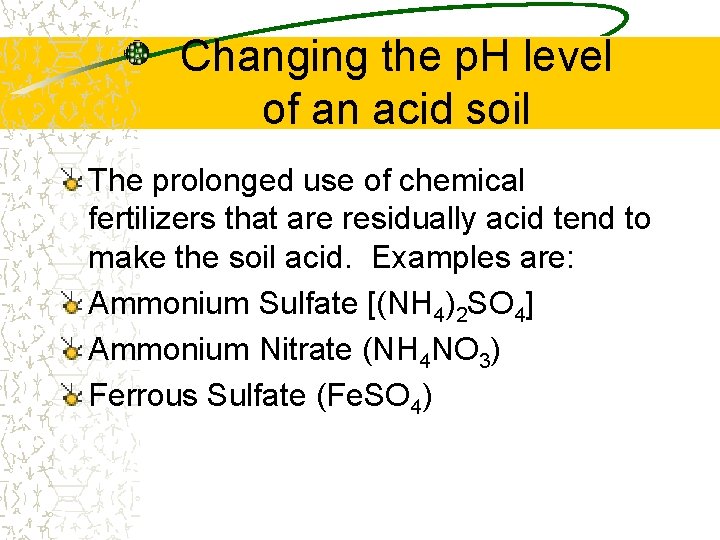
Changing the p. H level of an acid soil The prolonged use of chemical fertilizers that are residually acid tend to make the soil acid. Examples are: Ammonium Sulfate [(NH 4)2 SO 4] Ammonium Nitrate (NH 4 NO 3) Ferrous Sulfate (Fe. SO 4)
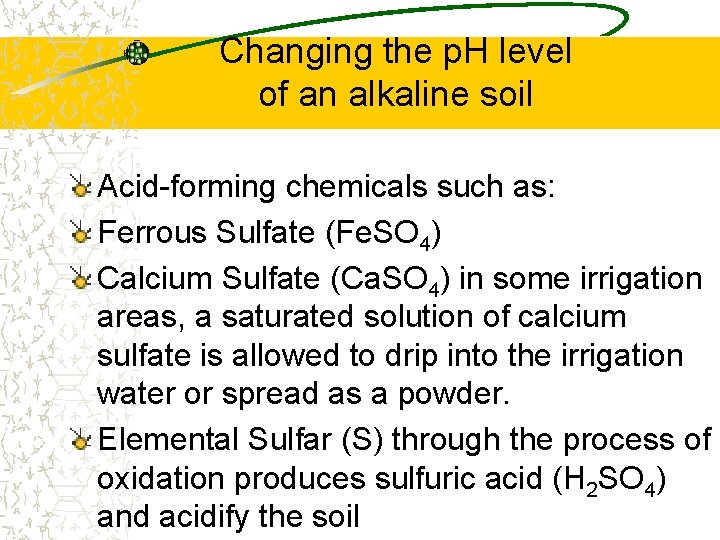
Changing the p. H level of an alkaline soil Acid-forming chemicals such as: Ferrous Sulfate (Fe. SO 4) Calcium Sulfate (Ca. SO 4) in some irrigation areas, a saturated solution of calcium sulfate is allowed to drip into the irrigation water or spread as a powder. Elemental Sulfar (S) through the process of oxidation produces sulfuric acid (H 2 SO 4) and acidify the soil
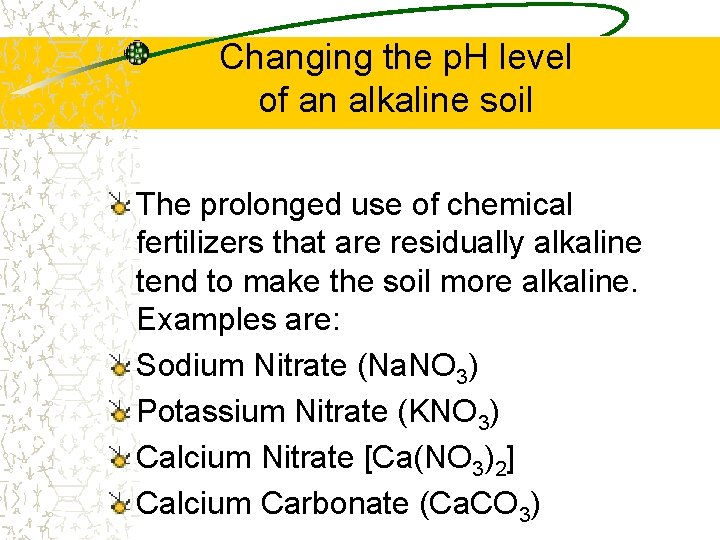
Changing the p. H level of an alkaline soil The prolonged use of chemical fertilizers that are residually alkaline tend to make the soil more alkaline. Examples are: Sodium Nitrate (Na. NO 3) Potassium Nitrate (KNO 3) Calcium Nitrate [Ca(NO 3)2] Calcium Carbonate (Ca. CO 3)
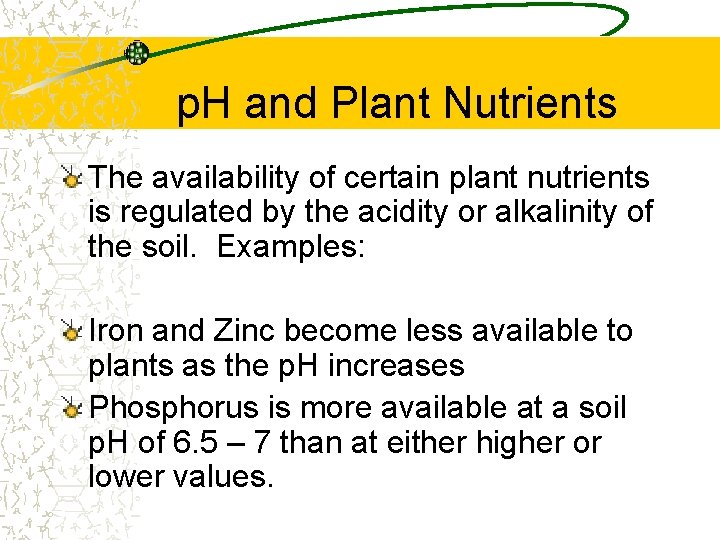
p. H and Plant Nutrients The availability of certain plant nutrients is regulated by the acidity or alkalinity of the soil. Examples: Iron and Zinc become less available to plants as the p. H increases Phosphorus is more available at a soil p. H of 6. 5 – 7 than at either higher or lower values.
p. H and Plant Nutrients Calcium availability decreases with increased acidity.
Cation Exchange Capacity CEC is an important measure of the fertility and potential productivity of a soil Clay and organic matter have a net negative charge which attract the positively charged cations. (se figure 19) Ca++, Mg++ K++ NH 4++ are plant nutrients Na++ & H++ effect soil chemical & physical characteristics
Soil Organic Matter Helps strengthen soil aggregates Improves aeration and water infiltration Increases water-holding capacity Provides significant amounts of CEC Provides buffering against rapid change in soil reaction acid 0 r alkaline forming materials are added to soil
Form stable organic compounds that can increase the availability of micronutrients. Provides a source of many plant nutrients. Provides a food source for soil microorganisms.
Types of organic matter Green manure crops Crop residues Animal manures Compost Look at Table 1 -3
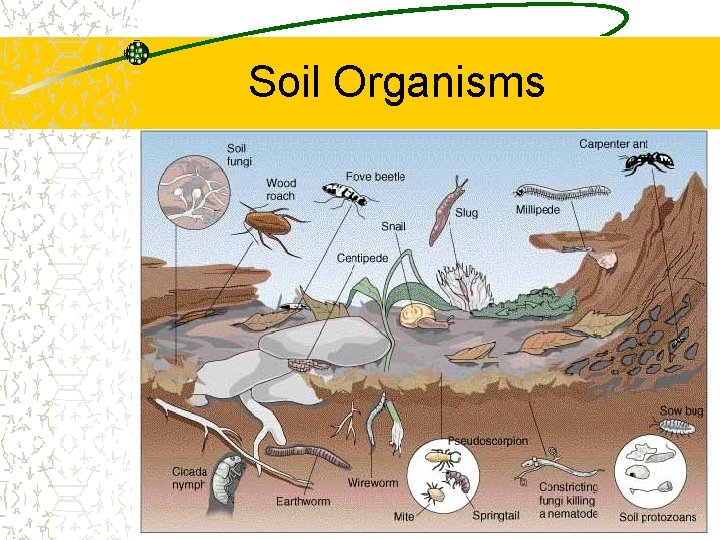
Soil Organisms
Soil Organisms Micro flora Bacteria Fungi Algae You tell me what they do?
Soil Management 1. Tillage (Primary & Secondary) 2. No-Till or Minimal till 3. Conservation (National Resources Conservation Service NRCS – 2 billion tons of topsoil lost per year) Best Management Practices (BMP, crop, fertilizer, pesticide, & water management)