
SOIL and AGRICULTURE The nation that destroys its
- Slides: 50
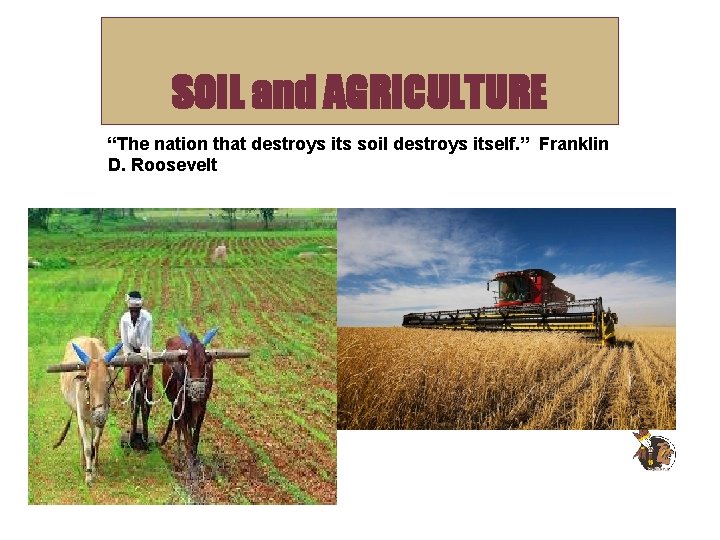
SOIL and AGRICULTURE “The nation that destroys its soil destroys itself. ” Franklin D. Roosevelt
Soil: the foundation for agriculture • Land devoted to agriculture covers 38% of Earth’s land surface • Agriculture = practice of raising crops and livestock for human use and consumption • Cropland = land used to raise plants for human use • Rangeland or pasture = land used for grazing livestock • Soil = a complex plant-supporting system consisting of disintegrated rock, organic matter, water, gases, nutrients, and microorganism - It is a renewable resource
Population and consumption degrades soil • Feeding the world’s rising human population requires changing our diet or increasing agricultural production • Land suitable for farming is running out • We must find ways to improve the efficiency of food production • Mismanaged agriculture turns grasslands into deserts; removes forests; diminishes biodiversity; and pollutes soil, air, and water - Fertile soil is blown and washed away
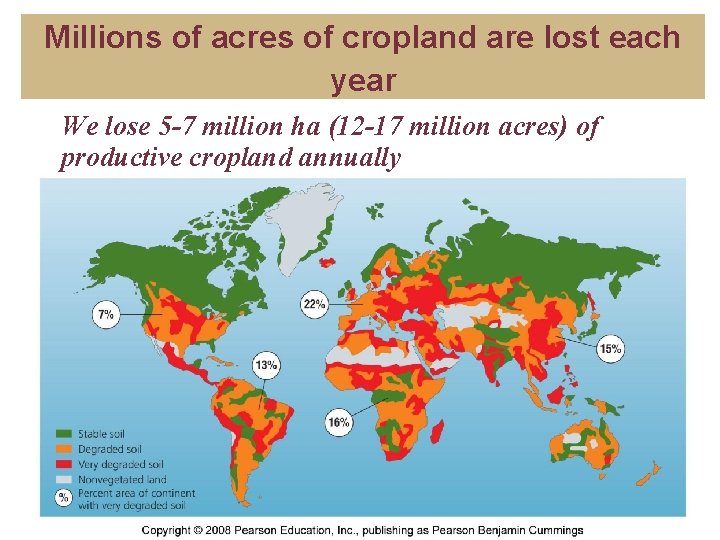
Millions of acres of cropland are lost each year We lose 5 -7 million ha (12 -17 million acres) of productive cropland annually
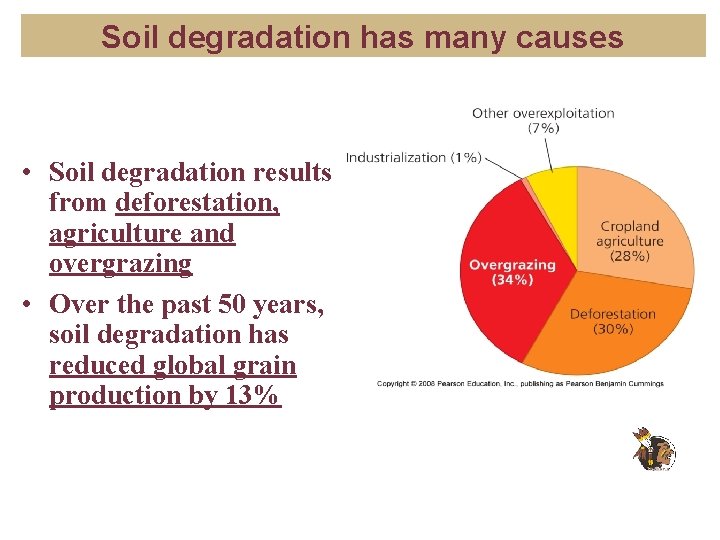
Soil degradation has many causes • Soil degradation results from deforestation, agriculture and overgrazing • Over the past 50 years, soil degradation has reduced global grain production by 13%
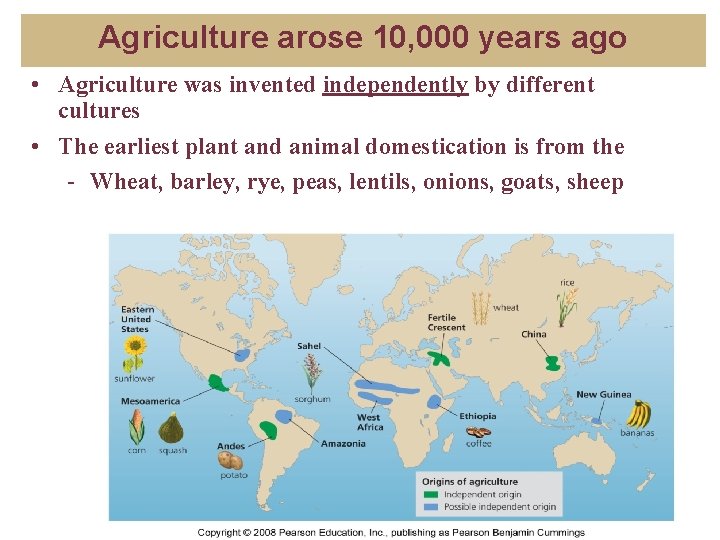
Agriculture arose 10, 000 years ago • Agriculture was invented independently by different cultures • The earliest plant and animal domestication is from the - Wheat, barley, rye, peas, lentils, onions, goats, sheep
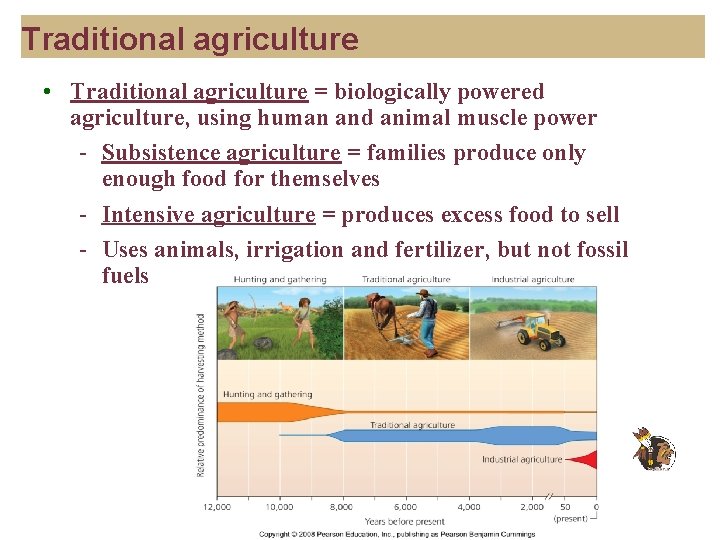
Traditional agriculture • Traditional agriculture = biologically powered agriculture, using human and animal muscle power - Subsistence agriculture = families produce only enough food for themselves - Intensive agriculture = produces excess food to sell - Uses animals, irrigation and fertilizer, but not fossil fuels
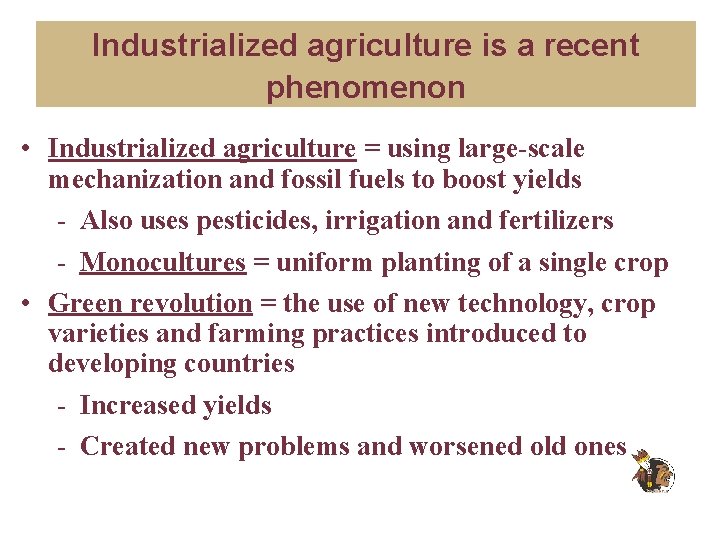
Industrialized agriculture is a recent phenomenon • Industrialized agriculture = using large-scale mechanization and fossil fuels to boost yields - Also uses pesticides, irrigation and fertilizers - Monocultures = uniform planting of a single crop • Green revolution = the use of new technology, crop varieties and farming practices introduced to developing countries - Increased yields - Created new problems and worsened old ones
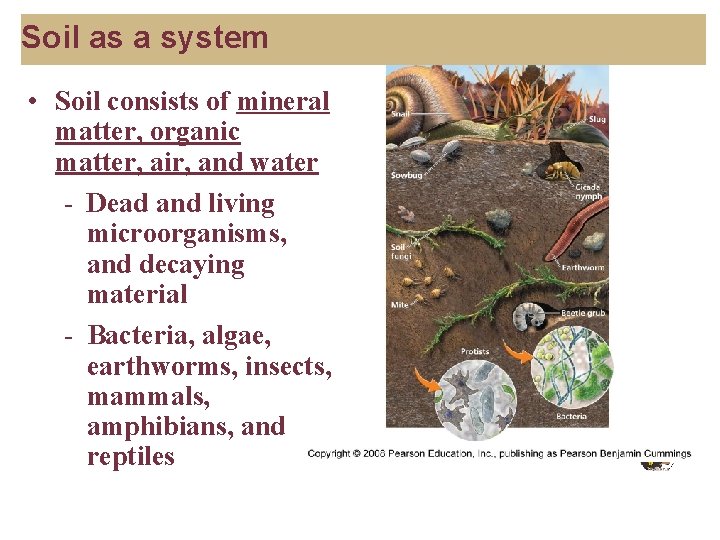
Soil as a system • Soil consists of mineral matter, organic matter, air, and water - Dead and living microorganisms, and decaying material - Bacteria, algae, earthworms, insects, mammals, amphibians, and reptiles
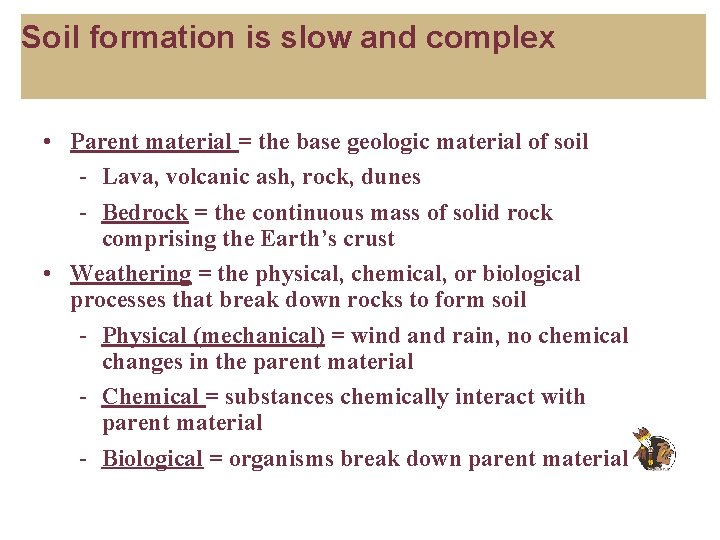
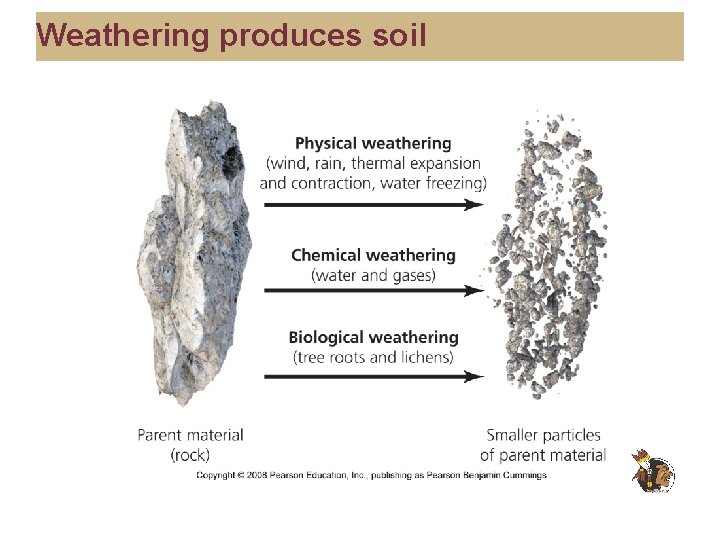
Soil formation is slow and complex • Parent material = the base geologic material of soil - Lava, volcanic ash, rock, dunes - Bedrock = the continuous mass of solid rock comprising the Earth’s crust • Weathering = the physical, chemical, or biological processes that break down rocks to form soil - Physical (mechanical) = wind and rain, no chemical changes in the parent material - Chemical = substances chemically interact with parent material - Biological = organisms break down parent material
Weathering produces soil
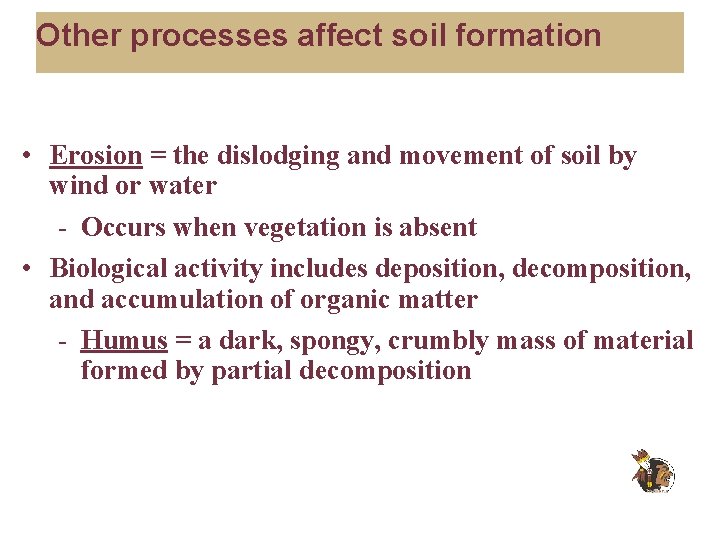
Other processes affect soil formation • Erosion = the dislodging and movement of soil by wind or water - Occurs when vegetation is absent • Biological activity includes deposition, decomposition, and accumulation of organic matter - Humus = a dark, spongy, crumbly mass of material formed by partial decomposition
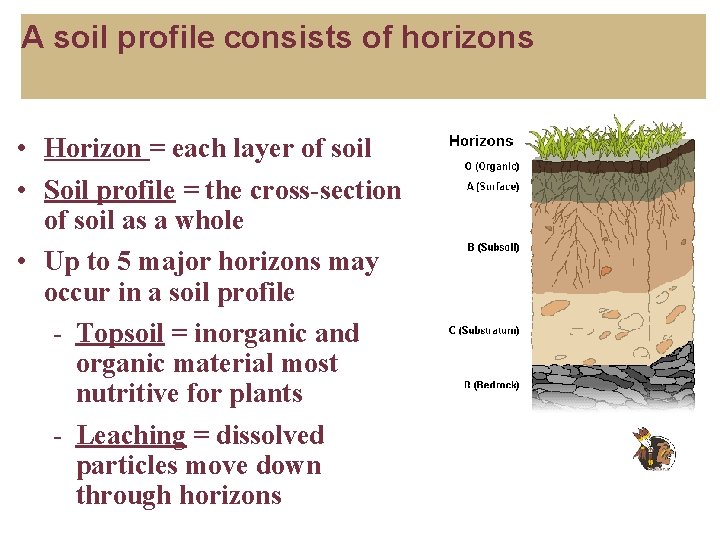
A soil profile consists of horizons • Horizon = each layer of soil • Soil profile = the cross-section of soil as a whole • Up to 5 major horizons may occur in a soil profile - Topsoil = inorganic and organic material most nutritive for plants - Leaching = dissolved particles move down through horizons
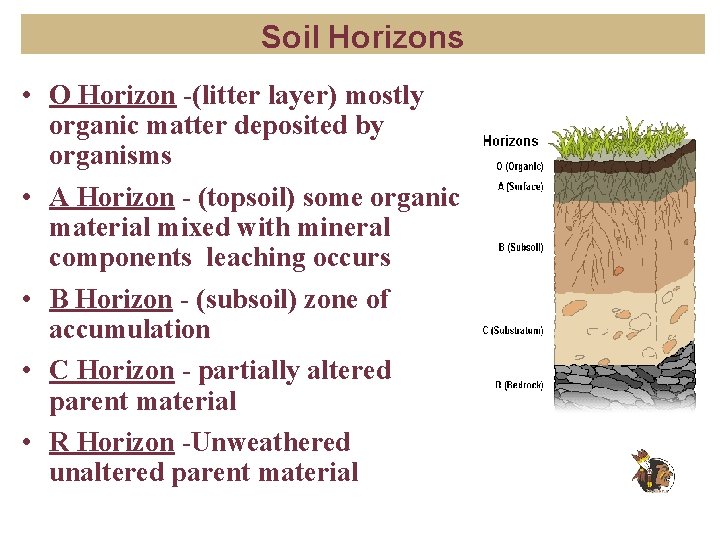
Soil Horizons • O Horizon -(litter layer) mostly organic matter deposited by organisms • A Horizon - (topsoil) some organic material mixed with mineral components leaching occurs • B Horizon - (subsoil) zone of accumulation • C Horizon - partially altered parent material • R Horizon -Unweathered unaltered parent material
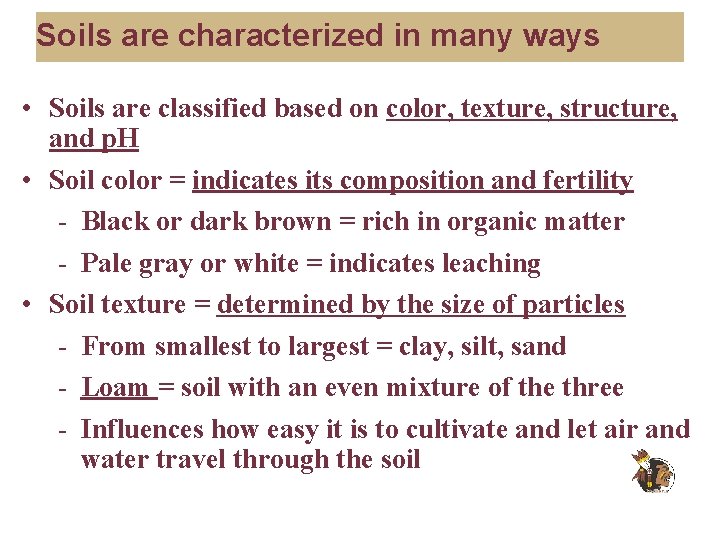
Soils are characterized in many ways • Soils are classified based on color, texture, structure, and p. H • Soil color = indicates its composition and fertility - Black or dark brown = rich in organic matter - Pale gray or white = indicates leaching • Soil texture = determined by the size of particles - From smallest to largest = clay, silt, sand - Loam = soil with an even mixture of the three - Influences how easy it is to cultivate and let air and water travel through the soil
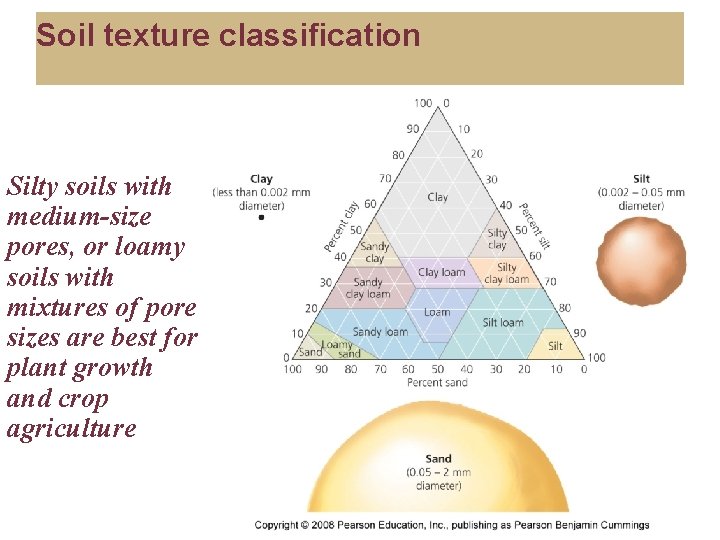
Soil texture classification Silty soils with medium-size pores, or loamy soils with mixtures of pore sizes are best for plant growth and crop agriculture
Soil structure and p. H • Soil structure = a measure of soil’s “clumpiness” - Large clumps can discourage plant roots - Repeated tilling compacts soil, decreasing its waterabsorbing capabilities - Plowpan = a hard layer resulting from repeated plowing that resists water infiltration and root penetration • Soil p. H = influences a soil’s ability to support plant growth - Soils that are too acidic or basic can kill plants
Erosion degrades ecosystems and agriculture • Deposition = the arrival of eroded material at its new location • Flowing water deposits sediment in river valleys and deltas - Floodplains are excellent for farming • But, erosion is a problem because it occurs faster than new soil is formed • Erosion increases through: excessive tilling, overgrazing, and clearing forests
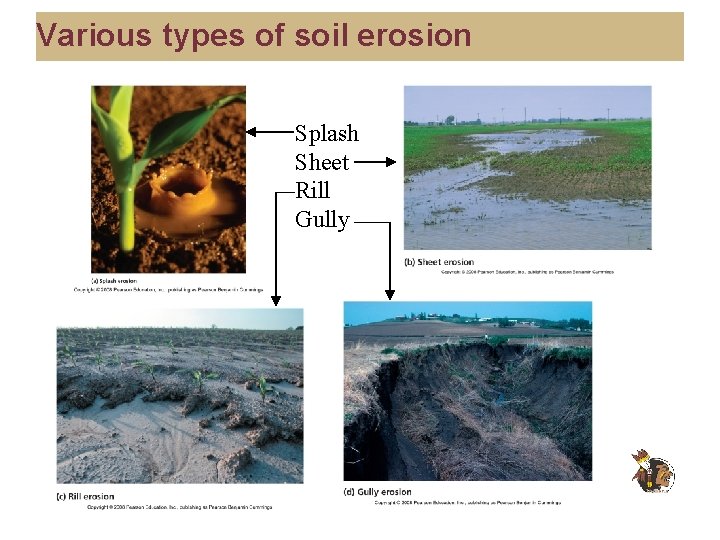
Soil erodes by several methods • Plants protects soil from erosion - Removing plants accelerates erosion • Rill erosion moves the most topsoil, followed by sheet and splash forms of erosion • Water erosion occurs most easily on steep slopes • Erosion in the U. S. declined between 1982 and 2001 - Soil conservation measures Despite conservation measures, the U. S. still loses 6 tons of soil for every ton of grain harvested
Various types of soil erosion Splash Sheet Rill Gully
Soil erosion is a global problem • Humans are the primary cause of erosion - It is occurring at unnaturally high rates • In Africa, erosion over the next 40 years could reduce crop yields by half - Coupled with rapid population growth, some observers describe the future of agriculture as a crisis situation
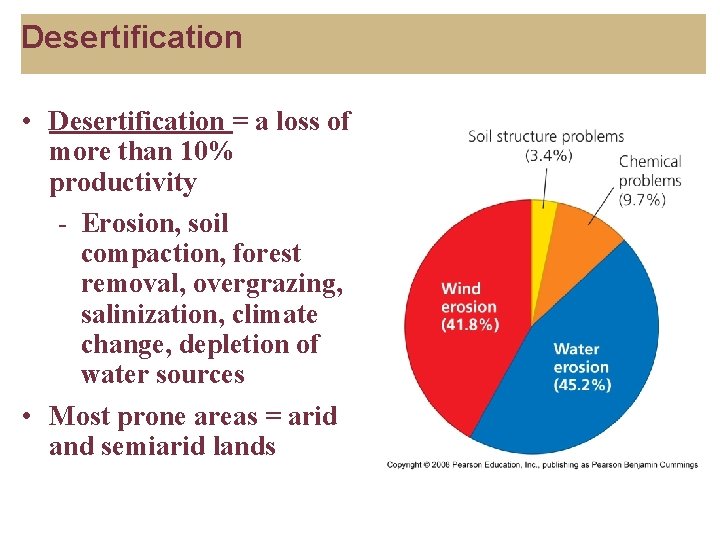
Desertification • Desertification = a loss of more than 10% productivity - Erosion, soil compaction, forest removal, overgrazing, salinization, climate change, depletion of water sources • Most prone areas = arid and semiarid lands
Desertification has high costs • Desertification affects 1/3 of the planet’s land area - In over 100 countries • Costs tens of billions of dollars each year - China loses over $6. 5 billion/year alone from goat overgrazing - In Kenya, 80% of he land is vulnerable to desertification from overgrazing and deforestation
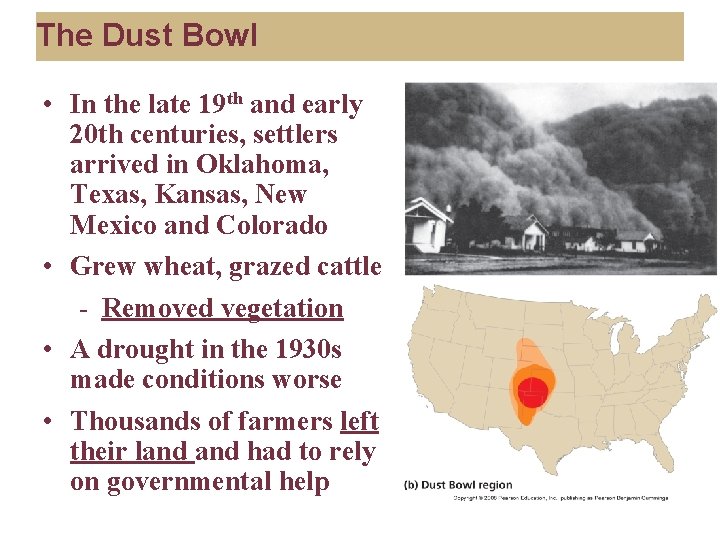
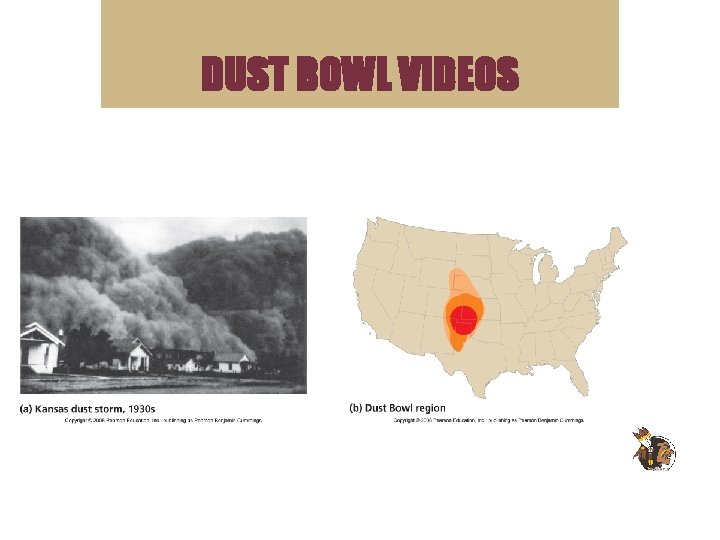
The Dust Bowl • In the late 19 th and early 20 th centuries, settlers arrived in Oklahoma, Texas, Kansas, New Mexico and Colorado • Grew wheat, grazed cattle - Removed vegetation • A drought in the 1930 s made conditions worse • Thousands of farmers left their land had to rely on governmental help
DUST BOWL VIDEOS
The Soil Conservation Service • Started in 1935, the Service works with farmers to develop conservation plans for farms - Assess the land - Prepare an integrated plan - Work closely with landowners - Implement conservation measures • Conservation districts = districts operate with federal direction, authorization, and funding, but are organized by the states
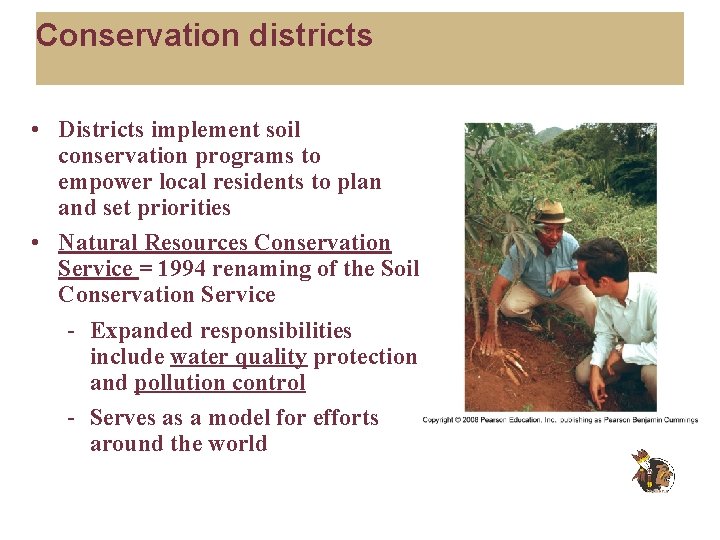
Conservation districts • Districts implement soil conservation programs to empower local residents to plan and set priorities • Natural Resources Conservation Service = 1994 renaming of the Soil Conservation Service - Expanded responsibilities include water quality protection and pollution control - Serves as a model for efforts around the world
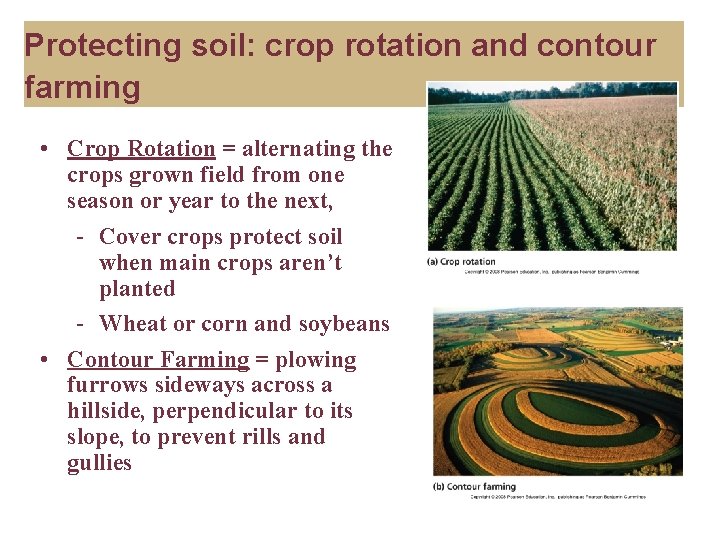
Protecting soil: crop rotation and contour farming • Crop Rotation = alternating the crops grown field from one season or year to the next, - Cover crops protect soil when main crops aren’t planted - Wheat or corn and soybeans • Contour Farming = plowing furrows sideways across a hillside, perpendicular to its slope, to prevent rills and gullies
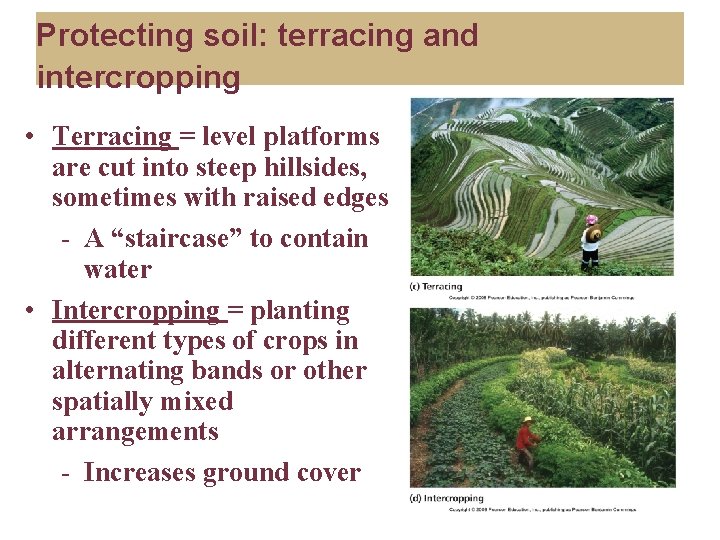
Protecting soil: terracing and intercropping • Terracing = level platforms are cut into steep hillsides, sometimes with raised edges - A “staircase” to contain water • Intercropping = planting different types of crops in alternating bands or other spatially mixed arrangements - Increases ground cover
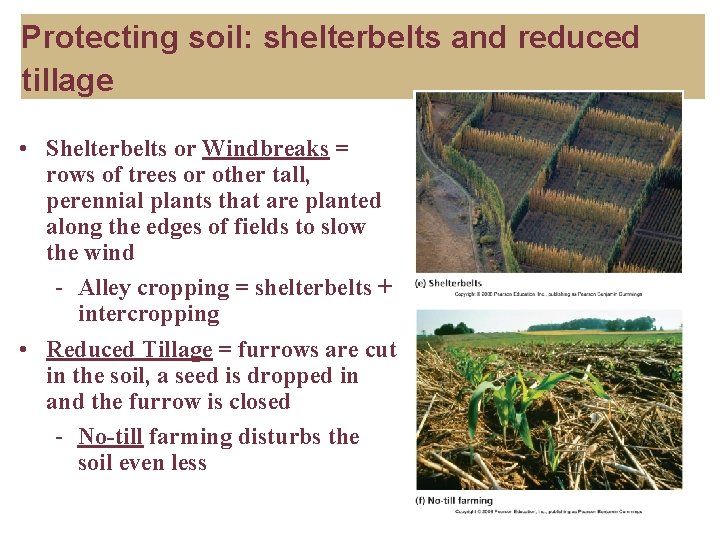
Protecting soil: shelterbelts and reduced tillage • Shelterbelts or Windbreaks = rows of trees or other tall, perennial plants that are planted along the edges of fields to slow the wind - Alley cropping = shelterbelts + intercropping • Reduced Tillage = furrows are cut in the soil, a seed is dropped in and the furrow is closed - No-till farming disturbs the soil even less
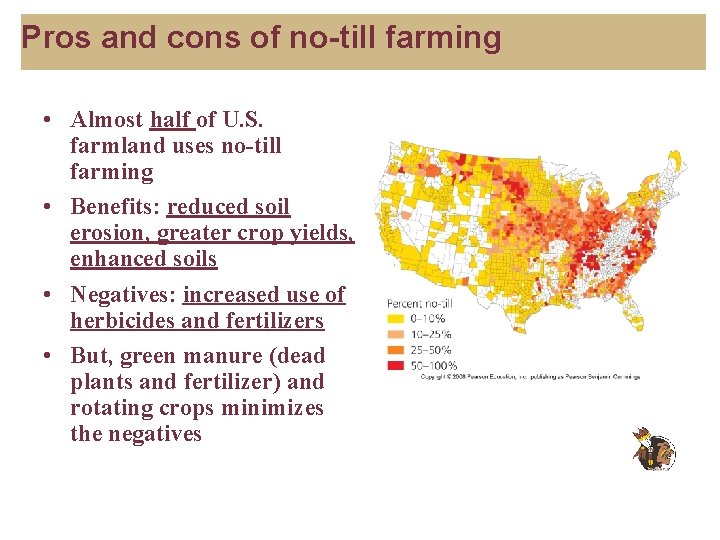
Pros and cons of no-till farming • Almost half of U. S. farmland uses no-till farming • Benefits: reduced soil erosion, greater crop yields, enhanced soils • Negatives: increased use of herbicides and fertilizers • But, green manure (dead plants and fertilizer) and rotating crops minimizes the negatives
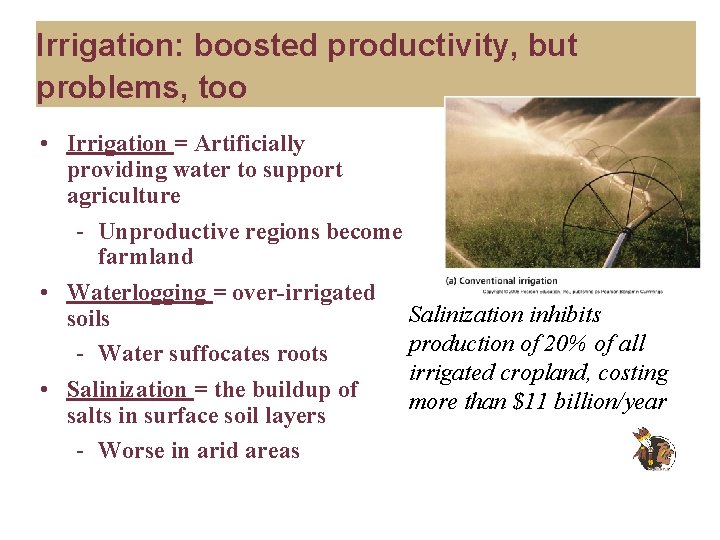
Irrigation: boosted productivity, but problems, too • Irrigation = Artificially providing water to support agriculture - Unproductive regions become farmland • Waterlogging = over-irrigated Salinization inhibits soils production of 20% of all - Water suffocates roots irrigated cropland, costing • Salinization = the buildup of more than $11 billion/year salts in surface soil layers - Worse in arid areas
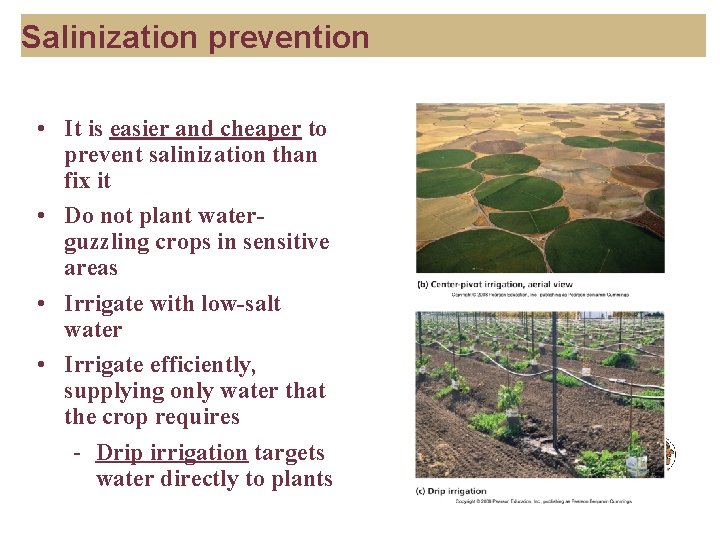
Salinization prevention • It is easier and cheaper to prevent salinization than fix it • Do not plant waterguzzling crops in sensitive areas • Irrigate with low-salt water • Irrigate efficiently, supplying only water that the crop requires - Drip irrigation targets water directly to plants
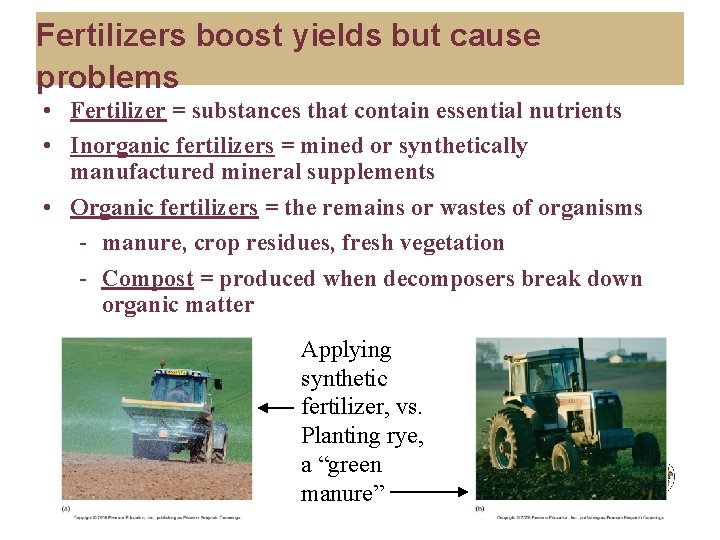
Fertilizers boost yields but cause problems • Fertilizer = substances that contain essential nutrients • Inorganic fertilizers = mined or synthetically manufactured mineral supplements • Organic fertilizers = the remains or wastes of organisms - manure, crop residues, fresh vegetation - Compost = produced when decomposers break down organic matter Applying synthetic fertilizer, vs. Planting rye, a “green manure”
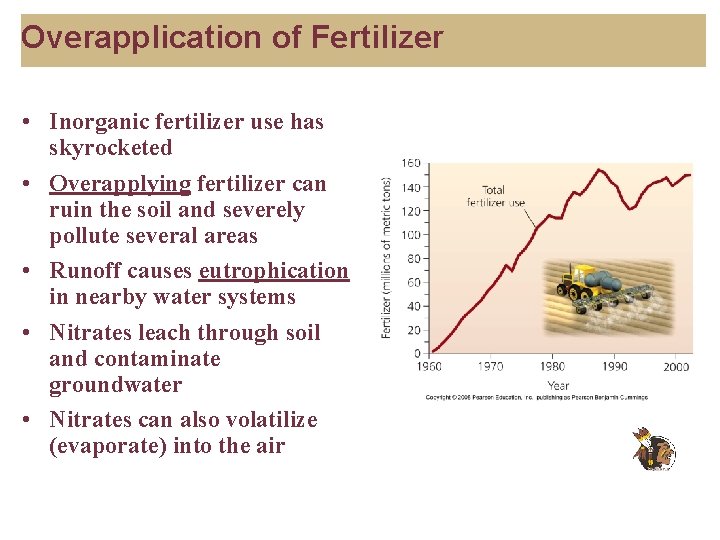
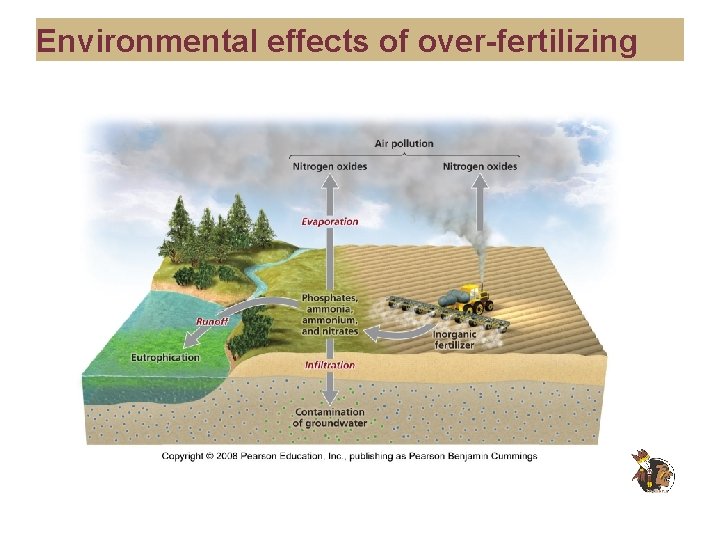
Overapplication of Fertilizer • Inorganic fertilizer use has skyrocketed • Overapplying fertilizer can ruin the soil and severely pollute several areas • Runoff causes eutrophication in nearby water systems • Nitrates leach through soil and contaminate groundwater • Nitrates can also volatilize (evaporate) into the air
Environmental effects of over-fertilizing
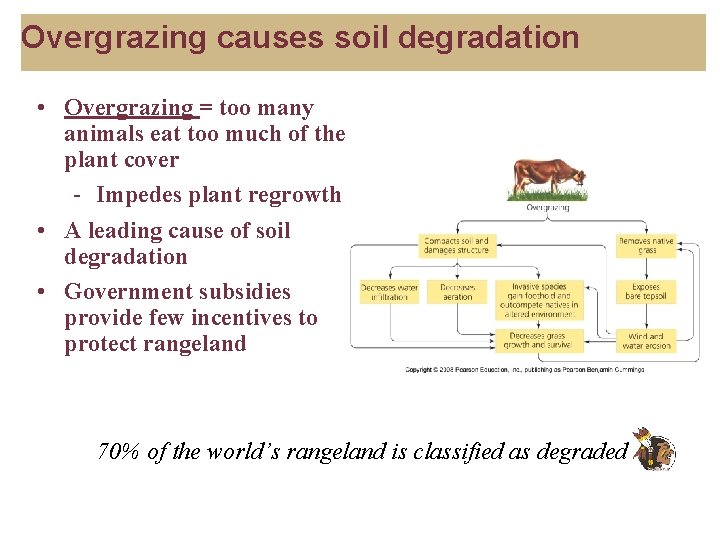
Overgrazing causes soil degradation • Overgrazing = too many animals eat too much of the plant cover - Impedes plant regrowth • A leading cause of soil degradation • Government subsidies provide few incentives to protect rangeland 70% of the world’s rangeland is classified as degraded
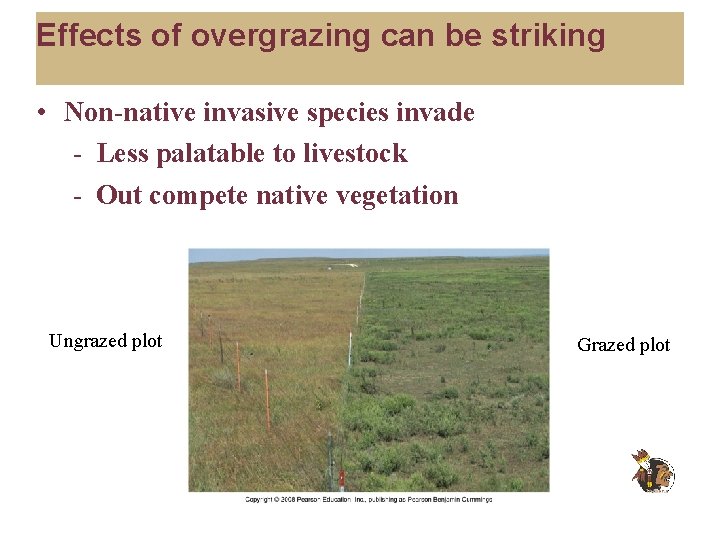
Effects of overgrazing can be striking • Non-native invasive species invade - Less palatable to livestock - Out compete native vegetation Ungrazed plot Grazed plot
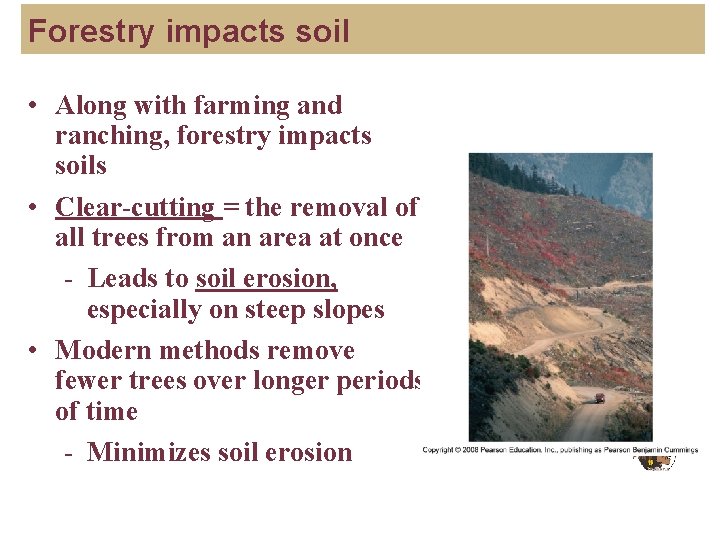
Forestry impacts soil • Along with farming and ranching, forestry impacts soils • Clear-cutting = the removal of all trees from an area at once - Leads to soil erosion, especially on steep slopes • Modern methods remove fewer trees over longer periods of time - Minimizes soil erosion
U. S. programs promote soil conservation • Food Security Act of 1985: Farmers that adopt soil conservation plan receive price supports and other benefits • Conservation Reserve Program (1985) - Farmers are paid to place highly erodible land into conservation reserves - Trees and grasses are planted instead of crops - Saves 771 million tons of topsoil per year - Generates income for farmers - Provides habitat for native wildlife
Federal Agricultural Improvement Act (1996) • Known as the Freedom to Farm Act - Promotes and pays for conservation practices in agriculture • Low-Input Sustainable Agriculture Program (1998) - Provides funding for sustainable agricultural practices for individual farmers
International soil conservation programs • Food and Agriculture Organization (FAO) = the United Nations’ main agricultural program • The FAO’s Farmer-Centered Agricultural Resource Management Program (FAR)… - Helps farmers duplicate agricultural success stories - Uses local communities to educate and encourage farmers to conserve soils and secure the food supply
QUESTION: Review Traditional subsistence agriculture uses all of the following, except: a) Animal power b) Irrigation c) Irrigation water d) Fossil fuels
QUESTION: Review Physical weathering is characterized by: a) The chemical interaction of water with parent material b) Organisms breaking down parent material c) Wind or rain breaking down parent material d) The dislodging or movement of soil by wind
QUESTION: Review Which horizon is the most valuable for agriculture? a) Topsoil (A horizon) b) E horizon c) B horizon d) R horizon
QUESTION: Review Erosion increases through all of the following, except: a) Excessive tilling b) Overgrazing c) Clearing forests d) All of the above increase erosion
QUESTION: Review Which sustainable farming method involves planting rows of trees along field edges to slow the wind? a) Terracing b) Crop rotation c) Shelterbelts d) Contour farming
QUESTION: Weighing the Issues Should developed nations fund reforestation projects in developing nations to combat erosion and deforestation? a) Absolutely, developing nations are facing a crisis b) No, not with money, but developed nations could give advice c) No, developed nations had to solve their problems, let the others solve their own problems d) I don’t care, it doesn’t really affect me
QUESTION: Weighing the Issues Should the U. S. government provide farmers with financial incentives to use technologies such as no-till farming and crop rotation? a) Absolutely, farmers may be more likely to switch to these techniques b) Yes, but farmers must put any money received into the farm c) No, it’s not the government’s job to interfere with farming practices d) I don’t care, it doesn’t really affect me
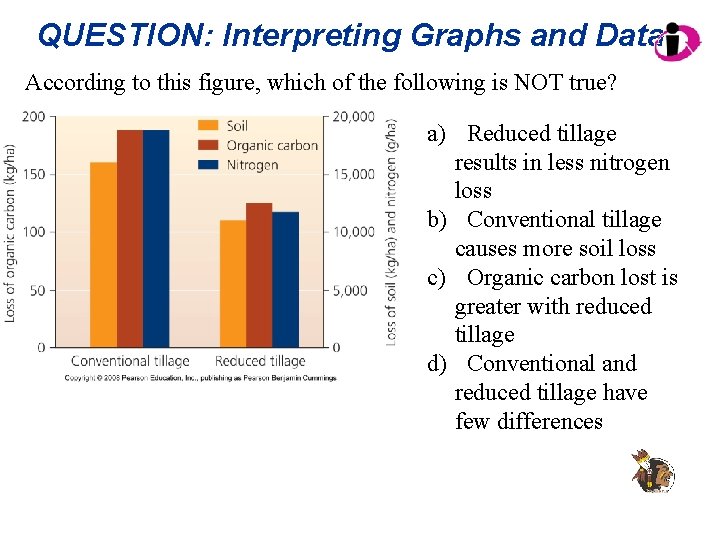
QUESTION: Interpreting Graphs and Data According to this figure, which of the following is NOT true? a) Reduced tillage results in less nitrogen loss b) Conventional tillage causes more soil loss c) Organic carbon lost is greater with reduced tillage d) Conventional and reduced tillage have few differences