
Sogang University Present by Krem Sona 12 November

Sogang University Present by: Krem Sona 12 November 2016

Outline 1. Introduction 2. Formalism of Susceptibilities Derive the formulas of the effective second-order susceptibility incorporating the surface and bulk contributions 3. Quadrupolar Hyperpolarizabilities The effective susceptibility is defined on the basis of the quadrupolar susceptibilities and related formulas, and they are presented in this section. 4. Dependence on Molecular Origin Discuss the dependence of the effective susceptibility on the molecular origin, demonstrating that the present theory is robust and well defined with respect to the definition of the origin for the quadrupole. 5. Discussion Discuss the consequences of these formulas and clarify the roles of the quadrupole contribution in the interfacial secondorder optical response. The confusion about the Kleinmann symmetry breaking is also resolved in this section. • Conclusion
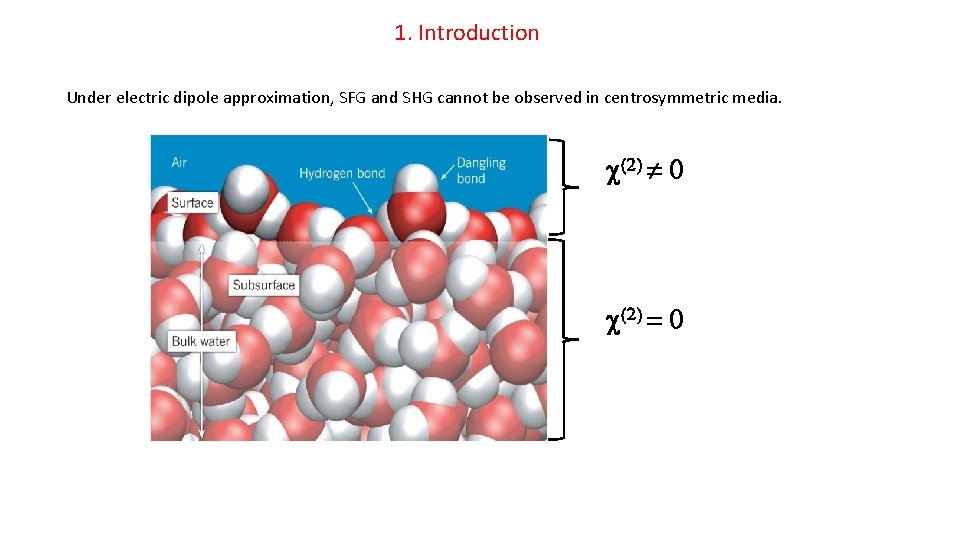
1. Introduction Under electric dipole approximation, SFG and SHG cannot be observed in centrosymmetric media. c(2) 0 c(2) = 0
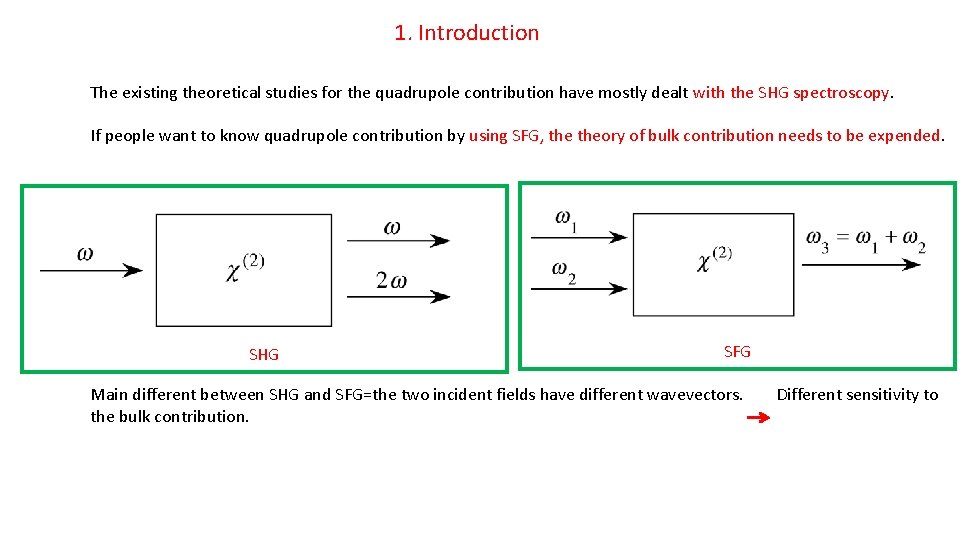
1. Introduction The existing theoretical studies for the quadrupole contribution have mostly dealt with the SHG spectroscopy. If people want to know quadrupole contribution by using SFG, theory of bulk contribution needs to be expended. SHG SFG Main different between SHG and SFG=the two incident fields have different wavevectors. Different sensitivity to the bulk contribution.
2. Formalism of Susceptibilities 2. 1 Dipole approximation 2. 1. 1 Effective Susceptibility 2. 1. 2 Expressions for SSP, SPS, PSS, and PPP Measurements 2. 2 Beyond the Dipole Approximation 2. 2. 1 Effective Susceptibility 2. 2. 2 Interface Contribution 2. 2. 3 Bulk Contribution 2. 2. 4 Expressions for SSP, SPS, PSS, and PPP Measurements
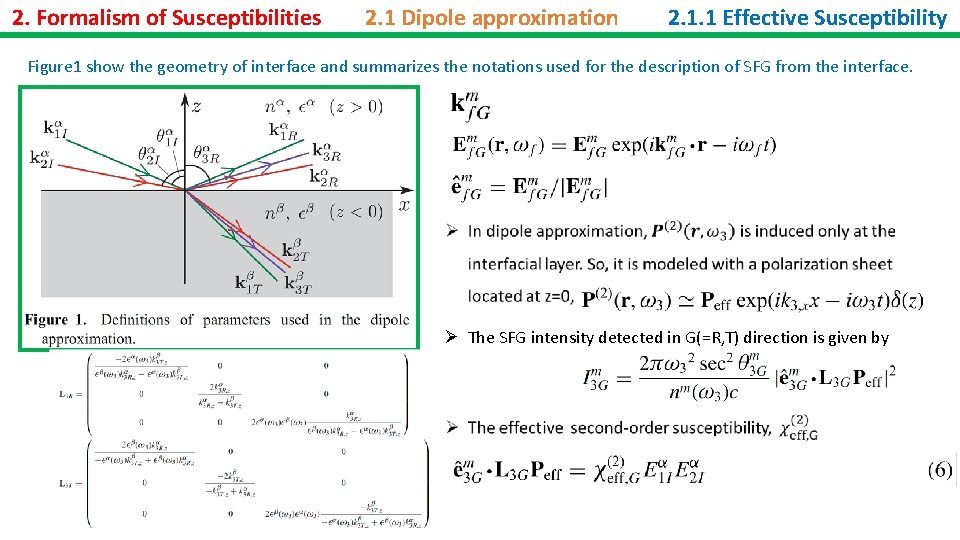
2. Formalism of Susceptibilities 2. 1 Dipole approximation 2. 1. 1 Effective Susceptibility Figure 1 show the geometry of interface and summarizes the notations used for the description of SFG from the interface. Ø The SFG intensity detected in G(=R, T) direction is given by
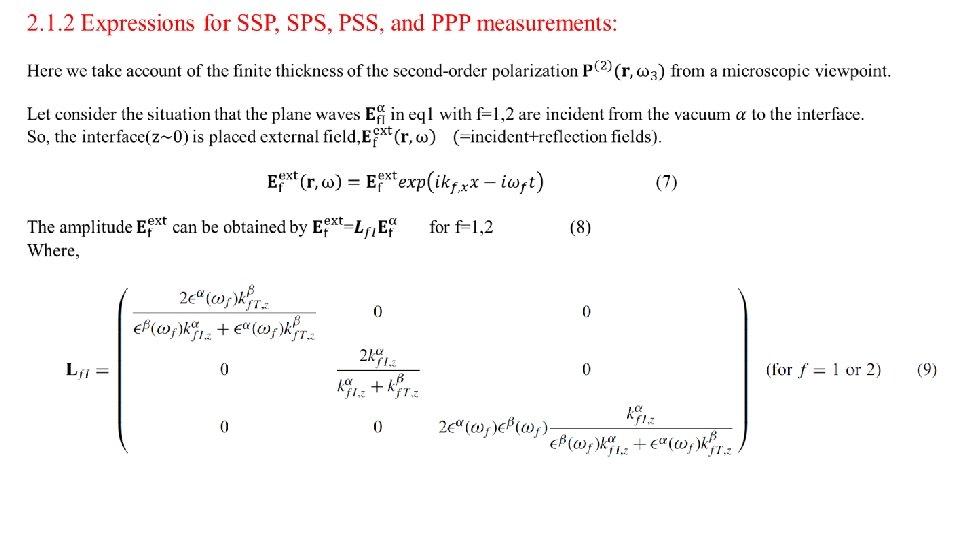
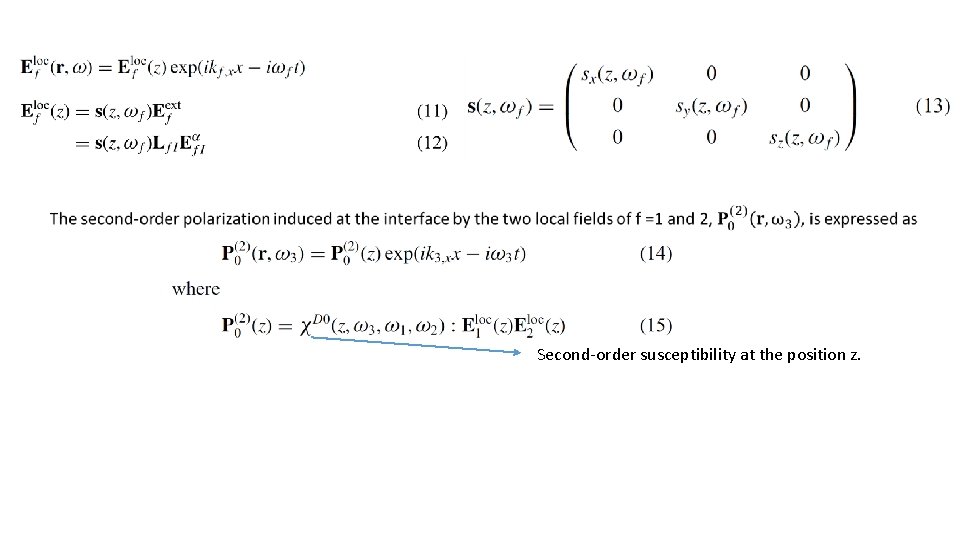
Second-order susceptibility at the position z.
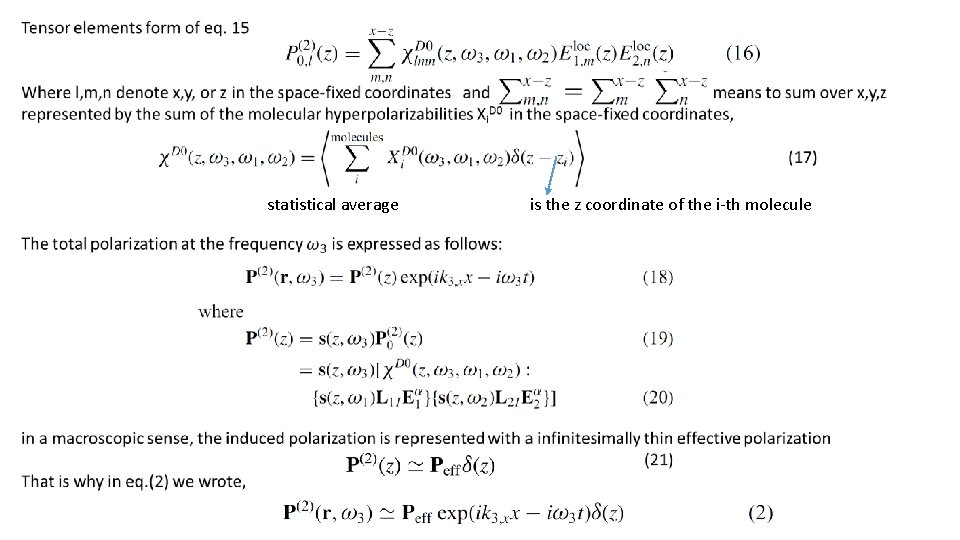
statistical average is the z coordinate of the i-th molecule
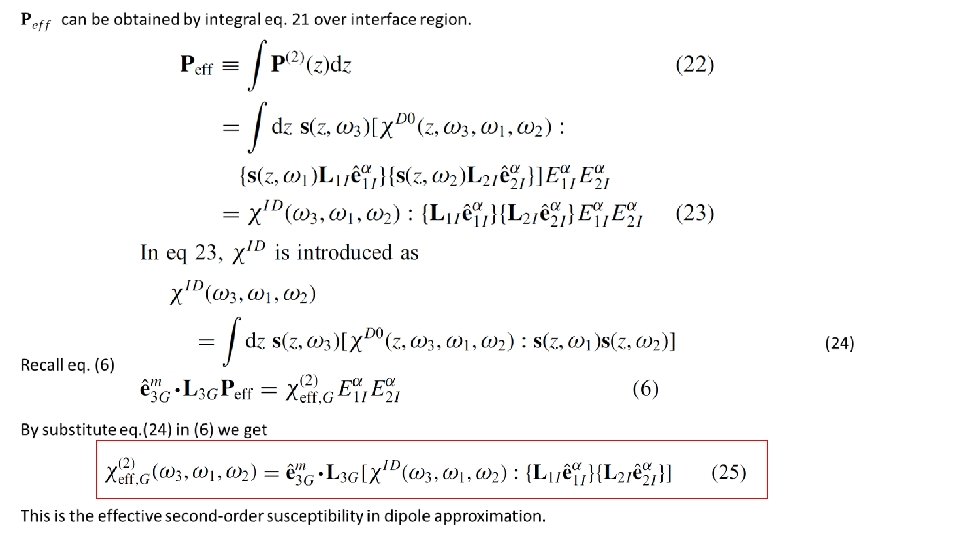
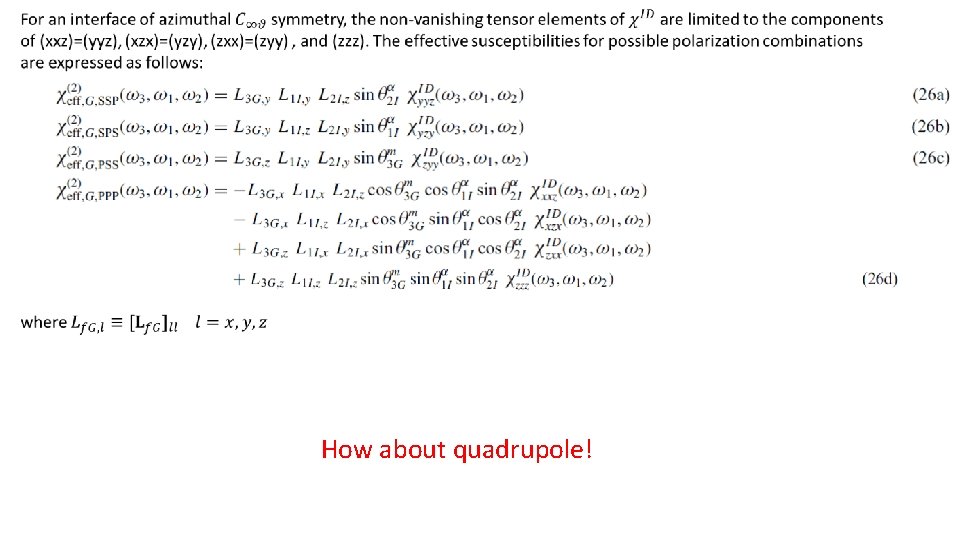
How about quadrupole!
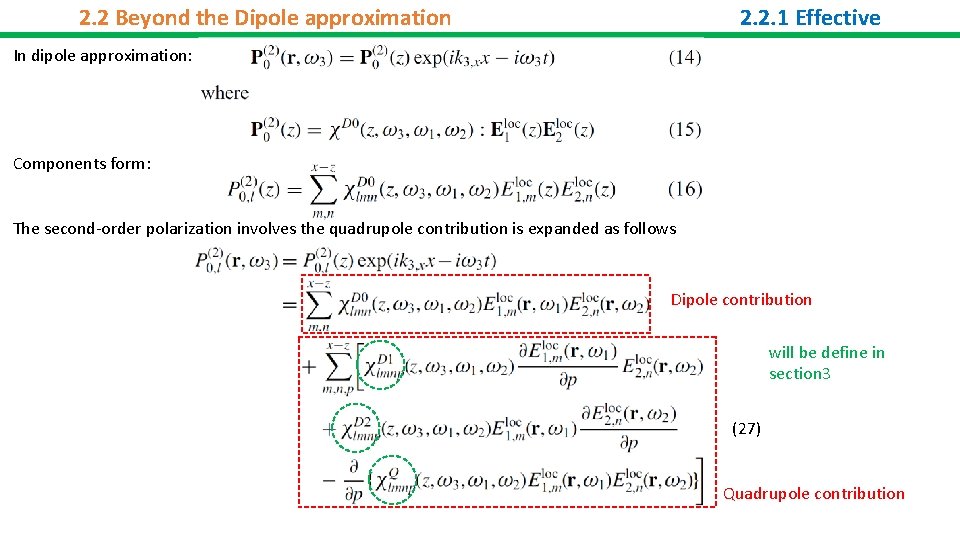
2. 2 Beyond the Dipole approximation Susceptibility: In dipole approximation: 2. 2. 1 Effective Components form: The second-order polarization involves the quadrupole contribution is expanded as follows Dipole contribution will be define in section 3 (27) Quadrupole contribution
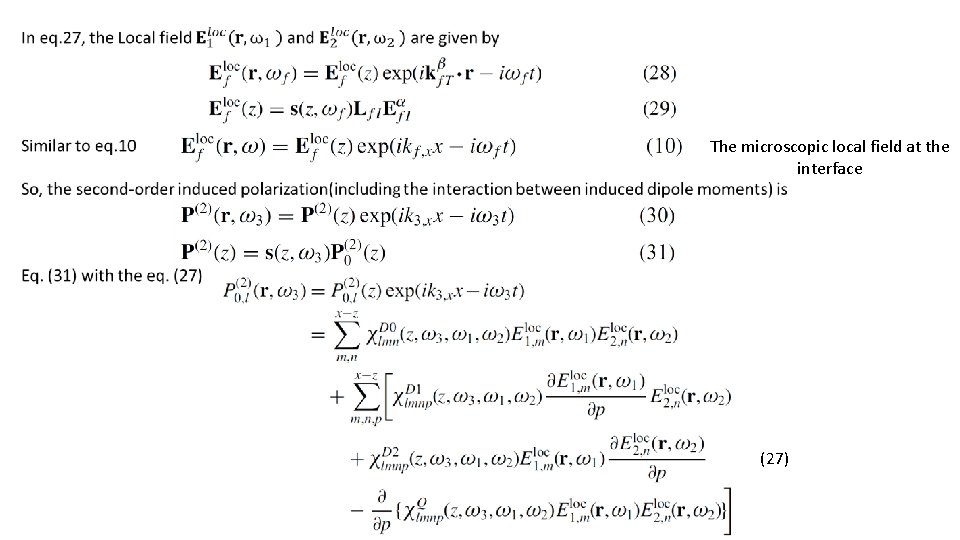
The microscopic local field at the interface (27)
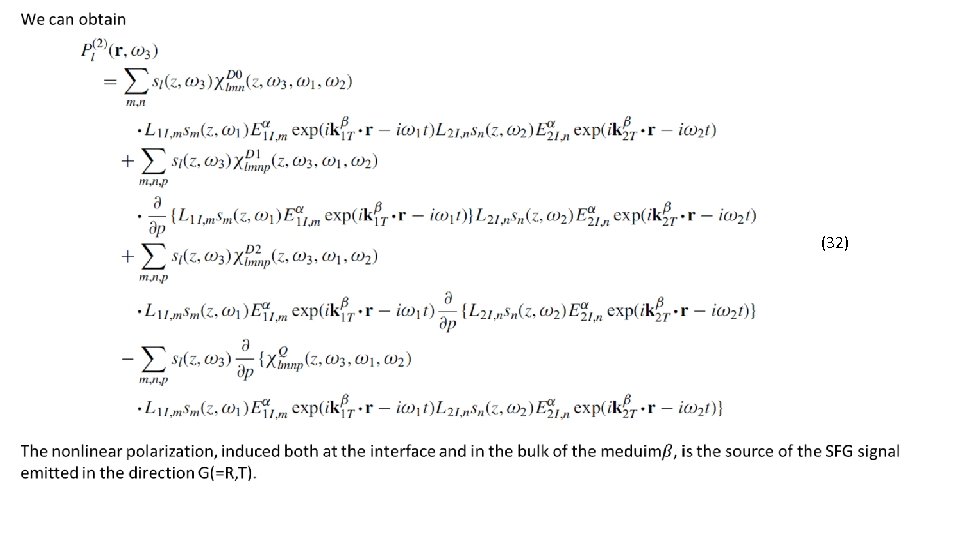
(32)
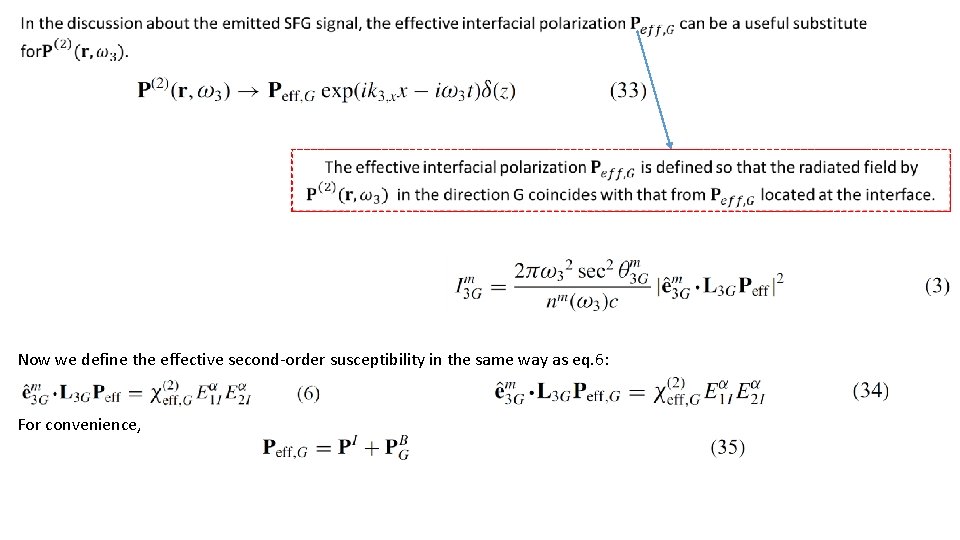
Now we define the effective second-order susceptibility in the same way as eq. 6: For convenience,
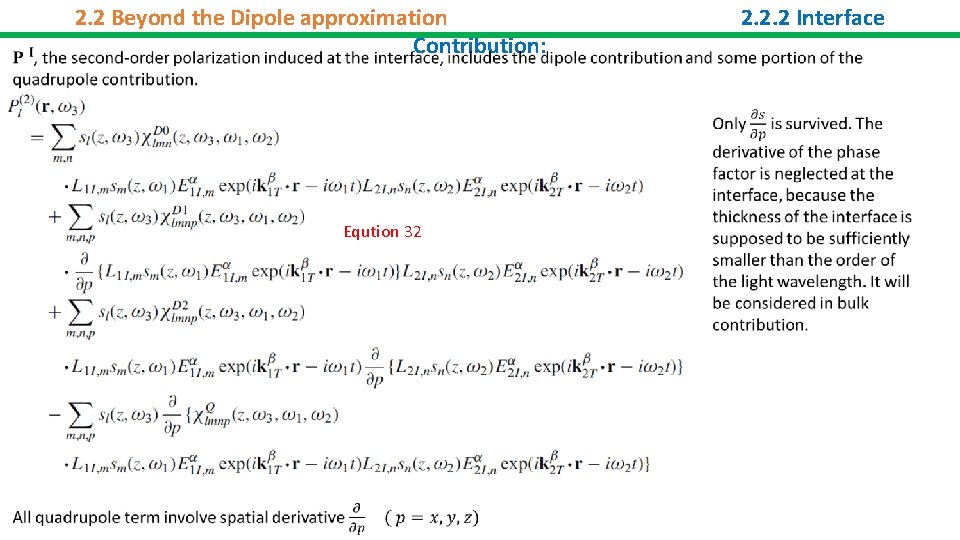
2. 2 Beyond the Dipole approximation Contribution: 2. 2. 2 Interface Eqution 32
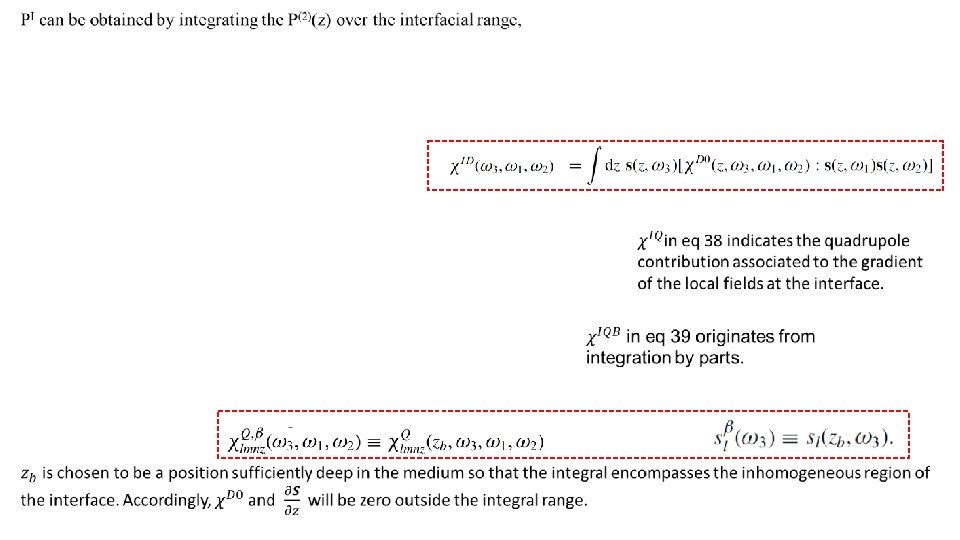
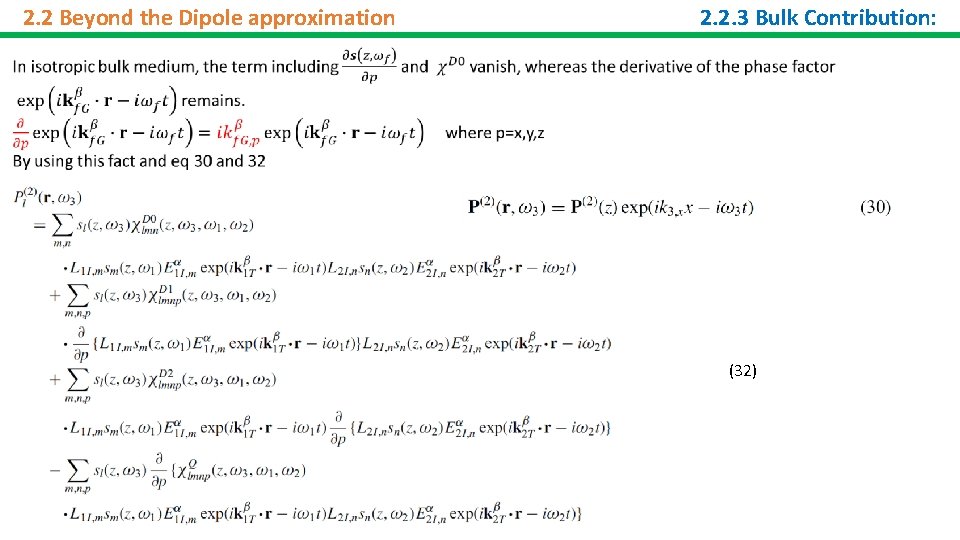
2. 2 Beyond the Dipole approximation 2. 2. 3 Bulk Contribution: (32)
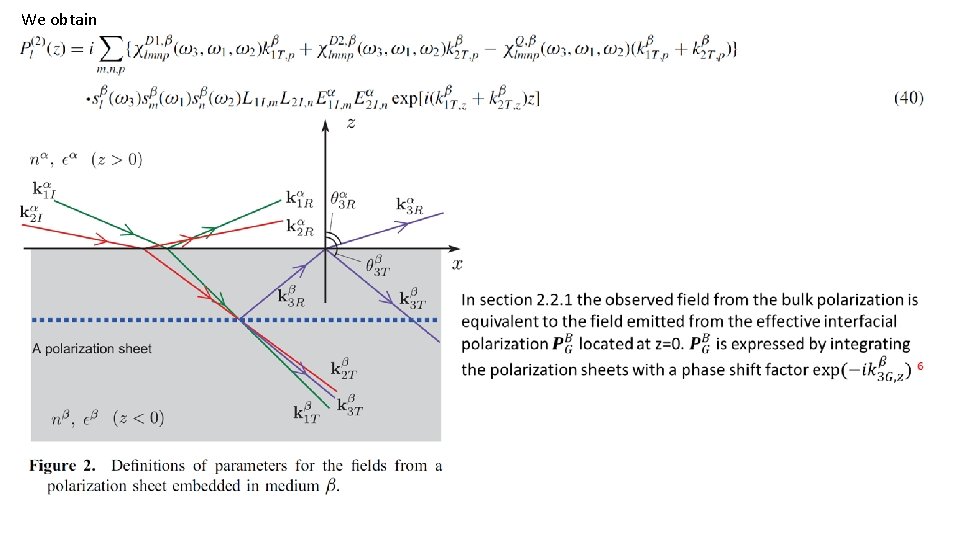
We obtain
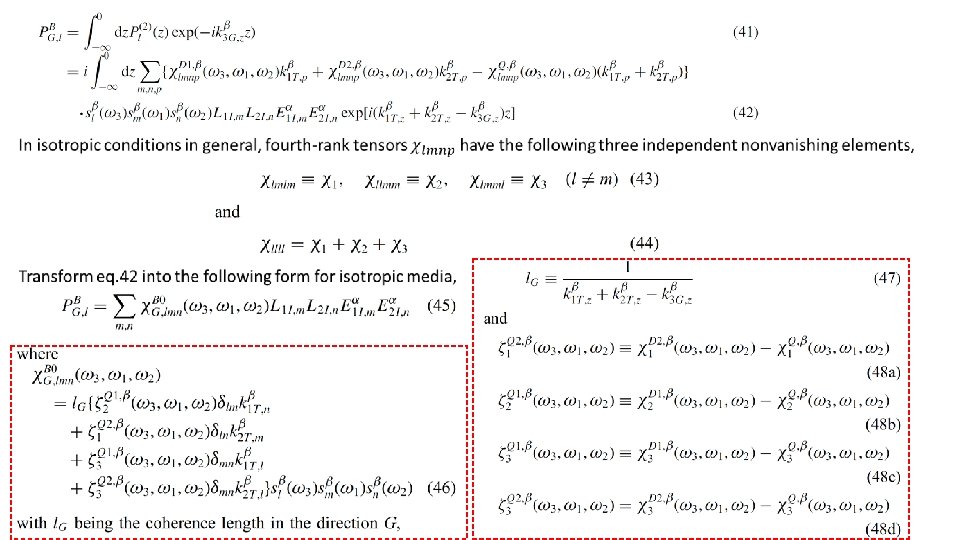
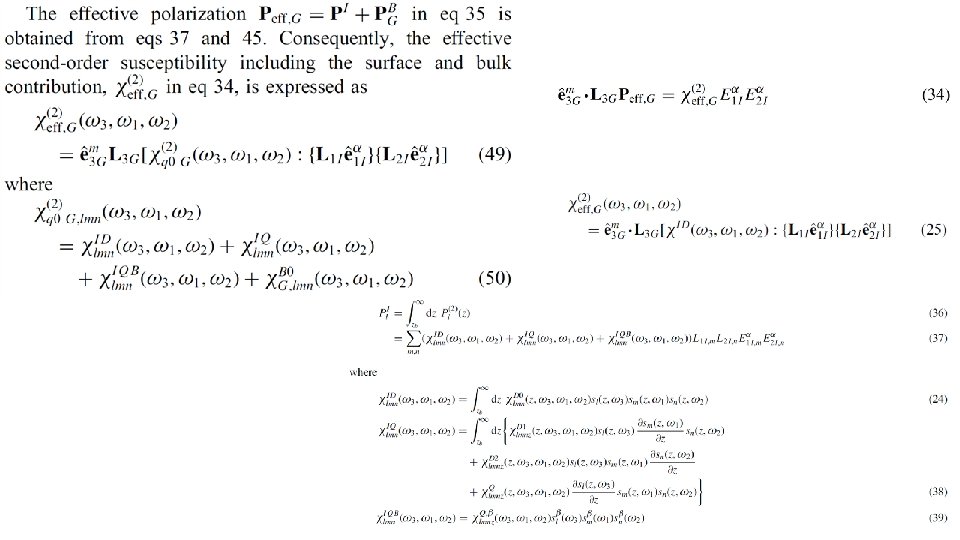
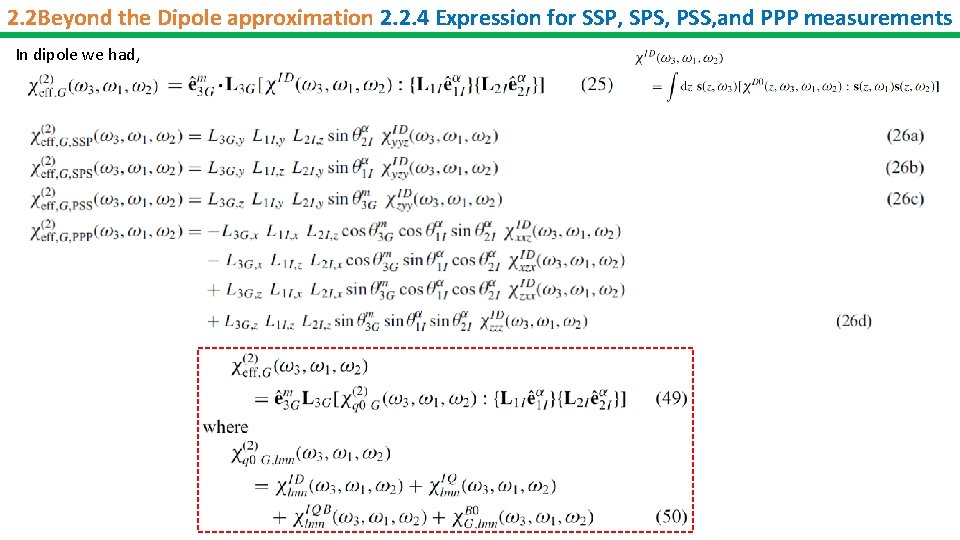
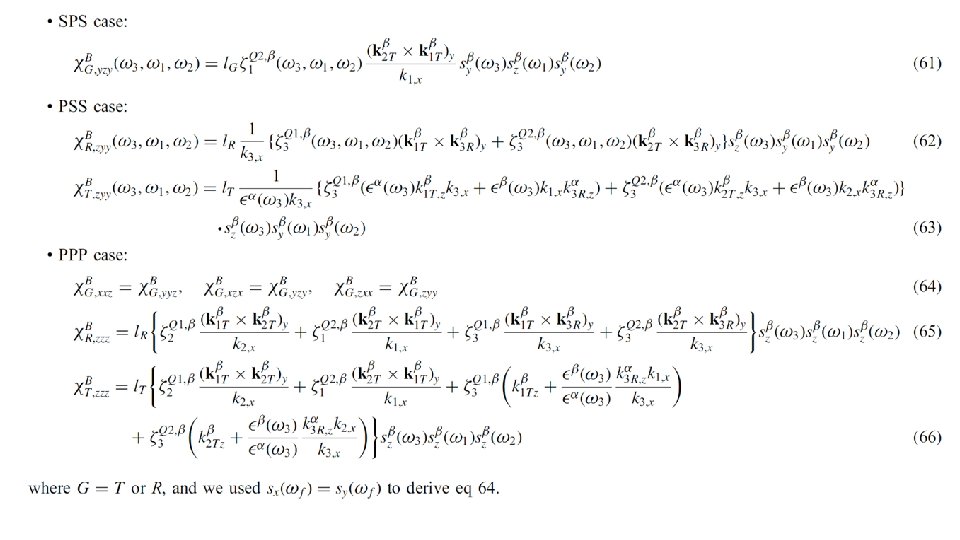
2. 2 Beyond the Dipole approximation 2. 2. 4 Expression for SSP, SPS, PSS, and PPP measurements In dipole we had,
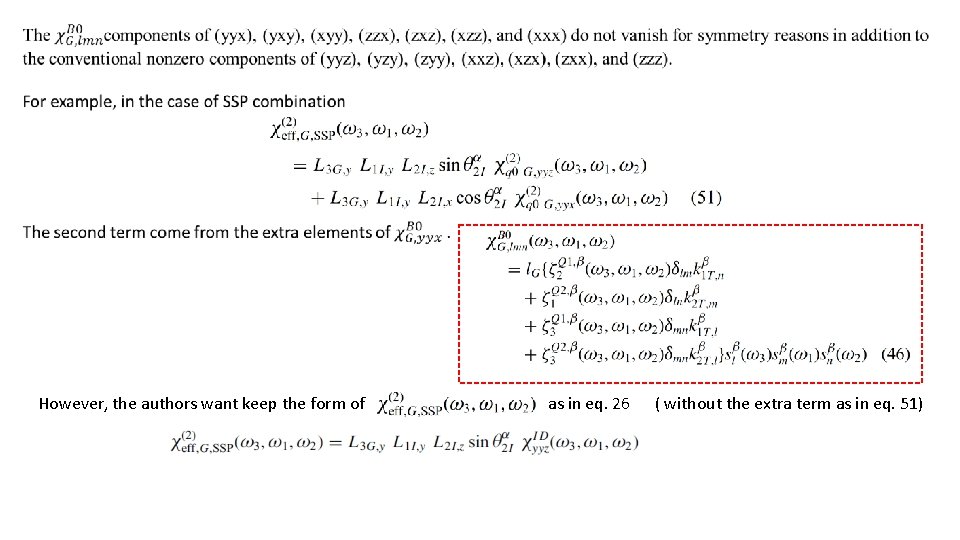
However, the authors want keep the form of as in eq. 26 ( without the extra term as in eq. 51)
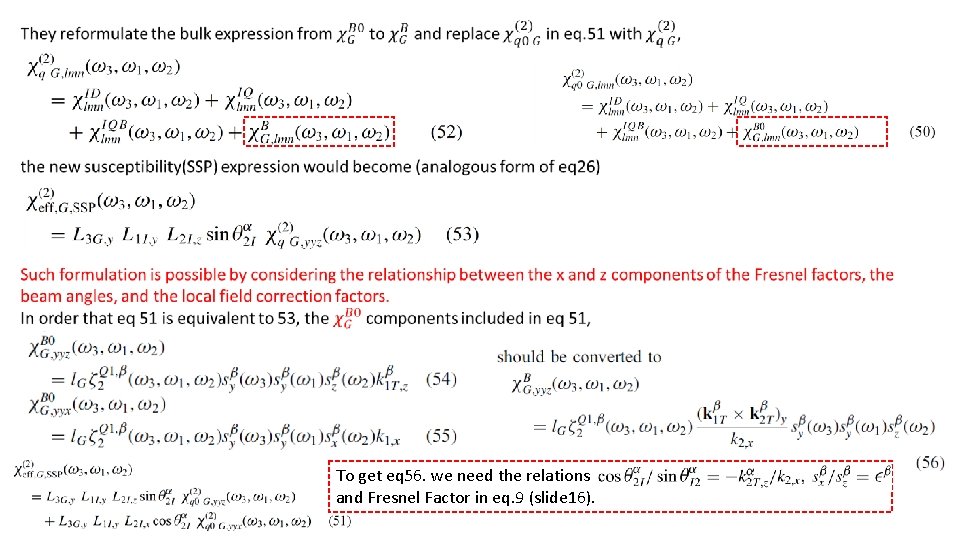
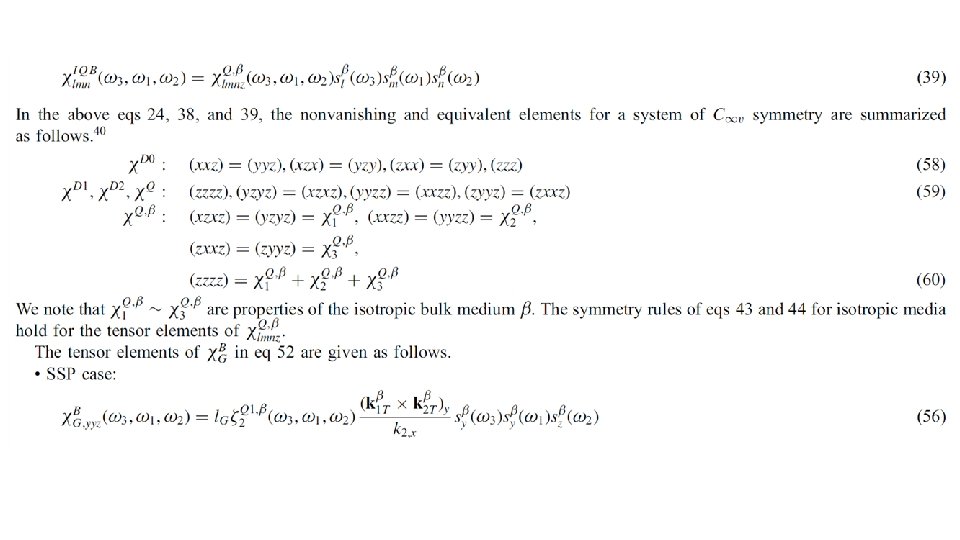
To get eq 56. we need the relations and Fresnel Factor in eq. 9 (slide 16).
- Slides: 27