
SoftwareBased Online Detection of Hardware Defects Mechanisms Architectural

Software-Based Online Detection of Hardware Defects: Mechanisms, Architectural Support, and Kypros Constantinides Evaluation University of Michigan Onur Mutlu Microsoft Research Todd Austin and Valeria Bertacco University of Michigan
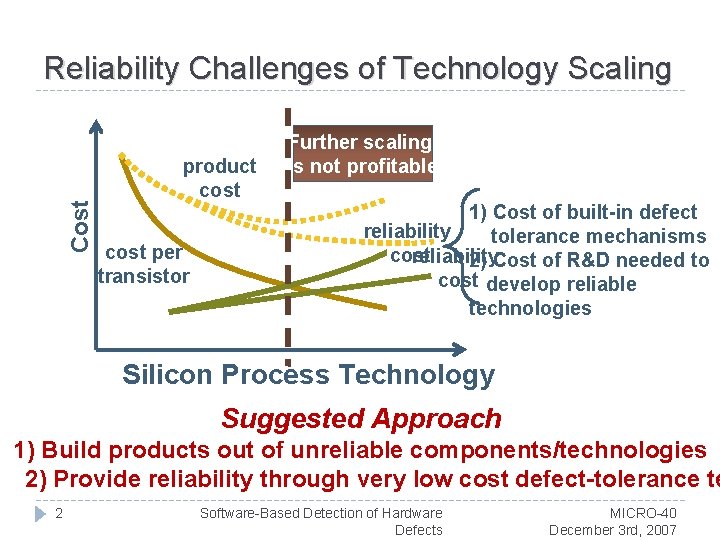
Cost Reliability Challenges of Technology Scaling product cost per transistor Further scaling is not profitable 1) Cost of built-in defect reliability tolerance mechanisms cost reliability 2) Cost of R&D needed to cost develop reliable technologies Silicon Process Technology Suggested Approach 1) Build products out of unreliable components/technologies 2) Provide reliability through very low cost defect-tolerance te 2 Software-Based Detection of Hardware Defects MICRO-40 December 3 rd, 2007
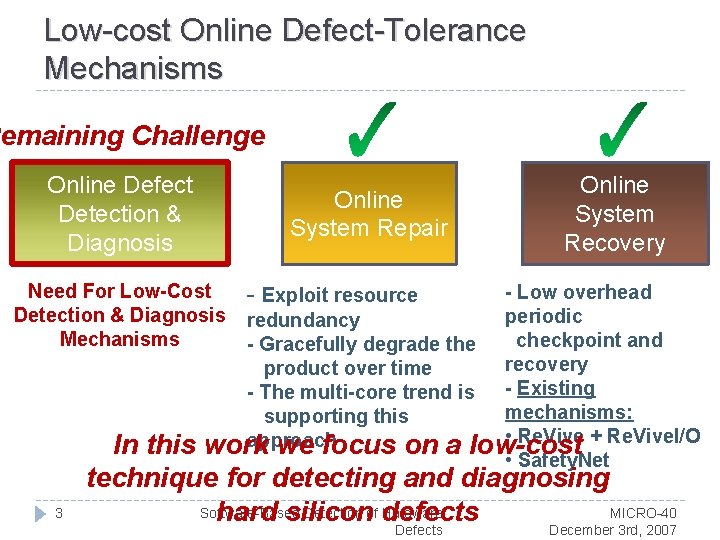
Low-cost Online Defect-Tolerance Mechanisms Remaining Challenge Online Defect Detection & Diagnosis Online System Repair Need For Low-Cost Detection & Diagnosis Mechanisms Online System Recovery - Exploit resource - Low overhead periodic redundancy checkpoint and - Gracefully degrade the recovery product over time - Existing - The multi-core trend is mechanisms: supporting this • Re. Vive + Re. Vive. I/O approach work we focus on a low-cost • Safety. Net 3 In this technique for detecting and diagnosing Software-Based Detection of defects Hardware MICRO-40 hard silicon Defects December 3 rd, 2007

Continuous Checking Techniques � Continuously check for execution errors Original Module Copy of the Module Checker Dual-Modular Redundancy Processor Checking Main Processor Checker Shortcomings of continuous checking: � Redundant computation requires significant extra hardware – high area overhead � Continuous checking consumes significant energy – pressure on power budget 4 Software-Based Detection of Hardware Defects MICRO-40 December 3 rd, 2007

Periodic Checking Techniques � Periodically stall the processor and check the hardware checking succeeds all previous computation is correct � Employ checkpointing and roll-back techniques On-chip Random Test Shortcomings � Built-In Self-Test (BIST) techniques to patterns check the Random do not Pattern Generation hardware target L any specific testing Module F technique Under S (fault model) Test - A lot of patterns are needed R for Too slow for online testing –good High performance coverage 5 overhead Software-Based Detection of Hardware MICRO-40 - Defects Long testing times December 3 rd, 2007 Signature Register � If

Our Approach – Software-Based Defect Detection FIRMWARE Periodically stalls the processor and run hardware checking routines Accessibility Architectural support to software-based checking Controllability ? 6 ? 1) Move the hardware checking overhead to software 2) Firmware periodically stalls the processor and perform hardware checking 3) Provide architectural support to the software checking routines Advantages over hardware-based techniques - Lower area overhead - Higher runtime flexibility - it can support multiple fault models - dynamic tuning of testing process Software-Based Detection of Hardware MICRO-40 - Easier to Defects upgrade (software patches) December 3 rd, 2007
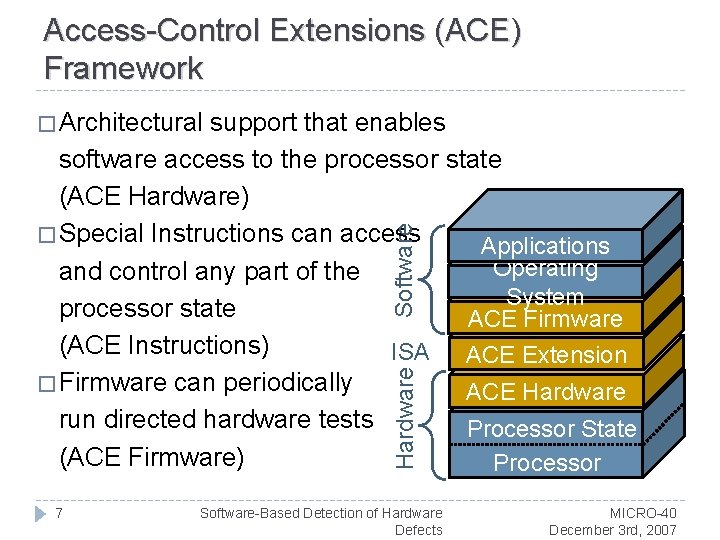
Access-Control Extensions (ACE) Framework support that enables software access to the processor state (ACE Hardware) � Special Instructions can access Applications Operating and control any part of the System processor state ACE Firmware (ACE Instructions) ISA ACE Extension � Firmware can periodically ACE Hardware run directed hardware tests Processor State (ACE Firmware) Processor Hardware Software � Architectural 7 Software-Based Detection of Hardware Defects MICRO-40 December 3 rd, 2007
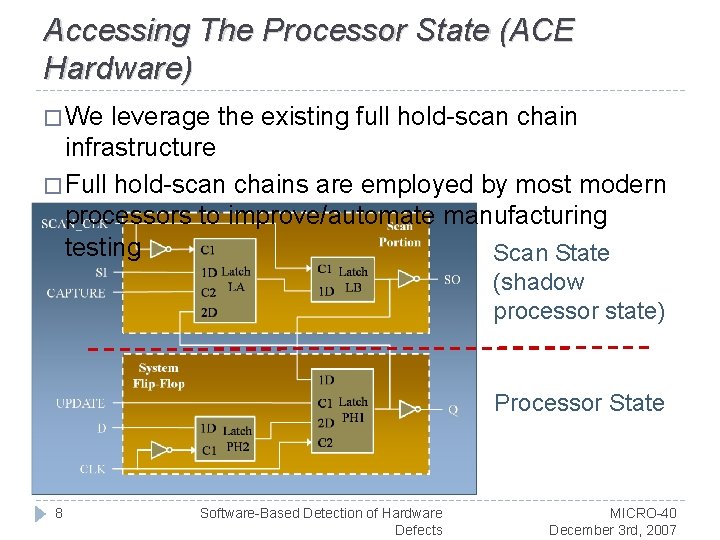
Accessing The Processor State (ACE Hardware) � We leverage the existing full hold-scan chain infrastructure � Full hold-scan chains are employed by most modern processors to improve/automate manufacturing testing Scan State (shadow processor state) Processor State 8 Software-Based Detection of Hardware Defects MICRO-40 December 3 rd, 2007

Accessing The Processor State (ACE Hardware) ACE Tree Regist er File ACE Node ACE Node Scan State Processor State � ACE Instructions can move values from the architectural registers to the scan state and vice versa � ACE Instructions can swap data between the scan state and the processor state 9 Software-Based Detection of Hardware Defects MICRO-40 December 3 rd, 2007
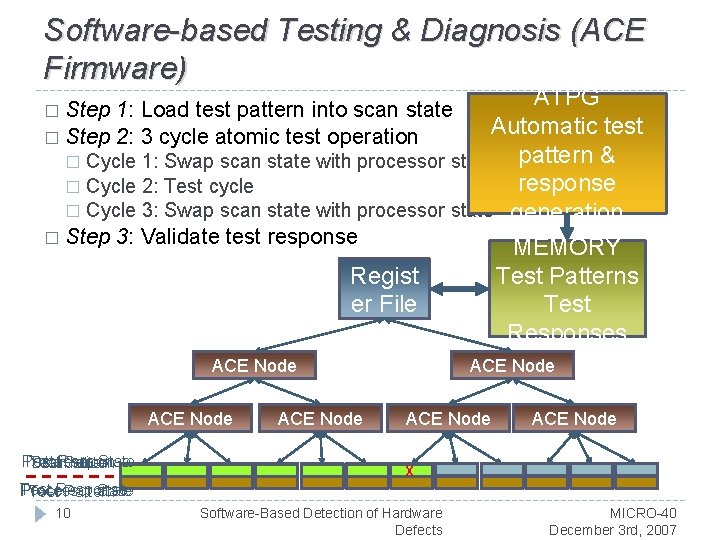
Software-based Testing & Diagnosis (ACE Firmware) ATPG Automatic test pattern & � Cycle 1: Swap scan state with processor state response � Cycle 2: Test cycle � Cycle 3: Swap scan state with processor state generation � Step 3: Validate test response MEMORY Regist Test Patterns Test er File Responses � Step 1: Load test pattern into scan state � Step 2: 3 cycle atomic test operation ACE Node Processor Test Response State Test Pattern Scan state Validation ACE Node X Test Processor State state Test. Response Pattern 10 Software-Based Detection of Hardware Defects MICRO-40 December 3 rd, 2007
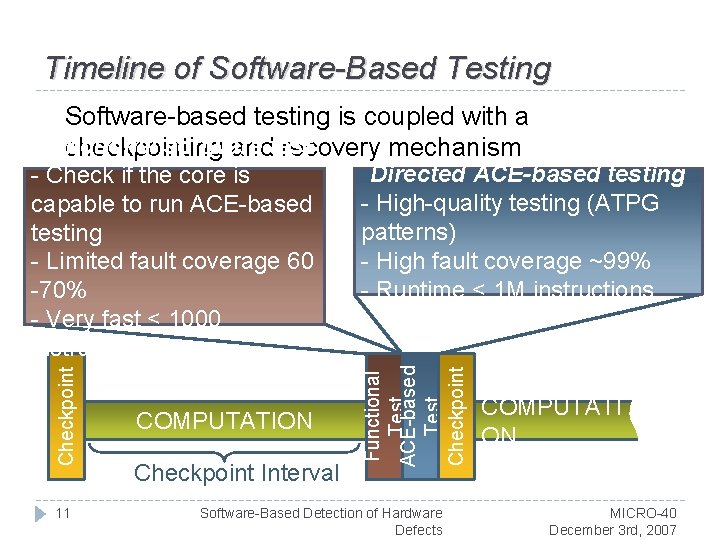
Timeline of Software-Based Testing Software-based testing is coupled with a Functional software checkpointing andtest recovery mechanism 11 COMPUTATION Checkpoint Interval Directed ACE-based testing - High-quality testing (ATPG patterns) - High fault coverage ~99% - Runtime < 1 M instructions Functional Test ACE-based Test Checkpoint - Check if the core is capable to run ACE-based testing - Limited fault coverage 60 -70% - Very fast < 1000 instructions Software-Based Detection of Hardware Defects COMPUTATI ON MICRO-40 December 3 rd, 2007
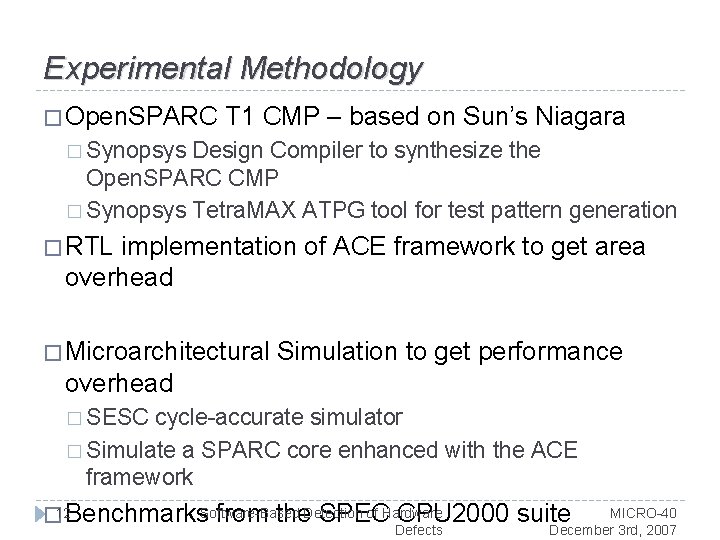
Experimental Methodology � Open. SPARC T 1 CMP – based on Sun’s Niagara � Synopsys Design Compiler to synthesize the Open. SPARC CMP � Synopsys Tetra. MAX ATPG tool for test pattern generation � RTL implementation of ACE framework to get area overhead � Microarchitectural Simulation to get performance overhead � SESC cycle-accurate simulator � Simulate a SPARC core enhanced with the ACE framework of Hardware � 12 Benchmarks. Software-Based from the. Detection SPEC CPU 2000 Defects MICRO-40 suite December 3 rd, 2007
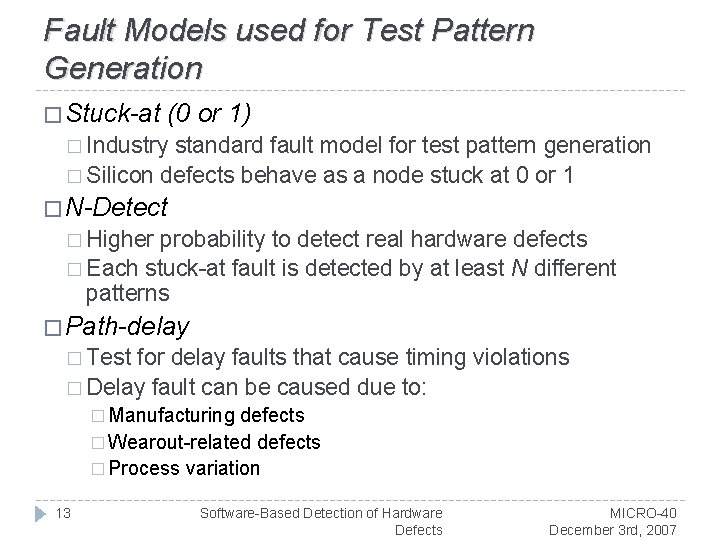
Fault Models used for Test Pattern Generation � Stuck-at (0 or 1) � Industry standard fault model for test pattern generation � Silicon defects behave as a node stuck at 0 or 1 � N-Detect � Higher probability to detect real hardware defects � Each stuck-at fault is detected by at least N different patterns � Path-delay � Test for delay faults that cause timing violations � Delay fault can be caused due to: � Manufacturing defects � Wearout-related defects � Process variation 13 Software-Based Detection of Hardware Defects MICRO-40 December 3 rd, 2007
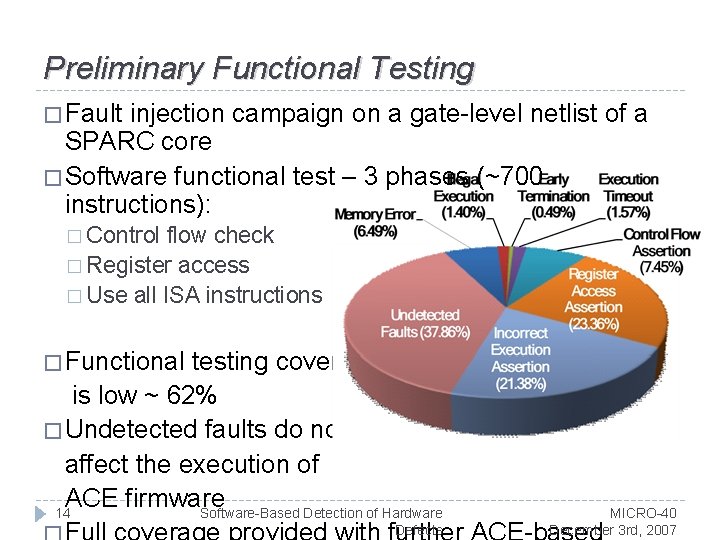
Preliminary Functional Testing � Fault injection campaign on a gate-level netlist of a SPARC core � Software functional test – 3 phases (~700 instructions): � Control flow check � Register access � Use all ISA instructions � Functional testing coverage is low ~ 62% � Undetected faults do not affect the execution of ACE firmware 14 Software-Based Detection of Hardware Defects MICRO-40 December 3 rd, 2007
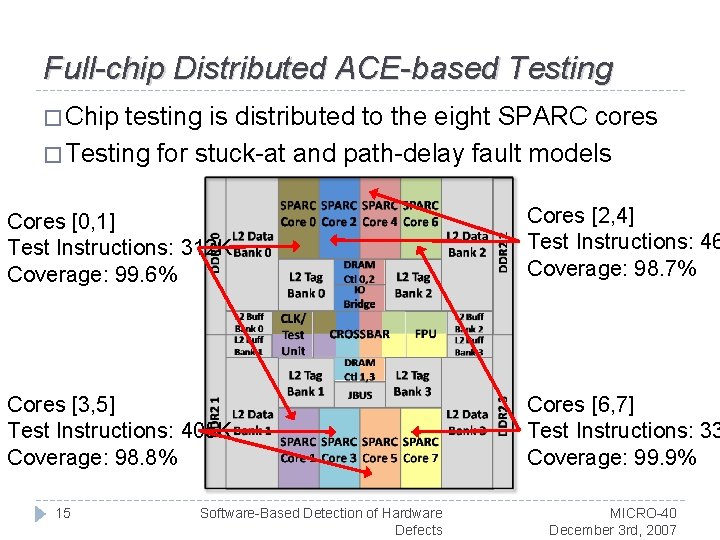
Full-chip Distributed ACE-based Testing � Chip testing is distributed to the eight SPARC cores � Testing for stuck-at and path-delay fault models Cores [0, 1] Test Instructions: 312 K Coverage: 99. 6% Cores [2, 4] Test Instructions: 46 Coverage: 98. 7% Cores [3, 5] Test Instructions: 405 K Coverage: 98. 8% Cores [6, 7] Test Instructions: 33 Coverage: 99. 9% 15 Software-Based Detection of Hardware Defects MICRO-40 December 3 rd, 2007
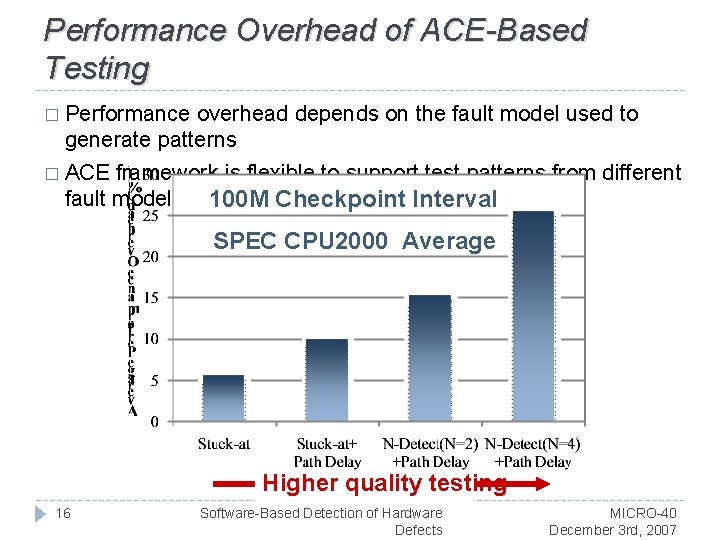
Performance Overhead of ACE-Based Testing � Performance overhead depends on the fault model used to generate patterns � ACE framework is flexible to support test patterns from different fault models 100 M Checkpoint Interval SPEC CPU 2000 Average Higher quality testing 16 Software-Based Detection of Hardware Defects MICRO-40 December 3 rd, 2007
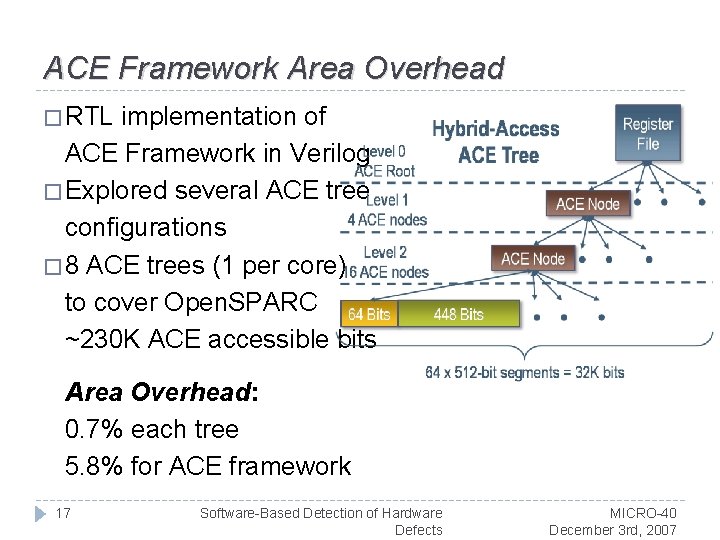
ACE Framework Area Overhead � RTL implementation of ACE Framework in Verilog � Explored several ACE tree configurations � 8 ACE trees (1 per core) to cover Open. SPARC ~230 K ACE accessible bits Area Overhead: 0. 7% each tree 5. 8% for ACE framework 17 Software-Based Detection of Hardware Defects MICRO-40 December 3 rd, 2007
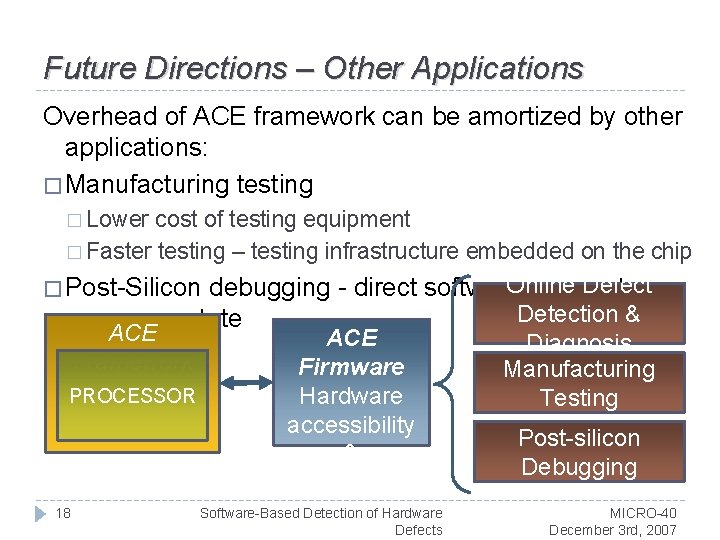
Future Directions – Other Applications Overhead of ACE framework can be amortized by other applications: � Manufacturing testing � Lower cost of testing equipment � Faster testing – testing infrastructure embedded on the chip Online Defect � Post-Silicon debugging - direct software access to Detection & processor state ACE Diagnosis Framework Firmware Manufacturing PROCESSOR Hardware Testing accessibility Post-silicon & Debugging controllability 18 Software-Based Detection of Hardware Defects MICRO-40 December 3 rd, 2007
Conclusions � We proposed a novel software-based online defect detection and diagnosis technique � Low area overhead: 5. 8% � High fault coverage: 99% � Low performance overhead: 5. 5% � Demonstrated the flexibility of the proposed technique to support: � Dynamic trade-off between performance and reliability � A number of fault models with varying test quality � The ACE infrastructure can be a unified framework that provides hardware accessibility and controllability to software 19 Software-Based Detection of Hardware Defects MICRO-40 December 3 rd, 2007
Thank You! Questions? 20 Software-Based Detection of Hardware Defects MICRO-40 December 3 rd, 2007
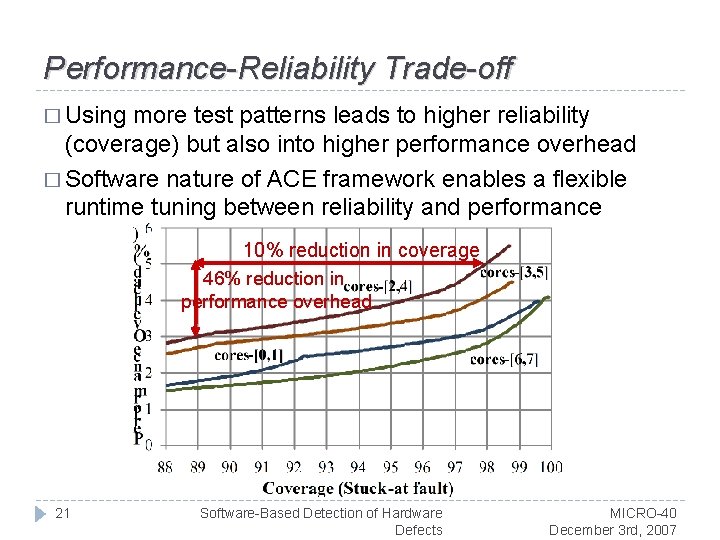
Performance-Reliability Trade-off � Using more test patterns leads to higher reliability (coverage) but also into higher performance overhead � Software nature of ACE framework enables a flexible runtime tuning between reliability and performance 10% reduction in coverage 46% reduction in performance overhead 21 Software-Based Detection of Hardware Defects MICRO-40 December 3 rd, 2007
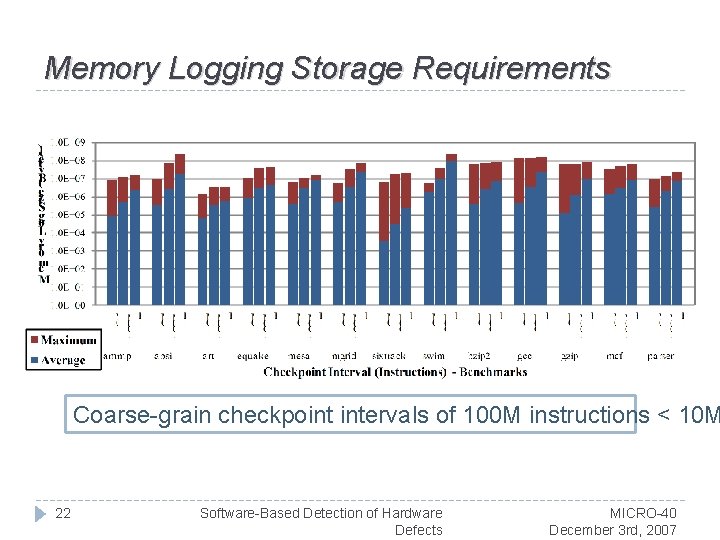
Memory Logging Storage Requirements Coarse-grain checkpoint intervals of 100 M instructions < 10 M 22 Software-Based Detection of Hardware Defects MICRO-40 December 3 rd, 2007
Performance Overhead of I/O-Intensive Applications 23 Software-Based Detection of Hardware Defects MICRO-40 December 3 rd, 2007
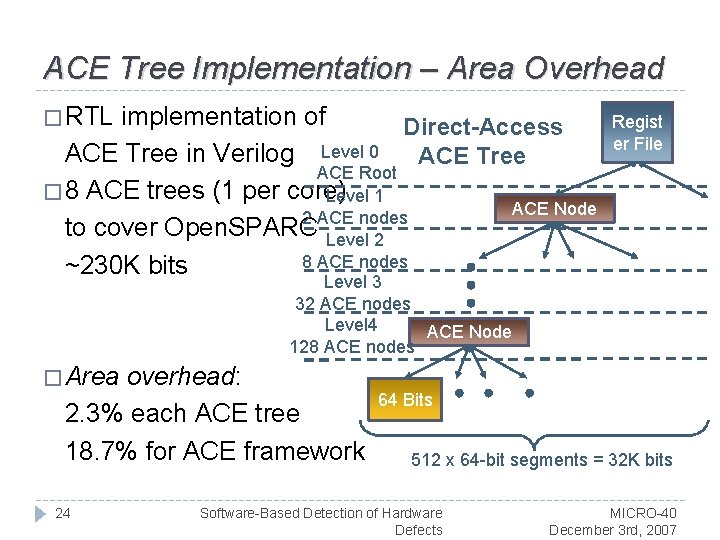
ACE Tree Implementation – Area Overhead � RTL implementation of Direct-Access ACE Tree in Verilog Level 0 ACE Tree ACE Root � 8 ACE trees (1 per core) Level 1 ACE Node 2 ACE nodes to cover Open. SPARC Level 2 8 ACE nodes ~230 K bits Regist er File Level 3 32 ACE nodes Level 4 ACE Node 128 ACE nodes � Area overhead: 2. 3% each ACE tree 18. 7% for ACE framework 24 64 Bits 512 x 64 -bit segments = 32 K bits Software-Based Detection of Hardware Defects MICRO-40 December 3 rd, 2007
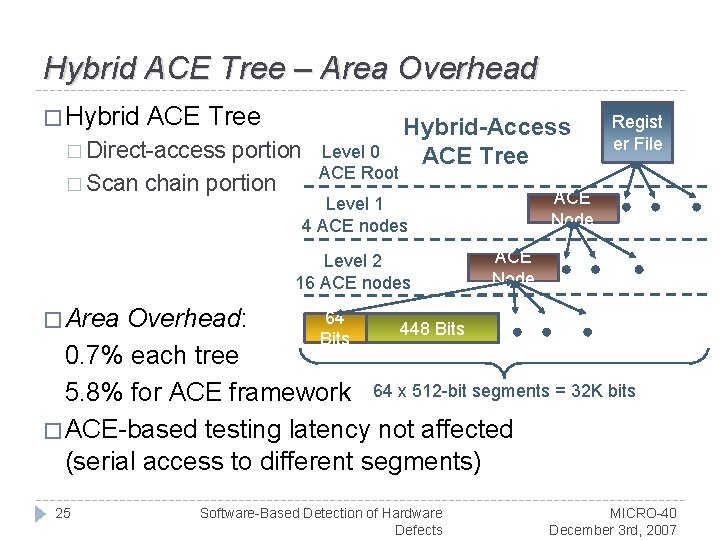
Hybrid ACE Tree – Area Overhead � Hybrid ACE Tree � Direct-access portion � Scan chain portion Level 0 ACE Root Hybrid-Access ACE Tree ACE Node Level 1 4 ACE nodes Level 2 16 ACE nodes Regist er File ACE Node � Area 64 Overhead: 448 Bits 0. 7% each tree 5. 8% for ACE framework 64 x 512 -bit segments = 32 K bits � ACE-based testing latency not affected (serial access to different segments) 25 Software-Based Detection of Hardware Defects MICRO-40 December 3 rd, 2007
- Slides: 25