
SOFTWARE VERIFICATION RESEARCH CENTRE THE UNIVERSITY OF QUEENSLAND
- Slides: 28
SOFTWARE VERIFICATION RESEARCH CENTRE THE UNIVERSITY OF QUEENSLAND Verification & Validation of Safety Critical Software Dr Peter Lindsay Assistant Director Software Verification Research Centre School of Information Technology The University of Queensland 1
Abstract of talk (1) u The increasing trend towards systems integration, and increased automation of critical functions which were once performed by humans, means that more and more reliance is placed on software. u Procurers of safety-critical systems are becoming more aware of the need for appropriate levels of safety assurance, and are increasingly requiring system developers to produce a Safety Case to document the reasons why a system is safe to be operated. 2
Abstract of talk (2) u This talk looks at recent and emerging standards for safety-critical software, and will introduce listeners to the key principles of safety assurance, including: – hazard and risk analysis – safety integrity levels – the structure and content of safety cases – management of the safety process 3
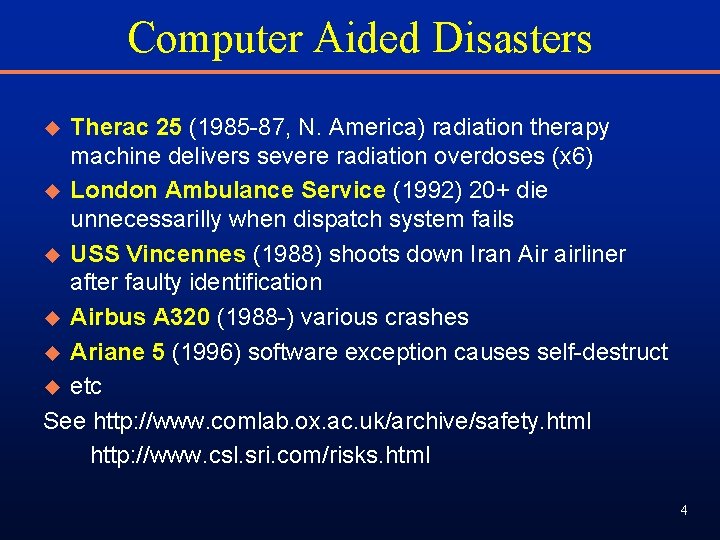
Computer Aided Disasters Therac 25 (1985 -87, N. America) radiation therapy machine delivers severe radiation overdoses (x 6) u London Ambulance Service (1992) 20+ die unnecessarilly when dispatch system fails u USS Vincennes (1988) shoots down Iran Air airliner after faulty identification u Airbus A 320 (1988 -) various crashes u Ariane 5 (1996) software exception causes self-destruct u etc See http: //www. comlab. ox. ac. uk/archive/safety. html http: //www. csl. sri. com/risks. html u 4
What’s Different About Software? Broadly speaking, traditional safety engineering is concerned with physical failures: – e. g. wear-out, corrosion, faulty manufacture – mitigations include: well-tried designs, safety margins, redundant components, inspection, maintenance – this has little relevance for software On the other hand, software is typically: – novel, complex, highly input-sensitive, not designed by domain experts Software demands a new approach to safety engineering 5
Talk outline u u Define main terms & concepts in safety engineering as they relate to software: – hazards, risk, safety integrity levels, etc Explain the basic principles of safety management & the safety lifecycle for software systems Outline 3 important safety analysis techniques – Failure Modes Effects Analysis (FMEA) – Fault Tree Analysis (FTA) – Hazard and Operability Studies (HAZOP) Summary 6
Reference Material u u IEC 61508 “Functional Safety: Safety-related Systems” (International Electrotechnical Commission, 1998) Def(Aust) 5679 Australian Defence Standard for Procurement of Computer-based Safety-critical Systems UK MOD 00 -55, 00 -56, 00 -58 Standards for software development and hazard analysis of safety-critical systems Nancy Leveson Safeware: System Safety and Computers Verification & Validation of Safety Critical Software SEA’ 99 Conference 7
Safety u u u A system is unsafe if it can cause unacceptable harm. Harm: loss of life, injury, damage to the environment, etc Safety is a whole system issue – only physical objects can cause harm – need to consider all system components: software, hardware, operators, procedures, infrastructure, … Safety is a whole lifecycle issue – from concept through to decommissioning Safety and reliability are two different things Verification & Validation of Safety Critical Software SEA’ 99 Conference 8
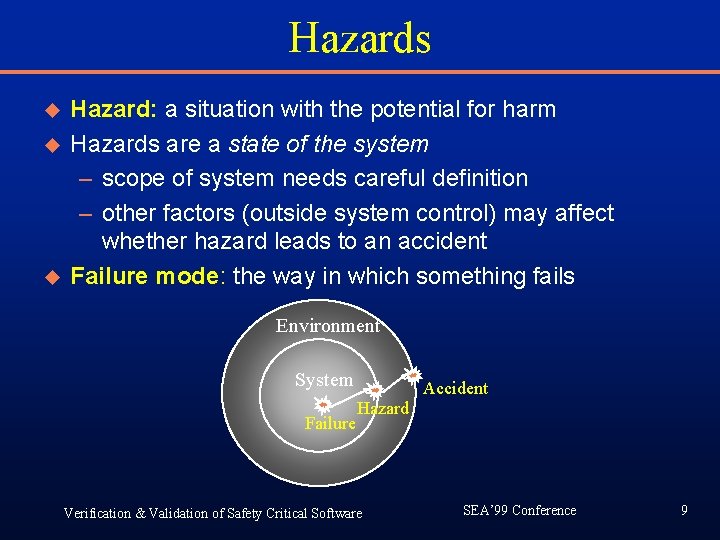
Hazards u u u Hazard: a situation with the potential for harm Hazards are a state of the system – scope of system needs careful definition – other factors (outside system control) may affect whether hazard leads to an accident Failure mode: the way in which something fails Environment System Failure Hazard Verification & Validation of Safety Critical Software Accident SEA’ 99 Conference 9
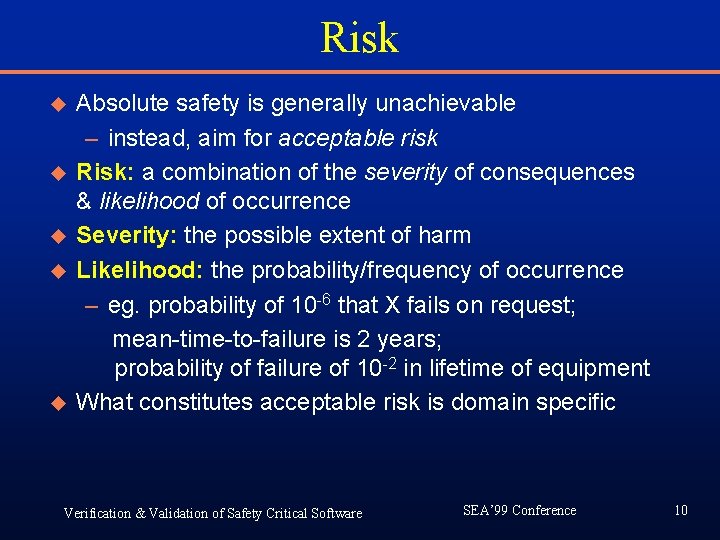
Risk u u u Absolute safety is generally unachievable – instead, aim for acceptable risk Risk: a combination of the severity of consequences & likelihood of occurrence Severity: the possible extent of harm Likelihood: the probability/frequency of occurrence – eg. probability of 10 -6 that X fails on request; mean-time-to-failure is 2 years; probability of failure of 10 -2 in lifetime of equipment What constitutes acceptable risk is domain specific Verification & Validation of Safety Critical Software SEA’ 99 Conference 10
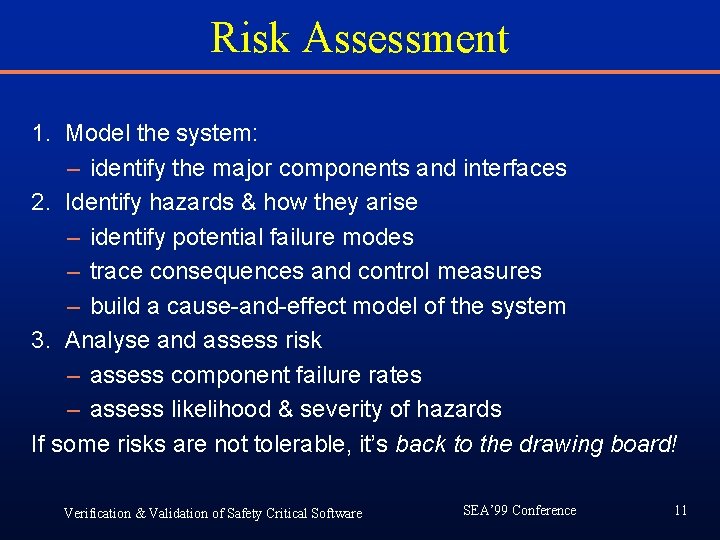
Risk Assessment 1. Model the system: – identify the major components and interfaces 2. Identify hazards & how they arise – identify potential failure modes – trace consequences and control measures – build a cause-and-effect model of the system 3. Analyse and assess risk – assess component failure rates – assess likelihood & severity of hazards If some risks are not tolerable, it’s back to the drawing board! Verification & Validation of Safety Critical Software SEA’ 99 Conference 11
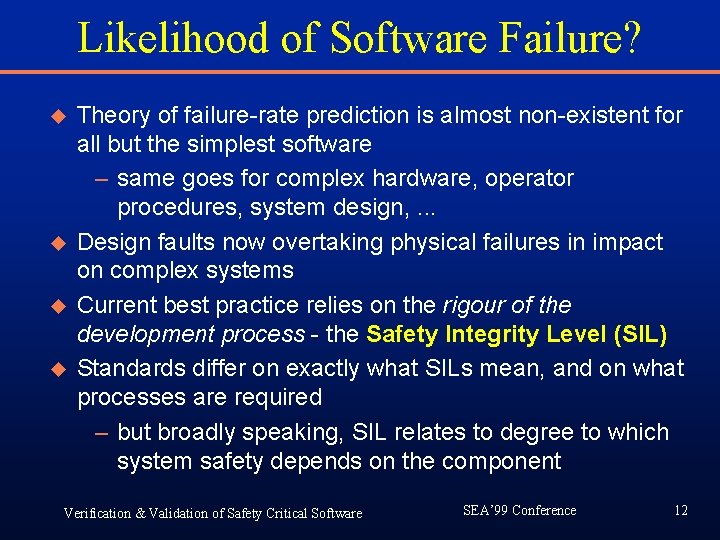
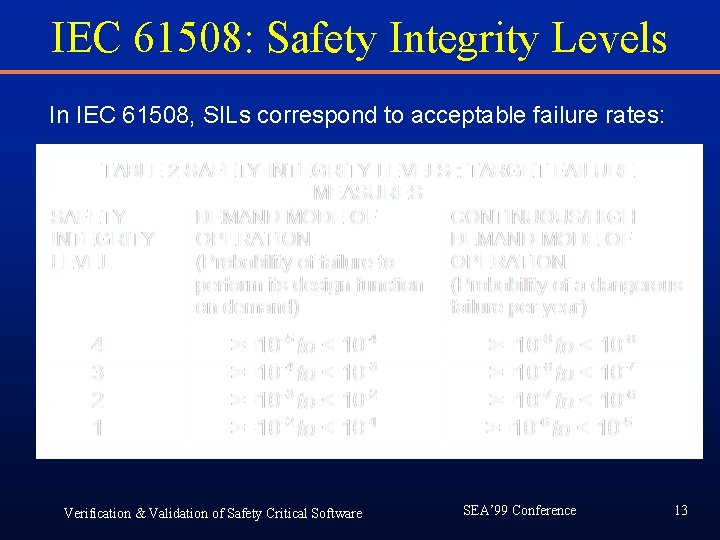
Likelihood of Software Failure? u u Theory of failure-rate prediction is almost non-existent for all but the simplest software – same goes for complex hardware, operator procedures, system design, . . . Design faults now overtaking physical failures in impact on complex systems Current best practice relies on the rigour of the development process - the Safety Integrity Level (SIL) Standards differ on exactly what SILs mean, and on what processes are required – but broadly speaking, SIL relates to degree to which system safety depends on the component Verification & Validation of Safety Critical Software SEA’ 99 Conference 12
IEC 61508: Safety Integrity Levels In IEC 61508, SILs correspond to acceptable failure rates: Verification & Validation of Safety Critical Software SEA’ 99 Conference 13
Safety Management u u u Overall goal: to deliver a safe system, however “Like justice, safety needs not only to be done, but to be seen to be done. ” A Safety Case documents the claim that the system is safe to be operated Main ingredients of a Safety Case: – identification of hazards, failure modes, failure mechanisms, safety features, safety targets & SILs – reasoned arguments for risk assessment – supporting evidence, including: hazard analysis, V&V results Verification & Validation of Safety Critical Software SEA’ 99 Conference 14
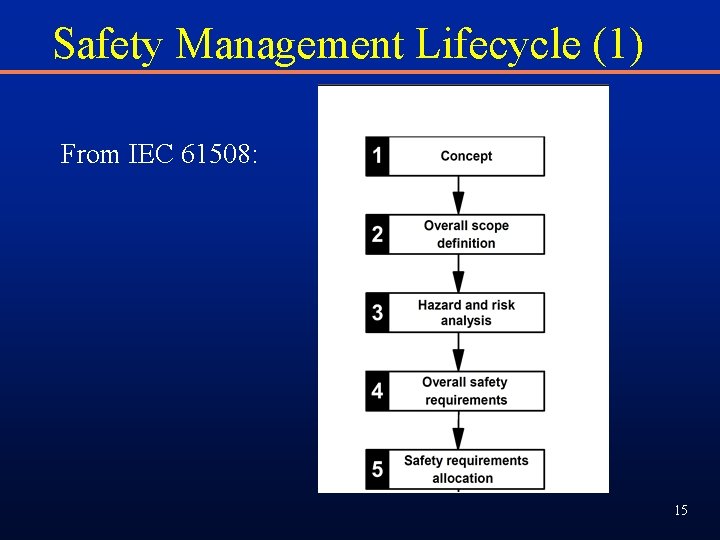
Safety Management Lifecycle (1) From IEC 61508: 15
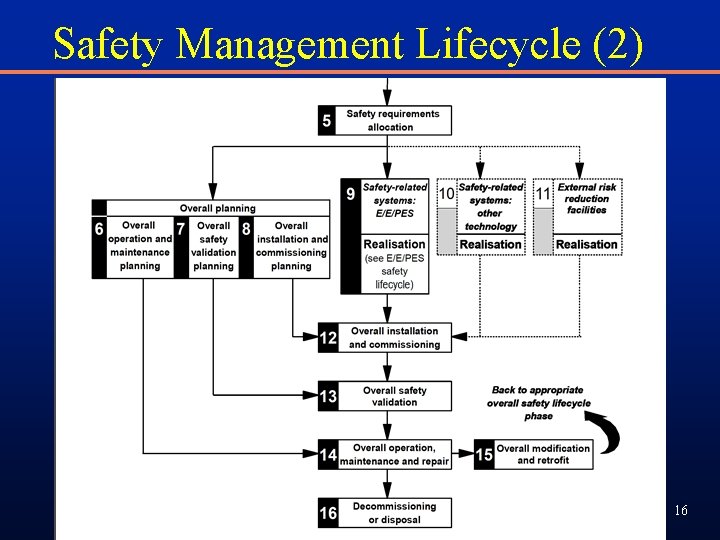
Safety Management Lifecycle (2) 16
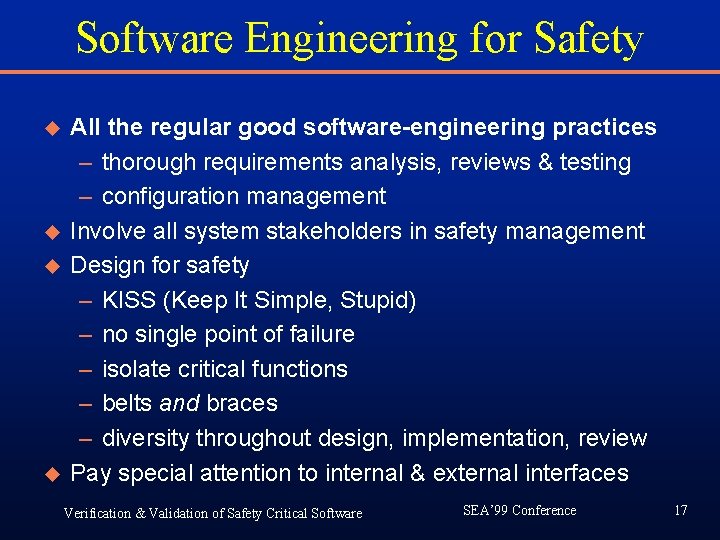
Software Engineering for Safety u u All the regular good software-engineering practices – thorough requirements analysis, reviews & testing – configuration management Involve all system stakeholders in safety management Design for safety – KISS (Keep It Simple, Stupid) – no single point of failure – isolate critical functions – belts and braces – diversity throughout design, implementation, review Pay special attention to internal & external interfaces Verification & Validation of Safety Critical Software SEA’ 99 Conference 17
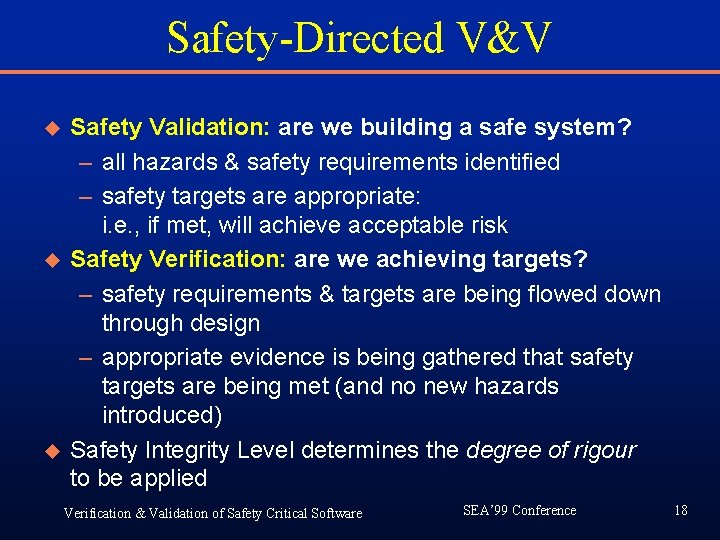
Safety-Directed V&V u u u Safety Validation: are we building a safe system? – all hazards & safety requirements identified – safety targets are appropriate: i. e. , if met, will achieve acceptable risk Safety Verification: are we achieving targets? – safety requirements & targets are being flowed down through design – appropriate evidence is being gathered that safety targets are being met (and no new hazards introduced) Safety Integrity Level determines the degree of rigour to be applied Verification & Validation of Safety Critical Software SEA’ 99 Conference 18
Important Safety V&V techniques The broad goals of Safety V&V are to – identify (& prioritize) all hazards and – trace their resolution Different techiques are applicable at different stages of design, according to what design details are available Will outline 3 techniques that apply well to software: – Failure Modes & Effects Analysis (FMEA) – Fault Tree Analysis – Hazard & Operability Studies (HAZOP) 19
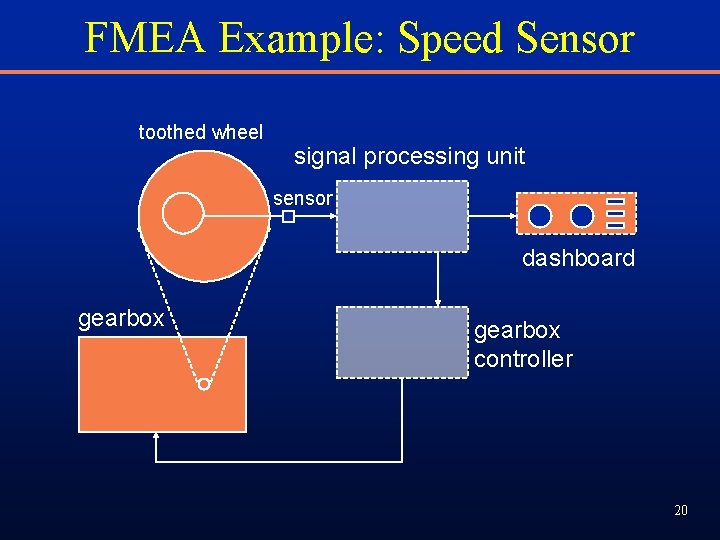
FMEA Example: Speed Sensor toothed wheel signal processing unit sensor dashboard gearbox controller 20
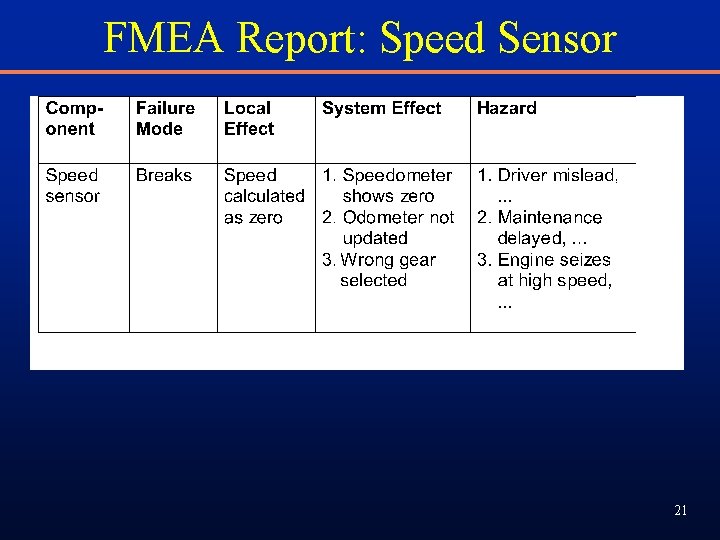
FMEA Report: Speed Sensor 21
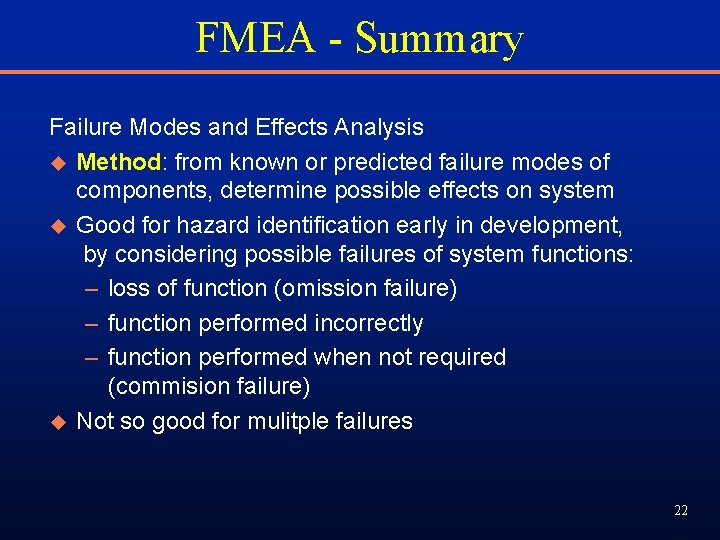
FMEA - Summary Failure Modes and Effects Analysis u Method: from known or predicted failure modes of components, determine possible effects on system u Good for hazard identification early in development, by considering possible failures of system functions: – loss of function (omission failure) – function performed incorrectly – function performed when not required (commision failure) u Not so good for mulitple failures 22
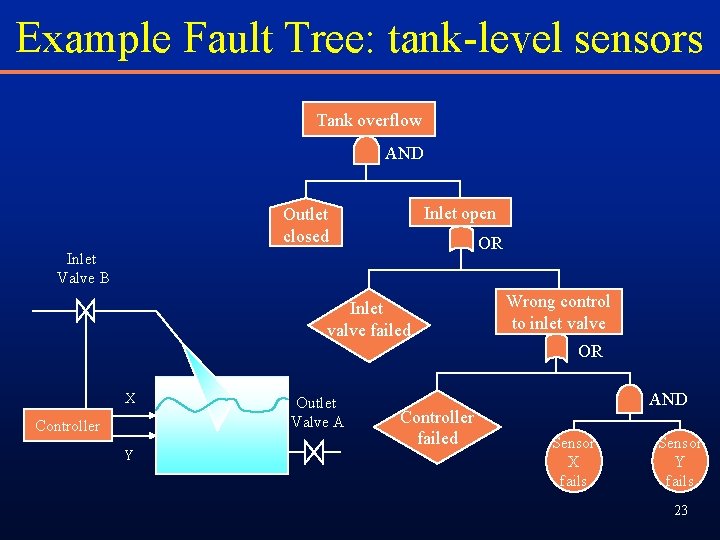
Example Fault Tree: tank-level sensors Tank overflow AND Inlet open Outlet closed OR Inlet Valve B Inlet valve failed Wrong control to inlet valve OR X Controller Y Outlet Valve A Controller failed AND Sensor X fails Sensor Y fails 23
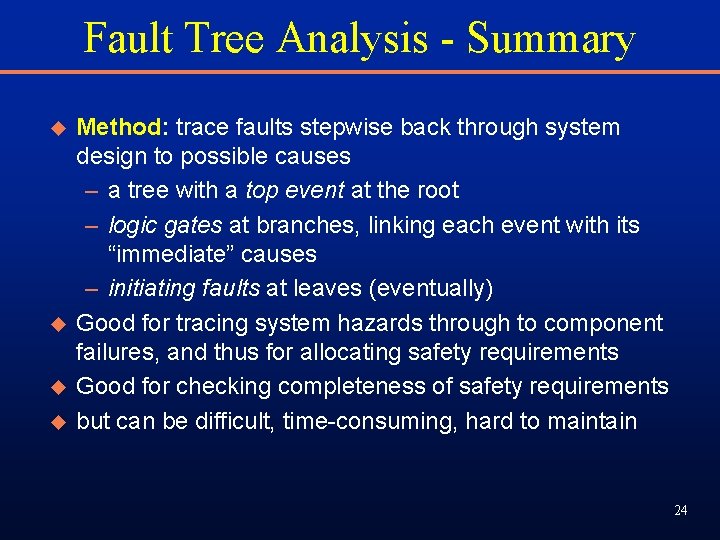
Fault Tree Analysis - Summary u u Method: trace faults stepwise back through system design to possible causes – a tree with a top event at the root – logic gates at branches, linking each event with its “immediate” causes – initiating faults at leaves (eventually) Good for tracing system hazards through to component failures, and thus for allocating safety requirements Good for checking completeness of safety requirements but can be difficult, time-consuming, hard to maintain 24
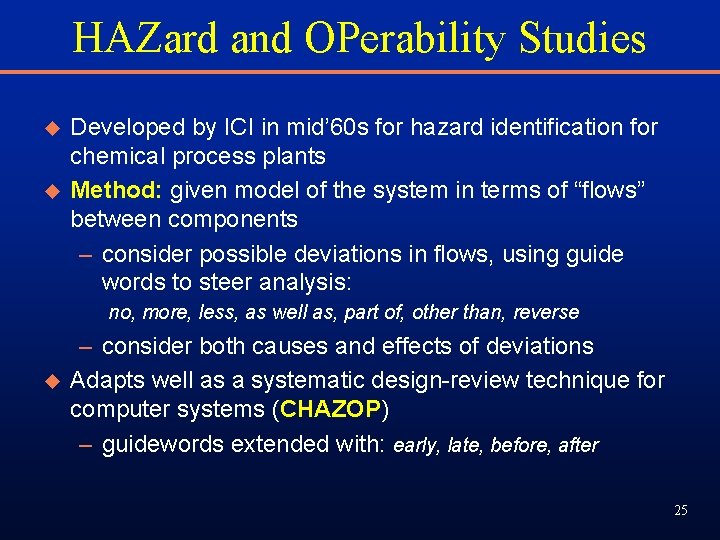
HAZard and OPerability Studies u u Developed by ICI in mid’ 60 s for hazard identification for chemical process plants Method: given model of the system in terms of “flows” between components – consider possible deviations in flows, using guide words to steer analysis: no, more, less, as well as, part of, other than, reverse u – consider both causes and effects of deviations Adapts well as a systematic design-review technique for computer systems (CHAZOP) – guidewords extended with: early, late, before, after 25
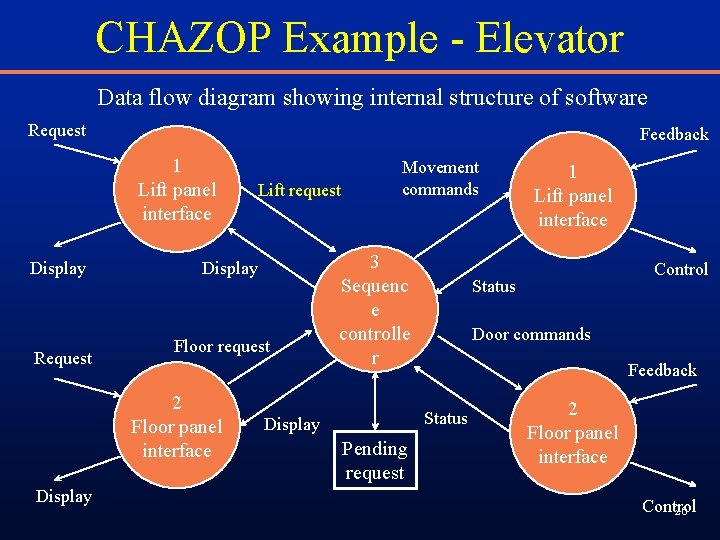
CHAZOP Example - Elevator Data flow diagram showing internal structure of software Request Feedback 1 Lift panel interface Display Request Display Floor request 2 Floor panel interface Display Lift request Movement commands 3 Sequenc e controlle r Pending request Control Status Door commands Feedback Status Display 1 Lift panel interface 2 Floor panel interface Control 26
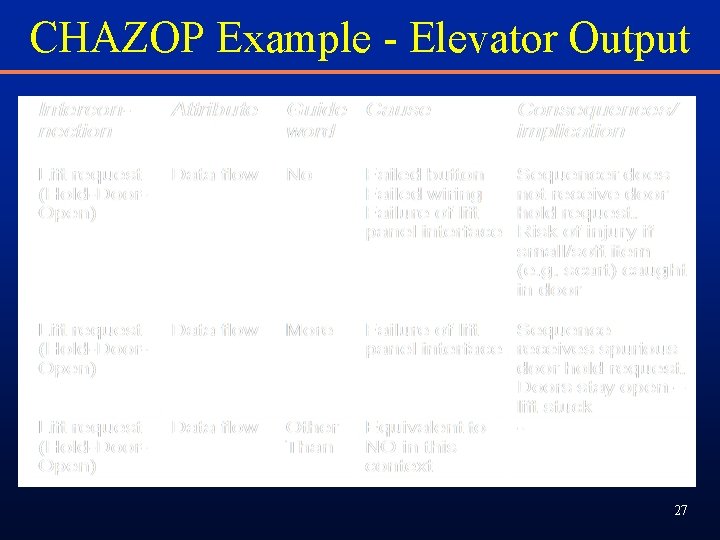
CHAZOP Example - Elevator Output 27
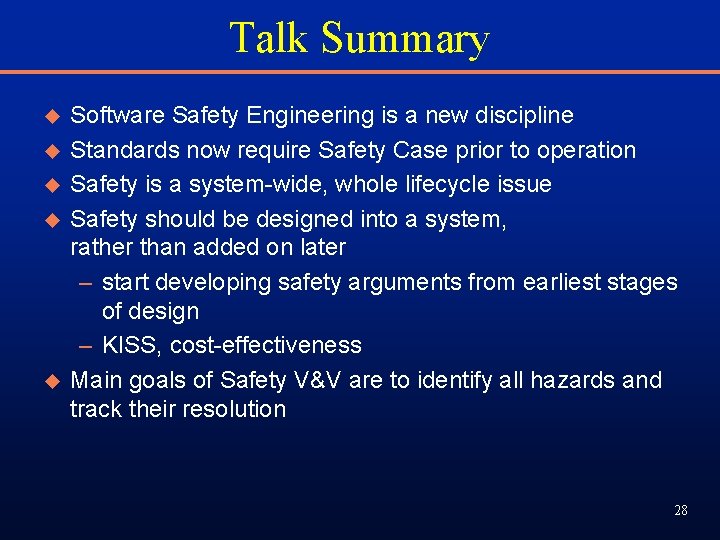
Talk Summary u u u Software Safety Engineering is a new discipline Standards now require Safety Case prior to operation Safety is a system-wide, whole lifecycle issue Safety should be designed into a system, rather than added on later – start developing safety arguments from earliest stages of design – KISS, cost-effectiveness Main goals of Safety V&V are to identify all hazards and track their resolution 28