
Software Testing with Quick Check Lecture 1 Properties

![The fault explained lists: delete(2, [2, 2]) lists: member(2, [2]) [2] not true false](https://slidetodoc.com/presentation_image_h2/1adbd442ad40e059fbf1b69de269c706/image-7.jpg "The fault explained lists: delete(2, [2, 2]) lists: member(2, [2]) [2] not true false")
- Slides: 14
Software Testing with Quick. Check Lecture 1 Properties and Generators
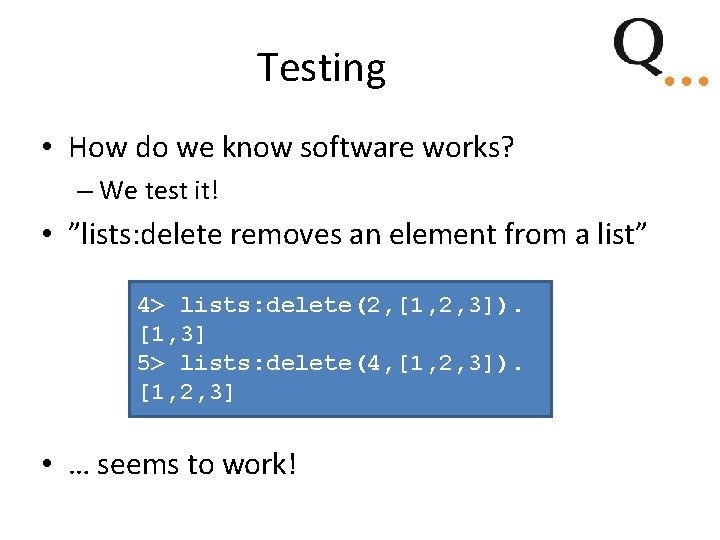
Testing • How do we know software works? – We test it! • ”lists: delete removes an element from a list” 4> lists: delete(2, [1, 2, 3]). [1, 3] 5> lists: delete(4, [1, 2, 3]). [1, 2, 3] • … seems to work!
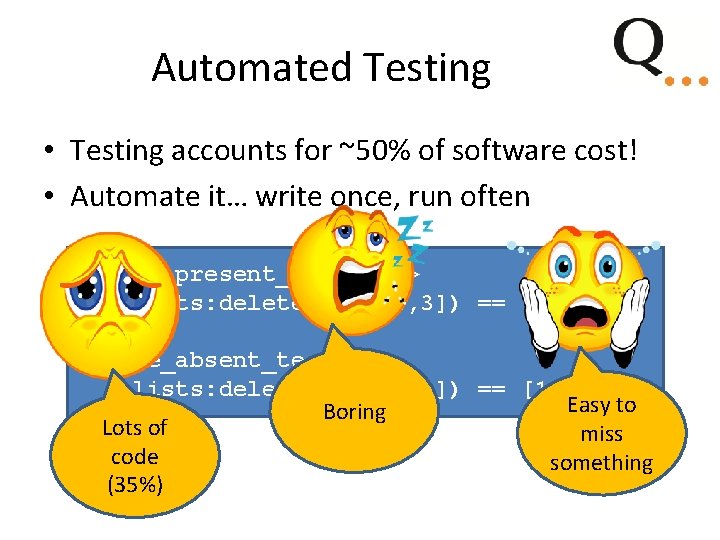
Automated Testing • Testing accounts for ~50% of software cost! • Automate it… write once, run often delete_present_test() -> lists: delete(2, [1, 2, 3]) == [1, 3]. delete_absent_test() -> lists: delete(4, [1, 2, 3]) == [1, 2, 3]. Easy to Boring Lots of miss code something (35%)
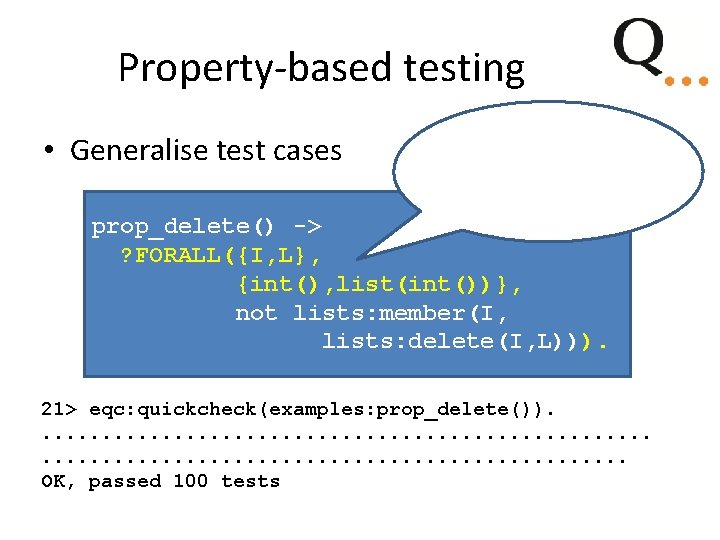
Property-based testing • Generalise test cases prop_delete() -> ? FORALL({I, L}, {int(), list(int())}, not lists: member(I, lists: delete(I, L))). 21> eqc: quickcheck(examples: prop_delete()). . . . . . . OK, passed 100 tests
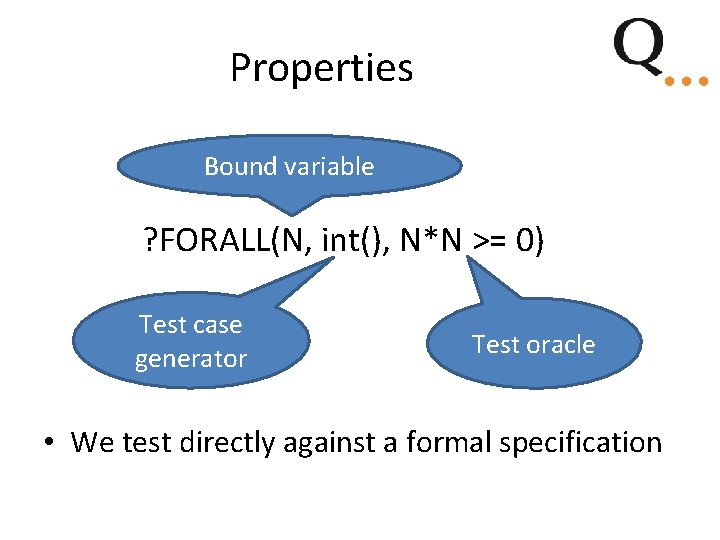
Properties Bound variable ? FORALL(N, int(), N*N >= 0) Test case generator Test oracle • We test directly against a formal specification
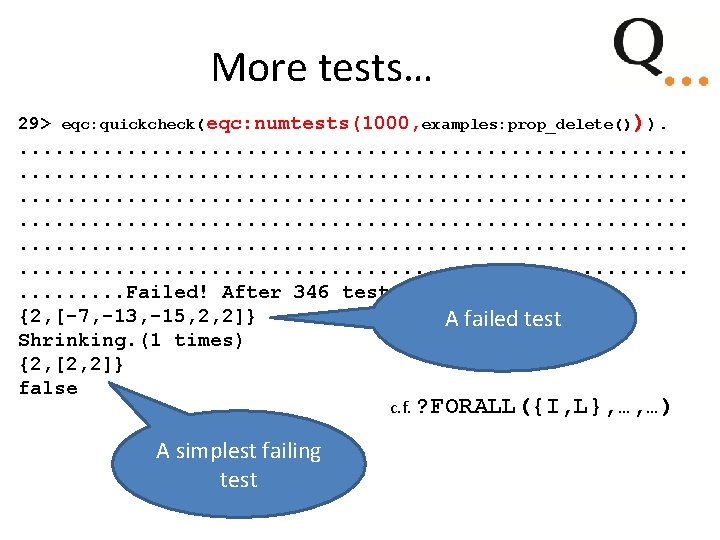
More tests… 29> eqc: quickcheck(eqc: numtests(1000, examples: prop_delete())). . . . . . . . . . . . . . . . . . . . . . Failed! After 346 tests. {2, [-7, -13, -15, 2, 2]} A failed test Shrinking. (1 times) {2, [2, 2]} false c. f. ? FORALL({I, L}, …, …) A simplest failing test
The fault explained lists: delete(2, [2, 2]) lists: member(2, [2]) [2] not true false
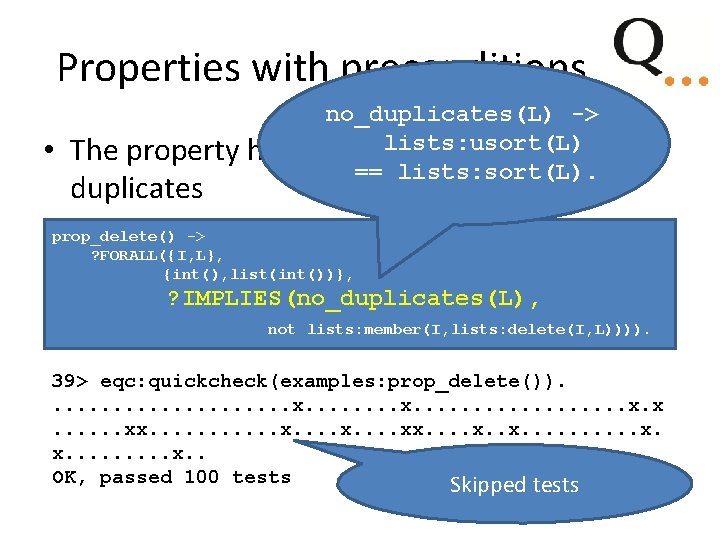
Properties with preconditions • The property holds duplicates no_duplicates(L) -> lists: usort(L) provided L contains no == lists: sort(L). prop_delete() -> ? FORALL({I, L}, {int(), list(int())}, ? IMPLIES(no_duplicates(L), not lists: member(I, lists: delete(I, L)))). 39> eqc: quickcheck(examples: prop_delete()). . . x. x. . . xx. . . x. x. . OK, passed 100 tests Skipped tests
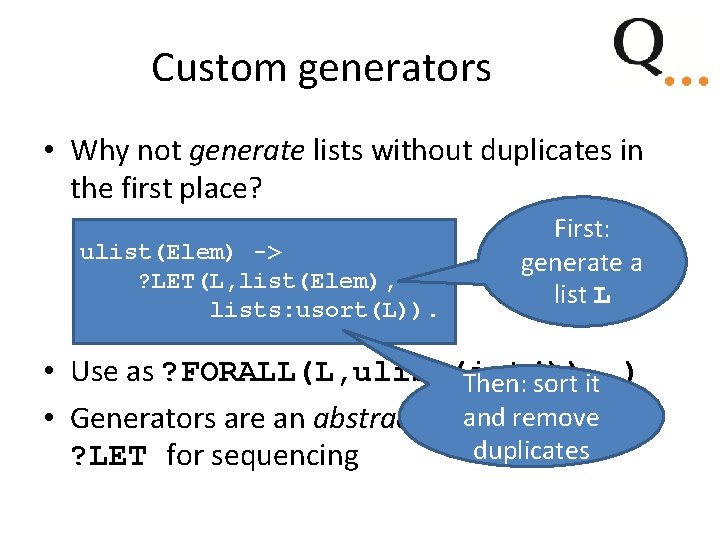
Custom generators • Why not generate lists without duplicates in the first place? ulist(Elem) -> ? LET(L, list(Elem), lists: usort(L)). First: generate a list L • Use as ? FORALL(L, ulist(int()), …) Then: sort it andtype remove • Generators are an abstract data with duplicates ? LET for sequencing
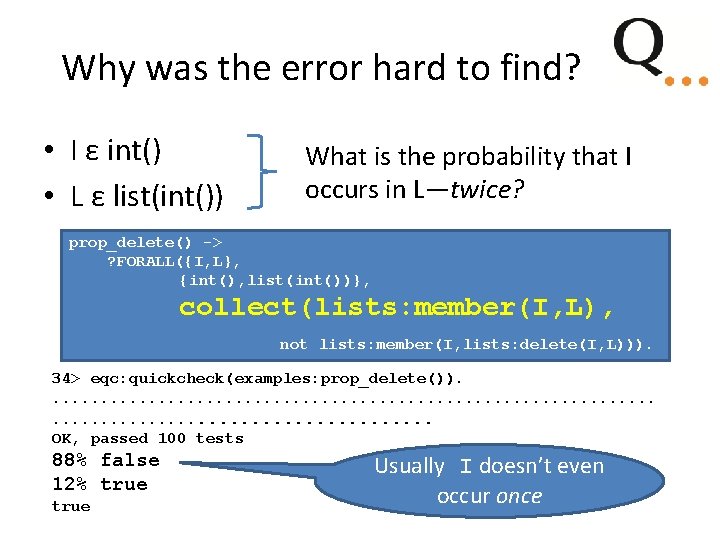
Why was the error hard to find? • I ε int() • L ε list(int()) What is the probability that I occurs in L—twice? prop_delete() -> ? FORALL({I, L}, {int(), list(int())}, collect(lists: member(I, L), not lists: member(I, lists: delete(I, L))). 34> eqc: quickcheck(examples: prop_delete()). . . . . . . OK, passed 100 tests 88% false 12% true Usually I doesn’t even occur once
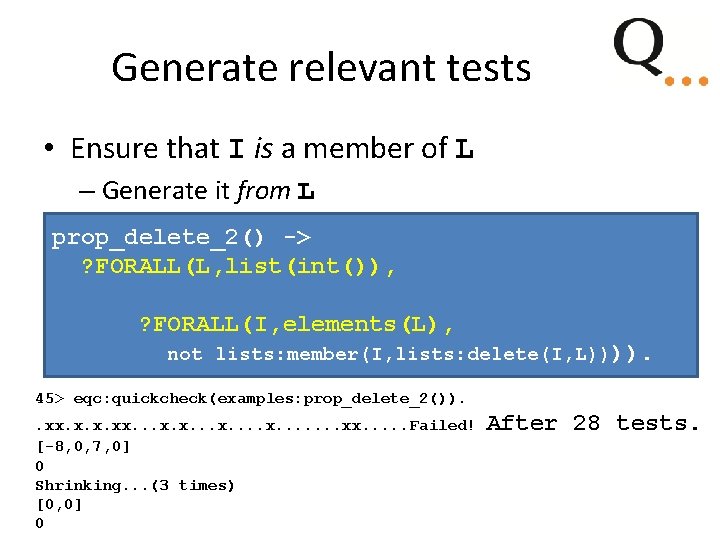
Generate relevant tests • Ensure that I is a member of L – Generate it from L prop_delete_2() -> ? FORALL(L, list(int()), ? IMPLIES(L /= [], ? FORALL(I, elements(L), not lists: member(I, lists: delete(I, L)))). 45> eqc: quickcheck(examples: prop_delete_2()). . xx. xx. . . Failed! [-8, 0, 7, 0] 0 Shrinking. . . (3 times) [0, 0] 0 After 28 tests.
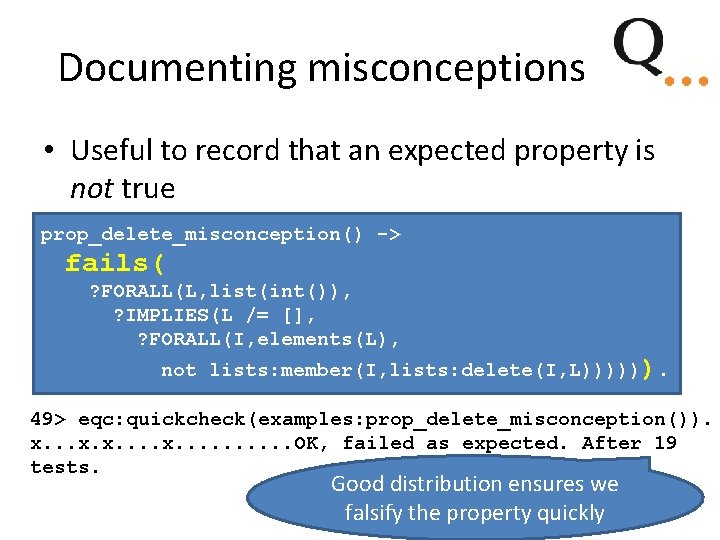
Documenting misconceptions • Useful to record that an expected property is not true prop_delete_misconception() -> fails( ? FORALL(L, list(int()), ? IMPLIES(L /= [], ? FORALL(I, elements(L), not lists: member(I, lists: delete(I, L)))))). 49> eqc: quickcheck(examples: prop_delete_misconception()). x. x. . . OK, failed as expected. After 19 tests. Good distribution ensures we falsify the property quickly
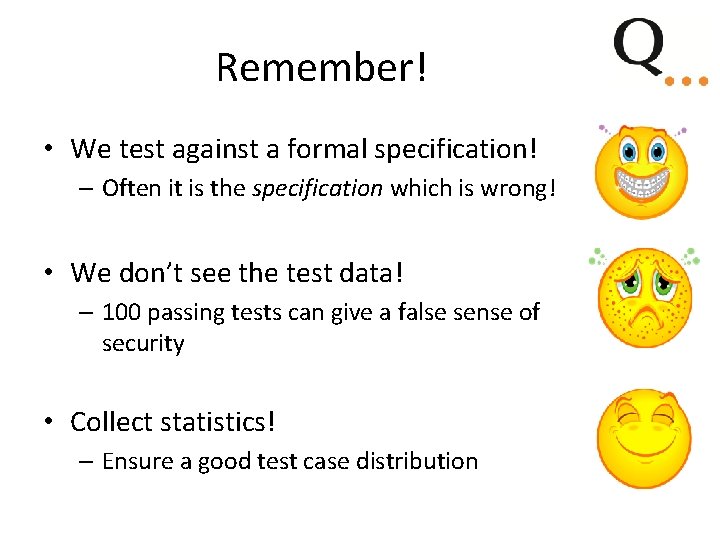
Remember! • We test against a formal specification! – Often it is the specification which is wrong! • We don’t see the test data! – 100 passing tests can give a false sense of security • Collect statistics! – Ensure a good test case distribution
Exercises