
Software Testing Techniques 141 Testability n n n
Software Testing Techniques 1/41
Testability n n n n Operability—it operates cleanly Observability—the results of each test case are readily observed Controllability—the degree to which testing can be automated and optimized Decomposability—testing can be targeted Simplicity—reduce complex architecture and logic to simplify tests Stability—few changes are requested during testing Understandability—of the design 2/41
What is a “Good” Test? n n A good test has a high probability of finding an error A good test is not redundant. A good test should be “best of breed” A good test should be neither too simple nor too complex 3/41
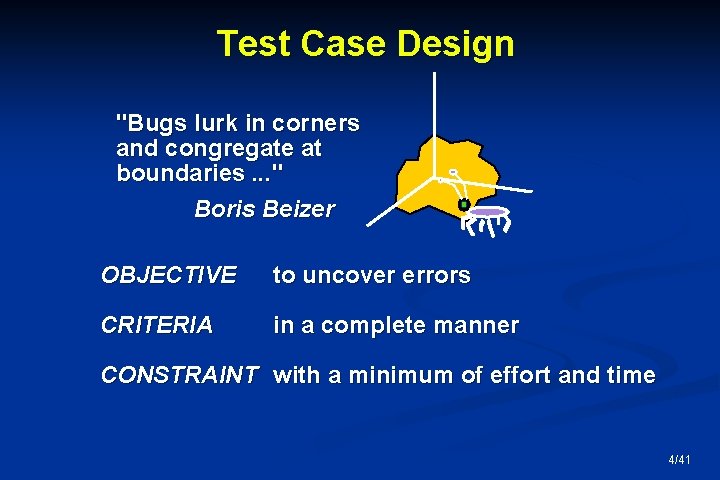
Test Case Design "Bugs lurk in corners and congregate at boundaries. . . " Boris Beizer OBJECTIVE to uncover errors CRITERIA in a complete manner CONSTRAINT with a minimum of effort and time 4/41
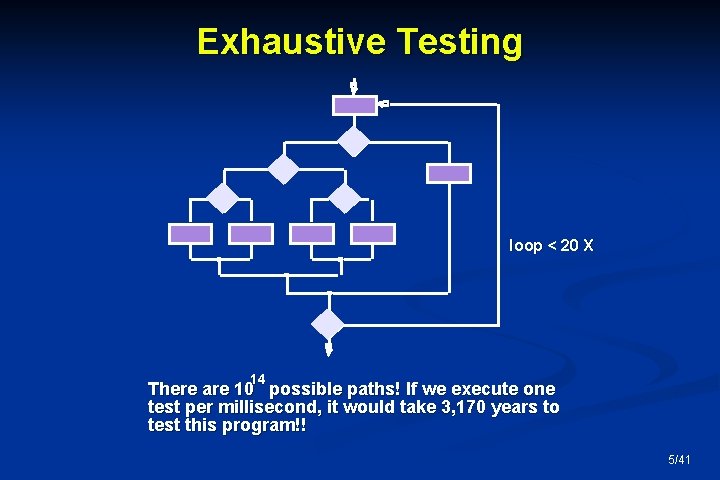
Exhaustive Testing loop < 20 X 14 There are 10 possible paths! If we execute one test per millisecond, it would take 3, 170 years to test this program!! 5/41
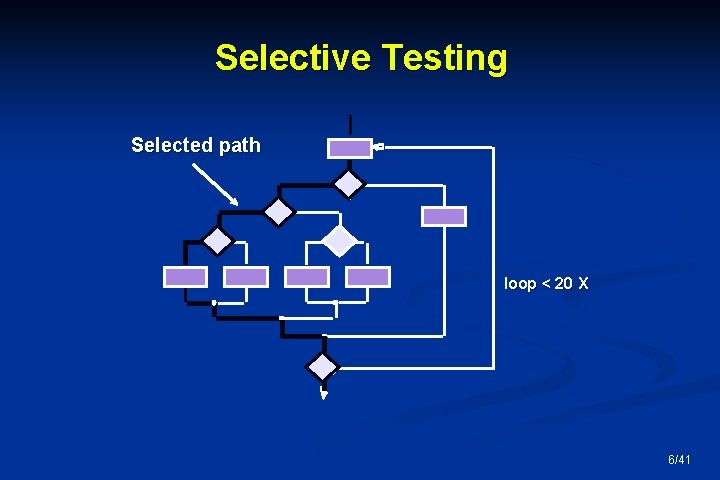
Selective Testing Selected path loop < 20 X 6/41
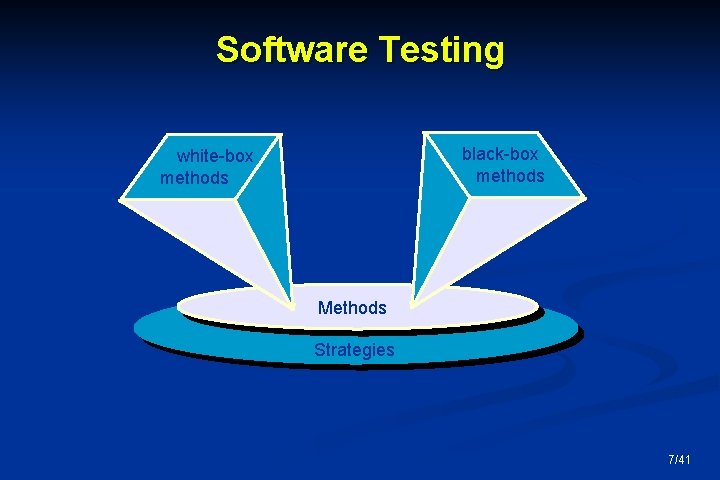
Software Testing black-box methods white-box methods Methods Strategies 7/41
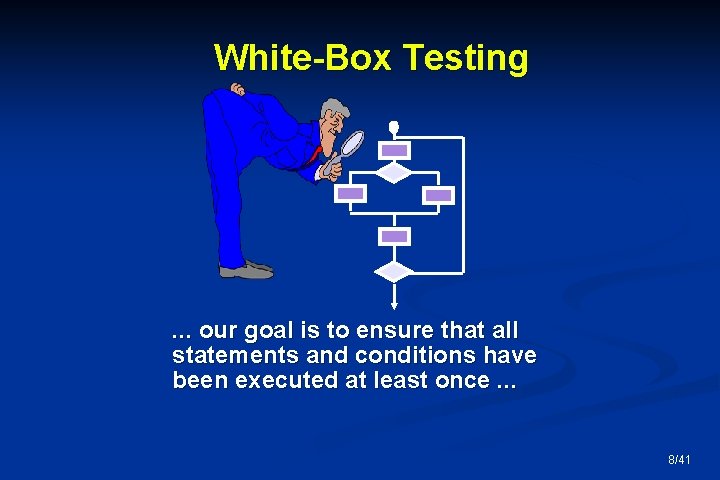
White-Box Testing . . . our goal is to ensure that all statements and conditions have been executed at least once. . . 8/41
Why Cover? logic errors and incorrect assumptions are inversely proportional to a path's execution probability we often believe that a path is not likely to be executed; in fact, reality is often counter intuitive typographical errors are random; it's likely that untested paths will contain some 9/41
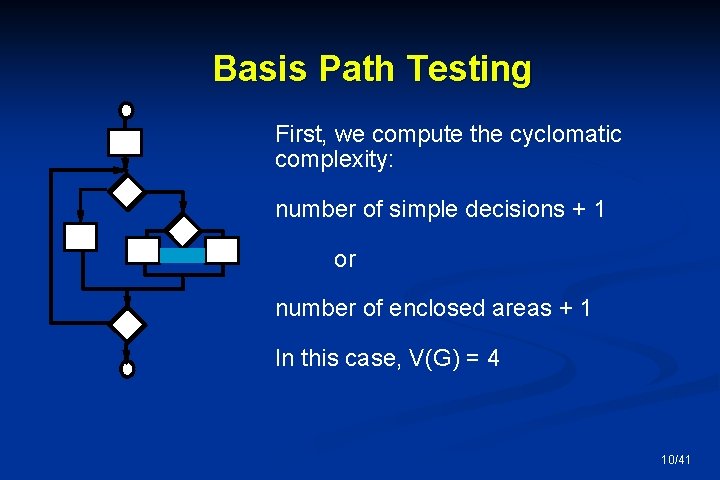
Basis Path Testing First, we compute the cyclomatic complexity: number of simple decisions + 1 or number of enclosed areas + 1 In this case, V(G) = 4 10/41
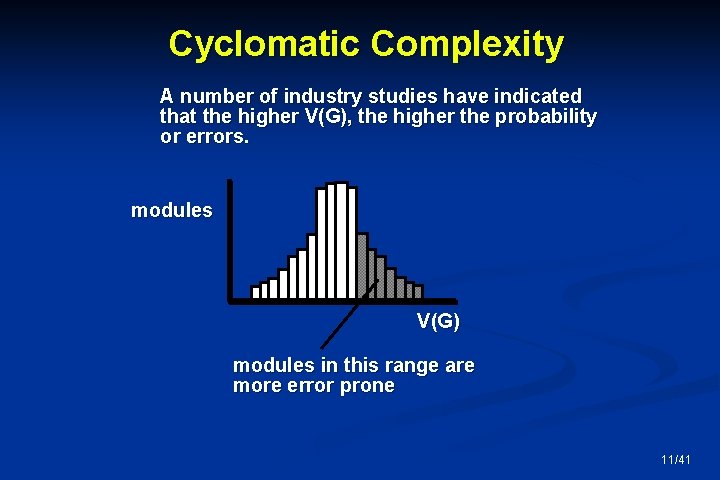
Cyclomatic Complexity A number of industry studies have indicated that the higher V(G), the higher the probability or errors. modules V(G) modules in this range are more error prone 11/41
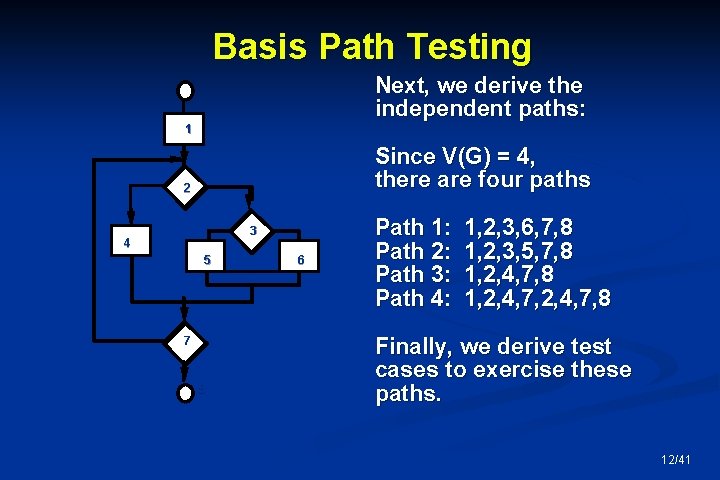
Basis Path Testing Next, we derive the independent paths: 1 Since V(G) = 4, there are four paths 2 3 4 5 7 8 6 Path 1: Path 2: Path 3: Path 4: 1, 2, 3, 6, 7, 8 1, 2, 3, 5, 7, 8 1, 2, 4, 7, 8 Finally, we derive test cases to exercise these paths. 12/41

Basis Path Testing Notes you don't need a flow chart, but the picture will help when you trace program paths count each simple logical test, compound tests count as 2 or more basis path testing should be applied to critical modules 13/41
Graph Matrices n A graph matrix is a square matrix whose size (i. e. , number of rows and columns) is equal to the number of nodes on a flow graph n Each row and column corresponds to an identified node, and matrix entries correspond to connections (an edge) between nodes. n By adding a link weight to each matrix entry, the graph matrix can become a powerful tool for evaluating program control structure during testing 14/41
Control Structure Testing n Condition testing — a test case design method that exercises the logical conditions contained in a program module n Data flow testing — selects test paths of a program according to the locations of definitions and uses of variables in the program 15/41

Loop Testing Simple loop Nested Loops Concatenated Loops Unstructured Loops 16/41

Loop Testing: Simple Loops Minimum conditions—Simple Loops 1. skip the loop entirely 2. only one pass through the loop 3. two passes through the loop 4. m passes through the loop m < n 5. (n-1), n, and (n+1) passes through the loop where n is the maximum number of allowable passes 17/41
Loop Testing: Nested Loops Start at the innermost loop. Set all outer loops to their minimum iteration parameter values. Test the min+1, typical, max-1 and max for the innermost loop, while holding the outer loops at their minimum values. Move out one loop and set it up as in step 2, holding all other loops at typical values. Continue this step until the outermost loop has been tested. 18/41
Loop Testing: Concatenated Loops If the loops are independent of one another then treat each as a simple loop else treat as nested loops for example, the final loop counter value of loop 1 is used to initialize loop 2. 19/41
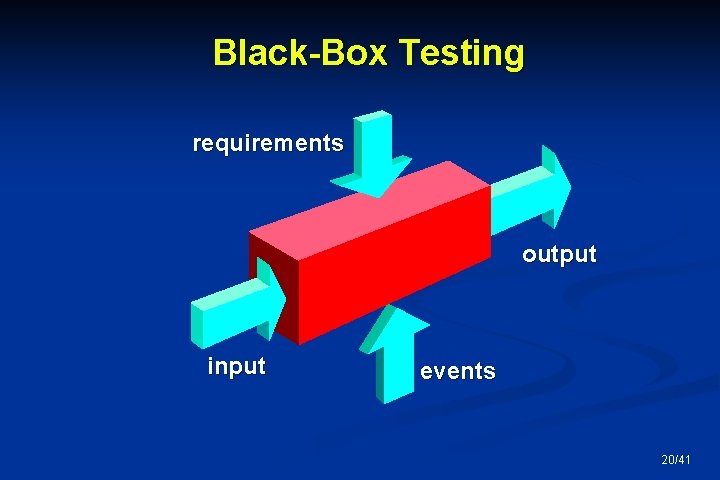
Black-Box Testing requirements output input events 20/41
Black-Box Testing n n n n How is functional validity tested? How is system behavior and performance tested? What classes of input will make good test cases? Is the system particularly sensitive to certain input values? How are the boundaries of a data class isolated? What data rates and data volume can the system tolerate? What effect will specific combinations of data have on system operation? 21/41
Graph-Based Methods To understand the objects and the relationships that connect these objects Objects: data objects, modules, and object-oriented elements 22/41
Equivalence Partitioning Black-box technique that divides the input domain into classes of data from which test cases can be derived An ideal test case uncovers a class of errors that might require many arbitrary test cases to be executed before a general error is observed 23/41
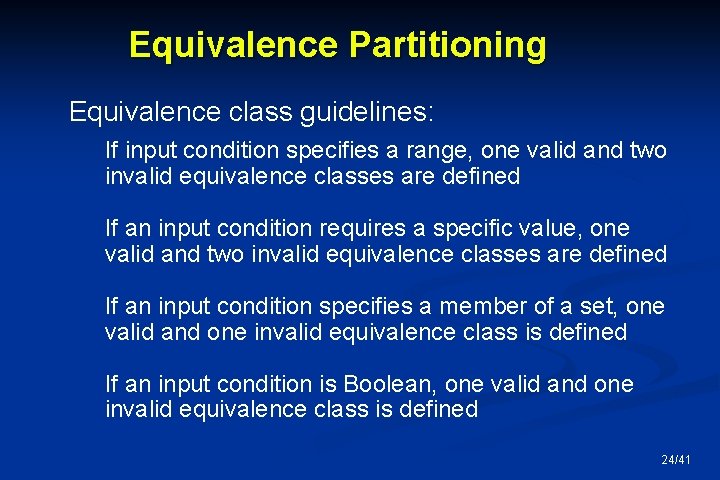
Equivalence Partitioning Equivalence class guidelines: If input condition specifies a range, one valid and two invalid equivalence classes are defined If an input condition requires a specific value, one valid and two invalid equivalence classes are defined If an input condition specifies a member of a set, one valid and one invalid equivalence class is defined If an input condition is Boolean, one valid and one invalid equivalence class is defined 24/41

Sample Equivalence Classes Valid data user supplied commands responses to system prompts file names computational data physical parameters bounding values initiation values output data formatting responses to error messages graphical data (e. g. , mouse picks) Invalid data outside bounds of the program physically impossible data proper value supplied in wrong place 25/41
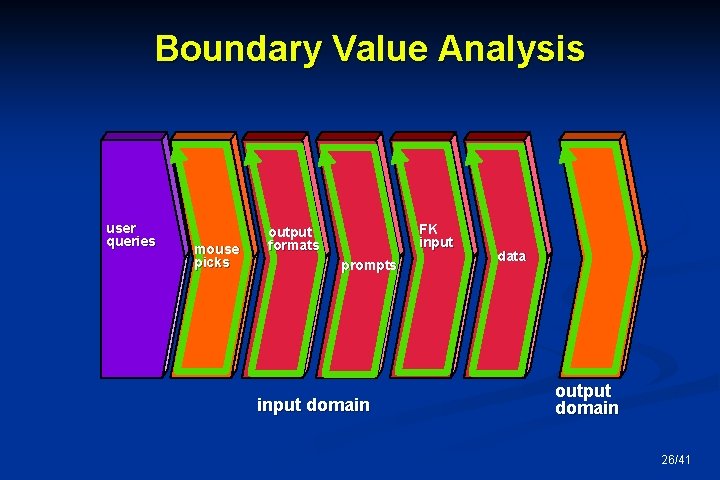
Boundary Value Analysis user queries mouse picks FK input output formats prompts input domain data output domain 26/41
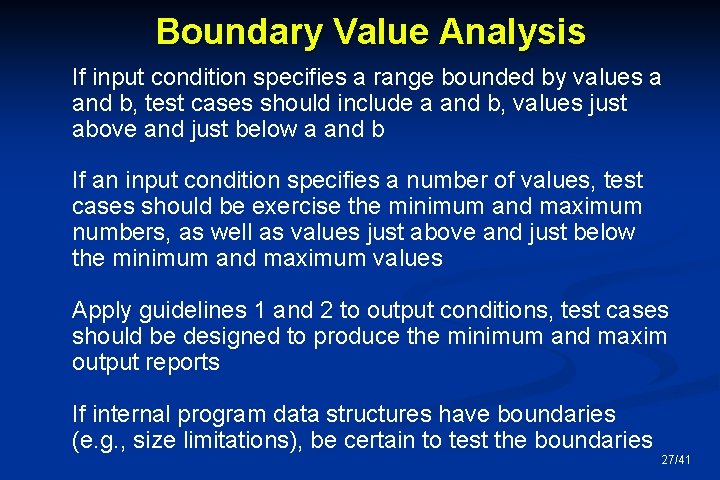
Boundary Value Analysis If input condition specifies a range bounded by values a and b, test cases should include a and b, values just above and just below a and b If an input condition specifies a number of values, test cases should be exercise the minimum and maximum numbers, as well as values just above and just below the minimum and maximum values Apply guidelines 1 and 2 to output conditions, test cases should be designed to produce the minimum and maxim output reports If internal program data structures have boundaries (e. g. , size limitations), be certain to test the boundaries 27/41
Comparison Testing n Used only in situations in which the reliability of software is absolutely critical (e. g. , human-rated systems) n Separate software engineering teams develop independent versions of an application using the same specification n Each version can be tested with the same test data to ensure that all provide identical output n Then all versions are executed in parallel with realtime comparison of results to ensure consistency 28/41
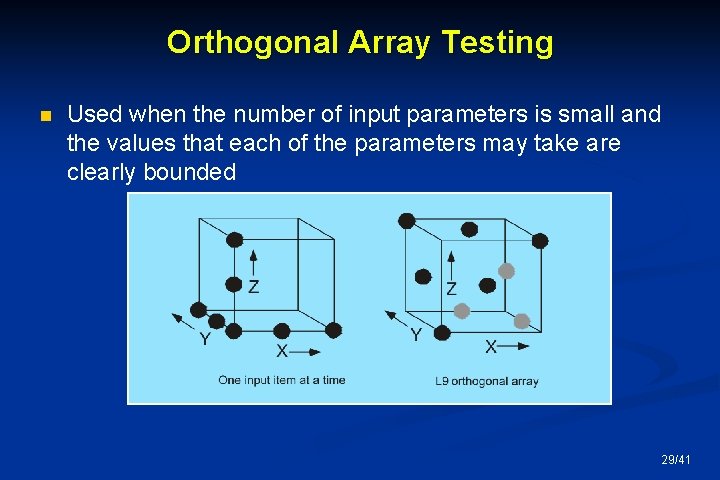
Orthogonal Array Testing n Used when the number of input parameters is small and the values that each of the parameters may take are clearly bounded 29/41
Orthogonal Array Testing Focus is on categories of faulty logic likely to be present in the software component (without examining the code) Priorities for assessing tests using an orthogonal array. Detect and isolate all single mode faults. Detect all double mode faults. Multimode faults 30/41
![OOT—Test Case Design (I) Berard [BER 93] proposes the following approach: 1. Each test](http://slidetodoc.com/presentation_image/6909b9a69523400616af0ee752621c79/image-31.jpg "OOT—Test Case Design (I) Berard [BER 93] proposes the following approach: 1. Each test")
OOT—Test Case Design (I) Berard [BER 93] proposes the following approach: 1. Each test case should be uniquely identified and should be explicitly associated with the class to be tested, 2. The purpose of the test should be stated, 31/41
OOT—Test Case Design (II) 3. A list of testing steps should contain: a. a list of specified states for the object that is to be tested b. a list of messages and operations that will be exercised as a consequence of the test c. a list of exceptions that may occur as the object is tested d. a list of external conditions (changes in the environment external to the software) e. supplementary information that will aid in understanding or implementing the test 32/41
Testing Methods (I) n Fault-based testing n The tester looks for plausible faults (i. e. , aspects of the implementation of the system that may result in defects). To determine whether these faults exist, test cases are designed to exercise the design or code. n Class Testing and the Class Hierarchy n Inheritance does not obviate the need for thorough testing of all derived classes. In fact, it can actually complicate the testing process. 33/41
Testing Methods (II) n Scenario-Based Test Design n Scenario-based testing concentrates on what the user does, not what the product does. This means capturing the tasks (via use-cases) that the user has to perform, then applying them and their variants as tests. 34/41
OOT Methods: Random Testing identify operations applicable to a class n define constraints on their use n identify a minimum test sequence n n an operation sequence that defines the minimum life history of the class (object) generate a variety of random (but valid) test sequences n exercise other (more complex) class instance life histories 35/41
OOT Methods: Partition Testing reduces the number of test cases required to test a class in much the same way as equivalence partitioning for conventional software n state-based partitioning n n attribute-based partitioning n n categorize and test operations based on their ability to change the state of a class categorize and test operations based on the attributes that they use category-based partitioning n categorize and test operations based on the generic function each performs 36/41
OOT Methods: Inter-Class Testing n For each client class, use the list of class operators to generate a series of random test sequences. The operators will send messages to other server classes. n For each message, determine the collaborator class and the corresponding operator in the server object. n For each operator in the server object (that has been invoked by messages sent from the client object), determine the messages that it transmits. n For each message, determine the next level of operators and incorporate these into the test sequence 37/41
OOT Methods: Behavior Testing The tests to be designed should achieve all state coverage. That is, the operation sequences should cause the Account class to make transition through allowable states 38/41
Testing Patterns Pattern name: pair testing Abstract: A process-oriented pattern, pair testing describes a technique that is analogous to pair programming in which two testers work together to design and execute a series of tests that can be applied to unit, integration or validation testing activities. 39/41
Testing Patterns Pattern name: separate test interface Abstract: There is a need to test every class in an object-oriented system, including “internal classes” (i. e. , classes that do not expose any interface outside of the component that used them). The separate test interface pattern describes how to create “a test interface that can be used to describe specific tests on classes that are visible only internally to a component. ” 40/41
Testing Patterns Pattern name: scenario testing Abstract: Once unit and integration tests have been conducted, there is a need to determine whether the software will perform in a manner that satisfies users. The scenario testing pattern describes a technique for exercising the software from the user’s point of view. A failure at this level indicates that the software has failed to meet a user visible requirement. 41/41
- Slides: 41