
Software Testing Strategies based on Chapter 13 Software
Software Testing Strategies based on Chapter 13 - Software Engineering: A Practitioner’s Approach, 6/e copyright © 1996, 2001, 2005 R. S. Pressman & Associates, Inc. For University Use Only May be reproduced ONLY for student use at the university level when used in conjunction with Software Engineering: A Practitioner's Approach. Any other reproduction or use is expressly prohibited. 1
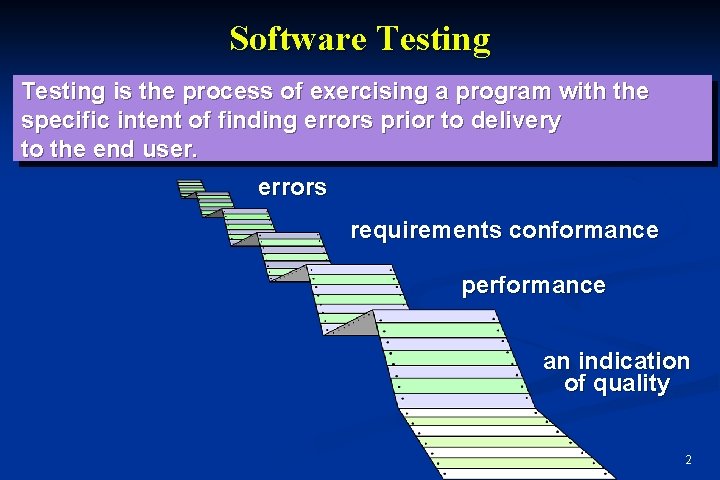
Software Testing is the process of exercising a program with the specific intent of finding errors prior to delivery to the end user. errors requirements conformance performance an indication of quality 2

Who Tests the Software? developer Understands the system but, will test "gently" and, is driven by "delivery" independent tester Must learn about the system, but, will attempt to break it and, is driven by quality 3
Levels of Testing n n n n n Unit testing Integration testing Validation testing n Focus is on software requirements System testing n Focus is on system integration Alpha/Beta testing n Focus is on customer usage Recovery testing n forces the software to fail in a variety of ways and verifies that recovery is properly performed Security testing n verifies that protection mechanisms built into a system will, in fact, protect it from improper penetration Stress testing n executes a system in a manner that demands resources in abnormal quantity, frequency, or volume Performance Testing n test the run-time performance of software within the context of an integrated system 4

Unit Testing module to be tested results software engineer interface local data structures boundary conditions independent paths test cases error handling paths 5

Integration Testing Strategies Options: • the “big bang” approach • an incremental construction strategy • Top Down, bottom-up, sandwich Integration 6
OOT Strategy n class testing is the equivalent of unit testing n n n …if there is no nesting of classes operations within the class are tested the state behavior of the class is examined integration applied three different strategies/levels of abstraction n thread-based testing—integrates the set of classes required to respond to one input or event use-based testing—integrates the set of classes required to …this is pushing… respond to one use case cluster testing—integrates the set of classes required to demonstrate one collaboration 7
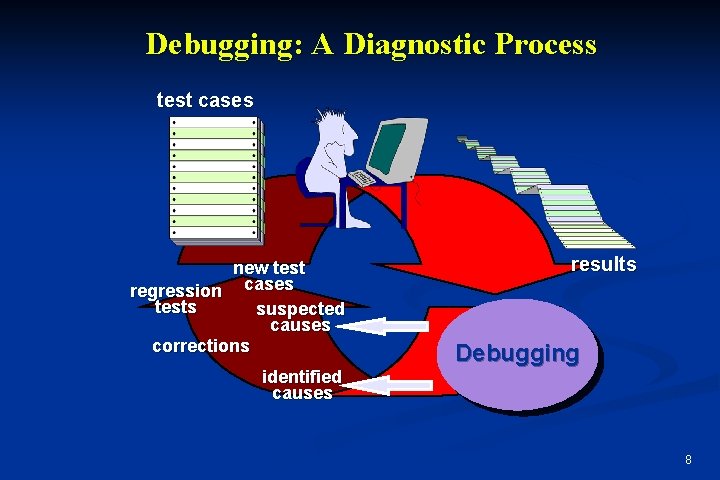
Debugging: A Diagnostic Process test cases new test regression cases tests suspected causes corrections identified causes results Debugging 8
Software Testing Techniques based on Chapter 14 - Software Engineering: A Practitioner’s Approach, 6/e copyright © 1996, 2001, 2005 R. S. Pressman & Associates, Inc. For University Use Only May be reproduced ONLY for student use at the university level when used in conjunction with Software Engineering: A Practitioner's Approach. Any other reproduction or use is expressly prohibited. 9
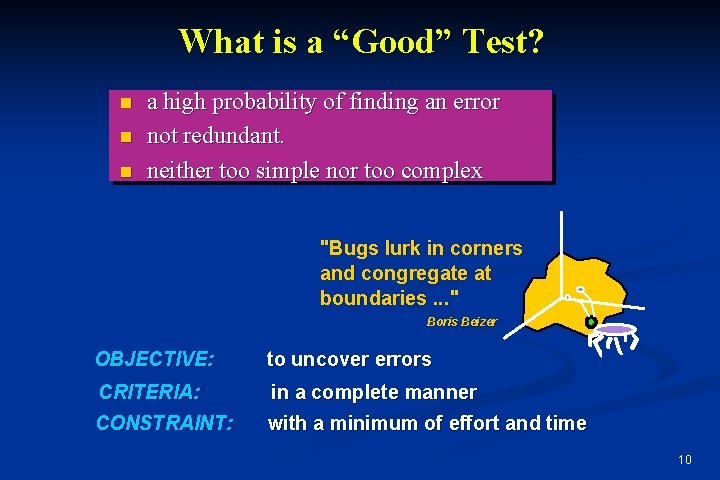
What is a “Good” Test? n n n a high probability of finding an error not redundant. neither too simple nor too complex "Bugs lurk in corners and congregate at boundaries. . . " Boris Beizer OBJECTIVE: to uncover errors CRITERIA: in a complete manner CONSTRAINT: with a minimum of effort and time 10
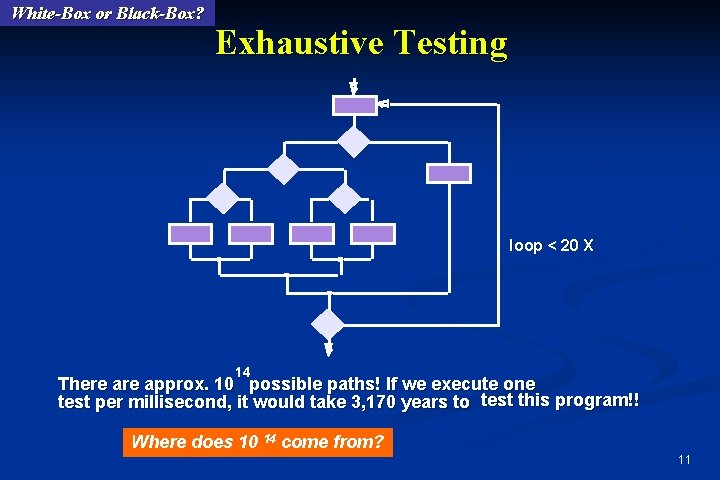
White-Box or Black-Box? Exhaustive Testing loop < 20 X 14 There approx. 10 possible paths! If we execute one test per millisecond, it would take 3, 170 years to test this program!! Where does 10 14 come from? 11
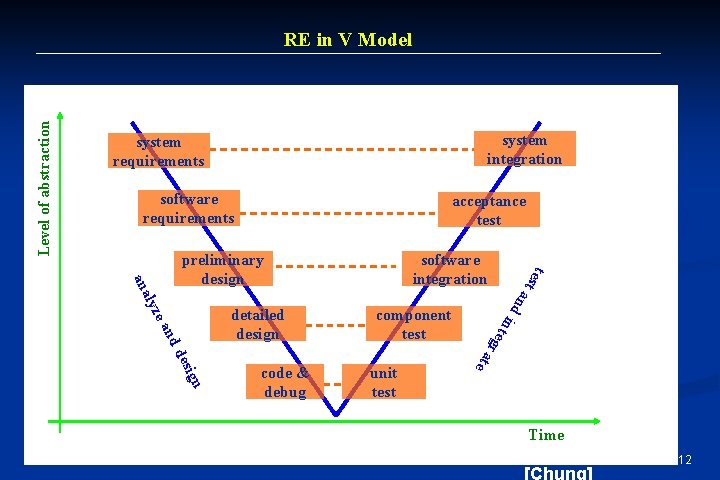
Level of abstraction RE in V Model system integration system requirements software requirements acceptance test t tes unit test nt gn esi code & debug component test eg r a te dd an detailed design software integration a n di ze aly an preliminary design Time [Chung] 12
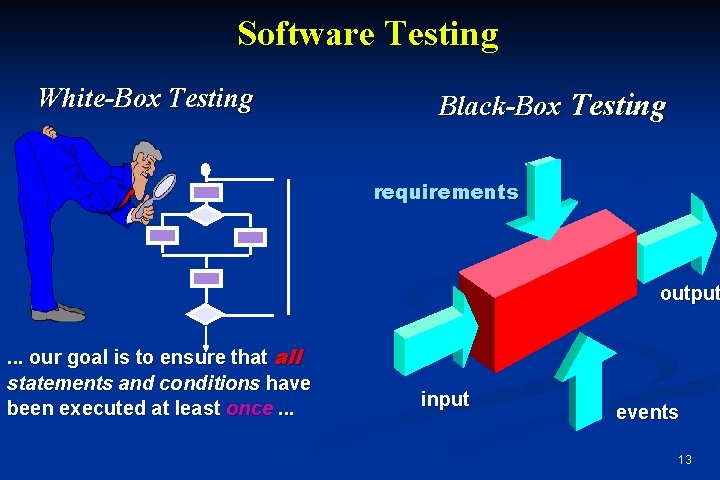
Software Testing White-Box Testing Black-Box Testing requirements output. . . our goal is to ensure that all statements and conditions have been executed at least once. . . input events 13
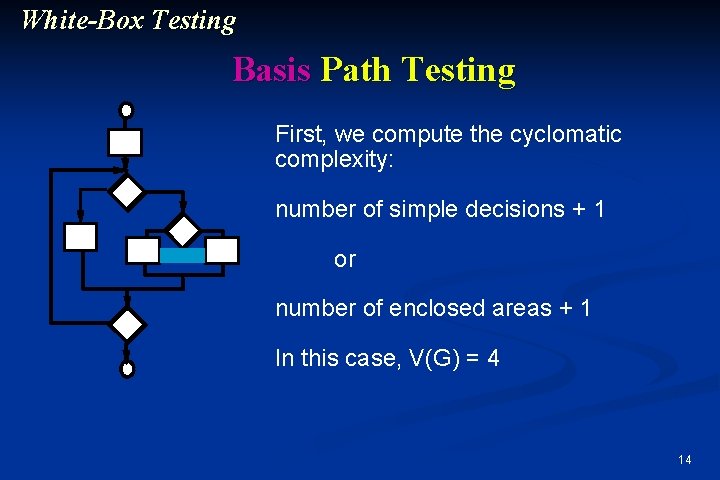
White-Box Testing Basis Path Testing First, we compute the cyclomatic complexity: number of simple decisions + 1 or number of enclosed areas + 1 In this case, V(G) = 4 14
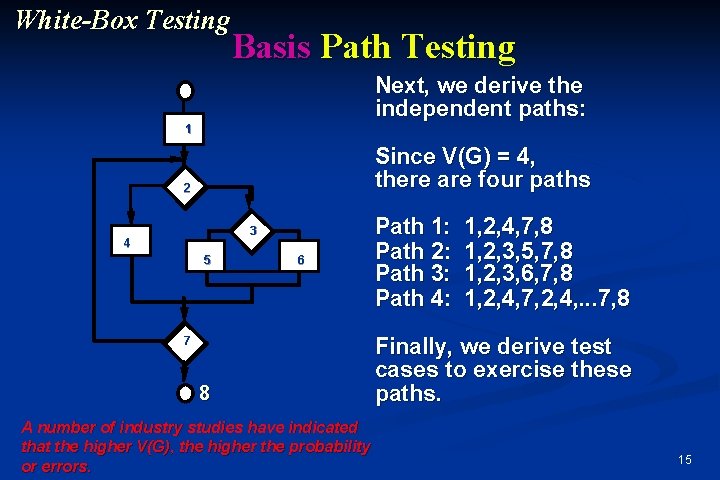
White-Box Testing Basis Path Testing Next, we derive the independent paths: 1 Since V(G) = 4, there are four paths 2 3 4 5 6 7 8 A number of industry studies have indicated that the higher V(G), the higher the probability or errors. Path 1: Path 2: Path 3: Path 4: 1, 2, 4, 7, 8 1, 2, 3, 5, 7, 8 1, 2, 3, 6, 7, 8 1, 2, 4, 7, 2, 4, . . . 7, 8 Finally, we derive test cases to exercise these paths. 15

White-Box Testing Loop Testing Simple loop Nested Loops Concatenated Loops Why is loop testing important? Unstructured Loops 16
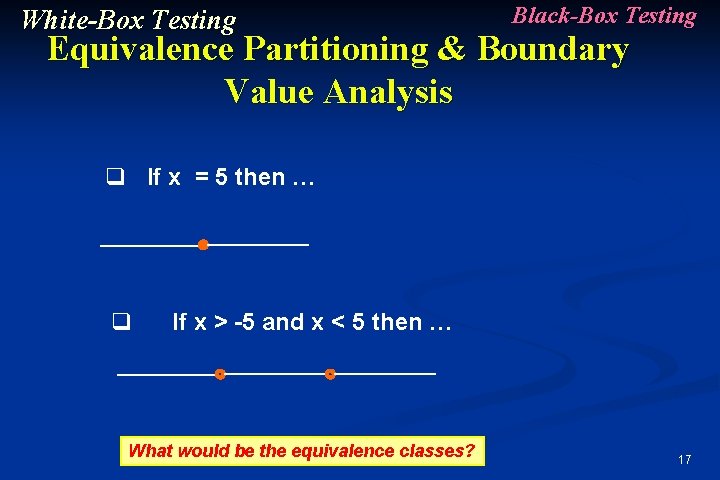
White-Box Testing Black-Box Testing Equivalence Partitioning & Boundary Value Analysis q If x = 5 then … q If x > -5 and x < 5 then … What would be the equivalence classes? 17
Black-Box Testing Comparison Testing n Used only in situations in which the reliability of software is absolutely critical (e. g. , human-rated systems) n n n Separate software engineering teams develop independent versions of an application using the same specification Each version can be tested with the same test data to ensure that all provide identical output Then all versions are executed in parallel with real-time comparison of results to ensure consistency 18
OOT—Test Case Design Berard [BER 93] proposes the following approach: 1. Each test case should be uniquely identified and should be explicitly associated with the class to be tested, 2. A list of testing steps should be developed for each test and should contain [BER 94]: a. a list of specified states for the object that is to be tested b. a list of messages and operations that will be exercised as a consequence of the test how can this be done? c. a list of exceptions that may occur as the object is tested d. a list of external conditions (i. e. , changes in the environment external to the software that must exist in order to properly conduct the test) {people, machine, time of operation, etc. } 19
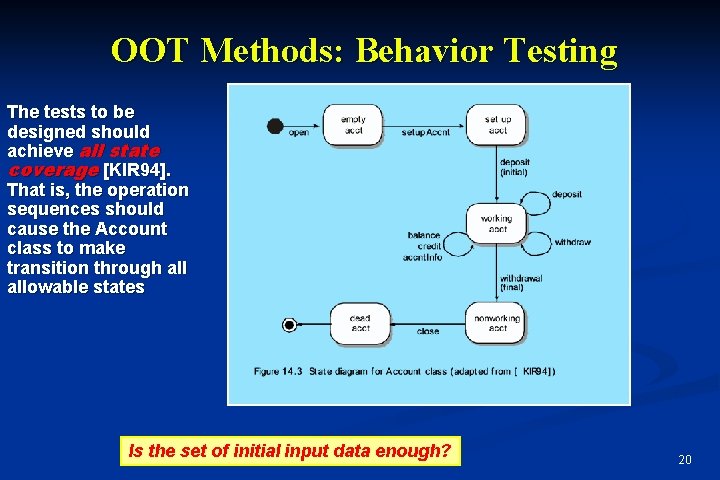
OOT Methods: Behavior Testing The tests to be designed should achieve all state coverage [KIR 94]. That is, the operation sequences should cause the Account class to make transition through allowable states Is the set of initial input data enough? 20

Omitted Slides 21
Testability n n n n Operability—it operates cleanly Observability—the results of each test case are readily observed Controllability—the degree to which testing can be automated and optimized Decomposability—testing can be targeted Simplicity—reduce complex architecture and logic to simplify tests Stability—few changes are requested during testing Understandability—of the design 22
Strategic Issues n Understand the users of the software and develop a profile for each user category. n Develop a testing plan that emphasizes “rapid cycle testing. ” n Use effective formal technical reviews as a filter prior to testing n Conduct formal technical reviews to assess the test strategy and test cases themselves. 23
![NFRs: Reliability [Chung, RE Lecture Notes]] Counting Bugs n Sometimes reliability requirements take the](http://slidetodoc.com/presentation_image_h2/85e42bf8418185728c3f817cd6146915/image-24.jpg "NFRs: Reliability [Chung, RE Lecture Notes]] Counting Bugs n Sometimes reliability requirements take the")
NFRs: Reliability [Chung, RE Lecture Notes]] Counting Bugs n Sometimes reliability requirements take the form: "The software shall have no more than X bugs/1 K LOC" But how do we measure bugs at delivery time? n Bebugging Process - based on a Monte Carlo technique for statistical analysis of random events. 1. before testing, a known number of bugs (seeded bugs) are secretly inserted. 2. estimate the number of bugs in the system 3. remove (both known and new) bugs. # of detected seeded bugs/ # of seeded bugs = # of detected bugs/ # of bugs in the system = # of seeded bugs x # of detected bugs /# of detected seeded bugs Example: secretely seed 10 bugs an independent test team detects 120 bugs (6 for the seeded) # of bugs in the system = 10 x 120/6 = 200 # of bugs in the system after removal = 200 - 120 - 4 = 76 n But, deadly bugs vs. insignifant ones; not all bugs are equally detectable; ( Suggestion [Musa 87]: "No more than X bugs/1 K LOC may be detected during testing" "No more than X bugs/1 K LOC may be remain after delivery, as calculated by the Monte Carlo seeding technique" 24
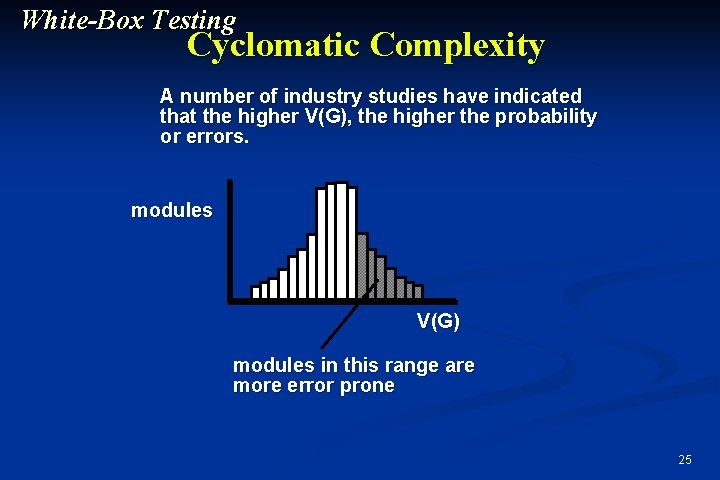
White-Box Testing Cyclomatic Complexity A number of industry studies have indicated that the higher V(G), the higher the probability or errors. modules V(G) modules in this range are more error prone 25
- Slides: 25