
Software testing Remark that the slides are highly
- Slides: 19
Software testing Remark that the slides are highly adapted from Ian Sommerville, Software Engineering, 9 th ed.
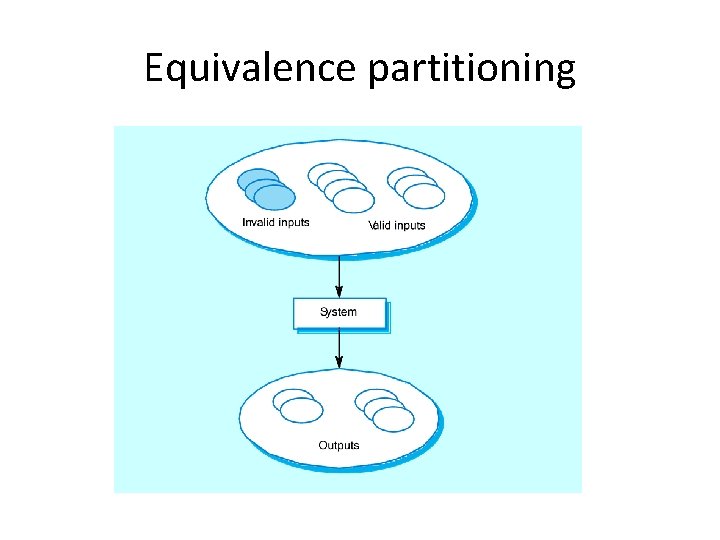
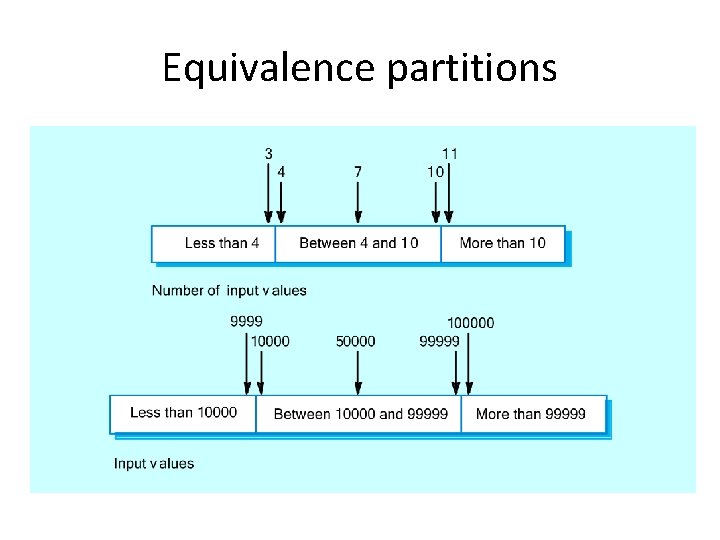
Partition testing • Input data and output results often fall into different classes where all members of a class are related. • Each of these classes is an equivalence partition or domain where the program behaves in an equivalent way for each class member. • Test cases should be chosen from each partition.
Equivalence partitioning
Equivalence partitions
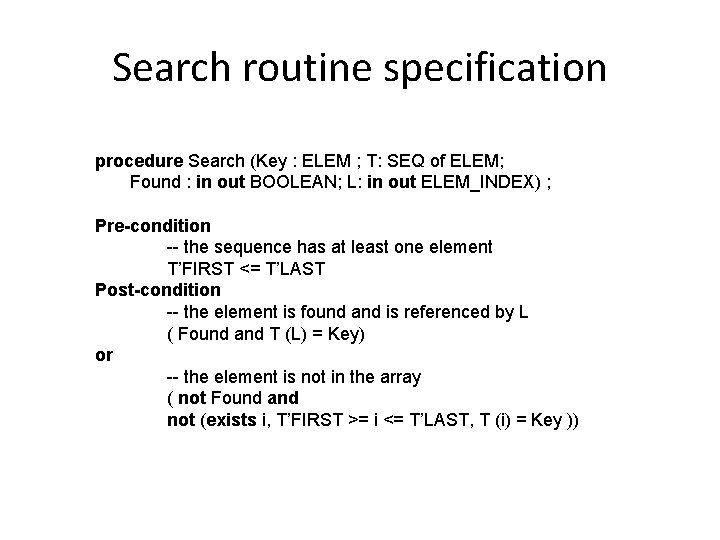
Search routine specification procedure Search (Key : ELEM ; T: SEQ of ELEM; Found : in out BOOLEAN; L: in out ELEM_INDEX) ; Pre-condition -- the sequence has at least one element T’FIRST <= T’LAST Post-condition -- the element is found and is referenced by L ( Found and T (L) = Key) or -- the element is not in the array ( not Found and not (exists i, T’FIRST >= i <= T’LAST, T (i) = Key ))
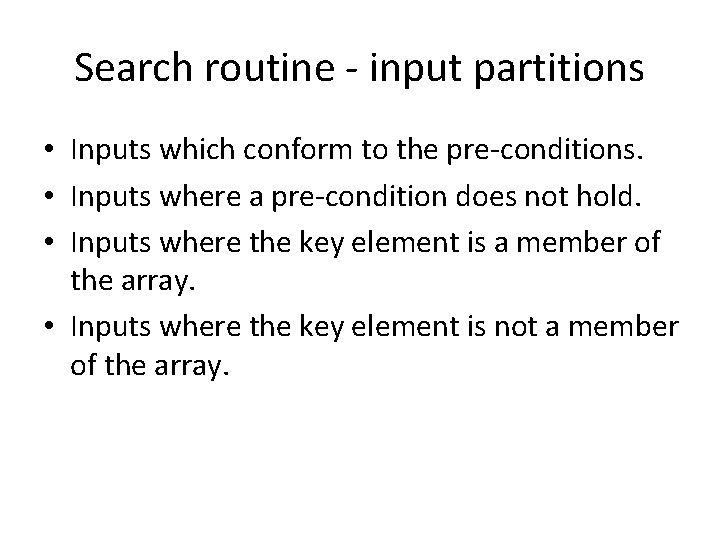
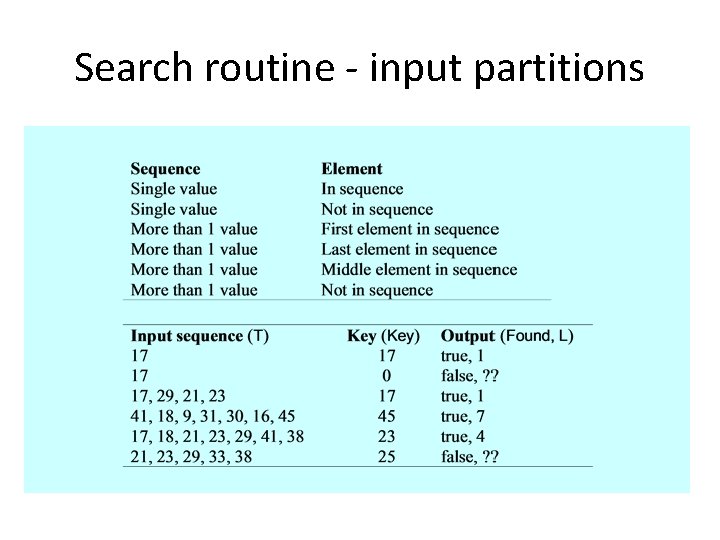
Search routine - input partitions • Inputs which conform to the pre-conditions. • Inputs where a pre-condition does not hold. • Inputs where the key element is a member of the array. • Inputs where the key element is not a member of the array.
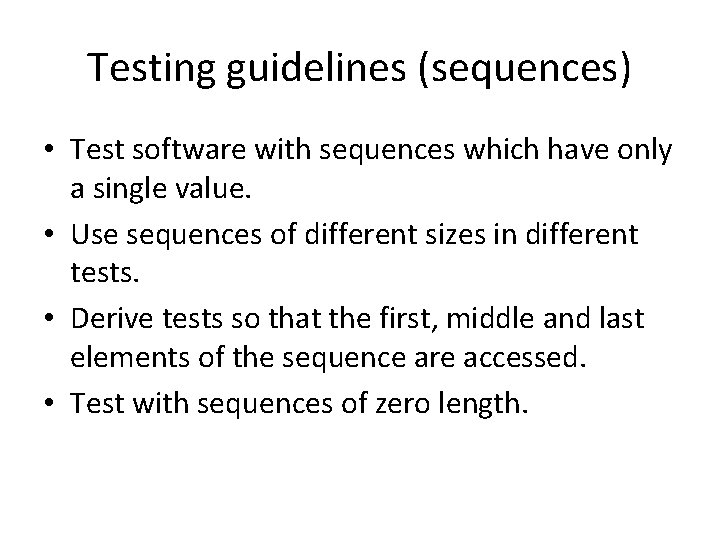
Testing guidelines (sequences) • Test software with sequences which have only a single value. • Use sequences of different sizes in different tests. • Derive tests so that the first, middle and last elements of the sequence are accessed. • Test with sequences of zero length.
Search routine - input partitions
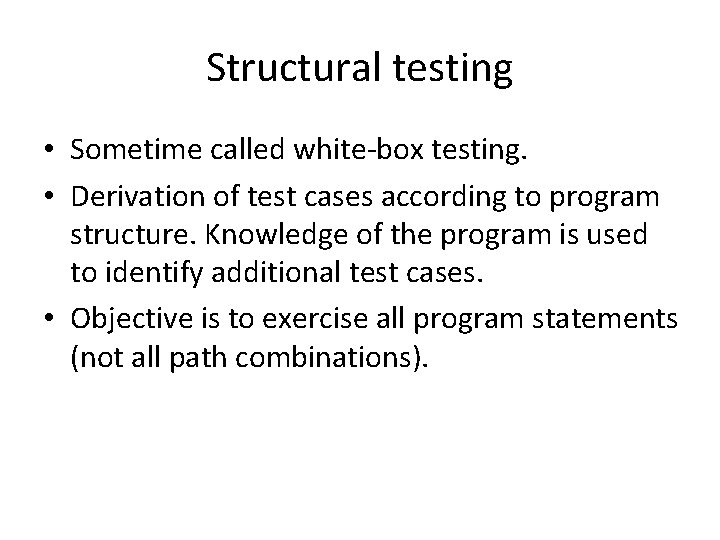
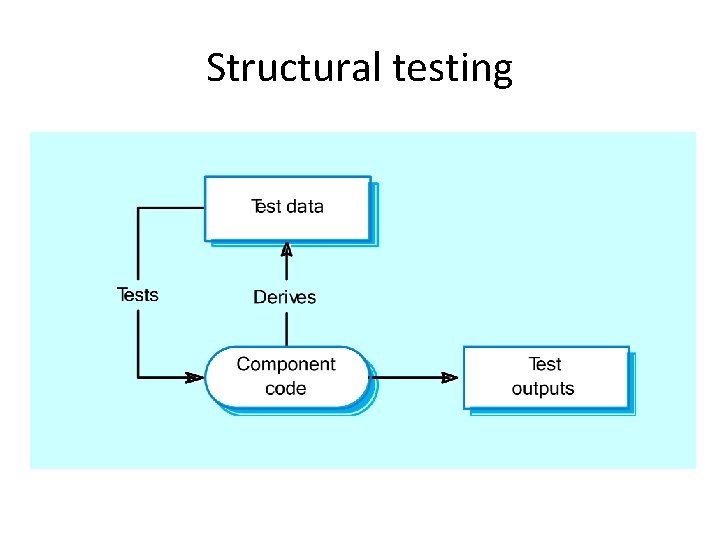
Structural testing • Sometime called white-box testing. • Derivation of test cases according to program structure. Knowledge of the program is used to identify additional test cases. • Objective is to exercise all program statements (not all path combinations).
Structural testing
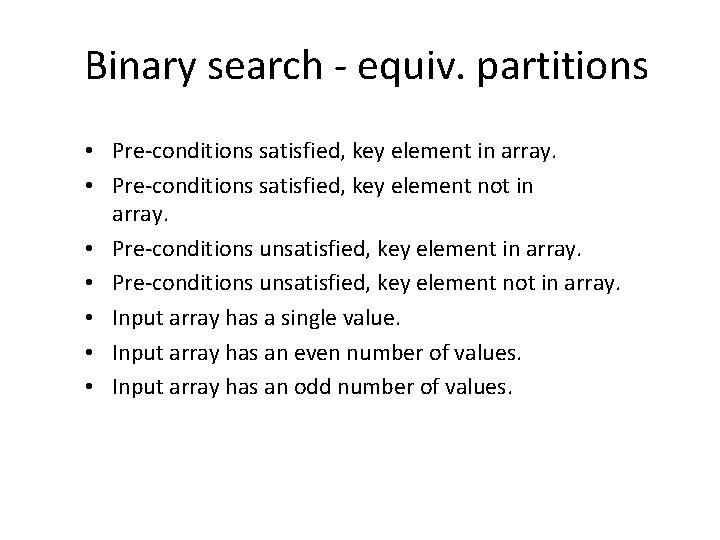
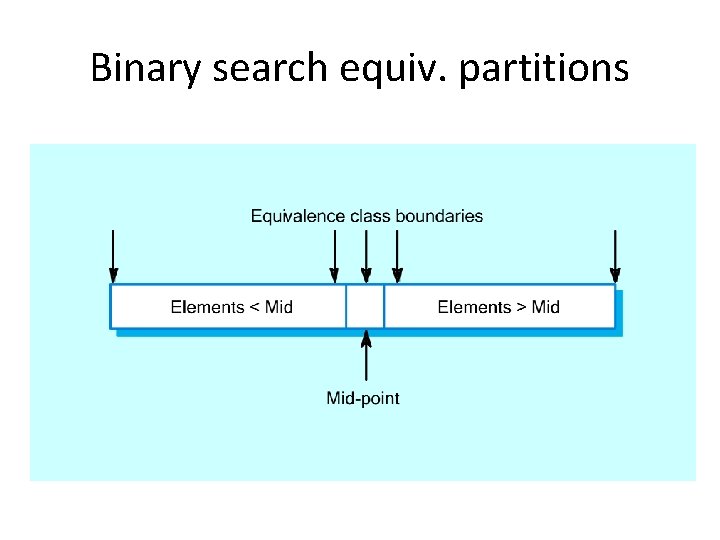
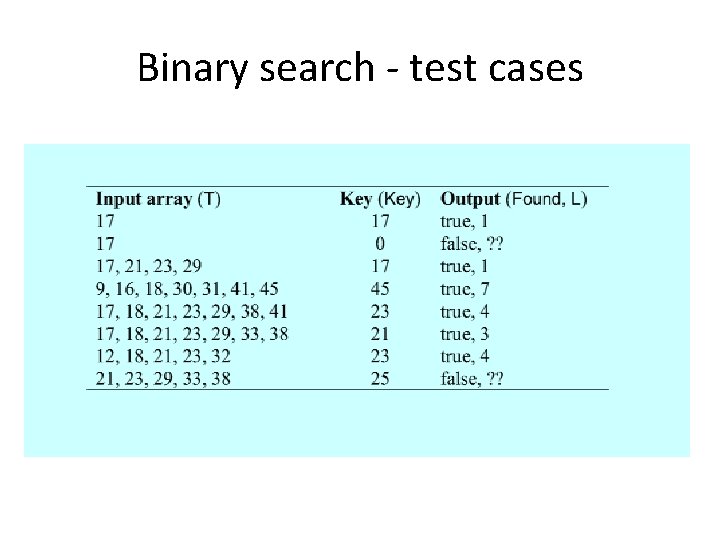
Binary search - equiv. partitions • Pre-conditions satisfied, key element in array. • Pre-conditions satisfied, key element not in array. • Pre-conditions unsatisfied, key element not in array. • Input array has a single value. • Input array has an even number of values. • Input array has an odd number of values.
Binary search equiv. partitions
Binary search - test cases
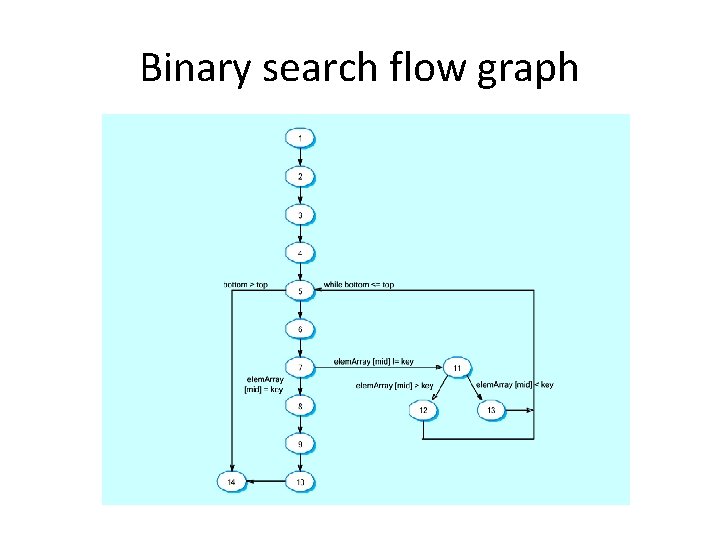
Path testing • The objective of path testing is to ensure that the set of test cases is such that each path through the program is executed at least once. • The starting point for path testing is a program flow graph that shows nodes representing program decisions and arcs representing the flow of control. • Statements with conditions are therefore nodes in the flow graph.
Binary search flow graph
Independent paths 1, 2, 3, 4, 5, 6, 7, 8, 9, 10, 14 1, 2, 3, 4, 5, 6, 7, 11, 12, 5, … 1, 2, 3, 4, 6, 7, 2, 11, 13, 5, … Test cases should be derived so that all of these paths are executed • A dynamic program analyser may be used to check that paths have been executed • • •
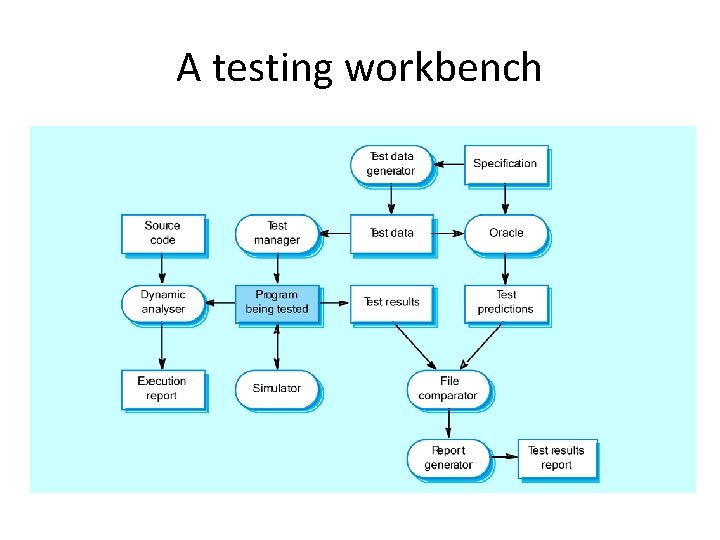
Test automation • Testing is an expensive process phase. Testing workbenches provide a range of tools to reduce the time required and total testing costs. • Systems such as Junit support the automatic execution of tests. • Most testing workbenches are open systems because testing needs are organisation-specific. • They are sometimes difficult to integrate with closed design and analysis workbenches.
A testing workbench
Testing workbench adaptation • Scripts may be developed for user interface simulators and patterns for test data generators. • Test outputs may have to be prepared manually for comparison. • Special-purpose file comparators may be developed.