
Software Testing Quality Engineering Chapter 13 Test Documentation


- Slides: 17
Software Testing & Quality Engineering Chapter 13 Test Documentation Linda Westfall Quality Press
Objectives • Test Execution Documentation: 1. Test Execution 2. Test Case 3. Test Procedure 4. Test Log 5. Problem Report 6. Test Result Data and Metrics 7. Test Report
Test Plan/Test Procedure Test planning, the most important activity to ensure that there is initially a list of tasks and milestones in a baseline plan to track the progress of the project. It also defines the size of the test effort. It is the main document often called as master test plan or a project test plan and usually developed during the early phase of the project. Test Plan Identifier
Test Planning Activities: v To determine the scope and the risks that need to be tested and that are NOT to be tested. v Documenting Test Strategy. v Making sure that the testing activities have been included. v Deciding Entry and Exit criteria. v Evaluating the test estimate. v Planning when and how to test and deciding how the test results will be evaluated, and defining test exit criterion. v The Test artefacts delivered as part of test execution. v Defining the management information, including the metrics required and defect resolution and risk issues. v Ensuring that the test documentation generates repeatable test assets.
Test Documentation Test documentation is documentation of artifacts created before or during the testing of software. It helps the testing team to estimate testing effort needed, test coverage, resource tracking, execution progress, etc. It is a complete suite of documents that allows you to describe and document test planning, test design, test execution, test results that are drawn from the testing activity. The degree of test formality depends on v The type of application under test v Standards followed by your organization v The maturity of the development process.
Test Execution Test execution is the process of executing the code and comparing the expected and actual results. Following factors are to be considered for a test execution process: • Based on a risk, select a subset of test suite to be executed for this cycle. • Assign the test cases in each test suite to testers for execution. • Execute tests, report bugs, and capture test status continuously. • Resolve blocking issues as they arise. • Report status, adjust assignments, and reconsider plans and priorities daily. • Report test cycle findings and status.
Test Case It is a group of input values, execution preconditions, expected execution post conditions and results. It is developed for a Test Scenario. Test Case acts as the starting point for the test execution, and after applying a set of input values, the application has a definitive outcome and leaves the system at some end point or also known as execution post condition. Test Case Parameters: Test Case ID Test Case Description Prerequisite Expected Result Actual Result Comments Test Scenario Test Steps Test Data Test Parameters Environment Information
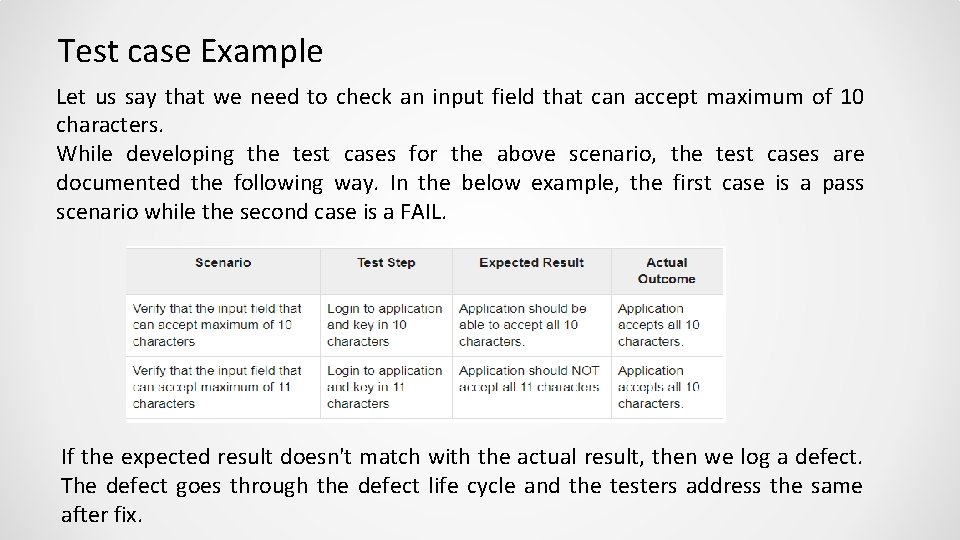
Test case Example Let us say that we need to check an input field that can accept maximum of 10 characters. While developing the test cases for the above scenario, the test cases are documented the following way. In the below example, the first case is a pass scenario while the second case is a FAIL. If the expected result doesn't match with the actual result, then we log a defect. The defect goes through the defect life cycle and the testers address the same after fix.
Test Log IEEE 829 Definition for Test Log: “To provide a chronological record of relevant details about the execution of tests, e. g. recording which tests cases were run, who ran them, in what order, and whether each test passed or failed. ” Test log is one of the crucial test artifact prepared during the process of testing. It provides a detailed summary of the overall test run and indicates the passed and failed tests. Additionally, test log also contains details and information about various test operations, including the source of issues and the reasons for failed operations. The focus of this report/document is to enable post execution diagnosis of failures and defects in the software. Testers play an extremely vital role in creating test logs, which should be created whenever test are executed or possibly when test scripts are implemented by the team. Moreover, apart from offering information about various tests, test log also includes images of the test application, links to files, and other various entries. It helps • If you want to prove what you tested “two” days ago; • Traceability. You can mark every test case you have tested and be sure that you won’t check it the second time or that you won’t miss something important. • Senior QAs/Mentors/Leads can verify that the most junior people tested everything needed and didn’t skip any important test cases.
Problem Report/Bug Report/Defect Report A Defect in Software Testing is a variation or deviation of the software application from end user’s requirements or original business requirements. A software defect is an error in coding which causes incorrect or unexpected results from a software program which does not meet actual requirements. Testers might come across such defects while executing the test cases. A Bug Report in Software Testing is a detailed document about bugs found in the software application. Bug report contains each detail about bugs like description, date when bug was found, name of tester who found it, name of developer who fixed it, etc. Bug report helps to identify similar bugs in future so it can be avoided. While reporting the bug to developer, your Bug Report should contain the following information Defect_ID - Unique identification number for the defect. Defect Description - Detailed description of the Defect including information about the module in which Defect was found. Version - Version of the application in which defect was found. Steps - Detailed steps along with screenshots with which the developer can reproduce the defects. Date Raised - Date when the defect is raised Reference- where in you Provide reference to the documents like. requirements, design, architecture or maybe even screenshots of the error to help understand the defect Detected By - Name/ID of the tester who raised the defect Status - Status of the defect , more on this later Fixed by - Name/ID of the developer who fixed it Date Closed - Date when the defect is closed Severity which describes the impact of the defect on the application Priority which is related to defect fixing urgency. Severity Priority could be High/Medium/Low based on the impact urgency at which the defect should be fixed respectively
Test Metrices "We cannot improve what we cannot measure" and Test Metrics helps us to do exactly the same. Software Testing Metrics are the quantitative measures used to estimate the progress, quality, productivity and health of the software testing process. The goal of software testing metrics is to improve the efficiency and effectiveness in the software testing process and to help make better decisions for further testing process by providing reliable data about the testing process. The ideal example to understand metrics would be a weekly mileage of a car compared to its ideal mileage recommended by the manufacturer. Software testing metrics or software test measurement is the quantitative indication of extent, capacity, dimension, amount or size of some attribute of a process or product. Example for software test measurement: Total number of defects Why Test Metrics are important • • Take decision for next phase of activities Evidence of the claim or prediction Understand the type of improvement required Take decision or process or technology change
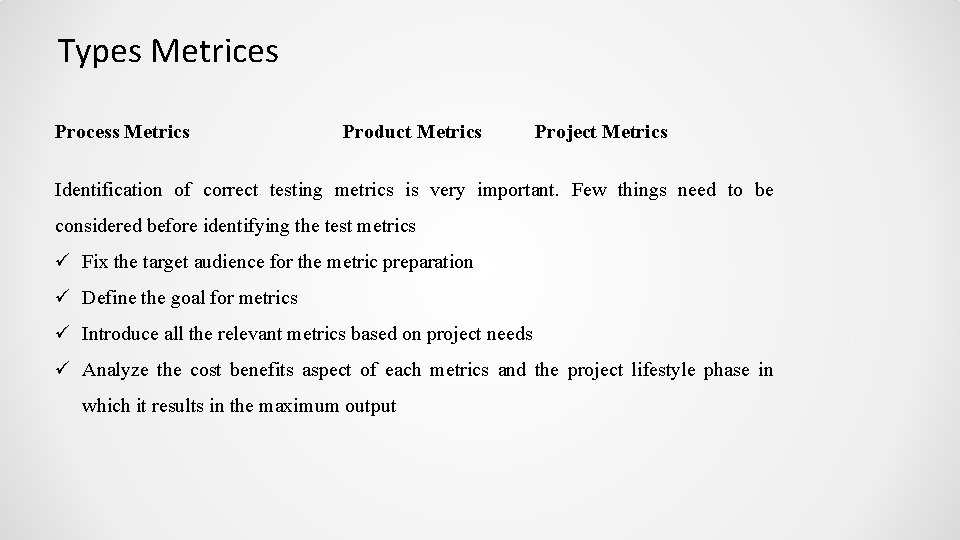
Types Metrices Process Metrics Product Metrics Project Metrics Identification of correct testing metrics is very important. Few things need to be considered before identifying the test metrics ü Fix the target audience for the metric preparation ü Define the goal for metrics ü Introduce all the relevant metrics based on project needs ü Analyze the cost benefits aspect of each metrics and the project lifestyle phase in which it results in the maximum output
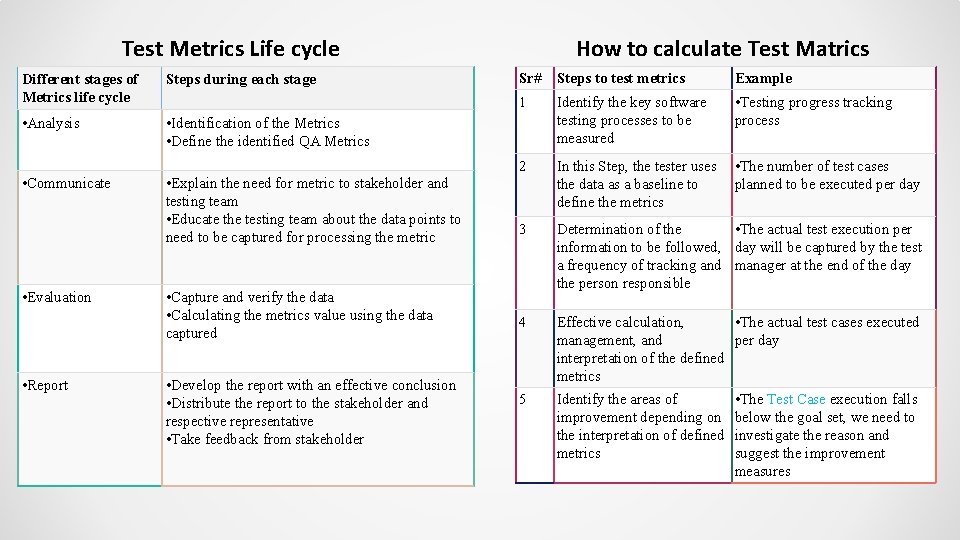
Test Metrics Life cycle Different stages of Metrics life cycle Steps during each stage • Analysis • Identification of the Metrics • Define the identified QA Metrics • Communicate • Evaluation • Report • Explain the need for metric to stakeholder and testing team • Educate the testing team about the data points to need to be captured for processing the metric • Capture and verify the data • Calculating the metrics value using the data captured • Develop the report with an effective conclusion • Distribute the report to the stakeholder and respective representative • Take feedback from stakeholder How to calculate Test Matrics Sr# Steps to test metrics Example 1 Identify the key software testing processes to be measured • Testing progress tracking process 2 In this Step, the tester uses the data as a baseline to define the metrics • The number of test cases planned to be executed per day 3 Determination of the • The actual test execution per information to be followed, day will be captured by the test a frequency of tracking and manager at the end of the day the person responsible 4 Effective calculation, • The actual test cases executed management, and per day interpretation of the defined metrics 5 Identify the areas of improvement depending on the interpretation of defined metrics • The Test Case execution falls below the goal set, we need to investigate the reason and suggest the improvement measures
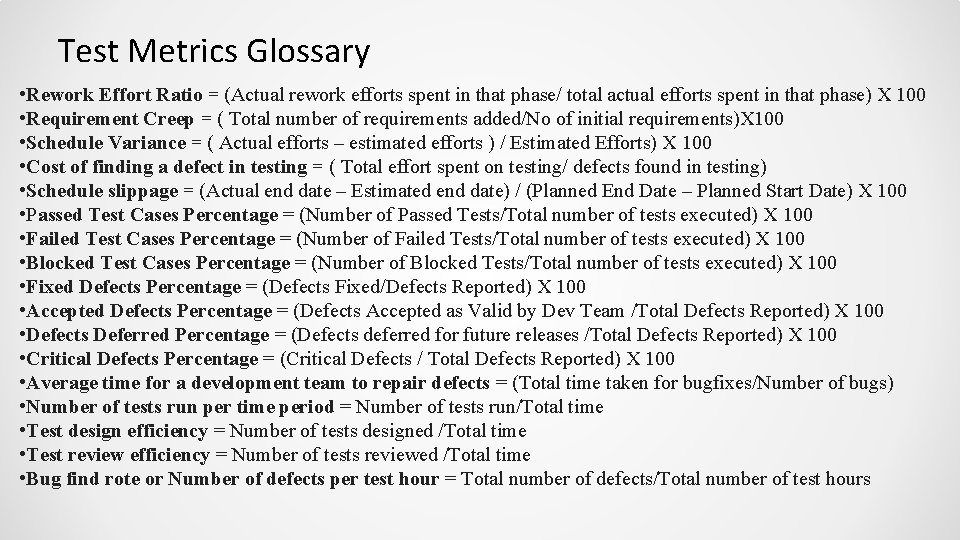
Test Metrics Glossary • Rework Effort Ratio = (Actual rework efforts spent in that phase/ total actual efforts spent in that phase) X 100 • Requirement Creep = ( Total number of requirements added/No of initial requirements)X 100 • Schedule Variance = ( Actual efforts – estimated efforts ) / Estimated Efforts) X 100 • Cost of finding a defect in testing = ( Total effort spent on testing/ defects found in testing) • Schedule slippage = (Actual end date – Estimated end date) / (Planned End Date – Planned Start Date) X 100 • Passed Test Cases Percentage = (Number of Passed Tests/Total number of tests executed) X 100 • Failed Test Cases Percentage = (Number of Failed Tests/Total number of tests executed) X 100 • Blocked Test Cases Percentage = (Number of Blocked Tests/Total number of tests executed) X 100 • Fixed Defects Percentage = (Defects Fixed/Defects Reported) X 100 • Accepted Defects Percentage = (Defects Accepted as Valid by Dev Team /Total Defects Reported) X 100 • Defects Deferred Percentage = (Defects deferred for future releases /Total Defects Reported) X 100 • Critical Defects Percentage = (Critical Defects / Total Defects Reported) X 100 • Average time for a development team to repair defects = (Total time taken for bugfixes/Number of bugs) • Number of tests run per time period = Number of tests run/Total time • Test design efficiency = Number of tests designed /Total time • Test review efficiency = Number of tests reviewed /Total time • Bug find rote or Number of defects per test hour = Total number of defects/Total number of test hours
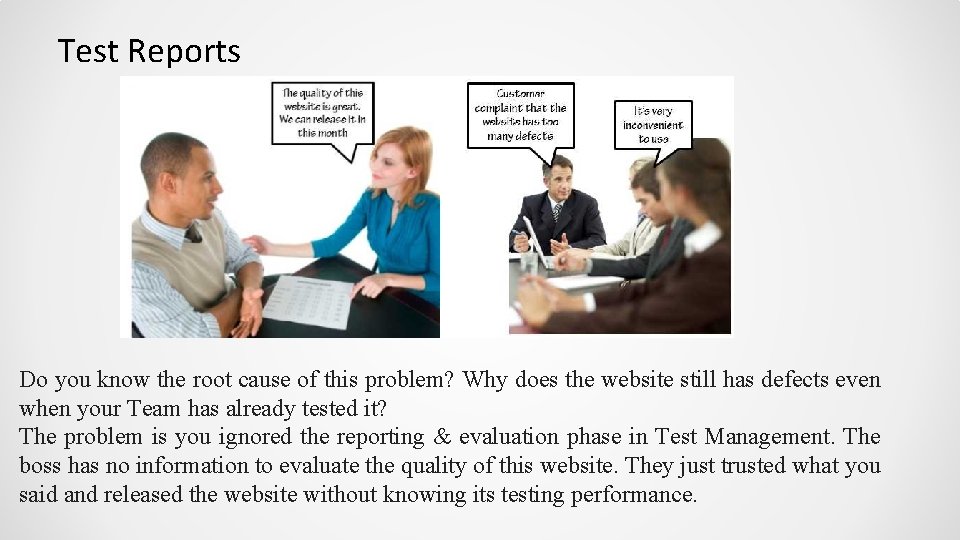
Test Reports Do you know the root cause of this problem? Why does the website still has defects even when your Team has already tested it? The problem is you ignored the reporting & evaluation phase in Test Management. The boss has no information to evaluate the quality of this website. They just trusted what you said and released the website without knowing its testing performance.
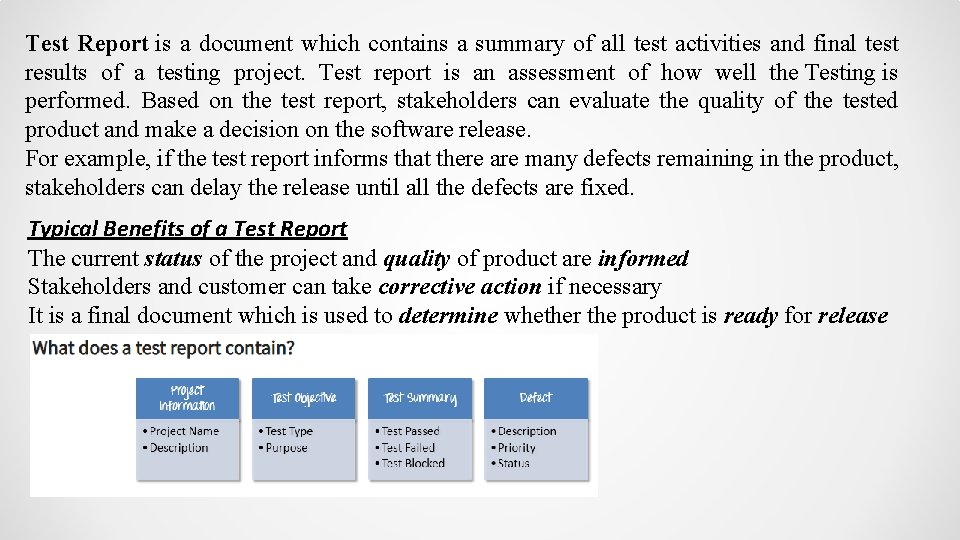
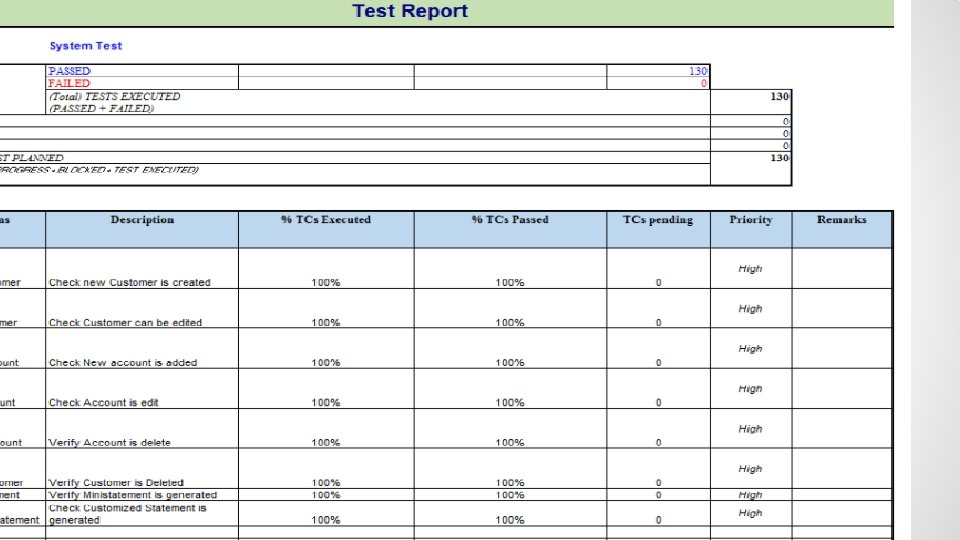
Test Report is a document which contains a summary of all test activities and final test results of a testing project. Test report is an assessment of how well the Testing is performed. Based on the test report, stakeholders can evaluate the quality of the tested product and make a decision on the software release. For example, if the test report informs that there are many defects remaining in the product, stakeholders can delay the release until all the defects are fixed. Typical Benefits of a Test Report The current status of the project and quality of product are informed Stakeholders and customer can take corrective action if necessary It is a final document which is used to determine whether the product is ready for release