
Software Testing Quality Engineering Chapter 13 Customer Deliverables

Software Testing & Quality Engineering Chapter 13 Customer Deliverables Linda Westfall Quality Press

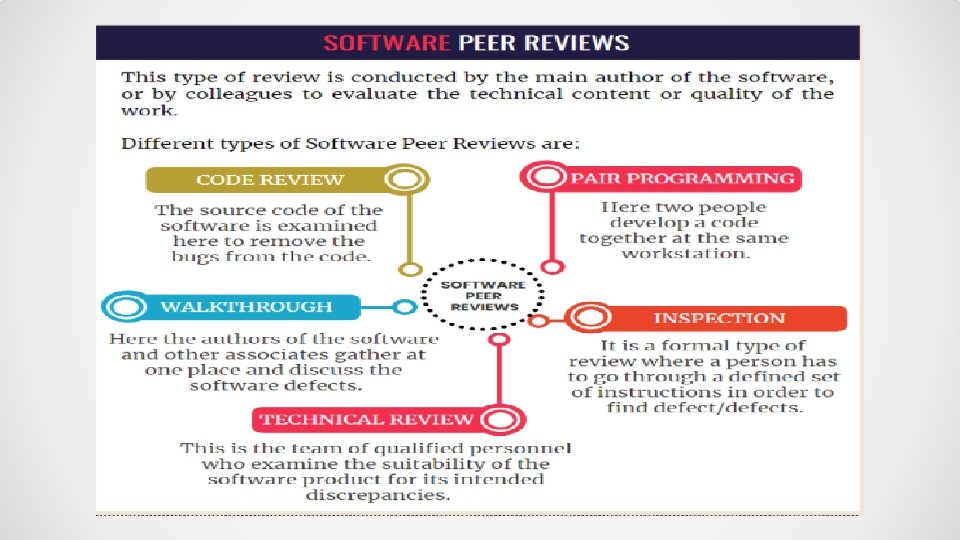
Objectives • Peer Reviews • Development Testing • Development Audits • Pilots • Installation Testing • Customer/User Testing
Development Testing Development testing (Dev. Test) is an approach in software development that aims to bring the development and testing phases closer together. In traditional software development, development and testing are two separate functions. The challenge with this approach is that it introduces delay between code being written and that same code being tested. In Dev. Test, these phases are more tightly integrated so that code that is being written and checked in is automatically tested. In this way, problems can be more quickly discovered and addressed. Benefits of Dev. Test Using a Dev. Test software development methodology can deliver numerous benefits. The most significant benefits are: • Higher code quality at any given time because new code is continually being tested • Shortened time to market for new features Why is Dev. Test important? Dev. Test is important because it enables higher levels of efficiency in the software development life cycle (SDLC), it helps to reduce the effect of software errors, and it speed the delivery of new features and bug fixes to customers.
Development Audit What is a software development process audit? A software development process audit is a continuous process that aims to maximize the success of a project by detecting its potential risks and weaknesses. This type of audit comes with another goal too: evaluating the performance of every single team member in the IT department. When should you carry out a software development process audit? It’s possible to audit a software project at any time during the software development lifecycle. However, by auditing it during the early phases, you’ll have a greater chance of improving the quality of the product which is being developed. Who performs a software development process audit? Most of the time, an audit is carried out by a varied team of professionals that comprises project managers, business analysts, and Quality Assurance (QA) specialists. The team examines every single phase of the software development lifecycle, from planning and creating to testing and deploying software.
Benefits of auditing the software development process 1. 2. 3. 4. 5. 6. By auditing software development, companies can check whether the software that appears to be working is actually doing what it is supposed to do. For example, auditors make sure that software analytics don’t measure any metrics that are superficial or irrelevant. Another perk of auditing a software development process is that it allows us to identify mismatches between the requirements and delivered features. These problems are more common than you would like to think. Most of the time, they result from misunderstandings between business and technical teams. A software development process audit offers independent validation of the testing process and shows areas where it could be optimized. It also brings an opportunity for mitigating potential risks that might crop up at any stage of the software development lifecycle. It’s an excellent due diligence practice that helps organizations to increase the quality of their offerings. Moreover, by carrying out an audit, organizations get advance notice of potential problem areas and can address these issues before they grow to become significant problems or even blockers. Finally, experienced auditors who assess a software development lifecycle are usually able to identify the opportunities for growth and offer their recommendations for improvements, so that things run smoothly and resource use is optimal.
Pilot Testing PILOT TESTING is defined as a type of Software Testing that verifies a component of the system or the entire system under a real-time operating condition. The purpose of the Pilot Test is to evaluate the feasibility, time, cost, risk, and performance of a research project. In Pilot testing, a selected group of end users try the system under test and provide the feedback before the full deployment of the system. Pilot testing is concerned with installing a system on a customer site (or a user simulated environment) for testing against continuous and regular use. Pilot Testing will answer the question like, whether the product or service has a potential market. Pilot Testing is Important because it helps in many ways like debugging software and procedure used for testing, checking product readiness for full-scale implementation, better decision on time and resources allocation, gives opportunity to gauge your target population's reaction to program, measurement of success of program and gives team a chance to practice activities they will use for usability test.
User Acceptance Testing (UAT) is a type of testing performed by the end user or the client to verify/accept the software system before moving the software application to the production environment. UAT is done in the final phase of testing after functional, integration and system testing is done. Purpose of UAT The main Purpose of UAT is to validate end to end business flow. It does not focus on cosmetic errors, spelling mistakes or system testing. User Acceptance Testing is carried out in a separate testing environment with production-like data setup. It is kind of black box testing where two or more endusers will be involved. Who Performs UAT? • Client • End users Need of User Acceptance Testing arises once software has undergone Unit, Integration and System testing because developers might have built software based on requirements document by their own understanding and further required changes during development may not be effectively communicated to them, so for testing whether the final product is accepted by client/end-user, user acceptance testing is needed.
- Slides: 8