
Software Testing and Maintenance Lecture 4 Graph Coverage

- Slides: 10
Software Testing and Maintenance Lecture 4 Graph Coverage for Design Element Paul Ammann & Jeff Offutt Instructor: Hossein Momeni momeni@iust. ac. ir Mazandaran University of Science and Technology
OO Software and Designs • Emphasis on modularity and reuse puts complexity in the design connections • Testing design relationships is more important than before • Graphs are based on the connections among the software components – Connections are dependency relations, also called couplings Introduction to Software Testing (Ch 2), www. introsoftwaretesting. com © Ammann & Offutt 2
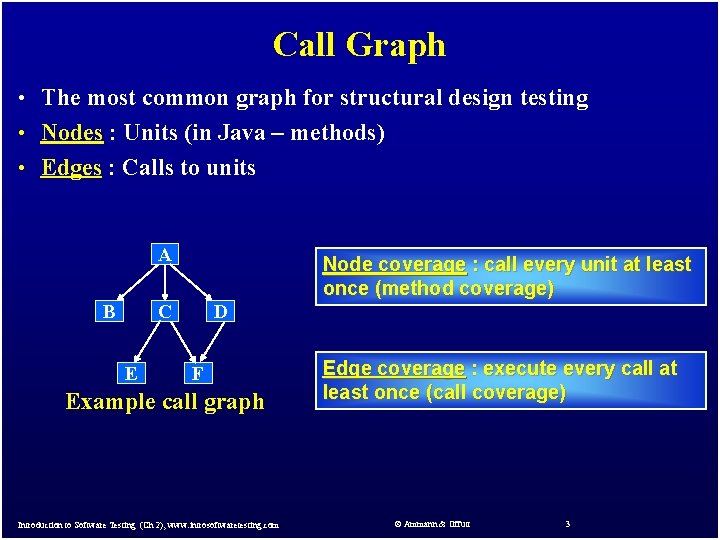
Call Graph • The most common graph for structural design testing • Nodes : Units (in Java – methods) • Edges : Calls to units A B Node coverage : call every unit at least once (method coverage) C E D F Example call graph Introduction to Software Testing (Ch 2), www. introsoftwaretesting. com Edge coverage : execute every call at least once (call coverage) © Ammann & Offutt 3
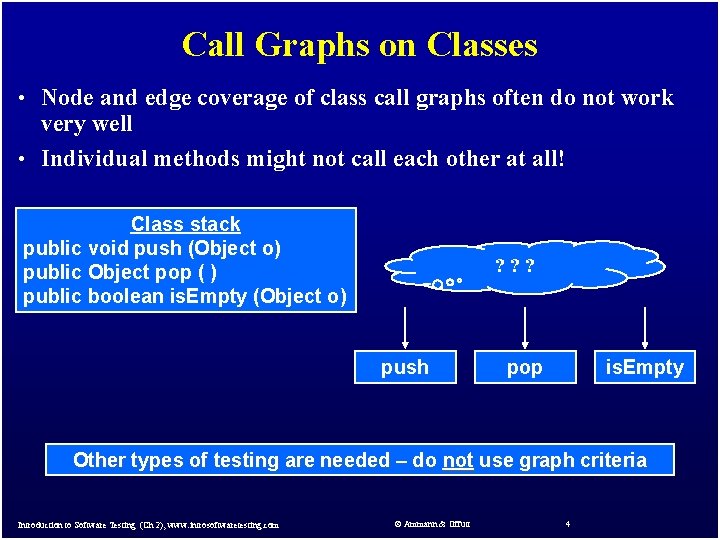
Call Graphs on Classes • Node and edge coverage of class call graphs often do not work very well • Individual methods might not call each other at all! Class stack public void push (Object o) public Object pop ( ) public boolean is. Empty (Object o) ? ? ? push pop is. Empty Other types of testing are needed – do not use graph criteria Introduction to Software Testing (Ch 2), www. introsoftwaretesting. com © Ammann & Offutt 4
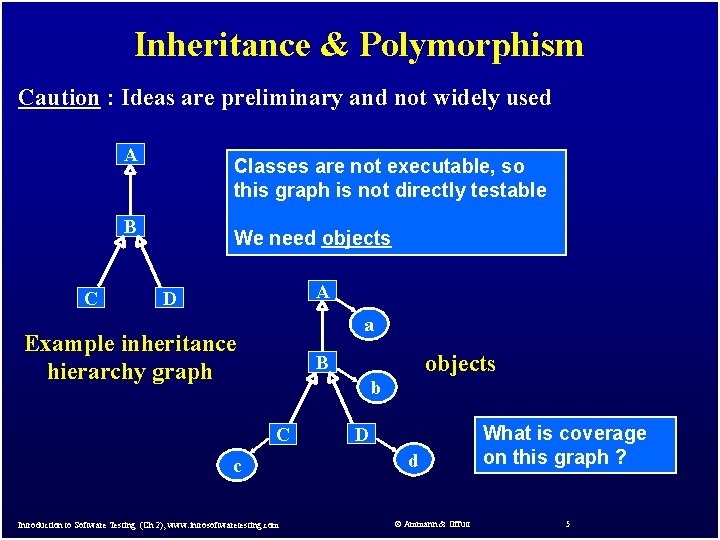
Inheritance & Polymorphism Caution : Ideas are preliminary and not widely used A Classes are not executable, so this graph is not directly testable B C We need objects A D a Example inheritance hierarchy graph objects B b C c Introduction to Software Testing (Ch 2), www. introsoftwaretesting. com D d © Ammann & Offutt What is coverage on this graph ? 5
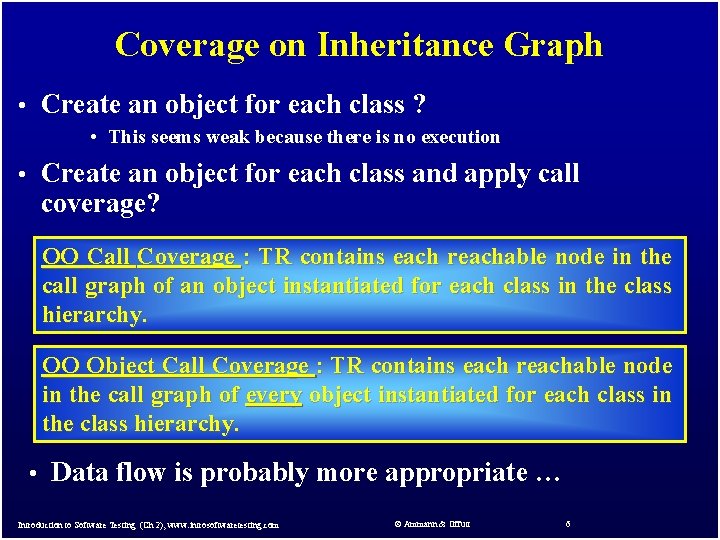
Coverage on Inheritance Graph • Create an object for each class ? • This seems weak because there is no execution • Create an object for each class and apply call coverage? OO Call Coverage : TR contains each reachable node in the call graph of an object instantiated for each class in the class hierarchy. OO Object Call Coverage : TR contains each reachable node in the call graph of every object instantiated for each class in the class hierarchy. • Data flow is probably more appropriate … Introduction to Software Testing (Ch 2), www. introsoftwaretesting. com © Ammann & Offutt 6
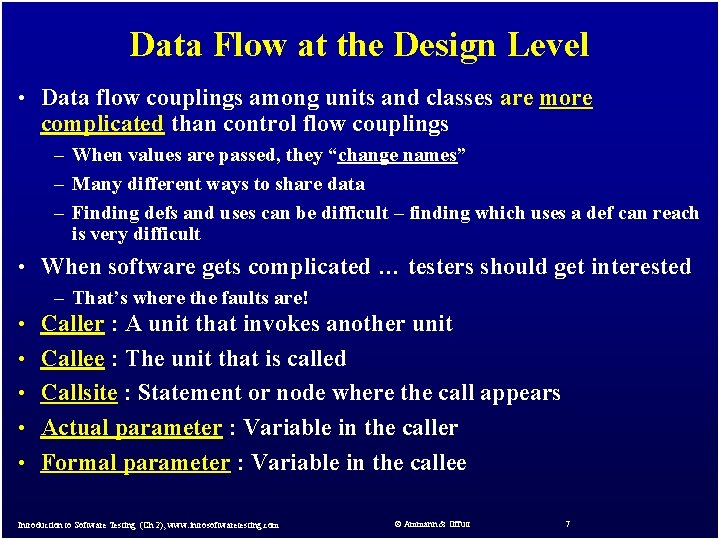
Data Flow at the Design Level • Data flow couplings among units and classes are more complicated than control flow couplings – When values are passed, they “change names” – Many different ways to share data – Finding defs and uses can be difficult – finding which uses a def can reach is very difficult • When software gets complicated … testers should get interested – That’s where the faults are! • Caller : A unit that invokes another unit • Callee : The unit that is called • Callsite : Statement or node where the call appears • Actual parameter : Variable in the caller • Formal parameter : Variable in the callee Introduction to Software Testing (Ch 2), www. introsoftwaretesting. com © Ammann & Offutt 7
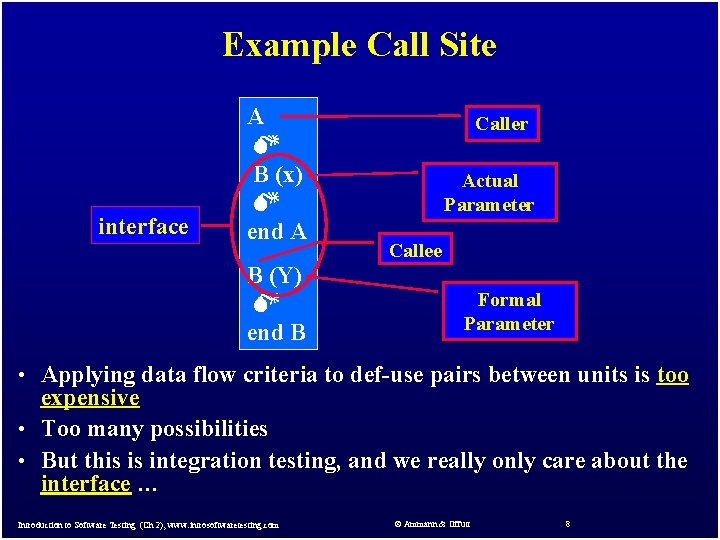
Example Call Site interface A B (x) end A B (Y) end B Caller Actual Parameter Callee Formal Parameter • Applying data flow criteria to def-use pairs between units is too expensive • Too many possibilities • But this is integration testing, and we really only care about the interface … Introduction to Software Testing (Ch 2), www. introsoftwaretesting. com © Ammann & Offutt 8
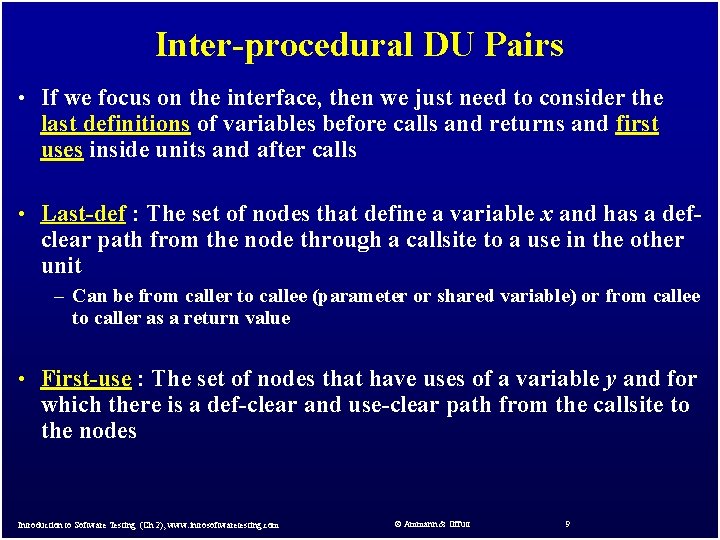
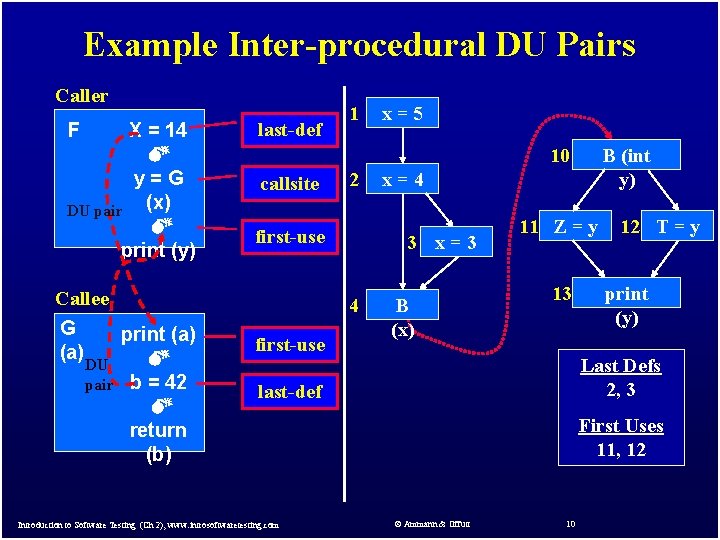
Inter-procedural DU Pairs • If we focus on the interface, then we just need to consider the last definitions of variables before calls and returns and first uses inside units and after calls • Last-def : The set of nodes that define a variable x and has a def- clear path from the node through a callsite to a use in the other unit – Can be from caller to callee (parameter or shared variable) or from callee to caller as a return value • First-use : The set of nodes that have uses of a variable y and for which there is a def-clear and use-clear path from the callsite to the nodes Introduction to Software Testing (Ch 2), www. introsoftwaretesting. com © Ammann & Offutt 9
Example Inter-procedural DU Pairs Caller F X = 14 y=G DU pair (x) print (y) last-def callsite DU pair 2 first-use B (x) 11 Z = y 13 12 T = y print (y) Last Defs 2, 3 last-def Introduction to Software Testing (Ch 2), www. introsoftwaretesting. com B (int y) x=4 3 x=3 4 print (a) b = 42 return (b) x=5 10 Callee G (a) 1 First Uses 11, 12 © Ammann & Offutt 10