
Software Tag Standard 1 0 Background and Definition
Software Tag Standard 1. 0 - Background and Definition Katsuro Inoue Osaka University
Talk Structure l Background and motivation l Software tag standard 1. 0 l Usage models l Summary 2 Osaka University Copyright © 2008 Nara Institute of Science and Technology / Osaka University

Background and Motivation Osaka University
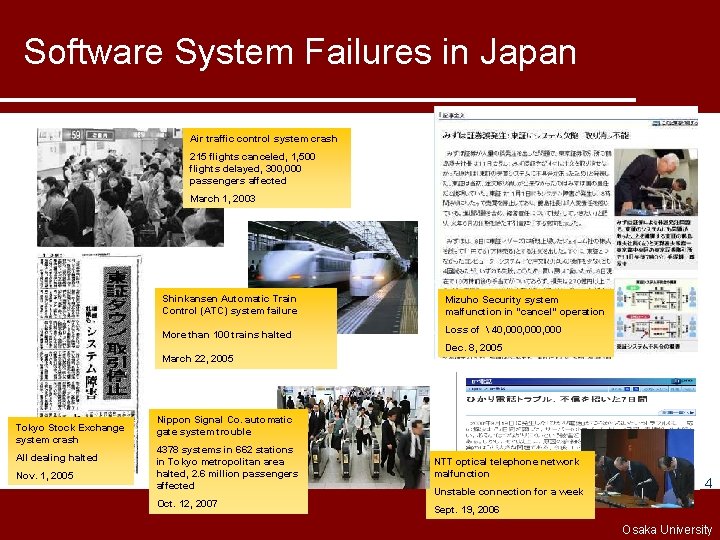
Software System Failures in Japan Air traffic control system crash 215 flights canceled, 1, 500 flights delayed, 300, 000 passengers affected March 1, 2003 Shinkansen Automatic Train Control (ATC) system failure More than 100 trains halted Mizuho Security system malfunction in “cancel” operation Loss of 40, 000, 000 Dec. 8, 2005 March 22, 2005 Tokyo Stock Exchange system crash All dealing halted Nov. 1, 2005 Nippon Signal Co. automatic gate system trouble 4378 systems in 662 stations in Tokyo metropolitan area halted, 2. 6 million passengers affected Oct. 12, 2007 NTT optical telephone network malfunction Unstable connection for a week 4 Sept. 19, 2006 Osaka University Copyright © 2008 Nara Institute of Science and Technology / Osaka University
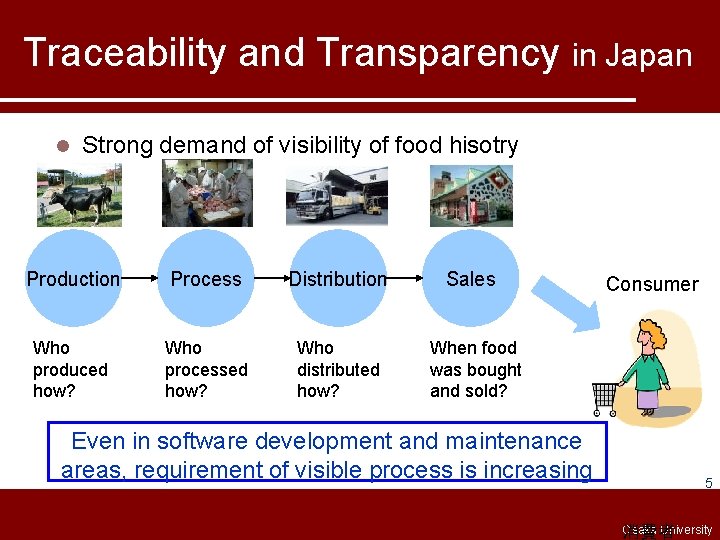
Traceability and Transparency in Japan l Strong demand of visibility of food hisotry Production Process Distribution Sales Who produced how? Who processed how? Who distributed how? When food was bought and sold? Even in software development and maintenance areas, requirement of visible process is increasing Consumer 5 Osaka University Copyright © 2008 Nara Institute of Science and Technology / Osaka University 消費者
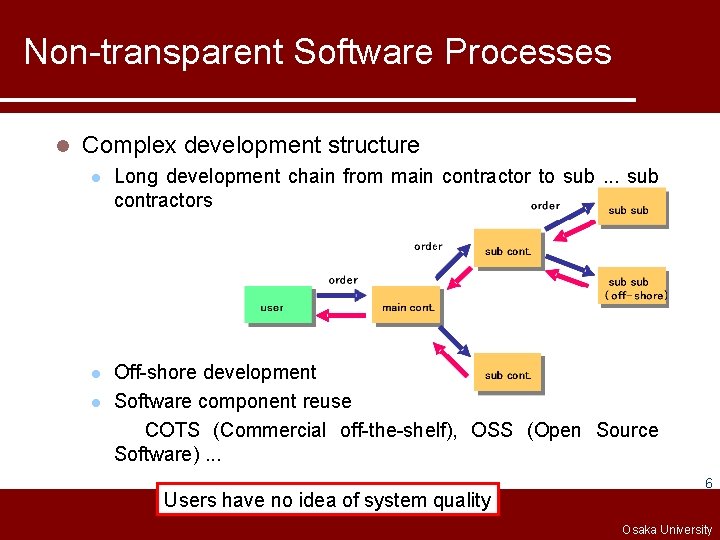
Non-transparent Software Processes l Complex development structure l Long development chain from main contractor to sub. . . sub contractors l Off-shore development Software component reuse COTS (Commercial off-the-shelf), OSS (Open Source Software). . . l Users have no idea of system quality 6 Osaka University Copyright © 2008 Nara Institute of Science and Technology / Osaka University
Software Tag Standard 1. 0 Osaka University
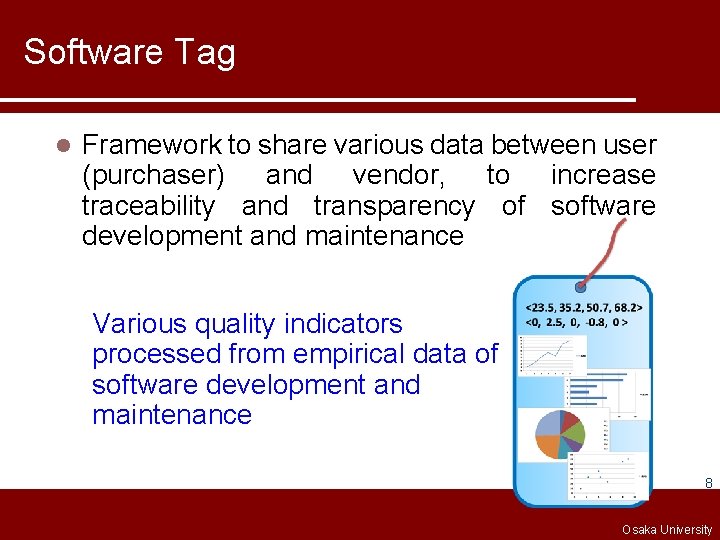
Software Tag l Framework to share various data between user (purchaser) and vendor, to increase traceability and transparency of software development and maintenance Various quality indicators processed from empirical data of software development and maintenance 8 Osaka University Copyright © 2008 Nara Institute of Science and Technology / Osaka University
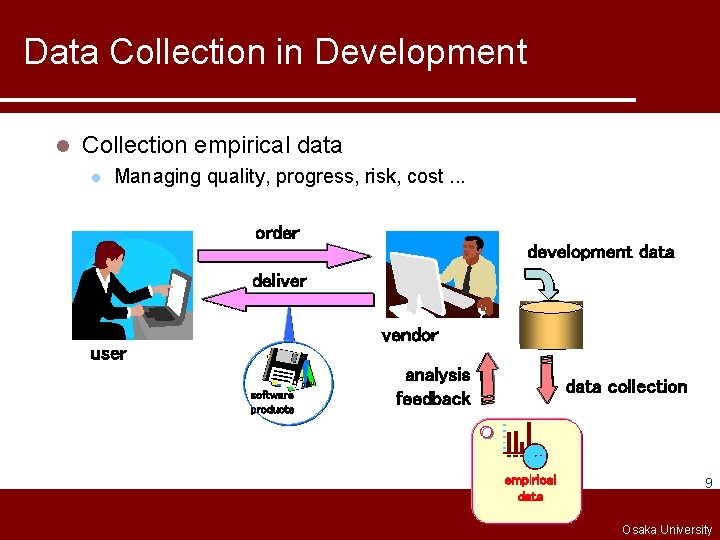
Data Collection in Development l Collection empirical data l Managing quality, progress, risk, cost. . . order development data deliver vendor user software products analysis feedback data collection empirical data 9 Osaka University Copyright © 2008 Nara Institute of Science and Technology / Osaka University
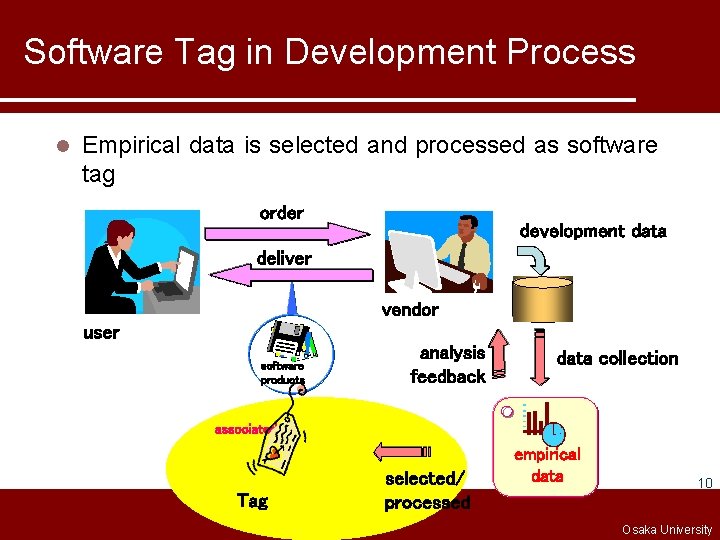
Software Tag in Development Process l Empirical data is selected and processed as software tag order development data deliver vendor user software products analysis feedback data collection associated Tag selected/ processed empirical data 10 Osaka University Copyright © 2008 Nara Institute of Science and Technology / Osaka University

Elements of Tag l Project information(12) Basic information for project and system l Progress information (29) Development information of the system 11 Osaka University Copyright © 2008 Nara Institute of Science and Technology / Osaka University
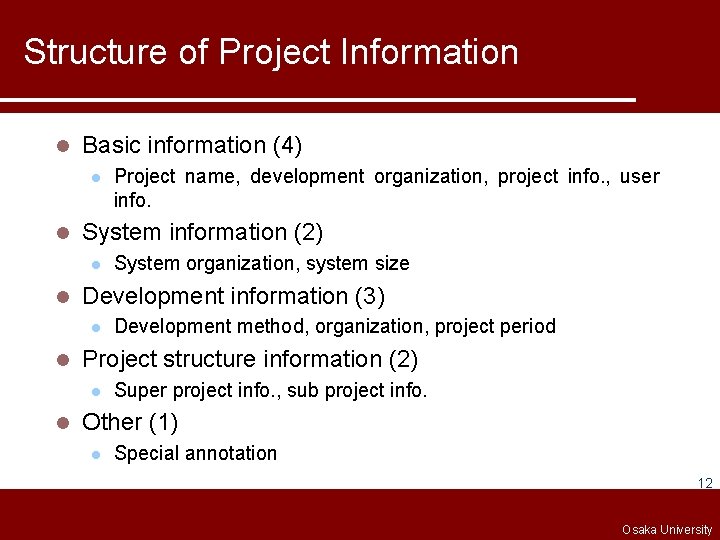
Structure of Project Information l Basic information (4) l l System information (2) l l Development method, organization, project period Project structure information (2) l l System organization, system size Development information (3) l l Project name, development organization, project info. , user info. Super project info. , sub project info. Other (1) l Special annotation 12 Osaka University Copyright © 2008 Nara Institute of Science and Technology / Osaka University
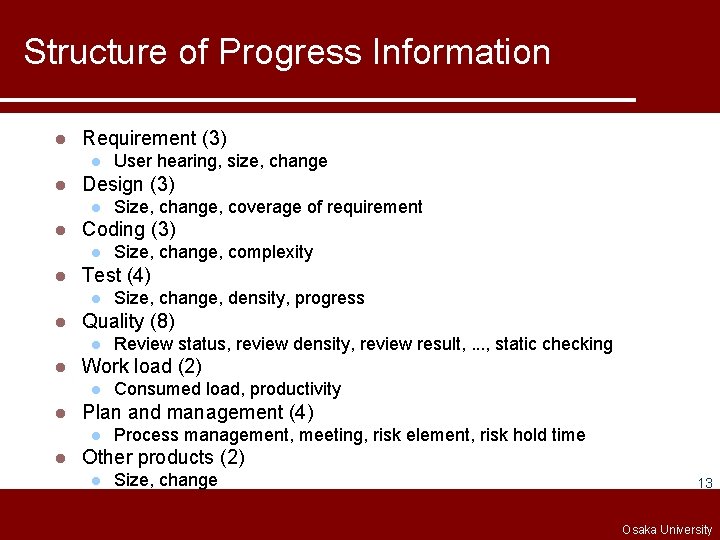
Structure of Progress Information l Requirement (3) l l Design (3) l l Consumed load, productivity Plan and management (4) l l Review status, review density, review result, . . . , static checking Work load (2) l l Size, change, density, progress Quality (8) l l Size, change, complexity Test (4) l l Size, change, coverage of requirement Coding (3) l l User hearing, size, change Process management, meeting, risk element, risk hold time Other products (2) l Size, change 13 Osaka University Copyright © 2008 Nara Institute of Science and Technology / Osaka University
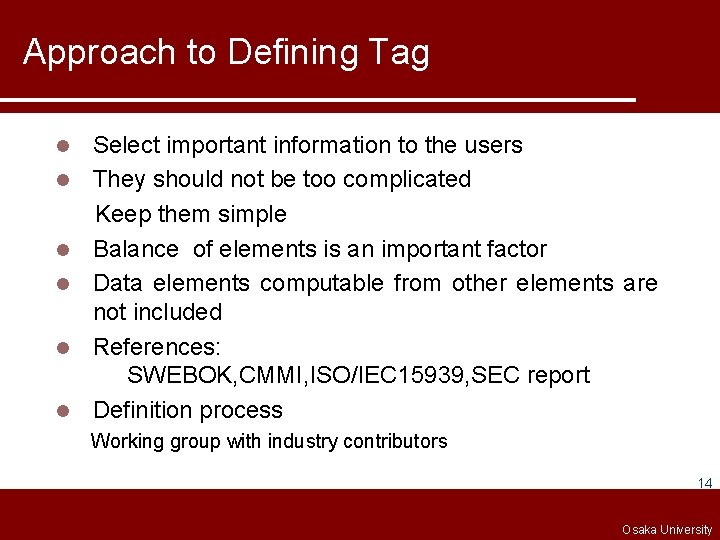
Approach to Defining Tag l l l Select important information to the users They should not be too complicated Keep them simple Balance of elements is an important factor Data elements computable from other elements are not included References: SWEBOK, CMMI, ISO/IEC 15939, SEC report Definition process Working group with industry contributors 14 Osaka University Copyright © 2008 Nara Institute of Science and Technology / Osaka University
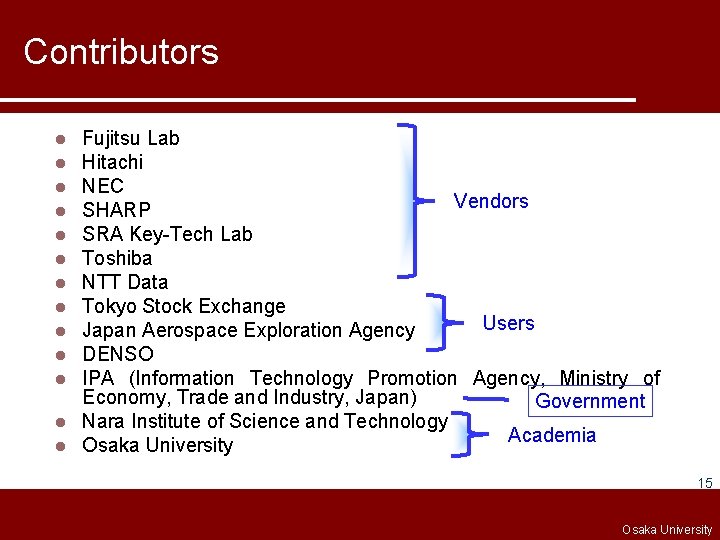
Contributors Fujitsu Lab Hitachi NEC Vendors SHARP SRA Key-Tech Lab Toshiba NTT Data Tokyo Stock Exchange Users Japan Aerospace Exploration Agency DENSO IPA (Information Technology Promotion Agency, Ministry of Economy, Trade and Industry, Japan) Government l Nara Institute of Science and Technology Academia l Osaka University l l l 15 Osaka University Copyright © 2008 Nara Institute of Science and Technology / Osaka University
Usage Models Osaka University
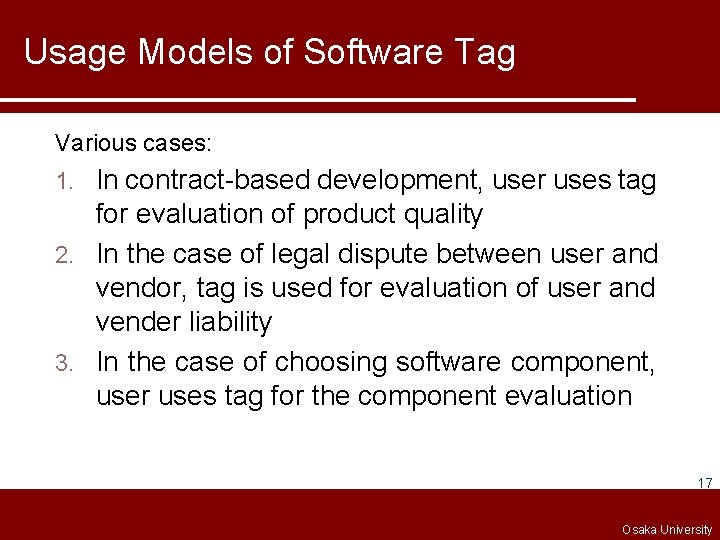
Usage Models of Software Tag Various cases: In contract-based development, user uses tag for evaluation of product quality 2. In the case of legal dispute between user and vendor, tag is used for evaluation of user and vender liability 3. In the case of choosing software component, user uses tag for the component evaluation 1. 17 Osaka University Copyright © 2008 Nara Institute of Science and Technology / Osaka University
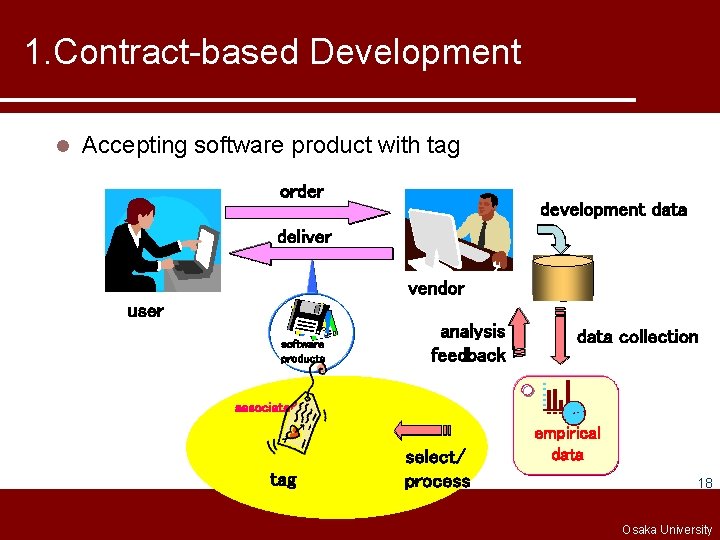
1. Contract-based Development l Accepting software product with tag order development data deliver vendor user software products analysis feedback data collection associated tag select/ process empirical data 18 Osaka University Copyright © 2008 Nara Institute of Science and Technology / Osaka University
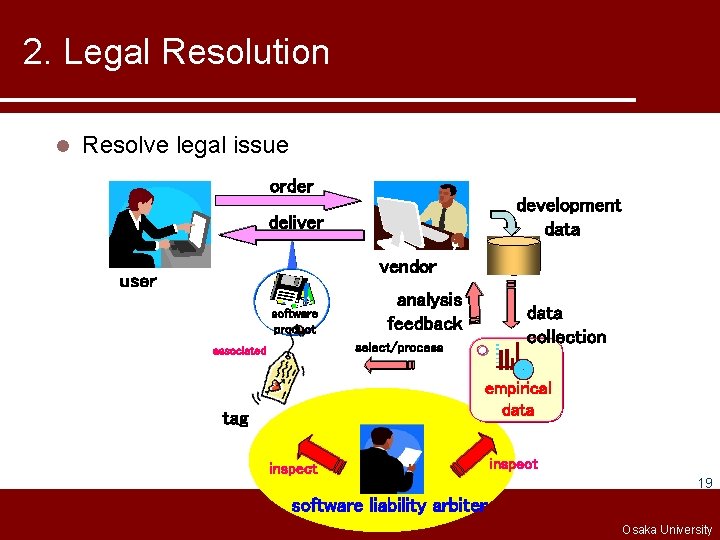
2. Legal Resolution l Resolve legal issue order development data deliver vendor user software product analysis feedback data collection select/process associated empirical data tag inspect 19 software liability arbiter Osaka University Copyright © 2008 Nara Institute of Science and Technology / Osaka University
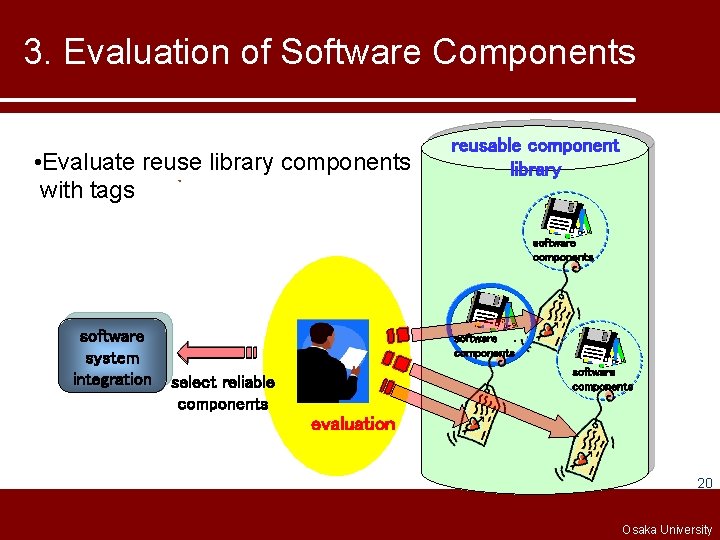
3. Evaluation of Software Components • Evaluate reuse library components with tags reusable component library software components software system integration software components select reliable components evaluation 20 Osaka University Copyright © 2008 Nara Institute of Science and Technology / Osaka University
Empirical Data l Supporting l raw data for tag elements Various data for target software products and their development l Ex. source code, design documents, bug reports, progress reports, ; . . . Encrypted if needed l Decrypted when l l Serious system failure, legal dispute, . . . 21 Osaka University Copyright © 2008 Nara Institute of Science and Technology / Osaka University
Practical Operation Tag elements are defined between user and vendor l Data collection target, scope, granularity, period, . . . l Not necessary to use all elements l Tag data are shared only between user and vendor, and they are not public l Timing of sending tags is to be determined between user and vendor Ex. at delivery time of final product, at every major phase of development, at every week, at every month, . . . 22 Osaka University Copyright © 2008 Nara Institute of Science and Technology / Osaka University
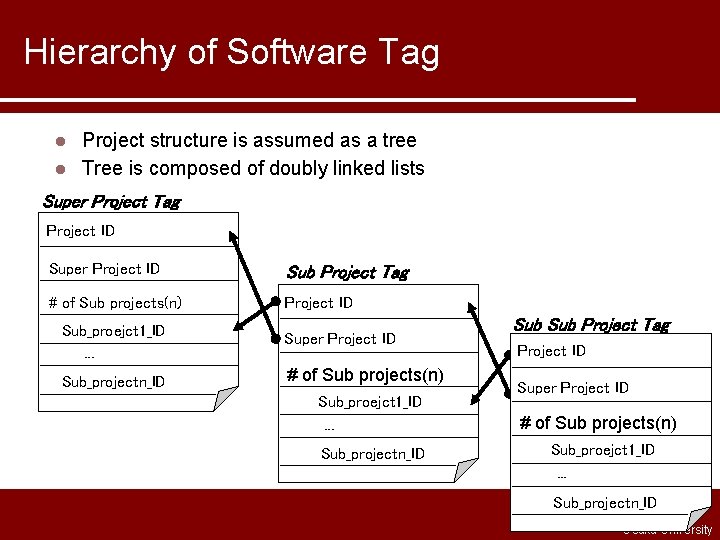
Hierarchy of Software Tag Project structure is assumed as a tree l Tree is composed of doubly linked lists l Super Project Tag Project ID Super Project ID Sub Project Tag # of Sub projects(n) Project ID Sub_proejct 1_ID. . . Super Project ID Sub_projectn_ID # of Sub projects(n) Sub_proejct 1_ID. . . Sub_projectn_ID Sub Project Tag Project ID Super Project ID # of Sub projects(n) Sub_proejct 1_ID. . . .... 23 Sub_projectn_ID サブ(子)プロジェクトn_ID 23 Osaka University Copyright © 2008 Nara Institute of Science and Technology / Osaka University
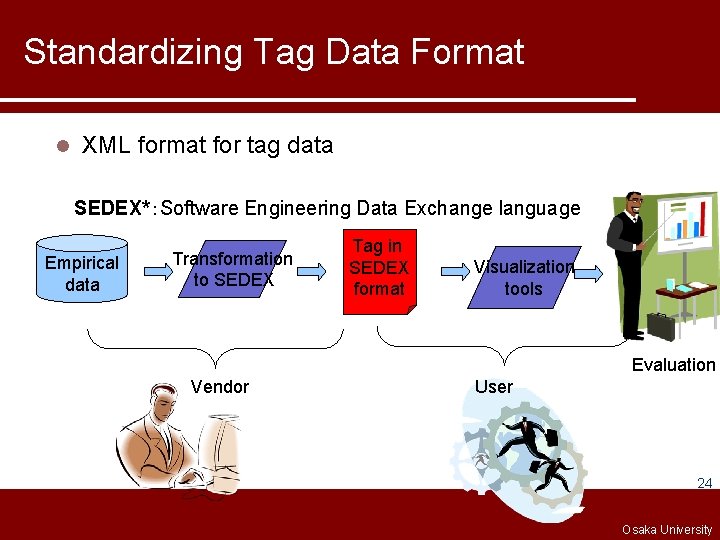
Standardizing Tag Data Format l XML format for tag data SEDEX*:Software Engineering Data Exchange language Empirical data Transformation to SEDEX Tag in SEDEX format Visualization tools Evaluation Vendor User 24 Osaka University Copyright © 2008 Nara Institute of Science and Technology / Osaka University
Summary Osaka University
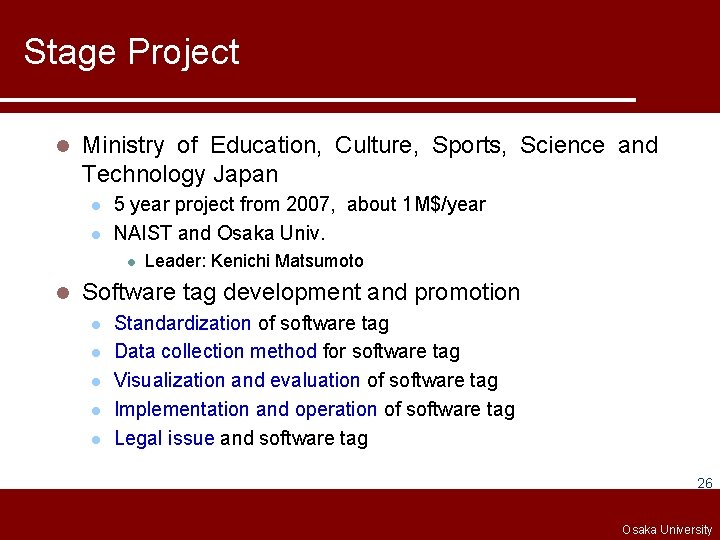
Stage Project l Ministry of Education, Culture, Sports, Science and Technology Japan l l 5 year project from 2007, about 1 M$/year NAIST and Osaka Univ. l l Leader: Kenichi Matsumoto Software tag development and promotion l l l Standardization of software tag Data collection method for software tag Visualization and evaluation of software tag Implementation and operation of software tag Legal issue and software tag 26 Osaka University Copyright © 2008 Nara Institute of Science and Technology / Osaka University
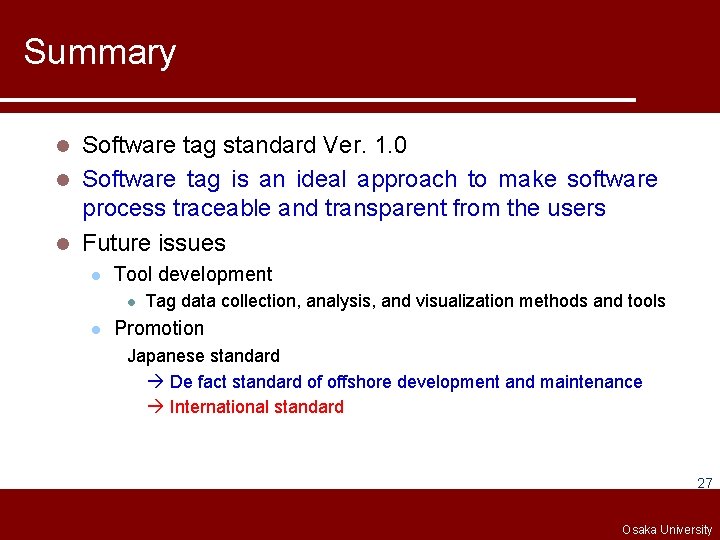
Summary Software tag standard Ver. 1. 0 l Software tag is an ideal approach to make software process traceable and transparent from the users l Future issues l l Tool development l l Tag data collection, analysis, and visualization methods and tools Promotion Japanese standard De fact standard of offshore development and maintenance International standard 27 Osaka University Copyright © 2008 Nara Institute of Science and Technology / Osaka University
Links Homepage : http: //www. stage-project. jp l E-mail : stage-contact@is. naist. jp l 28 Osaka University Copyright © 2008 Nara Institute of Science and Technology / Osaka University

END 29 Osaka University Copyright © 2008 Nara Institute of Science and Technology / Osaka University
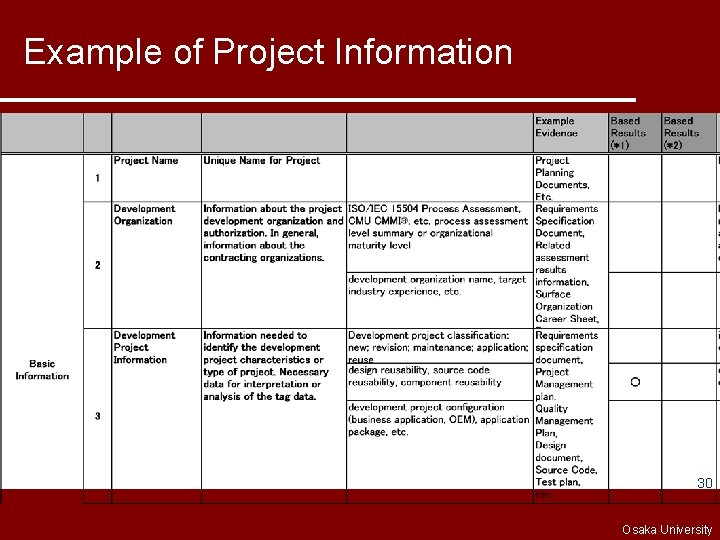
Example of Project Information 30 Osaka University Copyright © 2008 Nara Institute of Science and Technology / Osaka University
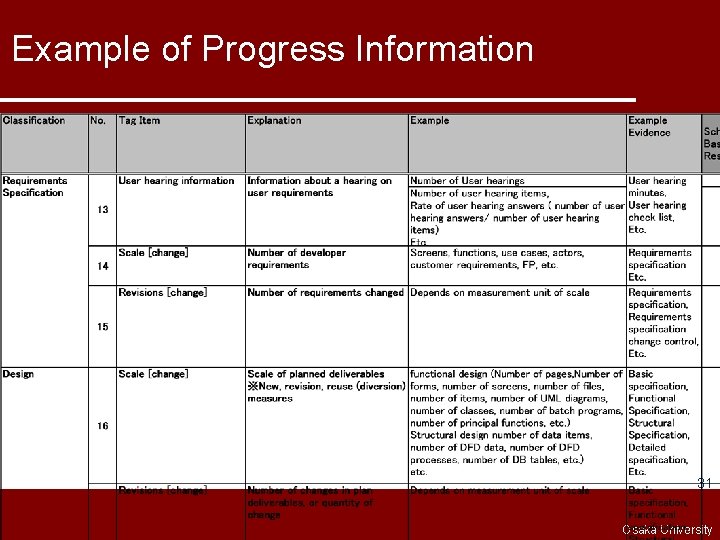
Example of Progress Information 31 Osaka University Copyright © 2008 Nara Institute of Science and Technology / Osaka University
- Slides: 31