
SOFTWARE SYSTEM ENGINEERING A TUTORIAL Richard H Thayer
- Slides: 18
SOFTWARE SYSTEM ENGINEERING: A TUTORIAL Richard H. Thayer 발표자 : 이동아
INTRODUCTION Specific of software Getting Large Getting complex
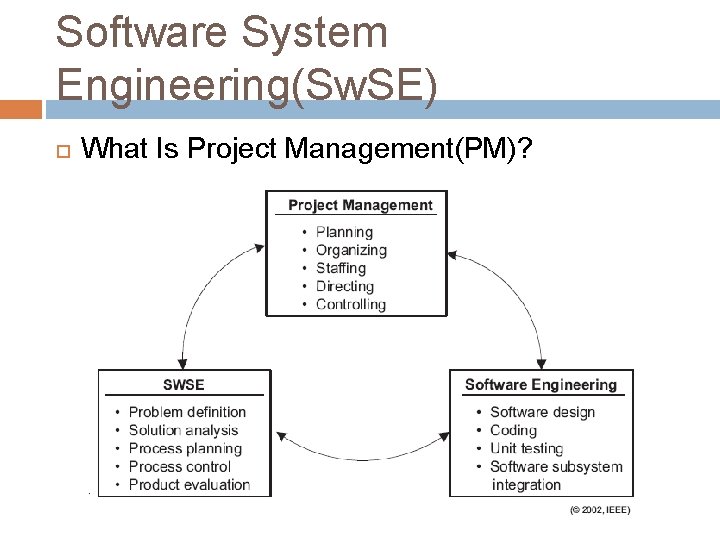
System �A collection of elements related in a way that allows the accomplishment of a common object System Engineering(SE) � The practical application of scientific, engineering, and management skills necessary to transform an operational need into a description of a system configuration that best satisfies that need Functions of SE � Problem definition � Solution analysis � Process planning � Process control � Product evaluation
Software System Engineering(Sw. SE) �A Technical and Management process The technical process of Sw. SE is the analytical effort necessary to transform an operational need into : A description of a software system � A software design of the proper size, configuration, and quality � Documentation requirements and design specifications � The Procedures necessary to verify, test, and accept the finished product � The documentation necessary to use, operate, and maintain the system. �
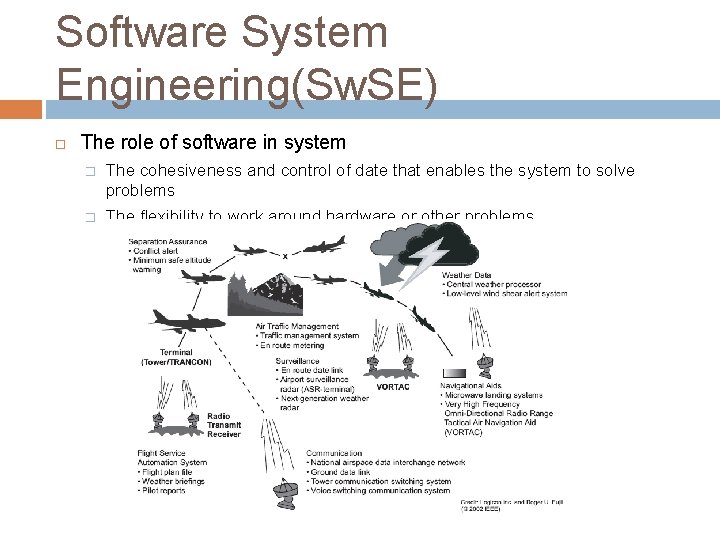
Software System Engineering(Sw. SE) The role of software in system � The cohesiveness and control of date that enables the system to solve problems � The flexibility to work around hardware or other problems
Software System Engineering(Sw. SE) What Is Software Engineering(Sw. E)? � The practical application of computer sciences to the analysis, design, construction and maintenance of software and its associated documentation � An engineering science that applies the concepts of analysis, design, coding, testing, documentation, and management to the successful completion of large, custom-built computer programs under time and budget constraints � The systematic application of methods, tools and techniques to achieve a stated requirement or objective for an effective and efficient software system
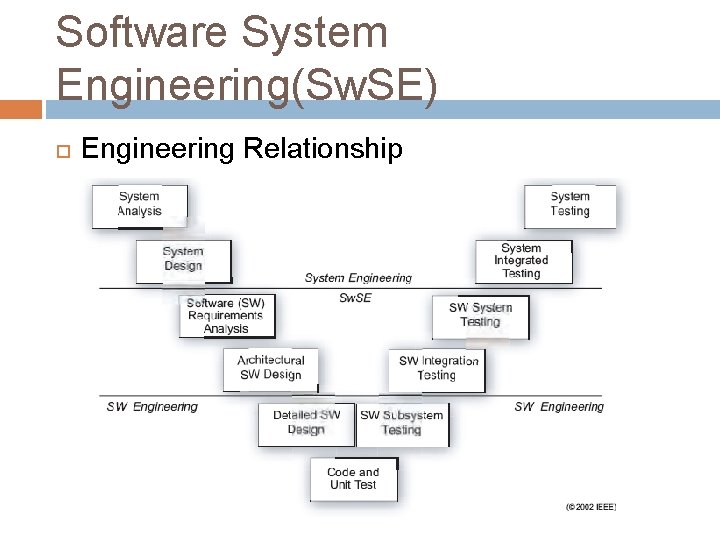
Software System Engineering(Sw. SE) Engineering Relationship
Software System Engineering(Sw. SE) What Is Project Management(PM)?
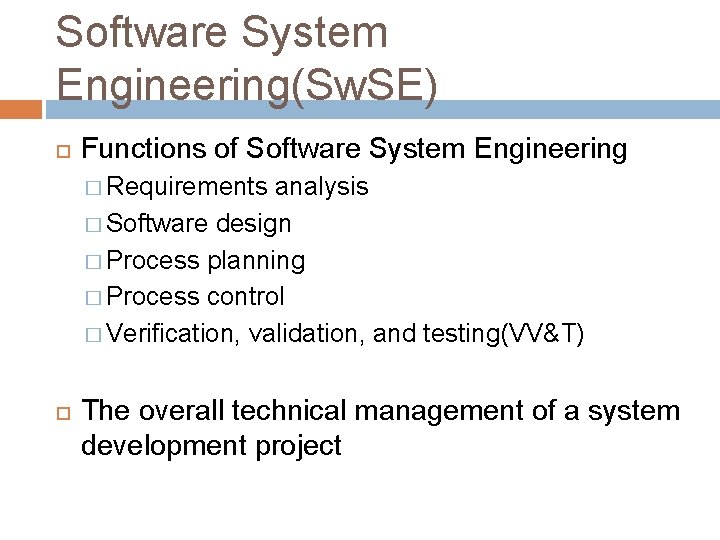
Software System Engineering(Sw. SE) Functions of Software System Engineering � Requirements analysis � Software design � Process planning � Process control � Verification, validation, and testing(VV&T) The overall technical management of a system development project
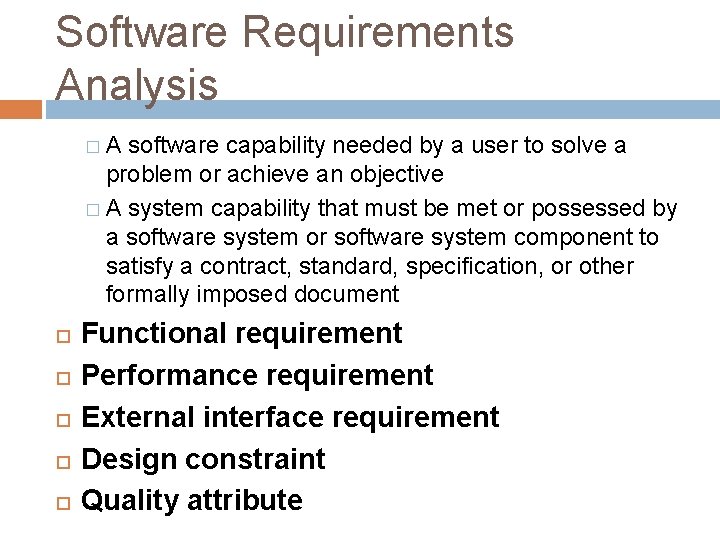
Software Requirements Analysis �A software capability needed by a user to solve a problem or achieve an objective � A system capability that must be met or possessed by a software system or software system component to satisfy a contract, standard, specification, or other formally imposed document Functional requirement Performance requirement External interface requirement Design constraint Quality attribute
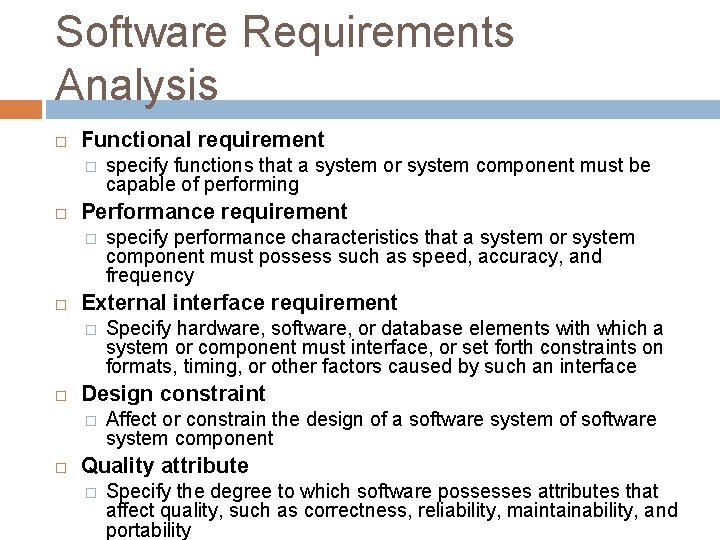
Software Requirements Analysis Functional requirement � Performance requirement � Specify hardware, software, or database elements with which a system or component must interface, or set forth constraints on formats, timing, or other factors caused by such an interface Design constraint � specify performance characteristics that a system or system component must possess such as speed, accuracy, and frequency External interface requirement � specify functions that a system or system component must be capable of performing Affect or constrain the design of a software system of software system component Quality attribute � Specify the degree to which software possesses attributes that affect quality, such as correctness, reliability, maintainability, and portability
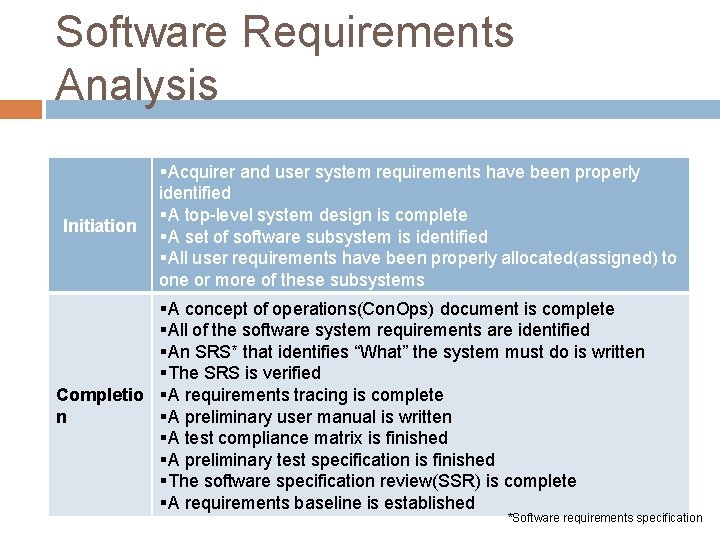
Software Requirements Analysis Initiation §Acquirer and user system requirements have been properly identified §A top-level system design is complete §A set of software subsystem is identified §All user requirements have been properly allocated(assigned) to one or more of these subsystems §A concept of operations(Con. Ops) document is complete §All of the software system requirements are identified §An SRS* that identifies “What” the system must do is written §The SRS is verified Completio §A requirements tracing is complete n §A preliminary user manual is written §A test compliance matrix is finished §A preliminary test specification is finished §The software specification review(SSR) is complete §A requirements baseline is established *Software requirements specification
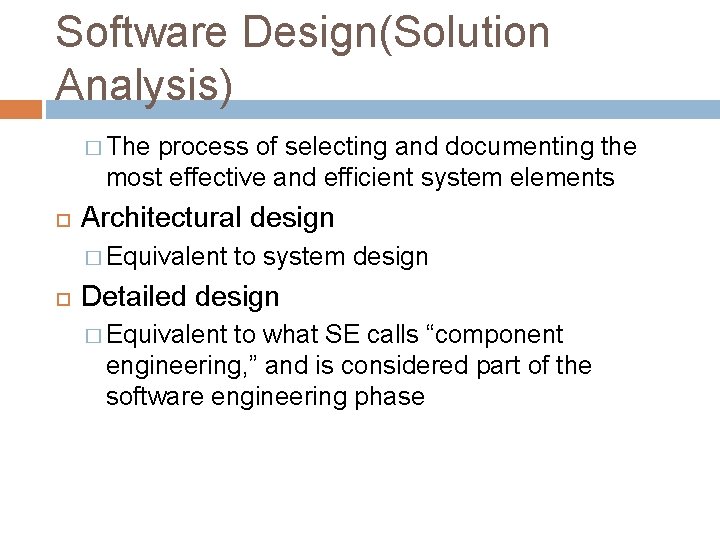
Software Design(Solution Analysis) � The process of selecting and documenting the most effective and efficient system elements Architectural design � Equivalent to system design Detailed design � Equivalent to what SE calls “component engineering, ” and is considered part of the software engineering phase
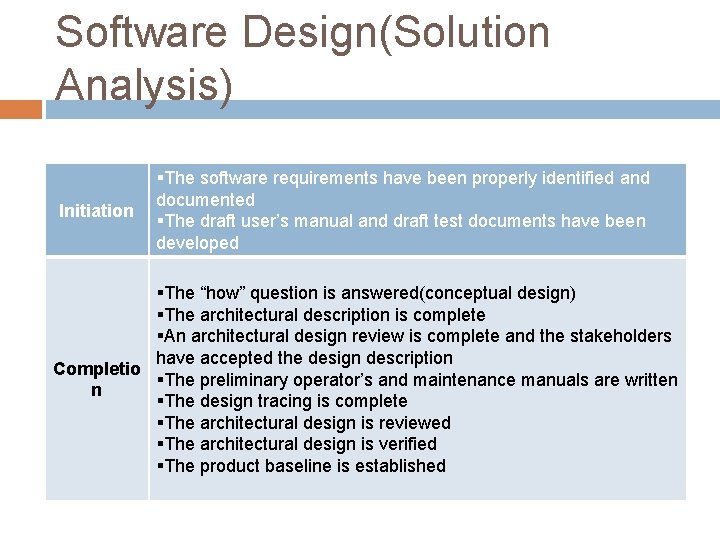
Software Design(Solution Analysis) Initiation §The software requirements have been properly identified and documented §The draft user’s manual and draft test documents have been developed §The “how” question is answered(conceptual design) §The architectural description is complete §An architectural design review is complete and the stakeholders have accepted the design description Completio §The preliminary operator’s and maintenance manuals are written n §The design tracing is complete §The architectural design is reviewed §The architectural design is verified §The product baseline is established
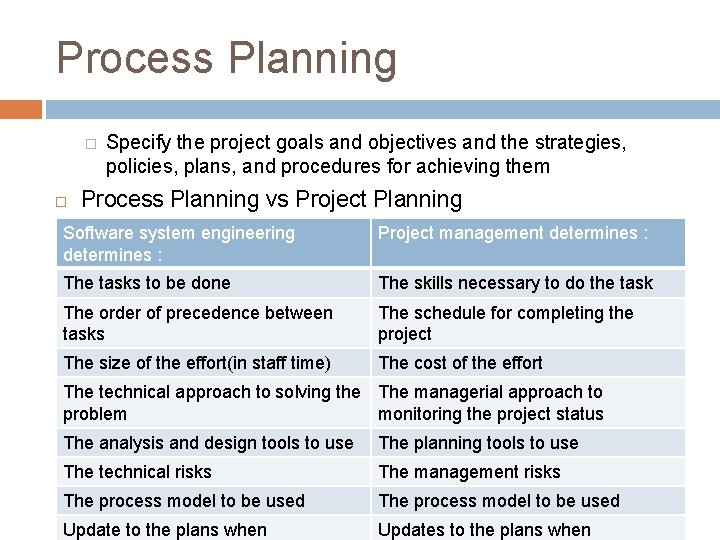
Process Planning � Specify the project goals and objectives and the strategies, policies, plans, and procedures for achieving them Process Planning vs Project Planning Software system engineering determines : Project management determines : The tasks to be done The skills necessary to do the task The order of precedence between tasks The schedule for completing the project The size of the effort(in staff time) The cost of the effort The technical approach to solving the The managerial approach to problem monitoring the project status The analysis and design tools to use The planning tools to use The technical risks The management risks The process model to be used Update to the plans when Updates to the plans when
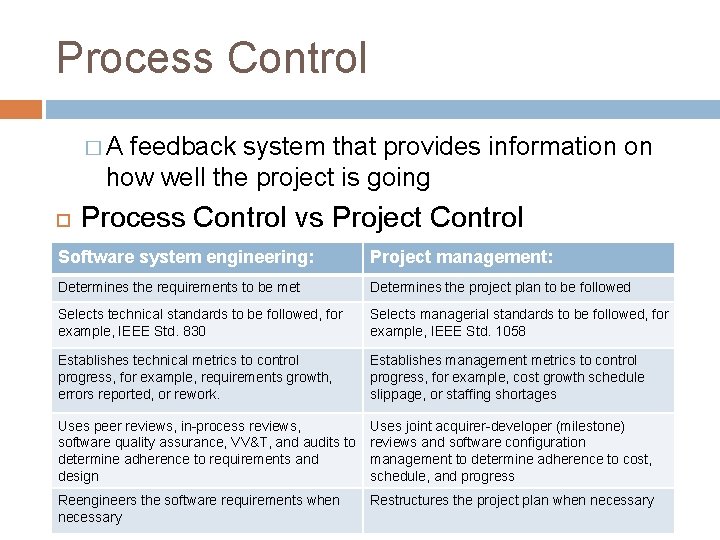
Process Control �A feedback system that provides information on how well the project is going Process Control vs Project Control Software system engineering: Project management: Determines the requirements to be met Determines the project plan to be followed Selects technical standards to be followed, for example, IEEE Std. 830 Selects managerial standards to be followed, for example, IEEE Std. 1058 Establishes technical metrics to control progress, for example, requirements growth, errors reported, or rework. Establishes management metrics to control progress, for example, cost growth schedule slippage, or staffing shortages Uses peer reviews, in-process reviews, software quality assurance, VV&T, and audits to determine adherence to requirements and design Uses joint acquirer-developer (milestone) reviews and software configuration management to determine adherence to cost, schedule, and progress Reengineers the software requirements when necessary Restructures the project plan when necessary
VV&T(Product Evaluation) Verification � determines whether the products of a given phase of the software development cycle fulfill the requirements established during the previous phase. Verification answers the question, “am I building the product right? ” Validation � determines the correctness of the final program or software with respect to the user’s needs and requirements. Validation answers the question, “am I building the right product? ” Testing � the execution of a program or partial program, with known inputs and outputs that are both predicted and observed for the purpose of finding errors. Testing is frequently considered part of validation
Summary and Conclusions Conducting Sw. E without conducting Sw. SE puts a project in jeopardy Sw. E and Sw. SE are primarily disciplines used in the front end of the system life cycle and at the latter part of the life cycle The other major activity of Sw. SE is the final validation and testing of the completed system Sw. SE is not cheap, but it is cost effective