
Software Supply Chain Attacks Definition Compromising software through
- Slides: 2
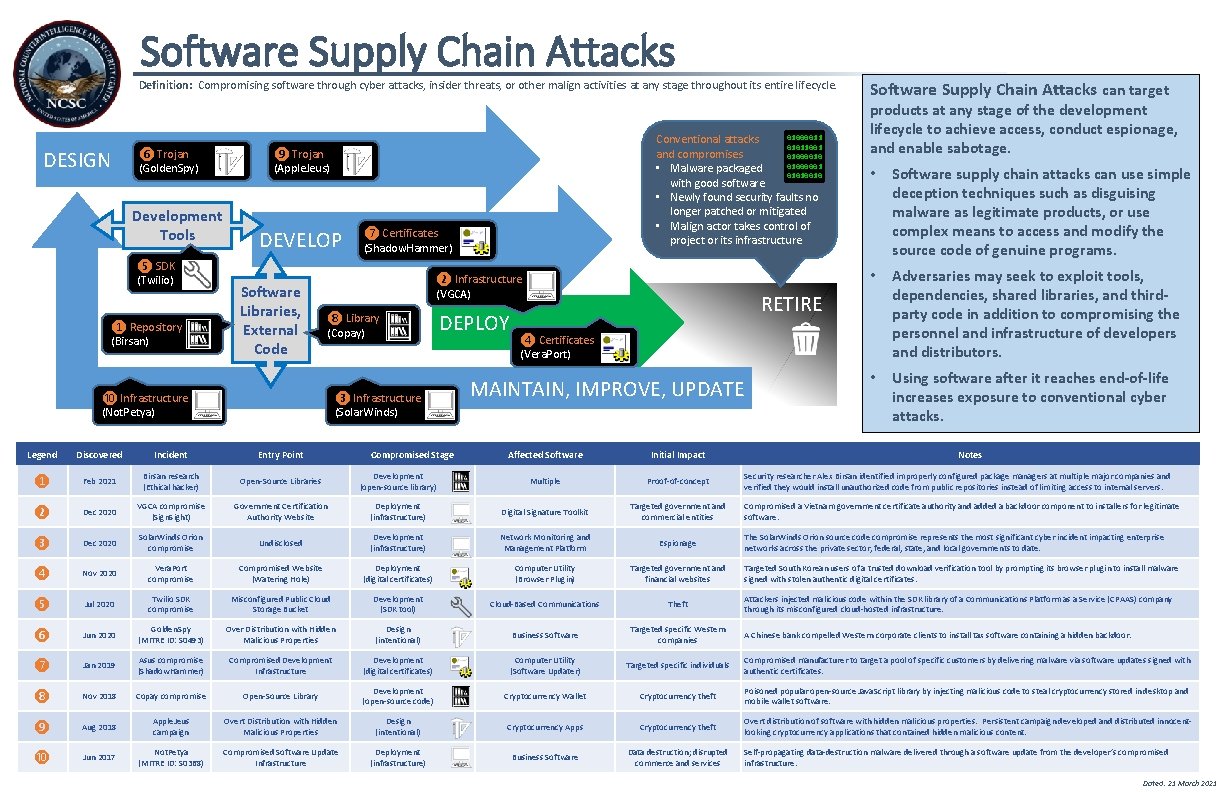
Software Supply Chain Attacks Definition: Compromising software through cyber attacks, insider threats, or other malign activities at any stage throughout its entire lifecycle. DESIGN ❻ Trojan (Golden. Spy) Development Tools ❺ SDK (Twilio) ❶ Repository (Birsan) 01000011 Conventional attacks 01011001 and compromises 01000010 01000001 • Malware packaged 01010010 with good software • Newly found security faults no longer patched or mitigated • Malign actor takes control of project or its infrastructure ❾ Trojan (Apple. Jeus) DEVELOP Software Libraries, External Code ❼ Certificates (Shadow. Hammer) ❷ Infrastructure (VGCA) ❽ Library (Copay) ❿ Infrastructure (Not. Petya) DEPLOY ❸ Infrastructure (Solar. Winds) Legend Discovered Incident Entry Point ❶ Feb 2021 Birsan research (Ethical hacker) Open-Source Libraries ❷ Dec 2020 VGCA compromise (Sign. Sight) ❸ Dec 2020 ❹ Compromised Stage Software Supply Chain Attacks can target products at any stage of the development lifecycle to achieve access, conduct espionage, and enable sabotage. • Software supply chain attacks can use simple deception techniques such as disguising malware as legitimate products, or use complex means to access and modify the source code of genuine programs. • Adversaries may seek to exploit tools, dependencies, shared libraries, and thirdparty code in addition to compromising the personnel and infrastructure of developers and distributors. • Using software after it reaches end-of-life increases exposure to conventional cyber attacks. RETIRE ❹ Certificates (Vera. Port) MAINTAIN, IMPROVE, UPDATE Affected Software Initial Impact Notes Development (open-source library) Multiple Proof-of-concept Government Certification Authority Website Deployment (infrastructure) Digital Signature Toolkit Targeted government and commercial entities Solar. Winds Orion compromise Undisclosed Development (infrastructure) Network Monitoring and Management Platform Espionage Nov 2020 Vera. Port compromise Compromised Website (Watering Hole) Deployment (digital certificates) Computer Utility (Browser Plugin) Targeted government and financial websites ❺ Jul 2020 Twilio SDK compromise Misconfigured Public Cloud Storage Bucket Development (SDK tool) Cloud-Based Communications Theft ❻ Jun 2020 Golden. Spy (MITRE ID: S 0493) Over Distribution with Hidden Malicious Properties Design (intentional) Business Software Targeted specific Western companies ❼ Jan 2019 Asus compromise (Shadow. Hammer) Compromised Development Infrastructure Development (digital certificates) Computer Utility (Software Updater) Targeted specific individuals Compromised manufacturer to target a pool of specific customers by delivering malware via software updates signed with authentic certificates. ❽ Nov 2018 Copay compromise Open-Source Library Development (open-source code) Cryptocurrency Wallet Cryptocurrency theft Poisoned popular open-source Java. Script library by injecting malicious code to steal cryptocurrency stored in desktop and mobile wallet software. ❾ Aug 2018 Apple. Jeus campaign Overt Distribution with Hidden Malicious Properties Design (intentional) Cryptocurrency Apps Cryptocurrency theft Overt distribution of software with hidden malicious properties. Persistent campaign developed and distributed innocentlooking cryptocurrency applications that contained hidden malicious content. ❿ Jun 2017 Not. Petya (MITRE ID: S 0368) Compromised Software Update Infrastructure Deployment (infrastructure) Business Software Data destruction; disrupted commerce and services Security researcher Alex Birsan identified improperly configured package managers at multiple major companies and verified they would install unauthorized code from public repositories instead of limiting access to internal servers. Compromised a Vietnam government certificate authority and added a backdoor component to installers for legitimate software. The Solar. Winds Orion source code compromise represents the most significant cyber incident impacting enterprise networks across the private sector, federal, state, and local governments to date. Targeted South Korean users of a trusted download verification tool by prompting its browser plugin to install malware signed with stolen authentic digital certificates. Attackers injected malicious code within the SDK library of a Communications Platform as a Service (CPAAS) company through its misconfigured cloud-hosted infrastructure. A Chinese bank compelled Western corporate clients to install tax software containing a hidden backdoor. Self-propagating data-destruction malware delivered through a software update from the developer’s compromised infrastructure. Dated: 21 March 2021
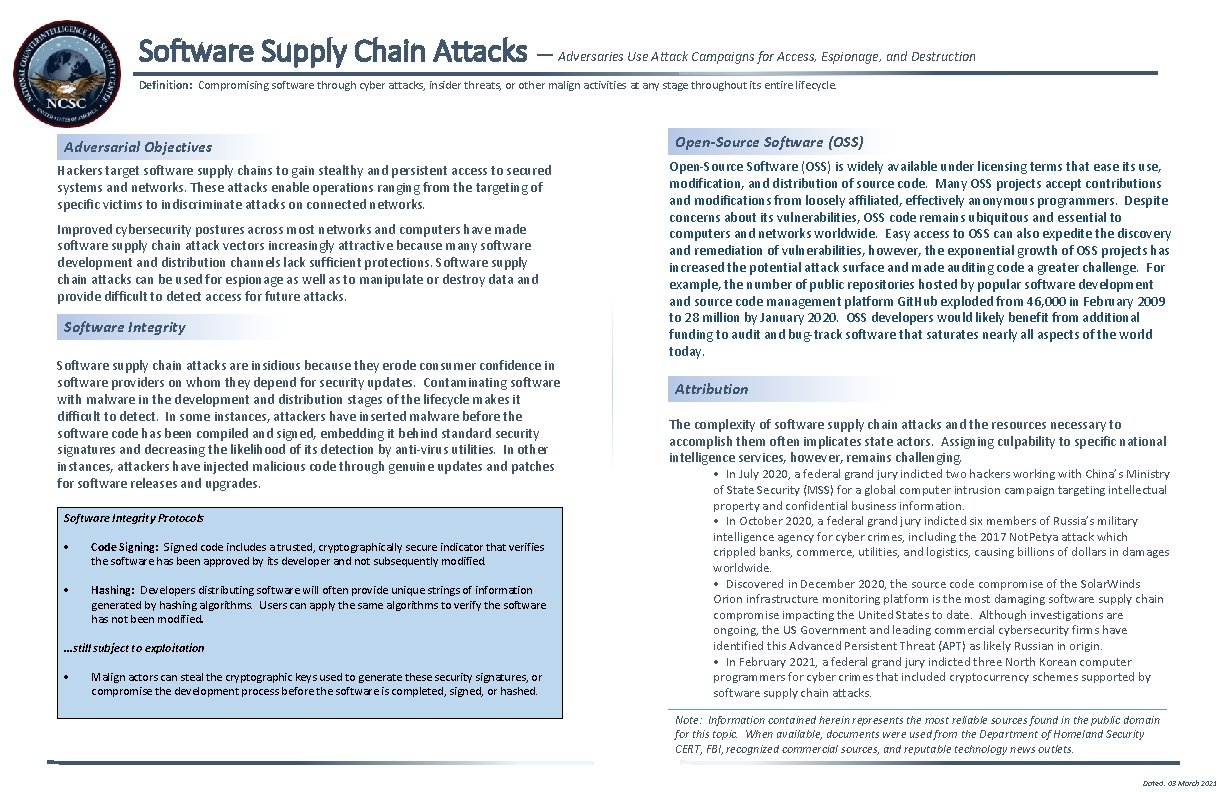
Software Supply Chain Attacks — Adversaries Use Attack Campaigns for Access, Espionage, and Destruction Definition: Compromising software through cyber attacks, insider threats, or other malign activities at any stage throughout its entire lifecycle. Adversarial Objectives Hackers target software supply chains to gain stealthy and persistent access to secured systems and networks. These attacks enable operations ranging from the targeting of specific victims to indiscriminate attacks on connected networks. Improved cybersecurity postures across most networks and computers have made software supply chain attack vectors increasingly attractive because many software development and distribution channels lack sufficient protections. Software supply chain attacks can be used for espionage as well as to manipulate or destroy data and provide difficult to detect access for future attacks. Software Integrity Software supply chain attacks are insidious because they erode consumer confidence in software providers on whom they depend for security updates. Contaminating software with malware in the development and distribution stages of the lifecycle makes it difficult to detect. In some instances, attackers have inserted malware before the software code has been compiled and signed, embedding it behind standard security signatures and decreasing the likelihood of its detection by anti-virus utilities. In other instances, attackers have injected malicious code through genuine updates and patches for software releases and upgrades. Software Integrity Protocols Code Signing: Signed code includes a trusted, cryptographically secure indicator that verifies the software has been approved by its developer and not subsequently modified. Hashing: Developers distributing software will often provide unique strings of information generated by hashing algorithms. Users can apply the same algorithms to verify the software has not been modified. …still subject to exploitation Malign actors can steal the cryptographic keys used to generate these security signatures, or compromise the development process before the software is completed, signed, or hashed. Open-Source Software (OSS) is widely available under licensing terms that ease its use, modification, and distribution of source code. Many OSS projects accept contributions and modifications from loosely affiliated, effectively anonymous programmers. Despite concerns about its vulnerabilities, OSS code remains ubiquitous and essential to computers and networks worldwide. Easy access to OSS can also expedite the discovery and remediation of vulnerabilities, however, the exponential growth of OSS projects has increased the potential attack surface and made auditing code a greater challenge. For example, the number of public repositories hosted by popular software development and source code management platform Git. Hub exploded from 46, 000 in February 2009 to 28 million by January 2020. OSS developers would likely benefit from additional funding to audit and bug-track software that saturates nearly all aspects of the world today. Attribution The complexity of software supply chain attacks and the resources necessary to accomplish them often implicates state actors. Assigning culpability to specific national intelligence services, however, remains challenging. • In July 2020, a federal grand jury indicted two hackers working with China’s Ministry of State Security (MSS) for a global computer intrusion campaign targeting intellectual property and confidential business information. • In October 2020, a federal grand jury indicted six members of Russia’s military intelligence agency for cyber crimes, including the 2017 Not. Petya attack which crippled banks, commerce, utilities, and logistics, causing billions of dollars in damages worldwide. • Discovered in December 2020, the source code compromise of the Solar. Winds Orion infrastructure monitoring platform is the most damaging software supply chain compromise impacting the United States to date. Although investigations are ongoing, the US Government and leading commercial cybersecurity firms have identified this Advanced Persistent Threat (APT) as likely Russian in origin. • In February 2021, a federal grand jury indicted three North Korean computer programmers for cyber crimes that included cryptocurrency schemes supported by software supply chain attacks. Note: Information contained herein represents the most reliable sources found in the public domain for this topic. When available, documents were used from the Department of Homeland Security CERT, FBI, recognized commercial sources, and reputable technology news outlets. Dated: 03 March 2021