
Software Reuse SEIILecture 28 Dr Muzafar Khan Assistant
- Slides: 20
Software Reuse SEII-Lecture 28 Dr. Muzafar Khan Assistant Professor Department of Computer Science CIIT, Islamabad.
Recap • Restructuring – Code restructuring, data restructuring • Forward engineering – Client-server architectures, object-oriented architectures • Economics of reengineering – Cost benefit analysis • Software reuse – Benefits of reuse 2
Problems with Reuse • Increased maintenance costs – If source code is not available of reused component – Incapability with system changes • Lack of tool support – No support for development with reuse component – Difficult/impossible to integrate such tools – Particularly true for embedded system engineering • Not-invented-here syndrome – Some rewrites component to improve it – Trust in themselves 3
Problems with Reuse • Creating, maintaining, and using a component library – Populating a reusable component library can be expensive – Use of the library can be expensive • Finding, understanding, and adapting reusable components – Some components need to be discovered – Understanding and adaption – Developers must be confident 4
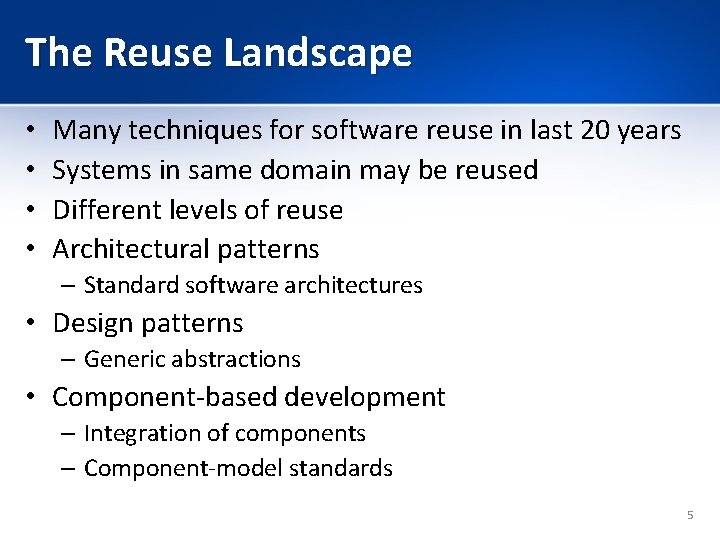
The Reuse Landscape • • Many techniques for software reuse in last 20 years Systems in same domain may be reused Different levels of reuse Architectural patterns – Standard software architectures • Design patterns – Generic abstractions • Component-based development – Integration of components – Component-model standards 5
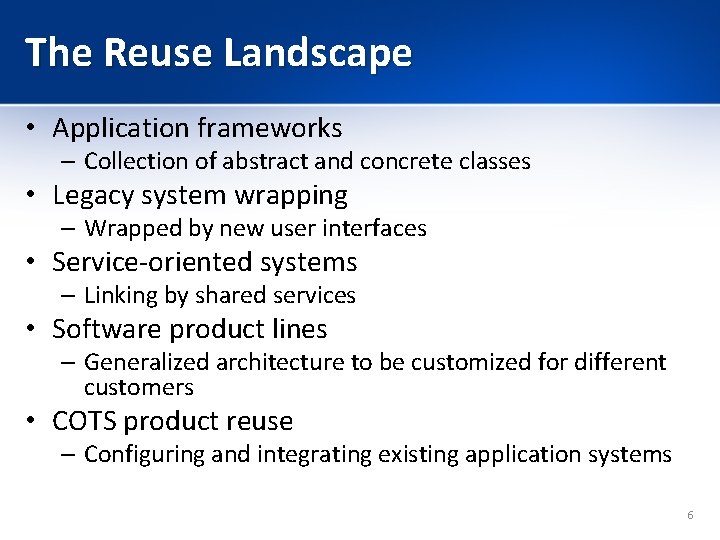
The Reuse Landscape • Application frameworks – Collection of abstract and concrete classes • Legacy system wrapping – Wrapped by new user interfaces • Service-oriented systems – Linking by shared services • Software product lines – Generalized architecture to be customized for different customers • COTS product reuse – Configuring and integrating existing application systems 6
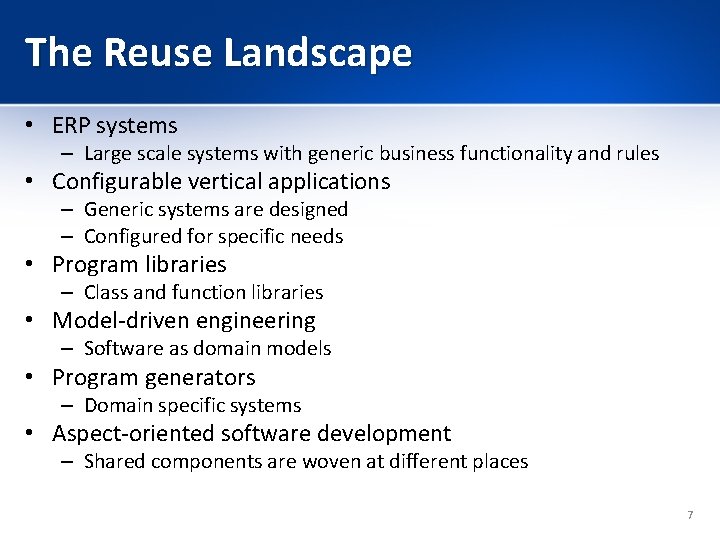
The Reuse Landscape • ERP systems – Large scale systems with generic business functionality and rules • Configurable vertical applications – Generic systems are designed – Configured for specific needs • Program libraries – Class and function libraries • Model-driven engineering – Software as domain models • Program generators – Domain specific systems • Aspect-oriented software development – Shared components are woven at different places 7
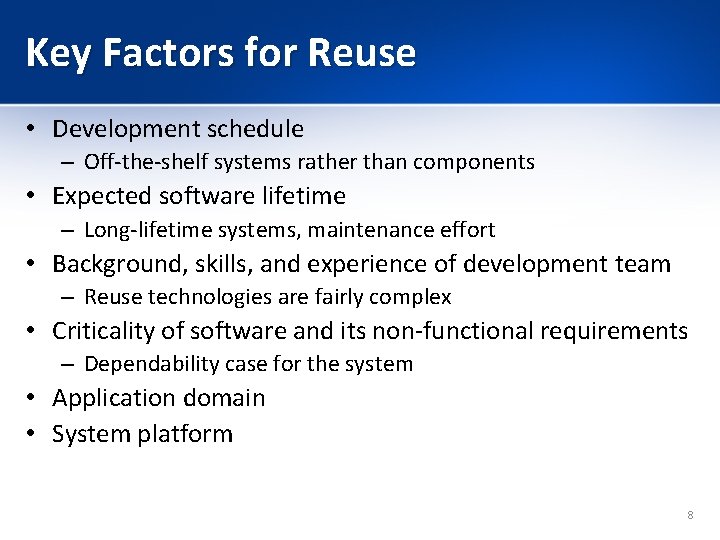
Key Factors for Reuse • Development schedule – Off-the-shelf systems rather than components • Expected software lifetime – Long-lifetime systems, maintenance effort • Background, skills, and experience of development team – Reuse technologies are fairly complex • Criticality of software and its non-functional requirements – Dependability case for the system • Application domain • System platform 8
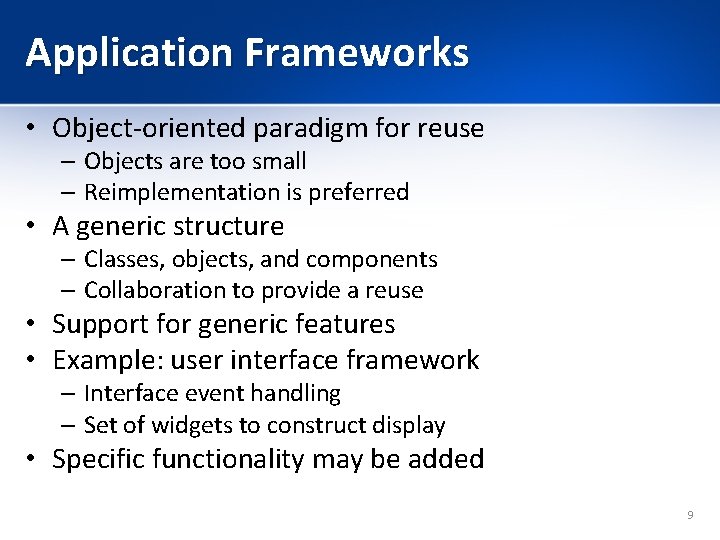
Application Frameworks • Object-oriented paradigm for reuse – Objects are too small – Reimplementation is preferred • A generic structure – Classes, objects, and components – Collaboration to provide a reuse • Support for generic features • Example: user interface framework – Interface event handling – Set of widgets to construct display • Specific functionality may be added 9
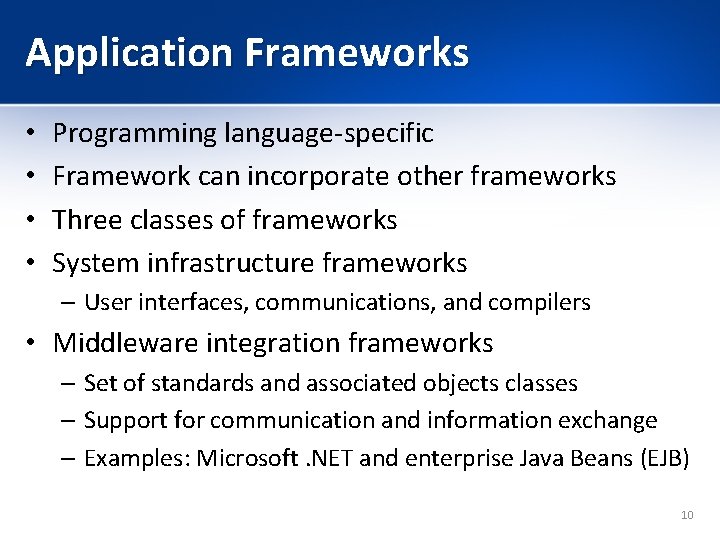
Application Frameworks • • Programming language-specific Framework can incorporate other frameworks Three classes of frameworks System infrastructure frameworks – User interfaces, communications, and compilers • Middleware integration frameworks – Set of standards and associated objects classes – Support for communication and information exchange – Examples: Microsoft. NET and enterprise Java Beans (EJB) 10
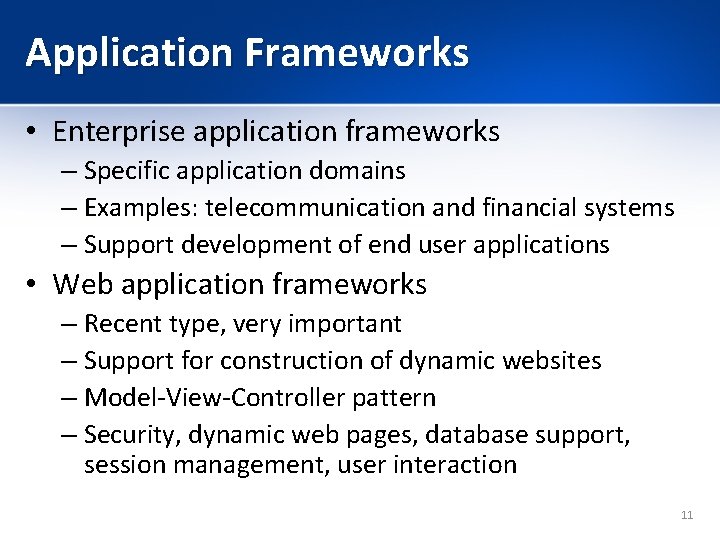
Application Frameworks • Enterprise application frameworks – Specific application domains – Examples: telecommunication and financial systems – Support development of end user applications • Web application frameworks – Recent type, very important – Support for construction of dynamic websites – Model-View-Controller pattern – Security, dynamic web pages, database support, session management, user interaction 11
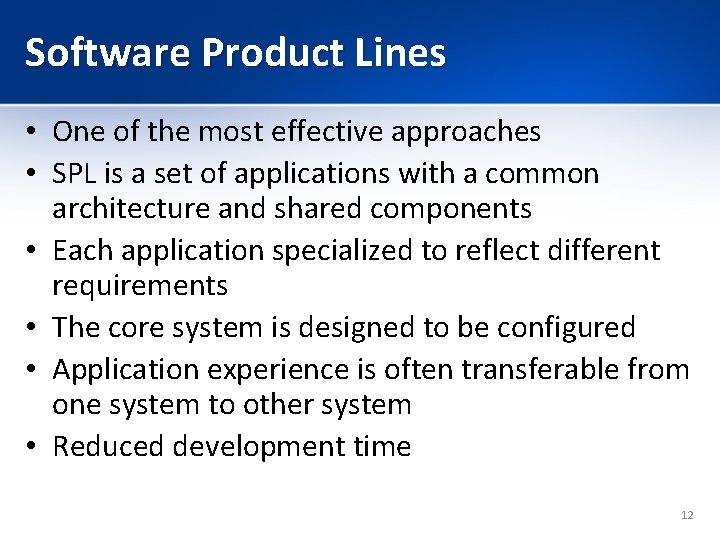
Software Product Lines • One of the most effective approaches • SPL is a set of applications with a common architecture and shared components • Each application specialized to reflect different requirements • The core system is designed to be configured • Application experience is often transferable from one system to other system • Reduced development time 12
Software Product Lines SPLs emerge from existing applications Change tends to corrupt application structure Consequently, design of a generic product line Identification of common functionalities A base application is structured to simplify reuse and reconfiguration • Application frameworks and SPL have commonalities • • • 13
Software Product Lines • Key differences • Application frameworks rely on object-oriented approach • Application frameworks are focused on providing technical details rather than domain-specific support • SPL are often control applications for equipment • SPL are made up of a family of related applications, owned by the same organization 14
Software Product Lines • • • Various types of specialization Platform specialization Environment specialization Functional specialization Process specialization Architecture of SPL reflects general, applicationspecific architectural style or pattern 15
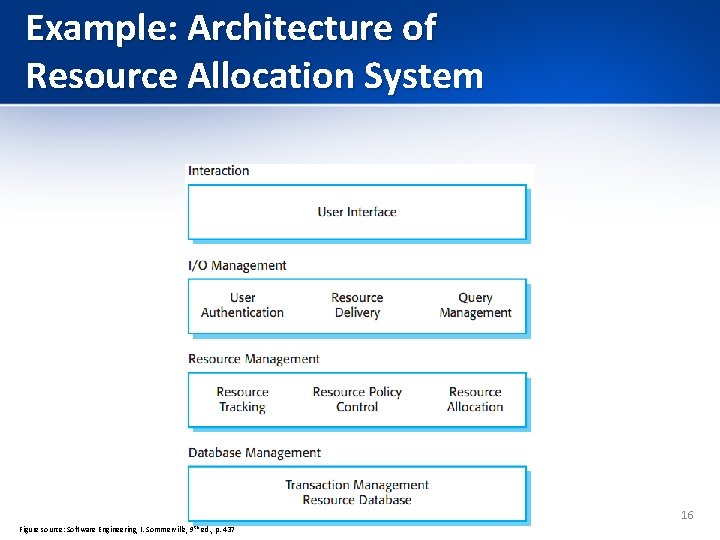
Example: Architecture of Resource Allocation System 16 Figure source: Software Engineering, I. Sommerville, 9 th ed. , p. 437
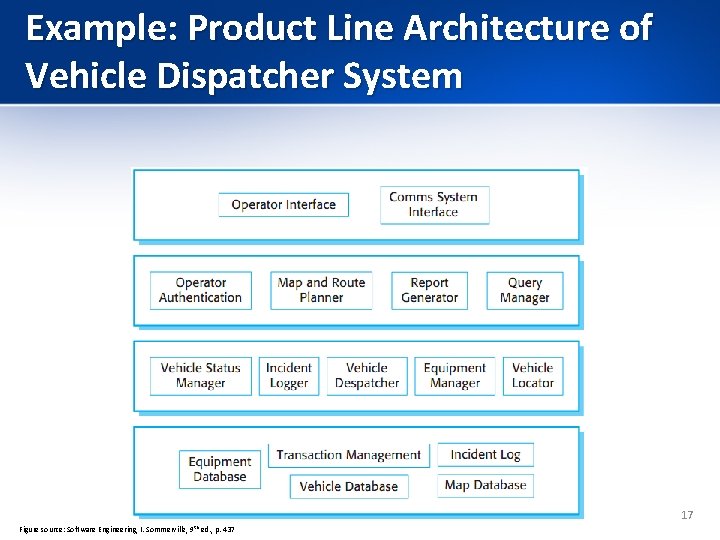
Example: Product Line Architecture of Vehicle Dispatcher System 17 Figure source: Software Engineering, I. Sommerville, 9 th ed. , p. 437
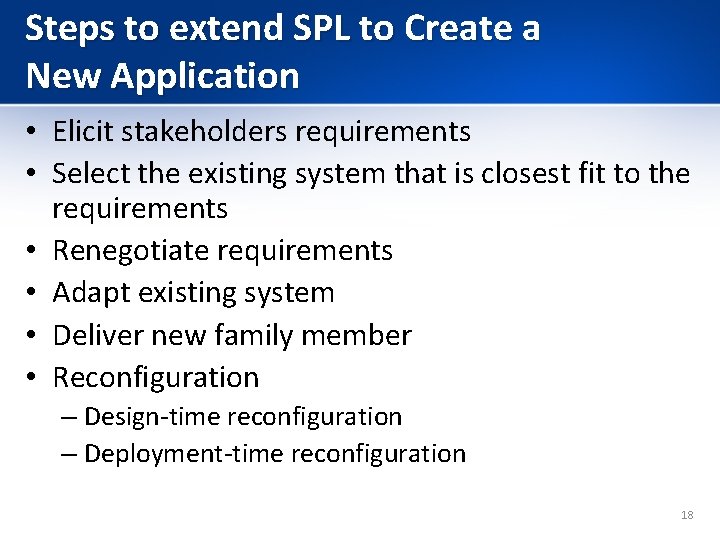
Steps to extend SPL to Create a New Application • Elicit stakeholders requirements • Select the existing system that is closest fit to the requirements • Renegotiate requirements • Adapt existing system • Deliver new family member • Reconfiguration – Design-time reconfiguration – Deployment-time reconfiguration 18
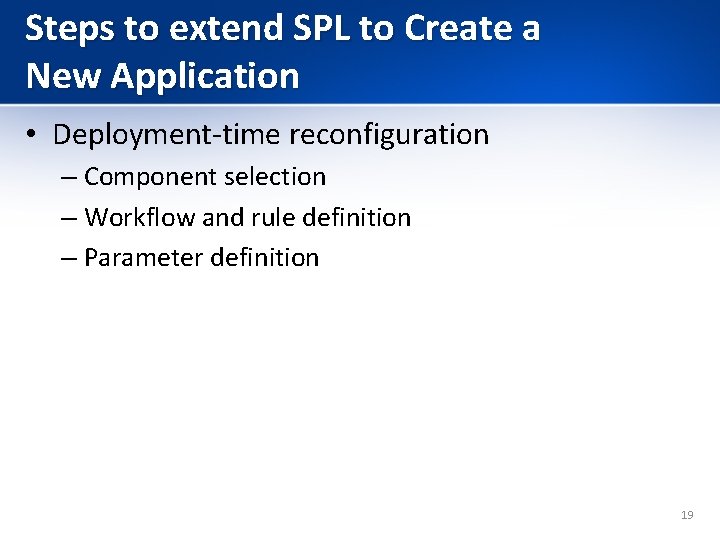
Steps to extend SPL to Create a New Application • Deployment-time reconfiguration – Component selection – Workflow and rule definition – Parameter definition 19
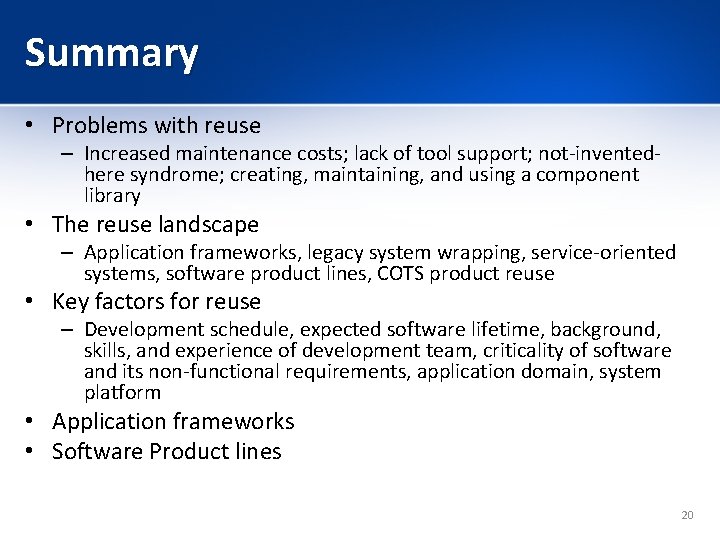
Summary • Problems with reuse – Increased maintenance costs; lack of tool support; not-inventedhere syndrome; creating, maintaining, and using a component library • The reuse landscape – Application frameworks, legacy system wrapping, service-oriented systems, software product lines, COTS product reuse • Key factors for reuse – Development schedule, expected software lifetime, background, skills, and experience of development team, criticality of software and its non-functional requirements, application domain, system platform • Application frameworks • Software Product lines 20