
Software Reliability Lecture 12 Organization of this Lecture
Software Reliability (Lecture 12)
Organization of this Lecture: $ $ $ Introduction. Reliability metrics Reliability growth modelling Statistical testing Summary
Introduction $ Reliability of a software product: $ $ $ a concern for most users especially industry users. An important attribute determining the quality of the product. Users not only want highly reliable products: $ want quantitative estimation of reliability before making buying decision.
Introduction $ Accurate measurement of software reliability: $ $ a very difficult problem Several factors contribute to making measurement of software reliability difficult.
Major Problems in Reliability Measurements $ Errors do not cause failures at the same frequency and severity. $ $ measuring latent errors alone not enough The failure rate is observerdependent
Software Reliability: 2 Alternate Definitions $ Informally denotes a product’s trustworthiness or dependability. $ Probability of the product working “correctly” over a given period of time.
Software Reliability $ Intuitively: $ $ a software product having a large number of defects is unreliable. It is also clear: $ reliability of a system improves if the number of defects is reduced.
Difficulties in Software Reliability Measurement (1) $ No simple relationship between: $ $ $ observed system reliability and the number of latent software defects. Removing errors from parts of software which are rarely used: $ makes little difference to the perceived reliability.
The 90 -10 Rule $ Experiments from analysis of behavior of a large number of programs: $ $ 90% of the total execution time is spent in executing only 10% of the instructions in the program. The most used 10% instructions: $ called the core of the program.
Effect of 90 -10 Rule on Software Reliability $ Least used 90% statements: $ $ called non-core are executed only during 10% of the total execution time. It may not be very surprising then: $ removing 60% defects from least used parts would lead to only about 3% improvement to product reliability.
Difficulty in Software Reliability Measurement $ Reliability improvements from correction of a single error: $ depends on whether the error belongs to the core or the noncore part of the program.
Difficulty in Software Reliability Measurement (2) $ The perceived reliability depends to a large extent upon: how the product is used, $ In technical terms on its operation profile. $
Effect of Operational Profile on Software Reliability Measurement $ If we select input data: $ only “correctly” implemented functions are executed, none of the errors will be exposed $ perceived reliability of the product will be high. $
Effect of Operational Profile on Software Reliability Measurement $ On the other hand, if we select the input data: $ $ such that only functions containing errors are invoked, perceived reliability of the system will be low.
Software Reliability $ Different users use a software product in different ways. $ defects which show up for one user, $ $ may not show up for another. Reliability of a software product: $ $ clearly observer-dependent cannot be determined absolutely.
Difficulty in Software Reliability Measurement (3) $ Software reliability keeps changing through out the life of the product $ Each time an error is detected and corrected
Hardware vs. Software Reliability $ Hardware failures: $ $ inherently different from software failures. Most hardware failures are due to component wear and tear: $ some component no longer functions as specified.
Hardware vs. Software Reliability $ $ A logic gate can be stuck at 1 or 0, $ or a resistor might short circuit. $ replace or repair the failed part. To fix hardware faults:
Hardware vs. Software Reliability $ Software faults are latent: $ system will continue to fail: $ unless changes are made to the software design and code.
Hardware vs. Software Reliability $ Because of the difference in effect of faults: $ Though many metrics are appropriate for hardware reliability measurements $ Are not good software reliability metrics
Hardware vs. Software Reliability $ When a hardware is repaired: $ $ its reliability is maintained When software is repaired: $ its reliability may increase or decrease.
Hardware vs. Software Reliability $ Goal of hardware reliability study : $ $ stability (i. e. interfailure times remains constant) Goal of software reliability study $ reliability growth (i. e. interfailure times increases)
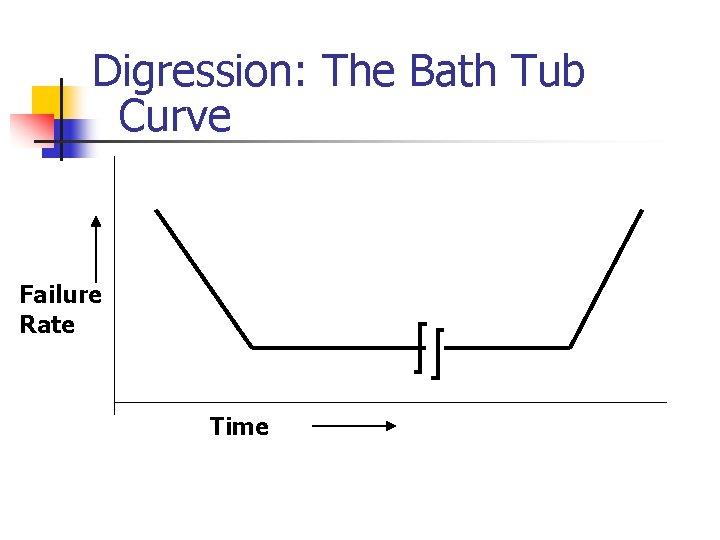
Digression: The Bath Tub Curve Failure Rate Time
Reliability Metrics $ Different categories of software products have different reliability requirements: $ level of reliability required for a software product should be specified in the SRS document.
Reliability Metrics $ A good reliability measure should be observer-independent, $ so that different people can agree on the reliability.
Rate of occurrence of failure (ROCOF): $ ROCOF measures: $ $ frequency of occurrence failures. observe the behavior of a software product in operation: over a specified time interval $ calculate the total number of failures during the interval. $
Mean Time To Failure (MTTF) $ Average time between two successive failures: $ observed over a large number of failures.
Mean Time To Failure (MTTF) $ MTTF is not as appropriate for software as for hardware: $ Hardware fails due to a component’s wear and tear $ $ thus indicates how frequently the component fails When a software error is detected and repaired: $ the same error never appears.
Mean Time To Failure (MTTF) $ We can record failure data for n failures: $ $ $ let these be t 1, t 2, …, tn calculate (ti+1 -ti) the average value is MTTF (ti+1 -ti)/(n-1)
Mean Time to Repair (MTTR) $ Once failure occurs: $ $ additional time is lost to fix faults MTTR: $ measures average time it takes to fix faults.
Mean Time Between Failures (MTBF) $ We can combine MTTF and MTTR: $ $ $ to get an availability metric: MTBF=MTTF+MTTR MTBF of 100 hours would indicae $ Once a failure occurs, the next failure is expected after 100 hours of clock time (not running time).
Probability of Failure on Demand (POFOD) $ Unlike other metrics $ $ This metric does not explicitly involve time. Measures the likelihood of the system failing: $ $ when a service request is made. POFOD of 0. 001 means: $ 1 out of 1000 service requests may result in a failure.
Availability $ Measures how likely the system shall be available for use over a period of time: $ $ considers the number of failures occurring during a time interval, also takes into account the repair time (down time) of a system.
Availability $ This metric is important for systems like: $ $ $ telecommunication systems, operating systems, etc. which are supposed to be never down where repair and restart time are significant and loss of service during that time is important.
Reliability metrics $ All reliability metrics we discussed: $ $ centered around the probability of system failures: take no account of the consequences of failures. $ severity of failures may be very different.
Reliability metrics $ Failures which are transient and whose consequences are not serious: $ $ of little practical importance in the use of a software product. such failures can at best be minor irritants.
Failure Classes $ More severe types of failures: $ $ may render the system totally unusable. To accurately estimate reliability of a software product: $ it is necessary to classify different types of failures.
Failure Classes $ Transient: $ $ $ Transient failures occur only for certain inputs. Permanent: $ Permanent failures occur for all input values. $ When recoverable failures occur: Recoverable: $ the system recovers with or without operator intervention.
Failure Classes $ Unrecoverable: $ $ the system may have to be restarted. Cosmetic: $ These failures just cause minor irritations, $ $ do not lead to incorrect results. An example of a cosmetic failure: $ mouse button has to be clicked twice instead of once to invoke a GUI function.
Reliability Growth Modelling $ A reliability growth model: $ a model of how software reliability grows $ $ as errors are detected and repaired. A reliability growth model can be used to predict: $ $ when (or if at all) a particular level of reliability is likely to be attained. i. e. how long to test the system?
Reliability Growth Modelling $ There are two main types of uncertainty: $ $ in modelling reliability growth which render any reliability measurement inaccurate: Type 1 uncertainty: $ our lack of knowledge about how the system will be used, i. e. $ its operational profile
Reliability Growth Modelling $ Type 2 uncertainty: $ $ reflects our lack of knowledge about the effect of fault removal. When we fix a fault $ $ we are not sure if the corrections are complete and successful and no other faults are introduced Even if the faults are fixed properly $ we do not know how much will be the improvement to interfailure time.
Step Function Model $ The simplest reliability growth model: $ $ a step function model The basic assumption: $ reliability increases by a constant amount each time an error is detected and repaired.
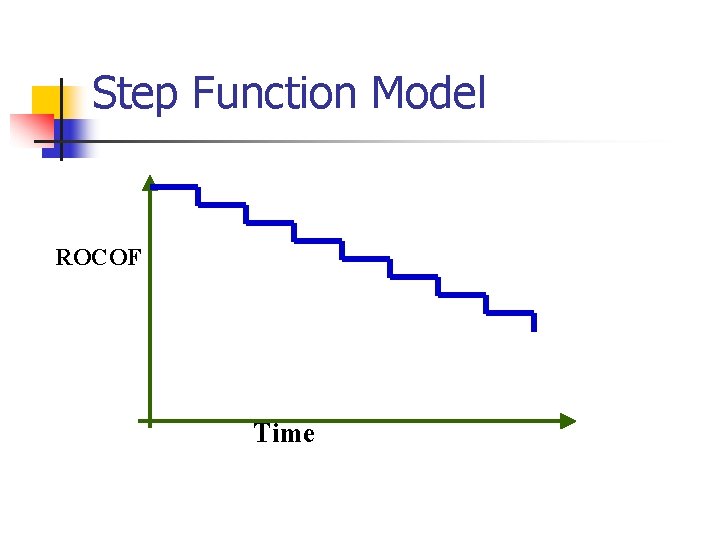
Step Function Model ROCOF Time
Step Function Model $ Assumes: $ $ all errors contribute equally to reliability growth highly unrealistic: $ we already know that different errors contribute differently to reliability growth.
Jelinski and Moranda Model $ Realizes each time an error is repaired: $ $ reliability does not increase by a constant amount. Reliability improvement due to fixing of an error: $ assumed to be proportional to the number of errors present in the system at that time.
Jelinski and Moranda Model $ Realistic for many applications, $ $ still suffers from several shortcomings. Most probable failures (failure types which occur frequently): $ discovered early during the testing process.
Jelinski and Moranda Model $ Repairing faults discovered early: $ $ contribute maximum to the reliability growth. Rate of reliability growth should be large initially: $ $ slow down later on, contrary to assumption of the model
Littlewood and Verall’s Model $ Allows for negative reliability growth: $ $ when software repair introduces further errors. Models the fact that as errors are repaired: $ average improvement in reliability per repair decreases.
Littlewood and Verall’s Model $ Treats a corrected bug’s contribution to reliability improvement: $ $ an independent random variable having Gamma distribution. Removes bugs with large contributions to reliability: $ $ earlier than bugs with smaller contribution represents diminishing return as test continues.
Reliability growth models $ There are more complex reliability growth models, $ $ more accurate approximations to the reliability growth. these models are out of scope of our discussion.
Applicability of Reliability Growth Models $ $ There is no universally applicable reliability growth model. Reliability growth is not independent of application.
Applicability of Reliability Growth Models $ Fit observed data to several growth models. $ Take the one that best fits the data.
Statistical Testing $ A testing process: $ $ the objective is to determine reliability rather than discover errors. uses data different from defect testing.
Statistical Testing $ Different users have different operational profile: $ $ i. e. they use the system in different ways formally, operational profile: $ probability distribution of input
Operational profile: Example $ An expert user might give advanced commands: $ $ use command language interface, compose commands A novice user might issue simple commands: $ using iconic or menu-based interface.

How to define operational profile? $ Divide the input data into a number of input classes: $ $ e. g. create, edit, print, file operations, etc. Assign a probability value to each input class: $ a probability for an input value from that class to be selected.
Steps involved in Statistical testing (Step-I) $ Determine the operational profile of the software: $ This can be determined by analyzing the usage pattern.
Step 2 in Statistical testing $ Manually select or automatically generate a set of test data: $ corresponding to the operational profile.
Step 3 in Statistical testing $ Apply test cases to the program: $ $ record execution time between each failure it may not be appropriate to use raw execution time
Step 4 in Statistical testing $ After a statistically significant number of failures have been observed: $ reliability can be computed.
Statistical Testing $ $ Relies on using large test data set. Assumes that only a small percentage of test inputs: $ likely to cause system failure.
Statistical Testing $ It is straight forward to generate tests corresponding to the most common inputs: $ $ but a statistically significant percentage of unlikely inputs should also be included. Creating these may be difficult: $ especially if test generators are used.
Advantages of Statistical Testing $ Concentrate on testing parts of the system most likely to be used: $ results in a system that the users find more reliable (than actually it is!).
Advantages of Statistical Testing $ Reliability predictions based on test results: $ gives an accurate estimation of reliability (as perceived by the average user) compared to other types of measurements.
Disadvantages of Statistical Testing $ It is not easy to do statistical testing properly: $ $ there is no simple or repeatable way to accurately define operational profiles. Statistical uncertainty.
Summary $ Reliability of a software product: $ $ essentially denotes its trustworthiness or dependability. probability of the product working “correctly” over a given period of time.
Summary $ Operational profile of a software $ $ reflects how it will be used in practice. Consists of specification of: classes of inputs $ probability of their occurrence. $
Summary $ Statistical testing: $ $ uses large data set selected based on operational profile. Provides more realistic reliability figures.
- Slides: 69